Abstract—Service-oriented computing (SOC) is increasingly
gaining in importance, as it promotes the creation of value by reusing and combining services. One of the challenges of SOC is the ease of composition in adaptive and personalized manner. In interactive web services composition, end-users are given the opportunity for composing their own services and the adaptivity is guaranteed at run-time. However, supporting end-users to compose services, at runtime, is a difficult undertaking. Hence, we propose an approach to guide end-user in interactive web services composition, that combines satisfaction notion with a meta-strategy. This approach is supported by a tool. During the composition process, the end-user interacts with the tool in order to meet his requirements.
Index Terms— Web services composition, Requirements,
Satisfaction, Guidance
I. INTRODUCTION
N the last years, Service-oriented computing (SOC) is increasingly gaining in importance, as it promotes the creation of value by combining web services. Web services are autonomous and loosely coupled software components distributed over the Internet. One of the challenges of the SOC is the ease of composition of a variety new services, in an adaptive and personalized manner [1]. To address this problem, most of the existing approaches adapt the composition at run-time to a given requirement [2]. Due to the complexity of the adaptation, these approaches can only be used by professional developers, as they require expertise in the specification of the adaptation and in the definition of requirements [3].
However, in many contexts end-users will want to drive the composition process, by influencing the selection of services at run-time. In addition, end-users may not have a complete idea of their needs, so it may be hard to explicit all the requirements from the beginning.
Recognizing the need that the end-users should play an active role during the composition process, interactive web service composition has emerged [4]. It aims to enhance the satisfaction of end-users.
Nowadays, satisfaction is an active research topic in the marketing literature. It refers to behavioral theories to study
Manuscript received December 2nd, 2014; revised January 5th, 2015. This work was supported in part by the SQU-TRC under Grant TRC/SCI/COMP/15/01. J.Y. Author is with the Department of Computer Science, College of Science, Sultan Qaboos University, PO Box 36, Al-Khoudh 123, Muscat, Oman (e-mail: [email protected]) on leave from the Ecole Nationale des Sciences de l’informatique (ENSI), Manouba, Tunisia. He is member of the research laboratory RIADI, ENSI, University of Manouba, Tunisia.
the customer satisfaction [5]. In the goal oriented requirement engineering works, satisfaction refers to "hardgoal" and "softgoal" satisfaction. Hardgoals are goals where satisfaction can be established by using verification techniques whereas softgoals cannot be satisfied in a clear-cut sense but only satisfied when thresholds of some precise criteria are reached [6].
In the SOC context, satisfaction could mainly be ensured thanks to the variability concept. The variability is the capacity of a system or an artefact to be changed, customized or configured to cope with a specific requirement. This variability could be defined at different levels. For instance, at business level, accommodating a Business Process (BP) relies on business rules and late modelling techniques for changing BPs. At technical level, selecting a service relies on the contractual relationship between provider and consumer of service [7].
Most of researches on interactive composition have a limited use of variability. They use a quite low-level variability BP models, and the possible configurations are not explicitly expressed with respect to business requirements [6]. Moreover these researches do not tackle the end-user’s satisfaction, as no decision-making support is proposed for them. While this, on the one side, simplifies the role of end-users, on the other side, it leads to a limitation due to the fact of the nonprofit of the high variability models defined by the requirements engineering community.
To overcome these problems, we consider that a new model of high variability BP should be used as a primary means for satisfying end-users. For this reason, our work fits into approaches that create service compositions based on goal-oriented requirement engineering principles. Thus, we propose a new approach that guide end-users at runtime. It uses :
A broker allowing end-user to interact during the composition process.
An evaluation of the end-user’s satisfaction during the composition process.
A guidance process for enhancing the satisfaction of end-users involved in the composition process.
The remainder of the paper is organized as follows. Section 2 presents some preliminaries related to goal-oriented requirements modelling. Section 3 is devoted to the proposed approach. Section 4 presents a tool support for our approach and briefly discusses its experimentation. Section 5 presents some related works. Finally, section 6 concludes this paper and outlines future work.
Towards an Approach to Guide End-user in
Interactive Web Services Composition
Yassine Jamoussi
Figure 1: Business goals for purchasing a book II. PRELIMINARIES
Our proposal consists of the satisfaction of end-users involved in interactive web service composition. In particular, variability arisen during the composition process is a mean of accommodating systems to changing business context in order to meet the end-user’s requirements. Thus, services must be modeled in terms of business goals and not in terms of technical statements.
We adopt the MAP meta-model to represent business goals [9]. The main reason for using the MAP formalism is that it permits to capture variability by focusing on the strategy to achieve an intention and the potential alternatives to accomplish the same intention. This explicit representation of variability offered by MAPs is missing in other requirement engineering formalisms [8].
A MAP is a meta-process formalism that allows designing several processes [9]. A MAP is a labelled directed graph with intentions as nodes and strategies as edges between intentions. It is composed of one or more sections. A section is a triplet <Source Intention Ii, Target Intention Ij, Strategy
Sij> that captures a specific manner to achieve the target
intention Ij starting from the source intention Ii with the
strategy Sij. Each MAP has two distinct intentions Start and
Stop to respectively begin and end the navigation in the MAP.
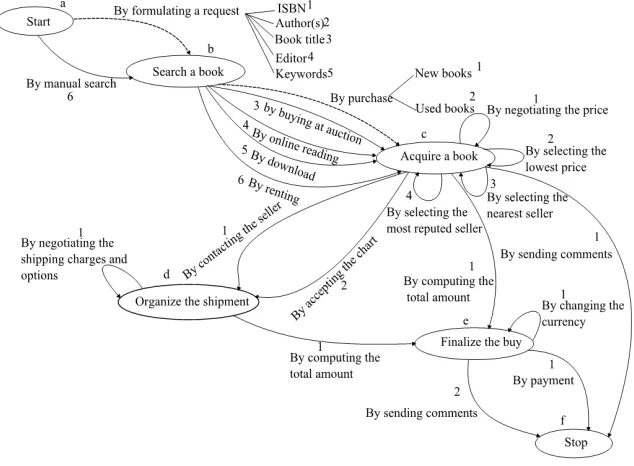
For instance, Figure 1 represents business goals for purchasing a book with the MAP formalism where <Start, Search a book, By formulating a request> represents a way to achieve the target intention “Search a book” from the source intention “Start” following the “By formulating a request strategy”. A strategy is a manner to achieve an intention. An intention is a requirement that can be achieved by following different strategies.
Based on the business goal represented with MAP, each path leads to a distinct composition of intentional services. This idea is detailed in our previous work [8].
III. THE PROPOSED APPROACH
The proposed approach supports high level goal-driven configuration of BP. In the BP model, atomic services are mapped to web service communities, giving more flexibility to the web service selection step. Accordingly to choices made at run-time, the BP is configured in accordance with a guidance process. This approach is based on an interactive broker supporting web service composition, satisfaction evaluation, and enactment.
In the following, we first describe the architecture of the broker and we present the principle of the evaluation of the end-user’s satisfaction. Finally, we describe the principle of guidance.
A.Architecture
The architecture of the broker is illustrated in Figure 2. It contains databases for storing BPs, users’ data and adaptation historic; and web services communities. As proposed in several web service brokers [10], the assumption behind our approach is that web service providers feed the broker with required information and the end-users as a service consumer will be guided on their behalf. In our case, two provider types can use the broker: virtual organizations, i.e. composite service providers and single web service providers that publish their services in the broker.
To use the broker, the provider connects and supplies a high-variability intentional service. Service model and related data are stored in the databases of the broker.
Figure 2. Broker’s Architecture
As shown in Figure 2, the composition process is an iterative process. At each iteration, the BP model is explored to discover candidate composition strategies, select services, and execute them. Unlike classical approaches that choose the best alternative according to the end-user profile or preferences, the variants that satisfy the final target are picked. A guidance process helps the end-user to make the right decision. Once a service is executed, each end-user satisfaction is assessed on the basis of stored information and/or direct judgments for the service requester.
B.Evaluation of Satisfaction
Our approach support end-user’s satisfaction all over the composition process. We elicit end-user’s satisfaction at an early phase through softgoals that are imprecise, subjective, idealistic and context-specific goals [11]. Taking into account an end-user satisfaction all over the composition process is motivated by the influence of past and current experience on the future perceptions. This idea is clearly expressed in the marketing research area that distinguishes between transaction-specific satisfaction and cumulative satisfaction [12]. While transaction-specific satisfaction may provide specific diagnostic information about a particular service encounter, cumulative satisfaction is concerned with all of consumer’s previous experiences with a firm, product, or service cumulatively [12].
Taking the state-based conceptualization of satisfaction, we define a local satisfaction measurement relative to each step of the composition process and a cumulative one relative to all the achieved steps in the process. To measure the cumulative satisfaction, we introduce the excelling concept suggested by [11]. In [11], authors noticed that satisfying softgoals does not cover situations in which continual improvement of thresholds is expected. They introduced the excelling notion to express this need. We also introduce the concept of the satisfaction degree as a customized measure of the satisfaction. The satisfaction degree plays the role of the anticipation decision function.
To determine the end-user satisfaction at the discovery and selection times, we evaluate the benefit of functional choices from an Intentional Service model obtained from the MAP [8].
Unlike functional strategy evaluation, which is done in a static manner, measuring the benefit of a concrete service is done dynamically. In this sense a decision model is
associated to each discovery and selection step. For instance, a book search service satisfies the user if he or she makes a minimum effort and gives him pertinent results. However a good book search service is a service that allows him to customize his choices. To select a concrete service, the user may require a high security rate for a payment service and not wonder about the security rate of the search service. The decision model is also a goal model described with softgoals related to the current step.
C.Guidance process
The guidance principle is based on the driving of a vehicle which is based on continual adaptation and anticipation in order to accommodate to the environmental changes [13]. The composition process is achieved through steps. A meta-strategy is proposed to offer continual adaptation and anticipation.
Figure 3. Steps of the composition process
1) Steps of the composition process
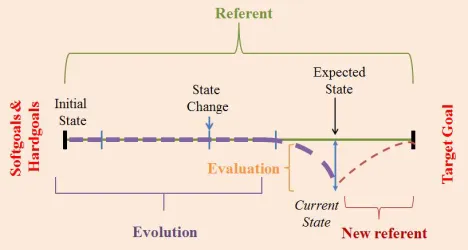
The steps of the composition process, as illustrated in Figure 3, are: initiate the process and generate a referent, progress step by step until the end; correct when a gap between the current state and the expected state is detected; end the process.
Step 1: Initiate the process and generate a referent : This
step aims to select a referent that achieves the objective. The referent is an optimal path extracted from the MAP. Its selection is based on similarity metrics that measures the distance between paths in the MAP and the target goal as following :
[image:3.612.314.548.428.553.2] Specify the target softgoals/hardgoals by using a formalism based on case base grammar, similar to the formalism described in our previous work [8].
Find all the paths that can be followed to meet the desired goal.
Select the path that optimizes the specified softgoals and consider it as referent.
Step 2: Progress step by step : This step reflects the
undertaken decisions during the composition process. Indeed, when navigating through a MAP, the user select one strategy among different strategies. The progression leads to a continual adaptation and requires an anticipation which is based on actions. Each action is based on criteria.
It is worth mentioning, that the composition process cannot be assimilated to an operational research problem that can be solved with some known algorithms allowing to find the optimal path. For that reason, we construct the adequate path at runtime by making the right decision at each adaptation, we formalized the decision process by offering to the end-users different strategies at each action. This process, called meta-strategy, will be detailed in section §III.C.2.
Step 3: Correction : This step consists to build a new
[image:4.612.70.298.368.457.2]referent when a deviation is observed. The gap is measured in terms of performance and reflects the unconformity to the expected objective result. The performance is described thanks the degree of satisfaction.
Figure 4. progression in the MAP
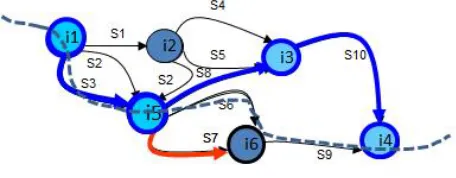
Figure 4 illustrates the progression in the MAP. First, the referent was calculated [i1, i5, i3, i4]. Second, the end-user has selected the section <i1,S3,i5>. Third, the referent was corrected [i1, i5, i6, i4]. Fourth, the end-user has selected the section <i5,S6,i6>. Finally, the end-user has selected the section <i6,S9,i4> and the process has ended.
Step 4: Termination : This step mark the achievement of
the guidance process when the desired goal is attempted.
2)Meta-Strategy
Meta-strategy is a decision-making process that guide an end-user to choose the appropriate decision when this latter is requested to anticipate. The anticipation situation, which should take into account the actual satisfaction degree, the cumulative satisfaction value, the proposed guidance, and anything he or she felts important to make his or her decision.
Hence, meta-strategy gathers behavioral patterns of end-users that reflect different attitudes to progress in the composition at run-time. The decision function of the guidance is based on the satisfaction degrees and operational semantic of the enactment. For instance, an adaptation is qualified as bad when the satisfaction degree is progressively decreasing.
Based on the literature review we ended up with the meta-strategy illustrated in Fig. 5.
Figure 5 describes the meta-strategy using the MAP formalism. Indeed, this latter allows specifying process models in a flexible way by focusing on the various ways to achieve intentions [9].
Meta-strategy contains a number or paths from ‘Start’ to ‘Stop’. Making a decision in any situation may lead to an anticipation which can be undertaken with different strategies. No path is recommended a priori. Decision is rather based on situations encountered. To make his or her choice, an end-user is supported by guidelines. A guideline is a set of indications on how to achieve a goal or execute an activity. The signature of the guideline is a couple <situation, intention>.
Guidelines are classified into three types: simple (executable, informal), tactic (choice, plan), and strategic. We distinguish between 3 types of directives:
Intention Achievement Guideline (IAG): they explain
how to achieve the selected intention and specify the operationalizing mechanism of this intention.
Intention Selection Guideline (ISG): they help the
progress in the Map by indicating how to pick an intention.
Strategy Selection Guideline (SSG): they allow progress
in the Map by helping the choice of a strategy among a range of available strategies. To explain the usage of the argumentation strategy, a SSG should guide the choice between different argumentation tactics. For example, case-based reasoning tactic is appropriate when a similar situation in the same context is encountered.
IV. TOOL SUPPORT AND DISCUSSION
To validate our approach, we implemented a tool prototype. We used the dynamic binding mechanism that allows dynamic selection of concrete services. We used an expert system to implement our adaptation meta-strategy. We defined the generic template of the MAP and let every party customize the definition of its adaptation situation.
Figure 5. meta-strategy
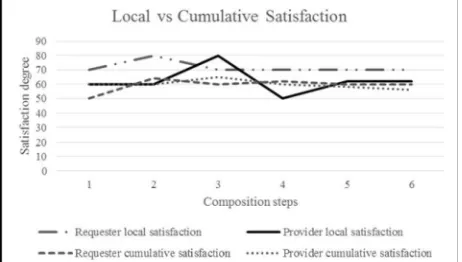
Figure 6 shows that considering cumulative satisfaction gives clearer idea about the real state of end-users’ satisfaction. Even if the local satisfaction degrees seem to be distant, cumulative satisfaction degrees are quite close and converge to close values thanks to the use of our meta-strategy. Cumulative satisfaction reflects the end-user experience and is more expressive than simple utility functions.
Figure 6. Local vs cumulative satisfaction
V. RELATED WORK
Our focus was the end-user’s satisfaction through an interactive composition process. We have proposed a guidance-based solution that create service compositions based on goal-oriented requirement engineering principles to ensure satisfaction. Most relevant research efforts are summarized next.
In [14], authors present an end-user oriented service composition model based on quotient space theory and service relation diagram. This model proposes a hierarchical service composition from coarse-grain to fine-grain. Although this work allows an interactive composition, it does not deal with the end-users satisfaction according to their goals.
In [15] authors propose a semi-automatic composition approach of semantic web services. Similarly to our approach, they propose a graph-based service composition algorithm. The composition problem is then addressed as a
discovery problem. However, that approach is mainly targeting users with application domain knowledge, i.e., Domain Experts and Advanced users. Hence, authors do not deal with the user context and preferences that can be used on the optimization and personalization to the composition process. Moreover, the algorithm is hardcoded in their approach.
VI. CONCLUSION AND FUTURE WORK
We have presented an approach for enhancing end-user’s satisfaction within web service composition. It is motivated by the potential interest to support end-user to adapt at run-time the composition at his requirements.
Our approach supports all composition steps and defines methods and models to assess end-user’s satisfaction within each step. We have contributed in the definition of anticipation decision function by introducing locale and cumulative satisfaction degrees and anticipation decision making thanks to a meta-strategy.
The benefit of our approach is that end-user’s satisfaction, especially cumulative satisfaction degree, gives an important anticipation decision function. The meta-strategy guides end-users, through behavioral patterns, to choose the most appropriate decision and strategy to achieve their goals. Another asset is that the behavioral patterns of the meta-strategy can be updated.
In our future work, we are going to conduct an extensive experimental study to measure the effectiveness of our proposed approach. Also, we will focus on auto-regulation of the meta-strategy and adding visual tools to the end-users. In addition, as we are currently defining method fragments that challenge both IT and business service engineering by considering the Welke’s SOA maturity model [16], we intend to consider more complex situations caused by the high variability of these fragments.
REFERENCES
[1] Le Blevec, Y., Ghedira, C., Benslimane, D., & Delatte, X. (2007). Service-oriented computing: Bringing business systems to the Web. IT Professional,9(3), 19-24.
Forward Selection
Finish Strategy Exhaustive Selection
End
Calculate Satisfaction Forward strategy
Increase satisfaction
Preference order Strategy Optimisation
Negotiation
Case-base reasonning
Maintain satisfaction
Start
Computation Strategy Evaluate
Preference order
Select
Initiate
Intention Selection
Exhaustive
BackwardSelection
d’intention
Backward Selectionstrategy
Decrease Satisfaction
Computation Strategy
AHP Strategy
[image:5.612.70.301.372.503.2][2] Liaskos, S., Litoiu, M., Jungblut, M. D., & Mylopoulos, J. (2011, January). Goal-based behavioral customization of information systems. In Advanced Information Systems Engineering (pp. 77-92). Springer Berlin Heidelberg.
[3] Namoun, A., Nestler, T., & De Angeli, A. (2010, December). Service composition for non-programmers: Prospects, problems, and design recommendations. In Web Services (ECOWS), 2010 IEEE 8th European Conference on (pp. 123-130). IEEE.
[4] Liang, Q., Bharadwaj, A., & Lee, B. S. (2011). Interactive and Iterative Service-Composition-Based Approach to Flexible Information System Development. International Journal of Web Services Research (IJWSR),8(4), 81-107.
[5] Kotler, P., and Armstrong, G. (2013). Principles of Marketing 15th Global Edition. Pearson.
[6] Oster, Z. J., Ali, S. A., Santhanam, G. R., Basu, S., & Roop, P. S. (2012). A service composition framework based on goal-oriented requirements engineering, model checking, and qualitative preference analysis. In Service-Oriented Computing (pp. 283-297). Springer Berlin Heidelberg.
[7] Hallerbach, A., Bauer, T., & Reichert, M. (2010). Capturing variability in business process models: the Provop approach.Journal
of Software Maintenance and Evolution: Research and
Practice,22(6 7), 519-546.
[8] Driss, M., Moha, N., Jamoussi, Y., Jézéquel, J. M., & Ghézala, H. H. B. (2010). A requirement-centric approach to web service modeling, discovery, and selection. In Service-Oriented Computing (pp. 258-272). Springer Berlin Heidelberg.
[9] Rolland, C., Souveyet, C., and Ben Achour, C. (1998). Guiding goal modeling using scenarios. Software Engineering, IEEE Transactions on, 24(12), 1055-1071.
[10] Issarny, N. Georgantas, S. Hachem, A. Zarras, P. Vassiliadist, M. Autili, M. Gerosa, and A. Hamida (2011). Service-oriented middleware for the future internet: state of the art and research directions. Journal of Internet Services and Applications, 2:23-45. [11] Jureta, I., Faulkner, S. and Schobbens, P. (2007), “Achieving,
Satisficing, and Excelling” ER Workshops, Springer-Verlag Berlin Heidelberg, LNCS 4802, pp. 286-295.
[12] Shou, Z., Wang, F. and Jia, J. Wang (2007), “A Cumulative Satisfaction Measure Model Based on Dynamic Customer Expectation”, Proceedings of the International Conference on Wireless Communications, Networking and Mobile Computing, pp., 3419-3422.
[13] Patten, K., Whitworth, B., Fjermestad, J., & Mahindra, E. (2005). Leading IT flexibility: anticipation, agility and adaptability.AMCIS 2005 Proceedings, 361.
[14] Lin-feng, S., & Yong, Q. (2010, May). A novel end-user oriented service composition model based on quotient space theory. InInternational Conference on Service Sciences (ICSS), (pp. 180-184). IEEE.
[15] Da Silva, E. G., Pires, L. F., & van Sinderen, M. (2011). Towards runtime discovery, selection and composition of semantic services. Computer communications,34(2), 159-168.