Abstract— This paper presents a gesture recognition system for Human-Robot Interaction. And it has been employed to the development of a service robot that can be operated by the human gesture given as the user’s command. Human motion is detected by the Kinect sensor on the robot and recognized as one of the predefined commands by using an algorithm based on Hidden Markov Model (HMM). Its recognition rates about the predefined gestures were verified through several experiments and compared to the region-based recognition method of the previous research. Finally, the developed system has been applied to Human-Robot Interaction for service tasks in office environment.
Index Terms— Service Mobile Robot, Human-Robot Interaction, Gesture Recognition
I. INTRODUCTION
OEXISTENCE and interaction between human and robot has been considered as one of the important issues in robotics research area in these days. It is based on the social expectation that robot’s main application area will be changed from the typical industry field to daily environment in the near future. For that, many communication skills for the service robot have been proposed such as voice recognition [1], gesture recognition [2-6], and so on.
There have been proposed the approaches of gesture recognition as follows: HMM (Hidden Markov Model) and Multi-Layer Perceptron with Radial Basis Function (MLP/RBF) have been used as the recognition algorithm in [2, 3]. A method by tracking both hands with camera [4], utilizing a remote controller with inertial sensor [5], and an approach to use multiple inertial sensors that could be attached human body have been researched for recognizing human motion [6]. In addition, the researches to exploit the above mentioned gesture recognition as a tool for communication between human and robot. For example, some researchers have been carried out for the application to operate a service robot and a cleaning robot [7, 8]. Especially in [7], the communication method to use both speech and gesture has been investigated.
A camera has been used as the typical device to detect human motion. However, a new device called ‘Kinect’ was
Manuscript received December 23, 2013; revised January 30, 2014. Every author is with Mechanical Engineering Course, Graduate School of Science and Engineering, Ehime University, 3 Bunkyo-cho, Matsuyama 790-8577, Japan
E-mail: Tatsuya Fujii <[email protected]>, Jae Hoon Lee <[email protected]>,
Shingo Okamoto <[email protected]>
developed by Microsoft co. several years ago, which can capture not only the image like general camera but also achieve depth image with 3D information. It has been employed in many applications of robotics research recently. The researches [9, 10] of gesture recognition using Kinect sensor have been also reported.
In spite of many researches related to human-robot interaction, there are not so many reports of its successful application to robotic service task. Therefore, this paper aims to develop a service robot with the communication capability based on gesture recognition, and apply it to realistic service tasks to support human in indoor environment. In the previous research of the authors [11], its possibility had been investigated with a robot having region-based gesture recognition system. The recognition system has been redesigned as the algorithm with HMM and confirmed through experiments of real robotic service tasks in this work.
II. SYSTEM CONFIGURATION
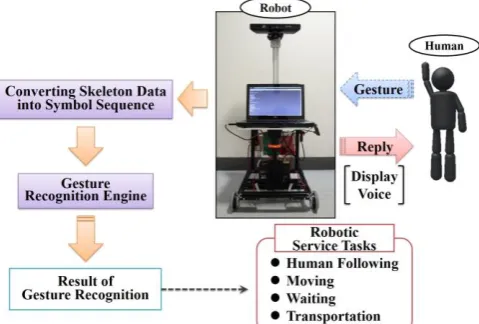
[image:1.595.308.548.581.743.2]Figure 1 shows the concept of the proposed service robot. Firstly, the human gesture which is one of the predefined commands for the service task is given to the robot. Then, it is detected in real time and given as the position information of human arm, i.e., positions of nodes in the skeleton model, by the Kinect sensor installed in the robot. It is translated to the input signal, i.e., symbol sequence, for the recognition engine installed in the robot. After processing to recognize user’s command, the robot replies to the human with the display and the audio messages based on the recognition result. At the same time, the robot starts the service task ordered by the user.
Fig. 1. Concept of the proposed service robot with gesture recognition system.
Gesture Recognition System for
Human-Robot Interaction and
Its Application to Robotic Service Task
Tatsuya Fujii, Jae Hoon Lee,
Member, IAENG
and Shingo Okamoto
the model with the data.
HMM consists of several states which are connected with the probability of transition from one state to another state. Where, state transitions occur stochastically according to time. The states at any time depend only on the state at the preceding time like Markov models. One symbol is yielded and observed from one of the states according to the probabilities assigned to the states. States are not directly observable, and can be observed only through a sequence of observed symbols. Therefore, it is named “Hidden” Markov model.
The complete parameter setM({A,B,})of the HMM is represented byA , B and , and HMM is described as follows. The state transition probability is given as
asn asn Prsnatt1snatt
A ,
where, n ns s
a is the transition probability from state sn to statesn. The observation symbol probability is given as
bsn(ok)bsn(ok)Prok snatt
B ,
where, bsn(ok) is the probability of output symbolok at statesn. The initial state probability is given as
Pr at 0
sn sn sn t
,
where, n s
is the probability that initial state is sn. The set of states are given as
s s sn
S 0, 1,, ,
where, sn is the state of number n. The observed symbol sequence is given as
o o oT
O 0, 1,,
where, Tis length of the observation sequence.
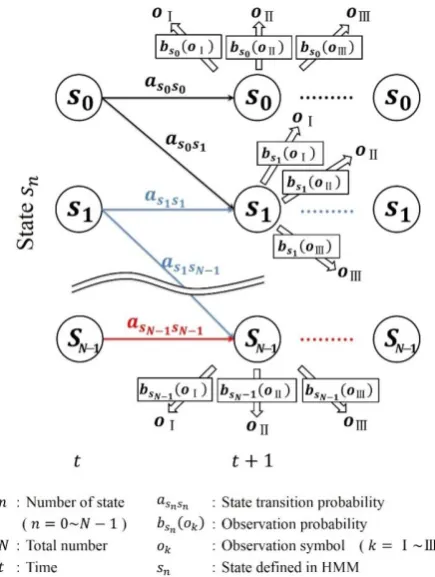
Besides, there are two basic types of model structures in HMM. In a fully connected (Ergodic model) HMM, every state of the model can be reached from every other state of the model. In a Left-to-Right HMM, state transition is not allowed to states whose state of number is lower than the current state. This research utilizes Left-to-Right HMMas a type of HMM to recognize gesture as shown in Fig. 2.
B. Training Parameters of HMM
[image:2.595.308.526.52.341.2]The parameters of HMM should be decided for the recognition of gestures. A recognition model of HMM is defined asMm({Am,Βm,m}), where mdenotes the type of gesture. In order to estimate parameters ofA,Band , training process has been conducted, where Baum-Welch algorithm [2] was employed. A number of example data for each gesture were used for training of HMM. Then, training process has been repeated until the parameters were converged to certain values.
Fig. 2. Left-to-Right HMM.
C. Recognizing Observed Symbol Sequence Using HMM
To recognize observed symbol sequence, calculation is conducted using recognition modelMm. The probability (likelihood) Pr(O Mm) is calculated to output symbol sequenceOo0,o1,,oT using Mm. This probability is calculated recursively by using the forward algorithm [2]. Namely, the probability that sequence was generated by Mis calculated by using Eq. (1) and (2).
) ( )
(
0 sn snbsn ok
(1)
) ( ] ) ( [ ) (
1 n t n ss s k
t s
s ann bn o (2)
Thus, we can calculate the likelihood of each recognition model using above equation and select the most likely HMM as the recognition result.
IV. GESTURE RECOGNITION WITH KINECT SENSOR A. Detecting Human Arm’s Coordinate with Kinect Sensor
Fig. 3. Human skeleton model detected by Kinect sensor.
Fig. 4. Sensor and human coordinate systems.
B. Converting Position Data into Symbol of Observation In this research, for easy and effective symbolization of human motion, we focused on the change of arm direction during human gesture. Namely, when a human moves his arm to make gestures, the direction from the elbow to the hand is changed. The direction is used as the observation for recognizing gestures because the position data cannot be used directly as the symbol of HMM.
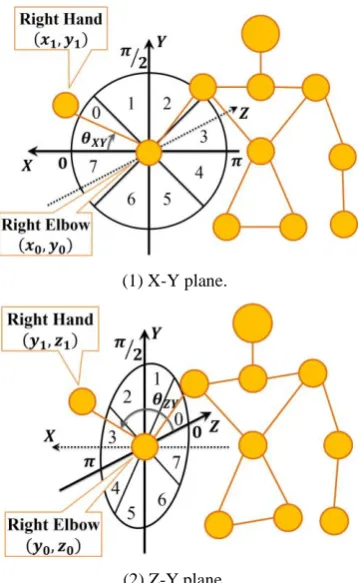
However, the motion of human arm in gesture is complicated and spatial actually. Therefore, the symbolization with respect to both front and side view is proposed in this paper. If only one of them is considered, some motions cannot be detected because the human arm moves in a certain hidden plane. For the front view and the side view, theX-Yplane and the Z -Y plane of the human coordinate system are defined as shown in Fig. 5. Besides, both planes are divided into the eight areas as shown in Fig. 5 (1) and (2). The angle XY from theX- axis to the arm in the
X-Yplane is calculated by using Eq. (3) with the position of human right hand and right elbow.
1 0, 1 0
2
atan y y x x
XY
(3)
The angle ZY from theZ- axis to the arm in the Z-Yplane is calculated by using Eq. (4).
1 0, 1 0
2
atan y y z z
ZY
(4)
Finally, the angle is converted into the observation symbol of each plane.
C. Gesture Recognition by Using Multiple Recognition Models
Six types of gesture are prepared in this research as shown in Fig. 6. It is assumed that the service robot is operated by the commands of human gestures.
(1) X-Y plane.
[image:3.595.67.266.51.169.2](2) Z-Y plane.
[image:3.595.90.247.199.324.2]Fig. 5. Two planes for converting motion of human arm into directional symbol.
Fig. 6. Types of gesture.
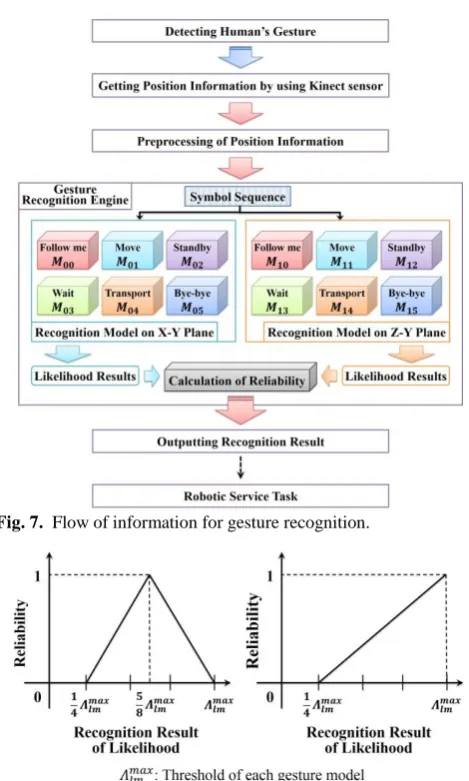
Figure 7 shows the flow of information from user’s gesture to robot motion. For that, a gesture recognition engine was developed, where multiple HMMs with trained parameters are employed in it. Parameter estimation is conducted by using the data with respect to both X -Y plane and
Z -Yplane. So a gesture is recognized by two models for both planes. The recognition models are defined asMlm. Where, the subscript l denotes the number of recognition plane asl0: X-Y, l1: Z-Y. The second subscript m denotes the number of gesture as follows; m0: ‘Follow me’, m1: ‘Move’, m2: ‘Standby’, m3 : ‘Wait’,
4
[image:3.595.320.529.382.573.2]Fig. 7. Flow of information for gesture recognition.
Fig. 8. Concept of reliability calculation.
Besides, the threshold is also prepared for each recognition model. Therefore, the likelihood, i.e., the output of each recognition model, is calculated by using forward algorithm with a symbol sequence as the input. As a result, the likelihood of largest value becomes the output of the recognition engine. However, the correct result cannot be judged because there are multiple results from both recognition models of X -Y and Z -Y planes and their effective range are different with each other. In order to recognize the gesture correctly, the following equations are utilized to extract data in the meaningful region of multiple likelihoods of models in both planes.
max lm lm max lm lm max lm lm max lm max lm lm lm lm max lm max lm lm lm Λ Λ Λ Λ Λ Λ Λ Λ f 0 8 5 3 8 3 8 8 5 4 1 3 2 3 8 4 1 0 max (5)
max lm lm max lm lm max lm lm max lm max lm lm lm Λ Λ Λ Λ Λ f 0 4 1 3 1 3 4 4 1 0 (6)connected to the predefined service task. V. EXPERIMENTAL RESULTS A. Experiment of Gesture Recognition
Experiments to confirm the performance of recognition for each gesture have been conducted. A human subject stands at the position of 1.5[m] in front of the robot with Kinect sensor and conducts all gestures for ten times. Where, three humans, subjects A, B and C, participated in the experiment.
The examples of gesture recognition experiment are shown in Fig. 9 (1) and (2). Their recognition results of three subjects are shown in Fig.10, where the system used the recognition model learned by gestures of subject A. The fourth results were performed by using the region-based algorithm of the previous research [11] for the same human of subject A. Besides, the experimental results with the recognition system including the model learned by gestures of subject B are given in Fig. 11.
It is observed that the recognition rates of subject A are higher than other subjects in Fig. 10, and those of subject B are higher than other subjects in Fig. 11, respectively. It denotes the natural result that the model shows higher performance in the case to recognize the gesture of the human used in training process. In this research and in general case, the communication with owner and robot is fundamental requirement. Therefore, the higher rate for recognizing the owner’s gesture is desirable and acceptable for real applications. Thus it is confirmed that the developed recognition system can be used in real field of human-robot communication.
(1) Recognition result of Bye-bye.
[image:4.595.51.544.524.778.2]Fig. 10. Experimental results of gesture recognition using learned data of subject A.
Fig. 11. Experimental results of gesture recognition using learned data of subject B.
B. Scenarios of Robotic Service Task
Experiments to check the possibility of the developed system have been carried out in some robotic tasks to support human as follows.
Scenario 1: human following service.
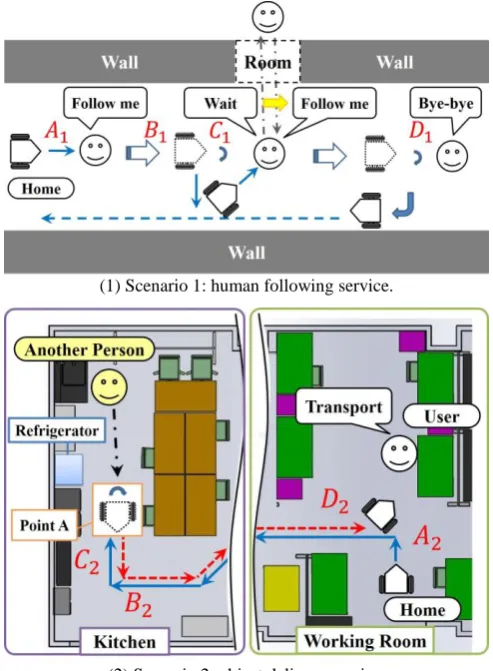
It is assumed that a service robot with a box for transportation has a capability of following human. So the service task starts (A1), the robot follows the human like as a companion (B1). The human can make the robot wait at certain position (C1), and after some time he can restart to follow himself again. After arriving to the goal position, he can give a command to the robot for returning to home position with his baggage (D1). All commands of the human are given by gestures to the robot, and above the demonstration scenario is shown in Fig. 12 (1).
Scenario 2: object delivery service.
It is assumed that the user cannot leave from his working place. He needs the object (for example, drink or food) which were located in another room. Then the human gives a command to the robot to bring it to himself (A2), and the robot moves autonomously to the destination (B2), (C2). And then another human who is at the destination puts the object on the robot, and the robot delivers it to the user (D2). Above the demonstration scenario is shown in Fig. 12 (2).
(1) Scenario 1: human following service.
(2) Scenario 2: object delivery service. Fig. 12. Scenario of robot’s service task.
C. Experiment of Robotic Service Task
Firstly, experiment according to ‘scenario 1’ was carried out as follows. Its representative scenes are given in Fig.13. A human subject commands to start the task of following himself to the mobile robot in home position (1), the mobile robot follows a subject during (2). Then, he makes the robot wait at (3), after for a while he makes the robot follows again (4). Finally, he makes the robot return to home position at (5), (6).
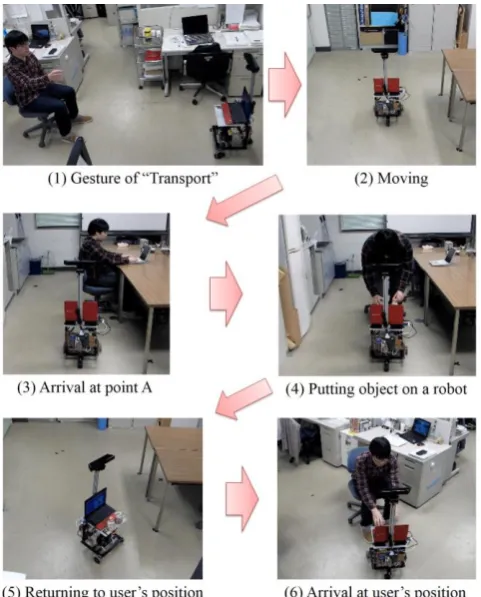
Secondly, experiment according to ‘scenario 2’ was carried out as follows. Its representative scenes are given in Fig.14. A human subject commands to start transporting task to the mobile robot in home position (1), the mobile robot moves autonomously to the point A at (2), (3). Then, another human who is at the point A puts an object to the robot at (4). Finally, the robot transports an object to user’s position at (5), (6).
The experiments with the developed system has been done successfully according to the scenarios.
VI. CONCLUSION
In this research, the gesture recognition system using HMM was developed for the communication between human and a service robot. The recognition rates for the predefined gestures familiar to human were verified through several experiments and compared to the region-based method of previous research. Furthermore, the developed system has been installed the robot and applied to Human-Robot Interaction for service tasks in office environment.
[image:5.595.51.290.248.403.2]Fig. 13. Example of experimental results. (Scenario 1: human following service)
Fig. 14. Example of experimental results. (Scenario 2: object delivery service)
[4] W. Xu and E. Lee, “A New NUI Method for Hand Tracking and Gesture Recognition Based on User Experience,” Proceedings of International Journal of Security and its Applications, Vol. 7, No. 2, pp. 149-158, 2013.
[5] T. Schlomer, B. Poppinga, N. Henze and S. Boll, “Gesture Recognition with a Wii Controller,” Proceedings of the 2nd international conference on Tangible and embedded interaction. ACM, pp. 11-14, 2008.
[6] H. D. Yang, A. Y. Park and S. W. Lee, “Gesture Spotting and Recognition for Human-Robot Interaction,” Proceedings of IEEE
Transactions on Robotics, Vol. 23, No. 2, pp. 256-270, 2007. [7] S. Rossi, E. Leone, M. Fiore, A. Finzi and F. Cutugno, “An Extensible
Architecture for Robust Multimodal Human-Robot Communication,”
Proceedings of IEEE International Conference on Intelligent Robots and Systems, pp. 2208-2213, 2013.
[8] N. Nguyen-Duc-Thanh, S. Lee and D. Kim, “Two-stage Hidden Markov Model in Gesture Recognition for Human Robot Interaction,”
Proceedings of International Journal of Advanced Robotics Systems, Vol. 9. 39, pp. 1-10, 2012.
[9] O. Patsadu, C. Nukoolkit and B. Watanapa, “Human Gesture Recognition Using Kinect Camera,”Proceedings of Computer Science and Software Engineering (JCSSE), International Joint Conference on.
IEEE. pp. 28-32, 2012.
[10] P. Doliotis, A. Stefan, C. McMurrough, D. Eckhard and V. Athitsos, “Comparing Gesture Recognition Accuracy Using Color and Depth Information,”Proceedings of the 4th International Conference on PErvasive Technologies Related to Assistive Environments. ACM, 2011.
[11] T. Fujii, J. H. Lee and S. Okamoto, “Communication with a Mobile Robot Based on Recognition of Human Motion by using Kinect sensor,” JSME Conference on Robotics and Mechatronics (Domestic). 1A1-002, 2012.
[12] J. Yamato, J. Ohya and K. Ishii, “Recognizing Human Action in Time-Sequential Images using Hidden Markov Model,” in Computer Vision and Pattern Recognition, 1992. Proceedings CVPR'92. IEEE
[image:6.595.51.292.401.700.2]