Abstract— CO2 is a natural refrigerant and suitable for the
ejector refrigeration cycle. Efficient nozzles cause high pressure recovery in ejectors. Converging-diverging nozzles with divergence angles of 0.076°, 0.153°, 0.306° and 0.612° were tested in a blowdown device during our previous study on supersonic two-phase flow of CO2. These nozzles were
considered in the design of the ejector for a CO2 vapor
compression refrigeration system. Inlet conditions were 6–9 MPa, 19–47°C. By using the data of the study, the efficiencies of the nozzles wherein transcritical and transonic flow of CO2 is
passing through were estimated. The dependence of efficiency and optimum divergence angle to pressure drop was determined. The Homogeneous Model was used because the steady state flow is considerably in homogeneous equilibrium. Each efficiency curve showed a maximum value at an optimum pressure drop. There was an optimum divergence angle for each pressure drop. The overall optimum divergence angle was 0.306° in the range considered which had the highest efficiency of 70% at a pressure drop of 7.3 MPa..
Index Terms— CO2, friction factor, energy conversion
efficiency, supersonic two-phase flow, converging-diverging nozzle, Homogeneous Model
I. INTRODUCTION
O2 is an environment friendly natural refrigerant
because it produces minimal global warming and does not deplete the ozone layer [1 – 2]. It is also safe to use because it is inert, non-flammable and non-explosive [3 – 4].
The main problem when using CO2 in the vapor
compression cycle is low coefficient of performance (COP). The compressor work needed to compress it to the required condenser inlet pressure is high. On the other hand, the energy loss at the expansion valve is also high. To increase the COP, the ejector refrigeration cycle which uses an ejector instead of an expansion valve is used [5 – 10]. The ejector takes advantage of the high pressure difference
Manuscript received March 17, 2014; revised April 10, 2014. The dissemination of this research is sponsored by the Engineering Research and Development Program (ERDT) of the Department of Science and Technology (DOST) of the Republic of the Philippines. The program is being managed and implemented by the College of Engineering of University of the Philippines–Diliman.
M. S. Berana is with the Department of Mechanical Engineering, College of Engineering, University of the Philippines – Diliman, Quezon City, 1101 Philippines (phone: +63-906-214-1782, +63-2-981-8500 loc 3130; fax: +63-2-709-8786; e-mail: [email protected]).
between the condenser and the evaporator. It recovers the energy lost during expansion in order to reduce the required compressor work.
The nozzle is an essential component of the ejector. It transforms the thermal energy of high-pressure liquid flow at the inlet to the kinetic energy of high-speed two-phase flow at the outlet. An efficient nozzle provides high kinetic energy at the nozzle outlet for high pressure recovery in the ejector. Several researches on converging-diverging nozzles for the ejector refrigeration cycle were done. The performance of converging-diverging nozzles with varying length of diverging sections for the ejector refrigeration cycle using R-134a was studied by Nakagawa and Takeuchi [5]. They found out from their calculation that the efficiency increases with the length of the diverging section. Nakagawa and Morimune [11] found out that the efficiency of the nozzles with CO2 flow increases with the divergence angle.
In those studies, friction was not considered in calculating nozzle efficiency.
To empirically embed friction in the analysis, the energy conversion efficiency of rectangular converging-diverging nozzles used for the ejector in this study was calculated using the flow data that were obtained in our previous experimental study on one-dimensional supersonic two-phase flow of CO2 [12]. Four rectangular
converging-diverging nozzles with divergence angles of 0.076°, 0.153°, 0.306° and 0.612° were tested in a blowdown device. Significant variation of decompression profiles occur in the investigated narrow range of divergence angle. Inlet conditions are around 6–9 MPa and 19–47°C, where many of them are above the critical point and most of them are reported in the literature of the study. By using the data of the study, the dependence of efficiency and optimum divergence angle to pressure drop for the compressor-driven ejector refrigeration system was determined. The empirical calculation results are presented in this paper. The Homogeneous Model was used in the calculation because the steady state flow in the study is considerably in homogeneous equilibrium.
Determination of Efficiency of
Converging-Diverging Nozzles with Transcritical and
Transonic Flow of CO
2
Menandro S. Berana
II. ENERGY CONVERSION EFFICIENCY OF CONVERGING -DIVERGING NOZZLES
A. The Homogeneous Model and energy conversion
efficiency of converging-diverging nozzles
Our previous study [12] showed that Isentropic Homogeneous Equilibrium (IHE) is only obeyed by the nozzles with divergence angles of 0.306° and 0.612° at inlet conditions of 9.1 MPa and around 36°C. IHE is not generally applicable to all of the nozzles at the flow conditions corresponding to the range of inlet conditions used in this study. It is also reported in the previous study that steady state and equilibrium at the measurement points on the nozzle wall occur and heat transfer to the wall is negligible. A past study on shorter nozzles with divergence angles of 0.306°, 0.480° and 0.981° [13] revealed through flow visualization that liquid droplets were homogeneously dispersed in vapor during two-phase flow in the diverging sections. The inlet conditions in such a study are within 7– 10.5 MPa, 30-50°C. Our previous study and the past study both showed through pressure profiles that supersonic homogeneous equilibrium two-phase flow occurred in the diverging sections of all investigated nozzles. Therefore, the Homogeneous Model, also called Homogeneous Equilibrium Model, was used in this study. It is also inferred from the past studies that the flow after the throat is generally not isentropic.
The following assumptions of the Homogeneous Model [14 – 15] were implemented in the calculation:
(1) Both phases have the same velocity;
(2) Both phases are in thermodynamic equilibrium; and (3) A single-phase friction factor can be suitably defined for two-phase flow.
The books of Collier [14] and Butterworth [15] can be consulted for a detailed discussion of the model.
It was also assumed that the flow was one-dimensional and parallel to the nozzle axis. All flow parameters at any arbitrary cross section perpendicular to the nozzle axis were assumed to be uniform. Flow parameters were assumed to vary only along the nozzle axis. The flow was considered adiabatic. Heat transfer to or from the nozzle wall was neglected.
The energy conversion efficiency of a converging-diverging nozzle is its ability to convert the thermal energy stored at the high-pressure inlet flow to the kinetic energy at the high-speed outlet flow. As the fluid passes through the nozzle, it gains momentum and creates friction with the nozzle wall. The increase in momentum increases the velocity of the fluid while friction on the other hand prevents that increase. The energy conversion efficiency of a nozzle is given by
2
,
2
out
in out s
u
h
h
(1)
The numerator indicates the change in kinetic energy that is available at the outlet. The expression for uout was derived by integrating the equations for mass and energy conservation of the Homogeneous Model. The derivation is described in this section. The inlet velocity was neglected because it was very low based on the experiment of our previous study. hin was obtained from the measured inlet temperature and pressure. REFPROP [16] was used in obtaining the thermodynamic parameters of specified states.
hout,s was obtained by using the outlet pressure of an experiment run and assuming that the flow was isentropic. The difference hin - hout,s is the maximum work of the flow corresponding to the pressure drop through the nozzle that can be converted to change in kinetic energy.
For convenience of analysis in proceeding discussions, the isentropic outlet velocity corresponding to the maximum work is defined as
,
2(
,)
out s in out s
u
h
h
(2)
The equation for conservation mass of the flow is given by
m
uA
W
constant
(3)
Where,
(1
)
m
x
gx
l
(4)
While the equation for conservation of energy is given by
2
2
u
dh
d
(5)By using the geometry and profiles of temperature and pressure through the nozzles used in our previous study [12], equations (3) and (5) can be combined to solve for the quality x and velocity u. It was observed that two phase flow mostly occurred in the diverging section; and transition from subsonic to supersonic mostly occurred near or at the throat. For single-phase flow which mostly happened in the converging section, v, h and u were numerically solved by first guessing h and then using equations (3) and (5). To determine the variation of x, v, h and u along a nozzle, the nozzle was divided into small partitions along the axis starting from the inlet down to the outlet. The calculation proceeded in a stepwise manner starting from partition containing the inlet down to the last partition containing the outlet.
After the outlet velocity was determined, the efficiency of the nozzle can already be calculated by using equations (1) and (2).
in the flow can also be determined after the fluid thermodynamic state point and velocity in a cross section are determined. The friction factor, f, for a small partition of the channel can be estimated using the conservation of momentum given by
2
2
2
W
mdP
W du
f
dz
A dz
A D
(6)
Where,
4
P
A
D
(7)
The homogeneous friction factor in this case is treated like the friction factor for single-phase flow. Many values of f
can be calculated from the flow in all nozzles. The calculated values of f around the throat are shown in this paper. Correlation for f in Blasius form for generalized flow at any section and different types of flow is also being investigated in another study.
III. EXPERIMENT SETUP
This paper used the results and experiment data of our previous study [12]. The basic description of the investigated nozzles and the experiment setup and procedure are mentioned in this paper again to facilitate understanding of its content. The experimental aspect of this study is discussed in details in the literature of the study.
A. Experiment apparatus
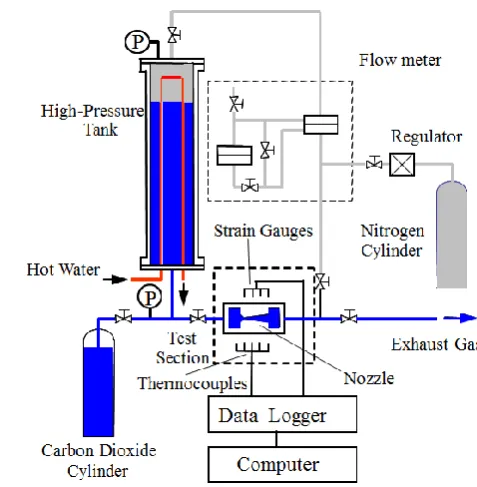
A blowdown test device shown in Fig. 1 [12] was used in the experiment in order to isolate the nozzles from the ejector and investigate them closely. The device basically comprises a test section, three tanks, an orifice housing and a differential pressure gage. The test section is used in order to mount and test a nozzle for an experiment run. The first tank was for liquid CO2 supply and the second one was for N2 gas
supply. The third tank was a high-pressure tank where liquid CO2 is prepared for a run. The orifice and the differential
pressure gage were used in order to determine the volumetric flow rate of N2 which was used in order to calculate the mass
flow rate of CO2. The volumetric flow rate of N2 was
considered constant and equal to that of CO2 for a run.
B. Nozzles used in the experiment
Fig. 2 [12] shows the shape and dimensions of the rectangular stainless steel nozzles from side and front views. The converging section and the following dimensions were the same: thickness of 3 mm and a total length of 83.5 mm. The divergence angle θ was varied among the nozzles. Table 1 [12] shows the values of the variable dimensions of the nozzles. Eleven thermocouple taps on one sidewall and four pressure taps on the opposite sidewall were made for static
temperature and pressure measurement, respectively.
C. Experiment procedure
High-pressure liquid CO2 was charged to the
[image:3.595.298.537.57.301.2]high-pressure tank shown in Fig. 1 for every run. To make the liquid temperature approximately equal to the value of the desired inlet temperature, the liquid was either kept at room temperature or warmed up through flowing hot water.
[image:3.595.313.535.350.476.2]Fig. 1. Schematic diagram of the blowdown device.
[image:3.595.312.531.532.650.2]Fig. 2. Dimensions of the nozzles.
Table 1. Variable dimensions of the nozzles.
Nozzle
(deg)
h
outlet(mm)
Outlet area
(mm
2)
1
0.076
0.39
1.17
2
0.153
0.54
1.62
3
0.306
0.84
2.52
Regulated high-pressure N2 gas was charged into the upper
part of the tank and the valve at the lower part of the tank was opened to let liquid CO2 flow at a constant pressure.
The pressure of N2 gas was controlled through the regulator.
An experiment run was started by opening the valve between the nozzle and the tank. Static temperature and pressure values along the nozzle sidewalls were measured. It is reported in our previous study [12] that the static fluid in the thermocouple and pressure taps are in thermodynamic equilibrium and the flow is in steady state condition.
IV. RESULTS AND DISCUSSION
A. Calculated energy conversion efficiency of the
converging-diverging nozzles
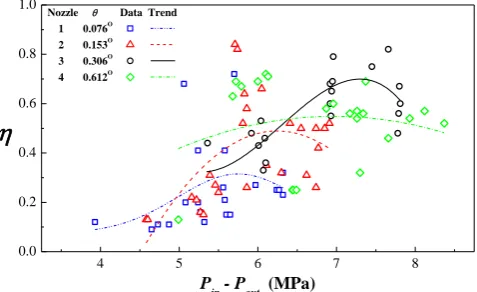
The calculated values of energy-conversion efficiency versus pressure drop through the nozzles are shown in Fig. 3. The trend for each nozzle was approximated using curve fitting analysis.
Each efficiency curve showed a maximum value at an optimum pressure drop. There was an optimum divergence angle or nozzle for each pressure drop. The overall optimum divergence angle which corresponded to Nozzle 3 was 0.306°. The divergence angle is recommended for converging-diverging nozzles of compressor-driven ejector refrigeration systems. Nozzle 3 had the highest efficiency of 0.7 at the pressure drop of 7.3 MPa.
The variation of f at the throat, calculated from the experimental data and calculated velocity u and thermal properties, with respect to inlet pressure is shown in Fig. 4. It is shown that f has no general trend with the values of divergence angle but it is relatively increasing with increasing inlet pressure. More flow data for CO2 in
different channel configurations and flow types is also being investigated in another study to get more generalized equation of f in Blasius form.
B. Importance of the present study to ejector refrigeration systems and other thermal systems
The efficiency of nozzles undergoing two-phase flow should be calculated in order to select the efficient nozzles that can cause satisfactory performance of their thermal systems. An efficient nozzle can lead to a higher COP of an ejector refrigeration system or higher thermal efficiencies of other thermal systems including powerplants. This paper presents empirical results and a way of calculating nozzle efficiency for CO2 that can be used in designing efficient
nozzles.
V. CONCLUSION
Converging-diverging nozzles with divergence angles of 0.076°, 0.153°, 0.306° and 0.612° were tested in a blowdown device in our previous study on transcritical and transonic two-phase flow of CO2. Inlet conditions are around
6–9 MPa, 19–47°C. By using the data of the study, the dependence of efficiency and optimum divergence angle to pressure drop was determined. The Homogeneous Model was used because the steady state flow is considerably in homogeneous equilibrium. This study also opened another study on determining the generalized homogeneous friction of CO2 which can govern flows in any section and type of
flow.
Each efficiency curve showed a maximum value at an optimum pressure drop. There was an optimum divergence angle or nozzle for each pressure drop. The overall optimum nozzle was the nozzle with the divergence angle of 0.306°. The divergence angle is recommended for converging-diverging nozzles of ejector refrigeration systems. The nozzle had the highest efficiency of 70% at the pressure drop of 7.3 MPa.
The presented technique in obtaining efficiency of nozzles can be applied not only to ejector refrigeration systems but also to other thermal systems including powerplants.
Nozzle Data
1 0.076O
2 0.153O
3 0.306O
4 0.612O
6 7 8 9
0 2 4 6 8 10
Noz. Trend Slope Intercept
1 5x10⁻⁴
6.0x10⁻⁴
2 2x10⁻⁴
2.0x10⁻³
3 1x10⁻⁴
3.5x10⁻³
4 2x10⁻⁴
1.0x10⁻³
fex
p
t,
th
(
x10
-3
)
[image:4.595.308.547.178.325.2]Pin (MPa)
Fig. 4. Friction factor calculated at the throat versus inlet pressure.
4 5 6 7 8
0.0 0.2 0.4 0.6 0.8
1.0 Nozzle Data Trend
1 0.076O
2 0.153O
3 0.306O
4 0.612O
Pin - Pout (MPa)
[image:4.595.49.288.426.572.2]NOMENCLATURE
A cross sectional area (m2) COP coefficient of performance (-)
D hydraulic diameter (m)
f homogeneous friction factor (-)
h enthalpy (J/kg) h height (m) IHE Isentropic Homogeneous Equilibrium (-) L length (m) P perimeter of flow cross section (m)
P pressure (Pa)
s entropy (J/kgK)
u velocity (m/s)
W mass flow rate (kg/s)
x quality (-)
z nozzle axis (m)
Subscripts
expt experiment
g vapor phase
in inlet
l liquid phase
m mean value
out outlet
s isentropic
th throat
Greek
divergence angle (°)
η energy conversion efficiency (-)
ν specific volume (kg/m3)
ACKNOWLEDGMENT
M. S. Berana thanks the Multi-Phase Flow Laboratory of Toyohashi University of Technology, Japan for the laboratory facility during the conduct of the study.
REFERENCES
[1] J. M. Calm, G. C.Hourahan, Refrigerant data summary. Eng. Syst 2001, 18(11), 74–88.
[2] US EPA, The Science of Ozone Layer Depletion. http://www.epa.gov/Ozone/science/index.html, 2011.
[3] F. C. McQuiston, J. D. Parker, J. D. Spitler, Heating, Ventilating and Air Conditioning Analysis and Design, sixth edn. John Wiley & Sons, Hoboken, NJ. 534–539, 2005.
[4] A. Pearson, Carbon dioxide—new uses for an old refrigerant. Int. J. Refrigeration 2005, 28, 1140–1148.
[5] M. Nakagawa, H. Takeuchi, Performance of two-phase ejector in refrigeration cycle. Proceedings of the 3rd International Conference on Multiphase Flow, Lyon, France, June 8-12, 1998, pp. 382/1-382/8. [6] J. Deng, P. Jiang, T. Lu, W. Lu, Particular characteristics of transcritical CO2 refrigeration cycle with an ejector. Appl. Thermal
Eng 2007, 27, 381–388.
[7] S. Elbel, P. Hrnjak, Experimental validation of a prototype ejector designed to reduce throttling losses encountered in transcritical R744 system operation. Int. J. Refrigeration 2008, 31, 411–422.
[8] J. Sarkar, Optimization of ejector-expansion transcritical CO2 heat
pump cycle. Energy 2008, 33, 1399–1406.
[9] M. S. Berana, Characteristics and shock waves of supersonic two-phase flow of CO2 through converging-diverging nozzles, Doctoral
Dissertation, Toyohashi University of Technology, Toyohashi, Aichi, Japan, 2009.
[10] N. Ruangtrakoon,, T. Thongtip, S. Aphornratana, T. Sriveerakul, CFD simulation on the effect of primary nozzle geometries for a steam ejector in refrigeration cycle. International Journal of Thermal Sciences 2013, vol. 63, 133-145.
[11] M. Nakagawa, Y. Morimune, Subsequent report on nozzle efficiency of two-phase ejector used in carbon dioxide refrigerator. Therm. Sci. Eng 2003, 11 (4), 10–11.
[12] M. Nakagawa, M. S. Berana, A. Kishine, Supersonic two-phase flow of CO2 through converging-diverging nozzles for the ejector refrigeration cycle. Int. J. Refrigeration 2009 32(6), 1195–1202. [13] H. Iida, Research on decompression boiling of two-phase flow of
carbon dioxide in nozzle, Master Thesis (In Japanese). Department of Mechanical Engineering, Toyohashi University of Technology, Toyohashi, Japan, 2006.
[14] J. G., Collier, Convective Boiling and Condensation, second edn. McGraw-Hill, New York. 4–35, 1981.
[15] D. Butterworth, Two-phase Flow and Heat Transfer, Ch. 4, Empirical Methods for Pressure Drop, Butterworth D., Hewitt G.F., ed. Oxford University Press, London. 58–90, 1977.