Structuring primitives in the Callimachus
component-based open hypermedia system
Manolis Tzagarakis
a,b,*, Dimitris Avramidis
a,b,
Maria Kyriakopoulou
a,b, Monica M.C. Schraefel
c,
Michalis Vaitis
a,b, Dimitris Christodoulakis
a,ba
Department of Computer Engineering and Informatics, University of Patras, GR-26500 Patras, Greece
b
Research Academic Computer Technology Institute, 61 Riga Feraiou st, GR-26221 Patras, Greece
cDepartment of Computer Science, University of Toronto, 10 Kings College Rd, Toronto, Canada
Received 1 December 2001; received in revised form 1 April 2002; accepted 1 December 2002
Abstract
Driven by the philosophy of the ‘primacy of structure over data’, Component-Based Open Hypermedia Systems (CB-OHS) present an open set of structure servers providing structural abstractions of different hypermedia domains. To address the emergent requirements and to facilitate the development of structure servers, structure should be handled as a first class entity. We propose patterns for structure, calledtemplates, that define the structural model upon which structure servers operate. We present how structure servers are developed and operate in the Callimachus CB-OHS. Development of structure servers within Callimachus is based on the explicit specification of structure with the use of an atomic structural primitive called the structural element. Explicit structure specification eases the development of structure servers in CB-OHS, making such development less error prone and providing the basis for tailoring domain specific abstractions.
q2003 Elsevier Science Ltd. All rights reserved.
Keywords:Hypermedia domain; Navigational domain; Callimachus CB-OHS
1. Introduction
The transition from monolithic to Open Hypermedia Systems (OHS) envisioned the provision of hypermedia functionality to third-party applications as well as
1084-8045/03/$ - see front matterq2003 Elsevier Science Ltd. All rights reserved. doi:10.1016/S1084-8045(02)00064-4
Computer Applications 26 (2003) 139–162
www.elsevier.com/locate/jnlabr/yjnca
* Corresponding author. Address: Research Academic Computer Technology Institute, 61 Riga Feraiou st, P.O. Box 1122, Hellas, GR-26221 Patras, Greece. Tel.:þ30-610-960381; fax:þ30-610-960438.
interoperability among different hypermedia systems, in a distributed, heterogeneous environment. Much research and development work, lasting for many years, resulted in the realization that various hypermedia domains impose different requirements and need markedly different abstractions. This led to common agreement that special protocols should be developed for each hypermedia domain. A ‘hypermedia domain’ is defined by a coherent set of abstractions solving a particular organization problem.
Within the effort of developing the Open Hypermedia Protocol (OHP) (Reich et al., 1999), OHP-Nav was the first effective approach for supporting the well-known navigational domain (Millard et al., 1998). New systems and protocols supporting structural abstractions of other domains, such as taxonomic (Van Dyke Parunak, 1991) or spatial (Marshall et al., 1994), had to be built from scratch. Inspired by the general trend in computing towards component-based, distributed, interoperable systems, Component-Based Open Hypermedia Systems (CB-OHS) emerged (Nu¨rnberg et al., 1998a; Reich et al., 1999). Driven by the philosophy of the ‘primacy of structure over data’ (Nu¨rnberg et al., 1997), CB-OHS provide an open set of components, calledstructure servers, each one providing the foundations to support the structural abstractions of a single hypermedia domain in a convenient and efficient way (Nu¨rnberg and Leggett, 1999). Functionality that is common among all domains such as storage, versioning, naming and collaboration is regarded as part of the infrastructure.
Besides providing appropriate abstractions of particular hypermedia domains, the CB-OHS approach may be useful in other situations as well. Sub-domains exist that may place constraints on an individual domain. As an example, thetyped(orstructured)navigational domain can be considered as a sub-domain or aspecializationof the navigational domain. Moreover, some domains may be regarded as functional aggregations of other domains, such as the linguistic and the digital libraries domains, where the taxonomic and the navigational domain have to co-exist and even interoperate at some levels (Ntoulas et al., 2000; Nu¨rnberg et al., 1998b; Wang and Fernadez, 2001). In addition, a wide number of applications need specific hypermedia functionality, not only generic link services. For example, alexicographicapplication requires specific associative mechanisms to express relations among lemmata in a lexicon (hyponyms, hyperonyms, homonyms, synonyms, etc.) (Ntoulas et al., 2000).
Thus, specific CB-OHS development tools are required to facilitate their development. Such software development tools for structure servers should include structure specification capabilities that will provide the fundamental elements upon which behavioral operations can be defined or programmed, such as traversal semantics, structure constraints and even presentation and transition effects.
In this paper we present how structure servers are developed and operate in the Callimachus CB-OHS. Development of structure servers within Callimachus is based on the explicit specification of structure with the use of an atomic structural primitive called thestructural element. The need to specify structure explicitly has already been pointed out (Anderson, 2000). Explicit structure specification eases the development of structure servers in CB-OHS, making such development less error prone and providing the basis for tailoring domain specific abstractions. Patterns for structure are presented, called templates, that define the structural model upon which structure servers operate. In Callimachus, the domain specific structural model (e.g. navigational, taxonomic) is perceived as a first class entity that can be formally defined through templates. This is in contrast to contemporary OHS, in which the structure model is closely coupled with the infrastructure or the individual structure servers. The interoperability level can thus be raised from the infrastructure level (i.e. the storage) to the template level. The perception of templates is part of larger effort towards the creation of software engineering tools for the development of CB-OHS within the Callimachus framework.
The paper is organized as follows. Sections 2 – 5 discuss some hypermedia domains that have been reported in the literature focusing on prevailing abstractions and interaction styles. Section 6 compares the domains exhibiting common concepts. Sections 7 and 8 introduce the Callimachus CB-OHS and describe its elementary constructs. Section 9 analyses how structure servers use the elementary constructs to provide navigational services. Section 10 compares Callimachus to other generalized hypermedia approaches. Section 11 concludes the paper.
2. Information navigation: navigational domain
The navigational domain was one of the first domains implemented in early hypertext systems, in which associations were provided between information. These associations— widely known as links—were to be made between semantically related information items, as Vannevar Bush envisioned in the Memex (Bush, 1945). On the one hand, hypertext links condition the user to expect purposeful and important relationships between linked materials, whereas on the other hand the emphasis upon this linking stimulates and encourages habits of relational thinking in the user (Landow, 1987).
(Fountain et al., 1990), ‘generic links’, available dynamically, were an important contribution to link formulations.
The evolution of navigational hypermedia systems continued with an arbitrary number of systems, each of them adopting different implementation strategies. However, as stated in the Dexter Open Hypermedia work (Halasz and Schwartz, 1994), the basic node/link network structure is the essence of (navigational) hypertext. Moreover, fundamental to Open Hypermedia models like Dexter and Microcosm, the linking information is to be kept separate from documents to allow powerful link structures, such as bi-directional or
n-ary links (Landow, 1987; Landow and Kahn, 1992; Millard et al., 1992; Nu¨rnberg,
1997). As a result, the navigational hypertext can be viewed as a network of data containing ‘components’ interconnected by relational ‘links’ (Halasz and Schwartz, 1994).
To support the navigational domain, many hypermedia researchers have adopted a fundamental entity that provides thenode,link,anchorandcontextabstractions (Demeyer, 1996; Halasz and Schwartz, 1994; Millard et al., 1992; Nu¨rnberg, 1997; Reich et al., 1999). A node provides a wrapper for an arbitrary resource and may have several anchors associated with it, whereas an anchor can be bound to several links (Millard et al., 1992; Reich et al., 1999). A link of the navigational domain is defined as an association between anchors with its direction clearly stated (Halasz and Schwartz, 1994; Millard et al., 1992) and a context is a collection of object references (similar to hypertexts in Dexter (Halasz and Schwartz, 1994) and to contexts in Leggett and Schnase (1994), or even more specifically—as stated in HOSS (Nu¨rnberg, 1997; Nu¨rnberg and Leggett, 1999)—is a set of link objects. The attribute/value pairs can be used to attach any arbitrary property and its value to a component.
3. Information classification: taxonomic domain
Taxonomic reasoning is a particular kind of reasoning task that deals with the comparison and classification of highly similar nodes, in which an analyst viewing one node thinks not in terms of linking it to another node, but of including it in or excluding it from a set of related nodes (Van Dyke Parunak, 1991). Taxonomic reasoning in combination with hypersets leads naturally to an a priori hierarchical, or tree-based, organization in the set of sets. The hierarchical structure is not a result of the data but is a way to structure the set of categories into which the artifacts are classified (Van Dyke Parunak, 1993). Therefore, users sort artifacts (the equivalent of nodes in graphs) into categories (sets) based on their characteristics. Different users (or different rules applied to the same nodes) may have different result sets for how the artifacts are partitioned (Millard et al., 1992).
In general, the task of taxonomic reasoning has the following characteristics (Van Dyke Parunak, 1991):
† Taxonoming reasoning develops descriptions of each item along a set of dimensions, but these dimensions are not fully defined when one begins the reasoning process.
† The basic activities that need to be supported to facilitate taxonomic reasoning are essentially set operations, such as sorting objects into sets based on their characteristics, looking together at the members of a single set, examining the different sets of which a single item is a member and generating new sets from old ones.
Eventually, the classification hierarchy that taxonomic reasoning entails is not a strict tree but rather a directed acyclic graph in which one node can have multiple parents. While a directed acyclic graph offers more navigational resources than does an arbitrary graph, a strict tree offers even more, including unique paths between nodes and thus unique distance metrics. A distance measure between artifacts is useful when we move beyond classification of artifacts to storing and retrieving them (Van Dyke Parunak, 1993).
There are two basic routes to formalizing a classification hierarchy. The first one involves the lower-level sets that can be elements of higher ones while the second one comprises these sets as subsets of higher ones. The nodes in a classification hierarchy are of two very different sorts. On the one hand, some nodes allow the analyst to select a perspective from which a given object is desired to be viewed. On the other hand, there are other nodes that require the analyst to sort the object into one of a set of disjoint categories. Actually, categories can be constructed in such a way that the structure remains a strict tree, and it is perspectives that cause the hierarchy to deviate from a strict tree, since they permit a given artifact to descend from several branches (Van Dyke Parunak, 1993). Taxonomic perspectives, then, allow different views of the organizations of some set of nodes within a branch of hierarchy. Therefore, perspective can be regarded as an abstraction that is, in many ways, similar to that of ‘context’ as used in some navigational hypertext systems (Millard et al., 1992). Modeling perspectives, such as associations, not only have the interesting property of allowing users to move between the different views just as if you were following a link, but also provide a convenient way of choosing a view. A taxonomic reasoning contains three main primary abstractions, the specimen, the taxon and the taxonomy. A specimen has arbitrary content and attributes and represents the elements of the given data. A taxon, on the other hand, has no content but has arbitrary attributes that form a constructed descendant. It can have three sides: supertaxa, subtaxa and specimens. More specifically, a subtaxa can contain an arbitrary number of elements while a supertaxa or a specimen consists of exactly one element. Finally, a taxonomy contains an hierarchy of specimen and taxon. Apart from the primary abstractions, there are some secondary ones such as annotation, posited specimen and delta calculation.
4. Information analysis: spatial domain
In the information analysis problem domain, the focus is on the process of structuring diverse material. Structuring and organization of information is a complicated intellectual process including activities such as collecting, comprehending and interpreting diverse types of information. During such activities, users tend to explore the structures they are creating and organize information by implicit and informal spatial methods formalizing incrementally their structures (Marshall and Rogers, 1992). Traditional authoring systems were too restrictive to use for such tasks, because they required commitment to formal structure in very early stages. The issues of supporting construction of hypermedia structures through exploration and incremental formalization define the boundaries of the information analysis domain.
To address problems in the information analysis domain new systems emerged emphasizing on the support of the structuring process at the user level. Taking advantage of the human perceptual system as well as spatial and geographic memory (Marshall et al., 1994), these systems allow to express relationships by spatial proximity and visual cues. Such expression of relationships achieves differentiation ofimplicitfromexplicitstructure hence permitting a smooth shift from informal to formal structure. Hypermedia systems providing such paradigm to information organization are referred to as spatial hypermedia systems.
Primary entities in spatial hypermedia systems include objects, collections and compositeseach usually appearing with a different visual symbol having different visual characteristics such as shape, color, border, text, font, etc. Objects represent wrappers for arbitrary types of data. Object types are supported by means of explicit visual characteristics. Collections contain arbitrary amount of objects or collections. Hierarchical ordering of collections is thus possible. A set of objects or composites in a particular visual configuration form composites.
Spatial hypermedia systems also provide visual and spatial means to denote relationships among entities. Consequently, these systems are able to recognize relationships by spatial arrangement, relationships by object type, relationships by collection, and relationships by composite. A special structure-finding process—the spatial parser—is responsible for discovering such relationships and suggesting the creation of new collections and composites to the user.
Navigation in spatial hypermedia systems is accomplished through ‘zoom-in’ and ‘zoom-out’ operations, known as semantic zooming (Furnas and Bederson, 1995; Herot et al., 1981), applied on collections. Zoom-in operation effects in filling the whole application window with the content of the affected collection thus revealing a new navigation space. Zoom-out operation on a collection, effects in revealing the navigation space of its parent collection.
5. Information architecture: schema domain
During hypermedia development the complex relations of subject specific information, for example museum applications or multimedia presentations, are captured in a clear and comprehensible way, making them accessible to the user. Users, often referred to as readers, come across hypermedia applications that enable them going through information by selecting paths to follow on the basis of interests emerging along the way (Nielsen, 1990). Hypermedia systems provide environments to facilitate the creation of hypermedia applications. Although readers are unaware of how hypermedia applications are created, two other user groups are very much concerned about that issue; namely, hypermedia designers and authors. Designers, as well as authors, use services provided by hypermedia systems to create hypermedia applications engaging in an activity called hypermedia development.
Hypermedia development is a complicated cognitive process that consists of recursive activities, like emergence of ideas, representation and structuring of ideas, evaluation and update (Nanard and Nanard, 1995), requiring a mental model of the target application domain. As it has been recognized, it is this complexity that roots the problems of cognitive overload and disorientation in hypermedia (Nanard and Nanard, 1995). Thus, much effort has been given in the creation of sophisticated tools and methodologies that will assist in developing hypermedia applications.
Towards the better support of activities related to hypermedia design,systematicand
structureddevelopment of hypermedia applications have been proposed (Garzotto et al.,
1993; Isakowitz et al., 1995; Marshall et al., 1991; Nanard and Nanard, 1991; Schwabe et al., 1996; Wang and Rada, 1998). These approaches differentiate between authoring-in-the-large, carried out by designers, aiming at the specification and design of global and structural aspects of a particular hypermedia application, and authoring-in-the-small, carried out by authors, referring to the development of the contents (Garzotto et al., 1991). With regard to authoring-in-the-large, they provide convenient environments within the hypermedia system for hypermedia development, offering a suitable data model helping articulate structural designs. A rich set of abstractions including aggregation,
generalization/specialization and the notion of constraints, facilitates the process of
tailoring abstractions. Furthermore in these approaches, ahypermedia schemaembodies structural designs leading to the notion of hypermedia modeling. In many cases, diagrammatic notations are used to represent such hypermedia schemas. Examples include enriched versions of Entity-Relationship (ER) (Isakowitz et al., 1995) and OMT/UML (Schwabe et al., 1996) diagrams or specialized notationsGarzotto et al., 1993). The view of these diagrammatic notations as hypertexts (Kyriakopoulou et al., 2000) defines the boundaries of the schema domain.
can develop hypermedia applications at a high level of abstraction. It helps them to conceptualize these applications via an instantiation of a schema without too much regard to structural details. In general, one of the major goals in hypermedia modeling is to provide authors with the ability to customize knowledge structures for their specific tasks.
6. Levels in hypermedia: common abstractions and templates for primitives
In the previous sections we have considered several domains in hypermedia that represent a particular set of practices which foreground a particular set of operations. Navigation foregrounds links; spatial hypertext foregrounds associations; taxonomy foregrounds set and (hierarchical) graph operations and so on. In each case, however, we can see that these domains also share operations at a fundamental level. The taxonomic domain needs both to support links (navigation) and associative layout (spatial hypertext) while navigation itself is enhanced by supporting notions from taxonomy of sorting and set making for the creation of user-determined composites. Indeed, we suggest that what characterizes these as specifically hypermedia domains, rather than simply representing a page layout program, a taxonomy program or data management tools is that they must each have access to these shared set of hypermedia-based services.
With so much overlap of core functionality, difference exists primarily at the domain level, and can largely be represented in terms of domain/service focus. We therefore require a way to conceptualize such services at several levels: at the domain level, at the service or middleware level, and at the fundamental architecture level. To this end, our goal has been to develop both structural primitives for our CB-OHS system Callimachus and the middle layer templates. The primitives allow us to conceptualize the fundamental architecture operational structure processes and the middle layer templates support the representation of those processes as particular domain services. In conceptualizing these structural primitives and service templates, we have found it useful to borrow the concept
of levels from programming languages. The hypermedia domain specific abstractions,
such as taxonomic hypertext or spatial hypertext are at thehighestlevel. The structural elements, which each domain draws upon, are at the lowest level of hypermedia (we describe these in the following sections). High and low levels are determined by how suitable the abstraction is to solve a problem at hand. The domain level is therefore especially useful for highlighting possible contexts of use for combinations of services, such as aggregation, sorting, or association, and for determining any new primitives or combinations of primitives that must be made available to support these services.
algorithm, but it is more convenient to write this in a higher level language. Moreover, we can use a higher level language like C to write new languages to solve in a more convenient fashion certain cases of problems, similar to the way PHP or Python provide effective language tools for crafting Web CGI applications.
By thinking in terms of structural properties in particular, and by working from the domain level to a well-defined set of primitives, we have a model for determining when or if new tools need to be built, and we have a ready-made middleware architecture for reuse of existing primitives or primitive composites for new services.
In the following sections, we do not claim to have defined the complete of core operations for hypermedia. To finish the programming languages analogy with relation to the concept of ‘computationally complete’, the repertoire of core operation here is not ‘structurally complete’; one may come up with another set. That is our hope: that by presenting the reasoning we have defined for Callimachus primitives, others interested in this domain may use this logic for expanding/extending the structures and service templates. Indeed, a concern of structural computing in general is to define the assembly level primitives for structural relations. A concern of CB-OHS’s in general and of Callimachus in particular, is to define the rules to create the templates that will function as a middle-layer, higher-level abstraction between the assembly level and the domain level. We touch on both these aspects in the rest of the following sections of this paper.
7. The Callimachus CB-OHS
The Callimachus CB-OHS attempts to provide the framework in which the aforementioned hypermedia domains co-exist and structure servers—providing new abstractions and services—for new domains can be developed. Given the complexity of development of structure servers in new hypermedia domains, special attention has been given in the provision of suitable tools to facilitate such task. Within Callimachus these tools are part of amethodologyi.e. a systematic, disciplined quantifiable approach in the construction of structure servers.
One such tool are the structure templates of Callimachus. The aim of structure templates is to maintain the specifications of the structure model of hypermedia domains. Structure servers operate guided by these structure templates to provide domain specific abstractions and constraints.Fig. 1outlines the architecture of the Callimachus CB-OHS and the role of structure templates.
In the following, we briefly illustrate the various parts of the architecture:
† Structure server. It consists of a structure model (structure template), structure cache and a set of behaviors that are used to deliver domain, sub-domain and application specific abstractions and services to clients.
† Structure template. The formal specification of the abstractions that define a
hypermedia domain, sub-domain or application.
† Structure cache. Provides an intermediate store for domain specific abstractions for
† Behavior. Behavior models the computational aspects of a domain, sub-domain or application. Behavior can be divided—depending on its purpose—into two main categories:services, which are available to clients through the use of a specific API and protocol (e.g. openNode, followLink, etc.), andinternal operationsthat are used by the structure server internally for consistency reasons mainly (e.g. to affirm conditions and constraints, or to interpret abstractions in a suitable manner).
† Infrastructure. This includes the fundamental hypermedia functionalities that are
available to all other entities. Functionalities, such as naming (Tzagarakis et al., 1999, 2000, persistent store (hyperbase service), and notification, constitute an essential part of the infrastructure.
† Template repository. A storage place for structure templates. Its main purpose is to hold structure definition as well as to support reusability and extensibility of structure among structure servers.
† Client. Any process that requests hypermedia functionality. Clients request hypermedia operations from one or more structure servers with the use of the appropriate APIs.
The methodology of developing structure servers within Callimachus, can be divided into two phases: thestructural design phaseand thebehavioral design phase.
During the structural model design phase, the abstractions of the target hypermedia domain as well as their complex interrelationships are captured and formally specified. Structure templates provide the mean to formalize such specifications. Devising structure specification formalism is a difficult task since it should be convenient to use it without compromising expressiveness. The formalism should be open to extensions, model-neutral and provide a common ground for cooperation. Such formalism deployed within the Callimachus framework is described in Section 9.
[image:10.468.78.385.75.267.2]During the behavioral design phase, the computational aspects of structure servers in Callimachus are specified and developed. Such computational aspects indicate how
structure servers function in order to realize a particular behavior e.g. following a link or affirm conditions. Although the specification of behavior is not in the scope of this paper we present a set of core operations upon which behaviors of structure servers can be built.
8. Structure elements
In Callimachus, the methodology for defining the structure model of a domain, sub-domain or application consists of the specification and inter-relation ofstructural types. A structural type is either an instantiation of a basic abstract class, theAbstract Structural
Element(ASE), or a specialization of another structural type. The notion of the ASE is
inspired by thestructure object, proposed byNu¨rnberg (1997) and Nu¨rnberg et al. (1996) and is similar to the Object abstract class in the majority of the object-oriented programming languages. Structure servers operate on structural objects. The set of structural types and the relationships among them defined by the model-designer at the same context, establish thetemplateof the domain, sub-domain or application. During the definition of a new structure model, already existing templates may be reused or extended. In the following subsections we describe the elementary constructs of the methodology, as well as the structure-model definition process.
8.1. Elementary constructs
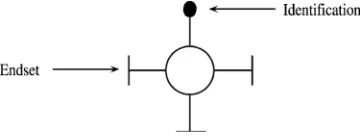
The ASE is a meta-class that consists of two attributes: an identifier and a name. The instances of ASE are structural types that are identified by a system-defined unique structural type identification(sid) and a designer-specified uniquename. A structure type may have an arbitrary number ofpropertiesandendsets. The instances of a structural type arestructural objectsin the sense described inNu¨rnberg (1997) and Nu¨rnberg et al. (1996) but they are constraint by their structure type specification, regarding the endsets and properties. Each structural object is identified by a system-defined uniquestructural object identification(oid).Fig. 2depicts an instance of an ASE.
The structure type properties are specified by a name, a data type and they may be
single-valuedormulti-valued. A special property, namedcontent, may be defined in the
[image:11.468.146.326.530.598.2]context of a structural type. At the instantiation level, the value of this property is an address specification of an arbitrary amount of data. Since our purpose is to specify structure, not data, we do not define other semantics for that property (like within-component layer in the Dexter hypertext reference model (Halasz and Schwartz, 1994).
Theendsetof a structural object is a placeholder for oids of other structural objects. It is the most significant construct since it enables the grouping of related objects. An endset of a structure type has the following attributes:
† Name. Unique among the endsets of the same structural type.
† Order number. An integer that designates the sequence of the endsets of a structural
type.
† Total participation indication.a[min, max] notation that indicates the minimum and
maximum number of oids that can participate in the endset.
† Multiplicity.a[min, max] notation that indicates the minimum and maximum number
of occurrences of that endset that can participate in a structural object of that type.
† Configuration. Whether or not the members of the endset bear a particular functional or structural relationship to one another (e.g. may form a set, list, queue etc).
Along an endset, a set of the structural types (sids) is defined, calleds-set, which configures the structure types whose instances may be end-points of the endset. An s-set may be inclusive or exclusive; an inclusive s-set specifies the allowed structure types, while an exclusive one specifies the forbidden structure types. Apartial participation
indication may be defined for each structure type in an inclusive s-set, indicating the
minimum and maximum number of objects of this type that can participate in the endset. In addition, for each structural type in the s-set, acardinality indicationis specified (a [min, max] notation can be used for that) defining the number of structural objects (of the structural type that is currently defined) to which a structural object of that type is allowed to be related (through that endset). This is similar to the cardinality ratio in the ER diagrams (Elmasri and Navathe, 1994) that specifies the number of relationship instances that an entity instance can participate in.
As a last notation, an endset with more that one structural types in its s-set, may be characterized as homogeneous or heterogeneous. At the instantiation level, a homogeneous endset can include structural objects of one type only, while a heterogeneous endset may point to structural objects of different types at the same time.
8.2. Operations on abstract structural elements
In Callimachus, structural objects are controlled by a core set of operations. This set of operations allows the manipulation of structure, thus forming the basis for the specification of the computational aspects of structure servers. In Callimachus this set is perceived as the instruction set of structure processing engine:
† createStructuralObject(). Instantiates a new untyped structural object. A unique system identification is given to the created structural object.
† getType(s). Returns a string indicating the structural type of structural objects.
† addEndSet(s, endSetName). Adds a new endset namedEndSetNameto the structural objects.
† addEndSetAttribute(s, endSetName, endSetAttribute). Adds a new attribute named
† setEndSetAttribute(s, endSetName, attributeName, attributeValue). Sets the value of the attribute named attributeName of the endset EndSetName to the value attributeValueof the structural objects.
† addStructuralObjectAttribute(s, attributeName). Adds a new attribute named attribu-teNameto the structural objects.
† setStructuralObjectAttribute(s, attributeName, attributeValue). Sets the value of the attributeattributeNameof the structural objectsto the valueattributeValue.
† addEndSetMember(s, targetS, endSetName). Adds the structural objectsto the endset endSetNameof the structural objecttargetS(seeFig. 3).
† getEndSetMembers(s, endSetName). Returns a list of the structural objects oids that are members of the endsetendSetNameof the structural objects.
† filterEndsetMembers(s, endSetName, condition). Returns a list of all structural objects that are members of the endset endSetName of structural object s satisfying the expressioncondition.
† moveEndsetMembers(s, fromEndSetName, toEndsetName). Moves all structural objects that are members of the endsetfromEndSetNameof structural objectsto the endset toEndsetName of the same structural object s. Graphically, this operation is depicted inFig. 4.
† moveSingleEndsetMember(s, t, fromEndSetName, toEndSetName). Moves the structural objecttthat is member of the endset namedfromEndSetNameof structural objectsto the endset namedtoEndSetNameofs.
The store of Callimachus is able toload,saveandquerystructural objects. It provides therefore the following operations:
(1) loadStructuralObject(id). Loads a structural object given its unique identification id from the store to structure cache. Successful completion of this operation will result in creating a new structural object, setting the appropriate values of the attributes of the structural object as well as setting the members (oids) of all of its endsets. (2) saveStructuralObject(s). Writes the structural objectsto the store.
(3) queryStructuralObject(s). Returns a list of structural elements from the store that match the given structural elements. In this context, the structural object s2 is the
result of the operation queryStructuralObject(s1) when the following conditions hold: (a) The endset names ofs1are a subset of the endset names ofs2:
(b) The attribute names ofs1are a subset of the attribute names ofs2:
(c) The non-empty attributes of all endsets of s1 have the same values with the
corresponding attributes of all endsets ofs2:
(d) The members of each non-empty endset ofs1are a subset of the members of the
[image:13.468.118.357.552.599.2]corresponding endsets ofs2:
(e) The s-sets of each endset ofs1 are a subset of the s-sets of the corresponding
endset ofs2:
The identification of the structural object s is not taken into consideration during the queryStructuralObjectoperation.
8.3. Customizing structure types
Structure types capture the semantics of domains/sub-domains/applications. Often it is useful to customize structure types of a domain in order to support the structure requirements of a sub-domain or an application. One point of attention is the relation of the customized structure type to the original one and the ability to compare them. We claim that instances of customized types are in fact a subset of the instances of the original type. In this way, compatibility is established between the two types, and instances of customized types can be used in places where instances of the original type are expected.
We define theextentof a structure type as the set of the possible instances of this type. The extent of a customized structure type is always a subset of the extent of its parent type, which means that it can take its place in applications without degrading their functionality. However, customization means different behavior. Customized types should support original behavior and extend it in order to accommodate additional functionality.
Within Callimachus, customization of structure types is modeled using the is-a abstraction, which may connect two structural types to express that the one is a specialization of the other. The customized type inherits all the properties and endsets of the parent type. Moreover, new properties may be defined and the various constraints of the endsets (participation indication, s-sets, cardinality indication, homogeneity-heterogeneity, multiplicity) may be restricted. Nevertheless, it is not allowed to add or eliminate endsets, since this will change the physiognomy of the structure type.
8.4. Templates
[image:14.468.146.318.78.168.2]As atemplatewe define the container of the structure types specifications that model a domain, sub-domain or application. A template is modeled itself as a structural object. More specifically, atemplate-classis a system-defined structure type that consists of a single endset, with the purpose to group the sid(s) of one or more designer-specified
structure types. When the designer specifies the structure types to define a structure model, in fact he creates an instance of the template-class (a template) and assigns anameto it. Templates are stored in a special part of the storage infrastructure, called template repository.
A template may be created from scratch or by utilizing existing templates, stored in the repository. Each template may have a set of templates that it inherits from. This set can be considered as an endset; the usesendset. All structure types described in the inherited templates are members of theusesendset.
A question that arises is how useful is such multiple inheritancefunctionality. We identify the following situations:
† A new structure model may be constructed that requires abstractions of two or more other structure models. The inherited structure types may be customized to express special needs (as long as the rules of the customization hold).
† A new structure type may be defined that combines structure types from different templates, i.e. enabling its endsets to point to the inherited structure types.
Templates could better be represented in a formal specification language, since they include various attributes and complex relationships. A visual representation would be easier to use, but it is not easy to visually express all the details of the specifications. XML is well suited for such a task, as it enables composition and arbitrary details. Furthermore, it is a well-known language and can be manipulated easily.
9. Structure servers
As mentioned earlier, structure servers provide the basis for delivering hypermedia domain specific abstractions to clients. In particular, they operate on structural objects transforming them to useful abstractions and allowing clients to use them according to the domain specific restrictions. However, in order to operate upon a structural object it has to be first loaded into the structure cache. Templates provide structure servers with the necessary definitions of the modeling primitives with which structural objects are reified. During their startup, structure servers load the template of the domain they support from the template repository into their structure cache. In Callimachus, structure servers are internally layered with respect to how structural objects are managed. Two layers can be identified: The Abstraction Factory Layer (AFL) which is responsible for reifying untyped structural objects to domain specific abstractions with the use of templates, and the Abstraction Utilization Layer (AUL) where the domain specific abstractions—once created—may be used by clients requesting hypermedia functionality.
9.1. Navigational hypermedia domain: modeling navigational hypermedia systems using ASE
As outlined earlier, navigational hypermedia systems provide abstractions such as anchor, link, composite and context. The navigational domain requires anchors to have one endset where arbitrary typed nodes can be contained and links with two endsets for source and destination nodes. Composites have only one endset keeping the oids of structural objects they aggregate. Context also has only one endset holding the links constituting it. For the navigational domain the structure types shown inFig. 5could be defined in the repository.
[image:16.468.115.349.273.602.2]We will describe briefly the operations applied by structure servers upon structural objects in order to provide navigational services to clients. We will analyze the following operations: openNode, followLink. In Callimachus, these operations are expressed using the repertoire of operations applicable to structural objects as shown below.
9.1.1. Opening nodes
TheopenNodeoperation of the navigational structure server is called every time users view a document. The task of theopenNodeoperation is to locate the anchors associated with chosen document and making them visible to the user. A unique identification of the opened document (which might be its file name for example) is supplied to this operation. Once the structure server receives an openNode request, it issues a createStructur-alObjectoperation in order to create a structural object which is in turn transformed to an object of type anchor. That operation occurs at the AFL where the structural object becomes a type according to the loaded template. A set of addEndSet, and
addStructuralObjectAttribute as well as addEndSetAttribute operations are applied,
shaping the newly created structural object at that level according to the definition of the anchor as it has been recorded in the template modeling the navigational domain. Typing of all structural objects follows such procedure. At the AUL, the structure server issues an
addEndsetMember operation in order to add the identification of the document to the
endset named ‘nodes’ of the newly created anchor. The store is queried with the
queryStructuralObjectoperation supplying as argument the configured anchor. The result
is a set of structural objects of type anchor having in their endset named nodes the specified document identification. In order to check which of the returned anchors are source anchors, for each returned anchor (i.e. structural object) the following occurs: a structural object of type ‘link’ is created adding to its endset namedsourcethe oid of the structural element that were determined by the previous step. The structure server issues then a queryStructuralObjectquery to the store supplying the created structural object of type link as argument. These anchors for which that operation does return an empty result set are removed from the initial result list whereas the remaining anchors (structural objects) are send back to the client. The client is responsible for displaying them to the user.
9.1.2. Following links
The followLink operation is one of the most important operations in navigational
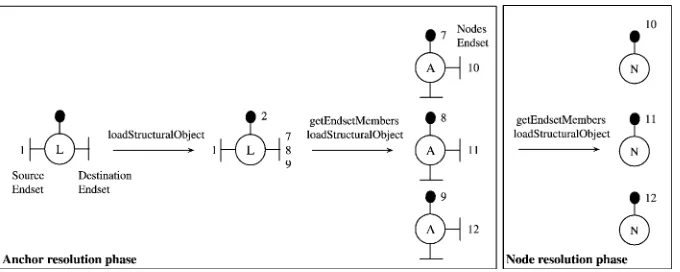
hypermedia systems since it is this operation that gives users the impression of navigating an information space. ThefollowLinkoperation is issued to the structure server whenever users select anchors that are displayed in the active document and can be divided into two phases: (a) the destination anchor resolution phase where the destination anchors are determined, and (b) the node resolution phase where the nodes to which the anchors of the previous phase belong are computed. Various versions of implementing traversal behavior is possible depending on who (client or structure server) is initiating each phase: client may initiate both phases, i.e. query structure servers to compute the destination anchors which are send back to clients which in turn can initiate the node resolution phase or the structure server initiates both phases (as a result of thefollowLinkmessage) sending to clients the destination anchors as well as the nodes to which these anchors belong. In any case, a set of structural objects will be sent back to clients and placed in their structure cache.
The oid of the structural object identifying the selected anchor is supplied to the
followLink operation. Upon reception of the followLink message, the structure server
the newly created link. A queryStructuralObject operation will load into the structure cache a structural object of type link, having the specified anchor oid in its endset named
source. Using the getEndSetMembers operation the members of the endset named
destination will be returned. The list of destination structural objects oid is now
determined. For each oid in the list aloadStructuralObjectoperation is performed loading the structural objects into the structure cache. Since these structural objects represent anchors, applyinggetEndSetMembersto the endset nodes of each anchor structural object will result in a set of oids denoting structural objects of type node to which these anchors belong. Since the oids of the target nodes are determined, a loadStructuralObject operation loads the information of nodes (attributes and their values) into the structure cache. The list of structural objects representing anchors and nodes are sent back to clients that are now responsible for displaying the nodes content to the user (Fig. 6). The accompanied attributes of the structural object of the structure type node supply the information for node content.
9.1.3. Composites
‘Following’ composite structures differs significantly from following links within Callimachus. The difference is manifested in the outcome of applying traversal operations on each structure type. While following links will result in a list of structural element denoting anchors and their respective nodes, following a composite will result in one structural object having in its endset the structural objects that are part of that composite (Fig. 7). These different outcomes would be reflected in the client’s and structure server’s structure cache. Thus, it would not be possible to model composite structures using the structure typelink. As a result, in Callimachus, composites are not followed but rather opened, through a specialized service namedopenComposite.
10. Related work
Hypermedia systems providing general structure oriented facilities are just now emerging. Notably examples include HOSS (Nu¨rnberg, 1997; Nu¨rnberg et al., 1996), FOHM (Millard et al., 1992) and Construct (Wiil, 2000; Wiil et al., 2000) that will be described within this section.
core operations upon the structural abstractions forming the basis of behavioral aspects of domains.
FOHM is a fundamental open hypertext model, which identifies data and permitted operations in a client/server style architecture. FOHM formalizes data and operations through the use of an abstract machine that models them by transitions. Its main scope is to represent all the structural abstractions and support the operations needed for the navigational, the taxonomic and the spatial domain. Furthermore, FOHM focuses on interoperability between domains, e.g. following links between navigational and taxonomic structures. In contrast to Callimachus, FOHM does not provide developers with the ability to declare structural models. Thus, the development of new abstractions and operations upon them cannot be accomplished in a methodological manner.
The Construct CB-OHS explicitly supports the development dimension in CB-OHSs and endeavors to be fully compliant with the OHSWG standards. Construct provides development tools targeting the middleware layer of CB-OHSs allowing new hypermedia services to be developed and deployed within its environment. These services can be created from scratch, on top of or using other existing services. Through the use of UML diagrams services can be modeled and in conjunction with the Construct Service Compiler (CSC) service code skeletons can be produced. Nonetheless, generation of services is semi-automated since the developer has to fill in parts of the outcome. Callimachus and Construct share the need of providing mechanisms to facilitate the development of structure servers. However, each of them pays attention to different aspects of CB-OHSs. Namely, while Construct focuses on behavioral aspects of CB-OHSs, Callimachus converges on their structural aspects.
11. Conclusions
[image:19.468.68.408.76.212.2]In this paper, we have presented the fundamental parts of the Callimachus CB-OHS and in particular we discussed how the structural model of a hypermedia domain is specified with the use of an atomic structural primitive called the structural element.
Moreover, we have introduced a set of core operations upon the structural element forming the basis for the development of structure server behaviors. By the use of the structural model specification and the core operations the development of structure servers can be accomplished, during the structural as well as the behavioral design phase, in a methodological manner.
OHSs in their move from domain-specific frameworks to cross-domain CB-OHSs, should clearly expose theprimacy of structureand thus need the proper foundations and tools to handle structure as a first class entity. Towards such an evolution path, we outlined the implications of admitting first class structure in Callimachus. OHSs, in general, benefits from such structure handling facilities, mainly in the areas of reusability, interoperability and tool development.
Future work of Callimachus includes evaluating whether the structural primitives as well as the set of operations are sufficient enough for the development of structure servers in less studied domains, such as hyperfiction and workflow. Furthermore, attention will be given to the formal specification of behaviors in terms of a structure behavioral language that can be based on the core set of the operations presented in this paper. Finally, the efficiency of the Callimachus system will be thoroughly assessed. The generality of the provided facilities degrades performance of structure servers. Thus, explicit support is needed to optimize performance for each domain.
References
Anderson KM, Structural computing requirements for the transformation of structures and behaviors, Proceedings of the Second Workshop on Structural Computing, San Antonio, TX, USA, Springer, Berlin, 2000, p. 140 – 6.
Bucka-Lassen D, Pedersen CA, Reinert O´ A. Cooperative authoring using open spatial hypermedia. Master’s Thesis. Computer Science Department, Aarhus University; December 1998.
Bush V, As we may think, Atlantic Monthly 1945, 101 – 108.
Conklin J, Begeman ML., gIBIS: a hypertext tool for team design deliberation, Hypertext ‘87 Proceedings, ACM, 1987, p. 247 – 51.
Demeyer S. ZYPHER: tailorability as a link from object-oriented software engineering to open hypermedia. PhD Thesis. Departmnent Informatica, Vrije Universiteit Brussel; July 1996. Demeyer S. Structural computing: the case for reengineering tools, Proceedings of the First
Workshop on Structural Computing, 1999.
Elmasri R. Navathe SB, Fundamentals of database systems, 1994.
[image:20.468.195.272.79.135.2]Engelbart DC, in: Howerton PD, Weeks DC. (Eds.), A conceptual framework for the augmentation of man’s intellect, Vistas in information handling, vol. 1, Spartan Books, Washington, DC, 1963, pp. 1 – 29.
Fountain AM, Hall W, Heath I, Davis HC. MICROCOSM: an open model for hypermedia with dynamic linking, Proceedings of the European Conference on Hypertext, INRIA, France, Cambridge University Press, 1990, p. 298 – 311.
Furnas GW, Bederson BB. Space-scale diagrams: understanding multiscale interfaces, CHI ‘95 Proceedings, 1995, p. 234 – 41.
Garzotto F, Paolini P, Schwabe D, Bernstein M. Tools for designer, in: E. Berk, J. Devlin (Eds.), Hypertext/hypermedia handbook, McGraw Hill, New York, 1991, pp. 179 – 207.
Garzotto F, Paolini P, Schwabe D. HDM—a model-based approach to hypertext application design, ACM Trans Inform Syst 1993; 11(1): 1 – 26.
Halasz F, Schwartz M. The Dexter hypertext reference model, Commun. ACM 37 (2) (1994) 30 – 39. Herot CF, Carling R, Friedell M, Kramlich D, Rosenberg RL. Overview of the spatial data management system. Technical Report CCA-81-08. Computer Corporation of America; 1981. Isakowitz T, Stohr EA Balasubramanian P. RMM: a methodology for structured hypermedia design,
Commun ACM 1995; 38(8): 34 – 44.
Kyriakopoulou M, Avramidis D, Vaitis M, Tzagarakis M, Christodoulakis D. Broadening structural computing towards hypermedia development, Proceedings of the Third Workshop on Structural Computing, Springer, 2000, p. 131 – 40.
Landow GP. Relationally encoded links and the rhetoric of hypertext, Hypertext ‘87 Proceedings, Chapel Hill, NC, USA, ACM, November 13 – 15, 1987, p. 331 – 43.
Landow GP, Kahn P. Where’s the hypertext? The Dickens web as a system-independent hypertext, ECHT ‘92 Proceedings, Milan, Italy, ACM, November 30 – December 4, 1992, p. 149 – 60.
Leggett JJ, Schnase JL. Viewing Dexter with open eyes, Commun ACM 1994; 37(2): 76 – 86. Marshall CC, Rogers RA, Two years before the mist: experiences with aquanet, ECHT ‘92
Proceedings, 1992, p. 53 – 62.
Marshall CC. Shipman III FM, Spatial hypertext: designing for change, Commun ACM 1995; 38(8): 88 – 97.
Marshall CC, Halasz FG. Rogers RA, Janssen Jr WC. Aquanet: a hypertext tool to hold your knowledge in place, Hypertext ‘91 Proceedings, ACM, 1991, p. 261 – 75.
Marshall CC, Shipman III FM. Coombs JH. VIKI: spatial hypertext supporting emergent structure, ECHT ‘94 Proceedings, 1994, p. 13 – 23.
Millard DE, Moreau, HC Davis, S Reich. FOHM: a fundamental open hypertext model for investigating interoperability between hypertext domains, Hypertext ‘00 Proceedings, ACM, 1992, p. 93 – 102.
Millard DE, eich S, Davis HC, Reworking OHP: the road to OHP-Nav, Proceedings of the Fourth Workshop on Open Hypermedia Systems, ACM Hypertext ‘98, Department of Computer Science, Aalborg University, Esbjerg, DK, 1998, p. 48 – 53.
Nanard J, Nanard M. Using structured types to incorporate knowledge in hypertext, Hypertext ‘91 Proceedings, ACM, 1991, p. 329 – 43.
Nanard J, Nanard M. Hypertext design environments and the hypertext design process, Commun ACM 1995; 38(8): 49 – 56.
Nelson TH. A file structure for the complex, the changing and the indeterminate, Association for Computing Machinery Proceedings of the 20th National Conference, 1965, p. 84 – 100. Nielsen J. Hypertext and hypermedia, Academic Press, New York, 1990.
Ntoulas A, Stamou S, Tsakou I, Tsalidis Ch, Tzagarakis M, Vagelatos A. Use of a morhosyntactic lexicon as the basis for the implementation of the Greek wordnet, Proceedings of the Second International Conference on Natural Language Processing, Patras, Greece, Springer, 2000. Nu¨rnberg PJ. HOSS: an environment to support structural computing. PhD Thesis. Department of
Nu¨rnberg P, Leggett J. A vision for open hypermedia systems, J Digital Inform 1999; 1(2): 207 – 248. Nu¨rnberg P, Leggett J, Schneider E. As we should have thought, Hypertext ‘97 Proceedings,
Southampton, UK, ACM, 1997, p. 96 – 101.
Nu¨rnberg PJ, Leggett JJ, Schneider ER, Schnase JL. Hypermedia operating systems: a new paradigm for computing, Hypertext ‘96 Proceedings, ACM Press, 1996, p. 194 – 202.
Nu¨rnberg P, Leggett J, Wiil U. An agenda for open hypermedia research, Hypertext ‘98 Proceedings, Pittsburgh, PA, USA, ACM, 1998, p. 198 – 206.
Nu¨rnberg PJ, Wiil UK, Leggett JJ. Structuring facilities in digital libraries. European Conference on Digital Libraries; 1998b. p. 295 – 313.
Papadopoulos A, Vaitis M, Tzagarakis M, Christodoulakis D, A methodology for flexible authoring of structured hypertext applications, ED-MEDIA/ED-TELECOM ‘98 Proceedings, Freiburg, Germany, 1998.
Reich S, Wiil UK, Nu¨rnberg PJ, Davis HC, Grønbæk K, Anderson KM, Millard DE, Haake JM, Addressing interoperability in open hypermedia: the design of the open hypermedia protocol, New Rev Hypermedia Multimedia 1999; 5: 207 – 248.
Rosenberg J. Hypertextuality of arbitrary structure: a writer’s point of view, Proceedings of the First Workshop on Structural Computing, 1999.
Schwabe D, Rossi G, Barbosa SDJ. Systematic hypermedia application design with OOHDM, Hypertext ‘91 Proceedings, ACM, 1996, p. 116 – 28.
Shipman III FM, Hsieh H, Maloor P, Moore JM. The visual knowledge builder: a second generation spatial hypertext, Hypertext ‘01 Proceedings, ACM Press, 2001, p. 113 – 22.
Trigg R, Suchman L, Halasz F. Supporting collaboration in note-cards, CSCW 86 Proceedings, Austin, TX, USA, ACM, 1986, p. 153 – 62.
Tzagarakis M, Papadopoulos A, Vaitis M, Christodoulakis D. A name service for open hypermedia systems, Proceedings of the First Workshop on Structural Computing, 1999.
Tzagarakis M, Karousos N, Christodoulakis D, Reich S. Naming as a fundamental concept of open hypermedia systems, Hypertext ‘00 Proceedings, ACM Press, 2000, p. 103 – 12.
Van Dyke Parunak H. Don’t link me in: set based hypermedia for taxonomic reasoning, Hypertext ‘91 Proceedings, San Antonio, TX, USA, ACM, 1991, p. 233 – 42.
Van Dyke Parunak H. Hypercubes grow on trees (and other observations from the land of hypersets), Hypertext ‘93 Proceedings, Seattle, WA, USA, ACM, 1993, p. 73 – 81.
Wang W, Fernadez A. A graphical user interface integrating features from different hypermedia domains, Proceedings of the Third Workshop on Structural Computing, Aarhus, Denmark, 2001. Wang W, Rada R, Structured hypertext with domain semantics, ACM Trans Inform Syst 1998; 16(4)
372 – 412.
Wiil UK. Using the construct development environment to generate a file-based hypermedia storage service, Proceedings of the Second Workshop on Structural Computing, San Antonio, TX, USA, 2000.
Wiil UK, Nu¨rnberg PJ, Hicks DL, Reich S. A development environment for building component-based open hypermedia systems, Hypertext ‘00 Proceedings, ACM Press, 2000, p. 266 – 7. Yankelovich N, Meyrowitz N, van Dam A. Reading and writing the electronic book, IEEE Comput
Manolis Tzagarakishold a diploma in Computer Engineering and Informatics from the University of Patras, Greece. He is currently unit manager of the Research Unit II of the Research Academic Computer Technology Institute. His research interests include structural computing, hypermedia models and services, software engineering and digital libraries. He is a member of the ACM and the Technical Chamber of Greece.
Dimitris Avramidisis an engineer in Research Unit 2 of Research Academic Computer Technology Institute, Patras, Greece. He received his Diploma in Computer Engineering and Informatics Department of Patras University, Greece. He also holds a Master’s degree in Computer Science and Engineering from the above department. His research interests lie in Hypermedia Systems with emphasis on Structural Computing, a research field that stimulated the interest of the working group in which Dimitris has been an active member for the last 5 years.
Maria Kyriakopoulouis an engineer working in Research Unit 2 of Research Academic Computer Technology Institute, Patras, Greece. She holds a Master’s degree in Computer Science and Engineering from Computer Engineering and Informatics Department of Patras University, Greece. Her Diploma in Computer Science is also from the same department. As an engineer she has been mainly working on Hypermedia systems, a research domain that has attracted the interest of her work while being a member of Research Unit 2. Her research interests, among others, lie on the field of Hypermedia Systems and Structural Computing.