Original Article
Effects of
CYP3A4
polymorphisms on efficiency of
general anesthesia combined with epidural block
in patients undergoing cardiac valve replacement
Guo-Jun Zhou, Quan-Min Peng, Li-Hui Tang
Department of Anesthesiology, 2nd Affiliated Hospital, College of Medicine, Zhejiang University, 310009, Zhejiang, PR China
Received May 17, 2017; Accepted July 20, 2017; Epub September 1, 2017; Published September 15, 2017
Abstract: This study aims to investigate the effects of CYP3A4 polymorphisms (*4, *5 and *6) on efficiency of general anesthesia (GA) combined with epidural block (EB) in patients undergoing cardiac valve replacement. From January 2014 to October 2015, a total of 511 patients undergoing cardiac valve replacement (case group) and 503 healthy individuals (control group) were selected for the study. Polymerase chain reaction-restriction fragment length polymorphism (PCR-RFLP) was applied for genotyping of CYP3A4 gene. Central venous pressure (CVP), mean arterial pressure (MAP), heart rate (HR), pulse oximetry (SPO2), extubation and duration of intensive care unit (ICU) stay during the surgery were observed and recorded. A nine-month follow-up was conducted. Genotype and allele frequency of CYP3A4*4 were significantly different between the case and control groups (all P < 0.05). Compared with wild-type *1*1 patients with heterozygous *1*4 of CYP3A4*4 showed significant difference in HR, MAP, SPO2 and CVP and in the time of extubation and ICU stay. CYP3A4*4 polymorphism may be associated with the effect of GA combined with EB in cardiac surgery. These results demonstrate that CYP3A4*4 polymorphism is correlated with the effects of GA combined with EB in cardiac surgery. CYP3A4 polymorphisms increase the risk of GA com-bined with EB among patients undergoing cardiac valve replacement.
Keywords: CYP3A4, CYP3A4*4, CYP3A4*5, CYP3A4*6, polymorphism, general anesthesia, epidural block
Introduction
General anesthesia (GA) is a drug-induced, reversible condition that includes specific behavioral and physiological characters [1]. It is reported that GA plays a crucial role in patients undergoing cardiac surgery [2]. Epidural anes-thesia can relieve pain during operation by blocking the transmission of all somatosensory pain impulses to the central nerve system [3]. Thoracic epidural anesthesia (TEA) may effec-tively improve myocardial ischemia, reduce arrhythmia, contribute to early tracheal extuba-tion and prevent respiratory complicaextuba-tions dur-ing cardiac surgery [4]. Acupuncture anesthesia is one way of anesthesia in cardiac surgery but is seldom put into practice due to sophisticated preoperative preparation and inadequate mus-cle relaxation [5]. At present, the anesthesia type of GA combined with epidural block (EB) in abdominal aortic aneurysm surgery has gained
popularity with modulating spinal sympathetic outflow with consequent vasodilatation, incr- eased visceral perfusion as well as decreased afterload [6]. The selection of GA combined with EB may be an efficient way for patients who receive laparoscopic adrenalectomy to pre-vent the undulations in hormone levels [7]. A combination of GA with TEA plays a beneficial role in clinical outcomes in patients undergoing cardiac surgery; however, there exist uncertain side-effects which cannot be evaluated with the current data [8]. It is well known that the efficacy of some drugs differ among individuals due to inter- and intra-individual variability, including gene polymorphisms [9]. The diverse effects of gene factors on GA combined with EB in cardiac surgery warrant further investig- ation.
consists of a family of hemoprotein enzymes which answers for the biotransformation of a number of xenobiotics, including therapeutic agents, and the primary human drug-metaboliz-ing CYPs dwells in families 1, 2 and 3 [10].
CYP3A4 is one of the important families of CYP including 13 exons and it is located on chromo-some 7q22.1 [11]. CYP3A4 enzyme is exten-sively found in the human liver, kidneys, lungs, gastrointestinal tract, brain, placenta, endothe-lium, lymphocytes and intestines and it metab-olizes a variety of endobiotics, such as proges-terone, testosproges-terone, cortisol and estradiol [12]. CYP3A4 is also in charge of the metabo-lism of approximately 45%-60% prescribed drugs and reduced CYP3A4 production or activ-ity is related to a functional single-nucleotide polymorphism (SNP) in intron 6 [13]. Being point mutation A13989G, C15820G and A17776 in- sertion and located in exon 5, exon 7 and exon 9, respectively, CYP3A4*4, CYP3A4*5 and
CYP3A4*6 are three mutant and variant alleles of CYP3A4 gene and these three alleles can reduce the CYP3A4 activity in a Chinese popu-lation, although these mutations occur rarely in Chinese subjects [14]. In addition, in repa-glinide’s pharmacokinetics, the inter-individual variability is associated with the genetic poly-morphisms of CYP3A4 gene[12]. A new func-tional polymorphism in CYP3A4 intron 6 was found to significantly affect tacrolimus pha- rmacokinetics in kidney transplantation [13]. However, regardless of these intriguing studies, it has not been established whether this muta-tion of CYP3A4 gene has any effect on anesthe-sia efficacy in cardiac surgery. Therefore, we performed a study to explore the correlation of
CYP3A4 polymorphisms (*4, *5 and *6) with the efficacy of GA combined with EB in patients undergoing cardiac valve replacement.
Materials and methods
Ethical statement
The study was approved by the ethics commit-tee of 2nd Affiliated Hospital, College of Medi- cine, Zhejiang University and informed con-sents were obtained from the subjects or legal guardians of study subjects. The study proto-cols followed the ethical principles and all the experimental procedures in this study were per-formed on the basis of Declaration of Helsinki [15].
Study subjects
From January 2014 to October 2015, a total of 511 patients (males: n = 209; females: n = 302; mean age: 51.4 ± 6.9 years; weight: 52.5 ± 2.9 kg) undergoing cardiac valve replace-ment with GA combined with EB in 2nd Affili- ated Hospital, College of Medicine, Zhejiang University were selected as case group. Among patients in the case group, 274 cases were mitral valve disease, 133 cases were aortic valve disease and 104 cases were combined valve disease. According to the criteria of American Society of Anesthesiologists (ASA) [16], there were 149 cases in Class II: and 362 cases in Class III. The inclusion criteria: (1) patients with chronic valvular heart disease aged 30-70 years, the left ventricular ejection fraction (LVEF) ≥ 35 detected by echocardiogra-phy; (2) patients in ASA class II~III; (3) patients without complications, such as hemorrhage and embolism; (4) patients without history of cerebrovascular disease; (5) patients with clear consciousness and no difficulty in communica-tion; (6) no consanguinity or intermarriage his-tory among patients. The exclusion criteria: (1) patients with other cardiac procedures requir-ing simultaneous treatment (such as, vntricular aneurysm and congenital heart disease) and under the age of 30 years; (2) patients with 2 times aminopherase in liver than normal range; (3) patients with less than 50 mL/min creati-nine clearance rate; (4) patients with allergic constitution; (5) patients with severely dam-aged liver or kidney functions and abnormal coagulation; (6) patients with abnormal thyroid function; (7) patients who refused to partici-pate in the study. Besides, a total of 503 healthy members (males: n = 179; females: n = 324; mean age: 51.7 ± 7.1 years; weight: 52.8 ± 3.7 kg) who took physical examination in 2nd Affiliated Hospital, College of Medicine, Zhe- jiang University at the same period were classi-fied as control group.
Sampling collection
Genome DNA Extraction Kit (Tiangen Biotech Co., Ltd, Beijing, China) after blood sampling and then preserved at -20°C. And nucleic acid-protein was analyzed by nucleic acid-acid-protein detector (Puyang Scientific Instrument Rese- arch Institute, Jiangsu, China).
Polymerase chain reaction-restriction frag-ment length polymorphism (PCR-RFLP)
CYP3A4 polymorphisms were sequenced and analyzed by PCR-RFLP. The polymerase chain reaction (PCR) reaction system ofCYP3A4 was 50 μl, including 0.2 mmol/l deoxyribonucleo-side triphosphate (dNTP), 1.5 mmol/l Mg2+, DNA template 100 ng, Taq DNA polymerase 1.25 u, 0.2 μmol/l of upstream and downstr- eam primers, respectively. PCR reaction condi-tions: 10 min of pre-denaturation at 94°C; 40 s of denaturation at 94°C, 45 s of annealing at 55°C and 35 s of extension at 72°C for totally 35 cycles, and finally 10 min of extension at 72°C. PCR products were detected by 1% aga-rose gel electrophoresis with 0.5 μg/ml ethid-ium bromide (Beijing Ruida Henghui Science & Technology Development Co., Ltd, Beijing, China). All the primers were synthesized by TaKaRa (Dalian, China) and the primer sequenc-es were shown in Table 1. PCR amplification
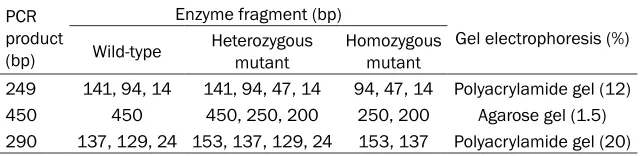
μl of buffer solution, 0.2 μl of bovine serum albumin (Yancheng Saibao Biotechnolofy Co., Ltd, Jiangsu, China) and 16.3 μl double-distilled water, and incubated for about 3.5 h at a 37°C incubator. DNA fragment of PCR produced or lost the cleavage site of a specific enzyme because of gene mutation, which changed the DNA fragment of the enzyme product. The enzyme products were evaluated by agarose gel electrophoresis and genotypes were deter-mined according to the electrophoresis map (Table 2).
Anesthesia regimens and monitoring
[image:3.612.89.408.87.200.2]Patients were required to open vein access before anesthesia. All patients were injected with 20~25 ml-1·kg-1 lactated Ringer’s solution (Shandong Baisheng Biotechnology Co., Ltd, Shandong, China) at the 1st h. After that, 10~15 ml lactated Ringer’s solution was injected into the patients and maintained by kg-1•h-1. Patients undergoing cardiac valve replacement were injected with 3~5 ml 0.5% lidocaine (Shanghai Wanjiang Biotechnology Co., Ltd, Shanghai, China) at the T8~9 or T9~10 interverte-bral space via epidural catheter. When the anesthesia level appeared, and stabilized at T5~10, GA was performed. During the surgery,
Table 1. Primer sequences for PCR-RFLP
Allele Primer Sequence amplicon PCR size (bp) CYP3A4*4 Exon5 (F) 5’-CACATTTTCTACAACCATGGAGACC-3’ 249 bp (A13989→G) Exon5 (R) 5’-TTTTATACCTCCCCACCAGATTC-3’
CYP3A4*5 Exon7 (F) 5’-TGTTGCATGCATAGAGGAAGGATGG-3’ 450 bp
(C15820→G) Exon7 (R) 5’-GATGACAGGGTTTGTGACAGGGG-3’
CYP3A4*6 Exon9 (F) 5’-GAGCCATATTCTCAGAAGGGAGATCAAG-3’ 290 bp (A17776 insertion) Exon9 (R) 5’-CAAACATGTGTCGTTCTGCTATGTGG-3’
Note: PCR-RFLP, polymerase chain reaction-restriction fragment length polymorphism; F, Forward primer; R, reverse primer.
Table 2. Genotyping ofCYP3A4*4, CYP3A4*5 and CYP3A4*6 by gel elec-trophoresis
PCR product (bp)
Enzyme fragment (bp)
Gel electrophoresis (%) Wild-type Heterozygous mutant Homozygous mutant
249 141, 94, 14 141, 94, 47, 14 94, 47, 14 Polyacrylamide gel (12) 450 450 450, 250, 200 250, 200 Agarose gel (1.5) 290 137, 129, 24 153, 137, 129, 24 153, 137 Polyacrylamide gel (20)
Note: PCR, polymerase chain reaction.
[image:3.612.88.408.269.347.2]3~5 ml 0.5% lidocaine was injected to the patients though epidural catheter every 2 h. The effects of genotypes of CYP3A4 on central venous pressure (VCP), mean arterial pressure (MAP), heart rate (HR), pulse oximetry (SPO2), extubation and duration of intensive care unit (ICU) stay during the surgery were observed and recorded.
Follow-up
With approval of the patients and their families, follow-up was carried out on a regular basis by telephone and return visit of patients. Every
age and measurement data were exhibited as mean ± standard deviation (_X± s). The t test was used for comparison between two groups. All tests were two-sided, with P < 0.05 as statis-tically significant.
Results
Genotyping of CYP3A4*4, CYP3A4*5 and CYP3A4*6 by electrophoresis map
[image:4.612.93.523.71.198.2]Genotyping was detected by electrophoresis. For CYP3A4*4, the restriction digestion prod-ucts for heterozygous mutant were 141 bp, 94
Figure 1. Genotyping of CYP3A4*4, CYP3A4*5 and CYP3A4*6 by electrophoresis map. Notes: A: Restriction diges-tion products for CYP3A4*4; B: Restriction digestion products for CYP3A4*5; C:Restriction digestion products for
CYP3A4*6.
Table 3. Comparisons of genotype and allele frequency of CYP3A4*4, CYP3A4*5 and CYP3A4*6 between the case and control groups
SNP Case group (n = 511) Control group (n = 503) X
2 P OR 95% CI
CYP3A4*4
*1*1 486 (0.951) 492 (0.978) Ref
*1*4 25 (0.049) 11 (0.022) 5.418 0.02 2.301 1.120-4.728 *1 997 (0.987) 995 (0.989) Ref
*4 25 (0.024) 11 (0.011) 5.321 0.021 2.268 1.110-4.635 CYP3A4*5
*1*1 508 (0.994) 503 (1.0) Ref
*1*5 3 (0.006) 0 (0.0) 2.962 0.085 6.931 0.357-134.6 *1 1019 (0.997) 1006 (1) Ref
*5 3 (0.003) 0 (0.0) 2.957 0.172 6.911 0.356-134.1 CYP3A4*6
*1*1 492 (0.963) 491 (0.976) Ref
*1*6 19 (0.037) 12 (0.024) 1.519 0.218 1.58 0.759-3.291 *1 1003 (0.981) 994 (0.988) Ref
*6 19 (0.019) 12 (0.012) 1.495 0.221 1.569 0.758-3.250
Note: SNP, single nucleotide polymorphism; OR, odds ratio; 95% CI, 95% confidence interval; Ref, reference.
patient was followed up every 3 months and at least once. The follow-up time ended on October 31, 2015 and the follow-up ra- te was 100%. The patients’ conditions (limb moveme- nt, intestinal function and survival situation) were re- corded regularly through follow-up feedback.
Statistical analysis
[image:4.612.88.388.285.512.2]percent-bp and 47 percent-bp; for wild type were 94 percent-bp and 141 bp; and homozygous mutant showed no diges-tion products (had no effects on final results) (Figure 1A). As for CYP3A4*5, the digestion products for heterozygous mutant showed three fragments of 450 bp, 250 bp and 200 bp; wild type had one fragment of 450 bp; homozy-gous mutant exhibited no fragment (Figure 1B). With respect to CYP3A4*6, the produced frag-ment of 153 bp and 24 bp were for heterozy-gous mutant and wild type respectively; and no fragment was observed for homozygous mutant (Figure 1C).
CYP3A4*5 alleles was zero in the healthy con-trols. Allele frequency and genotype distribu-tion of CYP3A4*4 showed significant difference between the case and control groups (all P < 0.05). No significant difference was observed in the genotype and allele frequency of
CYP3A4*5 and CYP3A4*6 between the two groups (all P > 0.05).
Relationship between CYP3A4*4, CYP3A4*5 and CYP3A4*6 polymorphisms and effects of GA combined with EB in cardiac surgery
As shown in Table 4, compared with wild-type *1*1, the HR, MAP, SPO2 and CVP were signifi-cantly different in patients with mutant hetero-zygous CYP3A4*4 *1*4 (all P < 0.05), indicat-ing that CYP3A4*4 polymorphism might be associated with the effect of GA combined with EB in cardiac surgery. While the HR, MAP, SPO2 and CVP in patients with different genotypes of
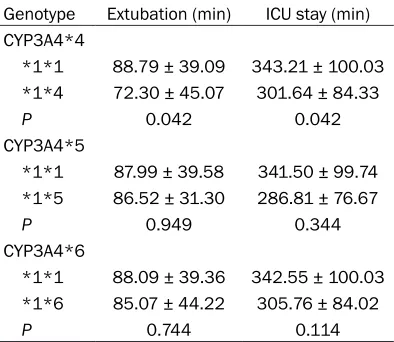
[image:5.612.88.381.97.279.2]CYP3A4*5 and CYP3A4*6 showed no signifi-cant difference (all P > 0.05). As showed in Table 5, compared with wild-type *1*1, the time of extubation and ICU stay in patients with mutant heterozygous *1*4 of CYP3A4*4 gene were significantly different (all P < 0.05), indi-cating that CYP3A4*4 polymorphism may be associated with the effect of GA combined with EB in cardiac surgery. However, there was no significant difference in those of patients with different genotypes of CYP3A4*5 and CYP3-A4*6 (all P > 0.05).
Table 4. Correlation of CYP3A4*4, CYP3A4*5 and CYP3A4*6 poly-morphisms with clinical indicators in cardiac surgery
Genotype (frequency/minHR ) MAP (mmHg) SPO2 (%) CVP (kPa) CYP3A4*4
*1*1 83.34 ± 17.51 59.86 ± 12.77 99.34 ± 0.06 10.98 ± 3.43 *1*4 73.85 ± 17.72 54.48 ± 12.85 99.30 ± 0.08 9.27 ± 3.05 P 0.009 0.041 0.002 0.015 CYP3A4*5
*1*1 82.89 ± 17.65 59.65 ± 12.81 99.34 ± 0.06 10.91 ± 3.43 *1*5 81.22 ± 13.51 50.69 ± 11.65 99.30 ± 0.06 9.38 ± 3.47 P 0.87 0.228 0.25 0.442 CYP3A4*6
*1*1 82.95 ± 17.76 59.63 ± 12.86 99.34 ± 0.06 10.94 ± 3.47 *1*6 80.98 ± 13.68 58.68 ± 11.58 99.33 ± 0.06 9.89 ± 2.14 P 0.633 0.751 0.477 0.191
[image:5.612.91.288.361.532.2]Note: HR, heart rate; MAP, mean arterial pressure; SPO2, arterial oxyhaemoglobin saturation; CVP, central venous pressure.
Table 5. Correlation of CYP3A4*4, CYP3A4*5
and CYP3A4*6 polymorphisms with the time of extubation and ICU stay
Genotype Extubation (min) ICU stay (min) CYP3A4*4
*1*1 88.79 ± 39.09 343.21 ± 100.03 *1*4 72.30 ± 45.07 301.64 ± 84.33 P 0.042 0.042 CYP3A4*5
*1*1 87.99 ± 39.58 341.50 ± 99.74 *1*5 86.52 ± 31.30 286.81 ± 76.67 P 0.949 0.344 CYP3A4*6
*1*1 88.09 ± 39.36 342.55 ± 100.03 *1*6 85.07 ± 44.22 305.76 ± 84.02 P 0.744 0.114
Note: ICU, intensive care unit.
Comparisons of allele
frequency and genotype
distribution of CYP3A4*4, CYP3A4*5 and CYP3A4*6 between the case and
con-trol groups
As shown in Table 3, allele frequency and genotype dis-tribution of CYP3A4*4, CYP-3A4*5 and CYP3A4*6 in the case and control groups reached genetic equilibrium with population representa-tiveness according to Hardy-Weinberg equilibrium test. In the 1014 samples, no homo-zygous mutant was found in
CYP3A4*4, CYP3A4*5 and
Effect of CYP3A4 polymorphism on the prog-nosis of patients undergoing cardiac valve replacement with GA combined with EB
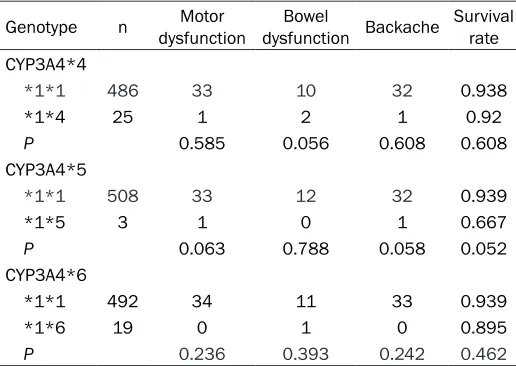
After 9 months of follow-up, motor dysfunction, bowel dysfunction and backache occurred in patients with heterozygous *1*4 of CYP3A4*4
mutation were 1 case, 2 cases and 1 case, respectively. And the survival rate was up to 92.0%. No significant difference was found between the wild-type *1*1 and heterozygous *1*4 (all P > 0.05). No bowel dysfunction, 1 case of motor dysfunction and 1 case of back-ache occurred in patients with mutant hetero-zygous *1*5 of CYP3A4*5, and the survival rate was up to 66.7%. Compared with wild-type *1*1, there was no significant difference (all P
> 0.05). One case of bowel dysfunction, no motor dysfunction or backache occurred in patients with mutant heterozygous *1*6 of
CYP3A4*6. The survival rate was up to 89.5%. Compared with wild-type *1*1, there was no significant difference (all P > 0.05) (Table 6). Discussion
In this investigation, we tried to explore the deli-cate relationship between CYP3A4 polymor-phisms and the efficacy of GA combined with EB in cardiac surgery. We focused on the three variant alleles (CYP3A4*4, CYP3A4*5 and
CYP3A4*6) of CYP3A4 gene and compared their differences in some indexes related to our study. All these data demonstrated that
CYP-erozygous mutants and two wild type in the restriction digestion products of CYP3A4*4, three heterozygous mutants, one wild type in
CYP3A4*5, as well as one band each for het-erozygous mutant and wild type in CYP3A4*6,
but no homozygous mutant in the three alleles. Meanwhile, allele frequency and genotype dis-tribution of CYP3A4*4 showed significant dif-ference between the case and control groups. In consistent with our study, Hsieh et al. also detected three heterozygous subjects and no homozygous in CYP3A4*4, and in their study,
CYP3A4*4 was found in 2.9% of the Chinese subjects for the first time [14]. The study con-ducted by Xin et al. also showed that there was no homozygous mutant subject in CYP3A4*4, CYP3A4*5 and CYP3A4*6 alleles in a case-control study of 368 cases of Chinese girls [20]. In the six well conserved CYP3A residues in the substrate recognition site 1, Ser119 played an important role in the CYP3A4 speci-ficity and was found to be a key determinant in the active site topology of steroid 6b-hydroxyl-ation [21]. Hsieh et al. revealed that subjects carrying the CYPA4*4, CYPA4*5 or CYPA4*6
alleles showed below average 6β-hydroxycor- tisol, implying decreased catalytic activity for its variant proteins [14].
Another important result showed that com-pared with wild-type *1*1, the HR, MAP, SPO2 and CVP were significantly different in patients with heterozygous *1*4 of CYP3A4*4 undergo-Table 6. Relationship between the CYP3A4 polymorphisms
and prognosis of patients undergoing cardiac valve replace-ment with GA combined with EB
Genotype n dysfunctionMotor dysfunction BackacheBowel Survival rate CYP3A4*4
*1*1 486 33 10 32 0.938
*1*4 25 1 2 1 0.92
P 0.585 0.056 0.608 0.608 CYP3A4*5
*1*1 508 33 12 32 0.939
*1*5 3 1 0 1 0.667
P 0.063 0.788 0.058 0.052 CYP3A4*6
*1*1 492 34 11 33 0.939
*1*6 19 0 1 0 0.895
P 0.236 0.393 0.242 0.462
Note: GA, general anesthesia; EB, epidural block.
3A4*4 polymorphism was associat-ed with the risk of GA combinassociat-ed with EB among patients undergoing car-diac valve replacement.
[image:6.612.90.348.108.291.2]het-ing cardiac valve replacement with GA com-bined with EB. However, the HR, MAP, SPO2 and CVP in patients with different genotypes of
CYP3A4*5 and CYP3A4*6 showed no signifi-cant difference. CYP3A4 played a significant role in drug metabolism and its different activi-ties were suggested to be accountable for indi-vidual variability in response to many drugs [22]. CYP3A4 polymorphisms was reported to be associated with blood pressure response to amlodipine among high-risk African-Americans and CYP3A4 genotype testing could be a clini-cal prediction for blood pressure response to amlodipine [23]. CVP, also known as right atrial pressure, can be used to detect adequacy of cardiac preload and circulating blood volume [24]. According to Tan et al., CYP3A4*4 was an allelic variant associated with a functional reduction of CYP3A4 activity; for instance,
CYP3A4*4 carriers have exhibited a higher decline of triglycerids and cholesterol levels with abundant simvastatin than non-carriers [25]. We also found that compared with wild-type *1*1, the time of extubation and ICU stay of patients with heterozygous *1*4 of CYP-3A4*4 gene were significantly different while there was no significant difference in those of patients with different genotypes of CYP3A4*5. Taken together, our study suggests that hetero-zygous mutation in CYP3A4*4 gene serves as a risk factor for patients receiving cardiac valve replacement under GA combined with EB. Kadlubar et al. reported that the mutational allele CYP3A4*1B of CYP3A4 gene was related to incremental testosterone availability and the early onset of puberty in young girls [20]. CYP3A4 enzyme is accountable for the metabo-lism of tacrolimus and CYP3A4 polymorphism is associated with pharmacokinetic variability [26]. CYP3A4 genetic variation had a confusing effect on evaluating the predictive role of
CYP3A4 polymorphisms for reacting to risperi-done and the functional variation in CYP3A4
gene was related to patients’ poor metabolis-ers of CYP2D6 [27].
In conclusion, our study supported a significant role of the CYP3A4 polymorphisms in cardiac surgery under GA combined with EB. It is a novel contribution for our study to investigate the relationship between the mutation allele
CYP3A4*4 of CYP3A4 gene and the risk factors in cardiac surgery under GA combined with EB for the first time, which helps to provide a refer-ence for anesthetic dosage in cardiac surgery.
However, it must be noted that our findings need to be further validated by additional func-tional studies and larger well-designed molecu-lar epidemiological studies that include diverse ethnic populations. In addition, data should be collected to enable inclusion of relevant con-founding factors in the analysis.
Acknowledgements
The authors are grateful to those who gave valuable advices on this paper.
Disclosure of conflict of interest
None.
Address correspondence to: Guo-Jun Zhou, Depart- ment of Anesthesiology, 2nd Affiliated Hospital, College of Medicine, Zhejiang University, No. 88, Jiefang Road, Hangzhou 310009, Zhejiang, PR China. Tel: 87767226; Fax: +86-0571-87767226; E-mail: [email protected]
References
[1] Brown EN, Lydic R, Schiff ND. General anesthe-sia, sleep, and coma. N Engl J Med 2010; 363: 2638-2650.
[2] Weis F, Beiras-Fernandez A, Hauer D, Hornuss C, Sodian R, Kreth S, Briegel J, Schelling G. Effect of anaesthesia and cardiopulmonary by-pass on blood endocannabinoid concentra-tions during cardiac surgery. Br J Anaesth 2010; 105: 139-144.
[3] Kim C, Cho ED, Kim HK, You S, Lee HJ, Hwang D, Lee SJ. beta1-integrin-dependent migration of microglia in response to neuron-released alpha-synuclein. Exp Mol Med 2014; 46: e91. [4] Svircevic V, Nierich AP, Moons KG, Diephuis JC,
Ennema JJ, Brandon Bravo Bruinsma GJ, Kalkman CJ, van Dijk D. Thoracic epidural an-esthesia for cardiac surgery: a randomized tri-al. Anesthesiology 2011; 114: 262-270. [5] Zhou J, Chi H, Cheng TO, Chen TY, Wu YY, Zhou
WX, Shen WD, Yuan L. Acupuncture anesthe-sia for open heart surgery in contemporary China. Int J Cardiol 2011; 150: 12-16.
[6] Bardia A, Sood A, Mahmood F, Orhurhu V, Mueller A, Montealegre-Gallegos M, Shnider MR, Ultee KH, Schermerhorn ML, Matyal R. Combined epidural-general anesthesia vs gen-eral anesthesia alone for elective abdominal aortic aneurysm repair. JAMA Surg 2016; 151: 1116-1123.
adrenalectomy. Surg Laparosc Endosc Percu- tan Tech 2011; 21: 372-379.
[8] Svircevic V, van Dijk D, Nierich AP, Passier MP, Kalkman CJ, van der Heijden GJ, Bax L. Meta-analysis of thoracic epidural anesthesia versus general anesthesia for cardiac surgery. Anes- thesiology 2011; 114: 271-282.
[9] Nicolas JM, Espie P, Molimard M. Gender and interindividual variability in pharmacokinetics. Drug Metab Rev 2009; 41: 408-421.
[10] Venkatakrishnan K, Von Moltke LL, Greenblatt DJ. Human drug metabolism and the cyto-chromes P450: application and relevance of in vitro models. J Clin Pharmacol 2001; 41: 1149-1179.
[11] Sata F, Sapone A, Elizondo G, Stocker P, Miller VP, Zheng W, Raunio H, Crespi CL, Gonzalez FJ. CYP3A4 allelic variants with amino acid substi-tutions in exons 7 and 12: evidence for an al-lelic variant with altered catalytic activity. Clin Pharmacol Ther 2000; 67: 48-56.
[12] Ruzilawati AB, Gan SH. CYP3A4 genetic poly-morphism influences repaglinide’s pharmaco-kinetics. Pharmacology 2010; 85: 357-364. [13] Elens L, Bouamar R, Hesselink DA, Haufroid V,
van der Heiden IP, van Gelder T, van Schaik RH. A new functional CYP3A4 intron 6 polymor-phism significantly affects tacrolimus pharma-cokinetics in kidney transplant recipients. Clin Chem 2011; 57: 1574-1583.
[14] Hsieh KP, Lin YY, Cheng CL, Lai ML, Lin MS, Siest JP, Huang JD. Novel mutations of CYP3A4 in Chinese. Drug Metab Dispos 2001; 29: 268-273.
[15] M PN. World Medical Association publishes the Revised Declaration of Helsinki. Natl Med J India 2014; 27: 56.
[16] Brovman EY, Gabriel RA, Lekowski RW, Dutton RP, Urman RD. Rate of major anesthetic-relat-ed outcomes in the intraoperative and immanesthetic-relat-edi- immedi-ate postoperative period after cardiac surgery. J Cardiothorac Vasc Anesth 2016; 30: 338-344.
[17] Kuehl P, Zhang J, Lin Y, Lamba J, Assem M, Schuetz J, Watkins PB, Daly A, Wrighton SA, Hall SD, Maurel P, Relling M, Brimer C, Yasuda K, Venkataramanan R, Strom S, Thummel K, Boguski MS, Schuetz E. Sequence diversity in CYP3A promoters and characterization of the genetic basis of polymorphic CYP3A5 expres-sion. Nat Genet 2001; 27: 383-391.
[18] Pratt-Hyatt MJ Snider NT, Zhang H, Hollenberg PF. Effects Of the human CYP3A4*4 (Ile118Val) genetic polymorphism on anandamide metab-olism. North American Regional International Society for the Study of Xenobiotics Meeting 2009.
[19] D’Antonio C, Milano A, Righini R, Onesti CE, Bassanelli M, Falcone R, Paris I, Lauro S, Marchetti P. Pharmacogenomics in lung can-cer chemotherapy: a review of what the oncol-ogist should know. Anticancer Res 2014; 34: 5241-5250.
[20] Xin X, Luan X, Xiao J, Wei D, Wang J, Lu D, Yang S. Association study of four activity SNPs of CYP3A4 with the precocious puberty in Chinese girls. Neurosci Lett 2005; 381: 284-288.
[21] Roussel F, Khan KK, Halpert JR. The impor-tance of SRS-1 residues in catalytic specificity of human cytochrome P450 3A4. Arch Bioch- em Biophys 2000; 374: 269-278.
[22] Yousef AM, Bulatova NR, Newman W, Hakooz N, Ismail S, Qusa H, Zahran F, Anwar Ababneh N, Hasan F, Zaloom I, Khayat G, Al-Zmili R, Naffa R, Al-Diab O. Allele and genotype fre-quencies of the polymorphic cytochrome P450 genes (CYP1A1, CYP3A4, CYP3A5, CYP2C9 and CYP2C19) in the Jordanian population. Mol Biol Rep 2012; 39: 9423-9433.
[23] Bhatnagar V, Garcia EP, O’Connor DT, Brophy VH, Alcaraz J, Richard E, Bakris GL, Middleton JP, Norris KC, Wright J, Hiremath L, Contreras G, Appel LJ, Lipkowitz MS; AASK Study Investigators. CYP3A4 and CYP3A5 polymor-phisms and blood pressure response to amlo-dipine among African-American men and wom-en with early hypertwom-ensive rwom-enal disease. Am J Nephrol 2010; 31: 95-103.
[24] Berlin DA, Bakker J. Starling curves and central venous pressure. Crit Care 2015; 19: 55. [25] Wang A, Yu BN, Luo CH, Tan ZR, Zhou G, Wang
LS, Zhang W, Li Z, Liu J, Zhou HH. Ile118Val genetic polymorphism of CYP3A4 and its ef-fects on lipid-lowering efficacy of simvastatin in Chinese hyperlipidemic patients. Eur J Clin Pharmacol 2005; 60: 843-848.
[26] Shi Y, Li Y, Tang J, Zhang J, Zou Y, Cai B, Wang L. Influence of CYP3A4, CYP3A5 and MDR-1 polymorphisms on tacrolimus pharmacokinet-ics and early renal dysfunction in liver trans-plant recipients. Gene 2013; 512: 226-231. [27] Du J, Zhang A, Wang L, Xuan J, Yu L, Che R, Li