To the Minister for Enterprise, Trade & Employment
Pursuant to the Industrial Development Act, 1993, Forfás herewith presents its report and accounts for the year ended December 31, 1999.
Do Aire Fiontar, Trádála agus Fostaíochta
De bhun an Achta um Fhorbairt Tionscail, 1993, tá a thurascáil agus a chuntais don bhlian dar chríoch 31 Nollaig, 1999, a dtíolacadh leis seo ag Forfás.
Peter Cassells Chairman
Is é Forfás an bord náisiúnta um polasaí agus comhairle le haghaidh fiontraíochta, trádála, eolaíochta, teicneolaíochta agus nuála. Is é an comhlacht é a bhfuil comhactaí dlíthiúla an stáit maidir le cur-chun-cinn tionscail agus forbairt teicneolaíochta dílsithe ann. Is é an comhlacht é freisin trína dciomnaítear cumhachtaí ar Fhiontraíocht Éireann le tionscail dúchais a chur chus cinn agus ar ghníomhaireacht Forbartha Tionscail na hÉireann (GFT Éireann) le
hinfheistíocht isteach sa tir a chur chun tosaight. Is iad feighmeanna Fhorfáis:
comhairle a chur ar an Aire ó thaobh cúrsaí a bhaineann le forbairt tionscail sa Stát;
comhairle maidir le forbairt agus comhordú polasaithe a chur ar fáil d’Fhiontraíocht Éireann, d’GFT Éireann agus d’aon fhoras eile dá leithéid (a bunaíodh go reachtúil) a d’fhéadfadh an tAire a ainmniú trí ordú;
forbairt na tionsclaíochta, na teicneolaíochta, na margaíochta agus acmhainní daonna a spreagadh sa Stát;
bunú agus forbairt gnóthas tionsclaíoch ón iasacht a spreagadh sa Stát; agus
Fiontraíocht Éireann agus GFT Éireann a chomhairliú agus a chomhordú ó thaobh a gcuid feidhmeanna.
Forfás is the national policy and advisory board for enterprise, trade, science, technology and innovation. It is the body in which the State’s legal powers for industrial promotion and technology development have been vested. It is also the body through which powers are delegated to Enterprise Ireland for the promotion of indigenous industry and to IDA Ireland for the promotion of inward investment. The broad functions of Forfás are to:
advise the Minister on matters relating to the development of industry in the State;
to advise on the development and co-ordination of policy for Enterprise Ireland, IDA Ireland and such other bodies (established by or under statute) as the Minister may by order designate;
encourage the development of industry, technology, marketing and human resources in the State;
encourage the establishment and development in the State of industrial undertakings from outside the State; and
advise and co-ordinate Enterprise Ireland and IDA Ireland in relation to their functions.
Board Members 4
Chairman’s Statement 5
Chief Executive’s Report 8
Overview of 1999 14
Activities in 1999 20
Statutory Obligations 41
Management Structure 42
Forfás Publications 44
Forfás Advisory Groups 45
Financial Statements 52
Board Members
L-R
William Murphy
Partner, Tynan Dillion & Company
John Travers
Chief Executive, Forfás
William Scally Economist
Peter Cassells, Chairman General Secretary, ICTU
L-R
John Lynch
Director General, FÁS
Dan Flinter
Chief Executive, Enterprise Ireland
Paul Haran Secretary General,
Department of Enterprise, Trade & Employment
Sean Dorgan
Chief Executive, IDA Ireland L-R
David Lovegrove Secretary to the Board
Professor Yvonne Scannell Professor at Law, Trinity College
Professor Michael Hillary Chair of Manufacturing Engineering,
University of Limerick
After six years as Chairman of Forfás, Tom Toner retired in December 1999. Tom was appointed Chairman when Forfás was established and was instrumental in developing its role in the evolution of national enterprise policy in recent years. His immense business experience and strong personal commitment to
economic and social progress in Ireland were invaluable assets to the new organisation. Having served on the Board with Tom during his entire period as Chairman, I am very aware of the leadership qualities he brought to Forfás. I want to express the Board's gratitude to Tom for his fine work as Chairman and wish him well for the future.
The sixth successive year of very strong growth in the Irish economy was achieved in 1999 and it is forecast that the economy will record further fast growth in 2000, albeit at a slower rate. As 2000 progresses, the US economy continues to grow steadily, the European economy is showing signs of improvement, Japan is emerging from recession and the east Asian economies are showing signs of a strong recovery since the financial crises of 1997. Growth in world output, at 3.0 per cent in 1999, is forecast to reach 3.5 per cent in 2000. All this suggests that conditions for Irish exporters should remain highly favourable. Since its launch on 1 January 1999, the euro has declined in value relative to sterling and the US dollar, providing an additional stimulus to Irish exports. With the US economy continuing to grow quickly and the rest of the world entering recovery, foreign direct investment (FDI) into Ireland should also continue to grow strongly.
While 1999 was a highly successful year for the Irish economy, Ireland's continued success is not guaranteed. Resource constraints, skill shortages, general labour shortages and infrastructural bottlenecks are imposing constraints on growth, and must be addressed if we are to make further progress in raising living standards, combating social problems and spreading the benefits of economic growth throughout the country. Increased productivity and new forms of work organisation which facilitates adaptation to new technological developments are essential.
There has been a significant acceleration in e-commerce and the technologies that support it. E-commerce is a powerful means by which enterprises can succeed in the rapidly transforming global economy and Forfás has detailed the changes underway and in prospect and the appropriate policy responses in a number of reports. The Government has responded quickly to the policy requirements of the e-commerce environment and a range of good initiatives have been put in place, are underway or are planned. However, other countries are equally responding to the opportunity and challenges involved and we still require to do much in order to position Ireland as a leader in the global e-commerce market.
Irish economic policy must continue to respond to global world trends in business, trade and technology in 2000 and beyond. Competitiveness challenges continue to accumulate as globalisation trends deepen. Ireland will face growing overseas competition for foreign investment and in the traded sector of the economy. Addressing these issues will be a major focus of Forfás' work in 2000.
Competitiveness
Ireland's economic performance in recent years has continued to impress. A number of factors can be identified as the basis of our recent progress, including: membership of the European Union (EU), participation in Economic and Monetary Union (EMU), high levels of FDI, low tax rates on corporation profits, investment in education and telecommunications and the sequential series of national social partnership programmes since 1987. All of these will continue to play an important role in our national competitiveness.
It is necessary to emphasise that these factors work in combination; there is no "magic bullet" that will achieve competitiveness by acting in a single policy area. Competitiveness strategy not only has to take account of the wide range of policy issues, it also needs to reflect the interaction between these policy areas. This is
demonstrated vividly by present difficulties in
infrastructure and transport, which are interacting with
Chairman's Statement
Peter Cassells
the housing and labour markets to create shortages of labour, upward pressure on wages, escalating house prices and congestion that adds to business costs and
environmental pollution.
Measures taken to improve competitiveness do not necessarily yield results in the short term. The most striking example of this is in the field of education. The decision to expand secondary education in the 1960s has led to a highly educated work force that has provided a significant competitive advantage for Ireland in its efforts both to attract foreign direct investment and to upgrade the Irish-owned enterprise sector. Similarly, the upgrading of Ireland's telecommunications infrastructure in the 1980s has provided a significant competitive advantage to Ireland, as well as a basis for the expansion of information intensive industries.
Technological change, however, continues to accelerate, impacting on many areas, including education, tele-communications, e-business and labour and capital markets which fall within the limit of Government policies. Educational systems that have met the requirements of growth to date will need to be continually reviewed and enhanced in the years ahead.
The telecommunications infrastructure also requires further rapid upgrading, with fast responses to changes in the requirements of global markets, driven by the spread of e-business and by the distribution of production and service delivery processes across national boundaries.
Ireland's new prosperity and self-confidence provide a good basis for meeting the challenges ahead. The most important requirement, however, is to fully realise the implications of these challenges and to foster a
determination to address them as the overriding priorities of enterprise policy. Without this, there exists a real danger that we will not succeed in exploiting our current
advantages and will put at risk the current progress in delivering better living standards and further reducing unemployment.
Social Partnership
The recently concluded Programme for Prosperity and Fairness (PPF) provides a solid basis for future development. Moreover, in the goals and in the implementation methods outlined, the
Programme makes a clear commitment to social as well as economic progress, with the objective of advancing the living standards and quality of life of all our citizens. From the perspective of employees, the PPF offers substantial gains in disposable income relative to other industrialised countries. Since the advent of the partnership process, the real incomes of most workers in Ireland have increased by almost a third, and employment levels have increased by over a half.
The series of successive national partnership programmes in Ireland has also provided a stable framework for enterprise development. By providing complementary assurances on costs and on real incomes, as well as the level of Government services and the development of infrastructure, the Programmes have ensured a favourable economic climate for investment and growth. They have also provided reasonable assurances of equity in the distribution of the benefits of that growth, with special emphasis on the needs of the most disadvantaged
members of the community. It is important, therefore, that the latest wage agreement is seen as a vital component of enterprise strategy. Such programmes provide the required balance of interest and reasonable degree of certainty on policy and the framework for industrial relations that is essential in promoting the development of enterprise in Ireland.
World of Work
The technological and economic changes underway in the world economy will have significant implications for the future world of work. The growth of e-business will bring about structural changes in the workforce, placing a premium on skills and flexibility and yielding significant benefits to enterprises. Traditional "middleman" activities will be increasingly threatened. The new technologies also allow for products to be produced in different locations, with different stages taking place in different countries. Growing bandwidth in telecommunications will allow for the carrying out of more activities at remote locations. Many manufacturing and service processes will, therefore, be open to new forms of work organisation.
Improved management practices will also have an impact on work organisation. Growing sophistication in
turn will impact on the labour force and the way in which work is carried out. There will be a growing emphasis on part-time and home working. This in turn will have implications for telecommunications and infrastructure development and on the type of employee skills valued by business. There will be an increased emphasis on generic skills, in particular on teamwork and on problem solving ability. With the advance of technological change, traditional skills will need to be updated more frequently. Training will thus become an ever more pervasive and continuing component of work itself; "Lifelong Learning" will be an established feature of the world of work.
Clearly, these trends will have major implications, not only for the internal operations of enterprises, but more importantly for the education and training systems that the country provides. Policy will increasingly need to be directed at ensuring that existing institutional structures are aligned with the changing requirements of the economy.
Acknowledgements
During 1999, Forfás received significant support from the Tánaiste and Minister for Enterprise, Trade & Employment, from the Department of Enterprise, Trade & Employment and from other Government Departments on the work which it carried out. I wish to acknowledge this support and its practical expression also in the range of Government policies and publications aimed at the further development of the enterprise sector in Ireland.
In 1999, our fellow State organisations engaged in enterprise development, namely Enterprise Ireland, IDA Ireland, FÁS, Shannon Development and Údarás na Gaeltachta, all achieved excellent results. I acknowledge and appreciate the sustained support of the third level sector, employer bodies and business organisations, trade unions and the media. This was essential to the achievement of the results of the development agencies and the pro-enterprise policies put in place across a range of Government Departments.
As Chairman, I want to express my thanks and appreciation to my fellow Board members, particularly Tom Toner who resigned as Chairman at the end of 1999, and to the many organisations which contributed to the work of Forfás during the year and, in particular, to the National
Accreditation Board (NAB), chaired by Dr. Marie Walsh, the National Competitiveness Council (NCC), chaired by Brian Patterson, the Irish Council for Science, Technology and
Innovation (ICSTI), chaired by Dr. Edward M. Walsh, and the Expert Group on Future Skills Needs, chaired by Dr. Daniel O'Hare.
I wish to acknowledge the significant support provided by the EU for industrial development and the support of science and technology in Ireland through the Operational Programme for Industrial Development and through a range of other programmes which significantly impact on the environment for enterprise.
Finally, I want to thank sincerely the staff of Forfás for their continued dedication, hard work and professionalism throughout the year.
Introduction
The performance of the Irish economy in recent years has been remarkable by historical and international standards. This is attributable to many factors, including the high quality of the labour force and the associated success of the enterprise sector in generating strong export growth, which in turn has led to higher levels of employment and real incomes. Ireland now has the capacity to achieve a
significantly higher quality of life and the benefits of growth for all its citizens.
Employment
The average annual increase in employment in 1999 was over 102,000, a rise of 6.3 per cent - higher than any other industrialised country. Fast employment growth resulted in a sharp fall in the rate of unemployment, from 5.7 per cent in April 1999 to 4.7 per cent in April 2000. The continued success of policies designed to facilitate the return of long-term unemployed people to work was highlighted by the fact that long-term unemployment accounted for 41 per cent of total unemployment in 1999, down from 48 per cent in 1998. The long-term unemployed now represent just 2.1 per cent of the labour force, down from 3.1 per cent in 1998.
With unemployment now at historically low levels, however, high productivity growth, rather than simply the movement of a high proportion of the labour force from being
unemployed to being employed will be the key to raising the living standards of all citizens. This will require a rapid shift toward higher value activities in enterprise and continued high levels of investment in education and training for employees in all sectors of the economy.
Overview of 1999
During 1999, Forfás worked in close co-operation with Government Departments and Agencies on the development and implementation of a range of policy issues relating to the support of enterprise, trade, science, technology and innovation in Ireland. It also provided the support for a number of bodies which operate under the aegis of Forfás viz the National Competitiveness Council (NCC), which reports to the Taoiseach, the Irish Council for Science, Technology and Innovation (ICSTI), which report to the Tánaiste and Minister for Enterprise, Trade and
Employment and to the Minister for Science & Technology, and the Expert Group on Future Skills Needs which reports to the Tánaiste and Minister for Enterprise, Trade & Employment and the Minister for Education & Science. This work and research helped to support the decisions and actions taken in a number of areas of key importance to the development of the enterprise sector.
Forfás continued to discharge its statutory role of advising the Minister for Enterprise, Trade & Employment on matters relating to the development of industry and science and technology. This was achieved through close working arrangements with the Department of Enterprise, Trade & Employment. It also involved working with other
Government Departments and State Agencies, the preparation of a series of reports and submissions, both published and unpublished, and direct participation in policy analysis and development with Government Departments.
Chief Executive’s Report
John Travers
Reports published by Forfás in 1999 included:
Report on e-Commerce - The Policy Requirements
State Investment in Science & Technology, 1998
Forfás/IBEC : Telecommunications for Business: A User's Guide
1998 Forfás Employment Survey
Annual Survey of Irish Economy Expenditures - Results for 1997
Survey of Research in the Higher Education Sector 1996
Business Education & Training Partnership - Report on the Inaugural Forum, Royal Hospital Kilmainham
In conjunction with the Irish Council for Science, Technology & Innovation (ICSTI):
Technology Foresight Ireland
State Expenditure Priorities for 1999
Investing in Research, Technology and Innovation (RTI) in the Period 2000 to 2006
Statement on Science in Second Level Schools
In conjunction with the National Competitiveness Council (NCC):
Annual Competitiveness Report 1999
Statement on Costs
Social Partnership
In 1999 Forfás coordinated the work of the development agencies - Enterprise Ireland, IDA Ireland, FÁS and Shannon Development where this was necessary for efficiency and effectiveness reasons - through a series of formal and informal working arrangements. The National Accreditation Board (NAB), which operates as a division of Forfás, effectively discharged a wide range of executive functions involved in the accreditation of laboratories and
certification bodies throughout the year.
The enterprise sector which is the focus of the promotional work undertaken by Forfás and the other development agencies continues to play a leading part in the development of the economy. The latest Forfás Irish Economy Expenditure Surveyshows that firms in the manufacturing and internationally traded services sectors spent over IR£23.6 (€30) billion in the economy in 1998, an increase of over nine per cent in real terms over 1997. Firms in these sectors have also contributed significantly to the level of corporation tax payments accruing to the Exchequer. In 1999, total corporation tax revenues amounted to over IR£2,700 (€3,440) million, a rise of 361 per cent in real terms since 1990 (equivalent to average growth of 18.5 per cent per annum). Some 49 per cent of total corporation tax revenues in 1999 is estimated to come from manufacturing,
internationally traded and international financial services companies.
Client firms of the development agencies employed a record 290,600 full-time workers in 1999, an increase of 4.7 per cent on 1998. The Forfás Annual Employment Survey shows that 73 per cent of the net increase in permanent full-time employment (9,500 jobs) over this period occurred in internationally traded and international financial services, which reflects the increased importance of higher value-added and knowledge-based activities in the Irish economy. Employment in manufacturing also continued to grow, increasing by 1.5 per cent in 1999 and by 18 per cent in the period 1990 to 1999. This is one of the highest growth rates worldwide and represents an excellent performance by both Irish-owned and foreign-owned manufacturing industry.
Future Outlook
The high rates of economic growth achieved in the Irish economy during the 1990s and the visible benefits that have flowed from it in terms of higher employment opportunities and standards of living, the virtual elimination of
unemployment and the overcoming of the dead weight of public indebtedness, are unprecedented by historical standards. Clearly good public policies have played a significant role in the achievements. The price of maintaining good growth prospects in future years is the avoidance of complacency.
objective of maximising employment creation and overcoming the socially regressive impact of the high-inflation, high-taxation economy.
In this context, recent experience in Ireland makes clear that low rates of taxation do not necessarily result in lower tax revenues. If well-designed and formulated lower tax rates, up to a particular point, can help to generate and support higher rates of economic activity resulting in higher levels of tax revenue than would otherwise be the case for investment in redistributive social policies and economic infrastructure.
The results achieved have been outstanding by any standard - for example, in terms of increased employment
opportunities, higher per capita income levels and increased financial resources for the Government sector to build on what has been achieved.
The period of economic growth and economic advance has brought with it the inevitable consequences of emerging resource constraints, especially in the areas of the labour market, the environment and economic infrastructure. The planning and delivery systems of significant parts of the State administrative system in Government Departments and State Agencies have also come under pressure from the impact of increased demand on services and the emerging economy-wide difficulties in recruiting and holding highly-skilled staff. It is essential that these emerging problems are managed so that they become simply temporary constraints as the economy adjusts to unanticipated rates of growth and not more permanent structural features. The recently published National Development Plan (NDP)aims to ensure that this is the case and sets out an ambitious investment programme in support of this aim. It will need to be accompanied by a substantive upgrading of the planning and delivery systems of the Government Departments and State Agencies, on which there has already been some advance, if it is to be successfully implemented.
In an environment where the exchange rate is set externally through membership of EMU, increases in costs have important implications for international competitiveness. Cost competitiveness is also under threat from inadequate economic infrastructure and especially in transportation and housing. For example, congested transport systems are impeding the effectiveness of the enterprise sector. Insufficient housing is leading to asset price inflation and placing affordable accommodation beyond the reach of many workers.
The economy is fast approaching what many consider to be technical full employment. Labour supply indicators have begun to diminish quite rapidly with consequent signs of wage inflation. Substantial increases in employment and corresponding reductions in unemployment are leading to problems of labour availability. This has important implications for the provision of workers and skills. In the face of a smaller natural increase in population and as the limitations of further increases in labour force participation are reached, a well structured and administered immigration policy has become essential for continued economic success. The inevitable product innovation and improved workplace technologies of a modern 21stcentury economy has the potential to quickly make redundant employee skill-sets and, therefore, necessitate continuous learning, training and upgrading of skills.
In this type of environment, where the economy is
exhibiting the strains of growth, an optimising rather than a maximising approach to economic development is
warranted. This will translate into a reduction in the levels of economic growth and employment creation to more sustainable, but still historically high levels, in the decade ahead.
Enterprise 2010
During 1999, the importance for enterprise policy, the development agencies and businesses themselves to respond quickly and effectively to these new realities was advocated in a Forfás long-term strategy report entitled Enterprise 2010 - A New Strategy for the Promotion of Enterprise in Ireland in
the 21stCentury. This report was published in January 2000
and was prepared as input to the NESC report Opportunities, Challenges and Capacities for Choice, which provided the policy analysis foundation for the discussions on the Programme for Prosperity and Fairness.
To achieve such an outcome, a rapid shift towards high-growth, high-tech, high-productivity activities is required. This will require high levels of investment in modern facilities, new technology and equipment, in employee knowledge and skills (both workers and management), new product development and innovation.
Enterprise 2010 identifies the need for a rapid and sustained improvement in the environment for business development to support productivity growth and maintain
competitiveness. Integrated investment in supportive infrastructure throughout the country guided by the National Development Plan must provide a logical support framework for enterprise in order that a high-productivity, high-value-added economy develops and is sustained well into the future.
Building Scientific and Technological Capability for the Future
The decision of the Government to establish a IR£560 (€711) million Technology Foresight Fund announced by the Tánaiste and Minister for Enterprise, Trade & Employment, Ms. Mary Harney T.D. and by the Minister for Science & Technology, Mr. Noel Treacy T.D., in March 2000 will contribute to the development of world-class research capability in niche areas of information and communication technologies (ICTs) and biotechnology in Ireland. The Technology Foresight Fund is the Government's response to the recommendations of Technology Foresight Ireland, published in 1999 by Forfás and the Irish Council for Science, Technology and Innovation (ICSTI). The money available from this initiative will be allocated in the period 2000 to 2006 and will be administered by a dedicated Research Foundation, operating under the aegis of Forfás.
Economic development in the future will depend increasingly on the development and application of specialised knowledge, which is outstripping in importance
traditional factors of production such as unskilled labour, fixed assets and natural resources in many areas of the economy.
This research initiative is essentially about investing in people and knowledge and demonstrates the Government's policy of using the benefits of recent economic growth to reinvest in key research areas that will determine the longer term competitiveness of the economy. The Fund will encourage clusters of research teams of world-class
standard to be established in Ireland, and will help position Ireland among the highest ranks in those countries where investment in the knowledge base of the country becomes the key instrument of social and economic development policies. The availability of highly qualified people will be crucial in this regard.
Skills Requirements
Investment in education and training has made an
important contribution to the high rates of economic growth in recent years. Tackling skills shortages, however, remains a fundamental policy concern. To this end, the Government, on the initiative of Forfás, has established a Business Education Partnership structure to address the issue of skills shortages. Forfás, jointly with the Higher Education
Authority and FÁS, provides the secretariat to the Expert Group on Future Skills Needs, one of the main groups of this Partnership.
The work of the Expert Group has highlighted that the major issue now facing Irish industry is the increasing shortage of a wide range of skills across all sectors of the economy. In other words, there is now an emerging general labour force shortage and not simply a skills shortage in certain sectors. Growing the stock of human capital is a necessary
prerequisite to sustaining competitiveness and promoting fast growth in labour force productivity. Following the publication of the First Report of the Expert Group, in December 1998, the Government allocated IR£75 (€95) million to fund an extra 5,400 student places in the IT education sector in April 1999. The First Report also
stressed, however, that the supply of graduates for all sectors must be continuously monitored to ensure there is an adequate supply of skilled labour in the economy.
Also highlighted by the Second Report is that Ireland's demographic profile, i.e. the falling natural rate of growth in the labour force and the declining population of potential entrants to third level education, means that non-traditional sources of labour supply will be required to address skills shortage in all sectors. These include immigration, higher female participation, and up-skilling within companies.
The Business Education Partnership held a forum in December 1999, where the findings of the Second Report were discussed with representatives from industry and education. In addition, the National Skills Awareness Campaign is continuing to encourage school leavers to consider careers in specific sectors which are identified as experiencing severe skills shortages. The campaign is managed by Forfás and operates under the aegis of the Expert Group.
Regional Development and Infrastructure
Balanced geographical development of the enterprise sector ensures that economic prosperity is more widely distributed and addresses some of the spatially significant social and political dimensions of economic development. National and regional efficiency is also served by taking steps to prevent congested development in a single or small number of regions. Currently, Forfás and the development agencies are developing strategies to encourage a more efficient spatial distribution of the enterprise sector that will benefit both the enterprise sector and the wider community.
Where the relationship between enterprise development and regional development is complex, two highly influential factors relate to the important role of settlement patterns and infrastructure. International and domestic experience points to the advantage of urban locations for business enterprises. This importance has been enhanced by the shift to higher-value-added and higher-skilled activities
represented by high-technology manufacturing and services businesses, which has placed a premium value on locations that offer accessibility, skills, consumer demand, research and development activities and social networks. Enterprises that value these qualities will tend, as a general rule, to emerge in and seek out central and urban locations. This locational behaviour can reinforce existing regional imbalances. While new developments in information and communications technologies offer some degree of locational freedom for certain activities, the significance of agglomeratious economies in urban places for economic development remains strong.
The availability of infrastructure has an important bearing on enterprise location. Regions and centres that do not possess an adequate volume and quality of supporting infrastructure such as roads, telecommunications, electricity, water and housing will inevitably experience a slow expansion of their enterprise base. In recognition of this, in 1999 Forfás conducted an examination of the infrastructure priorities for enterprise development in the regions. This has involved extensive consultations with the development agencies and business representatives in the regions to identify the key infrastructure deficiencies. Access infrastructures such as roads and telecommunications that impact on the exchange of goods, services and information emerged as the major priorities for regional businesses. In response to these concerns, Forfás made a number of recommendations for investment in roads and broadband telecommunications that have been adopted by Government in the new National Development Plan (NDP) 2000-2006.
In 2000, Forfás has continued its work on regional development issues. As part of this process, Forfás has commenced an examination of the resource base of the regions with respect to supporting enterprise development. This work will produce a factual database of the physical and social infrastructures in the regions, together with the existing enterprise base present in centres of population with 1,500 persons and above. The database will incorporate information on population, labour force, transportation, electricity, water and housing supply, plus cultural, leisure and recreational facilities etc. The final database will be capable of regular updating and allow for mapping of relevant data using a geographical information system. It is envisaged that this work will contribute to the development of a National Spatial Strategy (NSS) currently being
undertaken by the Department of the Environment and Local Government.
capture the exceptional opportunities for both economic and social benefit that e-commerce provides. In Ireland, the Government has set the target of making Ireland a global leader in e-commerce, and is actively implementing policies to develop the building blocks for the digital economy.
At the request of the Tánaiste and Minister for Enterprise, Trade & Employment, in 1999 Forfás examined the key enterprise policy implications of the development of e-business for key sectors of the Irish economy. Forfás published its policy action plan in a report entitled E-Commerce: The Policy Requirements in July 1999. The report made over 130 recommendations for action by Government, the development agencies and by firms and business organisations in order to develop a conducive, secure and competitive business environment for e-commerce in Ireland. With full implementation of the recommendations, Ireland has the potential to become a global leader in a number of e-commerce sectors.
The report makes a number of key recommendations:
changes in the legislative and regulatory framework for commerce are required to provide for the establishment of trusted third parties and to ensure that electronic contracts are enforceable in law;
the national education infrastructure needs to ensure that graduates from all disciplines are equipped with the skills required to participate in the e-commerce
economy;
research and development in e-commerce related activities must be enhanced;
Ireland needs to take a lead at EU level in determining the future VAT regime in the single market area, if we are to protect our leadership position as a centre for the digital distribution of content such as software, music and education and training content.
The report also sets out recommendations for a number of key sectors of the Irish economy to prepare for and develop competitive advantage in e-commerce:
the software, education and training and food sectors will have major growth opportunities but will also need to transform their operations to remain competitive in an e-commerce environment;
new opportunities are emerging in the areas of digital content management and e-commerce support services;
sectors such as banking and logistics need both to transform their own activities and to take a lead in enabling e-commerce in the wider economy;
small businesses and services firms face major challenges to prepare for e-commerce. Increasing their awareness of the business impact of e-commerce and equipping employees with the appropriate skills should be top priorities.
Work is continuing with the Department of Enterprise, Trade & Employment and the social partners on achieving speedy implementation of the report's recommendations.
GNP grew by an estimated 7.5 per cent in real terms in 19991, making it the sixth successive year of exceptionally strong economic growth. Both exports and imports increased rapidly. Merchandise exports are estimated to have increased by over 15 per cent (in value terms) while merchandise imports increased by over 14 per cent.
Employment grew by 6.3 per cent in 1999. Over 102,000 more people were in employment in the fourth quarter compared with the same period in 19982. The unemployment rate fell to 4.7 per cent in April 2000, compared with 5.7 per cent in April 1999 (CSO Principal Statistics). The long-term
unemployment rate (the number of persons unemployed for one year or more expressed as a percentage of the total labour force) represented 2.1 per cent of the labour force in September-November 1999, compared to 3.1 per cent in the same period of the previous year2. These figures show continued success in encouraging the long-term unemployed back to work.
According to the 1999 Forfás Annual Employment Survey, permanent full-time employment in companies supported by Enterprise Ireland, IDA Ireland, Shannon Development and Údarás na Gaeltachta reached 290,600 by the end of 1999, a net increase of 13,000 (4.7 per cent) on 1998 levels. Foreign-owned companies accounted for 8,700 (67 per cent) of the increase, while Irish-owned companies accounted for the remaining 4,300 (33 per cent).
Most of the net growth in employment over this period occurred in the internationally traded and financial services sectors. These sectors accounted for 9,500 (73 per cent) of the net increase in permanent full-time employment. Manufacturing accounted for the other 3,500 (27 per cent) of the increase in employment, a satisfactory performance given that manufacturing employment is in decline in many OECD countries.
In gross terms, there were 34,600 new permanent full-time jobs created in agency-assisted companies in 1999, the highest level of growth achieved in the past ten years. Irish-owned companies accounted for 15,300 (44 per cent) of the jobs created. Alongside this strong job creation, however, there has also been an increase in the number of job losses. Job losses increased by 22 per cent in 1999 to 21,600, which is also the highest level recorded over the past ten years. These losses reflect the gradual re-orientation of industry towards higher value-added sectors and restructuring in the indigenous and foreign-owned industrial base in response to intense competition in both domestic and export markets.
Overview of 1999
1991
1990 1992 1993 1994 1995 1996 1997 1998 1999 50,000 100,000 150,000 200,000 250,000 300,000
Overall Total Irish Owned Foreign Owned 0
Figure 1
Permanent Full-time Employment 1990-1999*
Employment Growth Imbalance between the Regions
Figure 3 shows the distribution of jobs created in agency-supported companies between the Southern and Eastern Region (Objective 1 in Transition) and the Border, Midland and West region3.
Mirroring the regional distribution of the population, the labour force and the larger urban centres, most of the jobs created in agency-supported companies during the late 1990s have been located in the Southern and Eastern region of the country. It is an aim of industrial policy, however, to achieve a greater regional dispersal in new jobs created. Accordingly, the regional distribution of agency-supported new jobs will be monitored closely in the future.
Increase in Part-time Employment
Part-time, temporary and short-term contract employment increased by 4.2 per cent to 33,250 in 1999. Employment in this category has grown steadily over the last decade accounting for 11 per cent of all jobs in agency-supported companies in 1999, compared with 6.7 per cent of all jobs in 1990*. Taking the two categories of employment together (permanent full-time and temporary/part-time), there are now 324,000 persons employed in agency-assisted companies, up from 229,000 in 1990.
Spending by Agency-Supported Firms in the
Economy up by IR£2 billion (
€
2.5 billion)
As in previous years, firms in manufacturing andinternationally traded services increased their spending in the Irish economy in 1999, resulting in significant indirect employment spin-offs. The latest Forfás Irish Economy Expenditure Surveyestimates that manufacturing and internationally traded services companies spent over IR£23.6 (€30) billion in the economy in 1998, up IR£2.0 (€2.5) billion on 1997, or 9.1 per cent in real terms.
This spending contributed significantly to the high rates of growth in the economy. Spending on wages and salaries, Irish raw materials and Irish services by both Irish-owned (IR£11.7/€14.9 billion) and foreign-owned (IR£11.9/€15.1 billion) firms in the manufacturing and internationally traded services sectors increased in 1998.
-20,000 -10,000 0 10,000 20,000 30,000 1991
1990 1992 1993 1994 1995 1996 1997 1998 1999 Net Change
[image:16.680.62.320.108.284.2]Gross Gains Losses
Figure 2
Job Gains, Losses and Net Change in Permanent Full-time Employment
Source: Forfás Annual Employment Survey
Share of Population 1996
Border Midland and West Southern and Eastern Region Share of
Labour Force 1999
Share of Jobs Created in 1999
0 20 40 60 80 100 26.6%
[image:16.680.79.295.546.725.2]73.4% 75.3% 81.5% 24.7% 18.5%
Figure 3
Share of Jobs Created in Agency Supported Companies by Region Relative to Share of Population and Labour Force
Source: Forfás Annual Employment Survey, CSO Census of Population and Quarterly National Household Survey
3 This is the regional classification used by the European Union for regional aid purposes. The counties in the Southern and Eastern region are Dublin, Kildare, Meath, Wicklow, Carlow, Kilkenny, Waterford, Wexford, Cork, Kerry, Clare, Limerick and Tipperary. The Border, Midlands and West region accounts for the other 13 counties.
1991
1990 1992 1993 1994 1995 1996 1997 1998 1999 Overall Total Irish Owned Foreign Owned
5,000 0 10,000 15,000 20,000 25,000 30,000 35,000 Figure 4
Trends in Part-time, Temporary and Short-term Contract Employment 1990-1999* Manufacturing and Internationally Traded / Financial Services
Source: Forfás Annual Employment Survey
The latest data from the Irish Economy Expenditure Survey estimate that exports made up 40.2 per cent of sales by Irish-owned manufacturing companies employing more than 19 people in 1998, compared with 37.7 per cent in 1991, reflecting the increased internationalisation of Irish-owned industry.
Substantial Rise in Corporation Tax Payments
Companies involved in manufacturing and internationally traded and financial services provide a very significant direct return to the exchequer by way of corporation tax payments.
Total corporation tax revenues amounted to over IR£2,700 (€3,440) million in 19994. This represents a rise of 361 per cent in real terms in the period 1990 to 1999, equivalent to an average annual increase of 18.5 per cent in real terms.
According to a survey by Forfás, corporation tax paid at the 10 per cent rate by manufacturing and internationally traded and financial services companies amounted to IR£1,330 (€1,690) million in 1999, or 49 per cent of total corporation tax receipts, equivalent to an annual increase of 26 per cent in real terms since 1990.
Increased Investment in Enterprise Development
Forfás undertakes an annual analysis of State investment to promote the development of the enterprise sector and create employment in Ireland. The latest analysis indicates that:
the gross cost of support to the enterprise sector in the form of direct expenditure (all costs of operating the development agencies, financial supports, etc.) was approximately IR£563.7 (€715.8) million in 1998, and is estimated at IR£652.8 (€828.9) million for 1999. This represents a rise of 58 per cent in real terms over the period 1988 to 1999, equivalent to 4.2 per cent per annum in real terms;
1998 % change
over 1997 Irish Owned Foreign Owned Total
IR£m €m IR£m €m IR£m €m %
Total Sales 15,221 19,327 34,394 43,671 49,615 62,998 10.7
Total Irish Economy Expenditures 11,679 14,829 11,935 15,154 23,614 29,983 9.1
Of which: Wages & Salaries 2,530 3,212 2,981 3,785 5,511 6,997 8.5
Irish Raw Materials 6,288 7,984 3,684 4,678 9,972 12,662 6.7
Irish Services 1,936 2,458 4,606 5,848 6,542 8,306 10.8
Profits -
all Irish Industry profits and
corporation tax paid by overseas firms 925 1,175 664 843 1,589 2,018 20.2
IEE % Sales 76.7 34.7 47.6
Source: Forfás Irish Economy Expenditure Survey
Estimated Irish Economy Expenditure (IEE) of Manufacturing and Internationally Traded Services Industry - Constant 1998 Prices
IR£M €M
1991
1990 1992 1993 1994 1995 1996 1997 1998 1999 Total Corporation Tax
Manufacturing/Internationally Traded and Financial Services 500
0 1000 1500 2000 2500 3000
[image:17.680.79.598.96.311.2]500 0 1,000 1,500 2,000 2,500 3,000 3,500
Figure 6
[image:17.680.61.339.561.722.2]Corporation Tax Payments (Constant 1999 prices) Figure 5
over the same period, 1988 to 1999, gross Government expenditure (current plus capital) grew by 89 per cent5 in real terms. GNP growth in real terms over this period was 95 per cent;
there has been a swing from fixed-asset related supports to other forms of support such as R&D, equity
investment, employment grants and supports aimed at upgrading the business capability of firms. In 1988 fixed asset supports accounted for 46.5 per cent of total direct expenditure. By 1998, the percentage had fallen to 35.3 per cent.
Cost Per Job Sustained
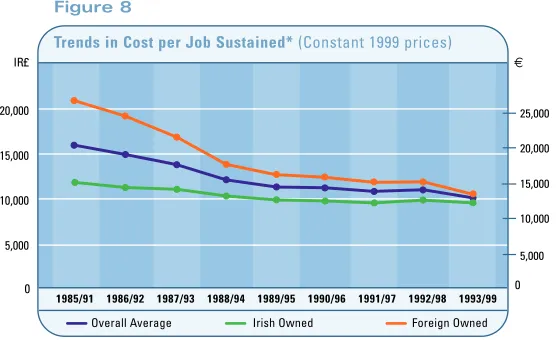
The average cost of each job sustained over a seven year period in agency-supported companies6amounted to approximately IR£10,100 (€12,824) in 1999, the lowest level recorded to date. The trend is shown in Figure 8 below. This reflects the improved value for money approach pursued, the overall improvement in the economic environment for enterprise development and the rapid growth in
internationally traded services projects, where the
investment costs are generally lower than in manufacturing projects.
Business Sector Research and Development
Forfás completed and published during 1999 the findings from the latest survey of business sector research and development (R&D).
In aggregate terms, R&D activity in industry continued to grow between 1995 and 1997. Total business expenditure on R&D (BERD) in 1997 was IR£535 (€679) million, or 1.1 per cent of GDP. This placed Ireland in 11th place out of 26 OECD countries and brought the country on a par with the European average. However, Ireland still lags behind other small northern European countries on this measure, including Sweden, Finland and Denmark.
Indigenous firms accounted for IR£192 (€244) million (36 per cent of BERD) of the total and foreign-owned firms accounted for IR£343 (€436) million (64 per cent of BERD). The R&D intensity (R&D spend to gross output) of
indigenous manufacturing was 1.1 per cent in 1997 (up from 0.5 per cent in 1991) while the R&D intensity in foreign-owned manufacturing was 1.2 per cent (up from 1.0 per cent in 1991).
The R&D intensities of indigenous and foreign-owned manufacturing are a cause for concern because these represent half of the OECD average (2.4 per cent) and approximately one-third of that found in the top performing country (Sweden, 3.5 per cent). The survey indicates that only 340 indigenous firms and 260 foreign-owned firms spent more than IR£100,000 (€126,974) on R&D in 1997.
Moreover, there are some signs of a slowing down in the growth rate of business sector R&D activity. The growth rate in R&D expenditure in real terms between 1995 and 1997 was 15 per cent per annum - lower than that witnessed in the period 1991 to 1995 (20 per cent per annum).
IR£M €M
1991 1990 1989
[image:18.680.62.340.526.696.2]1988 1992 1993 1994 1995 1996 1997 1998 1999 100 0 200 300 400 500 600 700 100 0 200 300 400 500 600 700 800 Figure 7
State Expenditure on Enterprise Development (Constant 1999 Prices)
Source: Financial Support by Government for the Development of Enterprise in Ireland, Forfás
5,000 10,000 15,000 20,000
IR£ €
1985/91 1986/92 1987/93 1988/94 1989/95 1990/96 1991/97 1992/98 1993/99
Overall Average Irish Owned Foreign Owned
0 0 5,000 10,000 15,000 20,000 25,000 Figure 8
Trends in Cost per Job Sustained* (Constant 1999 prices)
Source: Annual Employment Survey, Forfás
*Excludes companies under the remit of Shannon Development and Údarás na Gaeltachta
5 Including IR£3 (€3.8) billion pre-funded pension liabilities provided for in the Capital Expenditure Budget 1999. Excluding this, the rise in gross Government expenditure over the period 1998 to 1999 was 67 per cent in real terms.
Growth in Expenditure on Research in the Higher
Education Sector
Forfás completed and published during 1999 the findings from the latest survey of research in the higher education sector. The sector is defined as the universities and the institutes of technology, including the Programmes in Advanced Technologies (in the universities) and the Technology Centres in the Institutes of Technology. Expenditure on research amounted to IR£120.6 (€153.1) million in 1996, up 53 per cent in real terms on 1992 levels.
Among the major findings of the survey are the following:
expenditure on research in the higher education sector (HERD) amounted to 0.29 per cent of GDP in 1996, compared with an EU average of 0.38 per cent of GDP;
total number of HE researchers (full-time equivalent) was 2,065 in 1996, or 1.4 per thousand of the labour force, compared with an EU average figure of 1.75. This is up slightly from a total of 1,888 researchers in 1992, or 1.37 per thousand of labour force;
the major source of funding for HE research is the research component of the block grant to the colleges for their current and capital expenditure. It accounted for 45 per cent of the total funding. This component of funding is calculated from the time academics report that they spend on research (25 per cent on average of their working week);
other major sources of funding are direct Government grants (21 per cent), EU programmes (15 per cent), Irish business (6 per cent) and foreign sources (6 per cent).
State Expenditure on Science and Technology
The Forfás annual publication State Expenditure on Science and Technologyshows that Government allocations to scientific and technological activities amounted to IR£932 (€1,183) million in 1999, an increase of IR£46.5 (€59.0) million or 5.2 per cent over the 1998 level. All of the increase is accounted for by public funds (Exchequer + EU), which rose from IR£729 (€926) million in 1998 to IR£776 (€985) million in 1999; the balance of IR£156 (€198) million arises from income earned from the activities of the departments and agencies.
IR£M €M
1986 Constant Prices Current Prices 1990 1994
1988 1992 1996
20 0 40 60 80 100 120
0.16% 0.16% 0.18% 0.24% 0.26% 0.29%
20 0 40 60 80 100 120 140
HERD as a per cent of GDP
46 46 57 79 99 121 95 73 50 37 35 Figure 10
Higher Education Expenditure on Research & Development 1986 - 1996
Source: Survey of Research in the Higher Education Sector, Forfás
IR£M €M
1991 1992 1993 1994 1995 1996 1997
Constant Prices Current Prices 100 0 200 300 400 500 600
0.63% 0.71% 0.82% 0.93% 0.99% 1.05% 1.11%
100 0 200 300 400 500 600 700 195 172 220 268 330 392 464 242 290 349 405 471 535
[image:19.680.342.608.444.640.2]BERD as a per cent of GDP
Figure 9
Business Expenditure on Research & Development 1991 - 1997
The EU contribution to public sector Science and Technology (S&T) in Ireland grew from IR£141.8 (€180.0) million in 1998 to an estimated IR£168 (€213) million in 1999. This increase is mainly due to the extra funding allocated for grants to industry for R&D projects supported by Enterprise Ireland under its Research, Technology and Innovation Programme.
In relation to research and development activities,
Government Departments and their agencies allocated (i.e. made provision for spending) IR£169 (€215) million to the fundingof R&D in 1999, up from IR£151 (€192) million in 1998. A significant proportion of this increase represents additional support for R&D in enterprises allocated through the Department of Enterprise, Trade & Employment. The allocation for performanceof R&D within the State sector in 1999 is IR£61.8 (€78.5) million, up from IR£58.2 (€73.9) million in 1998.
State Expenditure on Science and Technology (Exchequer and EU Supported Funds)
Government Department Total Public Allocation
IR£'000 €'000 % Total
Taoiseach 454 576 0.06
Finance 2,796 3,550 0.36
Environment and Local Government 10,039 12,747 1.29
Education and Science 491,490 624,064 63.34
Marine and Natural Resources 16,484 20,930 2.12
Arts, Heritage, Gaeltacht and the Islands 3,793 4,816 0.49
Agriculture and Food 62,747 79,672 8.09
Enterprise, Trade & Employment 122,142 155,088 15.74
Public Enterprise 10,153 12,892 1.31
Social, Community and Family Affairs 8,845 11,231 1.14
Health and Children 13,848 17,583 1.78
Government Offices 33,134 42,072 4.27
Grand Total 775,925* 985,222* 100.00
Source: Forfás - State Expenditure on Science and Technology
* These figures do not include 'earned income' (such as fees for technical services) which amounted to IR£156 million (€198 million) in 1999. The inclusion of earned income brings the total to IR£932 million (€1,183 million).
IR£M €M
CSF Contribution Earned Income Exchequer Funds 0
100
90 91 92 93 94 95 96 97 98 99 200
300 400 500 600
100
0 200 300 400 500 600 700 800
Figure 12
Distribution of Government Supported S&T by Source of Funds (Constant 1999 prices)
Source: Forfás State Expenditure on Science & Technology, 1999
Introduction
Forfás was established in 1994 as the Advisory Board for Industrial Policy and Science and Technology. In this capacity, Forfás:
advises the Minister for Enterprise, Trade & Employment on the development of State policies designed to stimulate enterprise and employment;
is responsible for coordinating key aspects of the activities of the promotional agencies; and
is responsible for evaluating and monitoring programmes which promote enterprise development, science and technology.
The National Accreditation Board (NAB) operates as a division of Forfás.
Policy
Introduction
During 1999, Forfás developed policy recommendations on a wide range of issues related to the development of enterprise, trade, science, technology and innovation in Ireland. A number of these recommendations were developed in conjunction with bodies established by Government, including the National Competitiveness Council (NCC), the Irish Council for Science, Technology & Innovation (ICSTI) and the Expert Group on Future Skills Needs; for each of which Forfás provides the secretariat. A brief summary of some of the work is given below under the following headings:
Competitiveness
Technology Foresight
Irish Council for Science, Technology & Innovation
Regulation and Competition
Skills
Enterprise Development
Electronic Business
Trade
Infrastructure and Regional Development
Taxation
Finance
The Planning Process
Electricity
Competitiveness
The main focus of work under the broad heading of
competitiveness analysis has centred on the activities of the National Competitiveness Council (NCC), for which Forfás provides the secretariat.
The Council's Annual Competitiveness Report '99(ACR), published in May 1999, provided a detailed and
comprehensive evaluation of the state of, and progress in, Ireland's international competitiveness. The report benchmarks, on the basis of over 120 statistical indictors, Ireland's performance across all the main dimensions of competitiveness in the economy including human resources, R&D and innovation, trade and foreign
investment, business finance and economic infrastructure.
The NCC's Report on Costs, published in June, highlighted the critical importance of the cost structure in underpinning the international competitiveness of the overall economy. The report identified the main cost factors for Irish enterprise and compared them with cost levels in key competitor countries, in particular the UK, Ireland's major trading partner.
The Inter-Departmental Group on Competitiveness was asked by Government to consider and prepare a response to the ACR. Forfás, together with the Department of Enterprise, Trade & Employment, provided the secretariat to the Group. Their report, completed in July, concluded that for the vast majority of recommendations made by the Council, action consistent with the recommendations was under way or planned to address the competitiveness issue involved.
economy since 1987 and its significant contribution to economic and social progress over that period. The report highlighted the need for a new set of shared goals to bolster the partnership process and also examined the main competitiveness issues that a new partnership agreement should address.
Over the second half of the year, the Council also published follow-upreports to its earlier statements on skills,
telecommunications and e-commerce. These follow-up reports assessed progress in relation to the issues identified in the skills, telecommunications and e-commerce
statements and, reflecting recent developments, highlighted emerging priority actions in these vital areas. The Council's up-to-date assessment, detailed in the follow-up report, of the requirements for Ireland to achieve a leadership position in telecommunications and e-commerce has been furnished to agencies with responsibility (and/or interest) in the area. In support of the work being carried out by the Department of Enterprise, Trade & Employment, the NCC has also promoted awareness of the rapid implementation of the recommendations contained in the report E-Commerce: The Policy Requirementsprepared by Forfás for the Tánaiste.
Technology Foresight
The Technology Foresight initiative was launched in March 1998 and final reports were published in April 1999 by the Task Force established under the auspices of the Irish Council for Science, Technology and Innovation (ICSTI) within Forfás.
The Technology Foresight initiative highlighted the steps necessary to reposition Ireland as a global leader in the knowledge-based economy. The Technology Foresightreport recommended the establishment of a IR£500 (€635) million fund to support the development of world-class research capabilities in niche areas of information and
communication technologies and of biotechnology. This investment was deemed necessary to underpin the future competitiveness of indigenous industry, facilitate the undertaking of R&D in this country by multinational companies and attract more high-tech companies to Ireland.
The Tánaiste and Minister for Enterprise, Trade & Employment, Ms. Mary Harney T.D., and the Minister for Science, Technology & Commerce, Mr. Noel Treacy T.D., formally launched a Technology Foresight Fund of IR£560 (€711) million on March 8, 2000, to implement the ICSTI recommendations.
A dedicated Research Foundation will be established to evaluate research projects and to manage and allocate funding. The Foundation will put in place appropriate procedures for a competitive international peer review process to fund world-class research within the niche areas identified. The Foundation will operate under the aegis of Forfás as a sub-board of the Forfás Board.
Irish Council for Science, Technology &
Innovation - ICSTI
The Irish Council for Science, Technology and Innovation within Forfás advises the Minister for Enterprise, Trade & Employment, the Minister for Science, Technology & Commerce and the Government on policy for science and technology and related matters.
Output from the Council in 1999 was dominated by the nine reports from the Technology Foresight initiative, which the Minister had requested the Council to undertake in 1998 (see previous section). The ICSTI Foresight report advocated that a well-focused and significant investment in upgrading the technological infrastructure of the economy would enable Ireland to develop world-class research capability in strategic technologies.
In addition, 1999 saw the completion of three other ICSTI statements and one report as follows:
"Science in Second Level Schools". This statement makes specific and actionable recommendations to
Government, the education sector, the business sector and others to improve science, technology and mathematics education in second-level schools.
"Public Sector Research and Technology Services for Innovation in Enterprises". This statement puts forward a set of policy principles and guidelines that relate to the undertaking and delivery of public research, technology and innovation services to enterprises.
"Benchmarking School Science, Technology and Mathematics (STM) Education in Ireland against International Good Practice". Science, technology and innovation are taking on an increasingly important role in Irish society and the Irish economy. Effective primary and second level science, technology and mathematics education in Irish schools is a priority given this changing environment. As the knowledge age unfolds, it is
recognised that national competitiveness and well-being become more and more dependent on the scientific capability of the population. This report, undertaken with the assistance of the National Council for Curriculum and Assessment (NCCA), benchmarks STM education in Ireland, Scotland, Finland, Malaysia and New Zealand. Three key issues in science, technology and mathematics education identified by ICSTI are:
– how to develop and implement STM education policy on a timescale that meets the rapidly changing needs of an emerging knowledge-based society, while continuing to meet individual students' long-term needs and ensuring a high level of ownership among the social partners;
– how to recruit, train and retain high-quality STM teachers, particularly in the physical sciences and mathematics; and
– how best to teach and assess science, technology and mathematics.
In November 1999, the Council established three Task Forces to address the following issues:
Commercialisation of Research
This Task Force will make recommendations on the best means, circumstances and conditions for the transfer and commercialisation of research activities in the higher education and public research institutions.
Modern Biotechnology
This Task Force will examine the current state of modern biotechnology, identify and consider socio-economic issues that need to be addressed in a national context and prepare a statement on these in the context of the future development and application of modern biotechnology. Biotechnology is an enabling technology that affects a large number of sectors that are very important to the economic growth of the Irish economy and was
confirmed in the Technology Foresightreports as a critical technology for the future.
Public Awareness of Science, Technology and Innovation (STI)
This Task Force will make recommendations regarding the raising of public awareness about STI issues relevant to Ireland. Two particular aims are paramount:
– to contribute towards the development of a population which is well informed about, and comfortable with, STI issues; and
– to encourage more students to study the physical sciences at second and third level education, in order to meet the needs of industry for people with science and engineering skills.
A joint Steering Group, consisting of two members each from the Arts Council and ICSTI, was established in Spring 1999. The Steering Group is exploring ways of enhancing a new alliance between the arts and the sciences with a view to encouraging innovation and creativity.
National Development Plan 2000 to 2006
In its statement Investing in RTI in the Period 2000 to 2006, ICSTI called for a new programme of substantial investment in the country's RTI base as a means of enhancing
innovation and competitiveness. The ICSTI Statement was widely endorsed, and was included in the ESRI report on investment priorities for the period 2000 to 2006 and in the NESC report on national social and economic strategy published in December 1999.
This allocation consists mainly of additional resources for research and development across the different sectors of the economy. The major components of the RTDI allocation are as follows:
IR£550 (€698) million for RTDI in the third level sector. This will build upon the existing initiatives in the Programme for Research in the Third Level Institutions 1999-2001. It will also contribute to the strengthening of graduate enterprise programmes and of higher education - industry links. The investment will also allow for the development of support schemes for post-graduate and post-doctoral researchers;
IR£560 (€711) million for a Technology Foresight fund;
IR£381 (€484) million for research and technology development in industry;
IR£210 (€267) million to promote collaboration networks between colleges, research institutes and industry;
IR£128 (€163) million for agriculture/food RTDI, IR£50 (€63) million for fisheries and forestry, and IR£20 (€25) million for an Environmental Research Programme.
Skills
In November 1997, the work of the Business Education and Training Partnership began, supported by Forfás research and secretariat. The three components are:
An Expert Group on Future Skills Needs - to provide analysis and recommendations;
A high level Management Implementation Group - to facilitate fast-track decisions on key recommendations; and
A Business Education and Training Partnership Forum -involving the Tánaiste and Minister for Enterprise, Trade & Employment and the Minister for Education & Science.
Following publication of the First Report of the Expert Group on Future Skills Needs,the Government, in April 1999, approved the allocation of an additional IR£75 (€95.2) million to the Department of Education & Science for the provision of 5,400 places. Additional resources of IR£3.2 (€4.1) million were provided for by the Department of Enterprise, Trade & Employment in its 1999 budget, for an additional 750 places on FÁS high skill courses for the electronics and software sectors.
The Expert Group will continue to monitor the supply and demand for IT professionals and acknowledges that the shortage of computer science technicians is a major concern for the IT industry. Hence it recommends that greater priority should be given to allocating places in Accelerated Technician Programmes (ATP) in the Institutes of Technology to computer science students. Furthermore, the Group recognises the current and projected shortage of graduate engineers. The third level institutions have been provided with resources for such students, but given the fact that it takes four years to complete such a degree, the shortage of engineering professionals will only begin to decrease after 2003.
The Expert Group analysed the labour supply and demand for construction crafts, life sciences, research skills, and the labour market in general. The recommendations for these sectors and the IT sector are included in the Second Report published in March 2000.
The main recommendations for construction crafts include increasing the number of apprentices and exploring routes to shorten the duration of apprenticeships. Resources should be made available in providing apprentices with places on the off-the-job component of the apprenticeship programme. The Expert Group predicts that present craft shortages of 5,000 will decrease to 2,000 by 2003, but recommends that both FÁS and the CIF will need to continue to attract craftspersons from abroad.
Recommendations for research skills include providing attractive financial support for researchers in the Third Level institutions and attracting researchers from abroad.
In response to the forecast slowdown in labour force growth over the coming years, the Expert Group has recommended measures to:
encourage greater work participation through changes to the tax and welfare system and better childcare provision;
assist the unemployed to obtain jobs;
promote immigration;
increase the number of over 55s in the workforce; and
increase flexible work options.
The second Business Education and Training Partnership Forum, jointly chaired by Forfás and the HEA, was held in
December 1999. The Forum was addressed by the Minister for Education & Science and the Minister for Science, Technology & Commerce. The findings of the Expert Group as outlined above were presented and discussed and the Forum Report was published in March 2000.
As part of on-going work on employee training in 1999, Forfás conducted a joint study with the Open University Business School (OUBS) and PricewaterhouseCoopers (PwC) on management development in Ireland's enterprise sector. The study found that the vast majority of companies in this sector were conducting mostly informal and ad-hoc training of their managers, with little evidence of a systematic process of management development.
Experience worldwide suggests that alternative forms of remuneration such as profit-sharing, gain-sharing and employee share option schemes have a key role to play in helping firms, and smaller firms in particular, to attract and retain staff. In 1999 Enterprise Ireland, in conjunction with Forfás, commenced a study to establish the types of
remuneration and other incentives that might assist growth-oriented companies to attract and retain the services of skilled and experienced individuals. This study will be completed in 2000, and will be made available to the Consultative Committee, established under the Programme for Prosperity & Fairness, to prepare proposals for
consideration in the context of the Budget 2001.
Regulation and Competition
Forfás has undertaken work in relation to the appropriate design of a programme for regulatory reform in the Irish economy. This work began with an overall assessment of the existing status of regulation in Ireland, concentrating on a specification of the present legal and institutional framework, and also highlighting a number of general principles to be followed in regulatory activity and
competition policy. Initial identification of some key issues in this regard was made. Sector