Friendship in the Field:
Ethics and Reflexivity in Auto/biographical Research
by
Connor Tiarnach O’Donoghue
Abstract
The aim of this paper is to explore a model of researcher reflexivity, drawn from anthropological literature and applied to an auto/biographical study of young men in university. Social scientific research can involve significant
revelation of self for research participants through data generation tools such as interviews, diaries, photographs and social media, and this can have an impact on researchers, who can often be sensitive to the type of material they are studying, and sometimes deeply affected by it. This paper comes out of life history research completed with participants who lived with the
researcher, and with whom he developed a friendship. Auto/biographies
were co-constructed across a series of themed, semi-structured life history interviews, supplemented with visual and written data generated by the
research participants. The paper addresses issues of researcher reflexivity and
ethics when friendship intrudes on research, and looks at a number of models
for dealing with this, both in the field and in analysis stages. The paper draws examples from Van Maanen’s Tales of the Field, Behar’s The Vulnerable Observer,
and Wolcott’s Sneaky Kid and its Aftermath: Ethics and Intimacy in Fieldwork. The
models for ethics and reflexivity provided by these works is analysed and
possible applications discussed.
Keywords
Narrative research, auto/biographical research, reflexivity, ethics
1. Introduction
This paper aims to examine some of the dilemmas posed by the issue of
biographical study that I undertook into the lives of four young men, and looking at the relationship that developed between us. Some of the problems that arose in that research will be examined. A number of literary sources on
reflexivity will be reviewed, and a multi-part model for reflexivity will be
proposed.
1.1 Outline of paper
This introduction will continue with further contextualising information. In
the next section (1.2), the background to auto/biographical research will be
examined, its usefulness and popularity reviewed and some initial problems posed. In the following section (1.3), the context of this study will be laid out, including the research aims, goals and methodology.
Section (2) then gives a description of the research process, how ethical issues posed at the time of the data generation were dealt with as well as the aftermath of the period of data generation and how personal relationships threatened this study. Section (3) broadly reviews some of the literature on
reflexivity.
Section (4) then examines the work of three authors in the field, Van Maanen in 4.1, Behar in 4.2 and Wolcott in 4.3 and reviews their models for reflexivity. Section 5 then discusses the use of these three authors’ work in forming a three-part model for reflexivity in auto/biographical research by applying
it to this research project. Finally, in section (6), some conclusions are drawn, limitations of the study are noted and possible contributions are outlined.
1.2 Background: Auto/biographical Research
Auto/biographical research, a branch of narrative research, is a form of qualitative inquiry that involves eliciting partial or complete life histories
from research participants. Kohli is one of many to credit Thomas and
Znaniecki with having created the seminal work which popularised the auto/
biographical approach, when they took the life histories of Polish peasants in
Europe and America in the early twentieth century. They produced a massive work in five volumes claiming that personal life-records constituted “the
perfect type of sociological material”1. The “Chicago School” of sociology
applied the approach in prisons, in factories, in decaying societies in Europe
and emerging ones in Latin America. Interest in the approach declined in the
1960s and Bryman notes a “turn to biographical methods” since the 1990s, which he puts down to a “growth in the interest in the significance of agency in social life”2.
Faraday and Plummer note three advantages that the life history technique has over other forms of sociological research. The first of these is that life history enables the researcher to see “the subjective reality of the individual…
[It] documents the inner experiences of individuals, how they interpret,
understand and define the world around them…it comes to lay bare the ‘world taken-for-granted’ of people – their assumptions and what it is that they find problematic about life and their lives in particular”3 . The second
advantage they note is that the life history technique focuses on process and ambiguity. Much social scientific research is searching for “generalizability
[and] imposes order and rationality upon experiences and worlds that are
more ambiguous”4. The third advantage noted is the focus on totality. Faraday and Plummer claim that psychology cuts off attitude or personality from the totality of life experience, while sociologists separate culture or structures from daily lived experience. Life history allows us to view both the individual and the culture.
Riessman reviews a continuum of narrative types, from a single uninterrupted story, to a complete life history cobbled together from diaries, interviews, observations and visual artefacts5. Most psychological and sociological narratives, she claims, come somewhere in the middle. This study is group of four life histories, each principally made up of a narrative told from the subjective perspective of the research participants themselves through a series of interviews, but will also look at the social and cultural world in which they
find themselves, addressed in the interviews and supported by documentary and visual data, mainly from the participants’ Facebook accounts.
Connell uses life histories as the source of her data in her seminal work Masculinities. She claims that they allow her to see “the relation between the social conditions that determine practice and the future social world that
practice brings into being… [It] always concerns the making of social life
2 Bryman, Social Research Methods, 441.
3 Faraday and Plummer, Doing Life Histories, 252-253. 4 Ibid., 253
through time.”6 A narrative life story should allow us to see a person in their social world, and this is essential both to a modern sociological understanding of identity as social.
1.2(a) Possible problems with auto/biographical methods
These advantages claimed by auto/biographical researchers, however, can be
challenged because of their very subjectivity, because of their dependence on personal relationships and personal tellings of intimate stories. Revelation can be a painful process, both for the subject of a biography, and for the researcher, for the teller and the listener. Researchers in the social sciences can often be moved and touched by the stories they hear and the relationships they form through the process of revelation. This makes narrative research vulnerable to attack, both on ethical grounds and on the grounds of researcher objectivity (and therefore validity).
1.3 Context: Studying young men in university
1.3(a) Research aims
This paper arises in the context of a narrative study that is at the centre of
my own PhD in Masculinities. I take Connell and her socially and culturally constructed view of masculinities as the starting point for my study. My aim is
to supplement the work of Connell and her peers with the lens of subjectivity
provided by Charles Taylor’s work on identity. Taylor agrees with mainstream
sociology (as represented in my study by Connell) that much of our identity is a product of society, culture and history. However, he also believes in a
space for agency and individual subjectivity in the formation of the self. My aim is to examine these views on identity by applying them in the field of
masculinities.
My research questions are: 1. How do young Irish male undergraduates
formulate their masculine identities in relation to the social and moral space?
2. How can the work of Charles Taylor on identity contribute to the field of
masculinities?
1.3(b) Research methods
In attempting to answer these questions, I worked with four undergraduate men to co-compile their auto/biographies. This research primarily involved
a series of lengthy life history interviews (seven interviews of approximately ninety minutes in length with each of the participants) on the following
themes: 1. A Timeline of My Life, 2. My Family, 3. My Social World, 4. The Real Me, 5. Me, the Man, 6. My body, 7. My life at university. The themes for
these interviews were drawn from the literature on masculinities and from
Taylor’s work on identity. As well as interviews, written and visual data was
generated, from specially-written pieces by the participants and from their Facebook accounts.
1.3(c) The research participants and the researcher
At the time the data generation at the heart of this project took place, I was a 31-year-old, full-time PhD student living in a large apartment in university accommodation, sharing with the four research participants (all of whom were nineteen years old) and nine other young male undergraduates. I had
started living there out of financial need and had not initially considered including my own flatmates in the study.
In the semester before the project began, I built up a cautious friendship with
my flatmates that reflected the difference in age and life experience between
us. Initially, I only saw them about once a week and we had brief conversations in the shared living room. I did not eat with them or use the shared kitchen
and we never socialised together outside of Hall. Towards the end of the first
college semester, in December 2011, we became Facebook friends. We got
to know a lot more about each other’s lives. They also began reading my
personal blog, which gives a detailed account of my life, and included some
long passages on my flatmates themselves.
The choice to ask my flatmates to be the participants in my research was made
in the knowledge that, while I was living with them, I was not in a position
of financial power, like a landlord, and neither was I in a position of pastoral
As 2012 began, I began to see some of my flatmates a little more often,
including three of the four who participated in the project. As the year went on, and around the time life history interviews started, I began to see them
even more frequently, and helped out on a student election campaign that
two of the four research participants were running in. Over time, we began to advise each other on relationship and college issues and built up a stock of shared experiences, and so a real friendship began to be formed between me and some of the young men.
2. My research and personal relationships
I made genuine efforts to separate the research relationship I had with my
research participants from the friendship I had with my flatmates, attempting to formulate a way in which the researcher-as-friend is “kept out” of the
research.
While a close friendship existed between me and and some of the research
participants by the time the data generation phase had finished, boundaries were kept to, through which a “research relationship” was maintained that
ran parallel to our day-to-day friendship. Interviews never took place in our apartment, and I made efforts to ensure that participants were not aware of,
for example, each other’s pseudonyms or the timing of interviews. I never sent group emails or messages when arranging meetings or requesting written
work, although I often needed to send exactly the same message to more than one person. Although the research participants themselves sometimes brought up the interviews in our shared apartment, I always tried to ensure that these conversations were kept short and factual. I do regularly maintain a public blog, which all four research participants read, as mentioned above, and though I would have mentioned some of the research participants in their capacity as friends, I never mentioned that they were involved in interviews with me and, although I mentioned the interviews on the blog, I never said who they were with or what they were about.
ever being anything more than platonic was avoided.
The interviews were kept separate from our social life. I made sure that we arrived at interview locations separately, that I would always allow them
to leave before I did, so as to maintain the barrier between the “research relationship” and the social one. Every interview involved paperwork, and
I would regularly refer to the goals of the research during interviews. I also asked the participants to review the process as we went along. All this helped
to maintain a “work-like” atmosphere during interviews. The interviews
covered some very personal topics, and there was a danger that a faux-counsellor type relationship would arise. There was an element of this in the interviews and two of the participants in particular said that they found the interviews therapeutic. As mentioned earlier, I would often refer to the research goals and keep referring back to the PhD process for this reason. On one occasion, I informed one participant of the availability of the Student Counselling Service. On the only occasion where a participant asked me
directly for advice during an interview, I told him that I was not qualified
to do this and that that was not my role. He claimed to be happy to continue with the interview in spite of this and we did so.
Thus, on a formal level, I am able to say that I insulated my “self” from the
research process, and that I separated the research relationship from the social
relationship, at least at a superficial level.
However, there is no doubt that these friendships had the capacity to threaten
the research, as I found my “self” intruding, my relationship and feelings
for the research participants were not easy to silence. The revelations that they made in the course of the data generation affected me deeply, as did the growing friendship and acceptance I experienced at the hands of a group of men, twelve years my junior. The period of data generation was one where I experienced personal growth and transformation, in my family life and my social life and in my relationship with my sexuality and my body. The young men I lived with, including the participants in the research, played
a significant role in some of these changes, inspiring me and encouraging
The first time I was due to present a portion of my research publicly, I found
myself feeling very upset, and that evening I wrote on my blog:
“Sometimes my PhD makes me feel very, very sleazy. Here I am, taking the details of people’s lives, real people, with real lives, and “analysing” them. I felt like such an invasive, creepy, slimeball.”
3. Reflexivity: some background
Insulating the research process from the self, from perspectives coloured by experience, by relationships and by attitudes (as outlined in the previous section) may be the professed goal of empiricism, but Bourdieu would dismiss
this as “the illusion of absolute knowledge”7, as no researcher can claim not
to have “tainted” their research with their “selves”. Even purely quantitive
surveys, where the researcher may see themselves as simply adding up
verifiable, objective facts, are impacted by the researcher’s experiences, relationships and attitudes. A questionnaire on youth mental health that asks about the respondent’s sexual orientation, but not about their race suggests
that the researcher has already decided that sexual orientation is more likely
to be a significant factor in the mental health of the respondents than their
race is.
Dauphinée, in her work on the ethics of researching war, agrees. For her, the distance between the observer and the observed is “delusional”. 8 It could further be argued that divorcing the self from the research process creates a methodological power imbalance between researcher and researched, as it excludes the voice of all the participants in the research, and, potentially,
wrongly conveys the message that the findings are unquestionable. There is
no such thing as researcher-free research.
Knowledge is not an absolute, and no findings can be completely insured against questioning.
This paper argues, from the work of Van Maanen, Behar and Wolcott that a balanced and “honest” presentation of data is a realistic and achievable goal
that can still result in data from which we can learn. 7 Bourdieu, The Logic of Practice, 250.
4.1 Van Maanen and the Confessional Tale
Anthropologists conducting ethnographies were among the first academics who had to find a way to be “reflexive”. Those white men and women who went to live among tribal people in the South Pacific Islands, in Africa and
in South America faced many challenges to the objectivity of their work. The
questions they were forced to answer included: “To what extent did you ‘go native’?”, “How did your presence affect the lives of those who you were studying?”, “How do your colonial values and Western moral framework shape your perception of what you report?”
John Van Maanen writes that ethnographers have long realised that they cannot present their work on the basis of an “assumed Doctrine of Immaculate Perception”. The writing up of an ethnography is complex and depends on “an uncountable number of strategic choices and active constructions”9 . One of the principal solutions that the ethnographic community has to this issue is to write
what Van Maanen terms a “confessional tale”, an attempt to impose some form of
academic discipline on ethnographic stories that were in danger of being viewed
as “mere journalism”.
He goes on to list three conventions of the confessional tale:
The personalised author: The author of the confessional tale is not the “ubiquitous,
disembodied voice of the culture”. Instead, the author is an “I”, who writes in the first person, about what they have seen, heard and done. A first person narrative
accompanies the ethnographic narrative, describing the role of the researcher in full, how they came to have the knowledge that they are reporting and how they have put it together, how they have reached decisions about what to include and what to exclude.
The fieldworker’s point of view: A confessional tale usually describes the researcher as
researcher. It attempts to address questions like: How did the group being studied respond to the researcher? In what ways and at what points did the researcher “go native”? Was the researcher ever excluded or rejected by the groups they studied?
Did the researcher make any errors in the generation of data?
Naturalness: A confessional tale will also directly address concerns that others
may have about the scientific nature of the ethnography presented. It will show
how any errors of judgment or poor decisions made in the research process were mitigated.
Van Maanen sees these three conventions, in one form or another, in many “confessional tales”, a large genre within ethnography, and he sees it as pro forma to now include such a confessional tale in the “methodology” section of any
ethnographic article, book or dissertation10.
4.2 Behar and the Vulnerable Observer
Behar (also an anthropologist) describes situations where objectivity, distance
and abstraction are called into doubt as core values in social scientific research.
“But if you’re an African American scholar writing about the history of contract law and you discover, as Patricia Williams recounts in The Alchemy of Race and Rights, the deed of sale of your own great-great-grandmother to a white lawyer that bitter knowledge certainly gives “the facts” another twist of urgency and poignancy. It undercuts the notion of a contract as an abstract, impersonal legal document.” 11
She calls for the voice of the “vulnerable observer”. If abstraction and
distance are an impossibility, then position must be stated. She explicitly says
[image:10.421.140.281.348.488.2]that vulnerability is not the same as “anything personal goes” and that the “exposure of self…has to take us somewhere we wouldn’t otherwise get to.”12 Vulnerable writing should help us to an understanding of social realities and situations.
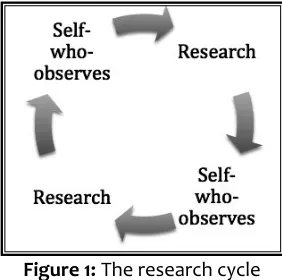
Figure 1:The research cycle
Figure 1 shows the cycle that the “vulnerable” observer presents in their research. This goes further than the “confessional tales” described by Van
10 Ibid., 81
Maanen. This is not simply a description of the observer’s position and the process of generating data, with all its flaws and failings.
The vulnerable observer asks her/himself how their own position, their
own life history, their experiences and emotions coloured the research, and then asks how the research affected their lives and their emotions in turn. If research brings the researcher new experiences and they experience strong emotions as a result, this can easily impact the analysis of any data generated in this process and in turn any conclusions drawn. It will also presumably affect any future research. The vulnerable observer engages in a perpetual
cycle, whereby the “self-who-observes” is at the core of any research project
and the reporting of it.
For Behar, vulnerable observation is far from a passing or minor trend. The
feminist claim that “the personal is political” aligned to a growth in so-called
native anthropology, and the increasing numbers of autobiographies in narrative research all mean that the cycle which Behar describes is one that is here to stay.13
4.3 Wolcott and the
Sneaky Kid
In the early 1980s, anthropologist Harry Wolcott discovered a homeless
19-year-old man living in the forest in which Wolcott’s own home was located. He befriended the young man, “Brad” or “the Sneaky Kid” and helped him,
giving him money in return for jobs, and allowing him to stay on the land without reporting him to the authorities. He also conducted life history interviews with the young man and published the results in an academic
journal with commentary on the failures of “the system” to provide him with an adequate education. Wolcott’s relationship with Brad deepened to include
sexual intercourse for a time. After a few months, it became clear that Brad was becoming increasingly mentally unwell, and he left the forest, and was
treated. Two years later, Brad returned and burned down Wolcott’s house,
attempting to murder him.
The relationship between Brad and Wolcott had clearly changed Brad. Research does not only have an effect on the researcher and on the data,
so the need here is greater than the need that the “vulnerable observer”
discussed above has. Not only does the researcher have to speak to how their position, experiences and emotion impact the data, and how the data affects
them, Wolcott’s story is a call for an account of how the researcher creates the data, and even how the researcher creates the research participant. Wolcott
had a hand in Brad’s actions and in his experience of the world, and Brad had a hand in Wolcott’s experience of the world. A researcher can constitute
and be constituted by the process and results of research. The case of Brad and Wolcott is an extreme example, but the elicitation of a detailed life history can have a profound impact on both the researcher and the researched, and can be formative of life itself, as well as of feelings and opinions.
5. Discussion: Applying the Theory to Practice
This brings me back to my own research, and the life history data I generated
from four of my flatmates, and how what precedes should be applied to my
own work.
5.1 Applying Van Maanen
The first step here is to account for what needs to be “confessed” when
describing the methodology of my own data generation.
Here I need to describe my experiences of life in our shared apartment, the
fact that I saw some of the research participants more frequently than others.
I need to account for the process I used to recruit these research participants, and to note what I did when practical problems arose in the course of the research, how I dealt with one participant not meeting me as often as the others, or a participant asking for advice on his personal life in the course of the interview, as mentioned above. I need to acknowledge the times when I glossed over information that the participants thought was important, or
when I asked questions that the participants were surprised by, or that they
did not answer.
5.2 Applying Behar
mattered.
I need to give an account of my position as an experienced teacher and single, 31-year-old gay man, from a suburban, middle-class, evangelical Christian background living among a group of young rural men. I need to give a description of my feelings on having these young men reveal themselves and
their stories to me. Hearing tales of my flatmates’ experiences of family life, of mental and physical health and illness, of fears and perceived flaws, of sexual
feelings and experiences had a profound effect on me, and this needs to be given space in my presentation of the life history data.
5.3 Applying Wolcott
Wolcott’s story calls for a deeper examination of how I “created” the data, and how it “created” me.
The research participants were aware of the impact that these narratives were
having on me, and that I was more than a “mere note-taker”, but a participant
in their lives. Some of them, as discussed above, claimed that the life history interviews had a therapeutic effect on them, and one claimed that this had an effect on his decisions and helped him think through certain choices. Another said that the process of being interviewed and writing preparatory
answers for the interview questions caused him to view himself differently.
Although I was careful to keep the research relationship separate from the social relationship, it would be futile to claim that they had no effect on each other. It is also important for me to acknowledge the ways in which my own relationship with my body, my sexuality and my gender identity shifted over the course of the study and to give an account of this.
6. Conclusions
The three models proposed by the authors accounted for in this paper make
for a progressively deeper and more searching framework for reflexivity in auto/biographical research. Van Maanen’s “confessional tale” is a call for a descriptive methodology, including the role of the researcher and the first person “I” voice. Behar’s “vulnerable observer” is a call for a full account
of researcher position and the emotional and experiential impact of the
research on the researcher and vice versa. Finally, Wolcott’s Sneaky Kid is a
researcher-subject and the researched-subject) as a result of the research.
6.1 Limitations
This study is a small-scale auto/biographical piece of research conducted in one flat over the period of one university semester, and so it would be difficult
to argue for widescale applicability. However, as a researcher, I believe in the potential of the particular to reveal the general, and indeed this is particularly true in a study which aims to discover more about the subjective contributions to identity.
The contribution to knowledge being put forward here is a proposition for a
three-stage model of reflexivity, that I found specifically relevant to my own
work. Further studies could review the experiences of larger numbers of narrative researchers, examine a wider variety of relationship-types between researcher and researched and review a wider variety of approaches to
reflexivity.
6.2 Contribution
The three-part framework proposed above has the potential to provide data
that is genuinely reflexive. In the case of my research, this approach produced
rich data on masculinities for my PhD, as the lens of my own masculine identity was examined to the same extent as the masculinity of the research partcicpants, by means of the progressive model outlined above. This allowed
for the Bourdieuvian ideal of the reflexive researcher, making themselves and
their worlds an object of their own study, and turning the instruments of research inward14.
As Van Maanen acknowledges, “confessional tales” are common practice in the social sciences. This model for reflexivity acknowledges the value
in an account of process, but argues for the need to go further and include an interrogation of position, on impact and on authorship. I feel that the interrogation of researcher as creator of data and creator of research participant (from Wolcott) is just as important as an acknowledgement of procedural
facts (from Van Maanen).
It does not, however, as May and Perry counsel against, entirely deconstruct
the data so that nothing meaningful remains to analyse. 15 What is left is a
piece of auto/biographical research that has deep, three-layered reflexivity, asking questions about the authorship of data and of the authorship of
research participants, and still allows for analysis of both the process and the product of the research.
Acknowledgements
The author would like to acknowledge the support of the School of Education
in Trinity College for funding this research through a School postgraduate research studentship scheme.
References
Behar, Ruth. The Vulnerable Observer: Anthropology that breaks your heart. Boston: Beacon Press, 1996.
Bourdieu, Pierre. The Logic of Practice Cambridge: Polity, 1992.
Bryman, Alan. Social Research Methods Third Edition. Oxford: Oxford University
Press, 2008.
Connell, Raewyn. Masculinities. Second Edition. Cambridge: Polity, 2005.
Dauphinée, Elizabeth. The Ethics of Researching War: Looking For Bosnia. Manchester: Manchester University Press, 2007.
Deer, Cécile. “Reflexivity”. In: Grenfell, Michael (ed). Bourdieu: Key Concepts. Durham: Acumen, 2008: 195 – 208.
Faraday, Annabel and Plummer, Kenneth. “Doing Life Histories”. In: Miller, Robert. (ed.) Biographical Research Methods: Volume IV London: Sage, 2005: 249 – 271.
Kohli, Martin. “Biography: Account, Text, Method”. In: Miller, Robert. (ed.)
Biographical Research Methods: Volume IV London: Sage, 2005: 59 – 72.
May, Tim and Perry, Beth. Social Research and Reflexivity: Content, Consequence
and Context.
Riessman, Christine. Narrative Methods for the Human Sciences. London: Sage, 2008. Van Maanen, John. (1988) Tales of the Field: Of writing ethnography Chicago: University of Chicago Press, 1988.
Wolcott, Harry F. Sneaky Kid and its Aftermath: Ethics and Intimacy in Fieldwork
Walnut Creek, California: Alta Mira, 2002.