Effectiveness of wheat straw mulch and Polyacrylamide
on shallow stability of roadside slopes
Aidin Parsakhoo*, Seyed Jamal Mirniazi, Ayoob Rezaee Motlaq
Department of Forestry, Faculty of Forest Science, Gorgan University of Agricultural Sciences and Natural Resources, Gorgan, Iran
*Corresponding author: [email protected]
Citation: Parsakhoo A., Mirniazi S.J., Rezaee Motlaq A. (2019): Effectiveness of wheat straw mulch and Polyacrylamide on shallow stability of roadside slopes. J. For. Sci., 65: 445–449.
Abstract:Soil aggregate instability on unprotected roadside slopes can cause landslide, soil erosion and sedimenta-tion. Different biological and chemical soil stabilizers are used to reinforce the instable slopes. In the present study, straw mulch and Polyacrylamide (PAM) combinations were investigated on a clay soil of road cutslope in campus of Gorgan University of Agricultural Sciences and Natural Resources, Gorgan, Iran. The selected cover treatments were Polyacrylamide (2, 3 and 4 g·m–2) with wheat straw mulch (50, 150 and 250 g·m–2) which was spread by hand to
attain 75% groundcover on a 1:1 slope. After the three months, soil sampling was done to determine the changes in aggregate stability of soil. Results showed that the most efficient treatment with respect to mean weight diameter of soil aggregates in dry and wet sieving (MWDdry and MWDwet), aggregate stability index (AS) and aggregate destruc-tionindex (DI) was treatment of B (150 g·m–2 wheat straw mulch and 3 g·m–2 Polyacrylamide tackifier) with 34%,
68% and 47% increment in MWDdry, MWDwet and AS, respectively as well as 37% reduction in DI as compared to the bare soil control.
Keywords: aggregate stability indices; soil stabilizer; cutslope; sieving; tackifier
Road construction results in soil instability, when soil is exposed to rainfall energy especially the first year after road construction. Rainfall provides the energy to cause detachment of soil particles. Soil properties include particle size distribution or mean weight diameter of aggregates, texture, ag-gregate stability indices affect soil potential to be washed by runoff. The soil surface can be protected with vegetation cover, straw and wood mulch, geo-textile, tackifier materials such as Polyacrylamide (PAM). Straw mulch is the cheapest temporary method of soil loss control. Wheat straw mulch can be easily found in agricultural lands of Iran. Besides PAM is a polymer which can increase and preserve soil aggregate structure by increasing the infiltra-tion and decreasing the runoff and surface crusting.
PAM used in conjunctions with mulch can be more effective in reducing soil instability and loss (Hayes et al. 2005). Bjorneberg et al. (2000) tested PAM in combination of wheat straw for soil instability control. They used the wheat straw at 250 g·m–2 and 67 g·m–2
with PAM at 0.2 and 0.4 g·m–2. Results showed that
250 g·m–2 wheat straw cover with PAM (0.2 g·m–2)
re-duce runoff and soil loss by 98% and 99%, compared to bare soil respectively. In another study, Lentz and Bjorneberg (2003) performed wheat straw treat-ment with PAM on a 1.5% slope silt loam soil. Results showed that with mixing PAM to low (48.5 g·m–2) and
high (149 g·m–2) rates of straw the soil instability
gra-dient of 10%. Results confirmed that 2 g·m–2 PAM
and straw mulch reduce soil loss by 93% compared to control. Dry PAM alone reduced the instability by 83% compared to control. Flanagan and Canady (2006) tested the efficiency of PAM on 4% and 8% slopes with two wheat straw cover levels of 0% and 30% under a rainfall simulator. Results showed that PAM in conjunction with wheat straw reduces runoff about 66% compared to bare soil control.
In the northern forests of Iran, road construction and mining activities are the main sources of soil insta-bility and sedimentation which directly affects water quality and aquatic ecosystem. Several million tons of sediment from construction sites are imported to the streams of Hyrcanian zone each year (Akbarimehr, Naghdi 2012). Simple, available and cheap soil ero-sion control methods such as straw mulching, wood mulching and seeding are typically recommended for this region. The main objectives of this study were to test the performance of three treatments (wheat straw mulch in conjunction with Polyacrylamide) to limit the soil instability compared to bare soil (control).
MATERIAL AND METHODS
Study area description
The study site was located in the campus of Gor-gan University of Agricultural Sciences and Natural Resources (36°50'32''N, 54°26'22''E) in the Golestan Province, Iran. The experiments were conducted
in April 2018 on road cutslopes with obvious bare and eroded surfaces. The soil texture of cutslope was clay (14% sands, 40% silts, 46% clays). Soil bulk density was 1.2 g·cm−3 with a pH of 7.7. Climate
records as measured at a Gorgan weather station showed that the mean annual air temperature dur-ing the study was 18°C and the mean precipitation was 538 mm. The road was constructed in 2014. The width of travel way was 7.5 meters and the mean of longitudinal slope was 3%. The mean slope gradient in study area was 50%. Totally, 12 sample plots with dimensions of 2 m × 5 m were randomly established on these slopes and then three soil sam-ples were taken from each plot.
Study treatments
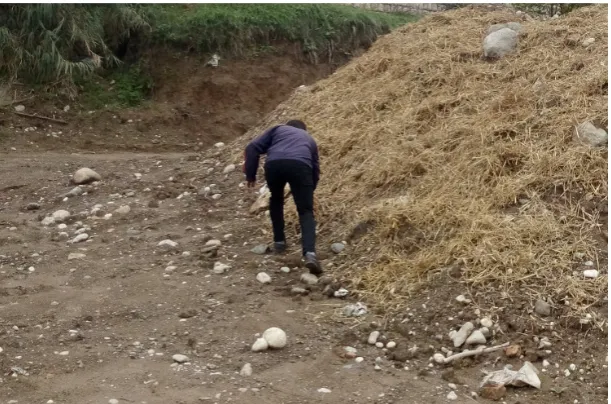
[image:2.595.146.452.527.729.2]Polyacrylamide (PAM) tackifier is a polymer from acrylamide subunits, is used to increase the soil structure stability. The use of PAM has been recognized as a best management practices (BMP) by the USDA-Natural Resources Conservation Ser-vice (NRCS) (Babcock, McLaughlin 2011). The use of acrylic-based polymer mulch is also expand-ing because of its environmental friendliness and safety. Polyacrylamides are odorless, colorless and non-polluting in surface and underground waters, plant tissues and soil (Manafi et al. 2016; Wang et al. 2019). Treatments were spread by hand to attain 75% groundcover on soil cutslopes (Fig. 1, Table 1 Babcock, McLaughlin 2013).
Soil sampling and sieving
After the three months from the treatment es-tablishment, soil samples were taken from 0–10 cm depth of cutslope and then mean weight diameter ex-periments in wet and dry condition was conducted in three replications for each treatment. For each rep-lication 50 g of soil sample with aggregates size of < 4.75 mm was weighed for sieving. Aggregates were transferred on to the series of sieves with 2, 1, 0.5, 0.425, 0.212, 0.090 and 0.045 mm openings. In wet sieving the sieves moved up and down through a ver-tical distance of 1.5 cm at the rate of 30 oscillations per minute. The remaining soil aggregates on sieve were put into the oven for approximately 24 hours in 105°C (Kemper, Rosenau 1986).
Measurement of soil stability indices
The Mean Weight Diameter (MWD) of soil ag-gregate was calculated using Equation 1:
1 K
i i i
MWD W X
(1)where:
Xi – mean diameter of remaining aggregate on sieve,
Wi – ratio of the weight of remained aggregates on each sieve to total weight of sample,
K – number of sieve
After the wet sieving method the aggregate sta-bility index was calculated using Equation 2 (Bis-sonnais 1996):
100
WSA MG AS
MS MG
(2)
where:
WSA – weight of remaining aggregates on sieve 0.25 mm,
MG – weight of gravel and MS is the total weight of sample.
The percentage of aggregate destruction is an-other index for evaluating physical structure of soil which is obtained from the measuring of mean weight diameter of soil aggregate in wet and dry condition. To determine the destruction index (DI)
the weight of aggregates greater than 0.25 mm is calculated in dry (MD) and wet (MW) condition (Equation 3, Van Bavel 1950).
100
MD MW DI
MD
(3)
Statistical analysis
The experimental design was systematic random-ized sampling method with three replications for each treatment. Soil stability indices were statistically analyzed using ANOVA procedure in SAS software. SNK test (Student Newman Kouls) at probability lev-el of 5% was used to compare the means of variables including MWDdry, MWDwet, AS and DI among dif-ferent treatments of A, B, C and control.
RESULTS AND DISCUSSION
Results showed that the effect of treatments on MWDdry (P < 0.01), MWDwet (P < 0.01) and AS (P < 0.05) was significant (Table 2). The B treatment resulted in 34% more MWDdry than control treat-ment (P < 0.05) but the A and C treatments did not show a significant difference in relation to the control (P > 0.05, Fig. 2a). The B treatment was observed to be the most effective in term of MWDwet with 68% increment as compared to the bare soil control (P < 0.05). This increment for treatments of A and C was estimated to be 42% and 52%, respectively (Fig. 2b).
Kukal and Sarkar (2010) showed that wheat straw and polyvinyl acetate (PVA) were more effec-tive in increasing aggregate stability in sandy loam than in silt loam.Bjorneberg et al. (2000) reported that 70% straw cover with PAM (4 kg·ha–1)
signifi-cantly reduce soil loss by almost 100% compared to bare soil than 70% straw with2 kg·ha–1 PAM.This
[image:3.595.64.529.113.158.2]result is supported by the Omane et al. (2018) and Watson et al. (2000). They reported that the adhe-siveness between the molecular structures of the PAM solution is higher and a smaller surface tension leads to decreased evaporation rate. PAMs are man-ufactured in a broad range of molecular weights,
Table 1. Treatmentsused in this study
Treatments A B C Control
Wheat straw (g·m–2) 50 150 250 0
charge types, and charge densities. Breakdown of PAM requires several weeks and occurs as a result of mechanical disturbances (Ding et al. 2019).
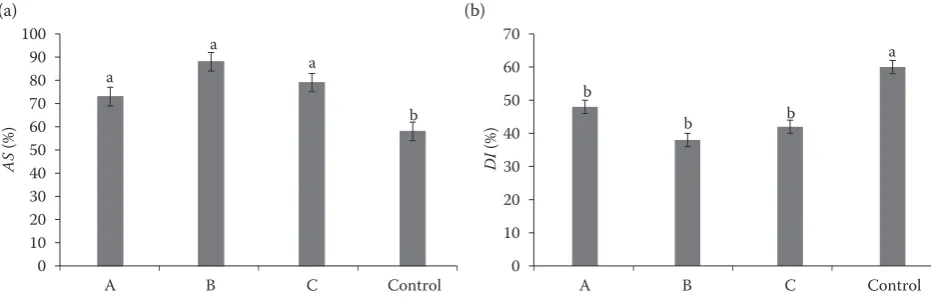
The B treatment resulted in 47% more AS than con-trol treatment (P < 0.05) but the A and C treatments show 28% and 36% increment, respectively (Fig. 3a). The B treatment was observed to be the most effec-tive in term of DI with 37% reduction as compared to the bare soil control (P < 0.05). This reduction for treatments of A and C was estimated to be 20% and 30%, respectively (Fig. 3b). Flanagan and Canady
[image:4.595.63.532.114.185.2](2006) tested the effectiveness of PAM on 4% and 8% slopes with two wheat straw cover levels of 0% and 30% under a rainfall simulator. Results showed that PAM in conjunction with wheat straw increase MWD of aggregates and consequently reduced runoff up to 66% compared to bare soil control. Moradi et al. (2017) showed that application of amendments have a significant effect on structural stability indicators. Ac-cording to the results of this research, application of both PAM and wheat straw improved structural sta-bility and treatment B (150 g·m–2 wheat straw mulch
Table 2. Analysis of variance for soil structural stability indicators
Sources of variations df Mean squares
MWDwet MWDdry AS DI
Treatment 3 0.035** 0.223** 342.563* 241.112ns
Error 2 0.001 0.012 12.512 9.856
CV (%) – 5.124 7.635 4.524 6.131
MWDdry–mean weight diameter in dry conditions, MWDwet–mean weight diameter in wet conditions, AS– aggregate stability
index, DI– destructionindex;*, ** significant at probability level of 95% and 99%; respectively, ns – not significant
0 10 20 30 40 50 60 70 80 90 100
A B C Control
A
S
(%
)
a
a
a
b
0 10 20 30 40 50 60 70
A B C Control
D
I
(%
)
a
b
b b
0 1 2 3 4 5 6 7
A B C Control
M
W
D
d
ry
(mm
) b
a
b
b
0.0 0.2 0.4 0.6 0.8 1.0
A B C Control
M
W
D
w
et
(mm)
a
a
a
[image:4.595.67.532.226.367.2]b (a) (b)
Fig. 2. Effect of treatments on mean weight diameter of aggregates in (a) dry sieving (MWDdry), (b) wet sieving ( MWD-wet); different letters shows significant difference at probability level of 5% based on SNK test
Fig. 3. Effect of treatments on aggregate (a) stability index (AS), (b) destructionindex (DI); different letters shows signifi-cant difference at probability level of 5% based on SNK test
[image:4.595.65.531.580.729.2]and 3 g·m–2 Polyacrylamide tackifier) was better than
other treatments in decreasing the percentage of de-struction aggregate.
COCLUSIONS
The main objective of the study was to test the soil stabilization performance of selected treat-ments compared to the bare soil control in terms of aggregate stability of soil. Results confirmed the efficiency of straw mulch in conjunction with Polyacrylamide to increase soil stability. In current study, the most efficient treatment with respect to MWD, AS and DI was treatment of 150 g·m–2 wheat
straw mulch and 3 g·m–2 Polyacrylamide
tacki-fier. Wheat straw can be used in erosion control as mulch. Straw mulch is inexpensive and easier to spread by hand or machine. Straw provides a high degree of cover to reduce the impact of raindrops and prevent soil particle detachment. Besides, Polyacrylamide increased and preserved surface aggregate structure, with reduced surface crusting, increased infiltration and decreased runoff volume.
References
Akbarimehr M., Naghdi R. (2012): Reducing erosion from for-est roads and skid trails by management practices. Journal of Forest Science, 58: 165–169.
Babcock D., McLaughlin R. (2011): Runoff water quality and vegetative establishment for groundcovers on steep slopes. Journal of Soil and Water Conservation, 66: 132–141. Babcock D., McLaughlin R. (2013): Erosion control
effec-tiveness of straw, hydromulch and polyacrylamide in a rainfall simulator. Journal of Soil and Water Conservation, 68: 221–227.
Bissonnais Y.L.E. (1996): Aggregate stability and assessment of soil crustability and erodibility: I. Theory and methodol-ogy. Europian Journal of Soil Science, 47: 425–437. Bjorneberg D., Aase J., Westermann D. (2000): Controlling
sprinkler irrigation runoff, erosion, and phosphorus loss with straw and polyacrylamide. Transactions of the ASAE, 43: 1545–1551.
Ding X., Xu G., Liu W.V., Yang L., Albijanic B. (2019): Effect of polymer stabilizers’ viscosity on red sand structure strength and dust pollution resistance. Powder Technol-ogy, 352: 117–125.
Flanagan D.C., Canady N.H. (2006): Use of polyacrylamide in simulated land application of lagoon effluent: Part I. runoff and sediment loss. Transactions of the ASABE, 49: 1361–1369.
Hayes S.A., McLaughlin R.A., Osmond D.L. (2005): Poly-acrylamide use for erosion and turbidity control on con-struction sites. Journal of Soil and Water Conservation, 60: 193–199.
Kukal S.S., Sarkar M. (2010): Splash erosion and infiltration in relation to mulching and polyvinyl alcohol application in semi-arid tropics. Archive of Agronomy Soil Sciences,
56: 697–705.
Kemper W.D., Rosenau R.C. (1986): Size distribution of ag-gregates. In: Klute A. (ed.): Methods of Soil Analysis, Part 1. Agronomy Monograph No. 9. Madison, ASA-SSSA: 425–442. Available at https://eprints.nwisrl.ars.usda.gov/732/3/585.pdf Lentz R.D., Bjorneberg D.L. (2003): Polyacrylamide and straw residue effects on irrigation furrow erosion and infiltration. Journal of Soil and Water Conservation, 58: 312–318. Moradi N., Emami H., Astaraei A.R., Fotovat A., Ghahraman
B. (2017): The effect of nanoparticles of Aluminum oxide and Silicon oxide on soil structural stability indices. Journal of Water and Soil Conservation, 23: 253–265.
Manafi M.R., Manafi P., Kehtari Karam S. (2016): Prevent soil loss by copolymer based on polyacrylamide. Journal of Advanced Materials and Technologies, 4: 6–11. (in Persian) Omane D., Liu W.V., Pourrahimian Y. (2018): Comparison of
chemical suppressants under different atmospheric tem-peratures for the control of fugitive dust emission on mine hauls roads. Atmospheric Pollution Research, 9: 561–568. Roa-Espinosa A., Bubenzer G.D., Miyashita E.S. (1999): Sedi-ment and runoff control on construction sites using four application methods of polyacrylamide mix. St. Joseph, ASAE, American Society Agricultural Engineers Annual Meeting Paper No. 99–2013.
Van Bavel C.H.M. (1950): Mean weight diameter of soil ag-gregates as a statistical index of aggregation. Soil Science Society of America Proceeding, 14: 20–23.
Watson J.G., Chow J.C., Pace T.G. (2000): Fugitive dust emis-sions. In: Davis W.T. (ed.): Air pollution engineering manual. New York, John Wiley & Sons: 117–135.
Wang H., Wei X., Du Y., Wang D. (2019): Effect of water-soluble polymers on the performance of dust-suppression foams: Wettability, surface viscosity and stability. Colloids and Surfaces A: Physicochemical and Engineering Aspects, 568: 92–98.