The Dynamic Curriculum Planning for a Database
Design Tutoring System
Feng-Jen Yang,
Member, IAENG
Abstract—As an intelligent tutoring system that tutors learn-ers in the domain of relational database schema normalizations. This virtual tutor is designed to be able to dynamically plan a sequence of problem solving sessions based on the run time interactions between a learner and the virtual tutor. This is an essential effort to make a virtual tutor more humanized so that instead of reiterating the knowledge that a learner has already conceived the virtual tutor can more appropriately challenge the learner at a suitable level of difficulty.
Index Terms—virtual tutor, intelligent tutoring system, dy-namic curriculum planning.
I. INTRODUCTION
W
THIN the shifting of paradigms from the traditionalComputer Aided Instruction (CAI) to the newer In-telligent Tutoring System (ITS), a remarkable advancement is that ITS can mimic real life tutoring behavior better than the traditional CAI. In real life, most of the human tutors will continuously evaluate the knowledge levels that their learners have conceived and prevent to reiterate what they have already learned. While the traditional CAI was not taking this essential human tutoring factor into consideration but tutoring all learners in the same manner to go through the entire set of predefined lessons, the newer ITS is more humanized in a manner of preparing dynamic curricula for learners based on their actually knowledge levels. This paper describes the dynamic curriculum planning within an intelligent tutoring system for relational database schema normalizations.
II. BACKGROUND
ANT (A Normalization Tutor) is an intelligent tutoring system motivated by the necessity of tutoring students in the domain of relational database schema normalization. The normalization of relational schema is the most important trade-off between database performance and data redun-dancy. This is also one of the major hurdles that database beginners will struggle to leap over. With this concern in mind, I implemented an intelligent tutoring system to assist the learning of this domain. Cognitive studies showed that students being tutored privately can learn approximately four times faster than students attending traditional classroom lectures [5]. Considering the very limited availability and affordability of hiring private tutors, the most cost effec-tive alternaeffec-tive is working with intelligent tutoring systems. Furthermore, learning from intelligent tutoring systems is authentic and risk free. The system is available 7 days a week and 24 hours a day. A student can sit comfortably and work with the system whenever possible.
Manuscript received July 6, 2013; revised July 28, 2013.
F. Yang is with the Department of Mathematics and Information Sciences, University of North Texas at Dallas, TX, 75241 USA, e-mail: [email protected].
A. The Emulation of Real Life Tutoring
In this application domain, the life tutoring is emulated by the collaboration of five modules, namely the student mod-eling, the instruction modeling, the domain knowledge, the
curriculum planningand the user interface. While tutoring, these five modules work together as follows [7], [8]:
1) The student modeling module is used to reflect a student’s cognitive status of learning normalization. Based on the student’s interaction with the system, it continuously evaluates the student’s progress of knowledge acquisition, and diagnoses the misconceptions that a student has revealed. The overall learning status is then become the basis to plan an adaptivecurriculum for the current student.
2) By consulting student modeling and domain knowledge, the adaptive curriculum planning module customizes a se-quence of problem solving sessions to be conducted to the current student.
3) In accordance with the adaptive curriculum begin planned, the instruction modeling module mimics a human tutor to conduct the curriculum. In this system, I adopt the
Socratic styleof tutoring to control the discourse and avoid open-end discussions [2], [4], [6].
4) Thedomain knowledgeis a typical module in intelligent systems. In this system, a backward chaining inference engine using rule-based normalization knowledge fromFirst Normal Form (1NF)toThird Normal Form (3NF)is imple-mented to support the problem solving.
5) As an auxiliary module to facilitate learning, the user interfaceis a vital design to push throughlearn-by-doingand make a student feel comfortable and confident while working with the virtual tutor.
B. A Sample Tutoring Session
In the tutoring domain of ANT, the Socratic style of tutoring is implemented as a dynamic protocol driven by the interactions between a student and the virtual tutor. A sample tutoring session taken from the system is illustrated in the following steps [8]:
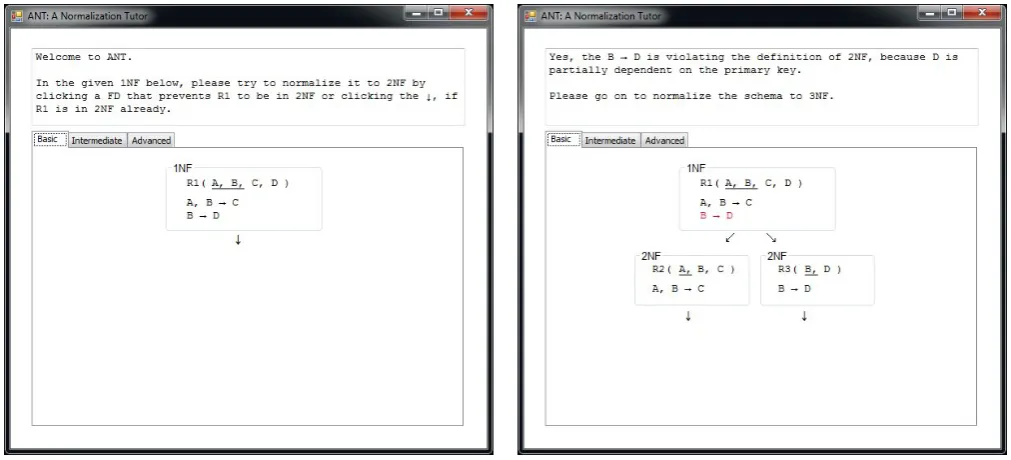
1) Presenting a 1NF schema to the student in which the Primary Key (PK) is underlined and the Functional Dependencies (FDs) are visualized by arrows going from the determinant attributes to dependent attributes as shown in Figure 1. This schema reads asA and B together are the compound PK, A and B functionally determine C, and B functionally determines D. The student is then asked to click the problematicFD that prevents R1 from being in 2NF or click the↓if R1 is in 2NF inherently.
Fig. 1. A Given Schema in 1NF
Fig. 2. Diagnosing the Student’s Misconception about 2NF
other clicks are diagnosed as the student’s misconceptions and the virtual tutor will take remediate actions accordingly to further guide the student towards finding the problematic FD as shown in Figure 2.
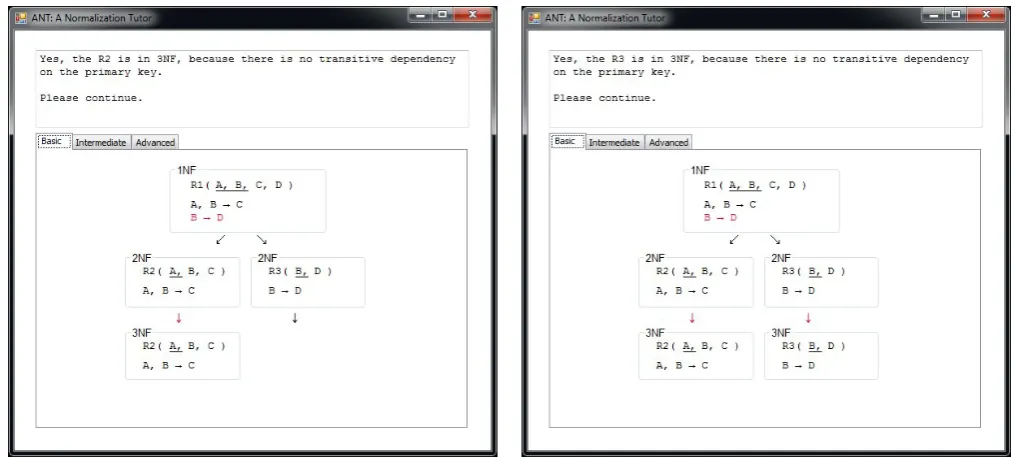
3) After theB→Dis clicked, the system will decompose R1 into R2 and R3. Both R2 and R3 are now in 2NF. The student is then asked to click theFDthat prevents R2 from being in 3NF or click the ↓ if R2 is in 3NF inherently as shown in Figure 3.
4) Diagnosing the students misconceptions based on what is being clicked. Since R2 is in 3NF already, the ↓ should be clicked. Other clicks are diagnosed as the student’s mis-conceptions and the virtual tutor will take remediate actions accordingly as shown in Figure 4.
5) After the ↓ is clicked, the system will bring R3 down to the level of 3NF. The student is then asked to click the
FDthat prevents R3 from being in 3NF or click the↓if R3
[image:2.595.60.546.318.548.2]Fig. 3. The Schema Is Normalized into 2NF
Fig. 4. Diagnosing the Student’s Misconception about 3NF
is in 3NF inherently as shown in Figure 5.
6) Diagnosing the student’s misconceptions based on what is being clicked. Since R3 is in 3NF already, the ↓ should be clicked. Other clicks are diagnosed as the student’s mis-conceptions and the virtual tutor will take remediate actions accordingly as shown in Figure 6.
7) After the ↓ is clicked, the system will bring R3 down to the level of 3NF as shown in Figure 7.
Along with a tutoring session, the student is able to
[image:2.595.298.550.323.550.2]Fig. 5. The Schema Is Partly Normalized into 3NF
Fig. 6. Diagnosing the Student’s Misconception about 3NF Again
III. THEDYNAMICCURRICULUMPLANNING
The current version of ANT consists of three difficulty levels, namely the basic level, the intermediate level and the advanced level. Each difficulty level in turn consists of three problem solving sessions. Although the learner is allowed to choose any level to start a tutoring session, at the end of a session, the curriculum planning module will consult the student modeling module to know the learner’s performance. Based on the learner’s actual performance the curriculum planning module can dynamically determine a level for the next tutoring session. The learner may be
retained at the same level, promoted to a higher level, or
[image:3.595.333.518.333.403.2]demotedto a lower level. So that different learners may go through different sequence of problem solving sessions until the domain knowledge is really comprehended.
Fig. 7. The Schema Is Completely Normalized into 3NF
TABLE I
THEPROGRESSIONS ANDMISCONCEPTIONS
Progression Misconception
1 From 1NF to 2NF 1 Misconceiving FFD 2 Mis-defining 2NF
2 From 2NF to 3NF 1 Misconceiving TD 2 Mis-defining 3NF
A. The Learning Status of a Student
To support the aforementioned dynamic curriculum plan-ning, a student’s misconceptions are continuously evaluated by the student modeling module during a tutoring session. In the current implementation the possible misconceptions in each progression are listed in Table 1, where the FFD
stands for Fully Functional Dependency, and TD stands for Transitive Dependency. In this table, each progression is also numbered according to its difficulty level and each misconception is numbered according to its severe level within its related progression.
The learning status of a student is evaluated by the
Weighted Total of Misconceptions (WTM)that a student has revealed during a tutoring session. Based on the miscon-ceptions that a student has revealed, a WTM is calculated by accumulating the multiplication of each misconception number and its progression number. As an illustration of this weighted calculation, assume that a student has mis-defined 2NF and misconceived TD, this student’s WTM is calculated as:
W T M = 1×2 + 2×1 = 4
TABLE II
THEWTM SCALE ANDNEXTTUTORINGSESSION
WTM Scale Next Tutoring Session
WTM=0 Promote to the next higher level 1≤WTM≤2 Retain at the same level
WTM>2 Demote to the next lower level
BEGIN
Choose a difficulty level to start SWITCH (level)
CASE basic:
Go on to the planning of basic sessions
CASE intermediate:
Go on to the planning of intermediate sessions CASE advanced:
Go on to the planning of advanced sessions
CASE exit:
Exit the system ENDSWITCH
END
Fig. 8. Choosing a Level to Start
B. The Start of Curriculum Planning
Whenever the system is executed, a curriculum is dy-namically planned. At the beginning the virtual tutor allows students to choose any difficulty level to start based their self-estimation of knowledge levels. The algorithm to start a self-chosen session is shown in Figure 8. From then on, the virtual tutor may decide to promote, retain, or demote the student to a level that is considered to more appropriate for the current student.
C. The Planning of Basic Sessions
When the student has chosen to start from the basic level, or has been demoted to the basic level, the virtual tutor will sequentially conduct the three predefined problem solving sessions until the student is promoted to the intermediate level. If the student is still retained at this level after all of these threes sessions are conducted, the virtual tutor will repeat these sessions again until the the student is qualified for a promotion. The planning algorithm of basic sessions is shown in Figure 9.
D. The Planning of Intermediate Sessions
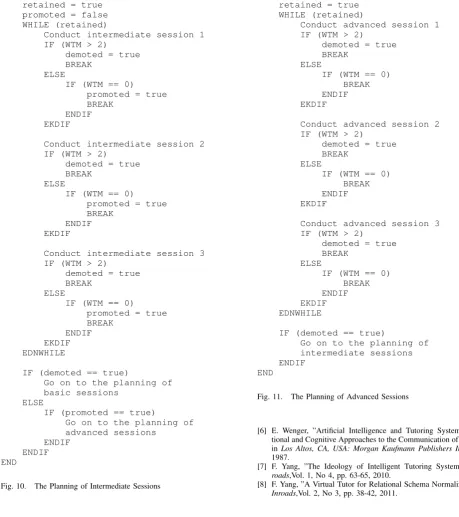
A student may choose to start from the intermediate level, may be promoted to the intermediate level, or may be demoted to the intermediate level. When the student enters this level, the virtual tutor will sequentially conduct the three predefined problem solving sessions until the student is either promoted to the advanced level or demoted to the basic level. If the student is still retained at this level after all of these threes sessions are conducted, the virtual tutor will repeat these sessions again until the the student is further promoted or demoted. The planning algorithm of intermediate sessions is shown in Figure 10.
BEGIN
promoted = false WHILE (NOT promoted)
Conduct basics session 1 IF (WTM == 0)
promoted = true BREAK
ENDIF
Conduct basics session 2 IF (WTM == 0)
promoted = true BREAK
ENDIF
Conduct basics session 3 IF (WTM ==0)
promoted = true BREAK
ENDIF EDNWHILE
Go on to the planning of intermediate sessions
END
Fig. 9. The Planning of Basic Sessions
E. The Planning of Advanced Sessions
A student may choose to start from the advanced level or may be promoted to the advanced level. When the student enters this level, the virtual tutor will sequentially conduct the three predefined problem solving sessions until the student is either qualified to leave the system or demoted to the intermediate level. If the student is still retained at this level after all of these threes sessions are conducted, the virtual tutor will repeat these sessions again until the the student is allowed to leave or demoted. The planning algorithm of intermediate sessions is shown in Figure 11.
IV. CONCLUSION
There is a fine line between challenging a student and frustrating a student. This critical trade-off is an essential tutoring philosophy that confronts not only human tutors but also virtual tutors. In the context of virtual tutoring, a good curriculum planner must able to dynamically choose and sequence the sessions to be tutored based on the run time interactions between a student and the virtual tutor [1], [3]. In this paper, I addressed the dynamic and adaptive curriculum planning within the tutoring domain of ANT system. Although the current implementation is covering the normalizations from 1NF to 3NF only, it will be continuously enhanced to have a full coverage of the normalizations from 1NF to 5NF. Some more related pedagogical theories will also be incorporated to further abound the tutoring strategies of this system.
V. ACKNOWLEDGEMENT
BEGIN
demoted = false retained = true promoted = false WHILE (retained)
Conduct intermediate session 1 IF (WTM > 2)
demoted = true BREAK
ELSE
IF (WTM == 0) promoted = true BREAK
ENDIF EKDIF
Conduct intermediate session 2 IF (WTM > 2)
demoted = true BREAK
ELSE
IF (WTM == 0) promoted = true BREAK
ENDIF EKDIF
Conduct intermediate session 3 IF (WTM > 2)
demoted = true BREAK
ELSE
IF (WTM == 0) promoted = true BREAK
ENDIF EKDIF EDNWHILE
IF (demoted == true)
Go on to the planning of basic sessions
ELSE
IF (promoted == true)
Go on to the planning of advanced sessions
[image:5.595.46.506.71.589.2]ENDIF ENDIF END
Fig. 10. The Planning of Intermediate Sessions
REFERENCES
[1] B. Cho, J. Michael, A. Rovick and M. Evens, ”A Curriculum Plannig Model for an INtelligent Tutoring System,” in Proceedings of the Twelfth International Florida AI Research Society Conference (FLAIRS-99), Orlando, FL, USA, pp. 197-201, 1999.
[2] M. Evens and J. Michael, ”One-on-One Tutoring by Humans and Computers,”Mahwah, NJ, USA: Lawrence Erlbaum Associates Incor-poration, 2006.
[3] S. Katz, A. Lesgold, G. Eggan, M. Girdin and L. Greenberg, ”Self-adjusting Curriculum Planning in Sherlock II,” in Lecture Notes in Computer Science: Proceedings of the Forth International Conference on Computers in Learning (ICCAL’92), Berlin: Springer Verlag, pp.343-355, 1992.
[4] G. Kearsley, ”Artificial Intelligence and Instruction: Applications and Methods,” Reading, MA, USA: Addison Wesley Longman Publishing Corporation, 1987.
[5] B. J. Reiser, J. R. Anderson and R. G. Farrell, ”Dynamic Student Modeling in an Intelligent Tutoring System for LISP Programming,” in
Proceedings of the Eighth International Joint Conference on Artificial Intelligence, Los Angeles, CA, USA, pp. 8-14, 1985.
BEGIN
demoted = false retained = true WHILE (retained)
Conduct advanced session 1 IF (WTM > 2)
demoted = true BREAK
ELSE
IF (WTM == 0) BREAK ENDIF EKDIF
Conduct advanced session 2 IF (WTM > 2)
demoted = true BREAK
ELSE
IF (WTM == 0) BREAK ENDIF EKDIF
Conduct advanced session 3 IF (WTM > 2)
demoted = true BREAK
ELSE
IF (WTM == 0) BREAK ENDIF EKDIF EDNWHILE
IF (demoted == true)
Go on to the planning of intermediate sessions ENDIF
END
Fig. 11. The Planning of Advanced Sessions
[6] E. Wenger, ”Artificial Intelligence and Tutoring Systems: Computa-tional and Cognitive Approaches to the Communication of Knowledge,” inLos Altos, CA, USA: Morgan Kaufmann Publishers Incorporation, 1987.
[7] F. Yang, ”The Ideology of Intelligent Tutoring Systems,” ACM In-roads,Vol. 1, No 4, pp. 63-65, 2010.