Abstract—In logistics, it is necessary to planning meetings to accomplish projects. For many planners, the meeting logistic could be challenging, due to the complex problem of setting up a low-risk strategy that considers the infrastructure. A preferred requirement is a fault-tolerant possibility, especially in high impact workgroups where meeting attendees are more or less critical for achieving the goal of the meeting.
In this work-in-progress paper, we used multilevel networks to represent infrastructure links between meeting members prospects. In our case of study, a wedding social event, the participants expressed their desire for attending the social meeting, and infrastructure network information was used to distinguish strategic groups within the airlines-airports network using multilevel network analysis algorithms.
We compared the simple infrastructure network analysis versus multilevel network analysis. Finally, we discussed the advantages and disadvantages of multilayer logistics from infrastructure multilevel network analysis approach to planning recommendations into a socio-technical system.
Index Terms—Logistics, Infrastructure network, Social net-work, Multilevel networks analysis algorithms, Recommenda-tion systems.
I. INTRODUCTION
I
N logistics, it is necessary to planning to accomplish projects. For many planners, the logistic could be chal-lenging, due to the complex problem of setting up a low-risk strategy that considers the infrastructure. A preferred requirement is a fault-tolerant possibility, especially in high impact organizations where sometimes are more or less critical for achieving the goal of the system.There are many ways to configure a logistic to set up a strategy, but we would like each one to be able to achieve the proposed goal successfully. One way is to create plans randomly, but some of them could be risky and prone to fail. Another way is simply find the shortest path to connect all together, but the success of all cannot be assured because there are some system participants that his presence would be crucial. Therefore, in addition to the infrastructure network, we would like to use the enterprise networks approach to analyze the relationship between airlines to discover other ways to plan strategies for a system.
The airlines network could be a description of airlines part-nership to others and used to identify featured organization in infrastructure systems. For example, we could use it to discover structures, applying network analysis algorithms to find emphasized airlines. Multilevel network theory metrics
Manuscript received March 24, 2017; revised March 31, 2017. This work was supported in part by the MyDCI program of the Division of Graduate Studies and Research, of the Autonomous University of Baja California, Mexico. The financial support provided by our sponsor CONACYT contract grant number: 218145. Jos´e de Jes´us Parra-Galaviz, Carelia Gaxiola– Pacheco, and Manuel Casta˜n´on–Puga are with the Autonomous University of Baja California, Tijuana, BC, 22390, Mexico, e-mail: joseparra95, cgax-iola, puga @uabc.edu.mx.
can help us to establish a core to qualify the risk of meetings. The identified groups of participants can express the local structures in the airlines system and could be used to propose strategy organizationally convenient.
In this work-in-progress paper, we used multilevel net-works to represent airline-infrastructure links between strate-gies prospects. In our case of study, a wedding social event, the participants expressed their desire for preferred airline, and network information was used to distinguish strategic groups within the people-airports network using multilevel network analysis algorithms.
We compared the simple infrastructure network analysis versus multilevel network analysis. Finally, we discussed the advantages and disadvantages of multilayer logistics from airline-infrastructure multilevel network analysis approach to planning recommendations into a socio-technical system.
II. RELATED WORK
A. Recommendation Systems
A recommended system is a software based on pref-erences and user profiles to give a recommendation in a given context. At present, in a high number of pages offer recommendations, for tourists and travelers. In[1] Adaptive recommendation system to provide a comprehensive view of traveler specifications and assumptions. On the other hand, be adaptive there is need to have a holistic perspective in terms of dimensions of traveler and travel products.
B. Infrastructure Logistics
Without a doubt, the organization of an event, activity or meeting involves a lot of effort, and logistics requires mobilization, cost, time and an efficient distribution of re-sources. However, something that is not in our hands is delays or cancellations. In [2], the use of a genetic algorithm for optimization and integration of cellular automata to the genetic algorithm to improve the performance. Sometimes trying to organize events may become difficult as in this research [3]. They address the problem of designing and implementing the logistics of hosting a large number of participants in individual and practical sessions on a massive scale, during a major scientific meeting or a continuing medical education course.In summary, they have developed a practical and workable methodology that can be adapted for use in scientific meetings and courses.
C. Social Networks
Fig. 1. Model of Multilevel network with three layers
connect these individuals to one another. Most of the time we join people who have some degree of similarity to us in [5] , proposed the use of parameters of social selection where these parameters could help to know the degree of similarity of the people and other attributes that can affect affiliation to a certain level, as well as the overall structure of the multilevel network. In conclusion, they determined that the additional incorporation of these parameters, will give them a more detailed and complete view the network structure and the underlying processes of the network.
D. Multilevel Network Analysis
Multilevel networks constitute the natural environment to represent interconnected systems, where an entity can be present in several of these systems, each of these systems form a layer on the network[6].
Nowadays when a problem is modeled raised it from the point of view of a single dimension, for example in a social network [7] an individual tends to represent themselves as a simple graph in a friendship, however, forget that this individual have different interactions with other nodes, as the family relationship of fellowship, friendship among others, if each of these interactions is represented in different layers the model would be more attached to reality [8].
With a multilevel network analysis we can identify who plays a central role in the structure of the system, the quality of their interactions, the tendency of nodes to form triangles and which node is the most visited as a bridge to get to another node, among other relevant metrics in order to minimize risks in the structure of the network.
Most of the research on multilevel networks are based on the strength and tolerance to failures. The most commonly used metrics are the analysis of the centrality of degree, betweenness centrality and eigenvector. Interpretation of de-gree centrality measure varies according to the context that is used for example when used in a social network can represent the friends of that person, if the context changes to air transport may represent the number of airline flights to other airports. On the other hand the measure betweenness is responsible for counting the number of times a node is used as an intermediary in the search for the path shorter than the other two nodes. If what we want is to know the influence of a node in the network, the centrality of the eigenvector is the correct action, carried out searches for nodes that are connected to other nodes that have a high degree of centrality. in [8], model the network of European
Fig. 2. The logistics recommendation system
air transport, addressing the problem of rescheduling flights to passengers and resilience of the network under random failures, where the layers represent airlines and airports are the nodes that are present in different layers. A research of robustness and resistance of the network is carried out from single-layer and multilayer approach. As a result, it was concluded that the multilevel paradigm reduces the resistance of the system noise.
In Figure 1 the model of a multilevel network with three layers each node can be in one or more layers. A node has connections inside and outside its layer, each of these connections can be classified qualitatively or quantitatively.
III. THE LOGISTICS RECOMMENDATION SYSTEM
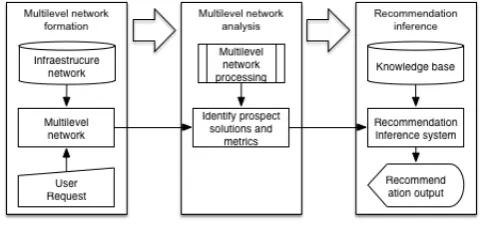
In Figure 2 the process to produce a recommendation from multilevel network analysis. The meeting members links are represented by social network and the infrastructure by physical connections and the resulting metrics used to infer a recommendation.
A. Multilevel Network Formation
In this step, the goal is to create a multilevel network by social and infrastructure systems.
1) Infraestrucure Network: The infrastructure network is the set of connections where meeting members are con-strained to moving.
2) User Request: The user request a recommendation. 3) Multilevel Network: A complex multilevel network obtains it from infrastructure and social network.
B. Multilevel Network Analysis
In this step, the information is processed by multilevel network analysis algorithms to identify prospects plans and obtain metrics values.
1) Identify Prospect Solutions and Metrics: Prospects solutions and its parameters values identified.
2) Multilevel Network Processing:Algorithms analyse the multilevel network created in the previous step.
C. Recommendation Inference
In this step, the solutions and its parameters values are used to infer recommendations.
[image:2.595.309.550.59.173.2]When an important event approaches the problem that always emerges is the location of the meeting. Our case study is the realization of a wedding, the bride and groom have a list of attendees according to categories such as family, relatives, best friends, friends, and colleagues.
Each category has different importance in the decision mak-ing of the location. It is also necessary to analyze the airport networks for their direct flights, with a stopover , and a history of delays or cancellations.
The data used to build the network were used in [9]. Once the network is analyzed, the data is entered recommender system to give as viable alternatives result in locations that are accepted by most of the guests without compromising the event.
A. Methodology
First, we build the multilevel network; it has 37 levels, each representing an airline, the links are the flights of the airlines, in each layer are the same airports, but only one airline. Wedding guests will be randomly distributed on the network and assigned an airport of origin, and will also have the influence label on the wedding venue. A network with a single layer will also be designed. In both models, centrality measures will be applied as described below.
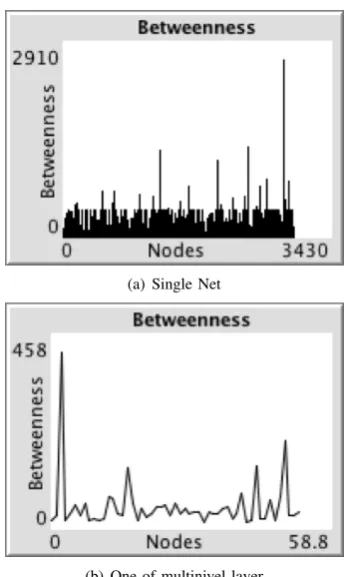
In table I shows a comparison of the measures betweenness and centrality degree (the eigenvector measure is not included in this comparison). The first column indicates the five high outcomes of the measures, the next column is the name of the metric and has results for the network view from single layer and one of the 37 layers of the model. The results of Betweenness are not standardized.
Immediately we can see the differences in the degree central-ity, where it is seen from a simple network, we can observe that there are nodes with more than 100 connections and is not modeling the existence of the airlines, so if a link is removed the model interprets that no one else can make the flight. In the context of the bride and groom does not model the categories of a friendship of each one.
On the other hand, the degree centrality seen from multilevel networks shows a lower connection but is only a fragment of the total network, in the context of the airlines if something fails in that layer, there is still the possibility of flying through another layer (airline).
Finally the measure of betweenness modeled from a simple network, we can deduce from Table 1 that there are critical nodes in the network; without groups, or distinctions. When modeling as a multilevel network, we identified several nodes that influence different groups, from the context of the groom we would see the importance of friendships of the bride and the influence of friendships of the groom and other influencers.
A representation of simulated network are in Figure 3 where subsection (a) is the graph of airports and direct flights
5 95 2 859 76
for all network, and in subsection (b) only one of all layers of the network is shown. It means that in the upper figure only airports and flights are considered, the lower image recognizes airports and airlines that perform flights, in such a way that a flight can be made by more than one airline.
(a) Single Net
(b) One of multilevel layer
Fig. 3. Representation of airports and their flights.
As we know, there are cities that have airports with many departures, in Figure 4 are a centrality degree measure where subsection (a) represents all the airports with all the direct flights, for that reason we see airports(nodes) with a lot of connections, and in subsection (b) one layer of the multilevel network, represents the number of direct flights between airports, between more direct flights has greater will be its connection in the layer (Only one airline).
In Figure 5 subsection (a) graph of the measure be-tweenness of the entire network of airports and flights, in subsection (b) only one of 37 layers of network and represents airports where an airline has flights.
(a) Single Net
[image:4.595.312.542.52.261.2](b) One of multilevel layer
Fig. 4. Node Degree Measure.
(a) Single Net
(b) One of multinivel layer
Fig. 5. Betweenness Measure.
influential node of the network, however in the context of our case study, this does not cling to reality because the bride and groom will have each of them friends or family or co-workers influencing them as in Figure 6 subsection (a) applied for a simple network and subsection (b) the influence of a node on a given layer.
B. Results
When airports and flights are simulated in both models we can conclude that a simple network considers a route as unique, i.e. in a case of any contingency the entire route is disabled, nobody can flight from origin to destiny.
(a) Single Net
[image:4.595.55.286.52.257.2](b) One of multinivel layer
Fig. 6. Eigenvector Measure.
Instead, the multilevel network manages routes for airlines and contingency affects the airline and not to the whole route. Just modeling the problem of logistics in a multilevel network promising results are observed, such as represent the network of friendships with categories and the network of airports with flights and airlines.
When node degree measure is applied, it gets a node with the highest connection. In our case of study, from a sin-gle network this means airport most connected, and from friendship context is the person with most friends, from a multilevel network means that each level has an airport highly connected and know that whoever has the most friends is not necessarily the most important in the network of friends.
To establish the route of the event it is important to know the most visited airport that serves as a bridge to reach another destination. The multilevel network model allows label the guests by priorities and is flexible in case of cancellation of flights by offering alternatives.
V. CONCLUSION AND FUTURE WORK
In this work-in-progress paper, we used multilevel net-works to represent airlines and flights between airports the result will become in inputs of a recommendation inference system. In our case study, a location is needed to celebrate a wedding in which most of the guests can attend, but some guests have priority and can influence the decision, this information was used to detect potential routes that guests can take, all this with the use of network analysis algorithms. Also this case study is carried under the approach of a simple complex network to compare both models.
[image:4.595.82.256.299.588.2]sions with a full-scale patient simulator at a scientific meeting,”Journal of Clinical Monitoring, vol. 13, pp. 399–407, 1997.
[4] K. Marx, M. Rubel, and .-. Bottomore, T. B., Selected writings in sociology and social philosophy. Harmondsworth, Mddx. : Penguin Books, 1963.
[5] P. Wang, G. Robins, P. Pattison, and E. Lazega, “Social selection models for multilevel networks,”Social Networks, vol. 44, pp. 346 – 362, 2016. [6] S. Boccaletti, G. Bianconi, R. Criado, C. del Genio, J. Gmez-Gardees, M. Romance, I. Sendia-Nadal, Z. Wang, and M. Zanin, “The structure and dynamics of multilayer networks,”Physics Reports, vol. 544, pp. 1 – 122, 2014.
[7] S. Wasserman and K. Faust, Social network analysis: Methods and applications. Cambridge university press, 1994, vol. 8.
[8] A. Cardillo, M. Zanin, J. G´omez-Garde˜nes, M. Romance, A. J. Garc´ıa del Amo, and S. Boccaletti, “Modeling the multi-layer nature of the european air transport network: Resilience and passengers re-scheduling under random failures,”The European Physical Journal Special Topics, vol. 215, pp. 23–33, 2013. [Online]. Available: http://dx.doi.org/10.1140/epjst/e2013-01712-8