Can Late Flushing Trees Avoid Attack by Moth Larvae
in Temperate Forests?
Ján KulfaN 1, lenka SarVašoVá1,2*, Michal ParáK 1, Marek DzureNKo 1,2 and Peter zach 1 1Institute of forest ecology, Slovak academy of Sciences, zvolen, Slovak republic; 2faculty
of ecology and environmental Sciences, Technical university in zvolen, zvolen, Slovak republic *corresponding author: [email protected]
Abstract
Kulfan J., Sarvašová L., Parák M., Dzurenko M., Zach P. (2018): Can late flushing trees avoid attack by moth larvae in temperate forests? Plant Protect. Sci., 54: 272–283.
We investigated moth larvae (Lepidoptera) developing in temperate forests in Central Europe shortly after the tree budburst (the “brumata-viridana complex”). Larvae were collected in southern Slovakia in May 2015 and May 2016 from young and mature trees of late flushing Quercus cerris L. and early flushing Q. pubescens Willd. Although Q. cerris yielded fewer species (40 species) than Q. pubescens (47 species), the rarefied number of species and the Chao index suggested a similar number of species on mature trees of both oak species. Both the total number of moth larvae in assemblages and the abundance of dominant species (pests) were significantly lower on Q. cerris than Q. pubescens. The results suggest the release of Q. cerris with delayed budburst from heavy infestations by folivorous moth larvae. Knowledge obtained can be applied in silvicultural and horticultural practices aimed to protect and maintain forest, fruit, and ornamental trees.
Keywords: Quercus cerris; Quercus pubescens;folivorous insects; Lepidoptera; phenology; budburst
Phenological synchrony between the hatching of folivorous larvae and the budburst of their host plants is crucially important for the fitness of many spring insect herbivores (Tikkanen & Julkunen-Tiitto 2003). This phenomenon has been documented in many lepidopteran species (Du Merle 1988; Hunter 1990, 1992; Van Dongen et al. 1997; Hunter & Elkinton 2000; Tikkanen & Lyytikäinen-Saarenmaa 2002). Recently, greater attention has been paid to the asynchrony (or mismatch) between insects and their host plants to reveal impacts of global warming on interspecific interactions (Visser & Holleman 2001; van Asch et al. 2007; De Vries et al. 2011; Foster et al. 2013; Wagenhoff et al. 2013; Martemyanov et al. 2015; Despland 2018). The phenological asynchrony between insect herbivores
and their hosts may modify the patterns of defoliation in temperate forests (Foster et al. 2013).
There are two types of asynchrony between the hatching of folivorous moth larvae and the tree budburst: (1) larvae hatch later – when leaves are relatively old and already well developed; (2) larvae hatch early – when leaves are not present as buds are still closed. In both cases, the larvae can disperse to suitable feeding sites using ballooning, lowering or walking (Holliday 1977; Hunter 1990; Zalucki
et al. 2002; Despland 2018) but their success in finding a suitable host is not clear (Zalucki et al.
2002). Negative effects of old leaves or low quality food on the late occurring larvae are well known (e.g. Feeny 1968, 1970; Raupp et al. 1988; Hunter & Lechowicz 1992; Tikkanen & Julkunen-Tiitto
2003; Jones & Despland 2006; Martemyanov et al. 2015). Several authors reported more extensive defoliation by insect herbivores on early rather than late flushing trees (Hunter 1992; Ovcharov et al.
2000; Wesołowski & Rowiński 2008; Mannai et al. 2017). Folivorous insect assemblages have not yet been described and compared between early and late flushing trees in complexity, and effects of late budburst on species assemblages remain unknown. Oak species (Quercus spp.) differing in the timing of budburst are ideally suited to fill up this lacuna.
Oaks play an important role in the forestry practices within Europe (Rock et al. 2004) where in total 22 autochthonous oak species are known to occur (Tutin et al. 2001). In Central Europe, the Turkey oak
Q. cerris ranks among the most important oak species along with Q. robur L. and Q. petraea (Matt.) Liebel. (Führer 1998). Besides the importance of Q. cerris
as a forest tree of economic importance, this oak species has also been planted as an ornamental tree in urban areas (Kabíček 2017). Of oak species in this region, Q. cerris has the latest budburst (Goliašová & Michalková 2006) timed approximately two weeks later compared with other oak species (Patočka 1954; Schafellner et al. 2005). Quercus cerris has a wide distribution from South-Eastern Europe (optimum) to Central Europe (Goliašová & Michalková 2006). Oak trees in Central Europe host over 300 lepi-dopteran species (Patočka 1954, 1980; Csóka & Szabóky 2005). Their larvae are important leaf consumers and key components of the tree-dwelling fauna. Many of them are polyphagous, causing dam-age to forest, fruit and ornamental trees. The highest number of moth larvae on oaks is recorded from mid-April until mid-June, that is, approximately 80–90% of the larvae associated with oaks are found within this period (Patočka 1954). The species assemblages dominated by the larvae of operophtera brumata and
Tortrix viridana (the “brumata-viridana complex”) occur first, being synchronized with the budburst of their hosts. Later on throughout the season, this species complex is followed by the larvae of lyman-tria dispar, archips xylosteana, orthosia spp. etc. (the “dispar-xylosteana complex”). They feed on the young leaves of Q. cerris and fully developed leaves of other oak species (Patočka et al. 1999). It might seem that late flushing Q. cerris will host less moth species than other co-occurring oak species (Kulfan 1992, 2012; Csóka & Szabóky 2005).
Life histories and phenological synchrony between folivorous moth larvae and the budburst of their host
plants have been studied mostly in abundant and economically important species such as o. brumata
(Grison & Silvestre de Sacy 1954; Mrkva 1968; Edland 1971; Holliday 1977; Graf et al. 1995; Tikkanen & Julkunen-Tiitto 2003), lymantria dispar (Schopf et al. 1999; Hunter & Elkinton 2000; Schafellner et al. 2005; Milanović et al.
2014), and T. viridana (Du Merle 1988; Ivashov
et al. 2002; Tiberi et al. 2005). Not much is known about other moth species foraging on trees (Forkner
et al. 2008).
To get more insights into the effect of budburst of oaks on the occurrence of their lepidopteran associ-ates we investigated the complex of spring-feeding moth larvae developing on two co-occurring oak species with different budburst phenologies: (1) late flushing Q. cerris and (2) early flushing Q. pubescens. The species assemblages on these two oak species were constituted by o. brumata and T. viridana, the synchrony of which with their hosts is well known (T. viridana: Du Merle 1983; Du Merle & Mazet 1983; Tiberi et al. 2005; o. brumata: Van Dongen
et al. 1997; Tikkanen & Lyytikäinen-Saarenmaa 2002), as well as many other species within the “bru-mata-viridana complex”.
We predicted that Q. cerris and Q. pubescens would host similar species assemblages, and that the abun-dance of moth larvae would be lower on Q. cerris be-cause of later budburst. We compared (1) the species composition of moth larvae assemblages, (2) number of species and (3) abundance of predominant species and abundance of all species between mature and young Q. cerris and Q. pubescens trees co-occurring in the temperate oak forest in Central Europe.
MATeriAL And MeThods
Study area. Study was carried out in the southern part of the Western Carpathians, in the Krupin-ská planina plain in Slovakia, Central Europe (48°10'0.19''N, 18°59'46.08''E), at the altitude between 265 and 330 m a.s.l. The area belongs to a warm cli-matic region with mean annual air temperature 8–9°C and mean annual precipitation between 600 and 700 mm (Klimatický atlas Slovenska 2015). Data were collected in an open-canopy xeric thermophilous oak forest dominated by pubescent oak (Quercus pubescens) and Turkey oak (cerris). Other tree spe-cies such as acer campestre L., a. tataricum L., Tilia
carpinus betulus L., Pyrus spp., and ulmus spp. were infrequent and less abundant.
Collecting moth larvae. Moth larvae were collected from Q. cerris and Q. pubescens trees during the first week of May 2015 and May 2016. They were obtained from oak branches (up to 3 m from the ground level in the case of mature trees and up to 2 m in the case of young trees) using beating trays with a diameter of 1.0 m (Basset et al. 1997). The larvae collected from three branches of one mature tree or from two branches from one young tree represented one sample. The samples were obtained from a total of 34 mature trees of each oak species in the first year, and from a total of 30 young trees (up to 2 m high) of each oak species growing solely in the forest understorey in the second year. Collected larvae were preserved in 75% ethanol and determined in the laboratory according to Patočka (1954, 1980), Wagner (2005), and Renn- wald and Rodeland (2013). Moth assemblages on each oak species were characterised by the species richness, abundance, and dominance of abundance of recorded species. The larvae of a. marginaria and
a. aurantiaria, which are difficult to distinguish by external characters (sibling species), were considered as a single taxon agriopis spp. The nomenclature of the species follows Pastorális et al. (2013).
Data analysis. The number of species and abun-dance of moth larvae were analysed using one-way analysis of deviance (ANODEV) models separately for mature and young Q. cerris and Q. pubescens. The negative binomial and Poisson error distribu-tions with log-link were used to test the effect of tree species on the number of moth species and abun-dance of moth larvae. The number of species models was then verified in the rarefaction analysis using species accumulation curves and by bias-corrected abundance-based Chao index estimations of the lower bounds for the total number of species (Chiu
et al. 2014). The rarefaction was based on Hurlbert’s formulation (Hurlbert 1971) with standard errors calculated according to Heck et al. (1975). The ef-fects of the ANODEV models were tested using the PIT-trap resampling method (Warton et al. 2017).
The effect of mature and young trees of both
Quercus species on the composition of species as-semblages was tested by the permutational multivari-ate analysis of variance (perMANOVA; Anderson 2001). The species abundance data were log(x + 1) transformed and the Bray-Curtis dissimilarity index (Bray & Curtis 1957) was used in the perMANOVA. The tests were done using unrestricted permutation
of residuals. Results of the perMANOVA models were presented using the nonmetric multidimensional scaling ordination method (NMDS; Kruskal 1964). The NMDS was run by the wrapper function meta-MDS in the vegan package (Oksanen et al. 2017). The NMDS ordinations were extended using the indicator species analysis, and abundant species in assemblages were tested using the IndVal function (Dufrêne & Legendre 1997). The results of the indicator species analysis were adjusted for multiple testing using Holm’s family-wise error rate method (Holm 1979).
The significance level of 0.05 was used. Statisti-cal analyses and graphiStatisti-cal outputs were made in R (R Core Team 2016) using the packages boot (Canty & Ripley 2016), indicspecies (De Cáceres & Legen- dre 2009), mvabund (Wang et al. 2017), and vegan (Oksanen et al. 2017).
resuLTs
Quercus cerris and Q. pubescens yielded in total 10 601 individuals of moth larvae of 53 species (Table 1). A total of 2 559 larvae and 40 species were recorded on Q. cerris, and a total of 8 042 larvae and 47 species were obtained from Q. pubescens (Table 1). As many as 35 species (66% of the recorded species), including all abundant species, occurred on both oak species. Species found on a single oak species were not abundant (D < 1.0%) (Table 1).
The composition of larval assemblages differed between Q. cerris and Q. pubescens in both mature (pseudo-f = 18.848, P = 0.0001; Figure 1A) and young trees (pseudo-f = 4.451, P < 0.0001; Figure 1B). Also, a comparison of assemblages using the quantitative and qualitative Sørensen indices (SI) calculated from the four pooled datasets (mature Q. cerris vs. mature
Q. pubescenss, young Q. cerris vs. young Q. pube-scens) reflected differences between assemblages. Both similarity indices between the corresponding assemblages on Q. cerris and Q. pubescens varied from low to medium values (SI = 0.44–0.76).
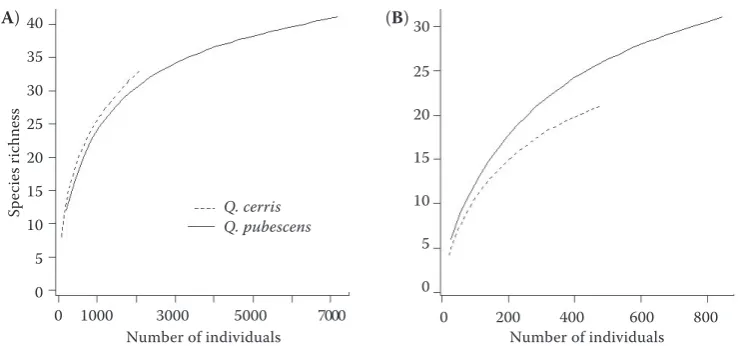
The number of species was significantly lower in samples from Q. cerris than from Q. pubescens on both mature (P < 0.0001) and young trees (P < 0.001) (Figure 2). However, when considering the same num-ber of larvae in the rarefaction analysis (Figure 3), the rarefied number of species was higher on mature
Table 1. Dominance of abundance (%) of moth species on mature and young Quercus cerris (Qc) and Quercus pubescens
(Qp) in the temperate forest in Central Europe. Dominant species (dominance > 5.0%) are highlighted
Species Mature Qc Mature Qp Young Qc Young Qp
Psychidae
Psychidae 1 < 1.0 0 0 0
Psychidae 2 < 1.0 0 0 0
Ypsolophidae
Ypsolophaasperella (Linnaeus, 1761) < 1.0 < 1.0 0 0
Ypsolophalucella (Fabricius, 1775) < 1.0 < 1.0 0 < 1.0
Ypsolophaalpella (Denis et Schiffermüller, 1775) < 1.0 < 1.0 < 1.0 < 1.0
Ypsolophasylvella (Linnaeus, 1767) < 1.0 0 0 0
Ypsolophaustella (Clerck, 1759) < 1.0 < 1.0 0 0
Chimabachidae
Dasystomasalicella (Hübner, 1796) 0 < 1.0 0 0
Gelechiidae
Psoricoptelagibbosella (Zeller, 1839) < 1.0 < 1.0 0 0
anacampsistimidella (Wocke, 1887) 0 0 0 < 1.0
Tortricidae
Tortrixviridana (Linnaeus, 1758) < 1.0 2.63 2.48 6.38
aleimmaloeflingiana (Linnaeus, 1758) 0 < 1.0 < 1.0 1.65
Tortricodesalternella (Denis et Schiffermüller, 1775) < 1.0 < 1.0 < 1.0 0
eudemisprofundana (Denis et Schiffermüller, 1775) 0 < 1.0 0 0
zeirapheraisertana (Fabricius, 1794) < 1.0 < 1.0 0 < 1.0
Lycaenidae
favoniusquercus (Linnaeus, 1758) 0 < 1,0 0 0
Satyriumilicis (Esper, 1779) 0 0 0 < 1.0
Pyralidae
Phycitaroborella (Denis et Schiffermüller, 1775) < 1.0 < 1.0 0 < 1.0
Drepanidae
cymatophorinadiluta (Denis et Schiffermüller, 1775) < 1.0 < 1.0 0 < 1.0
Polyplocaridens (Fabricius, 1787) < 1.0 < 1.0 < 1.0 0
asphaliaruficollis (Fabricius, 1787) < 1.0 < 1.0 < 1.0 < 1.0
Geometridae
alsophilaaescularia (Denis et Schiffermüller, 1775) < 1.0 < 1.0 0 < 1.0
alsophilaaceraria (Denis et Schiffermüller, 1775) 0 < 1.0 < 1.0 < 1.0
apocheimahispidaria (Denis et Schiffermüller, 1775) 4.29 1.61 1.86 < 1.0
Phigaliapilosaria (Denis et Schiffermüller, 1775) < 1.0 < 1.0 0 0
lyciapomonaria (Hübner, 1790) < 1.0 < 1.0 0 0
Bistonstrataria (Hufnagel, 1767) 0 < 1.0 0 0
Agriopisleucophaearia (Denis et Schiffermüller, 1775) 83.00 79.10 81.57 68.48
agriopisbajaria (Denis et Schiffermüller, 1775) 0 0 0 < 1.0
agriopis spp. = a. aurantiaria (Hübner, 1799) +
a.marginaria (Fabricius, 1776) 2.70 1.60 1.66 2.13
erannisdefoliaria (Clerck, 1759) 1.16 1.38 1.04 1.06
colotoispennaria (Linnaeus, 1761) < 1.0 0 0 0
2000 larvae, for example, predicted the occurrence of 32.6 ± 0.7 species on mature Q. cerris and 30.5 ± 2.2 species on mature Q. pubescens (Figure 3A). The Chao index estimated the occurrence of 49.5 ± 12.8 species onmature Q. cerris and 48.0 ± 6.6 species
on mature Q. pubescens. In the case of young trees, the estimations for e.g. 450 individuals gave fewer species on Q. cerris (20.6 ± 0.6 species) than on
Q. pubescens (25.3 ± 1.8 species) (Figure 3B), and the Chao index, in agreement, predicted much fewer
Species Mature Qc Mature Qp Young Qc Young Qp
Operophterabrumata (Linnaeus, 1758) 3.08 10.17 5.18 12.28 Erebidae
lymantriadispar (Linnaeus, 1758) < 1.0 < 1.0 < 1.0 < 1.0
ocneriarubea (Denis et Schiffermüller, 1775) 0 0 0 < 1.0
eilemacomplana (Linnaeus, 1758) 0 < 1.0 0 0
callimorpha dominula (Linnaeus, 1758) 0 0 < 1.0 0
catocalanymphagoga (Esper, 1787) 1.35 < 1.0 < 1.0 < 1.0
Noctuidae
asteroscopussphinx (Hufnagel, 1766) 0 < 1.0 < 1.0 < 1.0
conistravaccinii (Linnaeus, 1761) 0 < 1.0 1.04 < 1.0
Jodiacroceago (Denis et Schiffermüller, 1775) 0 0 0 < 1.0
Dicyclaoo (Linnaeus, 1758) 0 < 1.0 < 1.0 < 1.0
rileyianafovea (Treitschke, 1825) 0 < 1.0 0 0
Scotochrostapulla (Denis et Schiffermüller, 1775) 0 < 1.0 0 0
Dryobotodeseremita (Fabricius, 1775) < 1.0 < 1.0 < 1.0 < 1.0
Dryobotodesmonochroma (Esper, 1790) < 1.0 0 < 1.0 0
orthosiaincerta (Hufnagel, 1766) < 1.0 < 1.0 0 < 1.0
orthosiaminiosa (Denis et Schiffermüller, 1775) < 1.0 < 1.0 0 < 1.0
orthosiacerasi (Fabricius, 1775) < 1.0 < 1.0 < 1.0 < 1.0
orthosiacruda (Denis et Schiffermüller, 1775) < 1.0 < 1.0 0 < 1.0
anorthoamunda (Denis et Schiffermüller, 1775) < 1.0 < 1.0 0 < 1.0
Number of individuals 2 076 7 195 483 847
[image:5.595.61.524.110.457.2]Number of species 34 42 22 32
Table 1 to be continued
Figure 1.Nonmetric multidimensional scaling of species assemblages on mature (A) and young (B) Quercus cerris
and Quercus pubescens in the temperate forest in Central Europe
The Bray-Curtis dissimilarity index was used as a measure contrasting species assemblages; stress values of the ordination configuration in the two dimensions were 0.13 in mature and 0.14 in young trees
1.5
1.0
0.5
0.0
–0.5
–1.0
2
1
0
–1
–2
–3
–1.0 –0.5 0.0 0.5 1.0 1.5 –2 –1 0 1 2 3
Axis 1 Axis 1
Axi
s 2
Q. cerris Q. pubescens
[image:5.595.99.474.545.695.2]species on young Q. cerris (23.1 ± 2.5) than on young
Q. pubescens (38.2 ± 6.4 species).
The larvae of a. leucophaearia, o. brumata and
T. viridana constituted more than 85% of the lar-vae recorded on each oak species and in each age category (Table 1). The larvae of a. leucophaearia
dominated considerably (dominance between 68 and 83%; Table 1) and consistently on both young and mature trees of both oak species, whereas o. brumata
dominated (dominance > 5.0%) all assemblages ex-cept for the assemblage hosted by mature Q. cerris.
Tortrix viridana dominated only on young Q. pu-bescens (Table 1).
On mature trees, the abundance of a. leucophae-aria was 3.3, of o. brumata 11.4, and of T. viridana
21.0 times lower on Q. cerris than on Q. pubescens
(all three species, P < 0.0001). On young trees, the abundance of a. leucophaearia was 1.5, abundance of o. brumata 4.2 and abundance of T. viridana
4.5 times lower on Q. cerris.These differences were significant (P < 0.0001) except for the case of a. leu-cophaearia (P = 0.129).
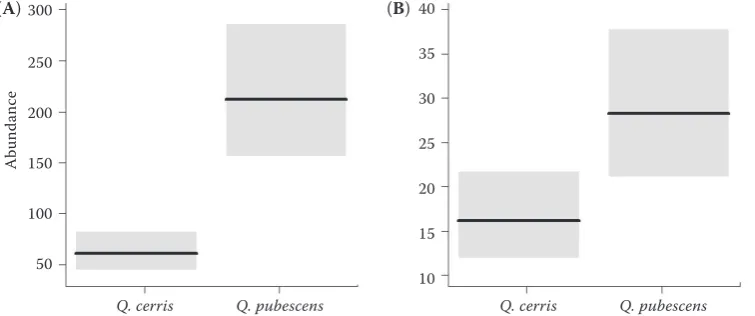
The total number of moth larvae in assemblages was approximately 3.5 times lower on mature (P < 0.0001) and almost twice lower on young Q. cerris
(P = 0.013) in comparison with the corresponding numbers on Q. pubescens (Figure 4).
Five indicator species specialised on certain hosts were documented. The larvae of catocala nympha- goga showed affinity (IndVal = 0.45, P = 0.0001) to mature Q. cerris, and none of the species preferred young Q. cerris. The larvae of a. leucophaearia
(In-Figure 2. Number of moth species in samples from mature (A) and young (B) Quercus cerris and Quercus pubescens
trees in the temperate forest in Central Europe
[image:6.595.108.484.93.252.2]Horizontal lines denote the mean, bars denote the 95% confidence intervals
Figure 3. Expected species richness in relation to the number of collected moth larvae – rarefied number of moth species on mature (A) and young (B) Quercus cerris and Quercus pubescens trees in the temperate forest in Central Europe The larvae were obtained from a total of 102 branches of 34 mature trees and from a total of 60 branches of 30 young trees of each oak species
N
umb
er of mot
h sp
ec
ie
s 6
5
4
3
Q. cerris Q. pubescens Q. cerris Q. pubescens
12
11
10
9
8
7
6
0 1000 3000 5000 7000
Number of individuals Number of individuals Q. cerris
Q. pubescens 40
35 30 25 20 15 10 5 0
0 200 400 600 800
Sp
ec
ie
s r
ic
hne
ss
30
25
20
15
10
5
0
(A) (B)
[image:6.595.110.481.527.700.2]dVal = 0.77, P = 0.0001), e. defoliaria (IndVal = 0.73, P = 0.0001) and T. viridana (IndVal = 0.84,
P = 0.0001) preferred mature Q. pubescens, while those of o. brumata showed affinity to both mature (IndVal = 0.89, P = 0.0001) and young Q. pubescens
(IndVal = 0.70, P = 0.0001).
disCussion
Our data suggest species-rich ephemeral assemblag-es of moth larvae of the “brumata-viridana complex” on both early flushing Q. pubescens and late flushing
Q. cerris. All moth species found on Q. cerris and
Q. pubescens are known to develop on oaks (Csóka & Szabóky 2005; Patočka & Kulfan 2009). The recorded larval assemblages included characteristic species of the “brumata-viridana complex” (Patočka
et al. 1999). Besides the well-known pests such as
o. brumata and T. viridana also other accompanying species can contribute significantly to the defolia-tion of host trees (Patočka 1954; Schwenke 1978; Patočka et al. 1999).
The same abundant species were present in all assemblages. However, similarity between the lar-val assemblages on Q. cerris and Q. pubescens was relatively low, reflecting differences in assemblage composition (especially in the presence/absence of not abundant species and abundance of species).
The lower number of larvae on Q. cerris than on
Q. pubescens obtained by the same sampling effort (from the same number of sample branches) reflected the lower number of moth species. This may explain the lower number of moth species on late flushing
Q. cerris compared with early flushing oaks also mentioned in other studies (e.g. Kulfan 1992, 2012; Csóka & Szabóky 2005). Our results suggest that the same number of larvae on mature oak trees of both species provides a similar number of species.
The most important results of our study relate to the lower number of all moth larvae in assemblages and the lower abundance of dominant species (a. leucophaearia, o. brumata, and T. viridana) on
Q. cerris than on Q. pubescens. This suggests a similar response of the species of the “brumata-viridana complex” to asynchrony between the hatching of larvae and the budburst of Q. cerris trees.
The females of o. brumata and T. viridana do not prefer any host tree for oviposition (Grison & Silvestre de Sacy 1954; Graf et al. 1995; Tiberi et al. 2005). Therefore, Q. cerris and Q. pubescens trees co-occurring in a forest may have an equal chance to be infested by these moth species and, possibly, by other species within the “brumata-viridana complex”. Besides the density and distribution of eggs, the occurrence of moth larvae in forest canopies strongly depends on their dispersal ability and mortality (Holliday 1977; Tiberi et al. 2005). When the larvae of the “brumata-viridana complex” are hatching, conditions in the crowns of Q. cerris differ from those in the crowns of Q. pubescens. As the buds of
Q. cerris are still closed, there is no food available for moth larvae. The neonate larvae of o. brumata
and T. viridana and many other species also require opening buds as a shelter (Patočka 1954; Schwenke 1978; Tiberi et al. 2005). When present on Q. cerris
[image:7.595.102.480.96.254.2]with the late budburst, young larvae cannot find any food and shelter (Zalucki et al. 2002). Moreover,
Figure 4. Abundance of moth larvae on mature (A) and young (B) Quercus cerris and Quercus pubescens trees in the temperate forest in Central Europe
Horizontal lines denote the mean, bars denote the 95% confidence intervals
A
bund
anc
e
Q. cerris Q. pubescens Q. cerris Q. pubescens
40
35
30
25
20
15
10 300
250
200
150
100
50
compared with Q. pubescens, the larvae on the nude branches of Q. cerris are more exposed to biotic (natural enemies) and abiotic factors (temperature fluctuation, UVB and infrared radiation, rain, etc.) (cf. Damman 1987; Kamata & Igarashi 1994; Buck & Callaghan 1999; Zalucki et al. 2002; Pincebourde et al. 2007; Abarca et al. 2014) which may affect their occurrence on trees.
Starving young moth larvae die or disperse to find appropriate food. They can balloon on wind currents (Edland 1971; Holliday 1977; Schwenke 1978) or they can lower down the tree (Mrkva 1968). The rate of dispersal depends on the ability of larvae to with-stand starvation. For example, while young larvae of
o. brumata can live without feeding up to 4–5 days only (Cuming 1961; Wint 1983), those of T. viridana
can withstand starvation up to 12 days (Hunter 1990). The larvae of the latter species are then less inclined to disperse (Mrkva 1968; Hunter 1990). In temperate oak forests, Q. cerris can be colonised by the larvae dispersing from Q. pubescens, when open buds or leaves are available. As our results suggest, the dispersal of
o. brumata from Q. pubescens to Q. cerris trees can be more pronounced than that of T. viridana.
The intraspecific variation in the date of larval hatching and the budburst of the hosts causes that some larvae of the same population can find appropri-ate food resources while the other larvae cannot detect them (Du Merle 1988; Tikkanen & Julkunen-Tiitto 2003). In the case of Q. cerris with the late budburst, the moth larvae which hatched later may take advantage over those hatched sooner.
Global climate change influences the phenology of both insect herbivores and their hosts but not at the same rates. This may lead to asynchrony between the phenology of moths and their hosts, resulting in only slight damage to foliage (van Asch & Visser 2007). According to van Asch et al. (2007), over the last two decades, the egg hatching date of o. brumata
advanced more than the date of Q. robur budburst. Such observations suggest that a relatively narrow time span between the hatching of this moth and the flushing of Q. cerris trees gets wider.
According to the theory of adaptive deme forma-tion (Edmunds & Alstad 1978; Van Dongen et al.
1997), some populations of herbivorous Lepidoptera have adapted genetically to an individual host tree and the phenology of its budburst (Tikkanen & Lyy-tikäinen-Saarenmaa 2002; van Asch et al. 2013). In forests, where trees of different species often grow relatively close to each other, moth adults and larvae
can migrate among them. Therefore, the hybridisa-tion of individuals developing on different trees acts against the establishment of specialised populations adapted to the phenology of individual trees or tree species (Tikkanen & Julkunen-Tiitto 2003). The presence of early flushing Q. pubescens or other tree species with early budburst in the stands of Q. cerris
may prevent or eliminate the occurrence of specific moth populations adapted to late flushing trees.
The geometrid a. leucophaearia was the most abundant species which consistently prevailed on both oak species irrespective of the age of infested oak trees. Its larvae feed on broadleaved trees pre-ferring Quercus spp. (Patočka 1954; Ebert et al.
2003; Patočka & Kulfan 2009). In Central Europe they hatch over a longer time period than those of
o. brumata, hence, different instars co-occur at the same time (J. Kulfan, personal observation). The larvae which hatch later can then find open buds of Q. cerris trees with ease. This could explain the relatively high abundance of this species even on
Q. cerris. The high abundance of a. leucophaearia
suggests the economic importance of this previously overlooked pest of oak trees, the larvae of which can be misidentified with those of o. brumata. At the present moment we do not know much about the phenological synchrony of a. leucophaearia with its hosts. We suppose that this species should be paid greater attention from a forestry point of view because it can cause severe defoliation in oak forests.
catocala nymphagoga was considered the only indicator species on mature Q. cerris. This thermo-philous species is abundant in the Mediterranean and Submediterranean oak forests (Goater et al.
2003) but also occurs in the temperate forests of Central Europe (Patočka 1954; Nowacki et al. 2003; Macek et al. 2008; Nowacki & Wasąla 2008). It is a southern species, the life cycle and phenology of which could differ between Central and southern Europe. Hence, Q. cerris with late budburst could be more appropriate for the larvae of c. nymphagoga
feeding on various oakspecies within Europe (Ahola & Silvonen 2005; Csóka & Szabóky 2005; Patočka & Kulfan 2009).
Considering the low numbers of moth larvae of the “brumata-viridana complex” on late flushing
silvicultural and horticultural practices aimed to protect and maintain forest, fruit and ornamental tree species. Herein, the emphasis was placed on the moth larvae within the “brumata-viridana complex”. The late occurring spring larvae within the “dispar-xylosteana complex” take advantage of consuming high-quality leaves of late flushing tree species such as Q. cerris. lymantria dispar, an important defoliator of oak trees within Europe, can be a good example of such species (cf. Schwenke 1978; Milanović et al. 2014). However, in the further future the abun-dance of this outbreak species could be lowered by the exotic entomopathogenic fungus entomophaga maimaiga (Zúbrik et al. 2016).
Acknowledgements. The study was conducted at the Institute of Forest Ecology SAS in Zvolen. We thank Peter Tuček and Milan Mikuš for technical assi-stance. The staff of the Plášťovce forestry station and private owners supported field studies.
references
Abarca M., Boege K., Zaldívar-Riverón A., Giray T. (2014): Shelter-building behavior and natural history of two pyralid caterpillars feeding on Piper stipulaceum. Journal of Insect Science, 14: 39. doi: 10.1093/jis/14.1.39 Ahola M., Silvonen K. (2005): Pohjoisen Euroopan
yök-kösten toukat. Volume 1. Vaasa, KuvaSeppälä Yhtiöt Oy. Anderson M.J. (2001): A new method for non-parametric
multivariate analysis of variance. Austral Ecology, 26: 32–46.
Basset Y., Springate N.D., Aberlenc H.P., Delvare G. (1997): A review of methods for sampling arthropods in tree ca-nopies. In: Stork N.E., Adis J., Didham R.K. (eds): Canopy Arthropods. London, Chapman & Hall: 27–52.
Bray J.R., Curtis J.T. (1957): An ordination of the upland forest communities of southern Wisconsin. Ecological Monographs, 27: 325–349.
Buck N., Callaghan T.V. (1999): The direct and indirect ef-fects of enhanced UV-B on the moth caterpillar epirrita autumnata. Ecological Bulletins, 47: 68–76.
Canty A., Ripley B. (2016): boot: Bootstrap R (S–Plus) Functions. R package version 1.3-18.
Chiu C.H., Wang Y.T., Walther B.A., Chao A. (2014): An improved nonparametric lower bound of species richness via a modified good-turing frequency formula. Biomet-rics, 70: 671–682.
Csóka G., Szabóky C. (2005): Checklist of herbivorous insects of native and exotic oaks in Hungary I. (Lepidoptera). Acta Silvatica et Lignaria Hungarica, 1: 59–72.
Cuming F.G. (1961): The distribution, life history, and economic importance of the winter moth, operophtera brumata (L.) (Lepidoptera,Geometridae) in Nova Scotia. The Canadian Entomologist, 93: 135–142.
Damman H. (1987): Leaf quality and enemy avoidance by the larvae of a pyralid moth. Ecology, 68: 88–97. De Cáceres M., Legendre P. (2009): Associations between
species and groups of sites: indices and statistical infer-ence. Ecology, 90: 3566–3574.
De Vries H.H., Ens S.H., de Graaf G., Teunissen L., van der Velde R., Vogelaar L., Winterink A., Visser M.E. (2011): Synchronisation of egg hatching of brown hairstreak (Thecla betulae) and budburst of blackthorn (Prunus spinosa) in a warmer future. Journal of Insect Conservation, 15: 311–319. Despland E. (2018): Effects of phenological synchronization on caterpillar early-instar survival under a changing cli-mate. Canadian Journal of Forest Research, 48: 247–254. Du Merle P. (1983): Phénologies comparées du chêne
pu-bescent, du chêne vert et de Tortrix viridana L. (Lep., Tortricidae). Mise en évidence chez l’insecte de deux populations sympatriques adaptées chacune à l’un des chênes. Acta Oecologica. Oecologia Applicata, 4: 55–74. Du Merle P. (1988): Phenological resistance of oaks to the
green leafroller, Tortrix viridiana (Lepidoptera: Tort-ricidae). In: Mattson W.J., Levieux J., Bernard-Dagan C. (eds): Mechanisms of Woody Plant Defences against Insects. Berlin-Heidelberg-New York, Springer: 215–226. Du Merle P., Mazet R. (1983): Les facteurs de mortalité
des oeufs de Tortrix viridana L. (Lep., Tortricidae). I. Le complexe des prédateurs (Hym., Formicidae; Derm., Forficulidae; Orth., Phaneropteridae; Neur., Chrysopi-dae). Agronomie, 3: 239–246.
Dufrêne M., Legendre P. (1997): Species assemblages and indicator species: the need for a flexible asymmetrical approach. Ecological Monographs, 67: 345–366. Ebert G., Steiner A., Trusch R. (2003): Ennominae
(Geom-etridae). In: Ebert G. (ed.): Die Schmetterlinge Baden-Württembergs. Band 9 – Nachtfalter VII. Stuttgart, Ulmer: 294–579.
Edland T. (1971): Wind dispersal of the winter moth lar-vae operophtera brumata L. (Lep., Geometridae) and its relevance to control measures. Norsk Entomoligisk Tidsskrift, 18: 103–105.
Edmunds G.F., Alstad D.N. (1978): Coevolution in insect herbivores and conifers. Science, 199 (4332): 941–945. Feeny P.P. (1968): Effect of oak leaf tannins on larval growth
of the winter moth operophtera brumata. Journal of Insect Physiology, 14: 805–817.
Forkner R.E., Marquis R.J., Lill J.T., Le Corff J. (2008): Tim-ing is everythTim-ing? Phenological synchrony and popula-tion variability in leaf-chewing herbivores of Quercus. Ecological Entomology, 33: 276–285.
Foster J.R., Townsend P.A., Mladenoff D.J. (2013): Mapping asynchrony between gypsy moth egg-hatch and forest leaf-out: Putting the phenological window hypothesis in a spatial context. Forest Ecology and Management, 287: 67–76.
Führer E. (1998): Oak decline in Central Europe: a synopsis of hypothesis. In: McManus M.L., Liebhold A.M. (eds): Proceedings: Population dynamics, impacts, and inte-grated management of forest defoliating insects, Aug 18–23, 1996, Banská Štiavnica, Slovakia. Radnor, USDA Forest Service, Northeastern Research Station, General Technical Report NE-247: 7–24.
Goater B., Ronkay L., Fibiger M. (2003): Noctuidae Europae-ae, 10. Catocalinae & Plusiinae. Sorø, Entomological Press. Goliašová K., Michalková E. (2006): Flóra Slovenska V/3.
Bratislava, VEDA.
Graf B., Borer F., Höpli H.U., Hohn H., Dorn S. (1995): The winter moth operophtera brumata L. (Lep., Geometri-dae) on apple and cherry: spatial and temporal aspects of recolonization in autumn. Journal of Applied Entomol-ogy, 119: 295–301.
Grison P., Silvestre de Sacy R. (1954): Déplacement ori-enté de la femelle de cheimatobie (operophtera brumata L.). Bulletin de la Societé Entomologique de France, 59: 151–154.
Heck K.L., van Belle G., Simberloff D. (1975): Explicit cal-culation of the rarefaction diversity measurement and the determination of sufficient sample size. Ecology, 56: 1459–1461.
Holliday N.J. (1977): Population ecology of winter moth (operophtera brumata) on apple in relation to larval dispersal and time of bud burst. Journal of Applied Ecol-ogy, 14: 803–813.
Holm S. (1979): A simple sequentially rejective multiple test procedure. Scandinavian Journal of Statistics, 6: 65–70. Hunter A.F., Elkinton J.S. (2000): Effects of synchrony with
host plant on populations of a spring-feeding Lepidop-teran. Ecology, 81: 1248–1261.
Hunter A.F., Lechowicz M.J. (1992): Foliage quality changes during canopy development of some northern hardwood trees. Oecologia, 89: 316–323.
Hunter M.D. (1990): Differential susceptibility to variable plant phenology and its role in competition between two insect herbivores on oak. Ecological Entomology, 15: 401–408.
Hunter M.D. (1992): A variable insect-plant interaction: the relationship between tree budburst phenology and
popu-lation levels of insect herbivores among trees. Ecological Entomology, 16: 91–95.
Hurlbert S.H. (1971): The nonconcept of species diver-sity: a critique and alternative parameters. Ecology, 52: 577–586.
Ivashov A.V., Boyko G.E., Simchuk A.P. (2002): The role of host plant phenology in the development of the oak leafroller moth, Tortrix viridana L. (Lepidoptera: Tor-tricidae). Forest Ecology and Management, 157: 7–14. Jones B.C., Despland E. (2006): Effects of
synchroniza-tion with host plant phenology occur early in the larval development of a spring folivore. Canadian Journal of Zoology, 84: 628–633.
Kabíček J. (2017): Phytoseiid mites on Quercus cerris in an urban park. Plant Protection Science, 53: 181–186. Kamata N., Igarashi Y. (1994): Influence of rainfall on
feed-ing behavior, growth, and mortality of larvae of the beech caterpillar, Quadricalcarifera punctatella (Motschulsky) (Lep. Notodontidae). Journal of Applied Entomology, 118: 347–353.
Klimatický atlas Slovenska (2015): Climate Atlas of Slovakia. Bratislava, Slovenský hydrometeorologický ústav. Kruskal J.B. (1964): Multidimensional scaling by optimizing
goodness of fit to a nonmetric hypothesis. Psychometrika, 29: 1–27.
Kulfan J. (1992): Zur Struktur und Saisondynamik von Raupenzönosen (Lepidoptera) an Eichen. Biologia (Brati-slava), 47: 653–661.
Kulfan M. (2012): Structure of lepidopterocenoses on oaks Quercus dalechampii and Q. cerris in Central Europe and estimation of the most important species. Munis Entomology & Zoology, 7: 732–741.
Macek J., Dvořák J., Traxler L., Červenka V. (2008): Motýli a housenky střední Evropy. Noční motýli II. – můrovití. Praha, Academia.
Mannai Y., Ezzine O., Hausmann A., Nouira S., Jamâa M.L.B. (2017): Budburst phenology and host use by operophtera brumata (Linnaeus, 1758) (Lepidoptera: Geometridae) in three Mediterranean oak species. Annals of Forest Science, 1 (74): 1–8.
Martemyanov V.V., Pavlushin S.V., Dubovskiy I.M., Yush-kova Y.V., Morosov S.V., Chernyak E.I., Efimov V.M., Ruuhola T., Glupov V.V. (2015): Asynchrony between host plant and insects-defoliator within a tritrophic system: The role of herbivore innate immunity. PloS ONE, 10 (6), e0130988. doi: 10.1371/journal.pone.0130988
Mrkva R. (1968): Bionomie píďalky podzimní (operophtera brumata L.) – motýl a vajíčko. Acta Universitatis Agri-culturae (Brno), Series C, 37: 223–246.
Nowacki J., Wąsala R. (2008): Changes in groups of Noctu-ids (Lepidoptera, Noctuidae) of xerothermic rock swards in the Pieniny Mountains, caused by operation of Czorsz-tyn-Niedzica and Sromowce Wyżne water reservoirs. Polish Journal of Environmental Studies, 17: 71–77. Nowacki J., Sosiński J., Śliwa W. (2003): catocala
nympha-goga (ESPER, 1787) (Lepidoptera: Noctuidae) in Poland. Polskie Pismo Entomologiczne, 72: 331–333.
Oksanen J., Blanchet F.G., Friendly M., Kindt R., Legendre P., McGlinn D., Minchin P.R., O’Hara R.B., Simpson G.L., Solymos P., Stevens M.H.H., Szoecs E., Wagner H. (2017): vegan: Community Ecology Package. R package version 2.4-3.
Ovcharov D., Dojchev D., Todorov A. (2000): Differences in attack from leaf chewing pests (families Tortricidae and Geometridae, order Lepidoptera) by some Quercus species. In: Pipkov N., Zhelev P., Draganova I. (eds): Yu-bileen sbornik nauchni dokladi: 75 godini visshe lesotekh-nichesko obrazovanie v Bulgariya. Sektsiya Ekologiya i opazvane na okolnata sreda, Sofia, Lesotekhnicheski Universitet: 269–378.
Pastorális G., Kalivoda H., Panigaj Ľ. (2013): Zoznam motýľov (Lepidoptera) zistených na Slovensku. Folia Faunistica Slovaca, 18: 101–232.
Patočka J. (1954): Húsenice na duboch v ČSR. Bratislava, Štátne pôdohospodárske nakladateľstvo.
Patočka J. (1980): Die Raupen und Puppen der Eichen-schmetterlinge Mitteleuropas. Monographien zur An-gewandten Entomologie, 23: 1–188.
Patočka J., Kulfan J. (2009): Lepidoptera of Slovakia: bio-nomics and ecology/Motýle Slovenska: bionómia a ekoló-gia. Bratislava, VEDA.
Patočka J., Krištín A., Kulfan J., Zach P. (1999): Die Eichen-schädlinge und ihre Feinde. Zvolen, Institut für Waldökol-ogie der Slowakischen Akademie der Wissenschaften. Pincebourde S., Sinoquet H., Combes D., Casas J. (2007):
Regional climate modulates the canopy mosaic of fa-vourable and risky microclimates for insects. Journal of Animal Ecology, 76: 424–438.
R Core Team (2016): R: A language and environment for statistical computing. Vienna, R Foundation for Statistical Computing. Available at www.R-project.org/ (accessed Jun 12, 2017).
Raupp M.J., Werren J.H., Sadof C.S. (1988): Effects of short-term phenological changes in leaf suitability on the survivorship, growth and development of gypsy moth (Lepidoptera: Lymantriidae) larvae. Environmental En-tomology, 17: 316–319.
Rennwald E., Rodeland J. (2013): Lepiforum: Bestimmung von Schmetterlingen (Lepidoptera) und ihren Präimaginalsta-dien. Available at www.lepiforum.de (accessed Jun 5, 2015). Rock J., Puettmann K.J., Gockel H.A., Schulte A. (2004): Spa-tial aspects of the influence of silver birch (Betula pendula L.) on growth and quality of young oaks (Quercus spp.) in central Germany. Forestry, 77: 235–247.
Schafellner C., Krämer W., Schopf A. (2005): Three trophic level interaction: the influence of host plants on the perfor-mance of gypsy moth (lymantria dispar) and its parasitoid, Glyptapanteles liparidis (Hymenoptera, Braconidae). In: Villemant C., Lahbib M., Jamāa B. (eds): Proceedings of the Meeting, Oct 4–8, 2004, Hammamet, Tunisia. Inte-grated Protection in Oak Forests IOBC/WPRS Bulletin, 28: 193–200.
Schopf A., Hoch G., Klaus A., Novotny J., Zubrik M., Schafell-ner C. (1999): Influence of food quality of two oak species on the development and growth of gypsy moth larvae. In: Lieutier F., Mattson W.J., Wagner M.R. (eds): Physiol-ogy and Genetics of Tree-Phytophage Interactions. Paris, INRA: 231–247.
Schwenke W. (1978): Die Forstschädlinge Europas. 3. Band – Schmetterlinge. Hamburg-Berlin, Paul Parey.
Tiberi R., Benassai D., Niccoli A. (2005): Influence of different host plants on the biology and behaviour of the green oak leaf roller, Tortrix viridana L.: first results. In: Villemant C., Lahbib M., Jamāa B. (eds): Proceedings of the Meeting, Oct 4–8, 2004, Hammamet, Tunisia. Integrated Protection in Oak Forests IOBC/WPRS Bulletin, 28: 211–217. Tikkanen O.-P., Julkunen-Tiitto R. (2003): Phenological
variation as protection against defoliating insects: the case of Quercus robur and operophtera brumata. Oeco-logia, 136: 244–251.
Tikkanen O.-P., Lyytikäinen-Saarenmaa P. (2002): Adap-tation of a generalist moth, operophtera brumata, to variable budburst phenology of host plants. Entomologia Experimentalis et Applicata, 103: 123–133.
Tutin T.G., Heywood V.H., Burges N.A., Valentine D.H., Walters S.M., Webb D.A. (2001): Flora Europaea. Cam-bridge, Cambridge University Press.
van Asch M., Salis L., Holleman L.J.M., van Lith B., Visser M.E. (2013): Evolutionary response of the egg hatching date of a herbivorous insect under climate change. Nature Climate Change, 3: 244–248.
van Asch M., van Tienderen P.H., Holleman L.J.M., Vis-ser M.E. (2007): Predicting adaptation of phenology in response to climatechange, an insect herbivore example. Global Change Biology, 13: 1596–1604.
Van Dongen S., Backeljau T., Matthysen E., Dhondt A.A. (1997): Synchronization of hatching date with budburst of individual host trees (Quercus robur) in the winter moth (operophtera brumata) and its fitness consequences. Journal of Animal Ecology, 66: 113–121.
Visser M.E., Holleman L.J.M. (2001): Warmer springs dis-rupt oak and moth phenology. Proceedings of the Real Society of London B, 268 (1464): 289–294.
Wagenhoff E., Blum R., Engel K., Veit H., Delb H. (2013): Temporal synchrony of Thaumetopoea processionea egg hatch and Quercus robur budburst. Journal of Pest Sci-ence, 86: 193–202.
Wagner W. (2005): Lepidoptera and their ecology. Available at www.pyrgus.de (accessed Jun 5, 2015).
Wang Y., Naumann U., Wright S., Eddelbuettel D., Warton D. (2017): mvabund: Statistical Methods for Analysing Multivariate Abundance Data. R package version 3.12.3. Warton D.I., Thibaut L., Wang Y.A. (2017): The PIT-trap –
A “model-free” bootstrap procedure for inference about regression models with discrete, multivariate respons-es. PloS ONE, 12 (7): e0181790. doi: 10.1371/journal. pone.0181790
Wesołowski T., Rowiński P. (2008): Late leaf development in pedunculate oak (Quercus robur): An antiherbivore defence? Scandinavian Journal of Forest Research, 23: 386–394.
Wint W. (1983): The role of alternative host-plant species in the life of a polyphagous moth, operophtera brumata (Lepidoptera: Geometridae). Journal of Animal Ecology, 52: 439–450.
Zalucki M.P., Clarke A.R., Malcolm S.B. (2002): Ecology and behavior of first instar larval Lepidoptera. Annual Review of Entomology, 47: 361–393.
Zúbrik M., Hajek A., Pilarska D., Špilda I., Georgiev G., Hrašovec B., Hirka A., Goertz D., Hoch G., Barta M., Saniga M., Kunca A., Nikolov C., Vakula J., Galko J., Pi-larski P., Csóka G. (2016): The potential for entomophaga maimaiga to regulate gypsy moth lymantria dispar (L.) (Lepidoptera: Erebidae) in Europe. Journal of Applied Entomology, 140: 565–579.