Marker-assisted selection is an efficient tool to speed up plant breeding. It helps also in pyra-miding of resistance genes. Markers linked to resistance genes have been applied for several decades. At present, the main attention is paid to DNA markers.
Wheat leaf rust (Puccinia triticina) belongs to the important pathogens of wheat, causes 10–15% yield losses and decreases grain quality. Breeding for resistance is the most effective way to control this pathogen. M�I����� et al. (1995) listed over 45 dif-ferent Lr genes. Several of them, genes Lr1, Lr3a, Lr10, Lr13, Lr14a, Lr17b, Lr20, Lr26 and Lr37, have been described in European wheat cultivars (P��� et al. 2001). Slovak wheat cultivars possess usually only gene Lr3 or Lr26 or both (H����� et al. 2000). Neither gene Lr3 nor Lr26 are effective against all
pathotypes of leaf rust identified in 1999 and 2000 in Slovakia (B����� et al. 2001). Another Lr gene – Lr19 – is known as highly effective against leaf rust (B����� & S���������� 1999; B����� et al. 2001) both here and all over Europe (M��������� et al. 2000). Lr19 has been introduced into wheat from the wild grass species Thinopyrum ponticum (syn. Agropyrum elongatum, 2n = 10x) and is lo-cated on chromosome 7DL of the wheat genome (M�I����� et al. 1995). A codominant protein marker – endopeptidase allele Ep-D1c – has been identified as a valuable marker linked with this gene (W������� et al. 1995).
The objective of this work was to apply this mo-lecular marker in the selection of wheat individuals possessing leaf rust resistance gene Lr19 and to generate resistant plants for further breeding.
Marker-Assisted Selection for Leaf Rust Resistance
in Wheat by Transfer of Gene Lr19
S������� ŠLIKOVÁ1, E���� GREGOVÁ1, P���� BARTOŠ2 and J�� KRAIC1
1Division of Applied Genetics and Breeding, Research Institute of Plant Production, Piešťany,
Slovak Republic; 2Division of Genetics and Plant Breeding, Research Institute of Crop Production, Prague-Ruzyně, Czech Republic
Abstract
Š������ S., G������ E., B����� P., K���� J. (2003): Marker-assisted selection for leaf rust resistance in wheat by transfer of gene Lr19. Plant Protect. Sci., 39: 13–17.
Cultivar Agrus, possessing a chromosomal substitution, and cultivar Sunnan, possessing a translocation from
Thinopyrum ponticum (= Agropyron elongatum, 2n = 10x) with leaf rust resistance gene Lr19 against Puccinia triticina, were crossed with the susceptible winter wheat cultivars Sofia, Simona and Lívia to transfer Lr19 into agronomi-cally better genotypes by marker-assisted selection. Altogether 304 individuals of the F2 progeny were screened for endopeptidase phenotypes. We found null endopeptidase allele Ep-D1c (marker tightly liked with resistance gene Lr19) in 49 plants. The progenies of 40 plants of the F2 generation (with Ep-D1c) were reselected with the same marker and tested for leaf rust reaction. Results achieved with the isozyme marker corresponded with those of the resistance tests. We obtained 28 F3 families with resistance gene Lr19 confirmed by presence of the null endopeptidase allele and by tests for leaf rust reaction. Field tests showed that Agrus increased the height of plants in the progenies, and the smallest negative effect on yield components was observed in both crosses with cultivar Sunnan.
Keywords: Puccinia triticina; leaf rust; Lr19; Triticum aestivum L.; endopeptidase; marker-assisted selection
MATERIALS AND METHODS
Winter wheat cultivar Agrus was used as a donor of gene Lr19. Agrus possesses chromosome 7Ag substituted from the wild species T. ponticum (syn. A. elongatum, 2n = 10x) (M�I����� et al. 1995). Gene Lr19 had been located on chromosome 7Ag (M�I�-���� et al. 1995; S����� & K���� 1966). Another donor of gene Lr19 used was the Swedish spring wheat cultivar Sunnan. It possesses a translocation designated as T4 (later known as “Agatha”) carry-ing a chromosome segment on wheat chromosome 7DL that originated from T. ponticum. As acceptor genotypes for gene Lr19 the cultivars Sofia, Simona and Lívia were used. Lívia possesses gene Lr26, Sofia Lr26 + Lr3, while Simona has no Lr genes. F2 progenies were created from all donor × acceptor combinations.
Analyses of endopeptidases were carried out according to K������ et al. (1988) and W������� et al. (1995). Protein extracts for isoelectrofocusing were prepared either from leaves or from embryos. Extracts were loaded into prefocused polyacryl-amide gel containing ampholyte (Pharmalyte pH 4.2–4.9). Fast Black K salt and Nα -benzoyl-��-ar-ginine-2-napthylamide hydrochloride were used for specific endopeptidase staining. Genetic in-terpretation of alleles at the Ep-D1 locus followed the study of K������ et al. (1988). Segregation of alleles at the Ep-D1 locus in the F2 generation was evaluated by χ2 test.
Leaf rust isolate 4332 SaBa was used for phy-topathological testing. This isolate overcomes resistance of genes Lr26, Lr3 and Lr3+Lr26. Infec-tion tests were carried out at the first leaf stage in greenhouse conditions at a temperature of 18–22°C with supplemental illumination with fluorescent tubes. Plants were inoculated by rubbing of first leaves with a urediospore/water suspension
and kept 24 h at high humidity in closed glass cylinders. Infection types were scored 14 d after inoculation, using the scale developed by S���-��� et al. (1962).
Seeds of F2 individuals and their parents were sown in field plots of the RIPP Piešťany. The prog-enies of F2 generations were sown in three rows 1 m long. Plant height was measured from soil surface to the tip, excluding awns. Thirty ears from the central row were harvested and evaluated. The t-test was used to compare the F3 generation and their parents.
RESULTS AND DISCUSSION
Screening of hybrids for the presence of Ep-D1c
allele
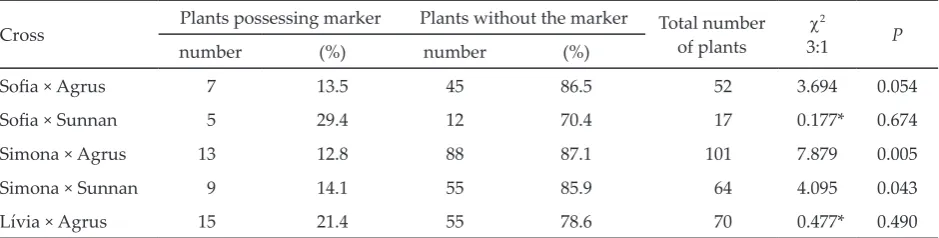
Segregation of the endopeptidase null allele linked with gene Lr19 in the F2 generation is shown in Table 1 and Figure 1. Altogether 304 plants of the five parent combinations were analysed. The null allele Ep-D1c was found in 49 plants and these were cultivated until harvest.
Segregation in the F2 generation of Sofia × Sun-nan and Lívia × Agrus fitted the expected ratio of 3:1, whereas the F2 generations of Sofia × Agrus, Simona × Agrus and Simona × Sunnan did not fit the expected ratio. Our results agree with those of W������� et al. (1995) who found a fit with the 3:1 ratio (P = 0.0554) only if the donor of Ep-D1c was used as the maternal component in a cross. The transfer of allele Ep-D1c by pollen was reduced, the P value for a 3:1 ratio being 0.0004 in their study. A reduced transfer of genes located on segments of alien chromosomes has been described also for the transfer of gene Lr38 (B����� et al. 1998). Similarly, M����� et al. (2001) showed that the translocation with gene Lr19 from Thinopyrum ponticum
gener-Table 1. Segregation of the isozyme marker for Lr19 in F2 populations of wheat crosses
Cross Plants possessing marker Plants without the marker Total numberof plants 3:1χ2 P
number (%) number (%)
Sofia × Agrus 7 13.5 45 86.5 52 3.694 0.054
Sofia × Sunnan 5 29.4 12 70.4 17 0.177* 0.674
Simona × Agrus 13 12.8 88 87.1 101 7.879 0.005
Simona × Sunnan 9 14.1 55 85.9 64 4.095 0.043
Lívia × Agrus 15 21.4 55 78.6 70 0.477* 0.490
[image:2.595.64.534.616.735.2]ally showed reduced pollen transmission from the BCF1 population.
Reselection of F3 generation
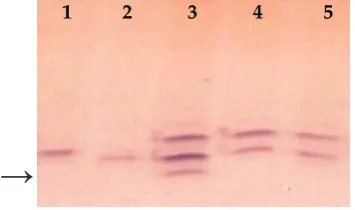
Embryos from selected plants were used for the isolation and analysis of endopeptidases to confirm the presence of null allele Ep-D1c (Figure 2). The presence of Ep-D1c was confirmed in 35 progenies of 40 plants selected from the five F2 generations. In the Sofia × Agrus progenies, Ep-D1c was found in six of the seven tested, while Ep-D1a was determined in one progeny. All analysed Sofia × Sunnan and Simona × Sunnan F2 progenies possessed marker allele Ep-D1c. Of the 10 tested progenies of the F2 generation from combination Simona × Agrus, seven possessed allele Ep-D1c and three allele Ep-D1a. Of the 12 progenies of the F2 generation from Lívia × Agrus, 11 progenies carried Ep-D1c.
Reaction to leaf rust in the greenhouse
Reaction to leaf rust was tested in 32 progenies of the F2 generation. A resistant reaction was char-acterised by chlorotic flecks without sporulation of the fungus (IT0), a susceptible reaction by abundant sporulation without chlorosis forma-tion (IT3-4). Three of the 32 progenies segregated for resistant and susceptible plants, one progeny was susceptible, while 28 were resistant. In 87.5% of the progenies the results of the isozyme analysis coincided with those of the infection test. The dis-crepancy between the results has not been further studied to reveal reasons for the differences. As W������� et al. (1995) calculated the genetic distance between gene Lr19 and allele Ep-D1c to be 0.33 ± 0.33 cM, we presume that such a discrepancy may
be caused by some ambiguity in the evaluation of leaf endopeptidase patterns.
Field plots
Preliminary results from field plot tests showed an influence by cultivar Agrus on the progenies; it increased plant height, and lowered the weight of kernels per ear and weight of thousand kernels. The t-test showed statistically significant differences in these traits between the crosses Sofia × Agrus and Sofia, Simona × Agrus and Simona, Lívia × Agrus and Lívia (Table 2). Yield components were least negatively affected in both crosses where Sunnan was used as a donor parent. The t-test showed statistically significant differences in ear length between Sofia × Sunnan and Sofia, Simona × Sunnan and Simona (Table 2). Cultivar Simona showed the highest level of the yield components compared to crosses Sofia × Agrus, Sofia × Sunnan, Simona × Agrus, Simona × Sunnan, and Lívia × Agrus (Table 2).
Our data indicate that the donor genotype with a chromosomal substitution (Agrus) had a more negative effect on yield components than the do-nor with a chromosomal translocation (Sunnan). Similarly, O������ et al. (1996) have shown that the presence of Lr9 (introduced from Aegilops umbellulata) reduced grain yield in wheat. K���� (1989) studied the effect of the transfer of genes for leaf rust resistance from nine alien sources (incl. Agropyron elongatum, Triticum speltoides and Secale cereale) into commercial cultivars. The results varied greatly for different transfers, some lines were undesirable in agronomical characteristics but with good traits of quality. R������� et al. (2001) found a significant increase in yield (13%), final
1. Sofia – allele Ep-D1a; 2. (Sofia × Agrus) – Ep-D1c; 3. Agrus – Ep-D1c; 4. (Sofia × Agrus) – Ep-D1c; 5. Simona – Ep-D1a; 6. (Simona × Ag-rus) – Ep-D1a; 7. (Simona × Agrus) – Ep-D1c; 8. Sunnan – Ep-D1c; 9. Lívia – Ep-D1a; 10. (Lívia × Agrus) – Ep-D1c
[image:3.595.123.497.594.692.2]1 2 3 4 5 6 7 8 9 10
Figure 1. Endopeptidase zymograms of parents and F2 progenies – leaf extracts (arrow indicates allele Ep-D1a
or null allele Ep-D1c)
biomass (10%) and grain number (15%) associated with introgression of alien chromatin carrying Lr19 in all backgrounds studied.
This study presents an unconventional approach to create 28 wheat progenies of the F2 generation resistant to the important pathogen Puccinia triti-cina by use of a molecular marker and marker-as-sisted selection. The success was asmarker-as-sisted by good coincidence between the marker-based selection and infection tests that identified resistant plants. Preliminary field tests also indicate that some re-sistant progenies of the F2 generation resemble the acceptor parents.
References
B����� P., H������� R., B������� V., Š������ M. (1998): Wheat cultivar Amigo and line W49 as sources of disease
resistance. Czech J. Genet. Plant Breed., 34: 49–54.
B����� P., S���������� E. (1999): Wheat leaf rust races/ pathotypes in the Czech Republic in 1997–1998. Plant
Protect. Sci., 35: 51–56.
B����� P., H����� J., H�������� A., H������ E. (2001): Wheat leaf rust races/pathotypes in Slovakia in
1999–2000. Plant Protect. Sci., 37: 85–90.
H����� J., C���� Ľ., V���� B. (2000): Biologická re-gulácia vybraných chorôb a škodcov pšenice letnej. SPÚ, Nitra, 4–39.
K���� D.R. (1989): The effect of transfers of alien genes for leaf rust resistance on the agronomic and quality
characteristics of wheat. Euphytica, 44: 65–72.
K������ R.M.D., M����� T.E., S���� J.W., L�� C.N. (1988): Wheat endopeptidase: genetic control, po-lymorphism, intrachromosomal gene location, and
alien variation. Genome, 30: 186–192.
M����� G.F., M����� A.S., G��������� J.Z. (2001):
Evaluation and reduction of Lr19-149, a recombined
form of the Lr19 translocation of wheat. Euphytica,
121: 289–295.
M��������� Á., B����� P., G����� H., N��� R.E., C���� M., A������� O., C������ F., I��� M., J���� E., M�-��������� J., M�������� K., P������� M., R������� D., S����������� G., S���������� A., S������ L., T������� M., U���� O., V���� B., V��� G., W������
����������������������������������������������������� Figure 2. Endopeptidase zymograms of lines of the F3 generations
with Ep-D1c allele and the susceptible line with Ep-D1a allele –
em-bryo extracts (arrow indicates allele Ep-D1a or null allele Ep-D1c)
[image:4.595.62.240.86.191.2]1. (Sofia × Agrus) – (Ep-D1c); 2. (Sofia × Agrus) – (Ep-D1c); 3. (Simona × Agrus) – Ep-D1a; 4. (Simona × Agrus) – (Ep-D1c); 5. (Lívia × Agrus) – (Ep-D1c)
Table 2. Small scale field test of F3 generations possessing Lr19 (average value of traits)
Cross Plant height (cm) Ear length (cm) No. of kernels per ear Weight of kernels per ear (g) Thousand kernel weight (g)
Sofia × Agrus 102.62 8.17 35.21 1.19* 33.65*
Sofia × Sunnan 99.40 7.25* 41.16* 1.67* 40.22
Simona × Agrus 108.57* 7.83* 35.45* 1.19* 33.48*
Simona × Sunnan 97.16 8.17* 45.40 1.54* 38.00
Lívia × Agrus 86.06 7.33* 30.01* 1.06* 35.06*
Sofia 81.00 8.61 48.80 2.07 43.32
Simona 93.33 9.83 55.27 2.44 47.01
Lívia 57.66 6.67 37.65 1.71 45.52
*statistically significant difference at the level P ≤ 0.05
[image:4.595.64.533.248.410.2]U. (2000): European virulence survey for leaf rust in
wheat. Agronomie, 20: 793–804.
M�I����� R.A., W������� C.R., P��� R.F. (1995): Wheat Rusts: An Atlas of Resistance Genes. CSIRO Australia/Kluwer Acad. Publ., Dordrecht, 29–82. O������ S., W������� M., W������� P., F���� P.M.,
N�������� J. (1996): Leaf rust resistance gene Lr9
and winter wheat yield reduction: I. Yield and yield
components. Crop Sci., 36: 1590–1595.
P��� R.F., G����� H., F���������� F.G., B����� P., Z����� F.Z. (2001): Regional phenotypic diversity of Puccinia triticina and wheat host resistance in
western Europe, 1995. Euphytica, 122: 113–127.
R������� M.P., C�������� D.F., C����� A.G., R������ S. (2001): Physiological basis of yield gains in wheat
associated with the Lr19 translocation from Agropyron
elongatum. Euphytica, 119: 137–141.
S����� D., K���� D.R. (1966): The transfer of leaf rust
resistance from Agropyron to Triticum by irradiation.
Can. J. Genet. Cytol., 8: 137–143.
S������ E.C., S������ P.M., L�������� W.Q. (1962):
Identification of physiologic races of Puccinia graminis
var. tritici. Minn. Agr. Exp. Sci. J., Ser. Paper, 4691.
W������� W., W������� H., K����� B. (1995):
Endo-peptidase polymorphism and linkage of the Ep-D1c
null allele with the Lr19 leaf rust resistance gene in
hexaploid wheat. Plant Breeding, 114: 24–28.
Received for publication January 7, 2003 Accepted a�er corrections March 3, 2003
Súhrn
Š������ S., G������ E., B����� P., K���� J. (2003): Markerom podporovaná selekcia pri prenose génu rezistencie Lr19 proti hrdzi pšenicovej do pšenice. Plant Protect. Sci., 39: 13–17.
Uskutočnili sme prenos génu rezistencie Lr19 proti hrdzi pšenicovej do genotypov pšenice, kombináciou klasickej hybridizácie s postupmi selekcie pomocou markerov. Odroda Agrus so substitúciou chromozómu 7Ag z Thinopy-rum ponticum (= Agropyron elongatum, 2n = 10x) a Sunnan s chromozomálnou translokáciou z Thinopyrum ponticum
na chromozóme 7DL, v ktorých bola prítomnosť génu rezistencie Lr19 potvrdená, boli krížené s odrodami Sofia, Simona a Lívia. Z 5 kombinácií rodičov (Sofia × Agrus, Sofia × Sunnan, Simona × Agrus, Simona × Sunnan a Lívia × Agrus) bolo získaných 304 rastlín F2 generácie. Všetky rastliny boli analyzované na prítomnosť, resp. neprítom-nosť nulovej alely Ep-D1c pomocou izoelektrickej fokusácie endopetidáz extrahovaných z listových segmentov. Prítomnosť alely Ep-D1c, biochemický marker génu rezistencie Lr19 proti hrdzi pšenicovej, bola zistená v 49 ras-tlinách. Segregácia alely v potomstve poukazuje na zníženie prenosu génu rezistencie Lr19 peľom z odrôd Agrus a Sunnan do potomstiev. Potomstvo F2 generácie bolo pestované v poľných podmienkach, znova selektované na detekciu prítomnosti alely Ep-D1c pomocou analýzy endopeptidáz izolovaných z embryí a testované proti hrdzi pšenicovej. Fytopatologické testy boli vykonané na potomstve z 32 selektovaných rastlín, v ktorých sme identifi-kovali prítomnosť alely Ep-D1c. Úspešný prenos génu Lr19 bol potvrdený v potomstve z 28 selektovaných rastlín, ktoré boli rezistentné proti hrdzi pšenicovej a zároveň v nich bola potvrdená prítomnosť markerovacej alely
Ep-D1c. Predbežné výsledky poľných testov naznačujú, že odroda Sunnan s translokáciou z Thinopyrum ponticum
má nižší negatívny vplyv na úrodotvorné prvky potomstva ako odroda Agrus so substitúciou.
Kľúčové slová: Puccinia triticina; hrdza pšenicová; Lr19; Triticum aestivum L.; endopeptidázy; selekcia pomocou markerov
Corresponding author:
Ing. S������� Š������, Výskumný ústav rastlinnej výroby, Divizia aplikovanej genetiky a šľachtenia, Bratislavská cesta 122, 92 168 Piešťany, Slovenská republika