Abstract— In this paper semi-realistic models were developed using an experimental approach and statistical techniques, to analyse the relationship between bending amplitude and bending stress (strain) of several overhead-line conductors. Four different overhead-line aluminum conductors steel-reinforced (ACSR), that is, ACSR Rabbit, ACSR Pelican, ACSR Tern, and ACSR Bersfort, were investigated at three different ranges of tensile load: 20, 25, and 30 per cent (%) of the ultimate tensile strength (UTS); and vibrated at frequencies between 10-40 Hz. Bending amplitude and bending stress data were collected and plotted, curve-fitting with polynomial functioning of third order in terms of four parameters give excellent predictions of the experimental data for these conductors. However, it was found that the accuracy of the fit is not improved by the consideration of higher-order terms. It was also noted that this model is the simplest polynomial model to be employed for the characterization all conductors investigated. In addition, the slip-stick theory was demonstrated by the analysis of different functional parameters with respect to the variation of the tension in the conductor.
Index Terms—bending amplitude, bending stress, curve
fittings, regression, size effects, slip-stick,
I.INTRODUCTION
N many engineering fields, inverse problems for modelling structural and load parameters have increased substantially compared with other mathematical approaches generally found inadequate or limited: (i) in engineering design, to remain in the limit requirements and (ii) in, or included within, a control system. These mathematical models are often established using theoretically-based approaches, or combined with experiments. Hence, techniques described are applicable to any condition for which causal equations are developed;
and/or where the input-output data are obtained. Some concerns could arise in data-observations leading to experimentation for assessing a relationship between two independent variables. This model can be elaborated using statistical techniques, i.e. regression (least square). This modelling technique is intended to assess the magnitude of an effect against the total variability within the experiment, by the identification of diverse sources of errors and their variances, which often occur during the collection of data. However, simulation and assessment of a vibrating complex system requires a good model which should describe the behavioural mechanism of the system whether or not under the same conditions. Simulating such a bending stress-bending amplitude relationship on a conductor, as a result of Aeolian vibrations (5-150 Hz), is intended to assess bending stress leading to fatigue failure of the overhead line conductor, having at least one accessible parameter, whether under the same or different conditions [1]-[5]. It is well known that mechanical stress cannot be directly measured, furthermore, because of the helical structure of most conductors leading to a stress regime on an individual outer layer wire of conductors, this would also be too complicated to be expressed by a simple formula [2].
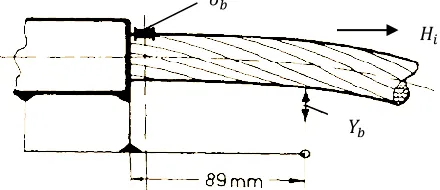
For almost half a century, the so-called Poffenberger-Swart (P-S) formula or model[1] has been used in transmission lines for safe design and maintenance purposes; that is, assessment of remaining life in conductors through the bending stress of wind-induced vibrations. In this model, the bending amplitude is measured peak to peak at 89 mm from the last point of contact (LPC); and the bending stress is given for the uppermost wire of the outer layer where the first sign of fatigue failure has been noticed. Based on this idea developed in a laboratory, strain-gauges are glued to the conductor at the clamp edge (KE), and a displacement transducer is fixed at 89 mm from the KE. Recommended by the IEEE [2], this model has been used in the vibration recorder measurement and the fatigue-test indoor assessment.
Previous researchers indicate that, when using the above model, there is considerable discrepancy between predictions and measurements [1]-[4]. This is because the P-S formula is based on both cantilever beam theory (Fig.1) and many assumptions taken (idealized model) [1]-[2]. This discrepancy also depends on the diameter of outer layer wire 𝑑𝑎, minimum
stiffness 𝐸𝐼𝑚𝑖𝑛 and the tension in the strand (% UTS). Later,
Statistical Modelling of Bending Stress in
ACSR Overhead Transmission Line Conductors
subjected to Aeolian Vibrations-I
YD. Kubelwa, RC. Loubser, KO Papailiou
I
Manuscript received March 08, 2016; revised March 29, 2016. This work was supported in part by the S.A NRF, THRIP, ESKOM, Pfisterer, Aberdare Cables and VRTC Lab (University of KwaZulu-Natal).
Y.D. Kubelwa is a member of the IAENG and with the VRTC (HVDC), School of Engineering, University Of KwaZulu-Natal, Durban, 4001, South Africa, phone(+27) 31 260 3862, fax:(+27) 31 260 8677, email: [email protected].
Papailiou improved the P-S model in introducing the varying bending stiffness model 𝐸𝐽(𝑘) which is a function of the bending curvature 𝑘 and explained by the slip-stick state.
The distribution of stresses in the stranded conductor during alternating motion is affected by numerous input factors both direct, that is, conductor structure (diameter of wire, overall conductor diameter, bending stiffness, length, and number of wires and layers), and indirect: types of clamps used, and clamp pressure distributions within the conductor. Another important factor is the contact stress between wires in the conductor. This factor is significantly influenced by the inter-wire friction as explained in the slip-stick theory developed by Papailiou [4].
In this context the prediction model, therefore, becomes a statement of probability with respect to repeatability and traceability. Concomitantly, the questionable utilization of the P-S model and the complexity of the Papailiou model lead to the development of a very simple and easy-to-use model. In combining experimental data and statistical techniques, a realistic and simple model may be derived: this approach has been proven in many disciplines and has been shown giving a good model of mechanical characteristics with non-linear behaviour. Claren and Diana noticed that the experimental relationship between bending stresses and bending amplitudes is non-linear, observing this result in most conductors tested [1]. With regard to this deduction, a statistical technique may be the unique means of easily and accurately expressing the mechanical behaviour of a conductor under alternated motion. In this paper, four overhead line ACSR (aluminium conductor steel-reinforced) conductors, i.e., Rabbit (6 Al./1St.), Pelican (18 Al./1St.), Tern (45 Al./7St.), and Bersfort(48 Al./7St.), were investigated at three different ranges of tensile load: 20 %, 25%, and 30% Ultimate Tensile Strength (UTS). Bending amplitudes (0.0 1mm -1.2mm), and bending stress measurements were collected and plotted as bending stress 𝜎𝑏 versus bending amplitude 𝑌𝑏, curve-fitting,
with a polynomial function of the third order in terms of four parameters. Moreover, it is possible, in combining both experimental data and statistical analysis, for a realistic model to be further developed. Strain-gauges were glued at the edge of the clamp; and a displacement transducer was affixed 89 mm away from the clamp edge (squared-faced clamp type) [1].
Fig. 1: Relationship principle of bending stress and bending amplitude system of a conductor-rigid clamp
Poffenberger and Swart recorded that, at low amplitudes, this bending amplitude method presented significant uncertainties [11]. Claren and Diana recorded, after several experimental works, which the average difference between a
predicted outcome using the P-S model, and measured stress was in the range of 30% difference compared with the test performed on many ACSR conductors. Recently, Levesque et al. concluded that the correlation between experimental strains and the theoretical (P-S) is weak [6].
II. STATISTICAL MODELLING
A.Basic theory and principle
Numerous researchers in the past have indicated that regression parameters obtained from experimental data may not always have a physical meaning [12]. However, statistical modelling and inference of the stress signature at the vicinity of a conductor-clamp system allows some general conclusions from data observed. Statistical modelling of the bending stress-bending amplitude relationship was performed using the polynomial and the non-linear regression technique, which characterizes top wire in the outer layer caused by the alternating motion. Once the modelling has been applied, a prerequisite is to understand the key concepts of the statistical inference.
𝜎𝑏𝑖= 𝐵0+ 𝐵1𝑦𝑏𝑖+ 𝐵2𝑦𝑏𝑖2+ 𝐵3𝑦𝑏𝑖3+∈𝑖, (1)
where 𝜎𝑏𝑖represents the bending of the dependent variable
at tension 𝑖. B0, B1, B2, and B3, are the curve-fitting
coefficients which obviously depend on the conductor characteristics (𝑑𝑎 , H, and 𝐸𝐽); while ∈𝑖 is the random error
on the bending stress. As underlined above, the aim of the prediction model is to minimize the standard error given as follows:
𝑆𝑆𝐸 = ∑[𝜎𝑏,𝑒𝑥𝑝𝑡 (𝑦𝑏) − 𝜎𝑏,𝑚𝑜𝑑𝑒𝑙(𝑦𝑏)] 2 𝑁
𝑛=1
(2)
where SSE is the standard deviation between𝜎𝑏,𝑒𝑥𝑝𝑡
(
𝑦𝑏)
and𝜎𝑏,𝑝𝑟𝑒𝑑𝑖𝑐𝑡(𝑦𝑏), which are, respectively, the experimental
stress obtained on the uppermost wire, and the stress from the predicted model at the amplitude 𝑦𝑏.
Since the distribution
of the stresses is not normal with respect to the bending
amplitudes, the random errors may be given as follows:
(3)
∈𝑖=
1 2√
𝑆𝑆𝐸
𝑁 − 𝑘 − 1
(3)
where N is the number of the amplitude analysed, k is the degree of freedom (DOF), and SSE is the standard error.
To bridge the theory and the experiments, the polynomial regression has to be defined, and the dependent and independent variables properly identified. In this scenario, the bending stress is a dependent variable. Thus, the independent variables analysed in this study: parameters of conductors, such as overall diameter, configuration, material, and number of wires, linear mass, and length of the conductor. All these parameters are represented as one, in the bending stiffness EI
factor. External parameters to the conductor are: (i) the force induced by the wind-drag force on the conductor quantified as
𝜎𝑏
𝑌𝑏
[image:2.612.52.272.557.652.2]the bending amplitude at 89 mm from the KE; and (ii) the static tension applied to the conductor.
B.Identification of statistical regression technique
To identify the appropriate statistical regression technique, these steps should be followed: (i) variables collected are plotted in a scatter-diagram with bending stress 𝜎𝑎 as a
function of bending amplitude 𝑦𝑏, and the relationship
between two variables represented in the graph; and (ii) observing the scatter-shape curve, which is a form of existing relationship-model shape, the type of regression technique is chosen from several predefined in the package. Three significant factors include: (i) the estimator, or predictor factor
𝑅2 which must be 𝑅2≅ 1 (strength of the relationship); (ii)
the standard deviation SSE between the result and the prediction model; and (iii) the model of stress distribution on which the standard error depends.
There are several statistical-analysis methods which are used for the prediction of the experimental result. The appropriate model should give a good correlation with the results. The selected model should also depend on the decision of the researcher apropos of the expected applications and analysis. In most cases, a prediction is a compromise of the above methods. Other concerns in statistical prediction are its limitations: the results may be valid for the values between the points tested.
III. EXPERIMENTAL PROCEDURES AND RESULTS
A.Experimental procedures
The goal behind this work is to record the bending strain for an enforced bending amplitude peak to peak, measured at 89 mm from the terminal clamp edge opposite the excitation side, as per the IEEE standards [2]. The vibration shaker connected at 1.2m from the rigid clamp, as shown in Fig. 1 subdued the conductor in the ranges of frequency 5-60 Hz. The bending stress is given by a direct product of the bending strains 𝜀𝑏
(strains) and the Young Modulus of the aluminium, in this case 𝐸𝑎 (MPa).
The aim of this procedure is to ensure that the bending strains are collected with as few errors as possible, taking into account the instruments, the analyst, and the procedure itself (errors in data acquisition are known as non-sampling errors).
This approach adopts inverse problems, although errors are inevitable; the admissible errors fall in the range of about 5%. All instruments were calibrated before this experimental work was conducted. In addition, to minimize those errors caused by instruments (which may, for instance, be due to signal conditioning), the measurements were repeated at least three times; the data taken into consideration is the average of these measurements. The temperature in the laboratory was maintained at 20 ± 1℃, as per international standards with regard to indoor measuring, obviously also to ensure the reliability of the instruments. It was noticed, and for the sake of reducing the noise during the recording of data, that a better sinusoidal signal was obtained for a natural frequency greater than 15 Hz. The testing was conducted at various tensions of interest for all conductors, i.e. 20%, 25 %, and 30% UTS, measured with load cells. However, the bending strain was measured by means of the strain-gauges (sensitivity 2.07 and resistance 𝑅 = 350 ± 5Ω), bounded on three uppermost wires of the conductor, and at the KE. The bending amplitude was accessed by the double time-integral of the accelerometer measurement placed at 89 mm from the KE.
B.Experimental results
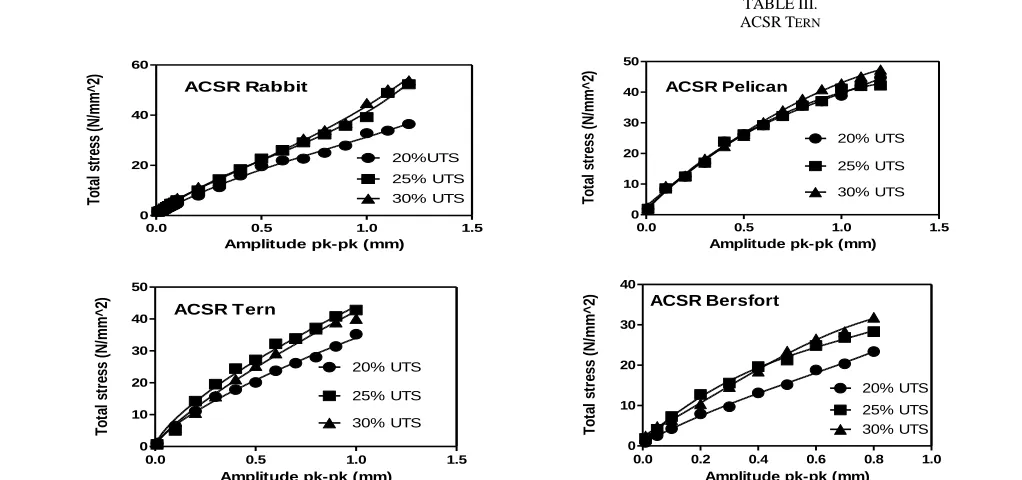
Data were plotted as bending strains (micro-strains) vs. bending amplitude (mm), as discussed earlier. Non-sampling errors were reduced by running several measurements for the same bending amplitude point. N is the number of tested amplitudes, from 0.01– 0.1mm, with a step of 0.01 mm; and 0.1–1.2 mm with a step of 0.1, consecutively. N = 21 for Rabbit and Pelican. The amplitudes attempted for Tern and Bersfort were 1.0 mm and 0.8 mm, respectively, which yielded N = 19 for Tern, and N =17 for Bersfort. For each amplitude three measurements were recorded: their mean was used as the final measurement. The error bars shown in the line graph above represent a description of strength of confidence that the mean of the bending strain (𝜀𝑏1, 𝜀𝑏2, 𝜀𝑏3)
represents the true bending strain value. The more the original data values range above and below the mean, the wider the error bars and less confidence there is of a particular value. These error bars are then compared with the distribution of data points in the original scatter plot above. With the error bars present, what may be said about the difference in the means of the bending strain values for each bending
Concrete block Concrete block
Rigid clamp
Rigid clamp Dead end
Termination clamp
Active span 84.5 m Conductor
Shaker Rigid connection
Accelerometers Strain gauges
Constant tension device
Displacement Transducer
Air conditioning
amplitude? Should the upper error bar for one bending amplitude overlap the range of bending strain values within the error bar of another bending amplitude, there is a much smaller likelihood that these two bending strain values will differ significantly. The Standard Error (SE), is an indication of the reliability of the mean. A small SE is an indication that the sample mean is a more accurate reflection of the actual bending-strain mean. A larger sample size will normally result in a smaller SE.
Fig.3. Illustration of the mean value of the bending stress and the error bars of the ACSR Rabbit tension at 25 % UTS.
IV.DISCUSSIONS
A.Polynomial Model
To perform the regression technique on the data recorded, and for convenience' sake, the bending strain was expressed in the bending stress (MPa), using the law of Hooke eq.4, as follows:
𝜎𝑏= 𝐸𝑎𝜀𝑏 (4)
where 𝜎𝑏 is the bending stress in MPa, 𝐸𝑎 is the Young
Modulus of the Aluminum equal to 𝐸𝑎= 6.9 GPa, and 𝜀𝑏 is the
bending strain in micro-strains.
The coefficient or function parameters, i.e. 𝐵0,𝐵1, 𝐵2, and
𝐵3 of the eq.1 are given in the tables below, for the various
conductors tested and the ranges of tension: Table I (ACSR Rabbit), Table II (ACSR Pelican), Table III (ACSR Tern), and Table IV (ACSR Bersfort). In general, the estimator parameter was close to 1. There was a small deviation between the statistical model and the experimental data defined by the SSE (eq.2).
TABLEI. ACSRRABBIT
Coefficient 20% UTS 25% UTS 30% UTS
B0 0.464 0.53 2.27
B1 45.27 59.33 44.61
B2 -24.03 -46.75 -16.52
B3 9.54 28.04 13.28
TABLEII. ACSRPELICAN
Coefficient 20% UTS 25% UTS 30% UTS
B0 0.57 0.60 3.54
B1 95.01 93.10 29.63
B2 -93.93 -86.03 15.66
B3 36.22 30.78 -1.082
TABLEIII. ACSRTERN
0.0 0.5 1.0 1.5
0 20 40 60
20%UTS
25% UTS 30% UTS
ACSR Rabbit
Amplitude pk-pk (mm)
To
ta
l s
tr
es
s
(N
/m
m
^2
)
0.0 0.5 1.0 1.5
0 10 20 30 40 50
20% UTS
25% UTS
30% UTS
Amplitude pk-pk (mm)
T
o
ta
l
st
re
ss
(
N
/m
m
^
2)
ACSR Pelican
0.0 0.5 1.0 1.5
0 10 20 30 40 50
20% UTS
25% UTS
30% UTS
ACSR Tern
Amplitude pk-pk (mm)
T
o
ta
l
st
re
ss
(
N
/m
m
^
2)
0.0 0.2 0.4 0.6 0.8 1.0
0 10 20 30 40
20% UTS
25% UTS 30% UTS
ACSR Bersfort
Amplitude pk-pk (mm)
T
o
ta
l
st
re
ss
(
N
/m
m
^
2)
[image:4.612.52.280.171.370.2] [image:4.612.53.563.228.721.2] [image:4.612.49.560.476.716.2]Coefficient 20% UTS 25% UTS 30% UTS
B0 0.3913 -0.9799 0.9462
B1 66.5 84.92 47.22
B2 -70.58 -66.95 15.58
B3 38.9 26.01 -23.48
TABLEIV. ACSRBERSFORT
Coefficient 20% UTS 25% UTS 30% UTS
B0 0.6686 1.222 2.422
B1 37.87 65.58 39.17
B2 -23.08 -61.72 14.04
B3 14.01 28.07 -21.85
B.Tension Effect Analysis for stress distribution in the conductor
The scenario in this experimental work is that the ACSR Rabbit and Pelican conductors constitute one steel core in which the diameters of both the aluminium and core wires are the same. On the other hand, ACSR Tern and Bersfort have multi-steel core conductors (7-steel wires) with varying diameters of aluminum and steel. The stress function is given by the expression in eq.2 in which the function parameters or coefficients, i.e. 𝐵0, 𝐵1, 𝐵2and 𝐵3 are particular (unique) to
each conductor and each tension H; i.e. 20 % UTS, 25 % UTS, and 30 % UTS. It is therefore important to discover the physical interpretation of differing parameters in the mentioned expression. Although the polynomial model is not simple to interpret [9], variations of the differing coefficients with respect to tension give an overview of the factor which affects the stress behaviour. A theory elaborated by Papailiou on the stick-slip principle is well-identified in the analysis of the various functions of parameters present in the figure below (Fig.4). As the final objective is to identify each possible function parameter as such, much experimental work is needed to achieve such a future study. However, the data in hand were helpful in demonstrating some elaborated theories on the conductor mechanism during the vibration peak to peak: a combination of slipping and sliding. In the first status, there is contact friction between wire of the same layer and wire from consecutive layers. In the second, the stick status is seen when wires are interlocked with each other. Finally, there is the combined slip-stick when, for instance, for low-vibration amplitudes, the bending stress has begun slowly to vary with the tension from 20% UTS to 25% UTS compared with the variation from 25% to 30% UTS where it is noticed as non-linear.
In general, the 𝐵0 increases towards the positive axis values
for all conductors except for the ACSR Bersfort. On this conductor, the 0.2 to 0.25 ratio of the UTS 𝐵0 varies from 0.73
to 0.54, increasing to 2.4 at the 0.3 tension ratio. In all cases 𝐵1, 𝐵2 and 𝐵3 at 20% and 25% UTS of the ACSR tern
Fig.4 Variation of function parameter B0, B1, B2 and B3 respectively, left-up, left-down, right-up, and right down with respect to the tension which is given by the ratio between the tension and the ultimate tension
0.2 0.22 0.24 0.26 0.28 0.3 0
0.5 1 1.5 2 2.5 3 3.5
Dimensionless Ratio Hi/H
F
u
n
c
tio
n
P
a
ra
m
e
te
r
B0
ACSR Rabbit ACSR Pelican ACSR Tern ACSR Bersfort
0.2 0.22 0.24 0.26 0.28 0.3 30
40 50 60 70 80 90 100
Dimensionless Ratio Hi/H
F
u
n
c
tio
n
P
a
ra
m
e
te
r
B 1
ACSR Rabbit ACSR Pelican ACSR Tern ACSR Bersfort
0.2 0.22 0.24 0.26 0.28 0.3 -100
-80 -60 -40 -20 0 20 40
Dimensionless Ratio H
i/H
F
u
n
c
tio
n
P
a
ra
m
e
te
r
B2
ACSR Rabbit ACSR Pelican ACSR Tern ACSR Bersfort
0.2 0.22 0.24 0.26 0.28 0.3
-40 -20 0 20 40 60 80
Dimensionless Ratio Hi/H
F
u
n
c
tio
n
P
a
ra
m
e
te
r
B3
conductor are, respectively, equal to 𝐵1, 𝐵2 and 𝐵3 at 25%
and 30% UTS of ACSR Bersfort. These two ACSR conductors have the same number of layers, n is equal to three (2n-1=3), but different stranded numbers of wires in their structure (ACSR Tern with 45 aluminium wires and 7 steel wires; while ACSR Bersfort has 48 aluminium wires and the same number 7 of steel wires. The equal approximate values were observed in some cases of the analysis of the results obtained; for instance, 𝐵0at 20% UTS of the ACSR Rabbit
are almost the same, with the ACSR Tern at the same tension. This function parameter is much closer at 25% for ACSR Rabbit, ACSR Pelican and ACSR Bersfort. The function parameter 𝐵1 at 30% is likely to be the same in ACSR
Rabbit, ACSR Tern, and ACSR Bersfort. The function parameters 𝐵2 of the ACSR Pelican at 20% and 25% UTS are
equal, respectively, to those of ACSR Tern and ACSR Rabbit. The discussions were based on the comparison of the elaborated model, the P-S model, and the results of the experiments. In this summary, a numerical application is given in order to ascertain the best method of predicting, as developed in the preceding section. Selection is derived by comparing the results on the ACSR Tern conductor, i.e., amplitude peak to peak from 0.2 to 1 mm, overall diameter: 27 mm, tension 20 % UTS. Using the eq. 2 and P-S model [1]-[3] respectively, the results of this comparison were summarized in Table V. below. The statistical model thus developed yields a much closer result to the experimental ones, compared with the results from the P-S model. The discrepancy is noted between 1-6% for the statistical model and 20-30% for the P-S model. In general, for results of all conductors tested, the conclusions are at the same level of discrepancy for both compared models.
TABLEV.
ILLUSTRATION OF COMPARISON BETWEEN STATISTICAL MODEL,EXPERIMENT RESULTS AND P-S MODEL OF ACSR TERN AT 20%UTS
Bending Amplitude Bending Stress
mm Statistical Model Experiments P-S Model
0.1 6.37 6.44 3.23
0.2 11.18 11.1 6.46
0.3 15.1 15.65 9.7
0.4 18.19 17.87 12.93
0.5 20.86 20.1 16.16
0.6 23.29 23.77 19.39
0.7 25.7 26.13 22.62
0.8 28.34 28.01 25.86
0.9 31.43 31.41 29.1
1 35.21 35.23 32.32
V. CONCLUSION
A simple model of characterization of bending stress of the conductor rigidly clamped has been developed and compared with the existing models. The statistical model is of great significance because of the accuracy that it produces, despite some limits which may arise. By developing the model, it was possible to identify theories such as the slip-stick status in the various function parameters developed by the analysis of the tension effect.
The realistic model thus developed may be improved in future, using the same approach on several conductors with the same configuration and number of layers but with different diameters of stranded wires. This would be to assess the dependence of the various function parameters of the statistical model developed.
ACKNOWLEDGMENT
The authors gratefully acknowledge the contributions of P. Moodley (VRTC Lab-UKZN), T. Nene (PFISTERER), L. Pillay (ESKOM) and L. Weight (Editor)
REFERENCES
[1] EPRI (2006), Transmission Line Reference Book: Wind-induced Conductor Motion, EPRI, Palo Alto, CA 2006, 1012317.
[2] IEEE “Standardization of conductor vibration measurements,” IEEE Trans. Power App. Syst., vol. PAS-85, no. 1, pp. 10–22, Jan. 1966. [3] R. Claren and G. Diana, “Dynamic strain distribution on loaded stranded
cables,” IEEE Trans. Power App. Syst., vol. PAS-89, no. 11, pp. 1678– 1686, Nov. 1969.
[4] K.O Papailiou 1994, Bending of helically twisted cables under variable bending stiffness due to internal friction, tensile force and cable curvature, Dr. Sc. thesis Eidgenössische Technische Hochschule Zurich. [5] KO. Papailiou, “On the Bending Stiffness of Transmission Line
Conductors,” IEEE Trans. Power App. Vol. 12, No. 4, pp. 1576-1588, Oct. 1997.
[6] F. Lévesque, S. Goudreau, A. Cardou, and L. Cloutier, “Strain measurements on ACSR conductors during fatigue tests I— Experimental method and data,” IEEE Trans. Power Del., vol. 25, No. 4, pp. 2825–2834, Oct. 2010.
[7] CIGRE SC22 WG 04, "Studies Carried out in Spain on Aeolian vibration Of Overhead Conductors, International Conference on large voltage Electric Systems", Cigre, Paris,1976.
[8] YD. Kubelwa, KO. Papailiou, R. Loubser and P. Moodley, “How Well Does the Poffenberger-Swart Formula Apply to Homogeneous Compact Overhead Line Conductors? Experimental Analysis On the Aero-Z® 455-2z Conductor”, 18th WCNDT, ISBN: 978-0-620-52872-6, Durban, 4000 pp118-128, April 2012.
[9] G. R. Gillich, et al., “Identifying Mechanical Characteristics of Materials with Non-linear Behavior using Statistical Methods”, Proceedings of the 4th WSEAS International Conference on Computer Engineering and Applications, WSEAS Press, 2010, p. 96-103.
[10] MC. Newman, "Regression analysis of log-transformed data: Statistical bias and its correction”, Volume 12, Issue 6, Pages 955–1133, June1993. [11] Ouaki B. Analyse experimentale et theorique de l’endommagement par fatigue `apetits d´ebattements des fils de conducteurs ´electriques au voisinage d’une pince de suspension. These (Ph. D.)–Universit´e Laval, 1998.