Printed in Great Britain
LACTIC AND SUCCINIC ACIDS AS EXCRETORY PRODUCTS
OF POLYMORPHUS MINUTUS (ACANTHOCEPHALA)
IN VITRO
BY D. W. T. CROMPTON AND P. F. V. WARD
The Molteno Institute, University of Cambridge and Biochemistry Department, A.R.C. Institute of Animal Physiology,
Babraham, Cambridge
{Received 21 December 1966)
INTRODUCTION
When adult worms of the acanthocephalan parasite, Polymorphus minutus, are in-cubated for 4 hr. at 417 ±0-5° C. under near-anaerobic conditions in a balanced salt solution containing radioactive glucose, they excrete two substances which contain approximately equal amounts of radioactivity. It was suspected that these metabolites might be organic acids. They were found to be non-volatile, dialysable, free from phosphorus and amino groups and not carbohydrate in nature. Examination of the incubation medium by one-dimensional, descending paper chromatography in a Shandon Panglass 300 Chromatatank indicated that one of the metabolites was lactic acid. The solvent systems used were PrF and EtAm (Smith, i960), and the organic acids were located by dipping dry papers in the bromcresol green reagent described by Smith. The other metabolite appeared to be succinic acid with the PrF solvent system, but its position on the paper after the EtAm solvent did not correspond exactly with that of authentic succinic acid, although it was always in the same region of the paper as succinic, malic and fumaric acids. The aim, therefore, of the work described in this paper was to identify, by means of gas chromatography, the unknown organic acid and to confirm the identity of the lactic acid. The results are considered to be applicable to the carbohydrate metabolism of the worms in vivo, because care was taken to ensure that the worms remained healthy during the incubation period.
MATERIALS AND METHODS
Incubation procedure. Worms of known age, sex and wet weight were obtained from
freshly killed Khaki Campbell ducks which had been fed on BOCM* baby chick crumbs. They were kept in glucose-free, physiological saline (Hanks, 1948), at 417 + 0-5° C , pH 7-8 and in equilibrium with air for less than an hour before being exposed to radioactive glucose. Crystapen benzylpenicillin and Streptomycin sulphate were present in the saline in concentrations of 1 mg./ml. For experimental purposes the worms were transferred from these conditions to a sterile glass vessel containing a known amount of sterile Hanks's saline and antibiotics, and D-[U-14C]glucose. Nitrogen was bubbled through the vessel for 15 min. before the taps were closed and
the worms were left for a further 3I hr. The worms were then removed and the incubation medium was analysed for radioactive excretory products.
It was presumed, for three reasons, that the worms remained in a healthy state during the incubation period. First, the oxygen tension in the incubation vessel was measured with an oxygen electrode and found to be about 10 mm. Hg. This value, and those of the temperature and pH in the experiments, are similar to measurements made in the small intestine of ducks by Crompton, Shrimpton & Silver (1965) and Crompton (1966). Secondly, the worms were observed to move spontaneously for 19 days under these conditions provided that glucose was present in the concentration originally prescribed by Hanks (1948). Thirdly, it was found that worms which had been kept for 4 hr. in vitro under the incubation conditions could be returned by surgical pro-cedures to the small intestine of a duck where their development continued. This test was performed once with seven worms, of which four were found to be attached to their host's intestinal wall 24 hr. after the operation. The establishment of the other three worms could have failed owing to the presence of anaesthetics which are known to affect schistosomes (Dickerson, 1965).
The possibility that the radioactive metabolites had been produced by bacteria in the medium was also investigated. No bacteria could be seen in a drop of medium examined at the end of the incubation period. A tenth of a ml. of the incubation medium and successive 20-fold dilutions of it were inoculated on to plates of a rein-forced clostridial medium and placed under anaerobic conditions at 370 C. Clostridia are common bacteria of the vertebrate intestine, but no growth was visible on any of the plates after a fortnight.
The results presented in this paper were obtained from the analysis of the incubation medium involving thirteen male and thirteen female 5-day-old worms weighing 13 mg. The worms were placed in 1-5 ml. of Hanks's saline containing 0-33 mg. D-[U-14 C]glu-cose/ml. of specific activity i6-2/ic/mg. Only two radioactive metabolites were de-tected by paper chromatography, and these were the only ones present on four other occasions when worms varying in age from 1 to 30 days old were used. All the radio-active chemicals employed in this work came from The Radiochemical Centre, Amersham, Bucks, U.K.
Extraction of organic acids. 7 ml. of N-HC1 were added to about 0-2 ml. of the
incubation medium, and the resulting solution was extracted continuously for 7 hr. with 50 ml. diethyl ether. The ethereal phase was dried overnight with anhydrous Na2SO4. After the Na2SO4 had been removed by filtration through a No. 1 sintered glass funnel, the volume of ether was reduced by distillation to about 1 ml. An air condenser, acting as a fractionating column, was fitted to the distillation flask; this modification was necessary to minimize the loss of radioactivity during the removal of the ether.
Preparation of methyl esters. Two methods were used to prepare the methyl esters
Excretory products of Polymorphus minutus 425
Estimation of the radioactivity in the volatile fraction. Half a millilitre of incubation
medium was placed in a double-necked, 100 ml. flask with a tap funnel attached to one neck and a Dreschel head to the other. Air, under pressure, was used to force about 20 ml. N-HC1 into the flask simultaneously with the bubbling of nitrogen through the Dreschel head. The air was switched off and the nitrogen passed for 10 min. through the acidic medium at 6o°C. into an absorption tube containing 2 ml. ethanol-amine and 4 ml. ethylene glycol monomethyl ether (JefFay & Alvarez, 1961). Nitrogen was next passed for 5 min. through the acidic medium at 100° C. into a fresh absorp-tion tube, and this process was repeated at ioo° C. using another fresh absorpabsorp-tion tube. Samples of 1 ml. each from the three absorption tubes were added to 5 ml. of a mixture of toluene-ethylene glycol monomethyl ether (2:1 v/v) containing 5-5 g./l. 2,5-diphenyl oxazole, and the radioactivity was counted in a Panax, A.C. 300/6, water-cooled, liquid scintillation counter standardized for this counting medium with w-[i -14C]hexadecane.
Gas chromatography. The methyl esters of organic acids were chromatographed in
the vapour phase using a Panchromatograph (W. G. Pye and Co. Ltd., Cambridge) fitted with a macro-argon detector. Glass columns 150x0-5 cm. diam., were used packed with one of two stationary phases; 10% (w/w) polyethyleneglycol adipate on Gas-Chrom Z 100-120 mesh (Applied Science Laboratories Inc., State College, Penn., U.S.A.) and 10% (w/w) Apiezon L grease on Gas-Chrom Z. 100-120 mesh. The polyethyleneglycol adipate column was operated at ioo° C. for 4 min. after injection of a sample, then temperature programmed at 6° C./min. until 1800 C. was reached. The carrier gas flow rate was maintained at a constant 70 ml./min. argon. The Apiezon L column was also operated at 100° C. for 4 min. after injection, then temperature programmed at 6° C./min. until 2000 C. was reached. Carrier gas flow rate was maintained at 40 ml./min. throughout. The identity of specific components during gas chromatography was confirmed by the addition of internal markers of authentic methyl esters. Radioactive components were collected by attaching to the effluent of the gas chromatograph a column (35x1-1 cm. internal diameter) fitted with a No. 1 sintered glass disk at its lower end and containing 7 ml. toluene in which was dissolved 4 g./l. 2,5-diphenyl oxazole and o-i g./l. i,4-bis-(5-phenyloxazole-2-yl) ben-zene. These solutions were counted in vials in the Panax scintillation counter as above.
RESULTS
Volatile fraction. Table 1 shows the loss of radioactivity by volatilization of an
aliquot of incubation medium (0-5 ml.) giving 73,900 disintegrations/sec, after heating with N - H C I first to 6o° C. then cooling to room temperature followed by boiling then recooling and finally reboiling. Details are given in the Materials and Methods section. The loss of radioactivity by volatilization after heating with HCl was found to be very small. The amount given off between room temperature and 6o° C. is likely to be dissolved CO2, while the fraction volatilized by boiling probably contains short-chain fatty acids. There does not appear to be any continued loss of radioactivity due to degradation of the main radioactive components after boiling with HCl as found by cooling and reboiling. The radioactivity volatilized by the second boiling was almost zero.
Gas chromatography of incubation medium acids. Preliminary results of the gas
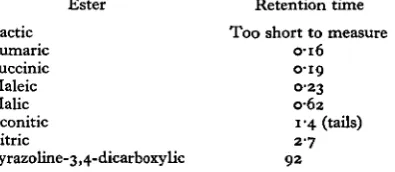
[image:4.451.131.329.322.408.2]chromatography on polyethyleneglycol adipate of the methyl esters of the organic acid fraction showed that almost all the radioactivity was divided fairly equally between two peaks. The first of these two peaks was, as expected, identical in retention time with methyl lactate and the second with methyl succinate. A number of other acids of biological importance were chromatographed but most of these had considerably longer retention times as can be seen from Table 2.
Table 1. Volatile fraction of incubation medium Radioactivity Radioactivity Temperature Time of heating volatilized volatilized
(°C.) (min.) disintegration/sec. (%) 60 10 470 0-64 100 s 762 1-03 100 5 24 0-03
Table 2. Retention times of methyl esters of organic acids relative
to methyl palmitate
(The column was 150 x 0-5 cm. and packed with 10 % (w/w) polyethyleneglycol adipate on Gas Chrom Z. The operating temperature was 1800 C.)
Ester Lactic
Fumaric Succinic Maleic Malic Aconitic Citric
Pyrazoline-3,4-dicarboxylic
Retention time Too short to measure
0-16 0-19 0-23 0-62
1-4 (tails) 2-7 9 2
If attempts are made to form the methyl esters of fumaric and maleic acids with diazomethane the compound dimethyl pyrazoline-3,4-dicarboxylate (Loudon, 1957,
IVa, p. 266) is formed. This was used as a useful means of effecting a better separation
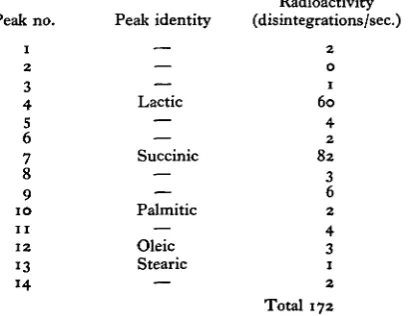
of fumaric, succinic and maleic acids on the gas chromatograph. Since all the radio-activity was eluted with the earliest peaks when the methyl esters from the incubation medium were chromatographed isothermally at 1800 C , temperature programming was adopted. A very good separation of all the peaks in this mixture was obtained by operating the chromatograph at ioo° C. for 4 min. after injection of the sample, followed by temperature programming at 6° C./min. Tables 3 and 4 show the results of gas chromatography of the methyl esters from the incubation medium on the two different stationary phases employed. The identity of the named peaks was ascertained by first chromatographing without, then with, internal markers.
Incubations with horse-heart muscle preparation. A preparation of horse heart-muscle
Excretory products of Polymorphus minutus 427
[image:5.451.130.346.147.278.2]to compare the action of the horse heart-muscle preparation on both [i-4-14CJsuccinic acid and the incubation medium of P. minutus. Four 10 ml. test tubes were labelled and made up as in Table 5.
Table 3. Gas chromatography of methyl esters of incubation medium
on polyethyleneglycol adipate
Peak no. 1 2 3 4 S 6 7 8 9 10 11
The amount of radioactivity injected was 507 disintegrations/sec, and the recovery from the chromato-graph was therefore 88%.
Table 4. Gas chromatography of methyl esters of incubation medium
on Apiezon L grease
Peak identity Lactic — Succinic — Malic — Palmitic — Stearic Oleic Radioactivity (disintegrations/sec.) 6 185 8
2 1 0 6 5 S 3 5 9 5 Total 447
ik no.
1 2 3 4 5 6 7 8 9 1 0 1 1 1 2 13 14 Peak identity — — — Lactic — — Succinic — — Palmitic — Oleic Stearic — Radioactivity (disintegrations/sec.) 2 0 1 6 0 4 2 8 2 3 6 2 4 3 1 2 Total 172
The amount of radioactivity injected was 202 disintegrations/sec, and the recovery from the chromato-graph was therefore 84 %.
The tubes were incubated at 370 C. for 2 hr. in a water bath with air from a manifold bubbling slowly through their contents. The incubation was terminated by the addition of 1 ml. N - H C I to each tube and the organic acids were extracted by continuous ether extraction as described previously. The radioactive components of all the tubes except tube 2 were extracted quantitatively into the ether. In tube 2 only 41 % of the radio-activity was extracted into the ether, the remainder presumably being largely 14 C-glucose. The other extracts were methylated with diazomethane and reduced to a volume suitable for gas chromatography. The methyl esters were injected successively
[image:5.451.134.344.347.505.2]on to the gas chromatograph and the peaks were collected separately from the effluent into 7 ml. toluene scintillation fluid as before.
Tube 4, the blank tube, gave no radioactive peaks and the chromatogram showed a large peak of methyl succinate and a number of other smaller peaks some of which were recognizable as long-chain fatty acid esters. In tube 3, the control tube, the radioactivity was confined to the succinic acid peak. The pattern of peaks was similar
Table 5. Incubation of horse heart-muscle preparation with [i-^-^C^succinic acid
and incubation medium of Polymorphus minutus
Tube 1 "C-succinic acid
1 ml. o-i M-phosphate buffer pH 7-3 containing 2-4 mg. succinic acid o-i ml. water containing
10 /ic. [i-4-14CsJsuccinic acid (48 /ic./mg.) 0-3 ml. cytochrome c
(10 mg./ml.) in buffer 50 jil. buffer
Tube 2 "C-incubation medium
1 ml. o-i M-phosphate buffer pH 7-3 containing 2-4 mg. succinic acid o- 1 ml. incubation medium
0-3 ml. cytochrome c (10 mg./ml.) in buffer 50 /i\. buffer
Tube 3 control
1 ml. o-i M-phosphate buffer pH 7-3 containing 2-4 mg. succinic acid o-1 ml. water containing
io/tc. [i-4-"C2]succinic
acid (48 /tc./mg.) 0-3 ml. cytochrome c
(10 mg./ml.) in buffer 50 fil. malonic acid 0-2 g./
ml. in buffer
Tube 4 blank
1 ml. o-i M-phosphate buffer pH 7-3 containing 2-4 mg. succinic acid o-i ml. water
0-3 ml. cytochrome c (10 mg./ml.) in buffer 50 /t\. buffer
o-i ml. horse heart prep. o-i ml. horse heart prep. o-i ml. horse heart prep. o-i ml. horse heart prep.
Table 6. Comparison of the radioactive acids produced when horse heart-muscle
preparation is incubated with [i-^-^C^succinic acid and a similar component from the incubation medium of Polymorphus minutus
Radioactive component at start of incubation
Acids produced after incubation with horse heart prep.
Succinic Malic Citric Pyrazoline dicarboxylic (fumaric) Unknown Total
[i-4-"C2]succinic
acid 0/ /o 3'4 54-6 3-0 6-i 22-8 8 9 0
•Medium from P. minutus 0//o 35-5 36-7 0 157 0 87-9
• For comparison, the radioactivity from lactic acid in this medium has been ignored.
to that of tube 4 except for an overload of methyl malonate. In tube 2 containing the methyl esters of the incubation medium, 88 % of the total radioactivity collected was in peaks identical with the esters of lactic, succinic, malic and pyrazoline-3-4-dicarbo-xylic acids. The latter would be formed from the action of diazomethane on fumaric acid (Loudon, 1957). In tube 1, which started with [i-4-14C2]succinic acid, the radio-activity was more scattered. Nevertheless, 90 % of the collected radioradio-activity appeared in peaks identical with the following esters: succinic, malic, citric, pyrazoline-3-4-dicarboxylic (fumaric) and an unknown compound. Table 6 compares the action of the horse heart particles on radioactive components of tubes 1 and 2.
Excretory products of Polymorphus minutus 429
heart preparation enzymes as did [i-4-14CJsuccinic acid. Nevertheless, most of the transformed radioactivity appeared in the peaks of malic and fumaric acids indicating that the component was indeed succinic acid.
DISCUSSION
The identification of succinic acid among the excretory products of Polymorphus
minutus provides the first record of the excretion of this organic acid by an
acantho-cephalan worm. P. minutus has also been found to excrete lactic acid as do Moniliformis
dubius (Laurie, 1957) and Neoechinorhynchus emydis and N. pseudemydis (Dunagan,
1964). The fact that succinic acid has not been found to be an excretory product of
M. dubius is of interest because Laurie (1959) extended his earlier work on this
parasite and studied its aerobic metabolism. He found, after careful analysis of the incubation medium, that formic and acetic acids were excreted as well as lactic acid, but he makes no mention of succinic acid. It is possible that formic and acetic acids were present in the radioactive volatile material excreted by P. minutus. Graff (1964, 1965) showed that radioactive succinic, malic, lactic and fumaric acids can be detected in extracts made from whole M. dubius, which have been incubated with either 14C-glucose or NaH14CO3. Bryant & Nicholas (1965) also found these four radioactive acids were produced when homogenates of the body wall of
M. dubius were incubated with 14C-glucose under conditions far removed from those
in vivo. It is important, therefore, that the medium remaining after M. dubius has been
incubated with exogenous carbohydrate under anaerobic conditions should be analysed for succinic acid. If M. dubius does not excrete succinic acid, in contrast to P. minutus, the intermediary metabolism of these parasites, from the same phylum and a similar environment, must be markedly different. The species of Neoechinorhynchus, studied by Dunagan, may also excrete succinic acid because he noted that the amounts of lactic acid excreted by the worms did not account for all the glycogen metabolized by them under starving conditions.
No evidence has been obtained for the formation of succinic acid by P. minutus. Von Brand (1966) has tabulated the helminths known to excrete succinic acid and discussed its production. Simpson & Awapara (1966) and Scheibel & Saz (1966) have studied mechanisms for the formation of succinic acid in marine molluscs and the cestode, Hymenolepis diminuta, respectively. Simpson & Awapara investigated the metabolism of 14C-glucose by preparations of the mantles of Rangia cuneata,
Crasso-strea virginica and Volsella demissus, and concluded that glucose is degraded to
phosphoenolpyruvate which is carboxylated to form oxalacetate and thence to succinate. Scheibel & Saz, however, decided that the pathway for the conversion of 14C-glucose to succinate is through the carboxylation of pyruvate followed by reduction to succi-nate. It is probable that the production of succinic acid by P. minutus will eventually be shown to be along one of these pathways.
SUMMARY
vivo. The acids were identified by paper and gas chromatography, and the identity
of succinic acid was confirmed with an enzyme preparation.
We are most grateful to Mr N. S. Huskisson and Mr D. Barnard for technical assistance, and Professor M. Dixon, F.R.S., Dr G. D. Greville and Dr T. Mann, F.R.S. for helpful discussions.
REFERENCES
BRAND, VON T. (1966). Biochemistry of Parasites. New York and London: Academic Press.
BRYANT, C. & NICHOLAS, W. L. (1965). Intermediary metabolism in Moniliformis dubius (Acantho-cephala). Comp. Biochem. Physiol. 15, 103-12.
CROMPTON, D. W. T. (1966). Measurements of glucose and amino acid concentrations, temperature and pH in the habitat of Polymorphus minutus (Acanthocephala) in the intestine of domestic ducks.
J. exp. Biol. 45, 279-84.
CROMPTON, D. W. T., SHRIMPTON, D. H. & SILVER, I. A. (1965). Measurements of the oxygen tension
in the lumen of the small intestine of the domestic duck. J. exp. Biol. 43, 473-8.
DICKERSON, G. (1965). Effects of anaesthetics on mature infections of Schistosoma mansoni in the white mouse. Nature, Land. 206, 953-4.
DUNAGAN, T. (1964). Studies on the carbohydrate metabolism of Neoechinorkynchus spp (Acantho-cephala). Proc. helminth. Soc. Wash. 31, 166-^72.
GRAFF, D. J. (1964). Metabolism of C14-glucose by Moniliformis dubius (Acanthocephala). J. Parasit. 50,
230-34-GRAFF, D. J. (1965). The utilization of C"Oa in the production of acid metabolites by Moniliformis
dubius (Acanthocephala). J. Parasit. 51, 72-75.
HANKS, J. H. (1948). The longevity of chick tissue cultures without renewal of the medium. J. cell. comp.
Physiol. 31, 235-60.
JEFFAY, H. & ALVAREZ, J. (1961). Liquid scintillation counting of carbon-14. Anal. Chem. 33, 612-15. KEILIN, D. & HARTREE, E. F. (1938). Cytochrome oxidase. Proc. R. Soc. B 125, 171-86.
LAURIE, J. S. (1957). The in vitro fermentation of carbohydrates by two species of cestode and one species of Acanthocephala. Exptl Parasit. 6, 245-60.
LAURIE, J. S. (1959). Aerobic metabolism of Moniliformis dubius (Acanthocephala). Exptl Parasit. 8, 188-97.
LOUDON, J. D. (1957). Compounds containing a five membered ring with two hetero atoms: pyrazole and iminazole groups. In Chemistry of Carbon Compounds (ed. E. H. Rodd). Amsterdam: Elsevier. ROPER, R. & MA, T. S. (1957). Diazomethane as a reagent for microsynthesis. Microchem. J. 1, 245-60. SCHEIBEL, L. W. & SAZ, H. J. (1966). The pathway for anaerobic carbohydrate dissimilation in
Hymeno-lepis diminuta. Comp. Biochem. Physiol. 18, 151-62.
SCHLENK, H. & GELLERMAN, J. L. (i960). Esterification of fatty acids with diazomethane on a small scale. Anal. Chem. 32, 1412-14.
SIMPSON, J. W. & AWAPARA, J. (1966). The pathway of glucose degradation in some invertebrates.
Comp. Biochem. Physiol. 18, 537-48.