Sharing Photos, sharing my life.
Improving social connectedness between mentally disabled children and their absent parents by introducing a distant photo exchange system.
Eva Johanna Beltman
University of Twente
Faculty of Behavioral Sciences, Psychology
Department of Cognitive Psychology & Ergonomics In association with The Twenste Zorgcentra
First supervisor: dr. M. Noordzij
Abstract
In a case study at an institution for mentally disabled children a digital photo frame was introduced like in studies of Biemans and Van Dijk (2009) and Biemans, van Dijk, Dadlani and Van Halteren (2009). As suggested by Eisenhardt (1989) for case studies data triangulation was used. For all stakeholders, the mentally disabled children, their parents and their caregivers several measurements methods were used. All measurements methods together supported the findings of improved social connectedness between mentally disabled children and their parents
through usage of a distant photo exchange system.The photos exchanged served as food for talk
Table of content
Introduction 6
Background 7
Social connectedness definitions 7
Social connectedness and development 7
Social connectedness and “others” 8
Social connectedness and awareness systems 9
Using photos 10
Previous research with digital photo frames 10
Measuring social connectedness 12
Introducing a photo exchange system 15
Explorative case study 15
Method 16
Participant 16
Mentally disabled children 16
Caregivers 18
Parents 18
Photo exchange system 19
Set up of the requirement inventory 19
Results form the requirement inventory 19
Decisions in designing a photo exchange system 21
Measurements 24
ABC-Q 25
IDQOL 25
Observations 27
Evaluative interviews 27
Photos exchanged 27
LEMTool 28
Results 29
ABC-Q 29
IDQOL 30
Observations 31
Evaluative interviews 31
Evaluative interview by the parents 32
Evaluative interview by the caregivers 34
Photos exchanged 37
Amount of photos exchanged by the parents 37
Amount of photos exchanged by the home groups 40
Content of the photos exchanged 42
Categorization of the photos by the researcher 42
General discussion 45
Content of the photos exchanged 45
Categorizations 46
LEMTool 47
Amount of photos exchanged 48
ABC-Q 48
Evaluative interview 49
Social connectedness 49
Photo exchange system 50
Research limitations 51
Future implications 53
Conclusions 55
References 57
Acknowledgements 63
Appendix A: ABC-Q 64
Appendix B: IDQOL 68
Appendix C: Checklist for observation of the behavior of the children 72
Appendix D: Evaluative interview Parents 74
Appendix E: Evaluative interview Caregivers 77
Introduction
Connectedness forms the basis for all human existence and it is the phenomenon of connectedness that brings quality of life (Register & Herman, 2010, p.53). Mentally disabled children living apart from their family experience a distance between themselves and their family. (Re) connecting with their family could improve their quality of life. Quality of life is said to be the affective evaluation by the child itself about different aspects of his/her life (Douma, Kersten, Koopman, Schuurman, and Hoekman, 2001).
According to Visser, Van Bel, Dadlani and Yarosh (2010) interpersonal awareness of each other’s lives can stimulate social connectedness. Biemans, van Dijk, Dadlani and Van Halteren (2009) and Biemans and van Dijk (2009) studied the effect of social connectedness on individual’s well-being and health improvement in care facilities (nursing home and
rehabilitation center). As used in several awareness systems (e.g. Romero, Markopoulos, van
Baren, de Ruyter, Ijsselsteijn and Farshchian (2007), Biemans et al., (2009) and Biemans and
van Dijk (2009) used photos (sent to digital photo frames). They found improvement of awareness between themselves and the absent family.
Background
Social connectedness definitions. A universal definition of social connectedness does not exist. The following definitions appoint to the predominant aspects of the concept social connectedness in this context. Visser et al., (2010) consider social connectedness to be the momentary experience of belongingness and relatedness with others. Lee and Robbins (1995; 1998) state that social connectedness is defined as an aspect of the self that reflects subjective awareness of
interpersonal closeness with the world in toto. The definition of Lee and Robbins is therefore
focused broader than just others. A sense of social connectedness develops early in life and
extends throughout the life span (Lee, Draper & Lee, 2001). For a sense of social connectedness to develop early in life, the developmental period is the most important period.
Social connectedness and development. According to the Attachment Theory of Bowlby (1982) the developmental period is strongly related to social support. Attachment is defined as an interpersonal bond that has important developmental implications (Sarason & Sarason, 2009). The Attachment Theory acknowledges the role of social ties in personal development. Ainsworth, Blehar, Waters & Wall (1978) distinguish two dimensions of individual reactions to distress, anxiety (attachment-related anxiety) and avoidance (attachment-related avoidance). These two working models of self and others begin to develop early in life in response to experiences with attachment figures (Ainsworth et al., 1978).
definitions from sources such The American Association on Intellectual and Developmental Disabilities, The International Classification of Functioning, Disability and Health as well as that of The United Nations Convention on the Rights of Persons with Disabilities).
The ontogenetic developmental period is in two aspects crucial for mentally disabled children as their mental disability originates in that period. Consequently, their mental disability can cause a different or impoverished social interaction. The importance of social functioning for individuals with mental disabilities is recognized as relevant to an individual’s quality of life (Nota, Ferrari, Soresi & Wehmeyer, 2007). Being socially connected to one’s peers and relatives is of great importance to an individual’s well being and contributes to one’s happiness and contentment (e.g. Baumeister & Leary, 1995; Biemans, van Dijk, Dadlani & van Halteren, 2009).
The interactions and relationships we have with other people form an essential social network that supports us and adds meaning to our lives. This can be illustrated by the massive success of communication media such as e-mail, mobile telephony, text messaging, and the massive adoption of social networking applications such as Facebook and Twitter (e.g. IJsselsteijn, van Baren, Markopoulos, Romero & de Ruyter, 2009). The current development of
Internet provides us with social networks and connectivity services to stay in touch with the whole world. Stay in touch with their family is a good start for mentally disabled children.
Using photos. Many of the awareness systems employ photos. The use of photos can be seen in the light of cognitive priming (Baldwin, 1994; Brewer & Gardner, 1996). In cognitive priming the memories of significant others are recalled, therefore increasing self-esteem and temporary feeling of belonging. This cognitive priming can be achieved by for example looking at a photo of a significant other (Visser et al., 2010). Cognitive priming is an individual process depending on the individual value of the content of the photo.
Previous research with digtial photo frames. Biemans & van Dijk (2009) and Biemans et al., (2009) investigated the importance of social connectedness on individual’s well-being and health improvement in institutions (nursing home and rehabilitation center) using digital photo frames. Distance between rehabilitant or elderly, and family increased permanent or temporally when the rehabilitant or elderly stayed in the care institution. In order to increase social connectedness Biemans et al., (2009) and Biemans & van Dijk (2009) used the Vodafone SIM card based digital photo frame. These photo frames enable delivery of photos taken on a camera phone through Mobile Message System (MMS). In addition it is possible to upload photos to the photo frame via the website.
In their study with elderly living in a nursing home Biemans & van Dijk (2009) found that the photo frames served as food for talk between the elderly and family members, and also between the elderly and caregivers. The frame was mainly used to send photos of special events that are meaningful to the elderly persons. In their study with the rehabilitants almost half of the photos had a focus on staying in touch by sharing everyday things of life. These photos were not necessarily followed by communication. Two different intentions of photos sent to stay in touch.
In this study the aim is to share photos by exchanging photos instead of sending from one side. Therefore, the intention of photos send and received can be different per user group. In the new communication via photo exchange, people can share information about their lives to give meaning and value to the social relationships. Such information can vary from rational to emotional information, and it can include positive and negative information (Visser et al., 2010). For connectedness-oriented communications the informational content of the message can be of secondary importance to the emotional, relational content that is being transmitted (Kuwabara et al., 2002).
Measuring social connectedness. To measure social connectedness, mostly questionnaires or scales are used (Lee & Robbins, 1995, 1998, 2000; Russel Peplau and Cutrona, 1980; Van Baren, Ijsselsteijn, Markopoulos and Romero, 2004; Romero et al., 2007). Douma and Kersten, (2001) mention the importance of involving mentally disabled peoples self. All regularly used measurement methods for social connectedness are too difficult for mentally disabled children. The measurement methods are written, or too long. Additionally they use concepts unfamiliar to mentally disabled children. For case studies (data) triangulation is strongly recommended (Eisenhardt, 1989). Decisions in order to find appropriate measurement methods for this case
study are based on the stakeholders. In this case: Mentally disabled children, Caregivers and
Parents. Several measurement methods are considered for usage per stakeholder.
First the Mentally disabled children. Characteristics for mentally disabled children are a
low cognitive level and difficulties in expressing themselves in communication. There are measurement instruments with a social component used with the children at the institution now e.g. the Communicatie Profiel – Z (CPZ) Dutch, Vragenlijst over Ontwikkeling en Gedrag (VOG) Dutch and, Sociaal Emotionele Ontwikkeling (SEON) Dutch. However all these tests have one or more obstacles to overcome in order to make them usable for mentally disabled children in relation to the social component. For example the level of the test is still too high.
Special attention is paid to the Family Relation Test (FRT) (Anthony and Bene, 1957). This projective test attempts to overcome the limitations of seeing the child as the identified problem, in isolation from their family (Griffin, 2005). The test uses postboxes representing family members to which the child can assign different statements. The original Dutch statements in the FRT do not fit the situations the children are in or would get in during the
intervention. Some statements are rather inappropriate. For example the test stated; with whom
use the FRT statements, the statements had to be rewritten to fit the situation the mentally disabled children are in. Reliability issues had to be taken into account for a rewritten version.
The Landelijk Kennis Netwerk Gehandicapten (LKNG), a nationwide database on mental disability, published a guide on how to do research with mentally disabled people. This guide mentions several focus points. For one they note that there is still little known on which support materials are the best to use in research (Schuurman Speet and Kersten, 2004, p.69). Usability of the measurement methods has to be considered. Kraijer and Plas (2006) mention in their manual on psycho diagnostics three types of measurements; tests, scales and questionnaires. Scales, in observations by caregivers, are the most commonly used measure. Scales are followed by tests, which are relatively subjective measurements. Finally, questionnaires are scarcely used as measurement method at mentally disabled people. In an overview of research methods on mentally disabled people no tests as measurement method are mentioned. (Schuurman et al., 2004, p.111). This indicates that not all types of measurement methods are available for mentally disabled children.
The LKNG publishes so-called Klappers, which are folders with thematically ordered
measurements (see the method section) mentally disabled children will complete the IDQOL as an interview with aid of a psycho diagnostic assistant. An inclusion criterion is set in order to determine if the children would be able to express themselves in communication for the different measurement methods. The ComVoor (Verpoorten, Noens, van Berckelaer-Onnes, 2004) is a test designed for the mentally disabled population, to determine what kind of communication support is needed. In the test the participants sort different representations of objects. The result of the test is a degree between presentation to representation level. On the presentation level there is a match between the concept and a copy of the concept. At the representation level, a concept can be sort by a representation of a concept of the same category (e.g. a picture or drawing of the concept).
The second stakeholders, the Caregivers, are trained and experience observers of the
children their behavior. Among other measurement methods, the proxy version of the IDQOL is used as a scale. The caregivers, based on their experience with the child, fill out the proxy version.
For the final stakeholder, the Parents, the Affective Benefits and Costs Questionnaire
Introducing a photo exchange system. Similar to other studies in this field, a user requirement inventory is conducted to develop a system addressing the communication needs (Visser et al.,
2010). The requirement inventory involves the stakeholders Parents and Caregivers. Mentally
disabled children are not able to contribute to the requirement inventory, due to their disability.
Therefore Specialists (e.g. behavioral experts at the institution), warrant the needs of the
children. Several open question interviews with all these stakeholders will be conducted, to determine the requirements for a photo exchange system.
Explorative case study. In this explorative case study a photo exchange system is introduced in order to improve social connectedness mentally disabled children and their parents. Based on the results from the user requirement inventory, a photo exchange system is set up. In a trial period of about 14 weeks photos can be exchanged between parents and children. For this trial period the dependent variables, social connectedness and quality of life will be measured with pre- and post measures.
Method
This study is an explorative case study at an institution for mentally disabled people at Almelo, The Netherlands. The study takes place at two home groups; Home-A and Home-B. These home groups provide care for mentally disabled children. In this section the participants and measurements are described. An overview of the analyses of data of these measurement methods is given. Additionally, in this section the photo exchange system is described based on the findings in the requirement inventory.
Participants
As mentioned earlier three stakeholders are distinguished; Mentally disabled children, their
Caregivers and their Parents. There are differences for the stakeholders on different aspects of introducing an intervention to improve social connectedness.
Mentally disabled children. The Mentally disabled children live in a home group at the institution for mentally disabled people. Dependent on the disabilities of the child, care is focused on specific care domains e.g. personal care. Several caregivers work at one home group. Children live together and share some communal areas like the living room, kitchen and all sanitary. All children have their own room, arranged to their own preferences.
For Home-A, 4 boys and 1 girl participated, aged between 14 and 26 years old. The girl moved to the home group during our study. A sixth inhabitant of the home group moved to the group as well though she and her parents did not participate in the study.
All children of Home-A are allowed and do go home for the weekend, though with
differences in frequency and duration of the stay. Two children go to school during the day. The other three children work during the day. Three children are unable to communicate through words. These children use some form of sign language. The children who are able to communicate are allowed to call their parents once during the week, and for special occasions once more. The call during the week is most times used, but is not required. Home-A exchanged photos for 13 to 15 weeks. Except for the last girl, she exchanged photos for 4 weeks.
For Home-B, 5 boys and 1 girl participate, two of the boys are brothers. These children are younger, aged 6 to 11 years old. All children stay at the home group for the weekend, except for special events. Parents, with strong differences in frequency, come visit their child at the home group. Most visits are during the weekend and sometimes during the week. For some parents a visit is under supervision, in the interest of the child. Some children can visit one of the parents for a day or two. All children go to school during the day, though not all at the same school. All children of this group are able to communicate through words, sometimes with aid of signs. All children are allowed to call their parents during the week, though this is not always done. Home-B exchanged photos for a shorter period of 7 to 8 weeks.
there is understanding that a photo on the digital photo frame is a representation of the moment the photo was taken. It does not guarantee there is understanding of the content of the photo. All children of the two home groups, Home-A and Home-B, reach the representation level.
The differences in contact with the parents were the second big difference between the children. The differences in visits to their family and from family could not be influenced; therefore it is documented and this difference is acceptable.
Caregivers. The second stakeholder is the caregiver. Caregivers are trained and used to observe the behavior of the mentally disabled children. Since observations are really subjective difference per caregiver are expected. For this study the caregivers are determined by the choice of the two home groups. As in most healthcares most caregivers are women. For Home-A most of the time between one and two caregivers are present at the home group. For Home-B this is
sometimes three at the same time present at the home group. For Home-B caregivers have to
work nightshifts, therefore they sleep over.
Parents. The third stakeholders are the parents. For Home-A all parents but one live together, in case of the separated parents the father of the child participates. While for Home-B all parents but one are separated. The parents still together are the parents of the brothers. In some cases separated parents no longer communicate together. For this study it is not essential for the parents to work together or communicate.
photos but since the mail server at the home group could not handle attached photos this was no longer done. One parent couple has already provided their child with a digital photo frame on which they occasionally put new photos from a memory card.
Photo exchange system
The set up of the requirements inventory contributed to the results of the requirements inventory. The photo exchange system designed was based on the requirements for the requirements inventory. Therefore the results will already discussed.
Set up of the requirement inventory. The requirements inventory is conducted by interviewing several stakeholders. Open interviews were used, so stakeholders are open to mention all sorts of requirements. Consequently the results cannot be statistically analyzed. The main results from the requirements inventory are requirements for a system supporting distant photo exchange.
Results from the requirements inventory. From the requirement inventory three main issues have to be covered by the system: Costs, Simplicity and Control.
Costs can be seen as financial contribution and also as effort needed to make the system
work. For this case study financial contribution is covered by subsidies. So only the Costs
coming from effort to make the system work have to be covered. Effort can be seen as ease of performing tasks on the system. Three main tasks can be distinguished from a photo exchange system; making photos, uploading photos and manage photos (viewing).
photos from the camera to the personal computer is supported mostly by software of the camera. More effort is needed to choose photos that you want to share. Managing the photos (e.g. on the personal computer) in order to retrieve the photos is strongly dependent on personal preferences (e.g. folder structure, back up, and printing options). Further management comes with the photos received and sent on the actual display.
Simplicity is related to the effort part of Costs. Effort is minimized with a simple system. In this study the parents demand Simplicity, since they described themselves as inexperienced with new technologies, and expressing fear for new technologies. Simplicity can be achieved by
using pre-existing structures. In making photos, Simplicity can come from using their own
camera they are familiar with. Uploading from their familiar camera and software is therefore
simple. Managing the photos should resemble familiar structures. Familiarity in the system can
reduce the fear of new technologies.
Mostly the Caregivers and Specialists demand Control. The moment and time the photos
are watched by the children had to be controlled. Moreover they also wanted Control on the
content of the photos exchanged in the system. The caregivers, turning on the photo frame at appropriate times for photo watching, will control the moment photos are watched. Additional to the control of the moment was the security of the photo frame. Some children are careless with objects and apparatus. For these children a protection around the photo frame is recommended to prevent damage of the photo frame. This protection will be locked by key, so that caregivers have to unlock in order to turn on the photo frame.
Decisions in designing a photo exchange system. For making photos the own cameras of the parents are used, or alternatively a Kodak Easyshare M580 is provided. The Kodak Easyshare M580 camera is able to choose automatically the appropriate setting for a photo moment. These cameras are used at the home groups. Because there is the possibility the children can also make photos a highly automatic camera is preferred. This camera would also be lent to those parents that have no camera. Since these parents probably did not previously use a digital camera it is desirable that the camera is easy to use.
Uploading photos dependents upon the software of the camera in use. The users determine which photos are shared. In order to Control the content of these photos direct sharing is intervened with a reviewer. The reviewer makes sure the photos are appropriate to be seen by the children. Photos can contain inappropriate content or quality of the photos is low (e.g. blurry). In order to have a reviewer before forwarding photos, photos are uploaded to a shared Dropbox folder with the reviewer. In the current study the reviewer is the researcher.
Dropbox is free online available software for sharing and storage of documents, for more see www.dropbox.com. Dropbox enables you to access folders with documents on different apparatus and the Dropbox folders are accessible online. Folders in Dropbox can be shared by inviting other Dropbox user to share this folder. Additionally the structure and design of Dropbox is intuitive to use to manage the photos. Dropbox resembles folders used on all types of personal computers. A known structure and design like Dropbox invokes Simplicity. In order to send photos, the user drags and drops or copies and pastes the photos in the Dropbox folder. Since the folder is shared, all invites are able to see and use the photos in this folder. Enabling
Dropbox to insert a Control system, all involved share a folder with the researcher. Just as the
After reviewing the photos are forwarded to a digital photo frame. The Kodakpulse 10” (see Figure 1) frame supports distance photo exchange through a wireless network connection. Biemans et al. (2009) and Biemans and van Dijk (2009) used the digital Vodafone SIM based photo frames, but those are no longer available. The only distant photo exchange options availble are trough wireless connections with the digital photo frame. The Kodakpulse and Samsung SPF 105V support wireless network connection. The Samsung frame is less intuitive to use when interacting with the photo frame. Especially connecting the frame to the wireless network is difficult. Simplicity and Costs is better covered with the Kodakpulse 10” digital photo frame.
For the Kodakpulse 10” digital photo frames it is their specific online support page www.kodakpulse.com you have to enter to upload the photos to the frame. One online kodakpulse-account can be connected to more than one photo frame.
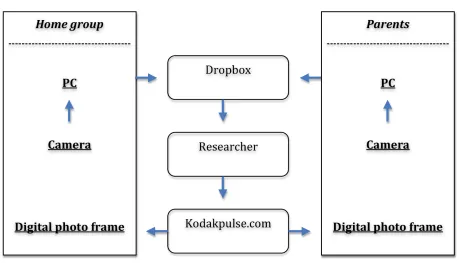
Photo exchange system. In its entirety the system is as follows (see Figure 2). (1) Make photos with a digital camera (Kodak Easyshare M50, or own camera). (2) Upload to the photos to a personal computer (or laptop). (3) Place photos to be shared in the shared Dropbox folder. (4) The researcher reviews the photos from this shared folder than forwarding to the corresponding kodakpulse.com online account. (5) This kodakpulse.com account is connected to the digital photo frame of the child and parent(s), making photos appear on both frames at the same time.
Figure 2. Distant photo exchange system.
The second system is based on sending and watching from Dropbox folders on the personal computer. Parents and the home group Home-B share two folders with the researcher, a
folder for sending photos and one for receiving photos for watching photos. The researcher
reviews the photos in the folder sending before placing them in the corresponding watching
folder of the parent or child. In order to watch the photos, parents can, at any time, open the folder watching and watch the photos. In the same manner children, accompanied by a caregiver, watched their received photos.
Measurements
Different measurement methods are used. De dependent variables social connectedness and quality of life are measured with the ABC-Q (Dutch version) and IDQOL (Dutch version). The Parents complete the ABC-Q. The ABC-Q is completed as pre- and posttest. The mentally disabled children complete the IDQOL (client version). Caregivers complete the IDQOL (proxy version), one or two caregivers together complete an IDQOL per child. The IDQOL is completed as pre- and posttest.
Qualitative measurement methods are used for data triangulation. Observations made by the caregivers are filled out during the complete trial period. All users of the system, caregivers and parents fill out evaluative interviews on the user experiences. The evaluative interviews are completed after the trial period.
ABC-Q. The ABC-Questionnaire (ABC-Q) (Van Baren et al., 2004) is a test to address the affective characteristics of communication means. The ABC-Q is sensitive for change, therefore the parents fill out the ABC-Q Dutch short version as a pre- and posttest.
Compared to the original ABC-Q, questions on the others perceptions are left out. The
other meant by the questionnaire are in this case mentally disabled children. Interpreting what mentally disabled children think of the affective characteristics of communication is difficult. Therefore the ABC-Q consists of twenty-seven questions on a 7 points licker scale from strongly agree to strongly disagree (see Appendix A). It covers nine domains with three questions per domain. The domains are; (1) personal effort, (2) thinking of each other, (3) sharing experiences, (4) staying in touch, (5) recognition, (6) obligations, (7) expectations, (8) invasion of privacy and (9) process effort. The first five domains together measure the Benefits, the last four cover the Costs (Ijsselsteijn et al., 2009).
According to IJsselsteijn et al., (2009) the ABC-Q (original version) has good internal consistency, with a Cronbach alpha coefficient reported of .96. In the current study for the ABC-Q pretest (Dutch short version), the Cronbach alpha coefficient is .53. For the ABC-ABC-Q posttest (Dutch short version) the Cronbach alpha coefficient is .81. ABC-Q scores from the pre and posttest will be compared using paired-samples t-test
How do you think about visiting others and (3) What do you think of being alone. The complete IDQOL consists of 19 questions (see Appendix B). Children complete the IDQOL with support
of a psycho diagnostic assistant. The psycho diagnostic assistant asks the questions, and can
explain the question when needed. The same psycho diagnostic assistant supports at the pre- and posttest. In total 10 children complete the IDQOL as pretest.
Caregivers fill out the proxy version of the IDQOL (Douma et al., 2001). This Proxy version consists of exact the same questions. Additional information, specifically from the open questions, is used as background. This background information helps interpreting the IDQOL scores of the children. For all children the IDQOL is filled out as pre- and posttest. When possible the same caregiver(s) fill out the IDQOL as pre- and as posttest.
Observations. During the photo exchange period the caregivers report observations of the children’s behavior on a checklist. The checklist of possible behavior of the children is filled out daily (see Appendix C). By using a checklist for the observations the observations are structured over the various caregivers of the children. Inserting additional space for comments and observations not listed, at the end of the checklist. Occurrence of behaviors will be scored and compared to the exchange-moments documented in a log over time.
Evaluative interviews. Parents answer questions presented in a structured oral interview (see Appendix D). The interviewer asks about their opinion on the value of the system. How they experience the system. And what they think of the type of photos sent and received.
Caregivers answer questions presented in a structured written interview (see Appendix E). There are questions on their opinion of the value of the system for the children. But since the caregivers also have to operate the system there are also questions about their user experiences. The results for both interviews will be described in a qualitative manner
Photos exchanged.
The exchange-moments of the photos are documented in a log. The amount of photos per exchange-moment and total amount are documented aside. The log distinguishes between users.
The content of the photos is determined by content analysis. The content analysis is based on the 5 categories of Van Dijk, Dadlani, Van Halteren, and Biemans, (2010). The categories are
(1) Message: I tell you something with this photo or I will show you something new. (2)
In the current study the photos are exchanged instead of sending from one way as for Van Dijk et al., (2010). In this study the photos on the photo frames can come from different senders, with different intentions. With the researcher in the photo exchange system the log of photos will keep track of the sender of the photos.
LEMTool.For a subjective value of the photos the children used the LEMTool (Huisman and van Hout, 2010). The LEMTool displays graphical emotions on small round stickers. According to Huisman and van Hout (2010) the stickers can be assigned to anything you want to assign an emotion too. In a playful setting the children will assign stickers to photos. All children stickered 12 photos out of the photos they receive.
Results
Several measurements were used for (data) triangulation, therefore both tests and other measures are described. As described in the method section the ABC-Q and IDQOL are analyzed statistically. For the ABC-Q, an alpha of .05 was accepted for all statistical tests. For the IDQOL an alpha of .10 was accepted for all statistical tests, due to the small sample size.
The qualitative measurement methods describe the qualitative information supported with descriptive data.
For the photos the exchange-moment, amount of photos and content, are presented as descriptive results. Results are presented for the parents separated per home group and for the caregivers per home group. Because the LEMTool was used explorative the results are the descriptive data and qualitative information.
ABC-Q
[image:29.612.65.497.601.687.2]The reliability of the pretest was low Cronbach alpha was .53. Comparison of the pretest scores with the posttest scores was not relevant. Independent-samples t-tests on differences scores on the pre- and posttest (see table 1) were not significant.
Table 1
Difference in scores from the pretests and posttests of the ABC-Q.
Dimension of the ABC-Q Mean score pretest Mean score posttest p
Costs 3.49 3.37 p = .61
Posttest showed good reliability, Cronbach alpha was .81. A paired-samples t-test was conducted to evaluate the difference in scores on Benefits and Costs. There was a statistically
difference in scores of Benefits (M = 5.74, SD = .57) and Costs (M = 3.37, SD = .87), t (9) =
11.59, p < .001 (two-tailed). The magnitude of the difference in the means (mean difference = 2.37, 90% CI: 2.00 to 2.75) was a large effect (eta squared = .83).
IDQOL
Ten children completed the IDQOL as pretest. Due to difficulty with completing the pretest only 8 children completed the IDQOL as posttest. Two Wilcoxon Signed Rank Test revealed a statistical significant difference in IDQOL scores on the proxy version and the scores on the IDQOL completed by the children, z = 1.96, p = .05 (pretest) z = 1.96, p = .05 ( posttest).
There was no significant difference on IDQOL scores for the pretest and posttest on the proxy version. A Wilcoxon Signed Rank Test revealed a statistical significant difference in IDQOL scores on the pretest and posttest scores on the IDQOL version completed by the children, z = 1.89, p = .06. For all but one child the posttest scores were higher.
Difference was found on the domain Psychological, z = 2.39, p = .02. For all but one
Observations
Caregivers did not keep up the observations. During the first 2 weeks half of the checklists were filled out. Note that children are not always at the home group. This was already less for the third week. Children were about the same time at the home group than the first two weeks. Some checklists were not completely filled out.
Caregivers indicated to forgot or have to little time to fill out the checklist. Besides that the caregivers stated that the behavior did not change that much it would change the way the lists
per day were filled out. The relative low change in behaviors could not be confirmed since the
short time frame and low quantity of filled out observations. The second home group never filled out any behavior observation checklist. They started at the time the first home group long stopped filling out the observations.
Additional questions in the interview are introduced to cope with the lack of behavioral observation data. These additional questions were also applicable to both home groups.
Evaluative interviews
Evaluative interview by the parents. There was an structured interview schema used (see Appendix D). Not all parents completed the interview. Due to personal problems the interviews could not be conducted. These were all parents using Dropbox. Besides that, the user experiences were somewhat different for using the photos frame or Dropbox, so results will be presented separately for the two parent groups. Five parents using photo frames, and 6 parents using Dropbox completed the interviews.
[image:32.612.66.540.376.466.2]The first question in the interview was to rate the project in its totality with a grade from 1 tot 10 (see Table 6).
Table 6
Grades given per parent group for the complete project.
Parents Average
Photo frame 10 8 8 8 7 8.2
Dropbox 10 10 8 8 8 8 8.7
The photo frame using parents found the project to be fun, users like watching photos and it worked! Parents would liked that the photo frames could be used with Picasa (an online photo sharing service), want their child to turn it on himself, or would want to ad text to the photos. One parent commented they were less content about their own participation, based on the
quantity of photos they sent. The Dropbox parents found the project to be fun, users like getting
Photos were watched with strong difference in frequency. The photo frames were almost always turned on daily, and especially when the child was there. Dropbox users had to turn on their PC in order to watch. There were parents who watched the photos from Dropbox daily, others when new photos were added. All parents sent photos the child would recognize, and could ‘talk’ about at the home group. Recognition was mentioned again when asked if they had an underlying idea of the photos sent. Parents were especially glad to receive photos of everyday life at the home group, or things they ‘forgot’ would happen at the home group. Trips of and special events at the home group showed how much the children did. A few photos were deleted, mostly vague photos or the oldest photos on the frame.
[image:33.612.66.542.461.549.2]Parents were asked to give a score of the involvement/ connectedness they experienced with this system. -5 to 0 was a decrease, 0 to +5 was an increase (see Table 7).
Table 7
Increase in involvement/connectedness experienced with their child, by the parents.
Parents Average
Photo frame +2 +3 +3 +3 +4 +3
Dropbox +1 +3 +4 +4 +5 +5 +4
Suggestions, problems, and solutions were noted in order to determine future implications. Some parents mentioned to lack the option to add text to the photos. Parents would also like to use the wireless connection to use other communication supports like Skype (e.g.
video talk) Home-B already used the digital photo camera to make short home videos. The
Evaluative interview by the caregivers. Caregivers completed a written structured interview about their experience, especially about the use of the system and their opinion on what value it would have for the children (see Appendix E). We will separate the results for photo frame users and Dropbox users for the same reason as we separated the results of the parents their evaluations. Both groups filled out the same interview. Three caregivers from both home groups completed the interview. The first question in the interview was to rate the project in its totality with a grade from 1 tot 10 (see table 8).
Table 8
Grades given per home group for the complete project.
Home group Average
Home-A 8 9 9 8.7
Home-B 8 8 8 8.0
The best aspect was the ability to use the system for the child to watch photos and talk about the photos, and related events. And the other way around was the ability for the parents to see photos from the children. This was promoting contact between children and parents.
On a scale from -3, deterioration to +3 huge added value caregivers scored the added value of the photo exchange system (see Table 9).
Table 9
Scores from the caregivers on the added value of the photo exchange system
Home group Average
Home-A +2 +2 +2 +2
Home-B +3 +2 +3 +3
The added value accounted for all children but not the same for all children. This was
related to the background of the child. The added value came from the ability to watch the photos (together) and use them as a basis for conversation. A child was now able to share what it had done at the parents, away from the home group.
All children were enthusiastic to watch the photos. The reactions of the children on the photos varied from neutral to happy/ content. Here was once again mentioned that children used the photos as support for sharing their experiences. Photos were sometimes watched more than once. At Home-B children asked to watch the photos if they knew there were photos made by the home group. When they watched those photos the photos from the parents were watched too.
The children did not show a difference in connectedness towards the parents. Home-A
said they believed the children did not experience any form of connectedness at all. This was
different for Home-B, they believed that through the photo exchange connectedness of the
meanwhile. The success of the photos was especially seen when the children went fishing and by change the father of one child sent photos of himself fishing that same day. The child was said to grow with confidence.
[image:36.612.65.541.323.409.2]The second part of the interview was about the user experience when interacting with the photo exchange system. The first question was to give a grade from 1 to 10 on the system (see Table 10).
Table 10
Grades from the caregivers on the photo exchange system
Home group Average
Home-A 7 8 8 7.7
Home-B 7 7 8 7.3
The system was relative easy to use. The manual and instructions were enough to operate the system. Problems with the system were due to problems with the wireless network.
Photos exchanged.
Because of strong difference in time period photos were exchanged the results of the photos exchanged are described separately for both digital photo frame users (Home-A) and Dropbox
users (Home-B). And results are separated for Caregivers and the Parents of the corresponding
home groups.
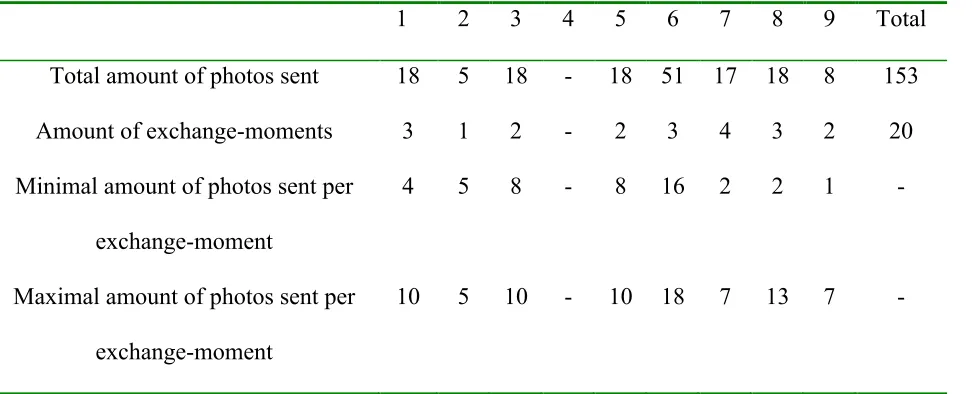
Table2
Descriptive data of photos sent for parents using digital photo frames
1 2 3 4 5 Total
Total amount of photos sent 166 205 124 35 35 565
Amount of exchange-moments 6 9 2 6 3 26
Minimal amount of photos sent per exchange-moment
4 3 14 2 4 -
Maximal amount of photos sent per exchange-moment
89 124 110 11 23 -
[image:38.612.71.541.388.640.2]Table3
Descriptive data of photos sent for parents using Dropbox.
1 2 3 4 5 6 7 8 9 Total
Total amount of photos sent 18 5 18 - 18 51 17 18 8 153
Amount of exchange-moments 3 1 2 - 2 3 4 3 2 20
Minimal amount of photos sent per exchange-moment
4 5 8 - 8 16 2 2 1 -
Maximal amount of photos sent per exchange-moment
10 5 10 - 10 18 7 13 7 -
Figure 4. Amount of photos sent per parent(s) for Dropbox users (Home-B).
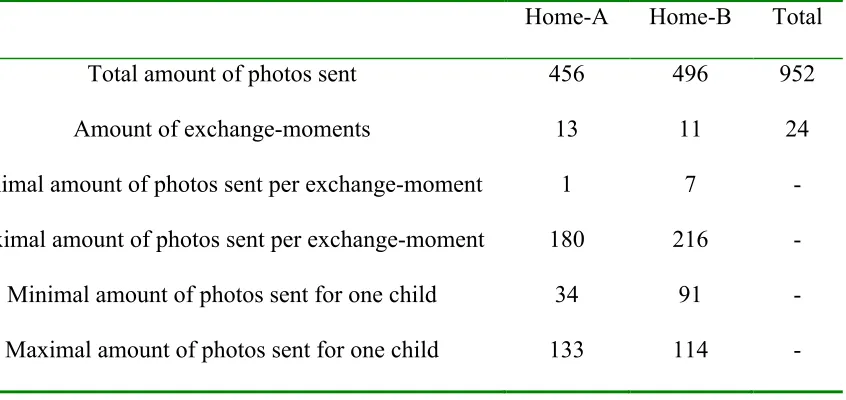
[image:39.612.74.540.393.619.2]Amount of photos exchanged by the home groups. All caregivers were instructed on how to exchange photos. For this analysis no difference between individual caregivers was made. The descriptive data from the log on the amount of photos sent by both home groups is displayed in table 4.
Table 4
Descriptive data of photos sent for Home-A and Home-B
Home-A Home-B Total
Total amount of photos sent 456 496 952
Amount of exchange-moments 13 11 24
Minimal amount of photos sent per exchange-moment 1 7 -
Maximal amount of photos sent per exchange-moment 180 216 -
Minimal amount of photos sent for one child 34 91 -
Maximal amount of photos sent for one child 133 114 -
Both home groups sent 54% unique photos, photos sent to one child only. The other
photos were sent to two or more children. For Home-A a child had minimal 4 and maximal 12
exchange-moments. For Home-B a child had minimal 5 and maximal 7 exchange-moments. The time children were at the home group differed.
The two brothers at Home-B had more than the maximal amount of photos sent for one
child, for the brothers together 151 photos were sent.
Figure 5. Amount of photos sent for children of Home-A.
[image:41.612.76.540.430.694.2]Content analysis of the photos exchanged. The content of the photos was determined by categorizations of the photos exchanged. The categorization was based on photos from both the parents and the home groups. A categorization was done by the researchers, based on the work of Van Dijk et al., (2010). The children themselves did the second categorization. The use of the LEMTool was explored in order to let the children categorize photos with stickers.
Categorization of the photos by the researcher. We started with the categorization of Van Dijk et al., (2010). The categories are (1) Message: I tell you something with this photo or I will show you something new. (2) Greetings: I want to say hi to you. (3) Everyday life: I want to keep you involved in the regular events in my environment. (4) Special events: I want to inform you about a special event. And (5) Something funny or aesthetic: I want to show you something and cheer you up. In order to see if the content of the photos fitted the categories three additional people categorized a small random set of 110 photos as a pretest of the categorization
The raters completed an unstructured open interview about the usability of the categorization. They commented to have to little background information on the photos to fully use the categories. These categories were based on the intention of the sender. A suggestion was to categorize on the objective components of the content. That would deal with all objections of the raters.
Based on work of Kindberg et al., (2005), the photos are categorized on the subject depicted on the photo. The difficulty with this type of categories was that photos fitted in more than one category when more than one subject was depicted. Therefore it was still not clear how to handle series of photos of one event.
versus sharing with people who were not physically co-present. The two categories fitted the underlying ideas of photo exchange in this study. First mutual experience; images used to enrich a shared, co-present experience. Secondly absent friends or family (images used to communicate with absent friends or family).
[image:43.612.69.546.378.494.2]There were no problems to objectively determine if the child was on the photo or not (see Table 5). Therefore the sender could also objectively be determined. For the home groups the unique photos were used.
Table 5
Number of photos for parents and home groups depicting the child on the photo or child not on the photo
Parents Home groups
Child on the photo 504 70% 474 92%
Total child NOT on photo 214 30% 41 8%
Total 718 515
LEMTool. In an explorative new way the LEMTool (Huisman and van Hout, 2010) was used. All children got 12 photos out of all photos received (the brothers had 17 photos since it was not known to whom the specific photo was sent). In total 118 photos were stickered. Children were asked to rate the photos with the LEMTool stickers.
Five of the 11 children were able to use the LEMTool. Two Children did not want to use the stickers at all. In other cases the child always chose the closest type of sticker at hand, independent of which this was. When asking the child why he/she chose for a specific emotion all answers involved the people on the photo. Some children wanted to put more than 1 sticker on the photo, mostly to make a distinction of the emotional expression per person on the photo.
General discussion
The photos served as food for talk, between the children, between children and their parents, and between children and the caregivers. Between the caregivers and parents it served for understanding of the work of the caregivers. However the photos in this study depicted both special events as everyday life as compared to the findings of Van Dijk, et al., (2010).
This discussion starts with focus upon various reasons for use of both photos depicting special events as photos depicting everyday life. The results contributing to social connectedness between parents and children will be discussed. And this discussion focuses on research limitations and suggestions for future research. Finally recommendations and implications will be discussed.
Content of the photos exchanged
Categorization of the content of the photos based on Van Dijk et al., (2010) appeared from a pretest to be difficult to use for photos exchanged in this study. The major problem was lack of background information in order to determine the intention of the photo sent.
The fact that digital photo cameras were used instead of camera phones generated more photos of one event. It is clear that with the ease and convenience of digital technologies (e.g. digital cameras), the number and also variety of images made has increased substantially (Van House, 2010). A so-called funnel effect (Van House, Davis, Takhteyev, Good, Wilhelm and Finn, 2004) where many photos are taken but only few get added was not found. The current categorization did not show how to treat multiple photos of the same event.
event, since there was a photo of it. This explains why for one rater an event is special just because there is a photo of it.
Photos appear to be objects with no stable meanings. Photos have always had the ability to convey a meaning other than the owner intended (Van House, 2010). Their meaning may change over time, for different viewers, in different context, in different associations with text and other images.
Categorizations. The difficulties with using the categorization from Van Dijk (2010) gave reason to use the objective properties of the photos exchanged. As Kindberg et al., (2005), the photos were categorized on the subject depicted on the photo. This way of categorizing has other complications. Photos fitted in more than one category when more than one subject was depicted. For series of photos it was still unclear how to handle them.
Kindberg et al., (2005) used their categories based on the subjective properties of the photos to come up with taxonomy. Since the photos were used to improve social connectedness the main focus was on the social-affective dimension. The social-affective use can be broadly broken down into sharing with people co present at the time of photo capture versus sharing with
people who were not physically co-present. First mutual experience; images used to enrich a
shared, co-present experience. Secondly absent friends or family (images used to communicate with absent friends or family).
Based on wheter the photos came from the parents or home group and secondly wheter the child was on the photo or not photos fitted in one of the two categories. On the photos of the home groups in 92% of the photos the child or children were depicted, sent to the parents
therefore fitting the second category absent family or friends. For the parents we saw that on
category, mutual experience. Drawing someone into an experience happening at the same time despite being separated by distance represent a compelling way to stay close Kindberg et al., (2005). Supported by Kindberg et al., (2005) the sender and the social use of the system contributed to sending photos of all kinds of events. The sender could be both the child as the parent, since photos were exchanged instead of sent from one part.
LEMTool. That people depicted on a photo were the main trigger for the children when watching the photos became clear with the use of the LEMTool. When presenting a photo to the child, the child always started with pointing out him or herself on the photo. Than (all) the others on the photos were mentioned. Consistent with Kim and Zimmerman (2006) when families shared stories bout the photos; they always started by who was in the photo, the social connection between themselves or the person they are engaging with. Most reactions of the children when stickering the photos where on the people depicted on the photo. This was strengthen when children asked to use two stickers to make a distinction on their judgments for the different
people on the photo. The two positive emotions joy and desire were stickered the most. This is
reason to believe that children were positive towards the photos they received. These results must be seen in the light that not all children seemed to understand and be able to use the stickers.
Amount of photos exchanged
Contribution to this effect was not found for the amount of photos exchanged. As with the content of the photos it was not clear how to treat multiple photos of one event, series of photos. The time the photo exchange system used was not the same for all parents. And when children were not at the home group when photos were taken, no photos were sent for this child.
Attaching to much importance to the amount of photos does not add value to the results. More photos do not have to be better. According to Kuwabara et al., (2002) the emotional and relational information transmitted in the communication (photos), are more important. This can be done with sending simply one photo ‘saying it all’. Communication with small amount of information (e.g., one photo or a trivial message) may be enough to create a sense of connection between people (Bernheim Brush et al., 2008)
In line with the studies of Biemans et al., (2009) and Biemans and van Dijk (2009) it is not that clear if a baseline in exchange moments has been reached, nor for the home groups, nor for the parents. There is too much difference in exchange moments per person and also in minimal amount of photos per exchange moment. In order to determine the baseline the photo exchange system needs to be used longer.
ABCQ
The ABC-Q scores given reason to believe that the baseline for photos exchanged will not be zero. The experienced Benefits of the photo exchange system were significantly higher than the Costs. Benefits of exchanging photos weigh heavier than the Costs, making it plausible that users accept the Costs in order to be able to exchange photos.
to have out weighted the Benefits. Simplicity of the system can contribute to low perceive Costs. This believes were strengthen by results from the evaluation interview of the parents. In the interview the photo exchange system was said to be easy to use.
Whether the Costs were higher than the Benefits before using the photo system could not be determined. The pretest of the ABC-Q was not found reliable. When completing the ABC-Q some parents had difficulty understanding the questions. An explanation for reliability at the posttest as opposed to the pretest is that parents just at the posttest understood the test. This is supported with the fact that at the pretest parents had to score on what they expected from the system, while at the posttest they could rely on their actual experiences of the system.
Evaluative interviews
In the evaluative interviews of the parents the experiences of exchanging photos with their child were asked. We found that all parents were positive about using a photo exchange system. Several parents said to sent photos to their child he or she could talk about at the home group. And they experienced that their child told more about his or her experiences when there was
support from photos. What was found promising is that the photos served as food for talk not
only towards the parents. The caregivers too reported the photos supported stories from the children on their experiences.
Social connectedness.
one’s own memories but other’ (Van House et al., 2004). When remembering the people on the photo, one is using nostalgic reverie. In nostalgic reverie “the mind is ‘peopled’” (Hertz, 1990, p. 195). Important figures from one’s past are brought to life and become part of one’s present (Davis, 1979). Wildschut et al., (2010) propose that nostalgia can holster social connectedness.
Photo exchange system
The designed photo exchange system to support distant photo sharing was based on the requirements form the requirement inventory. The usability of the photo exchange system was acknowledged by the both the parents and caregivers using the system. The usability of the system came from the Simplicity, low Costs and right execution of Control.
Simplicity was met with preexisting structures from Dropbox. And as mentioned in the
interviews, the system was found easy to use. The researcher executed the Control over photos
exchanged. No photos with inappropriate content were exchanged. The only photos not sent
through were some photos with low quality, vague photos. The Costs is different for the two
introduced photo exchange systems. This difference in systems was not prearranged but came from delivery problems by Kodak. The main difference was whether photos had to be watched actively on the personal computer or appeared automatically on the photo frame. The active
watching demanded more effort, Costs. There was no information on whether there were new
photos in Dropbox to be watched. This was changed half way during the exchange period when the researcher started sending e-mail when new photos were placed in Dropbox. Parents
appreciated this e-mail. The Costs, effort the researcher had to make to upload the photos the
Dropbox over the photo frame has the advantage to be relative cheap. For the users in the current study the process to sent photos was exactly the same. The main difference came with watching the photos received. For future implications the differences in watching photos with the systems can be used to determine future directions.
Research limitation
The current study was an explorative case study. As suggested by Eisenhardt (1989) data triangulation was executed. Due to participation of different stakeholders and difficulties with the measurements methods not all findings proved their value. For the analysis of the results in this case study problems occurred with small sample sizes. Some problems with the used measurements methods came from difficulty with including mentally disabled children with different mental disabilities. Mainly their difficulty in expressing themselves through speech
influenced the results. Though children all reached the presentation level on the ComVoor this
was no guarantee their expression in the different measurements methods was usable.
The parents filled out the ABC-Q. It was found that the ABC-Q was too difficult to fill out based on expectations instead of actual experiences. The reliability was higher when parents could rely on their experiences. The others perception was already left out, but it could be that parents still used the others perception to base their answers on. In this study, the others perception is difficult to determine and can be different for several facets of communication. The test was sensitive for social desirable answers. Questions concerned the relation between parents and their mentally disabled child. This relation is not always easy and there are reasons parents can no longer provide care for their child.
More important was that these smiley’s differ from pictograms used at the institution. Smiley’s predominantly differed in eyebrow position, which children are not accustomed to.
The IDQOL was found to be difficult to complete by all children and was therefore not completed by two children as posttest. The low reliability scores on the pretest compared to the posttest of the IDQOL completed by the children could have been a learning effect of the psycho diagnostic assistant. Several comments from the psycho diagnostic were made on difficulties interpreting answers from the children. For the only child with posttest scores lower than the pretest scores, comments are documented noting that the child experience being bullied by other children. This is a strong contributor to a lower quality of life.
Video recordings could have done the observations of behavior of the children. This has privacy concerns and costs. To keep observations simpler, color codes could be assigned to the behavior. Documentation of color codes is faster.
The findings and categories of the content of the photos exchanged could have been presented back to the sender. This takes away lack of background information on the photos. Especially for the photos sent by the parents this could be useful. As seen with the LEMTool this could be too difficult for the children. The LEMTool used other new pictograms not in use by the institution to represent emotions. The emotions used in LEMTool where not all clear to the children. With determining the content of photos exchanged the difficulty remains on how to treat multiple photos of one event.
Future implications
The findings from this study are positive, suggesting continuing exchanging photos between mentally disabled children and their parents. In a future system a photo frame is recommended. Photos appear automatically and a photo frame can be placed in the living room becoming part of the furniture (Biemans et al., 2009). The current photo frames are limited in file types they display. For parents to be able to exchange other type of files e.g. digital home video recordings an upgrade of the current system is necessary. This upgrade may involve the use of another device able to show photos and videos e.g. an iPad like device. This makes it also possible to use other online support to upload photos, since one is no longer depending on KokakPulse for the display of photos and videos.
In the future day care or school could be incorporated in exchanging photos. Children
could use the photos to share their experiences at these locations. And experiences at day care or school can be shared at the home group towards their parents. If more parties get involved in exchanging photos it is recommended to design an own system. This system should have additional functions and different rights for different stakeholders. For a new system it is recommended to use a requirements inventory to get requirements from future stakeholders. It is also recommended to test the new system in a case study with a small sample of all stakeholders, included mentally disabled children.
Future research can determine the effects of a photo exchange system by other mentally disabled people, e.g. adults. The influence of other social relations and life style can be investigated.
Further research on the content of digital photos exchanged could focus on solutions to handle multiple photos of one event. And what can be said about the selection of digital photos chosen to share. The other measurement methods not used with the mentally disabled children could also be further investigated. The usability of the ABC-Q in order to determine the relation between family of and mentally disabled people. The ABC-Q or other social connectedness measurement methods need to be evaluated for usage in case studies.
Conclusions
Exchanging photos between mentally disabled children and their parents improved social connectedness between mentally disabled children and their parents. As found by Biemans and Van Dijk (2009) the photos exchanged served as support for exchanging experiences. As (Register and Herman, 2010) suggest improvement of quality of life could come with improvement of social connectedness. Improved was not conclusive from scores of the IDQOL. The main improvement of quality of life was on the Psychological domain and is difficult to relate to social connectedness.
Parents felt to be more involved in the lives of their children due to the photos they
received and additional conversations with their child. Parents saw the Benefits of exchanging
photos to weigh heavier than the Costs. Caregivers found the photos to support the experience of the children when talking about past events. The caregivers felt therefore to be more involved in the other aspects of the mentally disabled children.
The photo exchange system met the requirement set by the requirement inventory. The photo exchange system supported, with low costs, simplicity and enough control, distant photo
exchange. The aim of awareness systems fitted the aim of photo exchange in our study. Photo
exchange helped people to stay in touch, i.e., to be reassured about the well being of others, to let others share your experiences, or to let someone know you are thinking of him/her (Kuwabara et al., 2002). The photos were used socially and affective with a distinction between sharing a
Measurement methods and measuring at mentally disabled children proved to be difficult. Methods are scarce and lack good support. Mentally disabled children have different relationships with their environment, therefore the parents and caregivers have to be incorporated to get an complete view. This data triangulation and involving all stakeholders is important in case studies with mentally disable children.
The research in practice with a case study makes standardization of results and measurement methods difficult. The researcher must be adaptive and open to all requirements. This was necessary when the photo frames were no longer available and a new system had to be designed. Eventually both systems worked well and were easy to use. Adaptation for measurements methods needed to be made when observation were not filled out. This could be compensated with an evaluative interview.