J. exp. Biol. (1980), 86, 19-37 19
With 10 figuret Printed in Great Britain
HAEMOGLOBIN-OXYGEN BINDING PROPERTIES IN
THE BLOOD OF XENOPUS LAEVIS, WITH SPECIAL
REFERENCE TO THE INFLUENCES OF AESTIVATION
AND OF TEMPERATURE AND SALINITY ACCLIMATION
BY ALFRED JOKUMSEN* AND ROY E. WEBERf
"'Department of Zoophysiology, University of Aarhus, DK-Sooo Aarhus C, Denmark; j"Institute of Biology, University of Odense, .D.K-5230
Odense M., Denmark
(Received 11 August 1979)
SUMMARY
The oxygen equilibrium properties of blood and of solutions of haemo-globin from Xenopus laevis are reported. At pH 7-6 the oxygen affinity of the
blood, expressed as half saturation oxygen tension (PM) amounts to 27-0 mm
and 137 mmHg (3-60 and 1-83 kPa) when measured at 25 and 10 °C, while the
Bohr factor (Alog P60/ApH) was — 0-40, and the Hill's cooperativity coefficient,
n, averaged 2-1. These data reflect an overall heat of oxygenation, AH, of
— 7-9 kcal. mol"1, which decreased to — 6-3 kcal. mol"1 when the live animals
were acclimated to each measuring temperature. Xenopus blood showed a
high O2 capacity (15 vol.%) compared to that of other amphibians.
Acclimation to water of increased salinity (i2%o), and aestivation, raised
blood O2 affinity; at 25 °C and pH 7-6, Pb0 decreased to 21-i and 25-2 mmHg
(2-81 and 3-36 kPa), respectively. These changes were concomitant with increases in the blood levels of urea. In contrast to NaCl and ATP, urea
increased O2 affinity of the purified haemoglobin, suggesting that
oxygenation-linked binding to haemoglobin is involved in the modulations of the blood O2
affinity during aestivation and acclimation to salt water.
Xenopus haemoglobin consists of two components. The major component
is electrophoretically anodal, and has O2 binding properties similar to those
of the haemolysate; the minor component is cathodal, and shows extremely
low P60, pH sensitivity and cooperativity.
INTRODUCTION
Xenopus laevis is neither a frog nor a toad, but is one of the ancient Aglossans (tongueless anurans). Xenopus is completely aquatic and lives in ponds and small
lakes at physical conditions (i.e. temperature, CO2 and O2 tensions and dissolved
solutes) that vary widely both diurnally and seasonally. During droughts Xenopus may escape dehydration and death by burrowing into the substrate and entering aestivation until the rainy season returns (Deuchar, 1975).
20 ALFRED JOKUMSEN AND ROY E. WEBER
Balinsky & Baldwin, 1961). However, adults become increasingly ureotelic under arid conditions or on exposure to saline water (Balinsky, Cragg & Baldwin, 1961; Ireland, 1973; Funkhouser & Goldstein, 1973; Romspert, 1976; Hillman, 1978; McBean & Goldstein, 1970). During aestivation high concentrations of urea accumulate in the blood of Xenopus (Balinsky et al. 1967) as is the case with dormant spadefoot toads, Scaphiopus (Shoemaker, McClannahan & Ruibal, 1969) and with aestivating lungfish (Jansen9 & Cohen, 1968).
Xenopus is exposed to wide seasonal temperature variations. The effects of tem-perature acclimation on aerobic metabolism in poikilothermic vertebrates are well known, but only a few investigations on the effect of temperature acclimation on
O2-binding properties of the blood have been carried out on amphibians. Oxygen
equilibrium curves of blood from cold-acclimated (15 °C) Rana esculenta are shifted slightly to the right of those of warm-acclimated (25 °C) specimens, when measured at either temperature (Gahlenbeck & Bartels, 1968). In a fish and a reptile, a similar
change in Ot affinity following temperature acclimation has been ascribed to changes
in the concentrations of intra-erythrocytic cofactors (Grigg, 1969, 1972; Wood et al. 1978).
This paper reports on 02 affinity of blood from Xenopus laevis, and concerns the
possible adaptive changes in the blood respiratory properties during aestivation and acclimation to altered salinity and temperature. Mechanisms responsible for the
changes in the 02 binding properties of the blood were also studied in experiments
on the influences of temperature, pH, urea, ATP, C02 and inorganic ions on the
oxygenation properties of the stripped (cofactor-free) haemoglobin in solution.
MATERIALS AND METHODS
Animals
Specimens of Xenopus laevis, of both sexes and of various size (most weighing 50—100 g), were obtained from a South African animal supplier (Thomas Cook, Johannesburg). The animals were kept at 25 °C, in groups of ten, in 60 1 plastic con-tainers with circulating, aerated fresh water for at least one month before experiments. They were fed chopped liver weekly.
Acclimation
Acclimation to water of increased salinity. Animals were first transferred to 2%o
salt water (Tropic Marine Export, Fulda) at 25 °C. Changing the water weekly, the salinity was then increased in 0-5-1 %, increments to 12 %„ over a 3-month period. Animals were acclimated to this salinity for 2 months before measurements were performed.
Cold acclimation. Animals that were pre-conditioned to 25 °C were used. Their water was changed weekly while the temperature was lowered 2 °C each time until 10 °C was attained. At 10 °C cold acclimation was continued for an additional two month period.
Blood respiratory properties of Xenopus 21
increase in dehydration. The animals burrowed until they were completely covered with mud. In preliminary experiments the animals died when the mud became dry and hard. The mud was therefore kept moist during aestivation. The data reported here are based on results from two specimens that survived for two months in the aestivating condition.
Blood sampling
Blood was sampled into heparinized syringes from the ventricle after exposing the heart. Sampling was carried out as rapidly as possible (within 5 min) to minimize acidification due to handling stress. With rapid sampling the lactate concentration was less than 5 nm.
Analysis of blood samples
Immediately following sampling the blood samples were subdivided and subjected to the following procedures. Blood pH was measured in duplicate by means of Radio-meter equipment BMS-2 MK-2 connected to a PHM 64 using precision buffers for calibration. Haematocrit values were determined in duplicate by centrifugation in glass capillaries (3 min at 12000 rev/min). Plasma and blood samples were frozen at — 18 °C for urea assay. Proteins were precipitated (as described below) in prepara-tion for determinaprepara-tion of blood lactate and red cell phosphates and the protein-free preparations were frozen at — 18 °C.
Haemoglobin contents in whole blood (quoted in Table 1) were calculated from
O2-capacity measurements, obtained using a Tucker chamber (below). In experiments
on haemolysates, the concentrations were determined spectrophotometrically with a Unicam SP 1800 spectrophotometer after diluting 10 /tl samples in 1 ml water. Pigment concentrations were calculated from the millimolar extinction coefficients for oxygen-ated Hb of 14-6 and 13-8 at 577 and 541 nm, respectively (Antonini & Brunori, 1971).
Nucleoside triphosphate (NTP) concentrations were assayed by thin layer chromato-graphy (Johansen et al. 1976). Prior to measurement 50/tl blood samples were deproteinized by addition of an equal volume of 12% trichloracetic acid (TCA). Concentrations inside the erythrocytes were calculated from the haematocrit values assuming that all NTP is erythrocytic.
Lactate was measured in 100/tl blood samples deproteinized with 200 /tl o-6 N perchloric acid (PCA) according to the lactate dehydrogenase enzymic method (Boehringer-Mannheim).
Urea concentrations in plasma and blood were determined by two methods: (a) the Barthelot's urease method (Boehringer), reading optical densities at 546 nm (this results in interference from haemoglobin and the method was only used in initial determinations on the separated plasma), and (b) the urease GIDH method (Boeh-ringer). This method rests on o.D. measurements at 340 nm and was used with plasma
and whole blood. Erythrocytic concentrations (Ce) of urea were calculated from
blood and plasma levels (Cb and C,,, respectively) and haematocrit (Hct) using the
formula (Weber & Lykkeboe, 1978):
22 ALFRED JOKUMSEN AND ROY E. WEBER
Chloride concentrations in whole blood and solutions were measured by titration with a Radiometer CMT 10 chloride titrator.
The osmotic concentrations in blood, plasma and acclimation water were determined with a Knauer semi-micro osmometer, type M.
Intra-erythrocytic pH was measured in 70 fi\ blood samples which had been
equili-brated for 20 min in a Radiometer BMS-2 MK-2 with mixtures of CO2 (1-5%) and
atmospheric air delivered by Wosthoff gas mixing pumps. After blood pH measure-ment, the samples were returned from the pH electrode into the tonometers. The blood was then layered below paraffin oil contained in 1-5 ml Eppendorf tubes using a haematocrit suction adapter and capillary tubes that had been rinsed in the equili-bration gas mixture. The plasma and red cells were subsequently separated in an Eppendorf 3200 microcentrifuge, and pH values in the plasma (drawn from under the paraffin oil into the BMS pH electrode) were measured. The pH values of blood and of plasma were not significantly different. After removal of the plasma the red blood cells were lysed by three times freezing (immersing the tubes in alcohol at —18 °C) and thawing, and the cellular pH was then measured.
Whole blood oxygen equilibria were measured by equilibrating 50 fi\ samples for
20 min periods to different gas tensions and measuring O2 content using a Tucker
chamber (Tucker, 1967) modified after Bridges et al. (1979). O2 capacity (i.e. 100%
saturation) was measured in samples equilibrated with a gas mixture having a po of
650 mmHg. Haemoglobin-bound oxygen was obtained by subtraction of dissolved
oxygen calculated from the Bunsen O2 solubility coefficients (Christoforides &
Hedley-Whyte, 1969).
Preparation of haemoglobin solutions. Red cells were washed three times in 0-9 % NaCl and lysed in thrice their volume of o-oi M Tris HC1 buffer at pH 8. The haemoglobin was stripped of cofactors and other ions, firstly by passage through mixed ion exchange resin (Amberlite MB-3) and subsequently by chromatography on a 30 cm column of Sephadex G-25 superfine gel eluting with 0-05 M Tris buffer pH 7-5 containing o-i M-NaCl (Berman, Benesch & Benesch, 1971). Curiously, the haemoglobin dena-tured when Sephadex stripping preceded the MB-3 treatment, and the absorption peak near 577 nm decreased strongly with CO, so CO treatment was avoided. The haemolysate was dialysed against four changes of o-oi M Tris buffer pH 7-5, con-taining 5 x io~* M EDTA for 48 h. The haemoglobin solutions were concentrated on Amicon B15 concentrators (Oosterhout, Holland) to a tetrameric concentration of
about 0-4 mM. (Control experiments showed that O2 affinity of the stripped
haemo-globin was virtually independent of concentration in the range of o-15-0-7 mM tetramer.)
To determine heterogeneity of the haemoglobin and to isolate the component haemoglobins, preparative isoelectric focussing was carried out at + 4 ° C in n o ml columns using ampholytes of pH ranges 5-8 (o-6%) and 3-10 (0-2 %) (LKB, Sweden).
All preparative procedures were carried out at 0-5 °C.
Oxygen equilibria of haemoglobin solutions were measured at 436 nm using a modified
gas diffusion chamber technique (Sick & Gersonde, 1969; Weber, Lykkeboe &
Johansen, 1976). When measuring the effect of CO2 on O2 affinity, separate samples
Blood respiratory properties of Xenopus
100
3
a 60
40
-20 -1
1 1
Acclim. 125 "
temp. i "" LV
" / /
ft",
•1
D0°O|25 °d'•'. • ' /
-if//'
r i i i
| lio^c
•/x
V \\ /
/
Meas. temp.
/
t
Is a.
1
/ '
' /
30 25 20 15
x
1
10
1
1 1
PH
10 ° C ^
15
Temp(
1 I
1 1
-7-6
-25 °C ! 20 25 °C)
I I
20 40 60 80
Oxygen teniion (mmHg)
100
Fig. 1. Oxygen equilibrium curves of Xmopus laevis acclimated to 10 (dashed curve) and 25 °C (continuous curve). Inset: the influence of temperature on PM of Xmopus blood,
inter-polated from Fig. 2. Dotted line indicates the temperature sensitivity in blood of acclimated animals.
stock solutions assayed with Boehringer test chemicals. The urea solutions used were first deionized with mixed ion-exchange resin. In view of the specific effect of chloride on oxygen affinity and its interactions with organic phosphates, care was taken to keep the chloride concentration constant when studying effects of other parameters.
The effect of the anion (Cl~) and/or cations (Na+, Mg2+) were investigated by
addition of Cl~ assayed stock solutions.
Values of P80 and n were obtained from calculated regressions of double logarithmic
plots of (Oxy-Hb]/[Total Hb] versus pQl (Hill plots). Due to heterophasic
coopera-tivity in O2 binding by Xenopus laevis Hb the regressions were calculated using only
values between 25-75 % saturation, where no change in Hill coefficient, n, was evident. Equilibrium curves were constructed from the Hill equation:
^g{y/(i~y)) = nlogp^ + a,
where a = — n log P^ if the cooperativity coefficient is constant (above).
RESULTS
Oxygen equilibrium curves of blood of Xenopus acclimated to 10 °C and 25 °C and measured at both temperatures are given in Fig. 1. For 25 °C acclimated animals the
Ps o values at pH 7-6 are 27-0 and 137 mmHg (3-60 and 1-83 kPa) at 25 and 10 °C,
respectively. Oxygen capacity averaged about 15 vol%, which is unusually high compared to other amphibians (Wood et al. 1975).
It is seen that acclimation to lower temperature (10 °C) decreases O2 affinity; PK
ALFRED JOKUMSEN AND ROY E. WEBER
2 0 | i i i 1 1 1 1 1 1 I 100
18
1-6
1-4
1-2
10
0-8 4
Measurem. Acclimation temp.' temp. io°C 25 °C
10 °c A o
25"C A •
I f t. • t° I 1 *• I
' 7-2 7-4 7-6 pH
7-8 8 0 75
50
40
30
25
20
15
12
10
S
'EE
"a
a.
Fig. 2. Values of Pl0 and Hill's coefficient, n, and their pH dependence measured at io (open symbols) and 25 °C (solid symbols) of blood of Xenopus acclimated to 10 (triangles) and 25 °C (circles). Regression equations (calculated by the method of least squares) are: 10 °C acclimation: log PM = — o-47pH + 4"77 (r = —0-98) (A); log PM = — o-3opH + 4'46 (r =
(-0-99) (A); 25 °C acclimation: log Pw = —o-38pH + 4'32 (r = —0-96) ( • ) ; log PM =
-0-47 PH + 4-7I (r = -0-92) (O).
80 ^T
7-8
7-8 8 0 8-2
Blood respiratory properties of Xenopus
100
80
-* 60 •
o 4 0
20
•
•
• ' •
Iff
r i
i • i
Salt water—:-''
A
///
/-//-
AjA estiva ting/ /
'—Fresh water
i i i
•
i
cel
l u
i
Re
d
1
125
100 75 50 25
1 1 1 1
25 UC, pH 7-6
o Fresh water ^ » , • Salt water / / ' " • Aestivating//
• / '
r i
-_
25 50 75 100 . Plasma urea (HIM)
I I I I
20 40 60 80 100
Oxygen tension (mmHg)
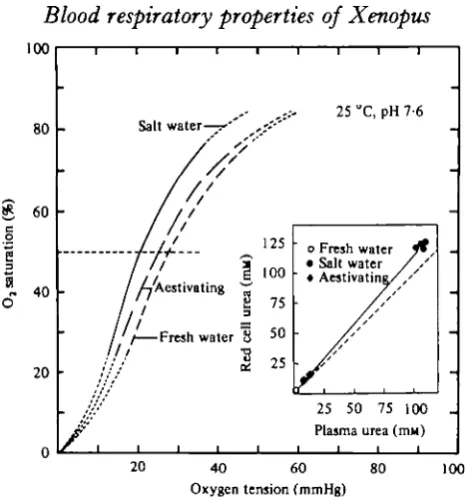
Fig. 4. O , equilibrium curves at 25 °C of blood from aestivating Xenopiit (dashed curve) and from specimens acclimated to i2°/oo salt water (continuous curve) compared to that in fresh water specimens (dotted curve). (Inset) Relationship between urea concentration in plasma and red cells of active Xenoput (O)> aestivating ( • ) and salt-water-ncclimated specimens ( # ) . Dotted line indicates isocline. Regression equation: [ U r e a ] ^ , ^ , = 1 1 4 [Urea],,,^,.— 0-002 (r = + 0 9 9 9 ) .
that the effect of temperature is greater in animals subjected to acute temperature changes than in those acclimated to different environmental temperatures. The Bohr factors were —0-39 and —0-47 when measured at 25 and 10 °C, respectively (Fig. 2). Interpolation from Fig. 2 at pH 7-6 shows that Oj> affinity of Xenopus blood has low temperature sensitivity; the AH values, calculated from the Van't Hoff equation as
— 2-303. i?.Alog P50/Ar~1, where T is the absolute temperature and R is the gas
constant (Wyman, 1964), were —7-8 and —8-0 kcal.mol"1 for warm and
cold-acclimated animals, respectively. In 10 °C animals, blood pH and red cell urea con-centrations were significantly higher than those at 25 °C (Table 1). Intraerythrocytic pH values were less than 0-2 units lower than those in plasma (Fig. 3).
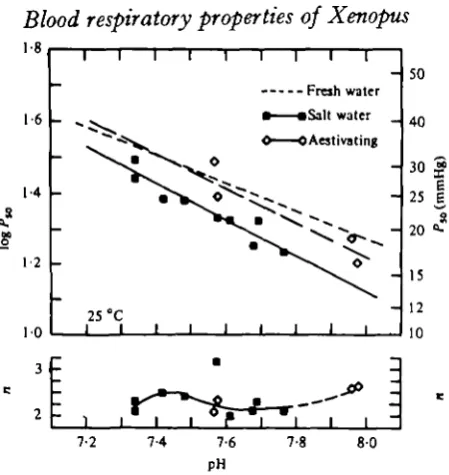
Salt water acclimation as well as aestivation resulted in higher O2 affinities than in
active, freshwater specimens (Fig. 4, 5). At pH 7-6 P60 values were 21-i and 25-2
mm-Hg, (2*81 and 3-36 kPa) respectively. Also, salt water acclimation and aestivation significantly raised the levels of urea in red cells, blood and plasma (Table 1 and Fig. 4)
[image:7.451.107.341.49.298.2]N (Mean s ±s.D . measure d i n th e bloo d (B) , salin e water , an d i n aestivation . Number s Fres h water , 2 5 ° C
(A) 35
Tabl e i . Hematological parameters plasm a (P ) an d re d bloo d cell s (RBC ) o f Xenopus lands acclimate d t o fresh wate r a t 2 5 an d 1 0 ° C an d t o in parenthese s = numbe r o f measurement s whe n no t performe d o n al l specimens. ) Hc t (% ) H b
(mM.l-1 (B)
)
AT
P
(mM.l-1 (B)
)
AT
P
(roM.l-1 (RBC)
)
ATP:H
b
Cl
-
(m-equiv.l-1 (B)
)
Ure
a
(mM.l-1 (P)
)
Ure
a
(raM.I"
1 (B)
)
Ure
a
(mM.l"
1) (RBC)
Blood respiratory properties of Xenopus
271-8
16
14
12
-10
1 1 1 1
-_
25 °C
1 1 1 I
1 1 1 1 Freih water
m aSalt water _
O—OAestivating
1 1 1 i
50
40
30
- 20
- 15
12 10
7-2 7-4 7-6
PH
[image:9.451.112.337.48.286.2]7-8 8 0
Fig. 5. Variation in Pl0 and n in blood from aestivating ( < » , and i 2 ° / o o salt-water acclimated specimens ( • ) with p H , measured at 25 °C. Regression equations: log PK = —051 pH + 5-20 (r = - 0 0 0 ) ( • ) ; and log PM = - 0 4 8 pH + 5 0 5 (r = - 0 9 1 ) (CO for salt water and aestivating specimens, respectively. Dotted line, fresh water specimens (from Fig. 2).
There is no evidence for a significant effect of aestivation and salinity acclimation
on blood haemoglobin concentrations (range, 1-5-1-9 mM tetramer.l"1 (B)) nor on
the ATP levels in blood and red cells. The relationship between O2 affinity and pH
in stripped haemoglobin in the absence and presence of urea and NaCl, is shown in
Fig. 6. At 10 and 25 °C the Bohr factor, <f> = A log P50/ApH, was -0-37 to -0-40.
The inverse relation between measurement temperature and O2 affinity (Fig. 6)
reflects a AH value of —5-6 kcal.mol"1 for the stripped pigment. Urea has a strong
positive effect on O2 affinity at all pH values studied, while NaCl decreases O2
affinity. Urea and NaCl, however, exert no significant effect on the cooperativity co-efficient, n (Fig. 6).
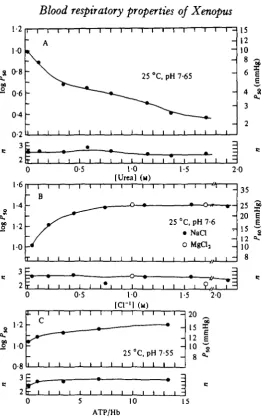
With the view of investigating their possible roles in the acclimation, the effects of increasing concentrations of urea and chloride were studied (Fig. 7). Raising the
urea concentration (Fig. 7 A) from o to 500 mM decreases Pb0 from about 10 to
4-5 mm Hg (1-33-6-00 kPa) at pH 7-65. Cl~ decreases the O2 affinity of in vitro
haemoglobin preparations most strongly at low concentrations (Fig. yB) as found in
the red cells (cf. Table 1); at pH 7-6 an increase from 0-05 to 0-5 M raises P5 0 from
about 10-21 mm (1-33-2-80 kPa). Equimolar concentrations of Cl~ added as NaCl
and MgCl2 respectively, resulted in similar P50 values, suggesting that the valency of
the cation has no distinctive effect on O2 affinity.
The organic phosphate, ATP, has a comparatively small effect on O2 affinity;
at pH 7-55, P50 is raised from 10-7 to only 13-4 mmHg (1-43-1-79 kPa) as the molar
28 ALFRED JOKUMSEN AND ROY E. WEBER 1-6
1-4
1-2
10
0-8
0-6
0-4
i i i i i i i i i i r
Hb IO°C25°C_ Stripped » •
0-52 M-urea • 0-2 MNaQ
35 30 25 20 15 12 10 8
E
B
5
- 3
_ _ . . o
-I -I -I -I
7 0 7-5 8 0 8-5
PH
Fig. 6. P60 and n values and their pH dependence in stripped Xenoptu haemoglobin in the
absence (O, • ) and presence of o-2 M-NaCl (A) and 0-52 M urea ( • ) , measured at 10 °C (O) and 25 °C ( • , A, • ) • Regression equations: 10 °C: log P,o = -0-40 pH + 3-oo(r =
- 0 9 9 6 ) : 25 °C, stripped: log PM= -o-37pH + 3'88 (r = - 0 9 9 ) ; 25 "C, 0-52 M urea:
log P60 = - 0 4 1 pH + 383 (r = -0-99); 25 °C, 0-2 M-NaCl: log Pl0 = - o -4o p H + 4-26
(r = —0997). Tetrameric Hb concentration, 0 4 mM; Tria buffer I, 005.
pH 7 1 , 50 times excess ATP to Hb increased PB0 from 5-0-7-6 mmHg (0-67-1 -oi kPa)
(Wood et al. 1975). Hb of the anuran, Rana esculenta, lacks significant ATP sensitivity (R. E. Weber & A. Jokumsen, unpublished data). In the viviparous caecilian Typhlo-nectes compressicauda there is, however, a large ATP effect. At pH 7-1 a 1 mM
con-centration changed P60 from 1-9-5-6 mmHg (0-25-0-75 kPa) (Garlick et al. 1979).
The influence of CO2 and ATP, singly and in combination, on O2 affinity and
cooperativity in Xenopus haemoglobin is shown in Fig. 8. A specific, pH-independent
effect of CO2 is demonstrated, decreasing O2 affinity of the stripped haemoglobin.
At pCOl levels near 7 and 30 mm (0-93 and 4-00 kPa), these effects were manifest only
above pH 7-4 and 7-26 respectively. The specific CO2 effect is markedly decreased in
the presence of ATP. This indicates competition between ATP and CO2 for common
amino groups as in mammals and shows that ATP is bound by the haemoglobin
despite its low oxygenation effects. It also suggests that the specific effect of CO2
will have limited influence on the in vivo P60. A CO2 effect, however, persists in the
presence of ATP when pH is high (above about 7-4) reflecting increased carbamate formation as protonation of the amino groups and competition from the anionic ATP decrease.
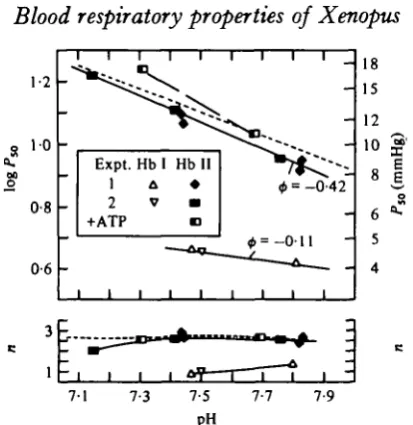
Isoelectric focusing resolves Xenopus haemoglobin in one minor and one major component (I and II in Fig. 9), which are isoelectric near pH 9-3 and 7-0, respectively, and account for about 3-9 and 96-1% of total haemoglobin. The major component has approximately similar oxygen affinities and n values as the haemolysate (Fig. 10).
ATP has the strongest effect on O2 affinity at lower pH, as expected from a greater
Blood respiratory properties of Xenopus
2902 3
1 1 1 1 1—1—1—1
1 1 1 1 1 1 1 1 1 1 1 1 1 1 1
15 12 10 8 6
4 3
1 1 1 1 1 1 1 1 1 1 1 1 1 1 1 1
0-5 10
[Urea] (M) 1-5 2 0
i i i i t 1 1 1 1 1
25 °C, pH 7-6 • NaCl O MgClj
i i i i . . i
35
25 20 15 12 10 8
s
E --, a.
p
2 R- 1 1 1 1 1 1 1 * 1 I I 1 I I [_
0-5 10
8 ' '2
$ 10
0-8 3
1 - I 1 1
c
i i i i
i i i i
. - •
-i -i -i -i i i i
25 °< i i i
i i
: ,PH i i
i i —
— •
7-55
i i
1-5 2 0
20 15 X
E
12 I
10 ~s 8
°-2 t r I I I I I I I I i I
5 10 ATP/Hb
15
Fig. 7. (A) Effect of increasing urea concentrations on PBo and n values of Xenopus
haemo-globin at 25 °C. p H , 7 6 5 ; H b , 0 4 3 ITIM; Tris buffer I, 0 0 5 . (B) Effects of NaCl and MgCl, on PK and n values of Xenopui haemoglobin at 2$ °C. p H , 7 6 ; H b , 0-7 mM; Tris buffer I, 0-05. (C) Effects of A T P on PM and n values of Xenopus haemoglobin at 25 °C, pH 7-55. Small
corrections of Pl0 values (to p H 7 5 5 ) were done using Bohr factors estimated for the given A T P : H b ratios from Figs. 6 and 8. Hb, 0 2 mM; 1, 0 0 5 .
smaller Bohr factor than Hb I I ; at pH y 6 , P5 0 and n are 4-3 mmHg (0-57 kPa)
and i-o, respectively, and (f> = - o - n . Only a small part of this difference may be attributable to the lower concentration in Hb I (see p. 22).
DISCUSSION
The O2 affinity (P5 0 = 27 mmHg or 3.60 kPa at 25 °C and pH 7-6) and the Bohr
[image:11.451.92.355.40.459.2]ALFRED JOKUMSEN AND ROY E. WEBER
1-6
1-4
1-2 •?
5 .0
0-8
0-6
r n i i i r
Stripped
Stripped + 1 % CO, Stripped + 4% CO, ATP
ATP + 1 % CO, ATP + 4% CO,
I l l J I
7 0 7-5 80
pH
8-5
35 30 25
20
15 12 10 8
6
I I I
9 0
Fig. 8. Effects of ATP (triangles) on P60 and n values of stripped Xenopus haemoglobin (circles)
in the absence of CO, (open symbols) and the presence of i % (~ 7-4 mm Hg) CO, (half-filled symbols) and 4 % ( ~ 30 mm Hg) CO, (solid symbols). Temperature, 25 °C; Hb, 037 mM; I, 0 0 5 ; ATP:Hb, 1 53.
20 30 Fraction number
40 50
Blood respiratory properties of Xenopus
1-2
1 0
0-8
0-6
- Expt.1 2 +ATP
-i -i
H b l A
V
i i
H b l l •
D
—&«—
|
-<t> = - 0 - 4 2 ~
<t> - - 0 - 1 1 a-^ _
i i i i
18 15
12
71 7-3 7-5 PH
[image:13.451.121.328.40.253.2]7-7 7-9
Fig. 10. Effects of p H on P5 0 and n of two haemoglobin components isolated separately from
haemolysates of two Xenopus specimens measured at 25 °C; A , V . H b I; • , • , H b I I ; D H b II (expt. 2) in presence of excess 13 times molar excess of A T P / H b . Dotted line, haemolyuate (from Fig. 6). H b I, 0-05 mM; H b I I , 0 2 miu.
other amphibians, where P60 values range from 18-50 mm (2.4-6-67 kPa) and <p from
— 0-13 to —0-29; the O2 affinity is particularly high compared to values for other
anurans (cf. Wood et al. 1975). These properties may be adaptive to the aquatic
existence. The high affinity will favour cutaneous O2 uptake, whereas the high pH
sensitivity and the specific CO2 effect will facilitate O2 unloading in the tissues as
pCOl rises during diving (cf. Emilio & Shelton, 1974). A comparison of the
Austra-lian and South American lungfish shows a decrease in Bohr factor with increasing dependence on air as a respiratory medium (Lenfant, Johansen & Grigg, 1966/7;
Johansen & Lenfant, 1967), whereas a similar relation between O2 affinity and air
dependence was found in a series of amphibians studied by Lenfant & Johansen (1967).
Our data show that the O2 affinity of blood of Xenopus is subject to environmental
modulation; O2 affinity is increased following acclimation to high temperature and
saline water, and during aestivation. ATP, the main allosteric modulator of blood O2
affinity in lower vertebrates, however, does not seem to play a major role, in view of its
small direct effect on the O2 affinity of the haemoglobin and the small changes in its
concentration. The latter, moreover, excludes a significant indirect effect of ATP via changes in intracellular pH coupled with its influence on the Donnan equilibrium of protons across the red cell membranes (Wood & Johansen,
1973)-The low values for the overall heat of oxygenation of the whole blood and the cofactor-free haemoglobin of Xenopus (AH, -7-9 and -5-6kcal.mol-\ respectively,
compared to — 10 to — 14 in most other vertebrates) suggest relatively constant O2
affinities in the face of varying external temperatures. In acclimated animals the temperature sensitivity is even lower than the acute in vivo effect; measured at the
32 ALFRED JOKUMSEN AND ROY E. WEBER
line). These results agree qualitatively with those found for Rana esculenta by Kir-berger (1952), Straub (1957) and Gahlenbeck & Bartels (1968).
In air-breathing vertebrates with an efficient pulmonary gas exchange, the arterial
blood will be essentially saturated with O2, so a decrease in O2 affinity is the only
way in which tissue O2 delivery can be enhanced through affinity modulation. A high
temperature sensitivity will normally thus be favourable, enhancing O2 unloading
as O2 demand increases at high temperature. Although Xenopus primarily relies on
lung breathing, its skin plays an important role in gas exchange. Emilio & Shelton
(1974) showed that it may account for 30% of O2 uptake and 80% of CO2 elimination,
and Jones (1967) found that during diving O2 uptake is 43 ml.kg^.h"1, compared to
pre- and post-dive rates of 63 and 91 ml.kg^.h"1, respectively. The low temperature
sensitivity of Xenopus haemoglobin may thus be adaptive in the sense that it
safe-guards O2 loading in ponds where O2 tension may be low and temperature high. This
property may also favour O2 uptake when similar conditions prevail in the
micro-environment of the aestivating animals.
During air breathing, when pulmocutaneous vasodilation accompanies increased
pulmonary blood flow (Shelton, 1970) the O2 tensions approximate 80 mm in the
systematic and 60 mmHg in the pulmocutaneous blood of Xenopus (Emilio & Shelton, 1974) providing evidence for the functional separation between blood flows through the single heart ventricle (De Graaf, 1957). However, pulmocutaneous blood is mixed due to a shunt of blood from the left to the right ventricle cavity (De Graff, 1957).
During diving, however, when O2 tensions fall in all parts of the circulation to about
45 mmHg (Emilio & Shelton, 1974), the above cardiovascular adjustments during lung ventilation are reversed (Shelton, 1970). The functional significance of this regulation of blood flow in conjunction with conveying mixed blood in the
pulmo-cutaneous circulation may be that it allows for a gradual depletion of the lung O2
stores during submersion or whenever Xenopus experiences hypoxic habitats. Our data do not permit inferences on the mechanisms underlying
temperature-induced changes in O2 affinity. It is, however, likely that changes in the erythrocytic
concentrations of inorganic ions are implicated. Straub (1957) and Gahlenbeck & Bartels (1968) report that whereas the erythrocytic concentration of K+ is higher in warm- than in cold-adapted Rana esculenta, the opposite applies to the concentrations of Na+, K+ and Cl~ in the plasma. Thermoacclimatory responses in inorganic
erythrocyte ions are also known in fish. Recently (1979) Houston & Smeda showed that with increasing acclimation temperature, the K+: haemoglobin ratio in rainbow
trout and the Na+: haemoglobin and Cl~: haemoglobin ratios in carp increased
whereas the Mg2+: haemoglobin in carp decreased. The inverse effect of NaCl on O2
affinity of Xenopus haemoglobin corresponds to that generally encountered in verte-brates (Antonini, Amiconi & Brunori, 1972). For intact human erythrocytes
Sommer-kamp et al. (1961) have shown an inverse relation between cation content and O2
affinity.
The increases in O2 affinity induced by osmotic stress and aestivation were
accom-panied by significant increases in the urea levels in blood, plasma and red cells. In conjunction with the specific effect of urea on the affinity of Xenopus haemoglobin
(Fig. 7 A), this suggests that the changes in blood O2 affinity result from the increased
Blood respiratory properties of Xenopus 33
'the higher affinities cannot be attributed to increases in the concentrations of these factors. On the contrary, changes in their concentrations may have reduced the urea effect. The concentrations of urea measured in the aestivating specimens (~ 11 raM (P) - Table 1) were, moreover, much lower than those (~ 30 m-mol.kg-^P)) Balinsky et al. (1967) found in naturally aestivating specimens. It follows that in nature the possible effects of urea on the functional properties of the blood will be greater than those we could document here.
Seymour (1973) found a similar increase in the O2 affinity of the blood of the
spade-foot toad during dormancy, and related the change (measured under unspecified pH
conditions) to an O2 storage function of the haemoglobin. As with Xenopus, the
affinity increase may have been caused by raised blood urea levels.
What may be the biological significance of an increased O2 affinity during aestivation ?
A high O2 affinity implies that the haemoglobin will only unload when O2 tension is
low. In the absence of compensatory increases in the circulation rate (cf. Coulson, Hernandez & Herbert, 1977), a high affinity could result in a decrease in the rate of
O2 delivery and thus lower O2 tensions at the mitochondria, which will favour the
lower metabolic rates that characterize dormancy. In lungfish, a significant increase
in blood O2 affinity during aestivation is ascribable to a marked fall in the erythrocytic
concentration of the cofactor guanosine triphosphate (Johansen et al. 1976). Studies on squirrels and hamsters have correspondingly showed 29-48% decreases in erythrocytic diphosphoglycerates during hibernation (Burlington & Whitten, 1971;
Tempel & Musacchia, 1975). The present contention that the increased O2 affinity
is adaptive to lower tissue O2 tensions rather than to high O2 saturation of the pigment
at the respiratory surfaces is analogous to the suggestion of Manvvell (1959) that the high affinities of some invertebrate haemoglobins may protect their tissues from
injurious effects of high O2 tension (O2 poisoning). A similar mechanism may be basic
to the findings (Wood et al. 1975) that blood P60 and ATP values increase when plaice
from hypoxic water is subjected to atmospheric O2 tensions, but then decrease again
as PO j increases to hyperoxic levels.
The high sensitivity of O2 affinity of Xenopus haemoglobin to urea is similar to that
of Human Hb (Rossi-Fanelli, Antonini & Caputo, 1961, 1964), but contrasts with the low sensitivity seen in Hb from aestivating lungfish (Weber et al. 1977) and the skate (Bonaventura, Bonaventura & Sullivan, 1974), which in life similarly experience high concentrations of urea. Urea causes dimerization of human haemoglobin (Bonaven-tura et al. 1974) whereas the quaternary structure of the elasmobranch Hb appears only slightly affected by this compound. This correlates with the different effects
of Cl~ on O2 affinity which indicates that the urea insensitivity in the skate results
from stronger electrostatic interactions between the Hb subunits. However, Xenopus Hb shows Cl~ sensitivity similar to that of human haemoglobin indicating that differ-ent molecular adaptations are basic to the tolerance of Xenopus and skate haemo-globins to urea.
34 ALFRED JOKUMSEN AND ROY E. WEBER
dissociated and hence negative terminal carboxyl groups of the subunits of haemo-globin (Krichevskaya, Lukash & Kartasheva, 1973). This suggests that urea may act
as a positively charged cofactor undergoing O2-linked binding of the Xenopus
haemo-globin molecule, in analogous fashion to anionic phosphate cofactors from most vertebrate erythrocytes.
We demonstrate a direct pH independence effect of CO2 on O2 binding of Xenopus
Hb. As HCO3~ is always present in experiments with COa, this anion could be
contributing to the effect attributed to CO2. However, the absence of CO2 and
sub-stitution of HCO3~ by acetate, an ion of similar size and charge distribution, resulted
in unchanged O2 affinity in lungfish haemoglobin (Farmer, 1979) indicating that the
specific CO2 effect is due to carbamino CO8. In human haemoglobin, CO2 binds at
the a and /? chain amino termini competing with DGP for the latter sites. Competition
between CO2 and the organic phosphate in Xenopus haemoglobin suggests
qualita-tively similar interaction to that which occurs in human haemoglobin A, and that
carbamino formation at the free a amino terminal groups mediates the CO2 effect
in Xenopus, In conjunction with the low levels of ATP in Xenopus blood, and its small influence on oxygen affinity, this competition also indicates that oxylabile
carbamates may contribute significantly to CO2 transport in Xenopus blood. Farmer
(1979) suggested that a CO2-induced decrease in O2 affinity in three fishes and one
amphibian of only half of that found in human Hb A may be due to blocked a chain amino termini. Acetylation of the a chain amino terminal groups has in fact been reported in some fish and amphibians (Riggs, 1970; De Witt & Ingram, 1967; Sullivan,
1974)-Though most CO2 in Xenopus is eliminated through the skin, pCOl of blood fluctuates
(7-13 mmHg) in relation to the breathing rhythm, with lower values during breathing periods and higher ones during immersion (Emilio & Shelton, 1974). During diving
CO2 may thus increase the O2 unloading pressure, resulting in larger oxygen gradients
from the blood capillaries to the cellular metabolic sites.
The higher O2 affinity found in the haemolysate compared to that in the whole
blood may be attributed to various interacting factors, including lower intracellular
pH, different concentrations of interacting ions, a specific effect of CO2 and the lower
haemoglobin concentration. Although the haemoglobin concentration effect was insignificant in the stripped haemolysate (p. 22) it may increase drastically at higher pigment concentrations in the presence of cofactor as was recently demonstrated for carp haemoglobin (Lykkeboe & Weber, 1978).
The presence of one minor component, Hb I, and one major component, Hb II, (3-9 and 96-1%, respectively) agrees with what has been found by Maclean & Jurd (1971). Gel-electrophoretic studies of Just, Schwager & Weber (1977) revealed two Hb components of different molecular weights, evidencing dimerization of the minor
Hb component. The distinctly different O2 binding properties of the two fractions is
reminiscent of many fish where an electrophoretically cathodal Hb (cf. Hb I) has
high O3 affinity and lacks cooperativity and pH sensitivity, while anodal Hbs (cf. Hb II)
have low O2 affinity and distinct cooperativity and pH sensitivity. In fish (Hashimoto,
Yamaguchi & Matsuura, i960; Powers, 1972; Weber & De Wilde, 1976), these
differences may represent a division of labour, the cathodal component ensuring O2
uptake and transport when O2 tensions or pH is low. Despite its low relative
Blood respiratory properties of Xenopus 35
Advice criticism and help from Dr Helmut Schrock, Karlsruhe, West Germany and Professor Kjell Johansen, Gunnar Lykkeboe and Winnie Heidemann, Aarhus, Denmark, are gratefully acknowledged. The work was supported by the Danish Natural Science Council.
REFERENCES
ANTONINI, E. & BRUNORI, M. (1971). Hemoglobin and Myoglobin in their Reactions with Ligands.
Amsterdam and London: North Holland.
ANTONINI, E., AMICONI, G. & BRUNORI, M. (1972). The effect of anions and cations on the oxygen
equilibrium of human hemoglobin. In Oxygen Affinity of Hemoglobin and the Red Cell Acid-Base
Status (ed. M. Rorth and P. Astrup), pp. 121-129. Copenhagen: Munksgaard.
BALINSKY, J. B., CRACC, M. M. & BALDWIN, E. (1961). The adaptation of amphibian waste nitrogen excretion to dehydration. Comp. Biochem. Physiol. 3, 236-244.
BALINSKY, J. B., CHORITZ, E. L., COE, C. G. L. & VAN DER SCHANS, G. S. (1967). Amino acid
metabolism and urea synthesis in naturally aestivating Xenopus laevis. Comp. Biochem. Physiol. 22, 59-68.
BURLINGTON, R. F. & WHITTEN, B. K. (1971). Red cell 2,3-diphosphoglycerate in hibernating ground squirrels. Comp. Biochem. Physiol. 38A, 469—471.
BERMAN, M., BENESCH, R. & BENESCH, R. E. (1971). The removal of organic phosphates from hemo-globin. Archs. Biochem. Biophys. 145, 136-239.
BONAVENTURA, J., BONAVENTURA, C. & SULLIVAN, B. (1974). Urea tolerance as a molecular adaptation of elasmobranch hemoglobins. Science, N.Y. 186, 57-39.
BRIDGES, C. R., BICUDO, J. E. P. W. & LYKKEBOE, G. (1979). Oxygen content measurement in blood containing haemocyanin. Comp. Biochem. Physiol. 6aA, 457—462.
BROWNING, J. (1978). Urea levels in plasma and erythrocytes of the southern fiddler skate (Tyrgonorhma
fasciata guanerius. J. exp. Zool. Z03, 325-330.
CHRISTOFORIDES, C. & HEDLEY-WHYTE, J. (1969). Effect of temperature and hemoglobin concentration on solubility of O, in blood. J. Appl. Physiol. 27, 592-596.
CRAGG, M. M., BALINSKY, J. B. & BALDWIN, E. (1961). A comparative study of nitrogen excretion in some amphibia and reptiles. Comp. Biochem. Physiol. 3, 227—235.
COLTLSON, R. A., HERNANDEZ, T. & HERBERT, J. D. (1977). Metabolic rate, enzyme kinetics m vivo.
Comp. Physiol. Biochem. 56A, 251-262.
DE GRAAF, A. R. (1957). Investigations into the distribution of blood in the heart and aortic arches of
Xenopus laevis (Daud.). J. exp. Biol. 34, 143-172.
DEUCHAR, E. M. (1975). Xenopus: The South African Clawed Frog. London: John Wiley.
DE WITT, W. & INGRAM, V. M. (1967). Acetylated peptide chains in bullfrog hemoglobins. Biochem.
biophys. Res. Commun. 27, (2), 236-241.
EMILIO, M. G. & SHELTON, G. (i974)- Gas exchange and its effect on blood gas concentrations in the
amphibian Xenopus laevis. J. exp. Biol. 60, 567-579.
FARMER, M. (1979). The transition from watei to air breathing: Effects of CO! on hemoglobin function.
Comp. Biochem. Physiol. 6aA, 109-114.
FUNKHOUSER, D. & GOLDSTEIN, L. (1973). Urea response to pure osmotic stress in the aquatic toad
Xenopus laevis. Am. J. Physiol. 224, 3, 524-519.
GAHLENBECK, H. & BARTELS, H. (1968). Temperature adaptation der Sauerstoffaffinitat des Blutes von
Rana esculenta L. Z. vergl. Physiol. 59, 232-240.
GARLICK, R. L., DAVIS, B. J., FARMER, M., FYHN, H. J., FYHN, U. E. H., NOBLE, R. W., POWERS, D. A.
RIGGS, A. & WEBER, R. E. (1979). A fetal-maternal shift in the oxygen equilibrium of hemoblogin
from the viviparous caecilian Typhlonectes compressicauda.Comp. Biochem. Physiol. 6aA, 239—244.
GRIGG, G. C. (1969). Temperature induced changes in the oxygen equilibrium curve of the blood of
the brown bullhead, Jctalurus nebulosus. Comp. Biochem. Physiol. 28, 1203-1223.
GRIGG, G. C. (1972). Respiratory function of blood in fishes. Chemical Zoology 8, 331-68. New York: Academic Press.
HASHIMOTO, K., YAMAGUCHI, Y. & MATSUURA, F. (i960). Comparative studies on two hemoglobins of
salmon. IV. Oxygen dissociation curve. Bull. Jap. Soc. Scient. Fish. 26, 827-834.
HILLMAN, S. S. (1978). Some effects of dehydration on internal distributions of water and solutes in
Xenopus laevis, Comp. Biochem. Physiol. 61 A, 303-307.
HOUSTON, A. H. & SMEDA, J. S. (1979). Thermoacclimatory changes in the ionic microenvironment of haemoglobin in the stenothermal rainbow trout (Salmo gairdneri) and eurythermal carp (Cyprinus
36 ALFRED JOKUMSEN AND ROY E. WEBER
IRELAND, M. P. (1973). Studies on the adaptation of Xenopus laevis to hyperosmotic media. Comp.
Biochem. Phytiol. 46A, 469-476.
JANSSENS, P. A. & COHEN, P. P. (1968). Biosynthesis of urea in the estivating African lungfish and in Xenopus laevis under conditions of water-shortage. Comp. Biochem. Physiol. 34, 887-898.
JOHANSEN, K. & LENFANT, C. (1967). Respiratory function in the South-American lungfish Lepidosiren
paradoxa (Fitz). J. exp. Biol. 46, 205-218.
JOHANBEN, K., LYKKEBOE, G., WEBER, R. E. & MALOIY, G. M. O. (1976). Respiratory properties of
blood in awake and estivating lungfish Protopterus amphibius. Respir. Physiol. 37, 335-345. JONES, D. R. (1967). Oxygen consumption and heart rate of several species of anuran amphibia during
submergence. Comp. Biochem. Physiol. 30, 691-707.
JUST, J. J., SCHWAGER, J. & WEBER, R. (1977). Hemoglobin transition in relation to metamorphosis in normal and isogenic Xenopus. Roux's Atch. Develop. Biol. 183, 307-323.
KIRBERGER, C. (1953). Temperaturadaptation der Sauerstoffbindung des Blutes von Rana esculenta L.
Z. vergl. Physiol. 35, 153-158.
KKICHEVSKAYA, A. A., LUKASH, A. I. & KARTASHEVA, L. D. (1973). The association of urea with
proteins at low concentration. Biochem. 38, 585-590.
LENFANT, C , JOHANSEN, K. & CRIGG, G. C. (1966/7). Respiratory properties of blood and pattern of
gas exchange in the lungfish Neoceratodus forsteri (Krefft). Respir. Physiol. 3, I - Z I .
LENFANT, C. & JOHANBEN, K. (1967). Respiratory adaptations in selected amphibians. Respir. Physiol. 3, 247-260.
LYKKEBOE, G. & WEBER, R. E. (1978). Changes in the respiratory properties of the blood in the carp, Cyprinus carpio, induced by diurnal variation in ambient oxygen tension. J. comp. Physiol. 138,
117-125.
MANWELL, C. (1959). Alkaline denaturation and oxygen equilibrium of annelid hemoglobins. J. cell.
comp. Physiol. 53, 61-74.
MCBEAN, R. L. & GOLDSTEIN, L. (1970). Accelerated synthesis of urea in Xenopus laevis during osmotic stress. Amer.J. Physiol. 319, (4) 1124-1130.
MACLEAN, N. & JURD, R. D. (1971). The haemoglobins of healthy and anaemic Xenopus laevis. J. Cell Set. 9, 509-528.
POWERS, D . A. (1972). Hemoglobin adaptation for fast and slow water habitats in sympatric catostomid
fishes. Science N.Y., 177, 360-362.
RALLS, J. O. (1943). Urea is not equally distributed between the water of the blood cells and that of the plasma. J. biol. Chem. 151, 529-541.
RIGGS, A. (1970). Properties of fish hemoglobins. In Fish Physiology, vol. 4 (ed. W. S. Hoar and D. J. Randall), pp. aoo-251. New York: Academic Press.
ROMSPERT, A. P. (1976). Osmoregulation of the African clawed frog Xenopus laevis in hypersaline
media. Comp. Biochem. Physiol. 54A, 207-210.
ROSSI-FANELLI, A., ANTONINI, E. & CAPUTO, A. (1961). Studies on the relations between molecular
and functional properties of hemoglobin. II. The effects of salts on the oxygen equilibrium of human hemoglobin. J. biol. Chem. 236, 397-400.
ROSSI-FANELLI, A., ANTONINI, E. & CAPUTO, A. (1964). Hemoglobin and myoglobin. Adv. Protein
Chem. 19, 74-222.
SEYMOUR, R. S. (1973). Gas exchange in spadefoot toads beneath the ground. Copeia, pp. 452-460. SHELTON, G. (1970). The effect of lung ventilation on blood flow to the lungs and body of the amphibian,
Xenopus laevis. Respir. Physiol. 9, 183—196.
SHOEMAKER, V. H., MCCLANAHAN, JR. L. & RUIBAL, R. (1969). Seasonal changes in body fluids in a
field population of spadefoot toads. Copeia, pp. 585-591.
SICK, H. & GERSONDE, K. (1969). Method for continuous registration of Ot-binding curves of
hemo-proteins by means of a diffusion chamber. Analyt. Biochem. 33, 362-376.
SOMMERKAMP, H., RiEGBL, K., HILPERT, P. & BRECHT, K. (1961). Uber den Einfluss der
Kationen-konzentration im Erythrocyten auf die Lage der Sauerstoff-Dissoziationskurve des Blutes. PflUgers
Arch. ges. Physiol. 37a, 591-601.
SULLIVAN, B. (1974). Amphibian hemoglobins. In Chemical Zoology. Vol. 9. Amphibia and Reptilia. (ed. M. Florkin & B. T. Scheer), pp. 77-122. New York: Academic Press.
STRAUB, M. (1957). Weitere Untersuchungen zur Temperaturadaptation der Sauerstoffbindung des
Blutes von Rana esculenta L. Z. vergl. Physiol. 39, 507-523.
TEMPEL, G. E. & MUSACCHIA, X. J. (1975). Erythrocyte 2,3-diphosphoglycerate concentration in
hibernating, hypothermic and rewarming hamsters 638589. Proc. Soc. exp. Biol. Med. 184, 588-592. TUCKER, V. A. (1967). Method for oxygen content and dissociation curves on microliter blood samples.
J. appl. Physiol. 33(3), 410-414.
WEBER, R. E., LYKKEBOE, G. & JOHANSEN, K. (1976). Physiological properties of eel haemoglobin:
Hypoxic acclimation, phosphate effects and multiplicity. J. exp. Biol. 64, 75—88.
Blood respiratory properties of Xenopus 37
RVEBER, R. E., JOHANSEN, K., LYKKEBOE, G. & MALOIY, G. M. O. (1977). Oxygen-binding properties
of hemoglobins from estivating and active African lungfiah. J. exp. Zool. 199, 85-96.
WEBER, R. E. & LYKKEBOE, G. (1978). Respiratory adaptations in carp blood. Influences of hypoxia, red cell organic phosphates, divalent cations and COt on hemoglobin-oxygen affinity. J. comp. Physiol. 138 137-137.
WOOD, S. C. & JOHANSEN K. (1973). Organic phosphate metabolism in nucleated red cells: Influence of hypoxia on eel HbO, affinity. Neth. jfl. Sea Res. 7, 328-338.
WOOD, S. C , JOHANSEN, K. & WEBER, R. E. (1975). Effects of ambient PO, on hemoglobin-oxygen
affinity and red cell ATP concentrations in a benthic fish, Pleuronectes platessa. Respir. Physiol. 25, 259-267.
WOOD, S. C , WEBER, R. E., MALOIY, G. M. O. & JOHANSEN, K. (1975). Oxygen uptake and blood
respiratory properties of the caecilian Boulengerula taitanus. Respir. Physiol. 24, 355—363.
WOOD, S. C , LYKKEBOE, G., JOHANSEN, K., WEBER, R. E. & MALOIY, G. M. O. (1978). Temperature
acclimation in the pancake tortoise Malacochersus tornieri: Metabolic rate, blood pH, oxygen affinity and red cell organic phosphates. Comp. Biochem. Physiol. 59A, 155-160.