Soumya Bera,1 Thomas Martynec,2 Henning Schomerus,3, 1 Fabian Heidrich-Meisner,4, 5 and Jens H. Bardarson1, 6 1
Max-Planck-Institut f¨ur Physik komplexer Systeme, 01187 Dresden, Germany 2Institut f¨ur Theoretische Physik, Hardenbergstr. 36,
Technische Universit¨at Berlin, D-10623 Berlin, Germany 3
Department of Physics, Lancaster University, LA1 4YB Lancaster, United Kingdom 4Department of Physics and Arnold Sommerfeld Center for Theoretical Physics,
Ludwig-Maximilians-Universit¨at M¨unchen, 80333 M¨unchen, Germany 5
Kavli Institute for Theoretical Physics, University of California, Santa Barbara CA 93106, USA 6Department of Theoretical Physics, KTH Royal Institute of Technology, Stockholm, SE-106 91 Sweden
(Dated: November 7, 2018)
We study interacting fermions in one dimension subject to random, uncorrelated onsite disorder, a paradigmatic model of many-body localization (MBL). This model realizes an interaction-driven quantum phase transition between an ergodic and a many-body localized phase, with the transition occurring in the many-body eigenstates. We propose a single-particle framework to characterize these phases by the eigenstates (the natural orbitals) and the eigenvalues (the occupation spectrum) of the one-particle density matrix (OPDM) in individual many-body eigenstates. As a main result, we find that the natural orbitals are localized in the MBL phase, but delocalized in the ergodic phase. This qualitative change in these single-particle states is a many-body effect, since without interactions the single-particle energy eigenstates are all localized. The occupation spectrum in the ergodic phase is thermal in agreement with the eigenstate thermalization hypothesis, while in the MBL phase the occupations preserve a discontinuity at an emergent Fermi edge. This suggests that the MBL eigenstates are weakly dressed Slater determinants, with the eigenstates of the underlying Anderson problem as reference states. We discuss the statistical properties of the natural orbitals and of the occupation spectrum in the two phases and as the transition is approached. Our results are consistent with the existing picture of emergent integrability and localized integrals of motion, or quasiparticles, in the MBL phase. We emphasize the close analogy of the MBL phase to a zero-temperature Fermi liquid: in the studied model, the MBL phase is adiabatically connected to the Anderson insulator and the occupation-spectrum discontinuity directly indicates the presence of quasiparticles localized in real space. Finally, we show that the same picture emerges for interacting fermions in the presence of an experimentally-relevant bichromatic lattice and thereby demonstrate that our findings are not limited to a specific model.
PACS numbers: 72.15.Rn 05.30.Rt 05.30.Fk
I. INTRODUCTION
The perturbative analysis of interacting lattice elec-trons in the presence of disorder [1, 2] and subsequent numerical and analytical studies [3–18] of primarily one-dimensional lattice models of fermions with short-range interactions and the related XXZ spin-chain with random field, have firmly established the existence of the many-body localized (MBL) phase, a perfectly insulating state of interacting particles that persists at any finite energy density. The insulating behavior manifests itself via a vanishing charge and thermal conductivity [1, 2]. De-pending on the strength of disorder, the MBL phase can transition into an ergodic phase as energy density in-creases. This general picture implies the existence of a mobility edge, which in systems with fully localized single-particle states arises as a many-body effect. The existence of the mobility edge is supported by numerical investigations [12,15,16,19,20], but has been questioned in Ref. [21]. Many-body localization in systems with a particle mobility edge or a fully delocalized single-particle spectrum were studied in Refs. 22 and 23 and 24–26, respectively.
The precise nature of the transition between the MBL and the ergodic, delocalized phase is still under scrutiny and not well understood (see the discussion in the re-views 27 and 28, and, in particular, Refs. 29–34). The delocalized phase itself has interesting transport proper-ties, with most studies indicating subdiffusive transport in the vicinity of the transition [19, 35–37], at least for the one-dimensional models that are amenable to nume-rical studies (some studies have challenged this picture [38–40]). An interesting aspect of the MBL transition, never observed in any other type of phase transition, is the difference in entanglement scaling in the two phases: the ergodic phase exhibits the usual volume law scaling consistent with thermal behavior and the validity of the eigenstate thermalization hypothesis [41–44], while in the MBL phase all many-body eigenstates exhibit an area law [7,12,45].
systems of trapped ions, however, realize a closed quan-tum system to a good approximation and therefore, se-veral experiments have investigated the effects of disorder in the presence of interactions at elevated energy densi-ties [47–52]. A series of optical-lattice experiments with fermions in 1D [47] and strongly interacting bosons in 2D [50] provided evidence that MBL is realized and that the transition to an ergodic phase (taking into account system sizes and accessible time scales) can be probed. Similar conclusions were reached in trapped ion experi-ments that realize a spin-1/2 chain, albeit with a smaller number of degrees of freedom [51].
The MBL phase is adiabatically connected to the An-derson insulator as interaction strength decreases, at le-ast for the paradigmatic model of 1D spinless fermions with nearest-neighbor interactions exposed to onsite dis-order [3, 5, 15, 16, 19]. Both phases share many fea-tures: they fail to thermalize [1, 3, 5], there is an area law of entanglement entropy in all many-body eigenstate [7, 12], and there are (quasi-)local conserved quantities [8, 9, 13, 14, 17, 18, 53]. The MBL phase is usually referred to as the generic state, given that in nature interactions are never exactly zero. Additional phase transitions, in which eigenstates exhibit topological or symmetry-breaking order [12,54], can furthermore occur inside the MBL phase and the possibility of MBL sta-tes not adiabatically connected to an Anderson insulator was discussed in Ref. [55]. The Anderson insulator and the MBL state nevertheless differ in several important respects, including, for example, the logarithmic increase of entanglement in global quantum quenches [4, 6] and dynamical properties [35, 36], such as the optical con-ductivity.
The observation of a logarithmic entanglement growth in global quantum quenches led to the introduction of local integrals of motion in the MBL phase [8,9,13, 14, 17, 18, 53] (these are often referred to as l-bits but in this paper, for reasons to become clear, we will from here on refer to them as quasiparticles). In a clean system, a linear spreading of entanglement [56,57] is believed to result from a propagation by contact [58], i.e., the fact that degrees of freedom that are spatially close to each other have a direct (off-diagonal) tunnel coupling. For the MBL phase in the regime where all many-body ei-genstates are localized, the following description in terms of an extensive set of conserved quantities has been wi-dely accepted [8,9,13]: there is an effective Hamiltonian expressed in terms ofLmutually commuting quasi-local conserved quantities ˆn(qp)i , withL the number of lattice sites, that are coupled only via products,
H=X i
inˆ (qp)
i +
X
ij Jijnˆ
(qp) i nˆ
(qp)
j +. . . , (1)
where the coupling constants Jij decay exponentially with distance between ˆn(qp)i and ˆn(qp)j . This type of coupling causes a dephasing of spatially separated qua-siparticles ˆn(qp)i , explaining the logarithmic increase of
entanglement as a function of time in quenches from a product state [10, 59]. The form of the Hamiltonian ˜H suggests that the MBL phase is integrable in the sense that L many quasiparticle density operators ˆn(qp)i exist with eigenvalues 0,1. Fixing the eigenvalues of all ˆn(qp)i uniquely specifies a many-body eigenstate in the MBL phase. This picture is consistent with the observation of a Poissonian level spacing distribution in the MBL phase, the failure of ETH and the vanishing of dc transport coef-ficients [18,27,28,53].
For the purpose of this work, let us discuss in more detail the structure of the local integrals of motion. For the density operators ˆn(qp)i =c(qp)†i c(qp)i we can make an ansatz for its expansion in terms of the original fermions ci where we ignore spin degrees of freedom (alternati-vely, one can start from the eigenbasis of the Anderson problem) [14,18,60]:
ˆ
n(qp)i =X j
A1j,(i)nˆj+ X
j6=k
B1j,k,(i)c†jck
= X
j,k,l,m
Cj,k,l,m2,(i) c†jc†kcmcl+. . . (2)
Here it is important thatA1j,(i)has its largest weight for i=jand thatA1j,(i)→1 as interactions and hopping are turned off, while all other coefficients vanish in that limit. Thus, thec(qp)i describe a quasiparticle that consists of a particle that is localized in real space over a distance ξqp(1) (A
1,(i)
j decays exponentially as exp(−|i−j|/ξ (1) qp)), dressed with particle-hole pairs. The existence of such localized quasiparticles in the MBL phase can in fact be concluded from the work by Basko, Aleiner and Altshu-ler [1], where the divergence of the quasiparticle lifetime in the localized phase was demonstrated. Thus, we can equivalently talk about either l-bits or (localized) qua-siparticles in characterizing the MBL phase. In the fol-lowing, we will use the latter to refer to the quasi-local integrals of motion. The actual construction of local inte-grals of motion, or the related quantum circuit that could generate them, for a given model is an actively studied problem [14,60–74].
Fermi gas in the limit of low energiesE→E0only, where E0 is the ground-state energy.
A hallmark feature of a Fermi liquid is the finite dis-continuity 0 < ∆nk < 1 at the Fermi energy in the momentum distribution function nk = hc†kcki, where the discontinuity is related to the quasiparticle weight Zk. In our previous work [16], we demonstrated that a similar discontinuity is also present in the occupation spectrum of the one-particle density matrix (OPDM) in the MBL phase (see also earlier analyses of the OPDM in 1D systems of hard-core bosons in the presence of dis-order [75, 76]). Specifically, we computed the OPDM ρ(1)ij = hn|c†icj|ni in individual many-body eigenstates |ni. The diagonalization of the OPDM yields a basis set in the single-particle subspace and their occupations:
ρ(1)|φαi=nα|φαi. (3)
In the Anderson insulator every many-body eigenstate is a Slater determinant and the occupation spectrumnα (assuming that thenα are orderedn1 ≥n2≥ · · · ≥nL) is a step function nα = 1 for 1 ≤ α ≤ N, where N is the particle number, and zero otherwise. This is true ir-respective of the disorder strength. In the MBL phase and with finite hopping and interactions, by contrast, the occupations start to deviate from zero or one in the vicinity of α = N. Nevertheless, our earlier work [16] indicated that the spectrum still exhibits a discontinuity ∆n =nN+1−nN <1. The existence of such a discon-tinuity is clearly incompatible with ergodic and thermal behavior since ∆n → 0 is expected in the delocalized phase as system size increases [16]. Based on the analysis of the eigenvalues of the OPDM, we therefore identified another means to distinguish the MBL from the ergodic phase.
Apart from the occupation spectrum, the eigenstates of the OPDM, commonly referred to as natural orbitals, bear interesting information as well: they are typically localized in the MBL phase and delocalized in the ergo-dic phase. Moreover, they exhibit an exponential enve-lope in the MBL phase with a natural-orbital localization length that we refer to as ξNO. It is natural to use this quantity as a measure of the effective single-particle loca-lization length in MBL phase. These properties suggest that these natural orbitals can be analyzed in much the same way as single-particle eigenstates in the Anderson insulator, for example using appropriately defined inverse participation ratios.
In this work we give a comprehensive overview of the properties of the eigenstates (the natural orbitals) and eigenvalues (the occupation spectrum) of the OPDM in a generic interacting 1D system in the presence of un-correlated diagonal disorder. First, as a prelude to the analysis, we discuss the connection between the local in-tegrals of motion and the eigenstates of the OPDM on a qualitative level. Second, we analyze the natural orbi-tals and discuss their dependence on disorder strength, energy density and interaction strength. Third, we dis-cuss the properties of the occupation spectrum,
focus-sing on the existence of the discontinuity ∆nin the MBL phase and its disappearance in the ergodic phase. We conclude the discussion of the natural orbitals by ar-guing that they provide an improved approximation to the quasiparticles compared to other single-particle basis sets. Finally, we apply our methodology to a system of interacting spinless fermions in the Aubry-Andr´e model, showing that properties of the OPDM capture the many-body localization physics in this model as well. We con-clude with a summary of our results and an outlook on open problems, with a focus on those cases in which we believe the analysis of the OPDM could be useful.
II. LOCALIZED CONSERVED QUANTITIES AND OPDM EIGENSTATES
An important concept in the theory of MBL is that of local conserved quantities [8, 9, 13, 14, 17, 18, 53]. We outline here how the eigenstates of the OPDM are rela-ted to these objects, which will serve as the basis for the rest of the paper. A useful starting point is to diagona-lize the noninteracting problem, including all one-body potentials and thus also disorder:
H0= X
µ
µnˆµ, (4)
with ˆnµ = c†µcµ the density operator. We reserve the indicesµ, ν, ηfor this Anderson single-particle eigenbasis. For this single-particle problem, the density operators ˆnµ, µ = 1, . . . , L, comprise, by construction, a set of local mutually commuting conserved quantities. All the many-body eigenstates are product states of the corresponding creation operators: |{nµ}i = Qµ(c
†
µ)nµ|0i, where nµ ∈ {0,1}, the eigenvalues of ˆnµ, determine the occupation of a given single-particle state in the many-body state.
In the presence of interactions the conserved quantities are similarly density operators of quasiparticles, which are dressed versions of the single-particle Anderson orbi-tals. Explicit algebraic constructions of the integrals of motion [14, 60], which we here denote as ˆn(qp)µ to stress the quasiparticle interpretation, result in
ˆ
n(qp)µ = ˆnµ+ X
(νν0)6=(ηη0)
Bµνν0ηη0c†νc †
ν0cηcη0+. . . . (5)
This particular form ensures that [H,nˆ(qp)µ ] = 0 in each N-particle subspace, including N = 1, which requires all off-diagonal quadratic terms to be zero. The choice of only single diagonal term ˆnµ on the right hand side with a prefactor of one makes the identifications of quan-tum numbers µ explicit [14, 60]. Expressing the inte-grals of motion like this in the Anderson eigenbasis ma-kes it transparent that a set of L many of them ex-ists for a given disorder realization and by construction, ˆ
is further essential in order for the quasiparticle opera-tor ˆn(qp)µ to generally have only eigenvalues 0 and 1, re-quired for the quasiparticle interpretation. In this case one can introduce the creation and annihilation opera-tors for quasiparticles via ˆn(qp)µ =c(qp)†µ c
(qp)
µ . Since the Hamiltonian remains diagonal in the ˆn(qp)µ , see the ex-plicit form of the Hamiltonian in Eq. (1), the many-body eigenstates are product states of the quasiparticles: |ni = |{n(qp)µ }i = Qµ(c
(qp)† µ )n
(qp)
µ |0i. Here, as in the noninteracting case, n(qp)µ ∈ {0,1} are the eigenvalues of ˆn(qp)µ and give the occupations of a quasiparticle in a given eigenstate.
For each many-body eigenstate|ni, the diagonalization of the OPDM by the unitary transformationUαi(n)defines a new complete set of single particle operators via
c†α=X i
Uαi(n)c†i =X µ
˜
Uαµ(n)c†µ. (6)
The column entries ofU(n)are the natural orbitalsφ α(i) and ˜U gives their projection onto the Anderson orbitals. The creation operator c†α therefore creates a particle in the natural orbitalφα. The indicesα, β, γ, δare reserved for the OPDM eigenbasis. Since these states are obtained in a given many-body eigenstate, the operatorsc†α are in general state dependent. We emphasize that therefore, any quantity below that has an index α, β, γ, δ depends in general on the state|ni.
By inserting this transformation into the quasiparticle expansion Eq. (5), we obtain the representation of the integrals of motion in terms of the creation and annihi-lation operators of the natural orbitals
ˆ
n(qp)µ =X α
|U˜αµ|2ˆnα+ X
α6=β ˜
Uαµ∗ U˜βµc†αcβ
+ X
αβγδ ˜
Bαβγδµ c†αc†βcγcδ+. . . , (7)
where ˆnα=c†αcαand ˜Bis obtained from the appropriate contraction of ˜U withB. This basis change generates off diagonal quadratic terms, but the natural orbital basis is special in that these terms vanish when this expression is evaluated in the state |ni. This results directly from their definition
hn|c†αcβ|ni=δαβnα, (8)
with nα the OPDM occupations. To leading order, we therefore have the following relation between the quasi-particle occupations and the OPDM occupations
n(qp)µ = X
α
|U˜αµ|2nα+. . . , (9)
wheren(qp)µ = 0 or 1 give the occupation of the quasipar-ticles in the eigenstate|ni. This suggests that as long as |U˜αµ|2 is strongly peaked at a particular valueα=α(µ)
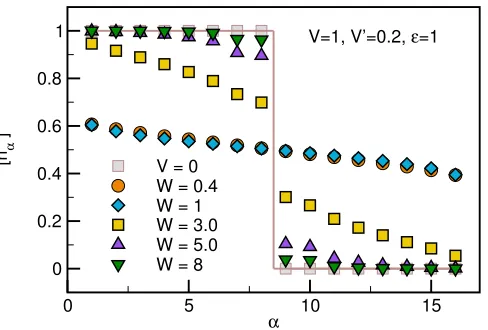
the occupations of the OPDPM are in a one-to-one cor-respondence with the occupations of the quasiparticles. This is corroborated by our numerical analysis presen-ted in Sec.IV, where we show that the natural orbitals generally have a well defined localization center and ex-ponential tails. Consequently, since the Anderson orbi-tals are also exponentially localized, |U˜αµ|2 is a sharply peaked function. In this case, a value ofn(qp)µ = 0 or 1 implies that nα(µ) is also close to 0 or 1, and the ideal step function structure of the quasiparticle occupations is reflected in a similar discontinuous structure in the OPDM occupations. This is indeed what we find, see for example Fig.5.
III. MODEL
The model we consider consists of spinless fermions on a 1D lattice with L sites, hopping constant t and ne-arest and next nene-arest density-density interaction with strengthV andV0, given by the Hamiltonian
H =t L X
i=1
−1 2(c
†
ici+1+c†i+1ci) +i
ˆ ni−
1 2
+V
ˆ ni−
1
2 ˆni+1− 1 2
+V0
ˆ ni−
1
2 ˆni+2− 1 2
. (10)
IV. PROPERTIES OF THE NATURAL ORBITALS
A. Typical natural orbitals
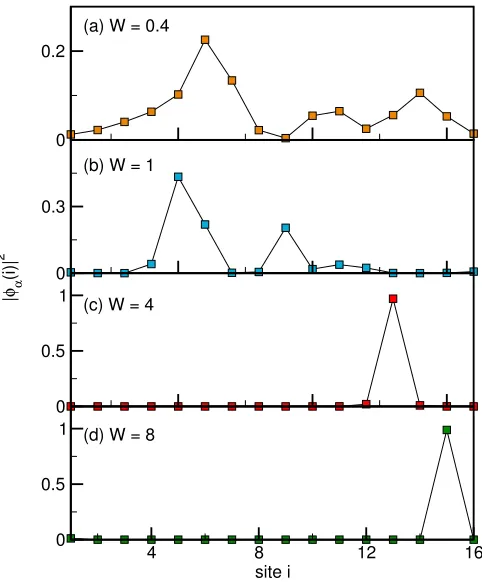
Figure1shows the spatial profile|φα,i|2of typical na-tural orbitals φα(i) = hi|φαi at V = 1, V0 = 0.2, ε = 1 and different disorder strengths. In the ergodic phase, O(L) many sites carry a nonzero weight. In the MBL phase, however, the vast majority of the natural orbi-tals possess an easily recognizable single maximum with a significantly larger weight than on all other sites; we associate this site with the localization center of the cor-responding quasiparticle. Thus, we summarize one of the main qualitative results of Ref. [16] as follows: while all single-particle eigenstates are localized in our model, in-teractions lead to a delocalization of natural orbitals in the ergodic phase. In the MBL phase the natural orbitals retain the main features of Anderson eigenstates, i.e., a well-defined localization center and exponential tails (see the discussion below).
These statements are substantiated by an analysis of the statistical properties of the natural orbitals over the disorder ensemble. One measure for the localization or delocalization of a single-particle state is the inverse par-ticipation ratio
IPR = 1 N
L X
α=1 nα
L X
i=1
|φα(i)|4. (11)
In the ergodic case, one expectsφα(i)∼1/ √
Land hence IPR∼1/L, while in the MBL phase and in the case of a single localization center, IPR∼1. We presented results for the so-defined IPR in [16], which confirm this expec-tation: the distribution of IPR valuesP(IPR) is centered around 1/Lin the ergodic phase and becomes narrower as Lincreases. In the MBL phase, the distributions are broad, centered around a large value that moves towards IPR ∼ 1 as W increases, and the distributions are L independent.
Another important feature of the eigenstates of the An-derson problem in one dimension is their exponential tails [78] as shown, for example, in Fig. 2(a). These tails di-rectly visualize the (single-particle) localization length in the Anderson problem. In Figs.2(b) and (c), we plot the two natural orbitals from Figs.1(c) and (d) (ε= 1) which represent states just beyond the transition and deep in the MBL phase, respectively. Clearly, these natural orbi-tals decay exponentially away from the localization cen-ter (note the log-lin scale in Fig. 2). Note that increa-singW makes the natural orbitals more narrow (compare Figs.2(b) and (c)).
In principle, one can therefore extract a single-particle localization length ξNO from the natural orbitals, with the expectation that ξNO ∼ξ
(1)
qp of thequasiparticles in the MBL phase. However, from such small systems as accessible to exact diagonalization or even the shift-and-invert method [15], this would not reliably work even in
0 0.2
0 0.3
0 0.5 1
|
φα
(i)|
2
4 8 12 16
site i 0
0.5 1
(a) W = 0.4
(b) W = 1
(c) W = 4
(d) W = 8
FIG. 1. (Color online) Spatial profile of typical natural orbi-tals in the (a),(b) ergodic phase (W = 0.4,1) and (c),(d) the MBL phase (W = 4,8). L= 16,V = 1,V0= 0.2,ε= 1.
the noninteracting case, due to the fluctuations in the single-particle states around their exponential envelope. Moreover, on the system size studied, not all natural or-bitals exhibit a clear exponential tail in the MBL phase. At present, it is unclear whether this is due to the small system sizes or an actual property of the states. We thus postpone this very interesting question, namely the ex-traction of the localization lengthξNO from the natural orbitals, and the analysis of their statistical properties as well as their dependence on disorder strength, to a future study using the DMRG methods that recently have been developed specifically for the MBL phase [66,67,70,79– 81]. System sizes of L ∼ 100 should be accessible with these techniques, at least deep in the MBL phase.
[image:5.612.320.561.50.341.2]10-6 10-3 100
|
φα
(i)|
2
4 8 12 16
site i 10-6
10-3 100 10-6 10-3 100
(b) V=1, W = 4
(c) V=1, W = 8 (a) V=0, W = 4
FIG. 2. (Color online) Natural orbitals for (a)V = 0,W = 4, (b) V = 1, V0 = 0.2, W = 4, ε = 1, (c) V = 1, V0 = 0.2,
W = 4,ε= 1 (both forL= 16). The states shown in (a) and (b) are computed for different disorder realizations.
B. Energy- andV-dependence
For every many-body eigenstate |ni, the diagonaliza-tion of the OPDM defines a unitary transformadiagonaliza-tion from the original real-space basis to a new basis labelled with α, as given in Eq. (6). There are several obvious questions about the properties of the cα and the transformations Uαj. First, can one give some physical interpretation to the indexα? In the clean case, since the OPDM respects lattice translational symmetry, αcan be identified with quasimomentum kand hence there is no information in the natural orbitals as one varies interaction strength; they are always plane waves. In the MBL phase, the discussion from Sec. IV A suggests that α can still be thought of as a site index, indicating the localization cen-ter of a quasiparticle. In the ergodic phase, there is no obvious way to interpret the indexα.
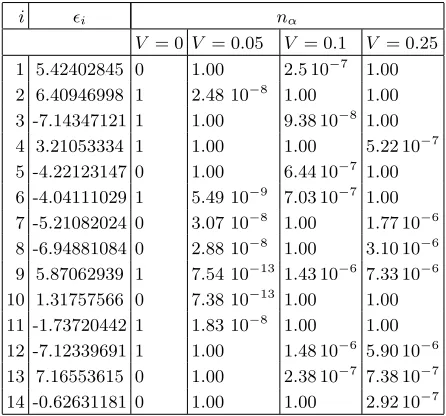
Second, how do the natural orbitals change as either interaction strength V or energy density ε varies? To address this point we consider a fixed disorder strength ofW = 8 deep in the MBL phase and onedisorder rea-lization that is also kept fixed asV orεare varied. The values of the onsite potentialsi and the occupationsnα are listed in Tab.I and Tab.IIfor fixedε= 1 and fixed V = 1, respectively. The site index listed in the first column is the localization center of the natural orbital φα(i), for which the nαis quoted.
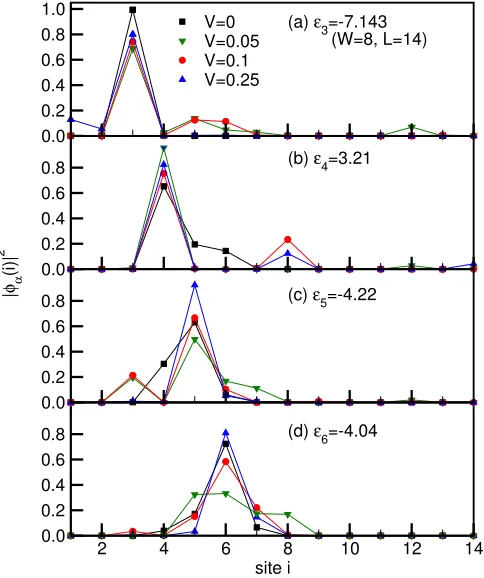
Let us first discuss the V-dependence. Figures 3(a)-(d) show four different natural orbitals at ε = 1
cen-i i nα
[image:6.612.55.299.49.306.2]V = 0 V = 0.05 V = 0.1 V = 0.25 1 5.42402845 0 1.00 2.5 10−7 1.00 2 6.40946998 1 2.48 10−8 1.00 1.00 3 -7.14347121 1 1.00 9.38 10−8 1.00 4 3.21053334 1 1.00 1.00 5.22 10−7 5 -4.22123147 0 1.00 6.44 10−7 1.00 6 -4.04111029 1 5.49 10−9 7.03 10−7 1.00 7 -5.21082024 0 3.07 10−8 1.00 1.77 10−6 8 -6.94881084 0 2.88 10−8 1.00 3.10 10−6 9 5.87062939 1 7.54 10−13 1.43 10−6 7.33 10−6 10 1.31757566 0 7.38 10−13 1.00 1.00 11 -1.73720442 1 1.83 10−8 1.00 1.00 12 -7.12339691 1 1.00 1.48 10−6 5.90 10−6 13 7.16553615 0 1.00 2.38 10−7 7.38 10−7 14 -0.62631181 0 1.00 1.00 2.92 10−7 TABLE I. Onsite potentialsi, occupationsnα, and localiza-tion centersi for the natural orbitals forε = 1, W = 8 but differentV = 0,0.05,0.1,0.25.
tered around sites i = 3,4,5,6, respectively, for V = 0,0.05,0.1,0.25. We select these sites since 3 is very low, which should typically localize a particle there at sufficiently low ε. The sites i = 5,6 have comparable onsite potentials5≈6.
As expected, the Anderson state for i= 3 has a very simple structure with its largest weight at the localiza-tion center. Increasing V changes this (and other na-tural orbitals) quickly and in an apparently unsystema-tic way: the i = 3 natural orbitals for V = 0.05 and V = 0.1 are more spread out while the one forV = 0.25 looks practically like the corresponding Anderson eigen-state (see Fig. 3(a)). Note that this observation makes no implication on theV-dependence of the localization length ξNO, since those need to be computed from full distributions from many disorder realizations.
The natural orbitals centered around i = 4,5,6 are already hybridized in the sense that all three of them have sizable weight on all three sites (still with a dominant maximum at the localization center). That structure is also not preserved systematically in the natural orbitals forV >0, while still, hybridizations between sites i= 5 andi= 6 frequently occur (see, e.g., the results forV = 0.25).
[image:6.612.328.551.51.259.2]i i nα
[image:7.612.56.298.51.260.2]ε= 0 ε= 1/3 ε= 2/3 ε= 1 1 5.42402845 1.72 10−11 1.88 10−5 1.00 3.76 10−8 2 6.40946998 1.530 10−8 1.00 8.75 10−6 2.89 10−7 3 -7.14347121 1.00 1.00 1.00 1.00 4 3.21053334 1.531 10−8 9.32 10−6 1.01 10−5 1.00 5 -4.22123147 1.00 1.00 8.18 10−6 2.00 10−6 6 -4.04111029 1.00 1.00 1.00 1.74 10−6 7 -5.21082024 1.00 1.31 10−5 1.08 10−6 9.30 10−7 8 -6.94881084 1.00 1.00 2.42 10−5 1.00 9 5.87062939 4.05 10−7 2.58 10−7 2.33 10−5 1.00 10 1.31757566 7.07 10−7 5.64 10−9 1.00 1.00 11 -1.73720442 1.00 1.44 10−7 1.00 5.17 10−6 12 -7.12339691 1.00 1.00 1.00 1.00 13 7.16553615 3.09 10−7 1.46 10−5 5.05 10−6 1.00 14 -0.62631181 6.18 10−9 1.00 1.00 4.37 10−6 TABLE II. Onsite potentialsi, occupationsnα, and locali-zation centersifor the natural orbitals forV = 1, W = 8 but differentε= 0,1/3,2/3,1.
V = 0 for a disorder realization that is kept fixed. Then, as interactions are turned on to small but finite values V >0, one needs to diagonalize the fullN-body subspace and select the one state whose real-space structure has the largest overlap with the non-interacting many-body state. This can be judged by diagonalizing the OPDM in each many-body eigenstate and by associating each nα to the localization center of the corresponding natu-ral orbital. This set of natunatu-ral orbitals is then the one that should evolve adiabatically from the original set of Anderson eigenstates as interactions are added, while its eigenenergy can evolve through the spectrum.
We next turn to the energy dependence of the natural orbitals. We present a set of natural orbitals centered around sites i = 3,4,5,6 for V = 1 in Figs. 4(a)-(d) (the Anderson states are included for comparison). In the ground state (ε = 0), the OPDM occupations (see Tab.II) follow the naive expectation that predominantly the sites with the lowest i are occupied. As energy density increases, different sets of N-many sites become occupied. The natural orbitals turn out to depend on ε as there is no systematic way in which they have a simple structure (i.e., a large weight on only one site) or hydridizations (i.e., multiple sites with 0.1<|φα|2<1).
The key reason is that energy isnotthe relevant quan-tity to distinguish many-body eigenstates in the MBL phase, rather the defining property is the local structure as imprinted onto the state by the N occupied quasi-particles. As we discussed in Sec. II, it is in general ex-pected that the natural orbitals depend on the state from the relationships between quasiparticles and the (state-dependent) OPDM eigenstates.
0.0 0.2 0.4 0.6 0.8 1.0
V=0 V=0.05 V=0.1 V=0.25
0.0 0.2 0.4 0.6 0.8
2 4 6 8 10 12 14
site i 0.0
0.2 0.4 0.6 0.8 0.0 0.2 0.4 0.6 0.8
|
φα
(i)|
2
(a) ε3=-7.143 (W=8, L=14)
(b) ε4=3.21
(c) ε5=-4.22
(d) ε6=-4.04
FIG. 3. (Color online) Natural orbitals for one disorder realization at W = 8 but different interaction strengths
V = 0,0.05,0.1,0.25 (V0 = 0). The natural orbitals for the interacting case are computed from a state at energy den-sityε= 1 and we show the natural orbitals with localization centers at sites (a)i= 3, (b)i= 4, (c)i= 5, (d)i= 6.
V. OCCUPATION SPECTRUM
A. Limiting cases: Clean system, Anderson insulator and deep MBL regime
The other information obtained from the diagonaliza-tion of the OPDM is the occupadiagonaliza-tion spectrumnα. For a clean system with periodic boundary conditionsα=kis just quasimomentum andnαis thus nothing but the qua-simomentum distribution function. In an ergodic system (and away from integrability) we expectnαto be a ther-mal distribution [82], based on studies of quantum quen-ches in nonintegrable models (see, e.g., [44,83]). We will demonstrate that this expectation holds true in Sec.V C. There are two other limiting cases, in which the struc-ture ofnαis obvious. First, consider the Anderson model in 1D:
H0=−t 2
X
i
(c†ici+1+c†i+1ci) +t X
i i
ˆ ni−
1 2
. (12)
[image:7.612.320.562.52.341.2]0.0 0.2 0.4 0.6 0.8 1.0
V=0
ε=0
ε=1/3
ε=2/3
ε=1
0.0 0.2 0.4 0.6 0.8
2 4 6 8 10 12 14
site i 0.0
0.2 0.4 0.6 0.8 0.0 0.2 0.4 0.6 0.8
|
φα
(i)|
2
L = 14, W = 8, V=1 (a) ε3=-7.143
(b) ε4=3.21
(c) ε5=-4.22
(d) ε6=-4.04
FIG. 4. (Color online) Natural orbitals for one disorder re-alization at W = 8 and V = 1, V0 = 0 but different energy densitiesε= 0,1/3,2/3,1. We also include the corresponding Anderson eigenstates. The figures shows the natural orbitals for sites (a)i= 3, (b)i= 4, (c)i= 5, (d)i= 6.
the OPDM eigenvalues according to their sizen1> n2> · · · > nN >· · · > nL, we obtain a simple step function withnα= 1 for 1≤α≤N and zero otherwise.
Deep in the MBL phase whereW 1, V, we can ap-proximate the Hamiltonian by
H ≈tX i
i
ˆ ni−
1 2
. (13)
The OPDM eigenstates are now simply fully localized on individual sites, and in each eigenstateN of them are occupied. In that case, the many-body wave-function is a Slater determinant again andnαis a step function. Thus, in these two limits, we can think ofα=N corresponding to a Fermi-index labeling the last occupied state. We can define a Fermi-discontinuity ∆nfrom
∆n=nN+1−nN. (14)
which is ∆n= 1 in these two cases. These behaviors are obviously independent of disorder averaging in noninte-racting systems.
0 5 10 15
α
0 0.2 0.4 0.6 0.8 1
[n
α
]
V = 0 W = 0.4 W = 1 W = 3.0 W = 5.0 W = 8
V=1, V’=0.2, ε=1
FIG. 5. (Color online) Disorder-averaged occupation spectrum for different disorder strength. L = 16, V = 1,
V0= 0.2,ε= 1.
0.000 0.001
var
nα
L=14 L=16 L=18
0 0.2 0.4 0.6 0.8 1
(α+0.5)/L
0.00 0.01 0.02 0.00 0.01
0.00 0.02 0.04
(a) W=1
(b) W=2
(c) W=3.5
(d) W=6
[image:8.612.321.565.50.215.2] [image:8.612.61.301.51.339.2] [image:8.612.319.563.313.612.2]B. Disorder and energy dependence of the occupation spectrum
1. Disorder-averaged occupation spectrum and its
W-dependence
We now turn to a discussion of the overall W -dependence of the occupation spectrum, considering dis-order averaged quantities first (disdis-order averages are in-dicated by [·]). At finite values oft, V in the MBL phase, the discontinuity [∆n] remains finite but smaller than one, while some [nα] are correspondingly smaller as well. Far away from the “Fermi-edge” at αN, [nα] ≈ 1 or [nα] ≈ 0. This implies that the corresponding quasi-particles have a very simple structure, with very little contributions beyond the single-particle space. As Fig.5 shows, this behavior persists in the entire MBL phase W & 3.5. It also penetrates into the ergodic phase, at least on small finite systems (see the discussion below).
Sufficiently deep in the ergodic phase (see the data shown in Fig.5forW = 0.4 andW = 1), [nα] becomes a smooth function ofαand the discontinuity ∆n is small and just as large as other differences [nα+1−nα].
2. Realization-to-realization fluctuations
It is quite instructive to study both the results for nα on individual realizations and the entire distributi-onsP(nα) obtained from averaging over many realizati-ons. We showed in Ref. 16 that P(nα) develops a cha-racteristic structure in the MBL phase with two max-ima at nα = 0 and nα = 1, consistent with the pre-ceding discussion. In Fig. 6, we plot the variance of the OPDM eigenvalues versus (α+ 1/2)/L. In the er-godic regime, the overall fluctuations are small and are the largest at the edges. At the transition (see the data shown forW = 3.5 in Fig.6(c)), the situation changes as the largest fluctuations now occur at the emergent Fermi edge (i.e., (α+ 1/2)/L= 0.5). This behavior persists in the MBL phase, where the overall fluctuations decrease again, while their maximum remains at (α+1/2)/L= 0.5 (see the data shown forW = 6 in Fig.6(d)).
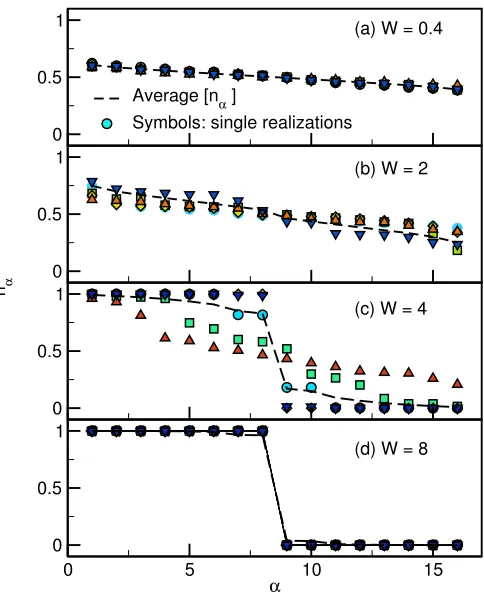
By inspecting individual realizations as well as such distributions, we find that deep in the MBL phase, vir-tually all realizations look quantitatively and qualitati-vely similar (i.e., they exhibit a discontinuity ∆n with small fluctuations), as is shown in Fig.7(d). Upon lowe-ringW and by approaching the transition (see Fig.7(c) for an example), for some realizations, the distributions appear to be smooth, with no discernible discontinuity, while for the majority of cases, the typical MBL beha-vior prevails. We can understand this observation from the fact that in the vicinity of the transition, increasingly large thermal clusters are expected to exist in an over-all insulating system [30,36]. Conversely, on the ergodic side, occasionally we still find realizations with a discon-tinuity, while the majority of realizations now has smooth
0 0.5 1
Average [nα ]
Symbols: single realizations
0 0.5 1
0 0.5 1
nα
0 5 10 15
α
0 0.5 1
(a) W = 0.4
(b) W = 2
(c) W = 4
[image:9.612.320.562.49.347.2](d) W = 8
FIG. 7. (Color online) Occupation spectrum in individual realizations for different disorder strength. L = 16,V = 1,
V0 = 0.2,ε = 1: (a) W = 0.4, (b) W = 2, (c) W = 4, (d)
W= 8.
occupation spectra (see Fig.7(b) for an example). Suf-ficiently far away from the transition and in the ergodic phase, practically all realizations result in smooth spectra (see Fig.7(a) for an example).
3. State-to-state variations in individual realizations
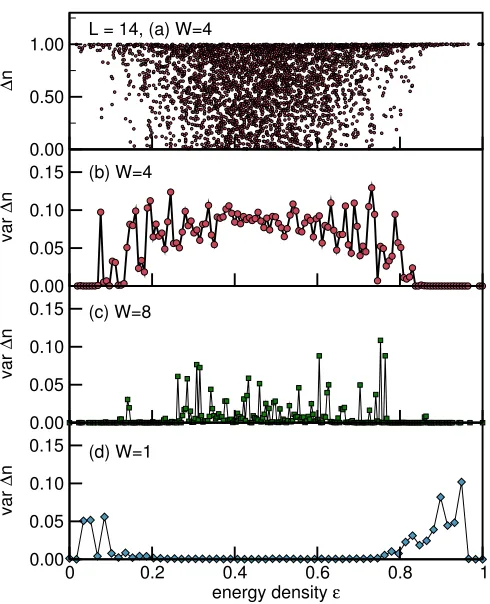
It is important to stress that there are not only va-riations in the occupation spectrum from realization to realization (that are typically large in the transition re-gion), but also from eigenstate to eigenstate for a given realization. In order to illustrate this, we plot the discon-tinuity ∆nversus energy density in Fig.8(a), computed in all eigenstates forW = 4, which is close to the transi-tion and on the MBL side. At the edges of the spectrum, the discontinuity is ∆n= 1, with virtually no fluctuati-ons, implying that the many-body states at low energies have a particularly simple structure in Fock space. In the bulk of the spectrum, the fluctuations of ∆nbecome large and exhaust the full range 0.∆n≤1.
in a more quantitative way: vanishing fluctuations at the edges that become large in the bulk of the spectrum. Deep in the MBL phase, the fluctuations tend to decrease (see Fig.8(c)). The fact that, in the MBL phase, state-to-state fluctuations of the discontinuity are the largest in the bulk but vanish at the edges of the spectrum can be viewed as a manifestation of the notion that many-body effects in the presence of disorder become the most rele-vant in the bulk of the system, i.e., at high energy densi-ties. This conforms with the idea that MBL is primarily a high-energy phenomenon that happens in what usu-ally is considered the nonuniversal part of the many-body spectrum (that fact notwithstanding, the low-energy por-tions still belong to the MBL phase). In the ergodic phase, however, the behavior is quite different and con-forms with the expectation for a generic system that obeys ETH: in the bulk, the state-to-state fluctuations are small and are the largest at the edges (see Fig.8(d)). To further analyze those states with a small ∆n, we search for a correlation with eigenstates with a large en-tanglement. More generally speaking, the question is whether the tails in the distribution of the entanglement entropy [30, 79, 84] that appear as the transition is ap-proached can be related to the tails in the distribution of ∆n. The entanglement entropy is defined as
SvN=−trR(ρRlnρR), (15)
whereρR is the reduced density matrix of the right half of the system withL/2 sites.
To clarify this, again for a fixed realization, we plot the half-cut entanglement entropy SvN versus the occupation-spectrum discontinuity ∆nin all many-body eigenstates for L = 14 and different disorder strengths W = 1,2,4,8 in Figs.9(a)-(d), respectively. The results confirm the overall expectation that large-entanglement eigenstates have small discontinuities ∆nand vice versa. This trend is most clearly visible in the data for the er-godic phase shown in Figs. 9(a) and (b). In the MBL phase (see the data for W = 4,8), there are less cases with large SvN overall (keeping in mind that the plots show results for only 3432 states in one realization). The trend is still present in the data that states with a small ∆n have larger values of SvN, while the most striking difference between ergodic (see the data forW = 1) and MBL phase (see the data forW = 8) is the bunching of points at small ∆n and large SvN versus large ∆n and smallSvN.
4. Distributions as a function of disorder strength
One can further analyze the full distributionP(∆n) of the discontinuity as a function of disorder strength. Fi-gure 10 shows the evolution of this distribution as one goes from the ergodic phase (W = 1.5) through the tran-sition region (W = 3) into the MBL phase (W = 6). Clearly, in the ergodic phase, the maximum is at ∆n≈0 (plus 1/Lcorrections). In the transition region, P(∆n)
0.00 0.50 1.00
∆
n
0 0.2 0.4 0.6 0.8 1
energy density ε
0.00 0.05 0.10 0.15
var
∆
n
0.00 0.05 0.10 0.15
var
∆
n
0.00 0.05 0.10 0.15
var
∆
n
L = 14, (a) W=4
(b) W=4
(c) W=8
(d) W=1
FIG. 8. (Color online) State-to-state variation of the discon-tinuity ∆nfor a single realization atW= 4,V = 1,V0= 0.2: (a) ∆n versus energy density , (b) var ∆nfor W = 4, (c) var ∆nforW = 8, (d) var ∆nforW = 1, (in (b)-(d), we use a binning of ∆E= 0.2 on the energy axis).
is much broader and there are two maxima at ∆n ≈ 0 and 1. As system size increases, the maximum at ∆n= 0 becomes more pronounced while the one at ∆n= 1 de-creases, consistent with the prediction [15] that W = 3 is on the ergodic side of the transition. Note that such a bimodal structure in the distributions has also been ob-served for local observables [84]. In the MBL phase, the distribution is sharply peaked at ∆n= 1, as expected.
[image:10.612.318.563.47.349.2]0 1 2 3
SvN 0 1 2 3
0 1 2 3
0 0.2 0.4 0.6 0.8 1
∆n
0 1 2 3
(a) W=1
(b) W=2
(c) W=4
(d) W=8
FIG. 9. (Color online) Half-cut entanglement entropy SvN versus occupation-spectrum discontinuity ∆n computed for a given disorder realization in all many-body eigenstates for
L= 14 and (a)W= 1, (b)W = 2, (c)W = 4, and (d)W = 8 (V = 1,V0= 0).
10-2
100
102
L=10 L=12 L=14 L=16
0.0 0.2 0.4 0.6 0.8 1.0
∆n
10-2
10-1
100
101
102
100
101
P(
∆
n)
(a) W=1.5
(b) W=3
[image:11.612.317.562.51.216.2](c) W=6
FIG. 10. (Color online) Distribution of the occupation spectrum discontinuity ∆n for different values of W and L
forV = 1,V0= 0.
0 2 4 6 8
W 0
0.1
var
∆
n
L=10 L=12 L=14 L=16 L=18 V=1, V’=0, ε=1
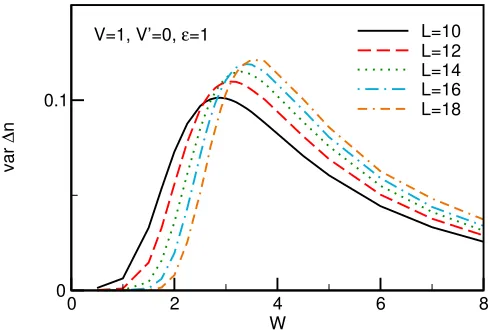
FIG. 11. (Color online) Variance of the distribution of the discontinuity as a function ofW for different values of L at
V = 1,V0= 0 and= 1.
C. Occupation spectrum in the ergodic phase and thermalization
In the ergodic phase, we expect the occupation spectrum [nα] to be smooth, with the actual values de-termined by the temperature. Since in the ergodic phase, the eigenstate thermalization hypothesis should hold, the set ofnαcomputed from individual many-body eigensta-tes should be identical to the expectation values in the canonical ensemble. There is a minor caveat here since the operators ˆnα=c†αcα are not necessarily local in the ergodic phase, in contrast to the MBL phase, where ˆnα can be related to the quasi-local conserved quantities (see the discussion in Sec. II). Thus, in the MBL phase the indexαcan be thought of as a position index, as argued above, while in the ergodic phase, this is not the case since the natural orbitals are extended wave functions. Despite the nonlocality of the ˆnα, their eigenstate expec-tation values are still expected to be thermal in the ETH sense, in analogy to the behavior of the quasimomentum distributionnk of a clean system [44,82,83].
In order to verify this expectation, we first consider individual realizationsρ(corresponding to a fixed set of Llocal potentialsi) and compute a temperatureTρfrom the condition
Eρ= Tr[ρ(1)can(Tρ)Hρ]. (16)
Here, Eρ is the energy of the many-body eigenstate closest to the target energy E from which we extrac-ted the natural orbitals and the occupation spectrum; ρcan(Tρ) = e−Hρ/Tρ/Zρ is the canonical ensemble with the partition functionZρ= Tr(e−Hρ/Tρ). We then com-pute the thermal expectation value of the OPDM at that temperature from
ρ(1)(Tρ) = Tr[ρcan(Tρ)c†icj] (17)
[image:11.612.56.300.51.352.2] [image:11.612.55.298.434.655.2]0 0.3 0.6 0.9
[n
α
], [n
α
(T)]
[nα ]
[nα(T )]
0 0.2 0.4 0.6 0.8 1
(α+0.5)/L
0 0.3 0.6 0.9
(a) L = 12
(b) L = 14
FIG. 12. (Color online) Comparison of [nα] to [nα(T)]. (a)
L= 12, (b)L= 14. W = 0.4,V = 1,V0= 0.2,ε= 1.
average over many disorder configurations, resulting in [nα(T)] (where we have now dropped the indexρ). Cle-arly, this procedure results in a distribution of tempe-raturesTν. We observe that these distributions of tem-peratures are quite narrow at weak disorder and in the ergodic phase, while upon approaching the transition and in the MBL phase, they become increasingly broad and develop tails [85].
A direct comparison of the disorder-averaged occupa-tion spectrum computed from either individual many-body eigenstates or in the canonical ensemble is shown in Figs. 12(a) and (b) for L = 12 and 14, respectively. The agreement is very good, while the quantitative dif-ferences between [nα] and [nα(T)] are of the magnitude typical for such a small system [83]. We studied these differences as a function of system size (not shown here) and find that they rapidly decrease withL, as suggested by the comparison of theL= 12 andL= 14 data. As a consequence, the difference ∆nbetween the occupation of theNth andN+1st natural orbital should vanish with system size and must be strictly zero in the ergodic phase in the thermodynamic limit. To summarize, computing ∆nserves as a very clean measure of obtaining the phase diagram.
D. Phase diagrams from the occupation spectrum discontinuity
Our previous discussion suggests that the discontinuity ∆ncan be used to compute phase diagrams of interacting disordered systems. We expect ∆n → 0 in the ergodic phase asLincreases and ∆n >0 in the MBL phase.
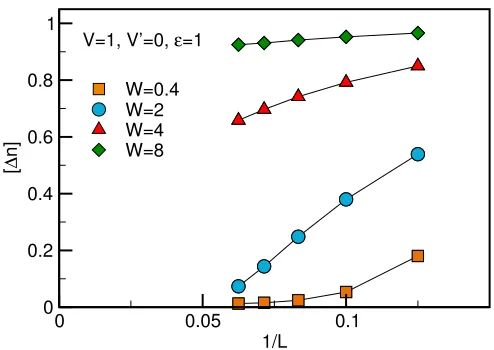
Currently, we are limited to the system sizes accessible to exact diagonalization. We demonstrate that the finite-size dependence of ∆ndeep in either phase is consistent with our expectations described above. Figure13, where we plot ∆n versus 1/L, shows that this is indeed the case for W = 1 and W = 8. For intermediate values of
0 0.05 0.1
1/L 0
0.2 0.4 0.6 0.8 1
[
∆
n]
W=0.4 W=2 W=4 W=8
V=1, V’=0, ε=1
FIG. 13. (Color online) Finite-size dependence of the disorder-averaged occupation-spectrum discontinuity for
W= 0.4,2,4,8 andV = 1,V0= 0,ε= 1.
Ergodic
MBL
FIG. 14. (Color online) Phase diagram, obtained from plot-ting the disorder average [∆n] of the occupation-spectrum discontinuity, of interacting 1D spinless fermions with un-correlated diagonal disorder Eq. (10) obtained from plotting ∆n=nN+1−nN as a function ofandW atV = 1,V0= 0. ED data forL= 16 andN= 8 particles.
W closer to where one expects the transition, the trend is not clear yet, due to the small system sizes. Note, however, that a somewhat faster convergence of ∆n to zero is observed when plotting the median instead of the mean of the distributionP(∆n). While we have not done so here, where we are mainly interested in qualitative properties, for a quantitative analysis, it may thus be better to study the median.
[image:12.612.316.563.49.224.2] [image:12.612.54.300.51.210.2] [image:12.612.324.560.287.447.2]0
2
4
6
8
V
0.0
0.2
0.4
0.6
0.8
1.0
ε
(a)
W= 1.
5
0
2
4
6
8
V
0.0
0.2
0.4
0.6
0.8
1.0
(b)
W= 3.
0
0
2
4
6
8
V
0.0
0.2
0.4
0.6
0.8
1.0
(c)
W
= 6.
0
0.0
0.5
1.0
[∆
n
]
FIG. 15. (Color online) Phase diagram of interacting 1D spinless fermions with uncorrelated diagonal disorder Eq. (10) in the
ε-V plane forL= 16 for three different values of disorder: (a)W = 1.5, (b) W = 3, and (c)W = 6 (V0= 0); obtained from plotting the disorder average [∆n] of the occupation-spectrum discontinuity.
infinite temperature 3.Wc.4, as well as the reentrant behavior as a function of interaction strength [5,15,19]. An important next step, which is beyond the scope of the present work, is to employ recently developed DMRG methods [66,67,70,79–81] that are specifically tailored for the MBL phase, to compute the OPDM.
Figure 15 shows the discontinuity in the energy den-sity versus interaction strength plane, which is not usu-ally shown. For smallW(see Fig.15(a)), a large region is delocalized, in particular, asincreases. For intermediate disorder strengthW = 3 (see Fig.15(b)), the delocalized region (indicated by small values of ∆nshrinks conside-rably, while at large disorderW = 6 (see Fig.15(c)), the system is uniformly in the MBL phase.
E. Single-particle occupation entropy
From the occupation spectrum nα, one can define a single-particle occupation entropy via
Socc0 =−1 N
X
α
nαln(nα/N). (18)
Note that here we choose a different normalization for the single-particle density matrix compared to Ref. [16], namely tr[ρ(1)] = 1 instead of tr[ρ(1)] = N. As a con-sequence, the single-particle occupation entropy is inten-sive. This normalization removes a trivial overall volume-law dependence of Socc0 . Moreover, we also remove an additive term ln(N) which is the contribution of a Slater determinant such thatSocc= 0 for a product state:
Socc=Socc0 −ln(N) =− 1 N
X
α
nαln(nα). (19)
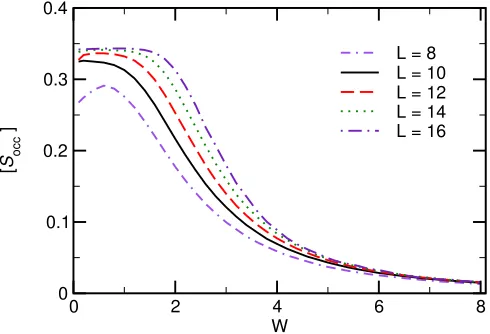
The dependence ofSoccon disorder strength is illustrated in Fig.16(a) for several system sizesL= 8,10,12, . . . ,16 andV = 1, V0 = 0.2. At smallW, S
occ quickly becomes L-independent. The small downturn as W →0 seen for the smallest system sizes such asL= 8,10 is a remnant of the proximity to the integrable model (W = 0,V0 = 0)
0 2 4 6 8
W 0
0.1 0.2 0.3 0.4
[
Socc
]
[image:13.612.60.561.54.180.2]L = 8 L = 10 L = 12 L = 14 L = 16
FIG. 16. (Color online) Disorder-averaged single-particle occupation entropy [Socc] for V = 1, V0 = 0.2, ε = 1 and for different system sizesL= 8,10, . . . ,16.
and is quickly suppressed by increasingL or making V0 larger.
For a fixed L (apart from the small feature at small W),Socc monotonically decreases withW and becomes small in the MBL phase, where it also exhibits a weak L-dependence only, saturating fast already for L = 16. The associated variance of theSocc(fluctuations between different realizations), has a maximum in the transition region (data not shown here, see Ref. [16]). The position of this maximum isL-dependent and shifts towards Wc asW increases.
F. Correlations between OPDM occupations computed in different many-body eigenstates
[image:13.612.318.563.248.415.2]eigensta-(a) (b) (c)
FIG. 17. (Color online) Probability density of obtaining a valuen(αm) in state |mi, given that a value n(αn) was obtained in state|ni, with both being calculated with the operator ˆnα obtained in the state|ni. This plot is obtained forL= 14,V = 1,
V0= 0, taking 64 disorder realizations, 64 states|nifrom the middle of the spectrum for each realization and then for each of these about 1500 states|midistributed over the full energy spectrum.
tes are product states of the form
|ni= L Y
i=1
(c(qp)†i )n(qp)i |0i, (20)
where the quasiparticle occupations n(qp)i = 0,1. Im-portantly, different eigenstates are product states of the same local operators. This suggests that the natural orbi-tals obtained from different eigenstates are close to each other, even though, as argued in Sec.II, they are in prin-ciple state dependent. To check this, we calculate the OPDM in eigenstate|ni, diagonalize it with the unitary U(n), and construct the creation operator:
c†α=X i
Uα,i(n)c†i. (21)
These operators satisfy the relation hn|c†
αcβ|ni = n(αn)δα,βas before. With this operator, we now take anot-her eigenstate|miand calculate the diagonal elements
n(αm)=hm|c†αcα|mi. (22)
If the natural orbitals are similar, then n(αm)≈n (n) α ifα has the same occupation as in |ni, but n(αm) ≈1−n
(n) α otherwise. We check this with the density plot of n(αm) versusn(αn)in Fig.17. In the ergodic phase these occupa-tions have a maximum at 0.5 for both|niand|mi. In the localized phase the occupationsn(αn) are always close to either zero or one, as expected, and in the state|mithe occupations ofcαobtained from|niindeed are predomi-nantly close to either zero or one. This demonstrates that the natural orbitals obtained for one eigenstate remain a good approximation of the natural orbitals computed in another state, and therefore the single-particle con-tent of the correspondingl-bit, in other eigenstates. For W .3.5, there is the additional effect that some states |miare from below the mobility edge and thus the natu-ral orbitals from states|niin the middle of the spectrum (which are already ergodic) should not be correlated to those.
2 4 6 8 10 12 14 16
α 0
0.2 0.4 0.6 0.8 1
[n
α
]
W=0.75 W=1 W=1.5 W=2 W=4
[image:14.612.55.562.53.183.2]V=1, ε=1, L=16
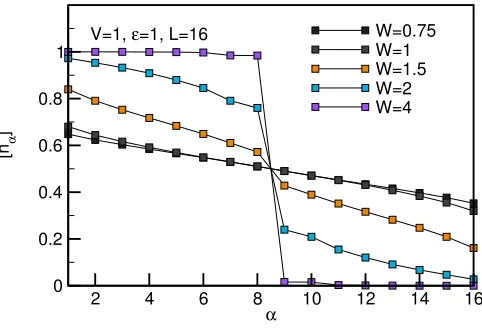
FIG. 18. (Color online) Disorder-averaged occupation spectrum in the interacting Aubry-Andr´e model (spinless fer-mions) for different disorder strengths, system size L = 16 and energy densityε= 1 (V = 1,V0= 0).
VI. OPDM PROPERTIES IN THE INTERACTING AUBRY-ANDR ´E MODEL
We verify that the occupation discontinuity is also obtained in the interacting Aubry-Andr´e model and use it to map out its phase diagram. This model is given by the Hamiltonian (10) with the quasirandom on-site disorder potential
i=Wcos(2πβi+φ), (23)
whereβ = √
5−1
[image:14.612.320.561.259.423.2]Ergodic
MBL
FIG. 19. (Color online) Phase diagram obtained from plotting the discontinuity ∆n, in the disorder strengthW interaction strengthV plane, of the Aubry-Andr´e model for system size
L= 16 and energy densityε= 1 (V0= 0).
[88,89]) and fermions (see, e.g, [90]). In the absence of in-teractions, the Aubry-Andr´e model has a metal-insulator transition at Wc = 2 [91] and interactions increase the critical disorder strength a little bit, to about Wc = 2.5 depending on the interaction strength [11].
In Fig. 18, we plot the occupation spectrum for dif-ferent disorder strengths (see [11, 20, 23] for other stu-dies of many-body localization in this system). As in the random model, the occupation spectrum has a clear discontinuity in the many-body localized phase, while in the ergodic phase, it is absent (up to 1/L corrections). From the discontinuity at different disorder strengthsW and interaction strengthsV we obtain the phase diagram given in Fig. 19. This phase diagram is consistent with what is already known about this model [11,20,47], i.e., interactions lead to a slight increase of the delocalized phase. The example of spinless fermions with nearest-neighbor interactions in the Aubry-Andr´e model demon-strates that our main findings, i.e., the existence of a dis-continuity in the occupation spectrum, is not restricted to the model of spinless fermions in a random lattice.
VII. NATURAL ORBITALS AS AN OPTIMUM
MEASURE FOR THE SINGLE-PARTICLE CONTENT OF QUASIPARTICLES
In this section we discuss the usefulness of the natu-ral orbitals as a basis for a quasiparticle expansion and as an optimum measure for the single-particle content of the quasiparticles. The motivation for this is as follows: in the bulk of the paper we have, based on the numerical analysis, demonstrated how the occupations of the na-tural orbitals characterize the full many-body localized phase. As far as formal operator expansions for the qua-siparticles are concerned, one may worry, however, that the perturbative expression (9) is only useful when the
2 4 6 8 10 12 14
α
0 0.2 0.4 0.6 0.8 1
[n r
]
r=qp r=i
r=µ
r=α
[image:15.612.318.563.50.218.2]V=1, V’=0, ε=1
FIG. 20. (Color online) Spinless fermions with nearest-neighbor repulsion and random onsite disorder: comparison of three different occupations [nr], the real-space occupation
ni, the occupation of Anderson orbitals nµ and that natu-ral orbital occupationsnα, ordered in descending order. The solid line is the (step-like) distribution function of the quasi-particles. HereV = 1.0,W = 6.0 andL= 14, for many-body states from the middle of the spectrum. We averaged over 64 disorder realizations.
effect of interactions is weak, that is, when the natural orbitals are very close to the Anderson orbitals. In this li-mit, the expectation valuenµ=hn|ˆnµ|niof the densities of the Anderson orbitals should also be a good approx-imation of the quasiparticle occupations. In Fig.20, we compare this density nµ with both the onsite densities ni = hn|ˆni|ni and the natural orbital occupations nα; in all cases, we have ordered them in descending order. The plot demonstrates that the natural orbitals give the best approximation to the quasiparticle occupations since they are the closest to integers. This is a central result of our study.
Given this and the fact that the whole many-body loca-lized phase has well defined quasiparticles, also at strong interactions, one may be tempted to express the quasi-particles in terms of the natural orbitals. That is, instead of Eq. (5), one writes
ˆ
n(qp)α 'nˆα+ X
(ββ0)6=(γγ0) ˜ Bββα,(0nγγ)0c
† βc
†
β0cγcγ0+. . . . (24)
This form is still consistent with the expectation that ˆ
[image:15.612.59.297.54.211.2]varies from many-body eigenstate to many-body eigen-state, although as shown in Fig.17 this variation is not too severe.
As a consequence of Eq. (24), the quasiparticle creation operator is related to the natural-orbital operators as
c(qp)†α =c†α+X βγδ
fβγδα c†βc†γcδ+. . . , (25)
This is reminiscent of the relation of quasiparticles in terms of plane waves in Fermi-liquid theory (see, for ex-ample, Eq. (8) in Ref. 92 and references within). Plug-ging Eq. (25) into Eq. (24) and evaluating the result in the state|ni, we obtain, to first order in f,
nα=n(qp)α
1−2ReX β
(fαββα −fβαβα )n(qp)β
. (26)
The advantage of this relation over the similar relation in terms of the Anderson orbitals (9) is that here it is ex-plicit that any deviation from the ideal step function in the occupations comes only from particle-hole dressing of bare fermions in the quasiparticle expansion. Furt-hermore, since this expression is purely in terms of the natural orbitals, it provides a reasonable approximation at any interaction strength at which quasiparticles with nonzero single-particle content emerge.
It remains as an open question to mathematically de-rive a nonperturbative relation between natural orbitals and integrals of motions/quasiparticles. Moreover, our results suggest that in any many-body eigenstate, the OPDM eigenbasis is the single-particle basis that best approximates the quasiparticles. Another interesting ex-tension would be to ask whether there is a global single-particle basis (perhaps obtained from suitable linear com-binations of natural orbitals from different states) that provides a further improvement along these lines.
VIII. SUMMARY AND OUTLOOK
In this work, we provided a comprehensive discussion of the properties of the particle density matrix in one-dimensional systems of interacting fermions in the pre-sence of disorder. We showed that the eigenstates of the OPDM, which form complete sets of single-particle sta-tes, computed in individual many-body eigenstasta-tes, are delocalized in the ergodic phase and localized in the MBL phase. The eigenvalues, after a suitable reordering, un-veil the Fock-space structure of MBL many-body eigen-states: they are weakly dressed Slater determinants [1] since most eigenvalues are close to either one or zero and the occupation spectrum has a discontinuity at an emer-gent Fermi edge in the MBL phase. This suggests a close analogy of the MBL phase to a zero-temperature Fermi liquid and is consistent with the existence of localized quasiparticles in the MBL phase. We relate these findings to the local integrals of motion introduced to describe the
phenomenology of the MBL phase [8,9,13, 17, 18]. We argue that the OPDM eigenstates provide a good (if not the best) approximation to the single-particle content of the local integrals of motion. In the ergodic phase, the occupation spectrum is thermal in agreement with the ei-genstate thermalization hypothesis and the occupation-spectrum discontinuity vanishes exponentially or faster as system size increases. Computing the occupation-spectrum discontinuity as a function of model parameters thus provides a sharp measure of the phase diagram.
We further discussed the statistical properties of both natural orbitals and of the occupation spectrum. Interestingly, there are increasing fluctuations in the occupation-spectrum discontinuity as the transition is approached. We demonstrate that there is a correlation between states with a small occupation-spectrum discon-tinuity and a large entanglement entropy. Similar to the conclusions drawn in other works, these fluctuations in-crease as the transition is approached and these fluctuati-ons are thus indicatifluctuati-ons of the breakdown of localization. While most of our analysis focussed on the paradig-matic model of spinless fermions with nearest-neighbor repulsive interactions, we also show that computing the occupation-spectrum discontinuity correctly resolves the ergodic and MBL phases in a model of interacting spin-less fermions in the Aubry-Andr´e model as well.
We conclude by pointing out several interesting appli-cations of our single-particle framework to other models that are of relevance in the theory of many-body locali-zation. An interesting case for the OPDM analysis to be applied to is the Fermi-Hubbard model [24, 25, 93, 94], where disorder has been introduced by either disorder that couples to the charge or in the interactions. In the latter case, there is not Anderson-insulator in the non-interacting limit and hence it would be very interesting to see whether the natural orbitals become localized in spite of the single-particle eigenstates all being delocali-zed. In the former case, recent work has raised doubts on the existence of localization and nonergodic dynamics in the spin sector [94], in which the chosen type of dis-order preserves SU(2) symmetry, which has been argued to protect the system from localizing [95].
A crucial question that is not fully understood yet is to which degree signatures of MBL can still be seen in open quantum systems (for some work in this direction, see [96–102]). That would be the generic situation in condensed matter systems, where a coupling to phonons is usually unavoidable. In the case of the Anderson in-sulator, it is known that phonons turn the system into a bad metal [1,78,103]. The notion of localized quasipar-ticles provides a framework to address this question. Can the lifetimesτqpof the quasiparticles in the presence of a bath be long enough as to allow MBL physics to survive at least on timest < τqp? The analysis of the OPDM in an open quantum system and the evolution of the dis-continuity as a function of bath coupling would be worth looking at.
Logan, F. Pollmann, and L. Rademaker for insightful dis-cussions. This work was supported by the ERC Starting
Grant No. 679722, and in part by the National Science Foundation under Grant No. NSF PHY11-25915.
[1] D. M. Basko, I. L. Aleiner, and B. L. Altshu-ler, “Metal-insulator transition in a weakly interacting many-electron system with localized single-particle sta-tes,”Ann. Phys.321, 1126 (2006).
[2] I. V. Gornyi, A. D. Mirlin, and D. G. Polyakov, “Inte-racting electrons in disordered wires: Anderson localiza-tion and low-ttransport,”Phys. Rev. Lett.95, 206603 (2005).
[3] V. Oganesyan and D. A. Huse, “Localization of inte-racting fermions at high temperature,” Phys. Rev. B 75, 155111 (2007).
[4] M. ˇZnidariˇc, T. Prosen, and P. Prelovˇsek, “Many-body localization in the heisenbergxxz magnet in a random field,”Phys. Rev. B77, 064426 (2008).
[5] A. Pal and D. A. Huse, “Many-body localization phase transition,”Phys. Rev. B82, 174411 (2010).
[6] J. H. Bardarson, F. Pollmann, and J. E. Moore, “Un-bounded growth of entanglement in models of many-body localization,”Phys. Rev. Lett.109, 017202 (2012). [7] B. Bauer and C. Nayak, “Area laws in a many-body lo-calized state and its implications for topological order,”
J. Stat. Mech.P09005(2013).
[8] R. Vosk and E. Altman, “Many-body localization in one dimension as a dynamical renormalization group fixed point,”Phys. Rev. Lett.110, 067204 (2013).
[9] M. Serbyn, Z. Papi´c, and D. A. Abanin, “Local conser-vation laws and the structure of the many-body locali-zed states,”Phys. Rev. Lett.111, 127201 (2013). [10] M. Serbyn, Z. Papi´c, and D. A. Abanin, “Universal slow
growth of entanglement in interacting strongly disorde-red systems,”Phys. Rev. Lett.110, 260601 (2013). [11] S. Iyer, V. Oganesyan, G. Refael, and D. A. Huse,
“Many-body localization in a quasiperiodic system,”
Phys. Rev. B87, 134202 (2013).
[12] J. A. Kj¨all, J. H. Bardarson, and F. Pollmann, “Many-body localization in a disordered quantum ising chain,”
Phys. Rev. Lett.113, 107204 (2014).
[13] D. A. Huse, R. Nandkishore, and V. Oganesyan, “Phe-nomenology of fully many-body-localized systems,”
Phys. Rev. B90, 174202 (2014).
[14] V. Ros, M. M¨uller, and A. Scardicchio, “Integrals of motion in the many-body localized phase,”Nucl. Phys.
B891, 420–465 (2015).
[15] D. J. Luitz, N. Laflorencie, and F. Alet, “Many-body localization edge in the random-field heisenberg chain,”
Phys. Rev. B91, 081103(R) (2015).
[16] S. Bera, H. Schomerus, F. Heidrich-Meisner, and J. H. Bardarson, “Many-body localization characteri-zed from a one-particle perspective,” Phys. Rev. Lett. 115, 046603 (2015).
[17] J. Z. Imbrie, “On many-body localization for quantum spin chains,”J. Stat. Phys.163, 998 (2016).
[18] J. Z. Imbrie, “Diagonalization and many-body localiza-tion for a disordered quantum spin chain,” Phys. Rev.
Lett.117, 027201 (2016).
[19] Y. Bar Lev, G. Cohen, and D. R. Reichman, “Absence of diffusion in an interacting system of spinless
fermi-ons on a one-dimensional disordered lattice,”Phys. Rev.
Lett.114, 100601 (2015).
[20] P. Naldesi, E. Ercolessi, and T. Roscilde, “Quantum mean-field approximation for lattice quantum models: truncating quantum correlations, and retaining classical ones,” arXiv:1607.01285.
[21] W. De Roeck, F. Huveneers, M. M¨uller, and M. Schiu-laz, “Absence of many-body mobility edges,”Phys. Rev.
B93, 014203 (2016).
[22] X. Li, S. Ganeshan, J. H. Pixley, and S. Das Sarma, “Many-body localization and quantum nonergodicity in a model with a single-particle mobility edge,” Phys.
Rev. Lett.115, 186601 (2015).
[23] R. Modak and S. Mukerjee, “Many-body localization in the presence of a single-particle mobility edge,” Phys.
Rev. Lett.115, 230401 (2015).
[24] Y. Bar Lev, D. R. Reichman, and Y. Sagi, “Many-body localization in system with a completely delocali-zed single-particle spectrum,” arXiv:1607.04652. [25] P. Sierant, D. Delande, and J. Zakrzewski,
“Many-body localization due to random interactions,” arXiv:1607.00227.
[26] X. Li, D.-L. Deng, Y.-L. Wu, and S. Das Sarma, “Sta-tistical bubble localization with random interactions,” arXiv:1609.01288.
[27] R. Nandkishore and D. A. Huse, “Many-body locali-zation and thermalilocali-zation in quantum statistical me-chanics,” Annu. Rev. Condens. Matter Phys.6, 15–38 (2015).
[28] E. Altman and R. Vosk, “Universal dynamics and re-normalization in many-body-localized systems,”Annu.
Rev. Condens. Matter Phys.6, 383 (2015).
[29] A. C. Potter, R. Vasseur, and S. A. Parameswaran, “Universal properties of many-body delocalization tran-sitions,”Phys. Rev. X5, 031033 (2015).
[30] R. Vosk, D. A. Huse, and E. Altman, “Theory of the many-body localization transition in one-dimensional systems,”Phys. Rev. X5, 031032 (2015).
[31] M. Serbyn, Z. Papi´c, and D. A. Abanin, “Criterion for Many-Body Localization-Delocalization Phase Transi-tion,”Phys. Rev. X5, 041047 (2015).
[32] L. Zhang, B. Zhao, T. Devakul, and D. A Huse, “Many-body localization phase transition: A simplified strong-randomness approximate renormalization group,”Phys.
Rev. B93, 224201 (2016).
[33] V. Khemani, S. P. Lim, D. N. Sheng, and D. A. Huse, “Critical Properties of the Many-Body Localiza-tion TransiLocaliza-tion,” arXiv:1607.05756.
[34] M. Serbyn, Z. Papi´c, and D. A. Abanin, “Thouless energy and multifractality across the many-body locali-zation transition,” arXiv:1610.02389.
[35] K. Agarwal, S. Gopalakrishnan, M. Knap, M. M¨uller, and E. Demler, “Anomalous diffusion and griffiths ef-fects near the many-body localization transition,”Phys.
Rev. Lett.114, 160401 (2015).