in Complex Environments
Thesis by
Christoph Brunner
In Partial Fulfillment of the Requirements
for the Degree of
Doctor of Philosophy
California Institute of Technology
Pasadena, California
2010
c
2010 Christoph Brunner
Acknowledgements
Primary thanks goes to my principle advisor, Jacob Goeree, for his unending support
and encouragement. I also thank my advisors Charlie Plott and Tom Palfrey as well
as my co-authors Charles Holt, Colin Camerer and John Ledyard for their comments
and assistance. The discussion with seminar participants at Caltech and at various
esa-meetings have helped to improve these papers. The financial support of the
Abstract
It has been suggested that information cascades might occasionally prevent asset
markets from performing efficiently (e.g., Alevy et al. 1997). We run experiments
in which private signals about an asset with a common value are released
sequen-tially. That allows us to compare the quality of information aggregation in periods
in which an information cascade would occur in the absence of prices to the quality
of information aggregation in other periods. We find no significant difference, but we
do find evidence that prices are less likely to converge to the fully revealing rational
expectations equilibrium when early signals are misleading.
In a second chapter, we focus on information cascades in sequential games, where
subjects choose between two options and each subject has a small chance of being
perfectly informed about which option is correct. In treatment “sequence,” subjects
observe the entire sequence of predecessors’ choices, while in treatment “no-sequence”
they only observe the number of times each option has been chosen. Subjects tend
to follow their immediate predecessor in treatment sequence, which is the optimal
strategy under common knowledge of rationality. In treatment no-sequence, fully
rational agents would follow the minority of their predecessors (Callander and H¨orner
2009), but subjects follow the majority more often than the minority. Models that
combine heterogeneity in the level of strategic thinking and allow for some degree of
trembling (e.g., noisy introspection proposed by Goeree and Holt 2004) fit our data
best.
A third chapter evaluates the performance of four different auction formats. We
find that bidders are not always bidding on the currently most-profitable combination
submit jumpbids. As a result, a clock auction (Porter et al. 2003) in which prices can
only increase incrementally generates particularly high revenues. We also find that
subjects are reluctant to risk exposure: when they have a high value for a combination
of items but low values for each item separately, they are unwilling to bid high on
these single items unless the auction allows them to submit a package bid. Such
package bids specify that the bid is only valid if the bidder wins all items included in
the package.
In the last chapter, we compare five different stationary concepts: Nash
equi-librium, quantal-response equiequi-librium, action-sampling equiequi-librium, payoff-sampling
equilibrium and impulse-balance equilibrium. Selten and Chmura (2008) run a large
number of completely mixed 2×2 games in the laboratory for that purpose. We reanalyze their data and find that there are no significant differences with respect to
goodness of fit except that the Nash equilibrium fits worse than all the other models.
In a game with a risky and a safe choice (Goeree et al. 2003), impulse-balance
equi-librium yields a particularly good fit, which is due to its built-in loss aversion. When
other models are augmented with loss aversion, they yield an even slightly superior
fit. In games in which losses cannot occur (McKelvey et al. 2000), action sampling
and payoff sampling fit better than logit QRE and impulse balance, which fit better
Contents
List of Figures x
List of Tables xiv
1 Introduction 1
2 Cascades in Experimental Asset Markets 5
2.1 Introduction . . . 5
2.2 Experimental Design . . . 8
2.3 Conjectures and Definitions . . . 10
2.4 Results . . . 12
2.4.1 Bad Cascade Periods . . . 13
2.4.2 Good Cascade Periods . . . 17
2.5 Alternative Cascade Period Definitions . . . 19
2.5.1 Shorter Information Cascades . . . 19
2.5.2 Who Trades First? . . . 19
2.5.3 Who Submits Orders First? . . . 21
2.6 Alternative Explanations . . . 22
2.6.1 Early Expected Value vs. Late Expected Value . . . 22
2.6.2 Strategic Behavior . . . 23
2.7 Conclusion . . . 24
3.2 Theoretical Predictions . . . 31
3.3 Experimental Design . . . 33
3.4 Results . . . 36
3.4.1 Subject Behavior . . . 36
3.4.2 Efficiency . . . 42
3.5 Explaining Subject Behavior . . . 43
3.5.1 Logit-QRE . . . 43
3.5.2 Subject Heterogeneity . . . 45
3.5.3 Level-k and Cognitive Hierarchy . . . 46
3.5.4 Noisy Introspection . . . 49
3.6 Conclusion . . . 53
4 An Experimental Test of Flexible Spectrum Auction Formats 56 4.1 Introduction . . . 56
4.2 Alternative Auction Formats . . . 57
4.3 Experimental Design . . . 62
4.4 Results . . . 66
4.5 Individual Bidding Behavior . . . 74
4.6 Conclusion . . . 79
5 A Correction and Reexamination of “Stationary Concepts for Ex-perimental 2 × 2 Games” 81 5.1 Introduction . . . 81
5.2 Reexamining the Selten and Chmura (2008) Results . . . 84
5.3 Differentiating Stationary Concepts in Other Data Sets . . . 90
5.3.1 A Matching Pennies Game with Safe and Risky Choices . . . 90
5.3.2 Asymmetric Matching Pennies Games . . . 91
5.4 Conclusion . . . 93
A.2 Treatment Baseline No-Cascade Periods . . . 97
A.3 Instructions for Treatment Baseline . . . 97
A.4 Instructions for Treatment Sequence . . . 103
B Appendix to Chapter 3 109 B.1 Instructions for Treatment Sequence . . . 109
B.2 Instructions for Treatment No-Sequence . . . 113
C Appendix to Chapter 4 115 C.1 Rules for the Simultaneous Multi-Round (SMR) Auctions . . . 115
C.2 Rules for the Resource Allocation Design (RAD) and the Simultaneous Multi-Round Auction with Package Bidding (SMRPB) . . . 117
C.3 Rules for the Combinatorial Clock (CC) . . . 118
C.4 Experimental Instructions . . . 120
C.5 Experimental Instructions for the Activity Rule . . . 139
C.6 Experimental Instructions for the Pricing Rule . . . 140
List of Figures
2.1 Prices in Treatment Sequence in Bad Cascade Periods . . . 14
2.2 Prices in Treatment Baseline in Bad Cascade Periods . . . 15
2.3 Prices in Treatment Sequence in Good Cascade Periods . . . 17
2.4 Prices in Treatment Baseline in Good Cascade Periods . . . 18
2.5 Prices for an Additional Bad Cascade Period . . . 20
3.1 Probability the Minority is Correct in Treatment No-Sequence . . . 34
3.2 Probability the Minority is Correct in Treatment No-Sequence . . . 35
3.3 Subject Behavior in Treatment Sequence. . . 37
3.4 Subject Behavior in Treatment No-Sequence. . . 38
3.5 Frequency with Which Unanimous Predecessors Are Followed . . . 39
3.6 Frequency with Which a Deviator’s Choice is Followed . . . 40
3.7 Frequency with Which the Minority is Followed . . . 41
3.8 Subject Behavior in a Logit QRE Model . . . 44
3.9 Fraction of Rational Choices . . . 46
3.10 Subject Behavior in a Poisson Level-k Model . . . 49
4.1 Eight-Bidder Design with 3 Regions . . . 63
4.2 Efficiency by Auction Format . . . 68
4.3 Revenue by Auction Format . . . 71
4.4 Bidder’s Profits by Auction Format . . . 73
5.1 Mean Squared Distances for the Action-Sampling Equilibrium . . . 86
5.2 Visualization of Equilibrium Predictions and Observed Averages . . . . 87
5.4 Theory Specific Squared Distances by Blocks of 100 Periods . . . 88
5.5 A Matching Pennies Game with Safe and Risky Choices . . . 90
5.6 Mean-Squared Distances for Game 4 . . . 91
5.7 An Asymmetric Matching Pennies Game. . . 92
A.1 Prices in Treatment Sequence No-Cascade Periods . . . 96
A.2 Prices in Treatment Baseline No-Cascade Periods . . . 97
A.3 Drawing Signals. . . 100
A.4 Your Screen. . . 102
A.5 Submitting Orders. . . 103
A.6 Your Screen: Updated Info. . . 104
A.7 Accepting Standing Orders. . . 105
A.8 Withdrawing Orders I. . . 106
A.9 Withdrawing Orders II. . . 106
A.10 Sorting Standing Orders. . . 107
A.11 Filtering Standing Orders. . . 107
A.12 End of Period Feedback. . . 108
A.13 Summary. . . 108
B.1 Urn Representation. . . 110
B.2 Information Given to Subjects in Treatment Sequence. . . 111
B.3 Record Sheet. . . 113
B.4 Information Given to Subjects in Treatment No-Sequence. . . 114
C.1 Slide 1. . . 120
C.2 Slide 2. . . 121
C.3 Slide 3. . . 121
C.4 Slide 4. . . 122
C.5 Slide 5. . . 122
C.6 Slide 6. . . 123
C.8 Slide 8. . . 124
C.9 Slide 9. . . 124
C.10 Slide 10. . . 125
C.11 Slide 11. . . 125
C.12 Slide 12. . . 126
C.13 Slide 13. . . 127
C.14 Slide 14. . . 127
C.15 Slide 15. . . 128
C.16 Slide 16. . . 128
C.17 Slide 17. . . 129
C.18 Slide 18. . . 129
C.19 Slide 19. . . 130
C.20 Slide 20. . . 130
C.21 Slide 21. . . 131
C.22 Slide 22. . . 132
C.23 Slide 23. . . 133
C.24 Slide 24. . . 133
C.25 Slide 25. . . 134
C.26 Slide 26. . . 134
C.27 Slide 27. . . 135
C.28 Slide 28. . . 135
C.29 Slide 29. . . 136
C.30 Slide 30. . . 136
C.31 Slide 31. . . 137
C.32 Slide 32. . . 137
C.33 Slide 33. . . 138
C.34 Slide 34. . . 138
C.35 Activity Rule I. . . 139
C.36 Activity Rule II. . . 140
List of Tables
2.1 Experimental Design. . . 10
2.2 Test Results Bad Cascade Periods . . . 16
2.3 Test Results Good Cascade Periods . . . 18
2.4 Test Results for Cascade Periods Based on the Time of the First Trans-action . . . 20
2.5 Test Results for Cascade Periods Defined Based on the Time of the First Order . . . 22
2.6 Using Devalue to Explain Differences in the Quality of Information Ag-gregation. . . 24
3.1 Experimental Design Parameters and Subjects’ Earnings. . . 36
3.2 Overview of Different Models . . . 51
4.1 Summary Statistics by Auction Format. . . 74
4.2 Bidding Behavior in SMR. . . 76
4.3 Average Bid Characteristics when Complementarities Are Low . . . 77
4.4 Bidding up to Value. . . 78
4.5 Size of Jumpbid . . . 78
5.1 Estimates for 5 Stationary Concepts . . . 85
5.2 Wilcoxon Matched-Pairs Signed-Rank Tests for the SC Data . . . 89
5.3 5 Stationary Concepts for Experimental Games . . . 93
5.4 Pairwise Tests . . . 94
Chapter 1
Introduction
There are many economically relevant situations in which individual actors hold
pri-vate information. Aggregating this pripri-vately held information can often greatly
im-prove the quality of individual choices. Therefore, it is of great interest to examine
institutions that perform that function. One example of such an institution is a
double auction market. According to the efficient market hypothesis, prices in asset
markets aggregate privately held information quickly and without bias (Fama 1970).
A large experimental literature (e.g., Plott and Sunder 1982, 1988) examines under
which conditions the aggregation of individually held information succeeds in such
markets. However, the process of how information is aggregated is still not very well
understood. In chapter 2, we will focus on one possible explanation for why privately
held information is not always aggregated successfully. Since neither individually held
information nor valuations are easily observable in the field, we turn to the laboratory
to address this question.
An important part of the aggregation process in asset markets involves individual
traders observing the bids and asks that their predecessors submitted. When traders
no longer pay attention to their own private signals and instead follow the choices of
their predecessors, an “information cascade” occurs and privately held information is
no longer being aggregated (Bikhchandani et al. 1992, Banerjee 1992). It has been
suggested that such information cascades might occasionally prevent asset markets
from performing efficiently (e.g. Alevy et al. 1997). However, Avery and Zemsky
common knowledge of rationality when there is only one dimension of uncertainty.
Only when some of these conditions are relaxed is it possible that agents neglect their
private information and simply follow the choices of their predecessors (Avery and
Zemsky 1998, Lee 1998).
In the experiment that we discuss in chapter 2, we implement environments in
which information cascades would occur in the absence of prices and test whether
they can also be observed in a market setting. We find evidence that the sequence in
which private signals are released to traders has an effect on the quality of information
aggregation: when early signals are misleading, prices are less likely to converge to
the fully revealing rational expectations equilibrium. At the same time, we find that
the quality of information aggregation is not significantly worse in periods in which
information cascades would occur in the absence of prices.
While further research is needed to establish how important cascades are to explain
price formation in asset markets, previous experiments show that they do occur in
the environment originally proposed by Bickhchandani et al. (1992). When agents
sequentially choose among two options for which they have common values, rational
agents should often ignore their private signal and follow their predecessors instead,
and subjects indeed often do so in the laboratory (Anderson and Holt, 1997, for
example). However, in many situations, it is impossible to observe the entire sequence
of predecessors’ choices. Instead, only the number of choices for each option is visible.
A tourist can, for example, only see the number of diners seated in the restaurants
among which he has to choose. Callander and H¨orner (2009) show that in such
a situation, it can be optimal to follow the minority when some agents have better
information than others. Chapter 3 focuses on this type of sequential decision-making
problem. In the laboratory, the prediction that subjects follow the minority fails
miserably. In fact, they are more likely to follow the majority than the minority. This
observed behavior is not entirely irrational: when agents tremble, the expected payoff
of following the minority is lower than the expected payoff of following the majority.
Trembles alone cannot explain subject behavior in this game satisfactorily, though.
combine this feature with trembles (e.g., “noisy introspection” proposed by Goeree
and Holt 2004) fit our data best.
Like in markets or in sequential games, individually held information is also
ag-gregated in auctions. These institutions typically aim at maximizing either the sellers
revenue or allocative efficiency. In the process, information about what the objects for
sale are worth to bidders is aggregated, even though this is not the primary purpose
of these mechanisms. Since the true values of bidders are typically unobservable in
the field, laboratory experiments are a suitable way to test different auction formats.
In chapter 4, we compare three combinatorial auctions as well as the simultaneous
multiround (SMR) auction. In a treatment with high value complementarities, all
three combinatorial auction formats generate a more-efficient allocation than SMR.
In these auctions, bidders can submit package bids, which are only valid if the bidder
wins all items included in the package. These package bids help bidders to avoid the
“exposure problem” which arises when a bidder has to bid on several items separately
and risks incurring losses in case he ends up winning only some of these items. We
also find that a clock auction (originally proposed by Porter et al. 2003) in which
prices steadily increase from one round to another on items for which there is excess
demand, generates the highest revenue. Part of the reason might be that subjects
are not always bidding in a straightforward way as typically assumed in the literature
(e.g., Milgrom 2004, p. 270). Instead, they sometimes submit jumpbids in auction
formats that allow them to do so and that can lead to inefficient allocations.
In chapter 5, we examine games in which players have no private information
other than their intentions of how to play the game and their beliefs about what
other players will do. Clearly, agents in these games have every interest in learning
about these intentions and beliefs held by other players. When playing the same
game repeatedly, agents will presumably converge to some stationary equilibrium.
Selten and Chmura (2008) run a large number of experiments to test five different
equilibrium concepts on completely mixed 2 ×2 games. We reanalyze their data, correct some errors, and find that there are no significant differences in terms of
models. In order to differentiate better between the five concepts, we also apply them
to previously published data of an experimental 2×2 game with a risky and a safe choice (Goeree et al. 2003). Impulse balance equilibrium, an equilibrium concept
with built-in loss aversion, explains subject behavior in this game particularly well.
However, all other non-Nash models do even slightly better than impulse balance
once they are also augmented with loss aversion. In games in which no losses relative
to the max-min payoff are possible (McKelvey et al. 2000), the payoff-sampling and
the action-sampling equilibrium fit better than logit QRE or impulse balance, which
Chapter 2
Cascades in Experimental Asset
Markets
2.1
Introduction
In the mid-1500s, the Netherlands became a center of cultivation and development of
new tulip varieties. A market for tulip bulbs was established. From November 1636 to
January 1637, prices of rare varieties surged upward and then rapidly collapsed to
ap-proximately 10 percent of their peak values (Garber, 1990). This episode, commonly
referred to as “tulip mania, is only one example for trade occurring at seemingly
irrational prices. Other instances often involve financial markets: in May 1719, the
shares of the French Compagnie des Indes sold at approximately 500 livres per share.
About 5 months later, the same shares were traded at 10.000 livres. The surge was
followed by a crash: in September 1721, the price was down at 500 livres per share
again (Garber, 1990). More recent examples of rapidly rising and shortly afterwards
even more rapidly collapsing prices include the stock market movements in the United
States at the end of the 1920s or the 1980s. In recent years, the valuations of many
Internet-related companies exhibited similar patterns.
Since the expected value of these assets given all available information at the
time is unknown, it remains unclear whether the according prices deviated from their
fundamental value or not. If they did, one possible explanation is that these were
informational cascade occurs when it is optimal for an individual, having observed
the actions of those ahead of him, to follow the behavior of the preceding individual
without regard to his own information” (p. 994). In an information cascade,
individ-ually held information is no longer revealed to others. As a consequence, agents can
end up making suboptimal choices given all privately held information at the time.
In this chapter, we will examine whether information cascades really routinely
occur in double auctions with endogenous prices. After a brief review of the relevant
literature, we will discuss the experimental design and then present the according
results.
Even though both Bikhchandani et al. (1992) and Banerjee (1992) mention
finan-cial markets as a possible environment in which information cascades might occur,
agents in their models sequentially choose among a set of options for which they have
common values. There are no prices and no trade occurs. In such environments,
information cascades are quite frequently observed in the laboratory (Anderson and
Holt, 1997, for example). However, it is unclear whether these results are relevant
to financial markets. Avery and Zemsky (1998) show that price adjustments prevent
information cascades under common knowledge of rationality when there is only 1
dimension of uncertainty. To test whether the presence of prices really eliminates
information cascades, Drehman et al. (2005a) and Cipriani and Guarino (2005)
im-plement markets in which the price of the asset always corresponds to the expected
value given the history of previous choices. If all agents were fully rational, subjects
should always follow their private information in these markets but they often fail
to do so. Nevertheless, neither Drehman et al. (2005a) nor Cipriani and Guarino
(2005) find evidence for information cascades. Instead, subjects exhibit contrarian
tendencies.
Despite these findings, it is not clear that it is impossible for information cascades
to be observed in financial markets. Avery and Zemsky (1998) show that
informa-tion cascades can occur in a model with an uninformed market maker, noise traders
and event uncertainty. Agents in their model are only allowed to trade once in an
that even under common knowledge of rationality, agents are not necessarily always
following their private information. However, these are not information cascades in
the sense of Bikhchandani et al. (1992) since agents’ actions still depend on their
private signal, they just might choose not to follow their signal if it is not strong
enough.
In the experimental literature, there is some evidence suggesting that
informa-tion cascades might occur even when prices are endogenous and in the absence of
restrictions on the time and quantity of trade. In an experimental double auction,
Barner et al. (2005) find that informed traders tend to trade particularly actively
at the beginning of the period except in periods in which information aggregation
fails. This result suggests that subjects carefully observe what other traders do and
update their valuations accordingly. If the first few actions in a trading period are
misleading, prices tend not to reflect the expected value of the asset. Plott and
Sun-der (1982) also report that informed traSun-ders are particularly active in the early stages
of trading. Other experimental studies find that subjects tend to rely on their private
information too often (N¨oth and Weber 1993, for example) or that they purchase too
many signals (Kr¨amer et al. 2006). These results would rather suggest that subjects
are unwilling to rely too strongly on information revealed by the market and as a
consequence, it might be difficult to observe cascades in a market setting.
Hey and Morone (2004) run experimental asset markets in which subjects can
purchase signals that indicate the true value of the asset. They report that in 1 period,
the first few signals purchased were misleading and as a consequence, prices failed to
converge to the true value of the asset. Since they do not report the expected value
of the asset given all signals purchased, it is not entirely clear whether information
aggregation really failed in this instance. Even if it did, other factors such as a high
variance of the signals purchased might have contributed to the failure of prices to
converge to the fully revealing rational expectations equilibrium. Moreover, there
might have been other periods in which early signals were misleading but information
aggregation nevertheless succeeded.
the market affects the quality of information aggregation, we design experiments that
allow us to control what information is released at which time more closely. Moreover,
we run a control treatment in which the same information is released simultaneously.
As a result, we can clearly identify periods in which information cascades would occur
if agents sequentially chose to buy or sell a unit of the asset at a fixed price. We
can then test whether the quality of information aggregation in these periods differs
relative to other periods. The treatment in which signals are released simultaneously
allows us to control for other possible explanations such as differences in the variance
of the signals released.
2.2
Experimental Design
In order to give subjects an incentive to pay attention to what other agents do,
all subjects have the same value for the asset that is being traded. This value is
determined independently for each trading period and is equally likely to be 0 or
100 units of the experimental currency. Even in such an environment, subjects often
place too much weight on their private information, which would prevent cascades
from occurring. One possible way to give traders an even higher incentive to infer
what signals other traders received is to release complementary signals. For example,
Plott and Sunder (1988) run experiments in which there are 3 possible states of the
world, x, y and z. Suppose the true state is y. In that case, half of the traders are
told that the state is either x or y while the other half knows that the true state is
either y or z. Such an information structure clearly encourages subjects to carefully
observe what others do. However, it is not suitable to study cascades since traders
would never ignore their private information.
Another possibility is to give more accurate signals to some traders. In that case,
it should be more obvious to traders with inaccurate signals that it is in their interest
to infer what signals other traders received. Moreover, they are probably more likely
to ignore their private information given that others know more about the true value
equilibrium in an experiment with heterogeneous private signals.
In order to keep the experimental design as simple as possible, there are only 2
types of signals in our experiments: strong signals and weak signals. Subjects with
weak signals should have every interest in finding out what information subjects with
strong signals have. Therefore, the difference between the accuracy of the strong
signal and the accuracy of the weak signal should be large. At the same time, even
subjects with strong signals should have an interest in observing what others do and
as a result, the strong signal should not be too accurate. Also, if weak signals contain
almost no information, it would be trivial to find that subjects’ decisions do not
depend on their private information. For these reasons, the weak signal reflects the
true value of the asset with probability 0.6 while the strong signal corresponds to the
true value with probability 0.8. Each one of 8 traders is equally likely to receive a
strong or a weak signal.
Trading occurs in a continuous double auction that was implemented in jTrade.
Each subject is given an endowment of 5 units of the asset at the beginning of each one
of 7 trading periods. Subjects also receive a cash loan of 500 units of the experimental
currency that they have to repay at the end of the period. Even if prices are at 100,
subjects would thus be able to purchase at least 5 units. In order to preserve the
symmetry between the buy and the sell side, subjects only have values for at most 10
units of the asset. If a subject ends up holding more than 10 units of the asset at the
end of a period, his value for these assets would nevertheless at most be 1000 units
of the experimental currency.
In treatment baseline, all subjects receive their private information at the
begin-ning of each trading period. They can then trade for 2.5 minutes. In treatment
sequence, the first subject also receives his signal at the beginning of the period and
30 seconds after the market period opens, the second subject receives his private
in-formation. After another 30 seconds, another signal is released to the next subject
until all 8 subjects received their signals. The position of each subject in this sequence
is randomly determined for each period and is shown to other traders along with each
Table 2.1. Experimental Design.
Treatment # Sessions # Subjects per Session Average Earnings
Baseline 5 8 $20
Sequence 5 8 $20
whether the trader who submitted a certain bid or ask already received his signal.
After all signals are released, subjects are given another 2.5 minutes to trade. As a
result, a market period in treatment sequence lasts 6 minutes. This duration is quite
different compared to treatment baseline but the time of trading available after all
information is released is exactly the same in both treatments. Since we use the same
signal and value draws for treatment baseline and treatment sequence, we can test
whether adding extra time during which information is released sequentially affects
the quality of information aggregation.
We run 5 sessions for each treatment using undergraduate and graduate students
at Caltech as subjects. Each subject was allowed to participate only once. In each
session, there is 1 practice period that does not affect earnings. Subjects receive a
$5 show-up fee as well as $1 for every 100 units of the experimental currency. As a
result, expected earnings are $22.5 per subject with sessions typically lasting for 1
hour for treatment baseline and 1.5 hours for treatment sequence.
2.3
Conjectures and Definitions
Under common knowledge of rationality, no trade should occur in either treatment
sequence or treatment baseline (Milgrom and Stokey 1982). However, we know from
previous market experiments that this is rather unlikely to happen. If trade does occur
and markets are efficient, prices should always reflect all information available to any
trader (Fama 1970). As a consequence, no information cascades should occur. On the
other hand, some subjects might fail to use their private information to update their
by actions of other market participants. In that case, information cascades could be
observed. More specifically, we examine both “good” and “bad” cascade periods and
compare the quality of information aggregation in these periods to other periods.
Definition 1 A bad (good) cascade period is a period which satisfies the following conditions:
• If subjects had to sequentially guess whether the value of the asset was 0 or 100 and the sequence of choices was observable, at least half of them would not pay
attention to their private signal under common knowledge of rationality.
• The majority of subjects would choose the wrong (correct) value.
For the parameters we use in our experiment, only periods in which the first signal
is misleading and both the second and the third signal are either weak or both strong
and misleading qualify as bad cascade periods. Similarly, only periods in which the
first signal is correct and both the second and the third signal are either weak or both
strong and correct are good cascade periods. If information cascades are likely to
occur in our markets, we expect that the quality of information aggregation in bad
cascade periods is worse than in other periods.
Conjecture 1 The quality of information aggregation for bad cascade periods is higher in treatment baseline than in treatment sequence.
Conjecture 2 The quality of information aggregation for bad cascade periods in treatment sequence is lower than for other periods in treatment sequence.
To measure the quality of information aggregation, we compute the average of the
absolute value of the difference between transactions prices and the expected value
of the asset given all private signals. We calculate this average for 4 different sets of
transactions:
• All transactions that occurred during the last 1.5 minutes of trading
• The last 5 transactions
• The last 5 units that were traded
The last 2.5 minutes of trading are relevant because all information has been
released by that time in treatment sequence. Therefore, prices would be identical in
both treatments if markets were efficient. We also take the average over transactions
that occurred during the last 1.5 minutes of trading in order to allow for time for
traders in treatment baseline to reveal their signals to others. For all measures,
the mean is always taken over the number of units that transact. For example, 2
transactions for 1 unit at price x are equivalent to 1 transaction for 2 units at price
x. The only exception is the third measure, for which we take the average over the
last 5 transactions giving equal weight to each one of them. Transactions at a price
of 0 or at prices of 100 or higher are dropped because these are obvious mistakes.
Just like in bad cascade periods, the aggregation of privately held signals stops
after some point in good cascade periods if information cascades occur. However,
The price at which information aggregation typically stops is almost always quite
close to the expected value of the asset given all private signals. Therefore, we do
not expect information aggregation in good cascade periods to be substantially worse
than in other periods but we nevertheless test whether or not it is. We will also test
whether there is a substantial difference in the quality of information aggregation
between treatment sequence and treatment baseline using all periods as observations.
Since there are only a few bad cascade periods and since we have no reason to expect
substantial differences in other periods, we do not expect these differences to be
significant.
2.4
Results
In this section, we will first test the conjectures stated above. Since we only find
the sequence in which signals are released might be favorable to trigger information
cascades. To conclude, we provide some evidence for strategic behavior on the part
of subjects, which might explain why we fail to find significant differences between
periods that could be favorable to information cascades and other periods in terms
of the quality of information aggregation.
2.4.1
Bad Cascade Periods
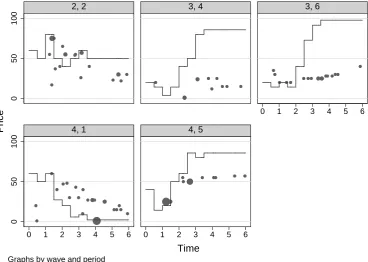
To test conjecture 1, we compare bad cascade periods in treatment sequence to bad
cascade periods in treatment baseline. Figures 2.1 and 2.2 display the according price
patterns separately for each one of the 5 periods that qualify as bad cascade periods.
The first number at the top of each period-specific graph indicates the session while
the second number corresponds to the period. The size of the dots is proportional
to the number of units exchanged. The line corresponds to the expected value of the
asset given all private signals. In treatment sequence, prices clearly fail to converge
to the rational expectations equilibrium in session 3, both in period 4 and period 6.
It could very well be that bad information released early in these periods led to an
information cascade that prevented prices from effectively aggregating information.
However, prices in the corresponding periods of treatment baseline also failed to
converge to the expected value of the asset given all privately held information. As
a result, none of the tests we run allows us to reject the null hypothesis that the
quality of information aggregation in treatment baseline is equivalent to the quality
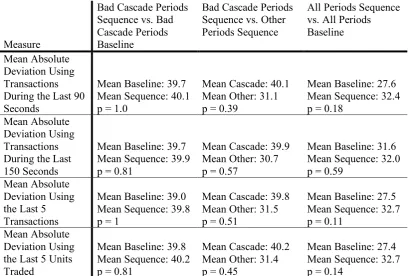
of information aggregation in treatment sequence for bad cascade periods. Table 2.2
contains the p-values of Wilcoxon matched-pairs signed-rank tests for the 4 different
measures of the quality of information aggregation.
Conjecture 2 does not fare much better than conjecture 1. Wilcoxon rank-sum
tests do not allow us to reject the null that the median of the quality of
informa-tion aggregainforma-tion is identical in bad cascade periods compared to other periods within
treatment sequence. When comparing all 35 periods of treatment sequence to all 35
hypoth-0
50
100
0
50
100
0 1 2 3 4 5 6
0 1 2 3 4 5 6 0 1 2 3 4 5 6
2, 2 3, 4 3, 6
4, 1 4, 5
Price
Time
[image:28.595.140.509.85.347.2]Graphs by wave and period
Figure 2.1. Prices in Treatment Sequence in Bad Cascade Periods.
esis of equal quality of information aggregation for some of the measures employed
with treatment sequence exhibiting the higher average absolute deviation of prices
from the rational expectations equilibrium price.
The fact that neither one of the main conjectures could be confirmed while there is
some support for the hypothesis that the quality of information aggregation is higher
in treatment baseline compared to treatment sequence might be due to an insufficient
number of bad cascade periods. Clearly, information cascades are not guaranteed to
occur even when the sequence of private signals would provide favorable conditions.
At the same time, information is not always aggregated very efficiently in treatment
0
50
100
0
50
100
0 .5 1 1.5 2 2.5
0 .5 1 1.5 2 2.5 0 .5 1 1.5 2 2.5
2, 2 3, 4 3, 6
4, 1 4, 5
Price
Time
[image:29.595.141.510.245.501.2]Graphs by wave and period
Table 2.2. Test Results Bad Cascade Periods.
Measure
Bad Cascade Periods Sequence vs. Bad Cascade Periods Baseline
Bad Cascade Periods Sequence vs. Other Periods Sequence
All Periods Sequence vs. All Periods Baseline
Mean Absolute Deviation Using Transactions During the Last 90 Seconds
Mean Baseline: 39.7 Mean Sequence: 40.1 p = 1.0
Mean Cascade: 40.1 Mean Other: 31.1 p = 0.39
Mean Baseline: 27.6 Mean Sequence: 32.4 p = 0.18
Mean Absolute Deviation Using Transactions During the Last 150 Seconds
Mean Baseline: 39.7 Mean Sequence: 39.9 p = 0.81
Mean Cascade: 39.9 Mean Other: 30.7 p = 0.57
Mean Baseline: 31.6 Mean Sequence: 32.0 p = 0.59
Mean Absolute Deviation Using the Last 5 Transactions
Mean Baseline: 39.0 Mean Sequence: 39.8 p = 1
Mean Cascade: 39.8 Mean Other: 31.5 p = 0.51
Mean Baseline: 27.5 Mean Sequence: 32.7 p = 0.11
Mean Absolute Deviation Using the Last 5 Units Traded
Mean Baseline: 39.8 Mean Sequence: 40.2 p = 0.81
Mean Cascade: 40.2 Mean Other: 31.4 p = 0.45
Mean Baseline: 27.4 Mean Sequence: 32.7 p = 0.14
2.4.2
Good Cascade Periods
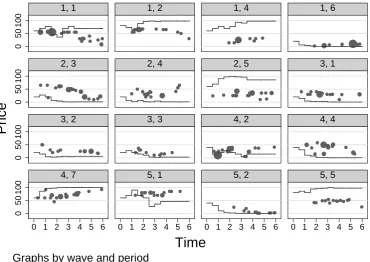
Figures 2.3 and 2.4 display the price patterns in good cascade periods for
treat-ment sequence and treattreat-ment baseline. The size of the dots is proportional to the
number of units exchanged. The line corresponds to the expected value of the
as-set given all private signals. Table 2.3 contains the according test results. We run
Wilcoxon matched-pairs signed-rank tests to obtain the p-values for the first column
and Wilcoxon rank-sum tests for the second column. While only 5 out of 35
peri-ods qualify as bad cascade periperi-ods, 16 qualify as good cascade periperi-ods. This might
be part of the reason why some of the comparisons between treatment sequence and
treatment baseline almost yield significant results. It appears that the quality of
infor-mation aggregation is somewhat lower in good cascade periods in treatment sequence
compared to good cascade periods in treatment baseline.
0
50
100
0
50
100
0
50
100
0
50
100
0 1 2 3 4 5 6 0 1 2 3 4 5 6 0 1 2 3 4 5 6 0 1 2 3 4 5 6
1, 1 1, 2 1, 4 1, 6
2, 3 2, 4 2, 5 3, 1
3, 2 3, 3 4, 2 4, 4
4, 7 5, 1 5, 2 5, 5
Price
Time
[image:31.595.140.511.358.620.2]Graphs by wave and period
0 50 100 0 50 100 0 50 100 0 50 100
0 .5 1 1.5 2 2.5 0 .5 1 1.5 2 2.5 0 .5 1 1.5 2 2.5 0 .5 1 1.5 2 2.5
1, 1 1, 2 1, 4 1, 6
2, 3 2, 4 2, 5 3, 1
3, 2 3, 3 4, 2 4, 4
4, 7 5, 1 5, 2 5, 5
Price
Time
[image:32.595.138.510.103.360.2]Graphs by wave and period
Figure 2.4. Prices in Treatment Baseline in Good Cascade Periods.
Table 2.3. Test Results Good Cascade Periods.
Measure
Good Cascade Periods Sequence vs. Good Cascade Periods Baseline
Good Cascade Periods Sequence vs. Other Periods Sequence Mean Absolute Deviation
Using Transactions During the Last 90 Seconds
Mean Baseline: 23.6 Mean Sequence: 32.4 p = 0.11
Mean Cascade: 32.4 Mean Other: 32.4 p = 0.89
Mean Absolute Deviation Using Transactions During the Last 150 Seconds
Mean Baseline: 28.5 Mean Sequence: 30.3 p = 0.68
Mean Cascade: 30.3 Mean Other: 33.4 p = 0.95
Mean Absolute Deviation Using the Last 5 Transactions
Mean Baseline: 23.7 Mean Sequence: 31.3 p = 0.15
Mean Cascade: 31.3 Mean Other: 33.9 p = 0.79
Mean Absolute Deviation Using the Last 5 Units Traded
Mean Baseline: 23.5 Mean Sequence: 30.9 p = 0.16
Mean Cascade: 30.9 Mean Other: 34.2 p = 0.74
2.5
Alternative Cascade Period Definitions
2.5.1
Shorter Information Cascades
Clearly, the low number of bad cascade periods combined with a relatively high
vari-ance in the quality of information aggregation in both treatments contributes to the
fact that we did not find much support in favor of conjectures 1 and 2. A possible
remedy would be to apply a more liberal definition of cascade periods by relaxing the
condition that at least 4 out of 8 traders would ignore their private signal if they chose
sequentially whether to buy or sell the asset. However, if only very few traders ignore
their private information, it would be difficult to find significant differences with
re-spect to the quality of information aggregation even if an information cascade actually
occurred. Therefore, the only extension that we test is one in which at least 3 traders
would ignore their private information if they chose sequentially. Unfortunately, this
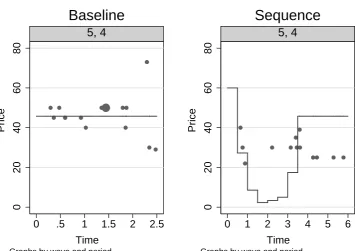
more-liberal definition only yields 1 additional bad cascade period (session 5, period
4) and all differences in the quality of information aggregation remain insignificant.
Figure 2.5 displays transaction prices in this additional bad cascade period. The size
of the dots is proportional to the number of units exchanged. The line corresponds
to the expected value of the asset given all private signals.
2.5.2
Who Trades First?
Another reason why conjectures 1 and 2 could not be confirmed might be that the
sequence in which signals are released does not correspond to the sequence in which
subjects actually trade. As a consequence, the sequence in which private information
is revealed to the market might not correspond to the sequence in which signals
are released to traders. To test this hypothesis, we compute the Spearman rank
correlation coefficient between the position of a subject in the sequence in which
private signals are released in treatment sequence and the time at which that subject
first buys or sells at least 1 unit of the asset. We obtain a positive correlation (0.24)
0
20
40
60
80
0 .5 1 1.5 2 2.5
5, 4
Baseline
Price
Time
Graphs by wave and period
0
20
40
60
80
0 1 2 3 4 5 6
5, 4
Sequence
Price
Time
Graphs by wave and period
[image:34.595.146.502.101.352.2]Figure 2.5. Prices in Session 5, Period 4 for Treatments Baseline and Sequence.
Table 2.4. Test Results For Cascade Periods Defined Based on the Time of the First Transaction. We run Wilcoxon rank-sum tests to obtain the p-values.
Measure
Bad Cascade Periods vs. Other Periods Both Treatments
Good Cascade Periods vs. Other Periods Both Treatments
Mean Absolute Deviation Using Transactions During the Last 90 Seconds
Mean Cascade: 31.9 Mean Other: 29.8 p = 0.79
Mean Cascade.: 32.7 Mean Other: 27.4 p = 0.35
Mean Absolute Deviation Using Transactions During the Last 150 Seconds
Mean Cascade: 33.5 Mean Other: 31.6 p = 0.88
Mean Cascade: 35.1 Mean Other: 28.6 p = 0.21
Mean Absolute Deviation Using the Last 5 Transactions
Mean Cascade: 33.8 Mean Other: 29.7 p = 0.57
Mean Cascade: 32.6 Mean Other: 27.7 p = 0.44
Mean Absolute Deviation Using the Last 5 Units Traded
Mean Cascade: 34.9 Mean Other: 29.5 p = 0.45
Since the correlation is not perfect, we reclassify cascade periods based on the
sequence in which subjects trade. We apply the same definition of cascade periods
that we originally used (Definition 1) but we now use the sequence of signals obtained
by the first 3 subjects who are buying or selling at least 1 unit of the asset to classify
periods. In treatment sequence, it occasionally happens that some of the these first
3 traders have not yet received their private information at the time at which they
first trade. We are not taking these traders into account since their private signal
clearly cannot have been revealed to the market at such an early stage. As a result,
7 out of 70 periods qualify as bad cascade periods and 5 of these periods are from
treatment sequence and 3 of them were already originally classified as cascade periods.
Wilcoxon rank-sum tests do not allow us to reject the null hypothesis that the median
of the quality of information aggregation in these bad cascade periods differs from the
median in other periods. When redefining good cascade periods based on the time
of the first transaction, 34 out of 70 periods qualify but none of the differences are
significant (table 2.4).
2.5.3
Who Submits Orders First?
Instead of the time of the first transaction, the time at which a trader first submits
a bid or an ask might be more closely related to the time at which he reveals his
private information to the market. Therefore, we test whether the time of the first
bid or ask is related to the time at which the private signal is received in treatment
sequence. The Spearman rank correlation coefficient is 0.29 and we can safely reject
the null that the 2 variables are unrelated (p=0.000). Instead of taking all bids and
asks into account, we only consider bids above 20 and asks below 80 since any signal
would justify lower bids or higher asks.
A reclassification of cascade periods based on the time of the first bid or ask yields
5 bad cascade periods, 4 of these periods already originally qualified as bad cascade
periods. We also obtain 35 good cascade periods. Wilcoxon rank-sum tests do not
Table 2.5. Test Results for Cascade Periods Defined Based on the Time of the First Order.
Measure
Bad Cascade Periods vs. Other Periods Both Treatments
Good Cascade Periods vs. Other Periods Both Treatments
Mean Absolute Deviation Using Transactions During the Last 90 Seconds
Mean Cascade: 25.5 Mean Other: 30.0 p = 0.81
Mean Cascade.: 31.4 Mean Other: 28.1 p = 0.82
Mean Absolute Deviation Using Transactions During the Last 150 Seconds
Mean Cascade: 25.9 Mean Other: 31.1 p = 0.74
Mean Cascade: 30.5 Mean Other: 30.9 p = 0.79
Mean Absolute Deviation Using the Last 5 Transactions
Mean Cascade: 30.8 Mean Other: 30.0 p = 0.89
Mean Cascade: 30.8 Mean Other: 29.5 p = 0.95
Mean Absolute Deviation Using the Last 5 Units Traded
Mean Cascade: 31.4 Mean Other: 29.9 p = 0.79
Mean Cascade: 30.2 Mean Sequence: 29.9 p = 0.87
not differ between bad cascade periods and other periods. Good cascade periods also
do not seem to yield a different quality of information aggregation (table 2.5).
2.6
Alternative Explanations
2.6.1
Early Expected Value vs. Late Expected Value
Even though subjects might not completely ignore their private information, they
might place too much weight on information that the actions of other traders reveal.
In that case, misleading early signals would still lead to a lower quality of information
aggregation but not necessarily in such a clear-cut way as the cascade model suggests.
To measure the extent to which early signals are misleading, we compute the expected
value of the asset given the first 4 signals. We then take the absolute value of the
difference between this early expected value and the expected value given all private
signals. This variable (devalue) is then used to explain the quality of information
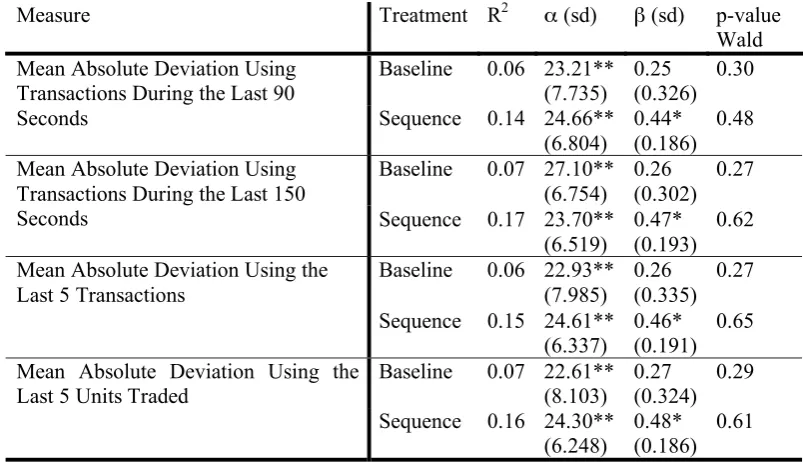
displayed in table 2.6.
In treatment sequence, the coefficient of devalue is always significant at the 10%
level. The larger the difference between the early expected value of the asset and the
late expected value of the asset, the larger the mean absolute deviation of prices from
the late expected value. In that sense, misleading early signals do have an effect on
the extent to which prices converge to the rational expectations equilibrium price.
Since devalue is correlated with the variance of the signals that traders receive,
it could be that a higher variance of signals is the true cause for the observed worse
quality of information aggregation in periods with high values ofdevalue. In that case,
we would expect the coefficient of devalue to be significant in treatment baseline as
well. Since that is not the case, we conclude that the sequence in which signals are
released does indeed affect the extent to which markets can aggregate privately held
information. We also test whether including a variable that measures the standard
deviation of signals significantly improves the fit of these regressions. Wald tests do
not allow us to reject the null hypothesis that the coefficient of the standard deviation
of signals is zero.
2.6.2
Strategic Behavior
When we classify periods as cascade periods, we assume that subjects reveal their
private information to other traders. If they fail to do so, the information that the
market receives might not correspond to the information used to classify periods,
which could explain why information aggregation in bad cascade periods is not
sub-stantially worse than in other periods. In order to test whether subjects are trying to
mislead other traders, we examine the first order submitted in each period. At that
time, the only information subjects have is their private signal. We only consider
bids above 20 and asks below 80 that were made by traders who had already received
their signal. 28% of such first orders are misleading in the sense that subjects are
submitting a buy order even though they received a low signal or that they submit
in-Table 2.6. Using Devalue to Explain Differences in the Quality of Information Ag-gregation.
Measure Treatment R2 (sd) ! (sd) p-value
Wald Baseline 0.06 23.21**
(7.735) 0.25 (0.326)
0.30 Mean Absolute Deviation Using
Transactions During the Last 90
Seconds Sequence 0.14 24.66**
(6.804)
0.44* (0.186)
0.48
Baseline 0.07 27.10** (6.754)
0.26 (0.302)
0.27 Mean Absolute Deviation Using
Transactions During the Last 150
Seconds Sequence 0.17 23.70**
(6.519)
0.47* (0.193)
0.62
Baseline 0.06 22.93** (7.985)
0.26 (0.335)
0.27 Mean Absolute Deviation Using the
Last 5 Transactions
Sequence 0.15 24.61** (6.337)
0.46* (0.191)
0.65
Baseline 0.07 22.61** (8.103)
0.27 (0.324)
0.29 Mean Absolute Deviation Using the
Last 5 Units Traded
Sequence 0.16 24.30** (6.248)
0.48* (0.186)
0.61
Coefficients marked by (* / **) are significant at the (10 / 5) percent level. Robust standard errors clustered by session are shown in parentheses.
consistent with the private signal received. For example, if a subject received a weak
high signal, the expected value of the asset is 60. It is then perfectly reasonable to
submit a sell order at a price of 70. However, 18% of all first orders are either sell
orders at a price below the expected value given the trader’s private signal or buy
orders at a price above the expected value given the trader’s signal. Clearly, other
traders will find it hard to figure out what signals these traders had based on the bids
or asks that they submitted. No matter whether these are intentional attempts to
mislead other traders or simply mistakes, the fact that bids and asks do not always
reflect the private information that a trader holds makes it difficult do identify the
effect of the sequence of signals on the quality of information aggregation.
2.7
Conclusion
While we find evidence that the sequence in which signals are released to traders
[image:38.595.116.518.112.343.2]1 and 2. Bad cascade periods in treatment sequence do not seem to fare substantially
worse than bad cascade periods in treatment baseline or other periods in treatment
sequence. A possible reason could be that we simply do not have enough
observa-tions. Another reason could be the difficulty involved in identifying the sequence in
which information is released to the market. In fact, the sequence in which signals
are released to traders does not always correspond to the sequence in which subjects
actively trade or submit orders. Moreover, when they submit orders, they do not
always reveal their private signal but might instead try to mislead other traders.
An alternative experimental design would eliminate these 2 sources of
complex-ity while still preserving an endogenous price. Instead of allowing subjects to trade
at any point of time, we could require them to trade in a predetermined sequence.
Each subject would be able to submit as many sell and buy orders as desired but
only once. As a consequence, subjects would no longer have an interest in misleading
other traders since it would be impossible to capitalize on flawed prices by
submit-ting further orders at a later point of time. At the same time, the sequence in which
subjects trade would always correspond to the sequence in which they receive their
private information. A control treatment would simply correspond to a call market
with identical signals and value draws. By eliminating much of the complexity of
a continuous double auction while preserving an endogenous price without a
mar-ket maker, such a design should allow us to establish whether information cascades
Chapter 3
Wise Crowds or Wise Minorities?
This chapter is based on a paper written jointly with Jacob K. Goeree.
3.1
Introduction
When people are imperfectly informed they may try to learn from others’ choices.
Prospective graduate students, for instance, often inquire which schools other students
chose to apply to. Teenagers consult the charts before deciding which CD to buy and
tourists tend to prefer well-occupied restaurants to half-empty competitors. In many
of these situations, only others’ choices can be observed, not the exact information
they had when making their choices. And while in some instances the exact sequence
of predecessors’ choices is observed (as in the US primary elections), more often only
aggregate statistics based on those choices are available (e.g., the number of diners
in a restaurant).
When do others’ decisions contain relevant information and what course of action
do they suggest? Obviously, predecessors’ choices matter only when their payoffs are
correlated to some extent. For this reason, most of the social-learning literature makes
the simplifying assumption that agents have identical values for the available options,
as is the case, for instance, when buying stocks.1 In this common-value environment,
folk wisdom suggests it would be best to follow the majority, an intuition that is
formalized by theoretical models of social learning. Bikhchandani et al. (1992), for
example, consider a model where agents are privately informed about which of 2
options is better and the quality of information is the same across agents. They
demonstrate that after a few decisions, information cascades occur and all agents
herd on the majority choice regardless of their private information.2 Following the
majority is also optimal in Banerjee’s (1992) model where uninformed agents have
the ability to signal that they have no information.
In contrast, Callander and H¨orner (2009) consider a situation where it can be
optimal to follow the minority. In their model, agents differ in terms of the quality
of information they possess and observe only the number of decisions for each option.
In this paper, we consider the following simplified version of their model: each agent
has a small chance of being perfectly informed about which of 2 options is correct or
gets no information at all (besides the prior information that puts equal weight on
both options). The information agents receive and the order in which they move are
exogenously determined.3 Finally, the probability of being informed is low enough
such that, under common knowledge of rationality, it is always optimal to follow the
minority. This result is explained in more detail below, but to glean some intuition
consider an uninformed agent who learns that 2 predecessors have chosen restaurant
A and one has chosen restaurant B. Such an outcome can only occur when the first agent was uninformed and chose the worse of the 2 restaurants. If both the second
and the third agent were informed, it would be best to follow the majority but such a
case is relatively unlikely when the probability of being informed is low. When only
the second agent was informed, the third agent faces a tie and chooses randomly, in
which case following the minority is no worse than following the majority. As opposed
where predecessors’ choices affect payoffs by changing the prices of the alternatives.
2Laboratory evidence provides partial support for these predictions in the sense that information cascades do occur but are often broken. In addition, subjects tend to overweigh their private information vis-`a-vis that contained in publicly observable predecessors’ choices (see, e.g., Anderson and Holt, 1997; C¸ elen and Kariv, 2004a, 2004b; Goeree et al., 2006, 2007).
to a sequence with 2 informed agents, it is quite likely that only the third agent was
informed, in which case it is strictly better to follow the minority.
This simple logic extends to more general minority-majority divisions if common
knowledge of rationality can be subsumed (see Callander and H¨orner, 2009). But
once we introduce the possibility of “trembles” or mistakes, it breaks down. Goeree
et al. (2007), for example, find that in standard social learning experiments (based
on Bikhchandani et al., 1992), cascades do form but almost never last as subjects
frequently opt to follow their contrary information and break the cascade.4 While
un-informed agents in our experiment do not possess any private information,5 trembles
may still occur especially because the information conveyed by predecessors’ choices
may be of low quality and value. Intuitively, the possibility of trembles greatly alters
equilibrium predictions in the Callander–H¨orner setup. In the example above, for
instance, the 2–1 division between restaurants is more likely caused by a trembling
uninformed agent than by a deviating informed agent when the probability of being
informed is very low.
More generally, whether it is optimal to follow the majority or the “deviant
minor-ity” therefore depends on the likelihood of mistakes, the quality of others’ information,
the correlation of tastes, etc. It would be hard to distinguish these confounding
ele-ments in data from the field, which is why we turn to the lab. We conducted 2 types
of sequential decision-making experiments: in treatment “sequence,” agents can see
the entire sequence of predecessors’ decisions and in treatment “no-sequence” they
only see the number of predecessors’ choices for either option. Collecting data from
both treatments allows us to connect our findings to prior literature, which mostly
employs the sequence treatment, and enables us to evaluate the efficiency gains that
may result from the additional information in treatment sequence.
4In these experiments, cascade breaks are informative and prevent the learning process from getting stuck. As a result, full information aggregation becomes possible in the limit as the number of agents grows large. Goeree et al. (2007) demonstrate how a logit quantal response model can account for much of the dynamics in the experiments.
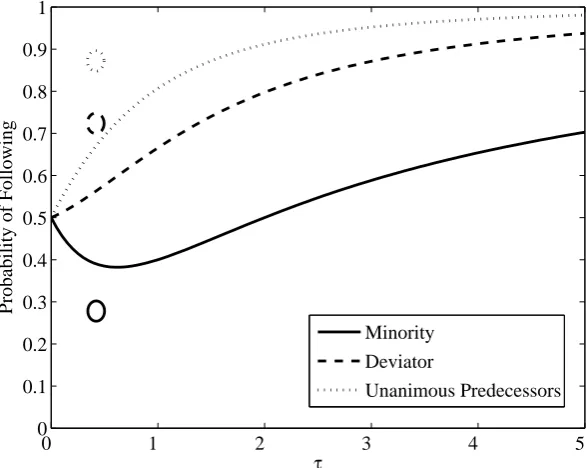
We find that informed subjects always follow their signal, i.e., they always pick
the correct option. On average, uninformed subjects tend to follow unanimous
pre-decessors close to 90% of the time both in treatments sequence and no-sequence.
Furthermore, the frequency with which unanimous predecessors are followed
signifi-cantly rises (to levels between 90% and 100%) as the number of predecessors grows.
This high percentage of rational choices is maybe not surprising given that the
deci-sion problem faced by an uninformed agent is relatively easy when all predecessors
agree. When there is a deviator in treatment sequence, subjects tend to follow the
deviator only 72% of the time. The frequency with which a deviator is followed is
significantly higher when the deviator’s choice belongs to the majority (80%) than
when it belongs to the minority of previous choices (58%). Finally, in treatment
no-sequence, subjects tend to follow the minority only 28% of the time. This
percent-age significantly declines when the difference between the number of majority and
minority choices grows.
While observed choices deviate from theoretical predictions, they are approximate
best responses to the empirical distribution of play in the following sense. Given
the choices of others, and given the signals used in the experiment, the cost of not
following unanimous predecessors in the experiment is $1.53 on average. Likewise, the
cost of not following a deviator in treatment sequence is $1.23 on average, and the cost
of not following the minority is −$0.36 on average. In other words, subjects who are (imperfect) profit maximizers would nearly always follow unanimous predecessors,
would more likely than not follow a deviator in treatment sequence (although not
as frequently as they would follow unanimous predecessors), and would follow the
majority in treatment no-sequence. The canonical model that captures this type of
imperfect maximization behavior is the (logit) QRE model. We show that, on an
aggregate level, logit-QRE is able to reproduce the main features of our data quite
well.
In the logit-QRE model, however, agents are assumed to be ex ante symmetric,
which is clearly not true in our data. While some subjects make rational choice in all
heterogeneity is captured by models that allow for different levels of strategic thinking,
such as the level-k model (e.g., Crawford and Iriberri 2007a, 2007b) and cognitive hierarchy (Camerer, et al. 2004). When we apply level-k and cognitive hierarchy to the data, we find they produce a worse fit both on an individual and aggregate level.
The reason for their poor performance is that these models subsume best response
behavior (given beliefs), except for level-0 who randomizes when uninformed. The
best-response assumption often conflicts with intuitive comparative statics observed
in the data, e.g., subjects tend to follow unanimous predecessors more frequently
when the group of predecessors is large. In addition, the best-response assumption
implies that a subject who mostly but not always makes a rational choice, is classified
as level-0 even though most of her choices suggest a higher level of thinking.
Goeree and Holt (2004) propose a “noisy introspection” model that blends the idea
of different levels of strategic thinking with noisy responses (trembling). In particular,
the noisy introspection model replaces the strict best responses of the level-k model with logit “better responses.” Importantly, agents in the noisy introspection model
are assumed to be aware that others tremble. For example, when computing the
probability that the minority choice is correct in treatment no-sequence, agents take
into account the possibility that the minority arose because of trembles. As a result,
the model can predict why subsequent choices favor the majority (not the minority)
even for agents with high levels of strategic thinking.
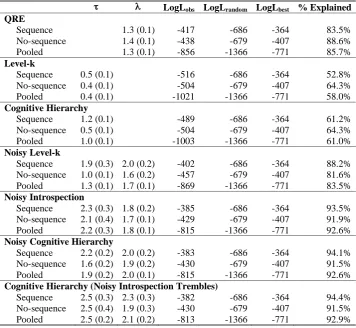
We find that the noisy introspection model provides a significant improvement in
fit relative to logit-QRE and a dramatic improvement relative to level-k and cogni-tive hierarchy. To illustrate the importance of the “common-knowledge-of-trembling”
assumption that underlies noisy introspection, we also estimate a noisy version of
the level-k model in which agents tremble but assume others do not. We find that the noisy level-k model provides a better fit than level-k and cognitive hierarchy, but does not do nearly as well as noisy introspection. We also estimate 2 versions of the
cognitive hierarchy model with trembles, one in which agents are aware that others
tremble and one in which they are not. Both of these models fit the data equally well
The chapter is organized as follows. In the next section, we briefly discuss the
theoretical predictions for the 2 treatments. The experimental design is presented in
section 3.3. The results of the experiment can be found in section 3.4. In section
3.5, we apply alternative models of bounded rationality to explain individual and
aggregate outcomes. Section 3.6 concludes.
3.2
Theoretical Predictions
Treatment sequence is a simple variant of the social learning model proposed by
Bikhchandani et al. (1992). There are 2 options, A and B, that are equally likely to be correct and a finite set ofnagents labeledt= 1,2, . . . , n. Each agent chooses either A or B after having observed a private signal st and the decisions of predecessors. Signals in the experiment are either fully informative or not informative at all: if
ω denotes the correct option then st = ω with probability q > 0 and st = ∅ with probability 1−q.
Given that some agents may be fully informed, the perfect Bayesian equilibria of
sequence treatment are easy to derive. First, an agent withst=ωchoosesω. Second, if all predecessors agree, then an uninformed agent follows the majority since either all
predecessors were uninformed and the agent is indifferent or some predecessors were
informed and the agent strictly prefers to follow the majority. Third, if predecessors
were not unanimous, i.e. choices switched from one option to the other, then the
first predecessor who “deviated” by not following her predecessors must have been
informed. In this case, the agent should follow the deviator. Note that all 3 cases can
be succinctly summarized as follows: under common knowledge of rationality,
unin-formed agents follow their immediate predecessor. Finally, if predecessors switched
from one option to the other and then switched back, play is off the equilibrium path.
In this case, the agent cannot infer anything from prior play and simply randomizes
when st=∅ and chooses ω when st =ω.