1
Me, myself and I: Non-collaborative customer behavior
in service outsourcing
–
the key role of outcome
orientation and outcome attributability
Torsten Steinbach
WHU Otto Beisheim School of Management
Carl Marcus Wallenburg
WHU Otto Beisheim School of Management
Kostas Selviaridis
Department of Management Science
Lancaster University Management School
To appear in the International Journal of Operations & Production Management
2
Me, myself and I: Non-collaborative customer behavior in service
outsourcing
–
the key role of outcome orientation and outcome
attributability
Abstract
Purpose: This research focuses on the role of customer behavior in service outsourcing rela-tionships that are governed by outcome-oriented contracts. It aims to explain how non-collab-orative customer behavior impedes the effectiveness of outcome-oriented contracts to align the goals and incentives of the customer and service provider, and leads to service provider opportunism.
Design/methodology/approach: Nine hypotheses are developed regarding customer behavior and the reaction of the service provider to this. These are tested using structural equation modelling with data from 213 service outsourcing relationships.
Findings: Outcome-orientated contracts in service outsourcing may have unintended conse-quences because they create value attribution ambiguity. This ambiguity induces non-collabo-rative customer behavior, which, in turn, results in service provider opportunism. This reveals a paradox, where customer behavior aimed at curbing service provider opportunism instead induces such opportunism. This chain of effects can be counteracted by increased outcome at-tributability, which reduces the ambiguity and, thus, the motivation for non-collaborative cus-tomer behavior.
3
1
Introduction
The successful outsourcing of business services requires effective governance of the customer–service provider (SP) relationship (Poppo and Zenger, 2002, Wacker et al., 2016). One approach to relationship governance is outcome-oriented contracting, which is used in an increasing range of business service outsourcing deals, both in private and public-sector set-tings (e.g., Caldwell and Howard, 2014, Essig et al., 2016). These contracts tie (at least part of) the payment of the SP to the customer’s desired outcomes (Kim et al., 2007). In this way they seek to align the goals and incentives of the two parties (Selviaridis and Spring, 2018) in order to prevent SP opportunism (Kim et al., 2007, Datta and Roy, 2011, Sumo et al., 2016b), which is known to reduce the performance of any business relationship (e.g., Williamson, 1985, Wathne and Heide, 2000), and specifically that of service outsourcing partnerships (Wang, 2002, Das, 2004).
However, empirical results regarding the implementation of outcome-oriented contracts are mixed. While some studies show that outcome-oriented contracts can lead to effective and efficient service provision (e.g., Datta and Roy, 2011, Sumo et al., 2016b), and mitigate op-portunism (Hypko et al., 2010a), other studies show that these contracts fail to align goals and incentives, and trigger SP opportunism (e.g., Shen, 2003, Selviaridis and Norrman, 2015). Overall, it is still unclear why, or why not, outcome-oriented contracts are effective in govern-ing service outsourcgovern-ing relationships.
4 Specifically, we argue that increasing outcome orientation in contracts (i.e., where a larger part of the payment is tied to the actual outcome) creates ambiguity regarding the ap-propriation of the value that is co-created by the customer and the SP in the outsourcing rela-tionship. We posit that this ambiguity will induce non-collaborative customer behavior to ap-propriate more of the co-created value and to prevent the SP from receiving payments (e.g., bonuses) that are disproportionate to its efforts. Such non-collaborative customer behavior (which we dissect into three distinct elements) is perceived by the SP as non-legitimate (Dunfee et al., 1999) and results in SP opportunism (Wallenburg and Schäffler, 2014). We further show that such negative relationship dynamics can be averted by the ability to clearly attribute outcomes to the input and effort of the involved parties (i.e., outcome attributability (Oflaç et al., 2012)), because this reduces ambiguity and limits the customer’s inclination to manifest non-collaborative behavior.
Based on data from 213 service outsourcing relationships, our results extend the exist-ing research on outcome-oriented contractexist-ing (e.g., Zu and Kaynak, 2012, Caldwell and Howard, 2014) by stressing the hitherto little-understood customer behavior under this con-tract type. The study also suggests that increasing outcome orientation in formal concon-tracts can undermine effective governance of outsourcing relationships (Wacker et al., 2016) in that it induces untrustworthy customer behavior.
2
Conceptual Framework
2.1 Outcome-oriented Contracts in Service Outsourcing
5 tasks according to the contractual specifications, since its preferences may be misaligned with the principal’s goals (Eisenhardt, 1989, Zu and Kaynak, 2012).
To address potential agent opportunism, the principal can choose behavior-oriented con-tracts, if agent behavior is observable and investment in behavior monitoring systems is effec-tive. Alternatively, when observability is limited, outcome-oriented contracts can be chosen to align interests and prevent hidden action (Eisenhardt, 1989), as these contracts tie the SP’s payment to the outcomes requested by the customer, thereby incentivizing the SP to achieve the customer’s goals (Kim et al., 2007).
Yet, empirical evidence regarding the effectiveness of such outcome-oriented contracts in governing service outsourcing relationships is mixed. Some studies are consistent with Agency Theory predictions, suggesting that outcome-oriented contracts result in alignment of goals and incentives (e.g., Ng et al., 2009, Datta and Roy, 2011, Sumo et al., 2016a), as attain-ing the specified outcomes is desirable for both the customer (as this improves the customer’s business) and the SP (because of receiving larger payments) (Martin, 2007).
Another research stream, however, points at the failure of outcome-oriented contracts in facilitating alignment, and the introduction of perverse incentives (see Selviaridis and
Wynstra, 2015). Such literature paints a bleak picture by focusing on the unintended conse-quences of outcome-oriented contracts in terms of inappropriate SP behavior and opportunism (Koning and Heinrich, 2013). SPs may misreport performance to avoid penalties and/or re-ceive bonus payments (Hypko et al., 2010a), exhibit “cherry-picking” behavior (i.e., avoiding “hard-to-serve” customers) (Shen, 2003), seek external insurance coverage against potential penalty payments (Zybell, 2013), or even intentionally reduce service effort where the costs of such effort outweigh the costs of failure or the extra revenue tied to outcome achievement (Selviaridis and Wynstra, 2015).
6 customer’s behavior has been neglected. This is perhaps not surprising, given that this litera-ture has mainly adopted an Agency Theory perspective that presents the customer as flawless principal and the SP as malicious agent requiring surveillance. Accordingly, the literature has stressed the importance of SP performance monitoring and management (e.g., Glas et al., 2018). In contrast, we emphasize the effects that outcome-oriented contracts have on the cus-tomer’s behavior. This focus is useful because co-production (and thus co-creation of value) is a key characteristic of service outsourcing that requires customer–SP collaboration (Randall et al., 2010, Ng et al., 2013). The customer plays an important role in service production and delivery, contributing critical input such as information and material resources (Sampson and Froehle, 2006).
2.2 Ambiguity in Outcome-oriented Service Contracts
The duality of the customer as recipient of the service and supplier of inputs has signifi-cant implications for outcome-oriented contracting in that the achievement of service out-comes depends not only on the SP’s inputs, but also on the quality of inputs provided by the customer (Sampson and Froehle, 2006). Thus, service co-production results in ambiguity con-cerning inputs (i.e., who is responsible for which inputs), as the interfaces between the actors are permeable (Sampson and Spring, 2012).
This input ambiguity is amplified in outcome-oriented contracts, with inputs being in-separable and contestable (Selviaridis, 2016b). Additionally, outcome-oriented contracts en-tail ambiguity regarding outcomes and their allocation, creating a value appropriation prob-lem. As payments are not fixed upfront, but rather depend on the outcome, it remains ambigu-ous until after service provision which exact outcome the SP will provide to the customer and how much the customer will actually pay to the SP (i.e., the financial outcome for the SP).
7 Aguilera, 2015) – is ambiguous with relation to both 1) the contribution (i.e., the inputs) of the SP and the customer to the achievement of co-produced outcomes, and 2) the legitimate claiming of the outcomes (Randall et al., 2010).
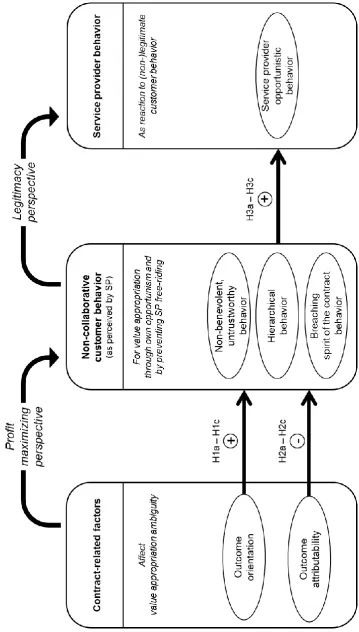
2.3 The Impact of Outcome Orientation and Outcome Attributability on Ambiguity Profit maximization by the customer, or as Cox (2001) formulates it, the desire to make money, puts the focus on value appropriation in the business relationship (Cox, 2001). Conse-quently, outcome orientation and outcome attributability, which both affect value appropria-tion ambiguity, will strongly impact customer behavior (see Figure 1): The larger this ambi-guity, the more it makes sense for the customer to try to appropriate more value itself and al-low less value appropriation by the SP (by preventing SP free-riding).
++++++_Insert_Figure_1_Approximately_Here_+++++++
2.3.1 Outcome Orientation
Agency Theory contrasts behavior- and outcome-oriented contracts (Eisenhardt, 1989). In practice, however, contract choice is hardly ever binary, and outcome orientation in service contracts is mostly a matter of degree (Hypko et al., 2010b). Outcome-oriented specifications may be used in combination with input- or process-oriented ones, stressing that appropriate provider behavior (Martin, 2007) and performance incentive fees (bonus/penalties) can form a smaller or larger share of the provider’s total compensation (Selviaridis and Wynstra, 2015). For the purposes of this study, outcome orientation is defined as the degree to which SP pay-ments are dependent on achievement of specified outcomes and, thus, determined ex post.
8 contingent on the actual outcome) and that the ambiguity increases in terms of who can legiti-mately claim (i.e., appropriate) the value co-created in the relationship (Randall et al., 2010). This conclusion may seem counterintuitive, as the underlying service contract exactly specifies which payment the SP will receive for each possible outcome. Yet, this specification cannot fully consider the inputs provided by the SP and the customer. It is possible that favor-able outcomes were reached because of the customer (e.g., the customer provided significant help to reach the outcomes) or in spite of the customer (e.g., the customer provided unfavora-ble service conditions by changing other interrelated processes). In the first case, the actual payment to the SP would be higher than the legitimate claim, and in the second case it would be lower. In both cases, the higher the share of variable payment, the higher the absolute dif-ference between what is contractually paid and what is legitimate compensation. Overall, this situation arises because of co-production and illustrates how stronger outcome orientation in-creases the value appropriation ambiguity.
2.3.2 Outcome Attributability
Outcome attributability refers to the transparency within the outsourcing relationship with regard to the locus of service-performance failures or achievements (Oflaç et al., 2012). High outcome attributability implies that outcomes are attributable to a specific party in-volved in service co-production, or to a specific (uncontrollable) outside factor influencing service delivery (Oflaç et al., 2012, Selviaridis, 2016b). Or to put it simply, it is clear (i.e., can be easily determined) who is responsible (and to what degree) for the achieved outcomes.
9 2016b). Furthermore, in such situations any unfavorable attribution of value can be chal-lenged more easily, given the high transparency over the locus of outcome achievement. Con-sequently, outcome attributability clarifies who is legitimized to appropriate the co-created value.
This, in turn, reduces the scope for opportunism and free-riding, as it is more difficult for the SP to reduce effort and still obtain financial benefits (e.g., bonuses) by relying on the customer’s contribution (Selviaridis and Norrman, 2014), as such behavior will be transparent to the customer. Conversely, the SP also feels more confident that it will not incur penalty payments for service delivery failures for which it is not responsible (Nullmeier et al., 2016).
2.4 Reaction to Ambiguity in Outcome-oriented Service Contracts
The value appropriation ambiguity has a strong behavioral impact. As the appropriated value is the difference between the benefits one party receives and the inputs it contributes in exchange, each party can try to influence the situation in its favor by reducing inputs to the value-creation process and by attempting to achieve more benefits from it. The customer can employ two general approaches to this: 1) behave opportunistically and therefore acquire more than the legitimate share of value; and 2) prevent the SP from free-riding and acquiring a larger share of value than is legitimate (i.e., not justified by the SP’s inputs and efforts).
10
Preventing free-riding refers to behavior whereby the customer takes action that disal-lows the SP to take advantage of the situation. The free-riding problem is created in co-pro-duction settings where the SP may opportunistically exploit the customer’s effort and receive full or even extra payment despite expending less-than-expected effort in achieving the con-tracted outcomes (Koning and Heinrich, 2013). This even leads to the paradoxical situation where a customer has to pay twice for its efforts: first, by using resources to support the ser-vice provision; and second, by paying more to the SP because of improved outcomes (result-ing from the customer’s efforts to support the SP). Naturally, the customer wants to safeguard itself against provider opportunism and avoid situations in which the provider obtains benefits undeservedly (Datta and Roy, 2011).
Putting effort into the two approaches that influence the value appropriation (i.e., own opportunism and preventing free-riding) only makes sense for the customer if the share of un-allocated value is significant, and it becomes more attractive the larger the corresponding am-biguity is. Consequently, we conclude that the larger the value appropriation amam-biguity, the more intensive the customer’s efforts will be to influence value appropriation via own oppor-tunism and preventing SP free-riding.
2.5 Mechanisms to Deal with Ambiguity
Our research posits that the customer tries to maximize its value appropriation from ser-vice outsourcing by employing three mechanisms for its own opportunism and to prevent SP free-riding. These are all non-collaborative in nature: 1) exhibiting a non-benevolent, untrust-worthy behavior toward the SP; 2) acting more hierarchically and limiting SP autonomy; and 3) breaching the spirit of the outsourcing contract.
2.5.1 Non-benevolent, Untrustworthy Customer Behavior
11 2014). According to Social Exchange Theory (SET), informal, social relations are embedded in economic exchanges (Granovetter, 1985, Griffith et al., 2006), thus creating a complex tan-gle of formal and informal governance mechanisms (Cao and Lumineau, 2015). SET empha-sizes the development and preservation of trust (e.g., Heide, 1994, Lusch and Brown, 1996) as a key relational mechanism, where trust is defined as “the confidence or belief that [a com-pany] possesses about the honesty and benevolence of other partners” (Liu et al., 2009, p. 296). In other words, trusting a partner means believing that this partner has no intention to cheat or defect, that it will behave benevolently (Nooteboom et al., 1997), and is genuinely concerned about its exchange partner, which is a key element of a collaborative working rela-tionship (Doney and Cannon, 1997, Hill et al., 2009). Based on this notion, we focus on how benevolently the customer behaves as basis for the SP judging the customer’s trustworthiness.
In service outsourcing, trustworthiness-as-benevolence translates to a customer refrain-ing from opportunistic behavior (Gulati, 1995, Puranam and Vanneste, 2009), considerrefrain-ing the goals and the success of the SP, and treating the SP fairly. For example, the customer provides accurate and timely demand forecasts, knowing the importance of this information for the SP’s operational planning (e.g., staffing throughout the week).
When a customer tries to opportunistically exploit the ambiguity and to appropriate more value than legitimate, it manifests non-benevolent, untrustworthy behavior. The cus-tomer does so by reducing its inputs and by disregarding the provider’s interests when making decisions, instead putting its own interests first to appropriate a larger share of value. A less benevolent customer also acts in a way that prevents (or at least reduces) free-riding by the SP.
12 which it would have to exert more effort with a less benevolent customer). Consequently, be-nevolent customer behavior has the potential to backfire, when the customer effectively pays double by paying for the resources necessary to support the SP, and by paying the SP for achieving the predefined outcome levels.
Larger value appropriation ambiguity resulting from increased outcome orientation ren-ders opportunistic, non-benevolent behavior more appealing to the customer. As such behav-ior allows the customer to appropriate more value, the customer will be more inclined to ex-hibit such opportunistic behavior the more it can gain by it. The larger the ambiguity (as a re-sult of increased outcome orientation), the more this is the case. Thus, we can conclude that increasing outcome orientation leads to non-benevolent, untrustworthy customer behavior.
This effect of outcome orientation is counteracted by outcome attributability. High lev-els of outcome attributability reduce ambiguity, as outlined earlier. As such, outcome attribut-ability makes non-benevolent, opportunistic customer behavior less interesting because it re-duces the share of the total value that is contestable, as inputs of both parties become highly transparent (Selviaridis, 2016b). In other words, in cases where it is easy to attribute con-tracted outcomes to the inputs and efforts of the customer and SP (Oflaç et al., 2012), the cus-tomer will find it less appealing to focus on its own interests, as the potential for increasing its own benefits is limited. Instead, the customer can now exhibit more benevolent, trustworthy behavior that cannot be exploited by the SP. Thus, we hypothesize:
H1a:Outcome orientation in outsourcing increases non-benevolent, untrustworthy
cus-tomer behavior.
H2a:Outcome attributability in outsourcing reduces non-benevolent, untrustworthy
13
2.5.2 Customer Hierarchical Behavior
One core idea of outcome-oriented contracting is that only outcomes, and not the pro-cesses and inputs necessary to achieve those outcomes, are specified (Bernheim and
Whinston, 1998, Sumo et al., 2016a). In other words, the provider is granted autonomy re-garding the design and execution of the outsourced service (Sumo et al., 2016a) and has free-dom during the day-to-day operations of the service delivery to choose which activities to en-gage in and which resources to use (Johnson and Medcof, 2007, Wang et al., 2011). The un-derlying logic is that the customer does not focus on the provider’s behavior (i.e., the pro-cesses carried out for service provision), but only on the outcome. Service improvements are facilitated insofar as the provider has leeway in service provision decisions and can make the most of its expertise and creativity to achieve the specified outcomes (Martin, 2007).
At the same time, specifying only the outcomes of service provision reduces the cus-tomer’s control and creates potential for opportunistic SP behavior to appropriate more value. To counter such loss of control and to prevent free-riding, the customer may limit the SP’s au-tonomy and choose hierarchical behavior toward the SP, giving clear directives regarding ser-vice provision during contract execution. Such hierarchical (non-collaborative) customer be-havior is characterized by inequality of the actors, where the customer is the superordinate, controlling the SP and restricting its autonomy (Diefenbach and Sillince, 2011). The customer does not view the SP as an equal business partner and does not integrate it when making deci-sions, rather imposing directives and constraints (Zybell and Wallenburg, 2017). This runs counter to a collaborative relationship between companies.
14 more opportunities to exploit the SP (e.g., the customer specifies that data analysis for perfor-mance-related payments is only conducted on its own system). Hierarchical behavior is an ad-versarial action to seize a larger share of the value at the cost of the SP (Kim and Choi, 2015). It helps the customer to create more opportunities to exploit the SP and to capitalize on those opportunities, effectively forcing the SP to subscribe to the customer’s rules. This effect is amplified, as hierarchical customer behavior often involves a submissive mindset of the SP, leading to limited questioning of customer actions (Zybell and Wallenburg, 2017).
As hierarchical behavior prevents provider free-riding and potentially allows the cus-tomer to appropriate more value, the cuscus-tomer will be more inclined to exhibit this behavior the more it can gain by it. The larger the value appropriation ambiguity (as a result of in-creased outcome orientation), the more this is the case. Thus, we can conclude that inin-creased outcome orientation leads to more hierarchical customer behavior.
In contrast, outcome attributability reduces hierarchical customer behavior, because it reduces ambiguity, as outlined earlier. This makes hierarchical behavior less interesting be-cause the share of the contestable value is reduced, as the inputs of both parties and their link to outcomes are highly transparent (Oflaç et al., 2012, Selviaridis, 2016b). Thus, the potential for the customer to increase its own value appropriation through hierarchical behavior is lim-ited. Instead, the customer can revert to less hierarchical behavior, granting more autonomy to the SP, consistent with the principal logic of outcome-oriented contracting (Sumo et al., 2016a). Thus, we hypothesize:
H1b:Outcome orientation in outsourcing increases hierarchical customer behavior.
15
2.5.3 Customer Breaching the Spirit of the Contract
The contracting literature has long pointed out that any contract intended to govern a complex transaction will be incomplete (Hart and Moore, 1999). No formal contract can spec-ify all potential situations and be understood without reference to the broader business rela-tionship within which it is agreed and executed (Selviaridis, 2016a). The reference to the ‘business relationship’ recognizes the importance of social relations, collaboration norms, trust and expectations that complement the formal rights and obligations emanating from the written legal documents (Collins, 1999). As such, any contract, in addition to the spelled-out terms, entails a spirit of what was intended when the exchange partners agreed to the business relationship (Collins, 1999). This spirit is specific to the individual relationship and based on a mutual understanding of the two parties regarding the relationship’s function and intentions. It entails unwritten promises and obligations that go beyond the letter of the contract.
Customer breaching the spirit of the contract is defined as the extent to which the cus-tomer acts against these unwritten promises and obligations, which does not necessitate vio-lating the explicit clauses in the contract. In some cases the opposite is true, by insisting on the letter of the contract in order to legally, but not legitimately, appropriate value
(Williamson, 2008). Breaching the spirit of the contract can be considered highly non-collab-orative, as it violates the principles of any transaction and undermines trustworthiness.
16 stronger position when many providers are available. Then, the customer can reshape the rules of the relationship and address the situations where SP free-riding is expected.
As Williamson (2008) points out, breaching the spirit of the contract is more likely when the stakes are higher and the customer can gain more from such behavior. This is the case with increasing outcome orientation, which augments the value appropriation ambiguity and the stakes within the relationship (i.e., more to gain, but also more to lose). Consequently, we conclude that outcome orientation has a positive effect on breaching the spirit of the con-tract, as it increases the customer’s potential to appropriate value by such behavior.
Moreover, here outcome attributability serves as antagonist to the customer’s inclination to breach the spirit of the contract to benefit from a favorable interpretation of the contractual terms and conditions at the expense of the SP. There are two reasons for this. First and fore-most, outcome attributability reduces the potential gain from such behavior, as it diminishes the ambiguity, as outlined earlier. As such, attributability fully (or at least partially) removes the incentive for non-collaborative customer behavior. Second, attributability of outcomes plays an important role during contract execution in outcome-oriented contracts whose design hardly ever specifies (contractually) the expected inputs, roles, and behavior of the customer in service provision, hence offering significant room for interpretation of contractual terms (Selviaridis and Norrman, 2014, Nullmeier et al., 2016). High levels of outcome attributability will increase transparency regarding the cause-and-effect-relationships in service delivery and therefore make it more difficult for customers to hide behind opaque external factors that are arguably the reason for deviations. Based on the above, we hypothesize:
H1c: Outcome orientation in outsourcing increases customer breaching the spirit of the contract.
H2c: Outcome attributability in outsourcing decreases customer breaching the spirit of
17 2.6 Perception of Non-Collaborative Customer Behavior Induces SP Opportunism
One objective of outcome-oriented contracting is to limit SP opportunism (Hypko et al., 2010a). Yet, as argued in the following, based on Social Contract Theory (Dunfee et al., 1999), the three mechanisms that the customer employs to deal with value appropriation am-biguity in outcome-oriented contracting actually induce SP opportunism.
Social Contract Theory (Dunfee et al., 1999) builds on social contracts that are not le-gally binding but refer to a common understanding of a larger group, and are defined as “norms, assumptions, and beliefs that [companies] conceive as fair and appropriate [i.e., legit-imate] for parties involved in [outcome-based contracting] relationships” (Edwards and Karau, 2007, p. 67). As such, companies have an understanding (i.e., a social contract) of what is generally legitimate in a relationship and what is not. In contrast to the spirit of the contract and partner-related expectations regarding benevolent, trustworthy behavior, social contracts are not specific to the individual relationship between company A and B, but apply in the same way to all business relationships. Customer behavior experienced by the SP that is not endorsed by a social contract, or put differently, has no general legitimization, will – ac-cording to Social Contract Theory – lead to SP “reactance” and increased, rather than re-duced, SP opportunism (Heide et al., 2007, Wallenburg and Schäffler, 2014).
All three mechanisms (non-benevolent, untrustworthy behavior; hierarchical behavior; and breaching the contract’s spirit) can be considered not only non-collaborative, but also non-legitimate customer behavior from the SP’s perspective.
18 compared to simple service transactions. Therefore, the stronger the non-benevolent, untrust-worthy customer behavior, the less legitimate it will be from a SP’s perspective.
The same holds true for customer hierarchical behavior. Outcome-oriented contracts generally specify desired outcomes rather than required processes and input (Bernheim and Whinston, 1998, Sumo et al., 2016a). In other words, outcome-oriented contracting grants the SP autonomy regarding service design and execution, which enables the SP to make the most of its expertise and creativity (Sumo et al., 2016a). Consequently, exhibiting hierarchical be-havior in outcome-based contracting is not legitimate, and the more hierarchical the bebe-havior, the less legitimate it will be perceived by the SP.
Adhering to the spirit of the contract is deemed important in the execution of the con-tract (Sumo et al., 2016a) and is expected by any party in any concon-tractual setting. Because of the incomplete nature of the contract (Hart and Moore, 1999), what exactly constitutes a breach of the contract’s spirit can be subject to discussion. Yet, with respect to the SP’s ac-tions, only the subjective SP perception matters, as it will judge the customer’s behavior and act according to its judgment.
As all three customer behaviors are illegitimate, they will, according to Social Contract Theory, lead to reactance and increase SP opportunism (Wallenburg and Schäffler, 2014):
H3a: Non-benevolent, untrustworthy customer behavior increases SP opportunism.
H3b: Hierarchical customer behavior increases SP opportunism.
H3c: Customer breaching the spirit of the contract increases SP opportunism.
3
Methodology
3.1 Sampling and Data Collection
19 only the SP can validly report on the opportunism it exhibits, which is non-observable for its customer. Further, we chose to analyze the hypotheses across SPs to provide generalizable findings for the whole industry that are independent from idiosyncrasies of individual SPs. The alternative would have been to view a wide array of different customer relationships of one SP (a within-company analysis) to fully control for potential differences across SPs.
Each respondent answered the survey for one specific relationship with one of its business customers, which they chose based on two requirements: the respondents had detailed knowledge of the relationship; and the business customer was relevant to the LSP (to exclude insignificant customers).
The total sample comprised 2,203 contacts from a university database on German LSPs, which is a good representation of the underlying population of small, medium, and large LSPs. We received 231 responses, a satisfactory response rate of 10.49 per cent (Harman, 1976, Wagner and Kemmerling, 2010, Ralston et al., 2015). Due to missing data, 18
questionnaires were discarded. 73.4 percent of responses came from small and medium sized LSPs with fewer than 1,000 employees. The customers come from a broad range of industries, the largest being consumer goods and food (23.0%), automotive and aviation (20.7%),
chemicals, pharmaceuticals and health care (18.8%), industrial goods and machinery (17.4%).
3.2 Measurements
20 Likert scale statements anchored “1 = strongly disagree” and “7 = strongly agree” (see
Appendix).
Outcome orientation. The literature does not provide a scale to measure the intensity of outcome orientation. Therefore, a new 5-item scale was developed reflecting the degree to which the actual payment, as specified in the contract, depends on the generated outcomes, and to what extent bonuses and penalties are incorporated.
Outcome attributability. While the concept of attributability has been extensively discussed in the outcome-oriented contracting literature (e.g., Selviaridis and Norrman, 2014, Nullmeier et al., 2016), so far, no corresponding measurement exists. The new 5-item measurement builds on the extant literature and captures how easily problems, performance deviations and performance improvements can be attributed to one of the involved parties, and how transparent the dependencies between these parties are.
Non-benevolent, untrustworthy customer behavior. This construct is based on the work of Doney and Cannon (1997) and captures the benevolence domain of trust. It was adapted to the specific industry context of the study and one item was added from Hofer et al. (2012) to capture whether the customer treats the provider fairly. Hierarchical customer behavior. For this construct, we developed a 5-item scale measuring the extent to which the customer limits the SP’s autonomy and, from a superior position, gives instructions that the provider follows without questioning. Customer breaching the spirit of the contract. As no adequate measure-ment existed, a 5-item scale was developed assessing whether the customer acts according to the initial intention of the contract, or deviates, for example, by interpreting terms differently than intended.
21 effectiveness was included as alternative outcome. It was measured based on Ruekert and Walker Jr (1987) whose scale has been adapted to the LSP context by Hofenk et al. (2011).
Controls. For control purposes, the following variables were included in the model: SP size (i.e., number of employees); customer size relative to the SP; familiarity of the SP with the customer requirements; and outsourcing experience of the customer.
3.3 Reliability and Validity
Non-response bias was assessed by t-testing between early and late respondents (Armstrong and Overton, 1977). The analysis yielded no significant differences at p < 0.05, suggesting that nonresponse bias was not of concern for this study (Lambert and Harrington, 1990, Wagner and Kemmerling, 2010). Regarding common method bias (CMB), we took preventative measures during data collection, and retrospective measures applying statistical tests. We ensured respondents’ anonymity and clarified that no wrong responses to survey questions existed (Podsakoff et al., 2003). After data collection, we applied Harman’s single-factor test and used a marker variable to assess potential CMB. Harman’s single-single-factor test showed that 32.8 percent of the variance can be explained by a single factor (Harman, 1976). Following Lindell and Whitney (2001), we calculated Pearson’s correlation coefficients between the marker variable “profit growth in comparison to competitors” and the other variables in the model, and did not find any significant correlations at p < 0.05. All test results suggest that common method bias was not of concern for this study.
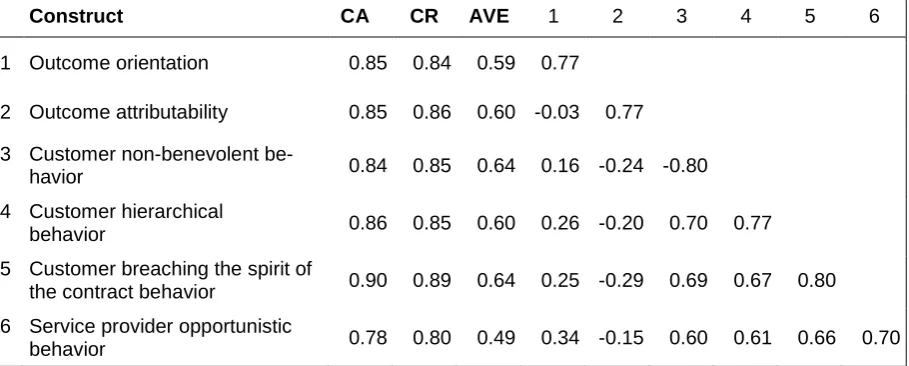
All values for Cronbach’s Alpha (Nunnally, 1978) and composite reliability (Bagozzi and Yi, 1988) for the purified scales exceeded 0.7 (Table 1), indicating high reliability (Hair et al., 2010). A confirmatory factor analysis was conducted to assess convergent and
22 Convergent validity was assessed by analyzing standardized factor loadings and the average variance extracted (AVE). All factor loadings fell into the acceptable or desirable range (Hair et al., 2010). Furthermore, all AVEs exceeded the commonly accepted threshold of 0.5 (Fornell and Larcker, 1981); only the provider opportunistic behavior scale was slightly below, at 0.49. However, all other AVE and composite reliability values suggested acceptable validity of the model.
Discriminant validity was assessed via the Fornell-Larcker criterion (Fornell and Larcker, 1981). Table 1 shows the square root of the AVE on the diagonal, which exceeded all the inter-construct correlations provided in the corresponding rows and columns,
indicating discriminant validity (Fornell and Larcker, 1981, Hair et al., 2010).
++++++_Insert_Table_1_Approximately_Here_+++++++
4
Results
The hypotheses were tested via structural equation modeling in a multi-stage approach using AMOS 24 with maximum likelihood estimation. Covariance-based structural equation modeling is especially appropriate in cases such as ours, where the focus is on testing a hypothesized causal model that entails latent variables (Hair et al., 2012, Hair et al., 2017).
In the first step, a controls only model was tested, where only the four controls were tested as antecedents to SP opportunism in order to establish a baseline. This model had sufficient fit, but only very low explanatory power (R² = 2.3%), indicating that the controls alone are only responsible for 2.3 percent of the experienced differences in SP opportunism.
23 In the third step, the hypothesized model was tested with the three customer behavior constructs added as mediators. This change led to a substantial increase in explanatory power by 43.1 percentage points to 57.8 percent, indicating that this model is highly superior in explaining SP opportunism compared to the model without mediating variables.
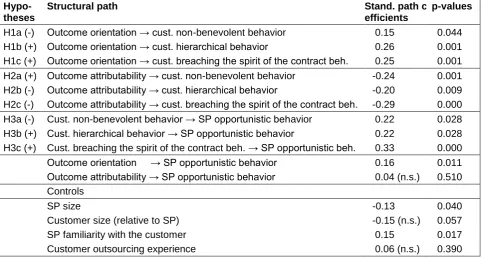
The fit for the model with the mediators was adequate: χ²/df = 1.80, CFI = 0.91, TLI = 0.90, RMSEA = 0.061 and SRMR = 0.074, allowing conclusions regarding the hypotheses. The statistical results presented in Table 2 support all nine hypotheses. Outcome orientation significantly increases customer non-benevolence (0.15), customer hierarchical behavior (0.26) and breaching the spirit of the contract (0.25), supporting hypotheses H1a to H1c. Out-come attributability has a significant counter-effect on customer non-benevolence (-0.24), customer hierarchical behavior (-0.20) and breaching the spirit of the contract (-0.29), sup-porting hypotheses H2a to H2c. We also found that all three types of non-collaborative cus-tomer behavior significantly increase provider opportunistic behavior (with standardized path coefficients of 0.22, 0.22, and 0.33 respectively), supporting hypotheses H3a to H3c.
++++++_Insert_Table_2_Approximately_Here_+++++++
In a fourth step, the robustness of the proposed model with respect to context-dependency was tested via multi-group analysis. Potential moderating effects of different variables were tested via chi-square difference tests where the path coefficients were restricted to be equal in both sub-groups. In all cases the path coefficients were not
24 As further test of the robustness of the conceptual model, we analyzed the model with relationship effectiveness (i.e., how effectively the two parties are working together) – as judged by the LSP – as an alternative outcome measure instead of SP opportunism. This model has a similar fit: χ²/df = 1.67, CFI = 0.94, TLI = 0.93, RMSEA = 0.056 and SRMR = 0.071 and shows customer non-collaborative behavior also to have a negative effect on relationship effectiveness. Further, the model exhibited substantial explanatory power (R² = 61%). This emphasizes the central role of customer behavior in the effectiveness of outcome-oriented contracts.
5
Discussion
5.1 Results Interpretation and Research Implications
The results of the study extend existing research by stressing that the customer’s behav-ior undermines the effectiveness of outcome-oriented contracts to align customer and SP goals and incentives and, thus, to prevent SP opportunism. Contrary to the focus of the extant literature on SP behavior and potential opportunism (e.g., Hypko et al., 2010b, Zu and
Kaynak, 2012, Sumo et al., 2016b), our research highlights non-collaborative customer be-havior to be a main source of ineffectiveness in outcome-oriented contracting by serving as a key mediator between the degree of outcome orientation in contracts and SP opportunism. This is underscored by the substantial increase in R² from 14.7 to 57.8 percent when including the mediating variables, and the fact that the results show to be independent of different con-textual variables.
25 2006). As outcome orientation in contracts increases, customers exhibit non-collaborative be-havior to appropriate a higher share of the value from the outsourcing relationship through their own opportunism and by preventing the SP from free-riding and receiving rewards that are not proportionate to the expended effort. Consistent with Social Contract Theory, this cus-tomer behavior, which is not only non-collaborative but also non-legitimate, in turn, leads to SP opportunistic behavior.
These results also reveal a paradox: customer behavior that is intended to curb SP free-riding (e.g., via detailed specifications and work instructions) instead appears to induce SP opportunistic behavior. This paradox adds to the existing literature by stressing the customer’s egoistic, untrustworthy behavior. The role of the customer’s behavior has been downplayed in extant research, which suggests that inappropriate contract design (leading to perverse incen-tives) is the main reason why outcome-oriented contracts may result in SP opportunism and win–lose, or even lose–lose, outsourcing relationships (Koning and Heinrich, 2013,
Selviaridis and Wynstra, 2015). Relating to Kim and Choi's (2015) supplier relationship ty-pology, we find that outcome-oriented contracting may lead to a “sticky relationship” – a close but adversarial relationship, where the more powerful party (customer) must, because of its own actions, be cautious of the opportunism of the weaker party (SP).
26 behavior (e.g., breaching the spirit of the contract), which in turn tends to attenuate the SP’s opportunism.
These results also underscore a positive role of outcome attributability in relation to the effectiveness of outcome-oriented contracts. This is different from existing research focusing on the negative connotations of outcome attributability with respect to the adoption and suc-cessful implementation of outcome-oriented contracts (see Nullmeier et al., 2016), for exam-ple, outcome attributability-related challenges contributing to SP reluctance to bear the finan-cial risks induced by outcome-oriented contracts (Selviaridis and Norrman, 2014).
Finally, our study contributes to the literature on the interplay of contractual and rela-tional governance mechanisms (e.g., Roehrich and Lewis, 2014, Cao and Lumineau, 2015, Wacker et al., 2016) by highlighting that increasing outcome orientation in formal contracts is detrimental to benevolent customer behavior and trust (Nooteboom et al., 1997), which is a vital element in this type of contract (see Ng et al., 2009). We find that (increasing) outcome orientation in contracts results in the customer manifesting non-benevolent, untrustworthy be-havior, and breaching the spirit of the contract. This is unlike a customer behavior which, in line with SET, would emphasize trust development (Liu et al., 2009). Thus, our study sug-gests that outcome-orientation as a formal contractual governance element hinders, rather than complements trust (Puranam and Vanneste, 2009) and can undermine effectiveness in out-sourcing relationships (Wacker et al., 2016).
5.2 Managerial Implications
27 opportunism. Investing in and nurturing trust and collaborative behavior via a different mana-gerial mindset (Zybell and Wallenburg, 2017) would potentially help to counter some of the challenges associated with increasing outcome orientation in formal contracts (see also Roehrich and Lewis, 2014).
Another lever to prevent negative relationship dynamics is outcome attributability, which is found to be a key counteracting factor to non-collaborative customer behavior. This implies that customer and SP managers should strive for high outcome attributability to foster a collaborative relationship and minimize potential opportunism. This can be done, for in-stance, by investing in detailed performance measurement systems that clearly monitor the causes of service delivery failures and achievements, as well as the service inputs contributed by each relevant party.
From a SP perspective, understanding the rationale for non-collaborative customer be-havior helps to be selective in terms of which customers are suitable for outcome-oriented contracts. Customers exhibiting collaborative behavior should be prioritized, as it is more likely that outcome-oriented service contracts will be effective with this type of customer.
5.3 Limitations and Further Research
This paper provides important insights into (non-collaborative) customer behavior and its role in relation to the effectiveness of outcome-oriented contracts in service outsourcing. However, the study has certain limitations that should be addressed through further research.
28 Second, as our data were collected in Germany only, the results might not reflect out-sourcing relationship dynamics in other cultural contexts. In addition, our study focuses on lo-gistics services. Although this industry serves as a suitable example to study the effectiveness of outcome-oriented contracts, and hence we expect our results to be highly transferable to other types of business service featuring powerful customers, future empirical studies cover-ing multiple service industries and countries would increase the generalizability of the find-ings.
Third, this study relies on the SP perspective. Therefore, it was only possible to consider the customer behavior as it was perceived by the SP. Here, it would be fruitful to also con-sider the customer perspective and investigate to which extent the customer is actually aware of how its behavior is perceived. In addition, the study is limited in that data was cross-sec-tional. As such, it is unclear how quickly the perception of non-collaborative customer behav-ior leads the SP to behave opportunistically. To address these limitations, we encourage quali-tative research designs utilizing longitudinal case studies or interview studies. These would allow deepening the understanding of the role of contracting with respect to customer-SP rela-tionship dynamics and would complement the survey results by triangulating findings and en-hancing their validity, thereby alleviating typical concerns regarding single-respondent sur-veys.
29
References
Armstrong, J.S. & Overton, T.S. (1977), "Estimating nonresponse bias in mail surveys",
Journal of Marketing Research, Vol. 14 No. 3, pp. 396-402.
Bagozzi, R.P. & Yi, Y. (1988), "On the evaluation of structural equation models", Journal of the Academy of Marketing Science, Vol. 16 No. 1, pp. 74-94.
Bernheim, B.D. & Whinston, M.D. (1998), "Incomplete contracts and strategic ambiguity",
American Economic Review, Vol. 88 No. 4, pp. 902-932.
Caldwell, N. & Howard, M. (2014), "Contracting for complex performance in markets of few buyers and sellers: The case of military procurement", International Journal of Operations & Production Management, Vol. 34 No. 2, pp. 270-294.
Cao, Z. & Lumineau, F. (2015), "Revisiting the interplay between contractual and relational governance: A qualitative and meta-analytic investigation", Journal of Operations Management, Vol. 33-34 No. January, pp. 15-42.
Collins, H. (1999), Regulating contracts, Oxford University Press, Oxford.
Cox, A. (2001), "The power perspective in procurement and supply management", Journal of Supply Chain Management, Vol. 37 No. 1, pp. 4-7.
Das, T. (2004), "Time-span and risk of partner opportunism in strategic alliances", Journal of Managerial Psychology, Vol. 19 No. 8, pp. 744-759.
Datta, P.P. & Roy, R. (2011), "Operations strategy for the effective delivery of integrated industrial product-service offerings: Two exploratory defence industry case studies",
International Journal of Operations & Production Management, Vol. 31 No. 5, pp. 579-603.
Diefenbach, T. & Sillince, J.A. (2011), "Formal and informal hierarchy in different types of organization", Organization Studies, Vol. 32 No. 11, pp. 1515-1537.
Doney, P.M. & Cannon, J.P. (1997), "An examination of the nature of trust in buyer-seller relationships", Journal of Marketing, Vol. 61 No. 2, pp. 35-51.
Dunfee, T.W., Smith, N.C. & Ross Jr, W.T. (1999), "Social contracts and marketing ethics",
Journal of Marketing, Vol. 63 No. 3, pp. 14-32.
Dunn, S.C., Seaker, R.F. & Waller, M.A. (1994), "Latent variables in business logistics research: Scale development and validation", Journal of Business Logistics, Vol. 15 No. 2, pp. 145-172.
Edwards, J.C. & Karau, S.J. (2007), "Psychological contract or social contract? Development of the employment contracts scale", Journal of Leadership & Organizational Studies,
Vol. 13 No. 3, pp. 67-78.
Eisenhardt, K.M. (1989), "Agency Theory: An assessment and review", Academy of Management Review, Vol. 14 No. 1, pp. 57-74.
Essig, M., Glas, A.H., Selviaridis, K. & Roehrich, J.K. (2016), "Performance-based contracting in business markets", Industrial Marketing Management, Vol. 59 No. November 2016, pp. 5-11.
Fornell, C. & Larcker, D.F. (1981), "Evaluating structural equation models with unobservable variables and measurement error", Journal of Marketing Research, Vol. 18 No. 1, pp. 39-50.
Garcia‐Castro, R. & Aguilera, R.V. (2015), "Incremental value creation and appropriation in a world with multiple stakeholders", Strategic Management Journal, Vol. 36 No. 1, pp. 137-147.
Glas, A.H., Henne, F.U. & Essig, M. (2018). Missing performance management and
30 Granovetter, M. (1985), "Economic action and social structure: The problem of
embeddedness", The American Journal of Sociology, Vol. 91 No. 3, pp. 481-510. Griffith, D.A., Harvey, M.G. & Lusch, R.F. (2006), "Social exchange in supply chain
relationships: The resulting benefits of procedural and distributive justice", Journal of Operations Management, Vol. 24 No. 2, pp. 85-98.
Gulati, R. (1995), "Does familiarity breed trust? The implications of repeated ties for
contractual choice in alliances", Academy of Management Journal, Vol. 38 No. 1, pp. 85-112.
Hair, J.F., Black, W.C., Babin, B.J. & Anderson, R.E. (2010), Multivariate data analysis: A global perspective, Pearson, Upper Saddle River, N.J.
Hair, J.F., Hult, G.T.M., Ringle, C.M., Sarstedt, M. & Thiele, K.O. (2017), "Mirror, mirror on the wall: a comparative evaluation of composite-based structural equation modeling methods", Journal of the Academy of Marketing Science, Vol. 45 No. 5, pp. 616-632. Hair, J.F., Sarstedt, M., Ringle, C.M. & Mena, J.A. (2012), "An assessment of the use of
partial least squares structural equation modeling in marketing research", Journal of the Academy of Marketing Science, Vol. 40 No. 3, pp. 414-433.
Harman, H.H. (1976), Modern factor analysis, University of Chicago Press, Oxford.
Hart, O. & Moore, J. (1999), "Foundations of incomplete contracts", The Review of Economic Studies, Vol. 66 No. 1, pp. 115-138.
Heide, J.B. (1994), "Interorganizational governance in marketing channels", Journal of Marketing, Vol. 58 No. 1, pp. 71-85.
Heide, J.B., Wathne, K.H. & Rokkan, A.I. (2007), "Interfirm monitoring, social contracts, and relationship outcomes", Journal of Marketing Research, Vol. 44 No. 3, pp. 425-433. Hill, J.A., Eckerd, S., Wilson, D. & Greer, B. (2009), "The effect of unethical behavior on
trust in a buyer–supplier relationship: The mediating role of psychological contract violation", Journal of Operations Management, Vol. 27 No. 4, pp. 281-293.
Hofenk, D., Schipper, R., Semeijn, J. & Gelderman, C. (2011), "The influence of contractual and relational factors on the effectiveness of third party logistics relationships",
Journal of Purchasing & Supply Management, Vol. 17 No. 3, pp. 167-175. Hofer, A.R., Knemeyer, A.M. & Murphy, P.R. (2012), "The roles of procedural and
distributive justice in logistics outsourcing relationships", Journal of Business Logistics, Vol. 33 No. 3, pp. 196-209.
Hypko, P., Tilebein, M. & Gleich, R. (2010a), "Benefits and uncertainties of performance-based contracting in manufacturing industries: An agency theory perspective", Journal of Service Management, Vol. 21 No. 4, pp. 460-489.
Hypko, P., Tilebein, M. & Gleich, R. (2010b), "Clarifying the concept of performance-based contracting in manufacturing industries: A research synthesis", Journal of Service Management, Vol. 21 No. 5, pp. 625-655.
Johnson, W.H. & Medcof, J.W. (2007), "Motivating proactive subsidiary innovation: Agent-based theory and socialization models in global R&D", Journal of International Management, Vol. 13 No. 4, pp. 472-487.
Kim, S.-H., Cohen, M.A. & Netessine, S. (2007), "Performance contracting in after-sales service supply chains", Management Science, Vol. 53 No. 12, pp. 1843-1858. Kim, Y. & Choi, T.Y. (2015), "Deep, sticky, transient, and gracious: An expanded buyer–
supplier relationship typology", Journal of Supply Chain Management, Vol. 51 No. 3, pp. 61-86.
31 Koning, P. & Heinrich, C.J. (2013), "Cream‐skimming, parking and other intended and
unintended effects of high‐powered, performance‐based contracts", Journal of Policy Analysis and Management, Vol. 32 No. 3, pp. 461-483.
Lambert, D.M. & Harrington, T.C. (1990), "Measuring nonresponse bias in customer service mail surveys", Journal of Business Logistics, Vol. 11 No. 2, pp. 5-25.
Lindell, M.K. & Whitney, D.J. (2001), "Accounting for common method variance in cross-sectional research designs", Journal of Applied Psychology, Vol. 86 No. 1, pp. 114-121.
Liu, Y., Luo, Y. & Liu, T. (2009), "Governing buyer–supplier relationships through transactional and relational mechanisms: Evidence from China", Journal of Operations Management, Vol. 27 No. 4, pp. 294-309.
Lusch, R.F. & Brown, J.R. (1996), "Interdependency, contracting, and relational behavior in marketing channels", Journal of Marketing, Vol. 60 No. 4, pp. 19-38.
Martin, L.L. (2007), "Performance-based contracting for human services: A proposed model",
Public Administration Quarterly, Vol. 31 No. 1, pp. 130-158.
Ng, I.C., Ding, D.X. & Yip, N. (2013), "Outcome-based contracts as new business model: The role of partnership and value-driven relational assets", Industrial Marketing Management, Vol. 42 No. 5, pp. 730-743.
Ng, I.C., Maull, R. & Yip, N. (2009), "Outcome-based contracts as a driver for systems thinking and service-dominant logic in service science: Evidence from the defence industry", European Management Journal, Vol. 27 No. 6, pp. 377-387.
Nooteboom, B., Berger, H. & Noorderhaven, N.G. (1997), "Effects of trust and governance on relational risk", Academy of Management Journal, Vol. 40 No. 2, pp. 308-338. Nullmeier, F.M., Wynstra, F. & Van Raaij, E.M. (2016), "Outcome attributability in
performance-based contracting: Roles and activities of the buying organization",
Industrial Marketing Management, Vol. 59 No. 11, pp. 25-36. Nunnally, J. (1978), Psychometric Methods, McGraw-Hill, New York.
Oflaç, B.S., Sullivan, U.Y. & Baltacioğlu, T. (2012), "An attribution approach to consumer evaluations in logistics customer service failure situations", Journal of Supply Chain Management, Vol. 48 No. 4, pp. 51-71.
Podsakoff, P.M., Mackenzie, S.B., Lee, J.-Y. & Podsakoff, N.P. (2003), "Common method biases in behavioral research: A critical review of the literature and recommended remedies", Journal of Applied Psychology, Vol. 88 No. 5, pp. 879-903.
Poppo, L. & Zenger, T. (2002), "Do formal contracts and relational governance function as substitutes or complements?", Strategic Management Journal, Vol. 23 No. 8, pp. 707-725.
Provan, K.G. & Skinner, S.J. (1989), "Interorganizational dependence and control as predictors of opportunism in dealer-supplier relations", Academy of Management Journal, Vol. 32 No. 1, pp. 202-212.
Puranam, P. & Vanneste, B.S. (2009), "Trust and governance: Untangling a tangled web",
Academy of Management Review, Vol. 34 No. 1, pp. 11-31.
Ralston, P.M., Blackhurst, J., Cantor, D.E. & Crum, M.R. (2015), "A structure–conduct– performance perspective of how strategic supply chain integration affects firm performance", Journal of Supply Chain Management, Vol. 51 No. 2, pp. 47-64. Randall, W.S., Pohlen, T.L. & Hanna, J.B. (2010), "Evolving a theory of performance-based
logistics using insights from service dominant logic", Journal of Business Logistics,
Vol. 31 No. 2, pp. 35-61.
Roehrich, J. & Lewis, M. (2014), "Procuring complex performance: Implications for
32 Ruekert, R.W. & Walker Jr, O.C. (1987), "Marketing's interaction with other functional units:
A conceptual framework and empirical evidence", The Journal of Marketing, Vol. 51 No. 1, pp. 1-19.
Sampson, S.E. & Froehle, C.M. (2006), "Foundations and implications of a proposed unified services theory", Journal of Production and Operations Management, Vol. 15 No. 2, pp. 329-343.
Sampson, S.E. & Spring, M. (2012), "Customer roles in service supply chains and
opportunities for innovation", Journal of Supply Chain Management, Vol. 48 No. 4, pp. 30-50.
Selviaridis, K. (2016a), "Contract functions in service exchange governance: Evidence from logistics outsourcing", Production Planning and Control, Vol. 27 No. 16, pp. 1373-1388.
Selviaridis, K. (2016b), "Who’s to blame or praise? Performance attribution challenges in outsourced service provision in supply chains", Supply Chain Management: An International Journal, Vol. 21 No. 5, pp. 513-533.
Selviaridis, K. & Norrman, A. (2014), "Performance-based contracting in service supply chains: A service provider risk perspective", Supply Chain Management: An International Journal, Vol. 19 No. 2, pp. 153-172.
Selviaridis, K. & Norrman, A. (2015), "Performance-based contracting for advanced logistics services: Challenges in its adoption, design and management", International Journal of Physical Distribution & Logistics Management, Vol. 45 No. 6, pp. 592-617. Selviaridis, K. & Spring, M. (2018), "Supply chain alignment as process: Contracting,
learning and pay-for-performance", International Journal of Operations and Production Management, Vol. 38 No. 3, pp. 732-755.
Selviaridis, K. & Wynstra, F. (2015), "Performance-based contracting: A literature review and future research directions", International Journal of Production Research, Vol. 53 No. 12, pp. 3505-3540.
Shen, Y. (2003), "Selection incentives in a performance‐based contracting system", Health Services Research, Vol. 38 No. 2, pp. 535-552.
Sumo, R., Van Der Valk, W., Duysters, G. & Van Weele, A. (2016a), "Using performance-based contracts to foster innovation in outsourced service delivery", Industrial Marketing Management, Vol. 59 No. 11, pp. 12-24.
Sumo, R., Van Der Valk, W., Van Weele, A. & Bode, C. (2016b), "Fostering incremental and radical innovation through performance-based contracting in buyer-supplier
relationships", International Journal of Operations & Production Management, Vol. 36 No. 11, pp. 1482-1503.
Wacker, J.G., Yang, C. & Sheu, C. (2016), "A transaction cost economics model for
estimating performance effectiveness of relational and contractual governance: Theory and statistical results", International Journal of Operations & Production
Management, Vol. 36 No. 11, pp. 1551-1575.
Wagner, S.M. & Kemmerling, R. (2010), "Handling nonresponse in logistics research",
Journal of Business Logistics, Vol. 31 No. 2, pp. 357-381.
Wallenburg, C.M. & Schäffler, T. (2014), "The interplay of relational governance and formal control in horizontal alliances: A social contract perspective", Journal of Supply Chain Management, Vol. 50 No. 2, pp. 41-58.
Wang, E.T. (2002), "Transaction attributes and software outsourcing success: An empirical investigation of transaction cost theory", Information Systems Journal, Vol. 12 No. 2, pp. 153-181.
Wang, L., Yeung, J.H.Y. & Zhang, M. (2011), "The impact of trust and contract on innovation performance: The moderating role of environmental uncertainty",
33 Wathne, K.H. & Heide, J.B. (2000), "Opportunism in interfirm relationships: Forms,
outcomes, and solutions", Journal of Marketing, Vol. 64 No. 4, pp. 36-51. Williamson, O.E. (1985), The economic intstitutions of capitalism, The Free Press, New
York.
Williamson, O.E. (2008), "Outsourcing: Transaction Cost Economics and Supply Chain Management", Journal of Supply Chain Management, Vol. 44 No. 2, pp. 5-16. Zu, X. & Kaynak, H. (2012), "An agency theory perspective on supply chain quality
management", International Journal of Operations & Production Management, Vol. 32 No. 4, pp. 423-446.
Zybell, U. (2013), "Partner management – managing service partnerships in the supply chain – a systemic perspective", International Journal of Physical Distribution & Logistics Management, Vol. 43 No. 3, pp. 231-261.
34
Appendix: Measurement Scales
Construct/item Mean SD
Outcome orientation * (new developed scale) CR = 0.85, CA = 0.84, AVE = 0.59
1 Based on agreed performance indicators, a bonus or penalty is determined
that has a strong influence on the overall compensation. 2.68 1.975
2 Our compensation is generally highly performance-related.** 3.93 2.040
3 The quality of our performance delivery has a strong influence on the actual
compensation (e.g., due to bonus/penalty agreements). 2.88 1.854
4 The better we perform (e.g., measured by key indicators), the higher our
compensation. 2.95 2.108
5 In cases of underperformance, we lose a large share of our margin or even
make a loss. 2.92 1.877
Outcome attributability * (new developed scale) CR = 0.85, CA = 0.86, AVE = 0.60
1 If deviations from the desired performance occur, it can easily be determined
whether our company, our customer or another company is responsible. 5.29 1.485 2 When issues arise, it can easily be determined which party is responsible. 5.11 1.480 3 For process improvements it is very transparent who contributed which part. 5.06 1.396 4 Dependencies between the customer and us (and possibly other firms) are
sufficiently transparent to easily determine who is responsible for changes in performance.**
4.92 1.336
5 Changes in results (e.g., measured by KPIs) can easily be attributed to a
single party. 4.96 1.432
Non-benevolent customer behavior * (Doney and Cannon, 1997) CR = 0.84, CA = 0.85, AVE = 0.64
1 The customer is genuinely concerned that our business succeeds. (reverse
coded) 4.93 1.658
2 When making important decisions, this customer also considers our
wel-fare.** (reverse coded) 4.13 1.626
3 We trust this customer keeps our best interests in mind. (reverse coded) 4.12 1.729 4 The customer generally treats us fairly. (reverse coded) 4.96 1.453
Hierarchical customer behavior * (new developed scale) CR = 0.86, CA = 0.85, AVE = 0.60
1 The customer gives us instructions that we as the service provider follow
without discussion.** 4.24 1.612
2 In this business relationship, we do not interact on an equal footing. 3.46 1.902 3 We are heavily restricted in our actions by this customer. 3.49 1.779 4 We are very rarely involved in the relevant decision-making processes of the
customer. 4.07 1.816
5 The customer frequently takes a strong position toward us. 4.13 1.829
* Items are measured on a 7-point Likert-scale, with 1 = strongly disagree and 7 = strongly agree ** items dropped during scale refinement
SD = standard deviation; CR = composite reliability, CA = Cronbach’s alpha, AVE = average variance extracted
35
Construct/item (continued) Mean SD
Customer breaching spirit of the contract behavior * (new developed scale) CR = 0.90, CA = 0.89, AVE =0.64
1 The customer's behavior does not comply with what was intended with the
agreed contract. 2.44 1.573
2 The customer does not act sincerely toward us. 2.38 1.603
3 The customer very often acts to its own advantage, instead of acting as it
was intended with the contract. 2.84 1.684
4 The customer does not keep generally accepted tenets that would be
suita-ble for this contract. 2.38 1.590
5 As soon as the customer has the feeling that we earn above average, con-tractual terms are renegotiated or interpreted differently than actually in-tended.
2.74 1.819
Service provider opportunistic behavior * (Provan and Skinner, 1989) CR = 0.78, CA = 0.80, AVE = 0.49
1 Sometimes we present facts to this customer in such a way that we look
slightly better than we actually are. 3.00 1.687
2 We do anything within our means that helps further our own interests.** 4.45 1.612 3 Complete honesty does not pay when dealing with this customer. 3.18 1.934 4 Sometimes we have to exaggerate our needs in order to get what we really
need. 3.94 1.783
5 We have not always provided the customer with a completely truthful picture
of our business operation. 2.41 1.501
Relationship effectiveness* (Ruekert and Walker, 1987; Hofenk et al. 2011) CR = 0.93, CA = 0.93, AVE = 0.76
1 We have a very effective working relationship with this client. 5.26 1.295 2 Overall, we are very satisfied with the working relationship with this client
during the last 6 months. 5.35 1.438
3 We feel that the working relationship with this client is highly productive. 5.23 1.415 4 The time and effort spent in developing and maintaining the working
relation-ship with this client is in any case worthwhile. 5.79 1.302
Controls
Logistics service provider size
How many employees did your company employ on average in 2014 (includ-ing possible subcontracted workers)?
(Grouped into 6 categories: 1–49; 50–99; 100–249; 250–999; 1,000–4,999; 5,000+)
4.07 1.850
Customer size (relative to logistics service provider)
Please assess the customer’s size based on total revenue compared to your company.
(Scale: 5-point, 3 anchors: much smaller, about the same, much larger)
4.36 1.143
Familiarity with the customer
How familiar was your company at the beginning of the contract with the specific requirements of this customer (e.g., due to a prior business relation-ship)?
(Scale: 7-point, 2 anchors: not familiar at all, very familiar)
5.05 1.819
Customer outsourcing experience *
This customer is very experienced with outsourcing. 5.20 1.712
* Items are measured on a 7-point Likert-scale, with 1 = strongly disagree and 7 = strongly agree ** items dropped during scale refinement
36
37
[image:37.595.74.529.126.309.2]Tables
TABLE 1:MEASUREMENT RELIABILITY AND VALIDITY
Construct CA CR AVE 1 2 3 4 5 6
1 Outcome orientation 0.85 0.84 0.59 0.77
2 Outcome attributability 0.85 0.86 0.60 -0.03 0.77
3 Customer non-benevolent
be-havior 0.84 0.85 0.64 0.16 -0.24 -0.80
4 Customer hierarchical
behavior 0.86 0.85 0.60 0.26 -0.20 0.70 0.77
5 Customer breaching the spirit of
the contract behavior 0.90 0.89 0.64 0.25 -0.29 0.69 0.67 0.80 6 Service provider opportunistic
behavior 0.78 0.80 0.49 0.34 -0.15 0.60 0.61 0.66 0.70
38
TABLE 2: HYPOTHESES TEST RESULTS
Hypo-theses
Structural path Stand. path
co-efficients
p-values
H1a (-) Outcome orientation → cust. non-benevolent behavior 0.15 0.044 H1b (+) Outcome orientation → cust. hierarchical behavior 0.26 0.001 H1c (+) Outcome orientation → cust. breaching the spirit of the contract beh. 0.25 0.001 H2a (+) Outcome attributability → cust. non-benevolent behavior -0.24 0.001 H2b (-) Outcome attributability → cust. hierarchical behavior -0.20 0.009 H2c (-) Outcome attributability → cust. breaching the spirit of the contract beh. -0.29 0.000 H3a (-) Cust. non-benevolent behavior → SP opportunistic behavior 0.22 0.028 H3b (+) Cust. hierarchical behavior → SP opportunistic behavior 0.22 0.028 H3c (+) Cust. breaching the spirit of the contract beh. → SP opportunistic beh. 0.33 0.000 Outcome orientation → SP opportunistic behavior 0.16 0.011 Outcome attributability → SP opportunistic behavior 0.04 (n.s.) 0.510 Controls
SP size -0.13 0.040
Customer size (relative to SP) -0.15 (n.s.) 0.057
SP familiarity with the customer 0.15 0.017