For Peer Review
Guidance on Conducting and REporting DElphi Studies
(CREDES) in palliative care – recommendations based on a
methodological systematic review
Journal: Palliative Medicine
Manuscript ID PMJ-16-0191.R1
Manuscript Type: Review Article
Date Submitted by the Author: 06-Dec-2016
Complete List of Authors: Jünger, Saskia; Hannover Medical School, Institute of General Practice Payne, Sheila; Lancaster University, International Observatory on End of Life Care, Division of Health Research, Faculty of Health and Medicine Brine, Jenny; Lancaster University, Academic Serivces, Lancaster University Library
Radbruch, Lukas; University Hospital Bonn, Department of Palliative Medicine
Brearley, Sarah; Lancaster University, International Observatory on End of Life Care, Division of Health Research, Faculty of Health and Medicine
Keywords: Delphi technique, palliative care, methodological systematic review, reporting standard
Abstract:
Background: The Delphi technique is widely used for the development of guidance in palliative care, having impact on decisions with relevance for patient care.
Aim: To systematically examine the application of the Delphi technique for the development of best-practice-guidelines in palliative care.
Design: A methodological systematic review was undertaken using the databases PubMed, CINAHL, Web of Science, Academic Search Complete, and EMBASE.
Data sources: Original articles (English language) were included when reporting on empirical studies that had used the Delphi technique to develop guidance for good clinical practice in palliative care. Data extraction included a quality appraisal on the rigour in conduct of the studies and the quality of reporting.
Results: 30 empirical studies (1997-2015) were considered for full text analysis. Considerable differences were identified regarding the rigour of the design and the reporting of essential process and outcome parameters. Furthermore, discrepancies regarding the use of terms for describing the method were observed, e.g. concerning the understanding of a “round” or a “modified Delphi study”.
For Peer Review
the conduct and reporting of studies. To allow a critical appraisal of the methodology and the resulting guidance, a reporting standard for Conducting and REporting of DElphi Studies (CREDES) is proposed.
For Peer Review
Review Article
Corresponding author
Dr. rer. medic. Saskia Jünger
Institute of General Practice, Hannover Medical School
Carl-Neuberg-Straße 1, 30625 Hannover, Germany
Email: [email protected]
Title
Guidance on Conducting and REporting DElphi Studies (CREDES) in palliative care –
recommendations based on a methodological systematic review
Authors
Saskia Jünger, Dr. rer. medic.
Institute of General Practice, Hannover Medical School, Germany
Saskia Jünger1, Sheila A. Payne2, Jenny Brine3, Lukas Radbruch4,5, Sarah G. Brearley2
1
Institute of General Practice, Hannover Medical School, Hannover, Germany
2International Observatory on End of Life Care, Division of Health Research, Lancaster
University, Lancaster, United Kingdom
3
Lancaster University Library, Academic Services, Lancaster University, Lancaster, United Kingdom
4
Klinik und Poliklinik für Palliativmedizin, Universitätsklinikum Bonn, Bonn, Germany
5
Zentrum für Palliativmedizin, Malteser Krankenhaus Seliger Gerhard Bonn / Rhein-Sieg, Bonn, Germany
For Peer Review
Guidance on Conducting and REporting DElphi Studies (CREDES) in palliative
care – recommendations based on a methodological systematic review
Abstract
Background: The Delphi technique is widely used for the development of guidance in palliative
care, having impact on decisions with relevance for patient care.
Aim: To systematically examine the application of the Delphi technique for the development of
best-practice-guidelines in palliative care.
Design: A methodological systematic review was undertaken using the databases PubMed,
CINAHL, Web of Science, Academic Search Complete, and EMBASE.
Data sources: Original articles (English language) were included when reporting on empirical
studies that had used the Delphi technique to develop guidance for good clinical practice in
palliative care. Data extraction included a quality appraisal on the rigour in conduct of the
studies and the quality of reporting.
Results: 30 empirical studies (1997-2015) were considered for full text analysis. Considerable
differences were identified regarding the rigour of the design and the reporting of essential
process and outcome parameters. Furthermore, discrepancies regarding the use of terms for
describing the method were observed, e.g. concerning the understanding of a “round” or a
“modified Delphi study”.
Conclusions:Substantial variation was found concerning the quality of the study conduct and
the transparency of reporting of Delphi studies used for the development of
best-practice-guidance in palliative care. Since credibility of the resulting recommendations depends on the
rigorous use of the Delphi technique, there is a need for consistency and quality both in the
conduct and reporting of studies. To allow a critical appraisal of the methodology and the
resulting guidance, a reporting standard for Conducting and REporting of DElphi Studies
(CREDES) is proposed.
Short title: Guidance on Conducting and REporting DElphi Studies (CREDES)
Key words: Delphi technique, palliative care, methodological systematic review, reporting
standard 1
For Peer Review
Key statements
What is already known about the topic?
! The Delphi technique is a relevant source of evidence in healthcare research.
! It has been employed in palliative care research for diverse purposes, but its application as
a method for the development of best practice guidance has not been systematically
examined.
! Guidance has been proposed for enhancing rigour and transparent reporting of Delphi
studies; however, clear recommendations on the conduct of Delphi studies and a reporting
standard for their publication in peer-reviewed journals to date are not available.
What this paper adds
! Demonstration of the use of the Delphi technique, including evidence on variation in study
design, study conduct, and reporting, for the production of consensus, knowledge, and
guidance on good clinical practice in palliative care.
! Recommendations on the rigorous conduct of studies using the Delphi technique for the
development of best practice guidance in health care, and a standard for the transparent
reporting of Delphi studies (Conducting and REporting of DElphi Studies CREDES).
Implications for practice, theory or policy
! The recommendations resulting from this review constitute an internationally applicable
guidance for the conduct and reporting of studies using the Delphi technique in health care
research.
! We suggest that these can serve as a guide for researchers undertaking Delphi studies, for
authors publishing them, as well as for reviewers and journal editors when evaluating the
quality of the study design and the transparency of reporting. 2
For Peer Review
Background
The Delphi technique in developing professional guidance
Since the 1950s, the Delphi technique has become an increasingly important tool used to
address issues in health and medicine, and an attractive method for developing consensual
guidance on best practice.13-15
The primary purpose of the Delphi technique is the formation of consensus or the exploration of
a field beyond existing knowledge and the current conceptual world.16,17 It is characterised by
four methodological features which enable the involvement of experts with diverse backgrounds
irrespective of their geographical location:16,18-20 (1) a group of experts, called “panellists”, is
questioned about the issue of interest; (2) the process is anonymous in order to avoid social
pressure and conformity to a dominant view (bandwagon effect); (3) the procedure is iterative in
nature, comprising several rounds of enquiry; and (4) the design of subsequent rounds is
informed by a summary of the group response of the previous round. It can be tailored to the
particular requirements of the research objective, ranging from open and exploratory to
standardised confirmatory approaches.20,21
In this review, the term Delphi technique is used to refer to the method as such; Delphi study
describes a research endeavour employing the Delphi technique as a method; Delphi survey
relates to the actual survey (rounds) conducted as part of the Delphi technique; and Delphi
process covers the overall process of consensus building during a Delphi study.
The role of the Delphi technique in palliative care research
With the increasing professionalization of palliative care, there are expanding demands
concerning the quality and quantity of palliative care service provision. In an environment of
rapidly increasing knowledge there are continuously changing assumptions about best practice
and healthcare professionals need guidance for their clinical decisions. Defining professional
standards and developing guidance on best practices have become important concerns in order
to guide the commissioning of services, the organisation of care, and the allocation of
resources.1
Evidence from meta-analysis, randomised controlled trials (RCTs) or high quality observational
studies is considered of highest quality to inform professional guidance.2 In comparison, expert
consensus is regarded as the lowest grade of evidence.3 However, in palliative care research, 1
For Peer Review
for ethical, economic, or practical reasons it is not always appropriate to undertake clinical trials
or large-scale observational research.4-6 As a consequence, sparse evidence from RCTs and
observational studies has been identified for relevant areas of symptom treatment.7-12
Many clinical guidelines are therefore grounded in expert opinions and experiences 13, captured
using consensus building processes such as the Delphi technique. The method has been
adopted by researchers and key opinion leaders in palliative care for the development of clinical
guidelines, treatment recommendations, and assessment tools; to define diagnostic criteria,
disease classification, and quality indicators; and to establish frameworks for policy and
advocacy.18 The resulting recommendations are endorsed by leading authorities and
professional organisations in the field; they are cited and used as a resource for scientific
justification and health policy decision making. Hence, the results of Delphi studies constitute an
important foundation for decisions with relevance for clinical practice.
Rationale and aim of this study
In order for the Delphi technique to be a reliable and credible source of evidence in palliative
care research, an examination of the rigour in its application is warranted.20,22 To assess the
soundness of the resulting guidance and its contribution to the scientific and clinical knowledge
base, it is important to systematically examine the rationale for choosing the Delphi technique;
its conduct; and the quality and transparency of reporting.22 Biondo et al.18 have examined the
use of the Delphi technique in palliative care research and focused on its application for
palliative care tool development. However, to date, no attention has been given to its use for the
development of good clinical practice in palliative care. The aim of this review is to
systematically examine the application of the Delphi technique for the development of guidance
for best practice in palliative care.
Methods
A qualitative and quantitative methodological systematic review23-26 was undertaken to answer
the review question “How is the Delphi technique being used for the development of guidance
for best practice in palliative care?” A particularity of a methodological systematic review is its
focus on the studies’ methodological features, instead of appraising the evidence on the
For Peer Review
therapeutic effects of medical interventions.25 Its purpose is to examine the quality of the study
design, and the rigour of the conduct and reporting of the respective studies. We adopted this
methodology to determine whether key components of the Delphi technique were adequately
applied and featured in studies using the method for the development of best-practice-guidance
in palliative care. The procedures for searching, identifying relevant publications, screening,
appraising quality criteria and handling of data extraction were informed by the Centre for
Reviews and Dissemination guidance for systematic reviews and the Preferred Reporting Items
for Systematic Reviews and Meta-Analyses (PRISMA).27,28
Search strategy
The literature search was conducted using the databases PubMed, CINAHL; Web of Science,
Academic Search Complete, and EMBASE between 15th and 22nd March 2015. For each
database, a specific search strategy was constructed to ensure high precision and sensitivity
(as an example, see Box 1 for the search strategy in PubMed). The main search was
supplemented by publications identified through other sources during online retrieval of full text
articles.
[insert Box 1 / search terms]
Study selection
All records were screened by title and abstract by SJ and were considered for full text analysis if
they fulfilled the eligibility criteria (Box 2). No limits were set in terms of the publication date of
the study. Any uncertainty was resolved through review by SGB and SP.
[insert Box 2 / criteria for eligibility]
Data extraction
Qualitative and quantitative data extraction was conducted by SJ using a structured form based
on the principles of the Centre for Reviews and Dissemination guidance for systematic
reviews.27 Since no reporting criteria for Delphi studies exist to date, criteria were developed
from key publications on the Delphi technique, and based on our own experience of conducting
For Peer Review
Delphi studies.20,22,29We collected all data pertaining to the key methodological components of
the Delphi process. Data extraction included details on (1) in- and exclusion criteria of the
article; (2) the focus of the study; (3) the rationale for the use of the Delphi technique; (4) the
overall study design; (5) the applied methods and the procedure; (6) data analysis; and (7) key
outcomes of the consensus process. Finally, a quality assessment was undertaken to rate the
rigour of the methodology and the transparency of reporting. The evaluation assessed whether
the following elements were considered and transparently described: purpose of the study and
rationale for using the Delphi technique; justification for the selection of experts; sound
description of methodology including flow chart; clear definition of consensus; piloting of
instruments; appropriate use of statistics; transparent reporting of results; adequate feedback
and information of next survey round; discussion of limitations; and whether the conclusions
drawn by the authors adequately reflected the process and the results of the Delphi study.
Results
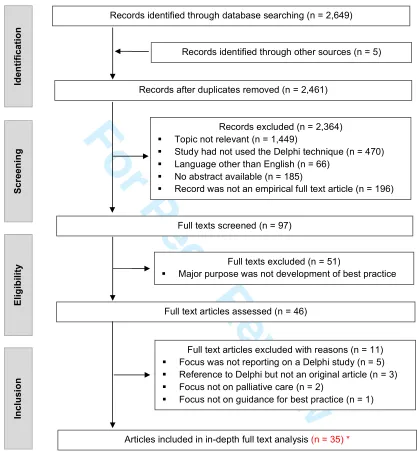
The search yielded 2,649 records. In addition, five records were identified through other sources
(Figure 1). Of these, 35 papers published between 1997 and 2015 were identified as meeting
the inclusion criteria and were eligible for in-depth analysis (Tables 1 a-c). These 35 papers
pertained to 30 Delphi studies since for four of the studies30-38, more than one publication was identified. The n=30 Delphi studies will constitute our sample and will be referred to for further
analysis. Eleven of these studies had an international scope; 14 a national scope with a
(potential) international applicability; and five studies had an explicitly stated national or local
scope, mostly conducted by within-country or local research teams.
[insert Figure 1 / PRISMA flow chart]
Focus and purpose of the studies
The majority of the 30 studies focused on interventions in palliative care (n=16); two studies
focused on specific conditions; five studies dealt with paediatric or neonatal palliative care; and
seven studies concerned standards for palliative care delivery in specific settings or work fields
(Tables 1 a-c). Half of the 16 intervention-focused studies (n=8) dealt with the pharmacological 2
For Peer Review
or non-pharmacological management of symptoms such as pain, dyspnoea, or depression.32-43 The remainder considered artificial nutrition or hydration (n=2)44,45, psychosocial or spiritual support (n=3) 30,31,46,47, end-of-life decision making (n=1) 48, palliative sedation (n=1)49, or euthanasia and physician assisted suicide (n=1)50. Studies addressing specific conditions focused on dementia51 and multiple sclerosis.52 Five studies aimed at developing guidance in the field of paediatric or neonatal palliative care.53-57 Of the studies concerning standards for palliative care delivery in specific settings or work fields, five were in institutional settings
(hospital or nursing home58-62, one in primary care63, and one focusing on general conditions for palliative care service delivery64.
[insert Tables 1 a-c / Focus and purpose of the studies]
Rationale for the use of the Delphi technique
All but three studies (n=27) explicitly provided a rationale for using the Delphi technique. This
included a lack of published guidance, the appropriateness of the method when evidence is
needed to be drawn outside the gold standard RCTs, and the aim to build systematic
consensus in order to resolve uncertainty about a clinical question or a concept of care. Two
studies emphasised the qualitative nature of the Delphi technique and therefore considered it
particularly appropriate for clinical questions where quantitative methods are unlikely to yield
results that can be successfully implemented in practice.30,58
Study design and type of Delphi
Most studies (n=28) explicitly referred to undertaking a consensus Delphi study. In ten
publications, the term “modified Delphi technique” was used; only two of these specified what
exactly the modification entailed. In nine articles modifications were identified but not labelled as
such; for example, the use of intermediate face-to-face meetings between Delphi survey
rounds 45 or the involvement of different expert panels in the consensus process.59
Of the 30 studies, 10 comprised the Delphi technique alone and 11 comprised a Delphi survey
plus additional elements such as a preparatory literature review or an evaluative assessment of
the guidelines during an expert workshop. In nine of the 30 studies, the Delphi technique formed
part of a larger piece of work with a more complex research design including multiple other 1
For Peer Review
stages such as subsequent field testing of a protocol, or a one-year follow-up to evaluate
implementation of a clinical guideline.
Selection of experts
The most prominent criteria for the identification and selection of experts were (1)
representation of a particular profession or stakeholder group (n=24); (2) affiliation to a
particular setting or work field (n=23); and (3) relevant clinical and / or academic expertise
(n=20) (Table 2). Other criteria included membership of an organisation or professional board
(n=11), being a recognised authority in the field (n=11), and geographical origin (n=13); with
several studies paying particular attention to a balanced composition of the expert panel with
representation from different regions and socio-economic backgrounds, or a relevant
participation of experts from developing countries.32-34,43
Definition of consensus
Most studies (n=25) reported a definition of consensus; five did not. Nearly all of them (n=22)
had set an a priori criterion or cut-off (Table 2); one used a post-hoc criterion for exclusion of
items if more than 10% of panellists rated a specific guideline as not important.62
For the majority of studies (n=25), consensus was conceptualised using statistical measures
such as the percentage of ratings or the median value on a rating scale. The attainment of
consensus based on statistical measures was operationalised depending on the rating scales
employed in the study; the most prominent response formats were either a traditional 9-point
scale (n=6) referring to the original RAND UCLA method 32-34,45,47-49,60 or a 5-point Likert scale 35,36,42,46,51,53,61,62,64, but 6- / 7- / 10- or 11-point scales were also used.37,38,41,45,51,53,57,59,62 Some studies used a ranking (n=4) 30,31,40,43,58 or selection of items (n=3) 39,52,63 rather than a scale.
The cut-off for (non)consensus was mostly based on percentage of agreement (mainly 75 or
80%), median score, or a combination of both (n=23) (Table 2). Three studies distinguished
between different degrees of (dis)agreement and consensus, reporting combined parameters to
define low, moderate, and high levels.42,51,64 Two studies used a more procedural definition
such as “stability of group response over successive rounds”30, or the cut-off for inclusion of
items being based on a “natural break” in the overall score.58 2
For Peer Review
Number and purpose of roundsThe number of rounds ranged from one to five, with the majority of the 30 studies reporting
either two (n=14), or three (n=8) survey rounds. Only one survey round was reported in two
studies.32-34,46 In terms of duration, for most studies (n=19) no details were provided on the length of survey rounds or the overall process. Seven studies specified the duration of rounds
ranging from 10 days to 10 weeks; and four studies provided details on the duration of the
overall study process, ranging from two to 18 months.
The majority of studies (n=27) stated the purpose of the survey rounds (Table 3) which
comprised: rating or evaluating statements (n=24); identifying issues or generating items (n=8);
collecting qualitative responses or comments (n=7); ranking or prioritising items (n=6); reviewing
or approving a (final) framework or document (n=5); and developing guiding principles or a draft
document (n=4).
Design of Delphi rounds
Different ways of informing the first and subsequent Delphi rounds were used within the studies.
Methods used to inform the first Delphi round included systematic or scoping literature
reviews 33,36,37,39,41,42,45,46,49,50,52,53,59,62-64; a synthesis of already existing guidelines 41,42,44,55,56,60; the identification of relevant elements and priorities for best practice 32,38,40,45,57,61,64; the development of a conceptual framework 34,38,39,45,53,56,60,64; the drafting of statements or guidelines 34,36,41,42,44,45,49-53,57,60-63; and information packages provided before the start of the first round in order to standardise the knowledge base of panellists. 39,59,60
The studies in this review reported diverse strategies of processing results between survey
rounds and feedback provided to inform the experts’ judgements during the next survey round
(Table 3). These included a statistical group response of quantitative parameters (n=11), a
summary of qualitative comments (n=8), the inclusion of newly generated items (n=10), the
modification of items (n=6), the selection or reduction of items (n=9), and the presentation of a
document for review or approval (n=8). The reduction of items can both refer to items with (very)
high agreement that were instantaneously accepted and therefore did not need further
consideration in a subsequent survey round; or to items with (very) low agreement or relevance
that were therefore entirely discarded from the list. The process of achieving consensus was not 1
For Peer Review
always visible; for example, eight studies did not detail how the synthesis of responses in one
survey round was used to design the following round; for six studies, the design of the next
survey round was either not reported or was unclear.
The role of the research team was identified in 25 of the analysed studies and included planning
and managing of the overall study process and processing results to inform the next Delphi
round. Sometimes this involved complex and difficult decisions such as managing persistent
non-consensus 51, or a conflict between the majority opinion on the best medical treatment and ethical concerns about this treatment 42 (p. 495).
Key outcomes resulting from the studies
The format of the guidance resulting from the Delphi studies varied and included elementary
tables with the top ten criteria identified as relevant for the field in question 30,31,57; detailed listings of key recommendations, and lists of recommended medicines (e.g., 32-34,43,63); and complex guidelines comprising several sections including an introduction, definitions, charts,
and clinical algorithms (e.g., 45,46,49,51).Variation was also found with respect to the scope of the
resulting guidance claimed by the authors, and the official or even binding character of the
guideline, ranging from rather moderate narrative descriptions of the key aspects resulting from
the Delphi study (e.g., 30,31,57) to intensely advocated guidelines with a high level of dissemination, often endorsed by one or more authorities in the field (e.g., 32-34,35,36,40,46,64).
Quality assessment
A quality assessment was undertaken with respect to the rigour of the conducted studies and
the transparency of reporting (Table 2). While the majority of studies (n=24) fulfilled at least nine
of the 12 predefined quality criteria, for a number of studies one or more of these criteria were
not reported. A clear definition of consensus was not provided for five studies; for 9 studies, an
appropriate discussion of potential limitations was not included; and only for five out of 30
studies some sort of piloting of the survey instruments was reported. The methods were clearly
described for 25 studies, but only six provided a flow chart illustrating the process. In cases
where two articles were included about one study (n=4), the publications differed in terms of the
transparency of reporting; variation was observed not only concerning the total number of 2
For Peer Review
quality criteria met, but also with respect to which of the criteria were met in either of the two
articles (Table 2).
Discussion
This methodological systematic review identified considerable variation in the design and the
reporting of process- and outcome parameters of studies using the Delphi technique to develop
guidance for best practice in palliative care. In the following, the main findings will be
summarised and related to previous treatises on the Delphi technique, with a focus on (1) the
rigour of the design and conduct of the analysed studies; (2) the quality of reporting; and (3) the
dissemination politics for the resulting guidance. Subsequently, implications and
recommendations for research will be discussed, and a standard for Conducting and REporting
DElphi Studies (CREDES) will be proposed.
Summary of main findings
The rigour of the design and conduct of Delphi studies
Across the studies assessed in this review, variation was found regarding the rigour of the
design and the conduct of the Delphi process; this included the absence of a clear consensus
criterion or a piloting of the survey instrument. Also, diverse interpretations were identified of
what constitutes a “Delphi round” and which steps are conceived of as additional preparatory or
concluding stages. Notably, for two studies only one survey round was reported while an
iterative process with at least two rounds is characteristic of the Delphi technique and
constitutes its distinguishing feature compared to a regular survey.
These findings reveal a lack of clarity and unanimity regarding the core elements of the Delphi
process. This makes the studies vulnerable to bias and arbitrariness during data collection,
analysis, and the interpretation of findings. Furthermore, it renders the Delphi technique
susceptible to criticism as an undependable research method.
The quality of reporting
The identified variations in the level of detail in reporting make it difficult for the reader to
appraise to quality of the study design, its conduct, and the resulting outcomes. For example,
across the assessed studies, it was not always clear how the synthesis of responses in one 1
For Peer Review
survey round was used to design the following round. A number of exemplary articles analysed
in this review illustrate how a sound and substantial reporting of essential parameters of the
applied Delphi technique is even possible with limited space (e.g., 35,36,39,42,44,47-49,51-53,59,60,62-64); these can serve as good examples of what is needed to allow the reader to make a judgment
about the rigour of the applied methods, the nature of the consensus building process, and the
quality of the resulting recommendations.
This review also revealed inconsistencies in the nomenclature and discrepancies regarding the
terms used to describe the methods applied in the Delphi studies. For example, a
heterogeneous use of the term “modified Delphi” was observed. Although some authors have
treated the concept “modified Delphi” as a methodological variant on its own 20,65, there is no
standard definition as to what a “modified Delphi” exactly entails. Since a range of
methodological variations do exist in the application of the Delphi technique, the use of the term
“modified” should be critically reconsidered – even more when used without further specification
or explanation. In addition, the reference against which the definition as “modified” is made
needs to be reassessed. Many studies in this review referred to early literature on the Delphi
technique; though some early works can still be considered as standard references, it needs to
be taken into account that the methodology has been further developed since its first usage.
Dissemination politics for guidelines resulting from Delphi studies
Across the analysed studies, the scope of the resulting guidance claimed by the authors varied.
Depending on the researchers’ scientific provenance and professional affiliation within the
palliative care research community, studies with only isolated reception were identified, while
others were intensely advocated with a high degree of dissemination activities and international
coverage. Some of these were used to inform political decision making or textbook knowledge,
and were lent credibility through endorsement by one or more authorities in the field, including
the World Health Organization. These findings emphasise the impact of Delphi studies on
knowledge production in palliative care and underline the importance of methodological rigour
and robustness of the results. 2
For Peer Review
Recommendations for conducting and reporting Delphi studies: CREDES
Since clinical guidance in palliative care relies to a considerable extent on the Delphi technique,
there is a need for consistency and quality both in the conduct and in the reporting of studies
using this method.20,22,29 This will constitute a prerequisite for acknowledgement of the method
as a contribution to robust evidence, and for a higher appraisal of the value of expert judgement
in evidence based medicine. Guidance has been proposed for enhancing rigour and transparent
reporting of Delphi studies by authors from diverse disciplines;13,20-22,29 however, clear
recommendations on the conduct of Delphi studies and a generally accepted reporting standard
for their publication in peer-reviewed journals to date are not available. We therefore propose
recommendations concerning the rationale for the choice of the Delphi technique, its conduct,
and the reporting of Delphi studies. Building on previous treatises,18,20,22,29 and drawing on the
findings from this review, a guide on minimal requirements was created for Conducting and
REporting of DElphi Studies (CREDES) (Box 3). Like existing reporting standards for other
types of research, such as CONSORT,66 COREQ,67 or PRISMA,28 these can be used by researchers undertaking Delphi studies, by authors publishing them, and by reviewers and
journal editors when evaluating the quality of the study design and the transparency of
reporting. Since such a standard to date does not exist, CREDES may also be used for studies
using the Delphi technique outside palliative care research.
[insert Box 3 / Conducting and REporting of DElphi Studies (CREDES)]
Recommendations concerning the rationale for the use of the Delphi technique
In line with Greenhalgh et al. 2, we argue that there is a need for an alternative view of evidence
based medicine which emphasises the value of expert judgement, including implicit or tacit
knowledge, for example pertaining to clinical routines, that is not directly accessible through
clinical trials. However, this implies that the choice of the Delphi technique as a method of
systematically collating expert consultation and building consensus needs to be well justified.
When choosing it for the development of good clinical practice in palliative care, two aspects
need to be taken into account: (1) it is a heuristic device that relies on expert knowledge to
negotiate a shared reality and to co-construct knowledge, rules, and recommendations; and (2)
its outcomes can only be as reliable as the available evidence and the participating experts. 1
For Peer Review
13,68,69 In consequence, it is important to keep in mind its constructivist nature when selecting the
Delphi technique to answer a particular research question.68,70-72
Recommendations for a sound and rigorous conduct of Delphi studies
When properly employed, the Delphi technique has the potential to create an environment that
will allow experts to arrive at justifiable, valid and credible solutions based on the best available
evidence and their experiential expertise (Box 3).14,22
Design, planning, and process
Flexibility of the Delphi technique allows adaptation of the method to the requirements of the
study.22 However, this should be done systematically and rigorously, justified by a rationale and
(whenever possible) a reference, to avoid arbitrariness. This includes systematic
methodological decisions such as careful planning of the process and justification of potential
modifications; as well as thorough development, review, and piloting of all relevant material
used throughout the consensus process such as cues and questions, survey instruments,
information and feedback provided to experts.
Definition of consensus
Ideally, an a priori criterion for consensus should be defined that is suitable for the purpose of
the study and applicable for the research question. As Diamond et al. 29 concluded from their systematic review on operationalisations of consensus, the mere fact of conducting a Delphi
study does not automatically imply consensus as its outcome. In the field of palliative care,
perfect agreement may often not be realistic due to different values, world views, and ethical
dilemmas concerning medical decision making. Therefore, the definition of consensus needs to
include procedures to be followed when consensus is not reached after several iterations. This
should be done in line with the envisaged scope of the resulting guidance, e.g. in terms of its
geographical span (local, national, or international); the range of settings for which it is intended;
or the applicability for one specific disease versus diverse conditions. The criteria for consensus
should provide a clear and transparent guide for action how to proceed with certain items or
topics in the next survey round – for example, delete them from the list, or refine them in order
to attain higher consensus.29 If an a priori definition of consensus is not realistic due to the 2
For Peer Review
explorative nature of the study, it should be identified and established by the research team in
the course of the process.
Interpretation of results
When interpreting the results of a Delphi study, it needs to be considered that consensus does
not necessarily imply that the “correct” answer or judgement has been found.71 The meaning of
(non)consensus needs critical reflection; the value of stable disagreement must not be
underestimated since it provides informative insights and highlights differences in perspectives
regarding complex issues.70
Ensuring credibility and preventing bias
It is the responsibility of the research team to allow the experts to arrive at valid and credible
judgements. Research is often driven by an original interest of the principal investigator who is
likely to have a determined position on a given topic; and the technique may force consensus
while several individuals still maintain their different positions.20,68 It is therefore important to
make sure to refrain from directly or indirectly influencing the experts’ judgements.
Informational input
Attention should be paid to how information will influence – and possibly bias - panellists’
judgements. This includes information provided at the outset of the study, such as a synthesis
of the available evidence; as well as the synthesis of experts’ responses provided as feedback
to inform the next survey round. Piloting informational input is indispensable to examine its
effect on experts’ judgements, preferably with selected candidates who are representative of the
expert panel. Likewise, the survey instrument needs to be pilot-tested for the impact of cues and
questions on the panellists’ responses. In addition, prevention of bias can entail a balanced
composition of the core research group; entrusting an independent researcher with the main
coordination of the consensus process; ensuring critical reflection of outcomes within the team;
and having a final draft of the outcomes reviewed by an external board or authority before
publication and dissemination. 1
For Peer Review
Recommendations for a transparent reporting of Delphi studiesAll methodological decisions throughout the Delphi process should be reported transparently to
allow readers to understand the steps taken, the evolvement of consensus building, and to
judge the results obtained (Box 3).22,29 This comprises a transparent description of the expert
panel, the procedure, the attainment of consensus, as well as the impact of methodological
limitations on the interpretation of results and the ensuing guidance for good practice in
palliative care. The format of reporting should be thoroughly reflected; in addition to the resulting
guidance on good clinical practice in palliative care (e.g., a clinical guideline or a white paper),
the publication of an additional methodological paper or at least a study protocol should be
considered to inform transparently on details of the study process (e.g., 51,64). A careful dissemination plan includes advocating the outcomes of the Delphi study by seeking
professional endorsement and political support.14 On an overarching level, clarity regarding the
nomenclature and the terminology when reporting on Delphi studies should be attained. For
example, the use of terms such as “round” or “modified Delphi study” should be clear and
unambiguous. Therefore, agreement needs to be settled on essential elements of the Delphi
technique, on the definition of its core features (e.g., what constitutes a “round”), as well as the
necessary features to qualify a study as a “Delphi process”. This will lay the foundation for
unambiguous reporting on the methodological features of a particular Delphi study, including
possible modifications.
Strengths and limitations
A particular feature of this review is its focus on research methodology. Since the credibility of
scientific knowledge depends on the rigour of the underlying research, a systematic
investigation of its methodology contributes to quality of health care and palliative care
research. Robustness and credibility of the analysis was supported by a multi-professional team
of international researchers.
A limitation of this review is that it was restricted to English language, and only considered
original articles published in peer-reviewed journals whilst not including grey literature.
Best-practice-guidance for palliative care with a national or local scope, or published outside the
scientific databases, may therefore be underrepresented in the analysis. In addition, the
consideration of grey literature – including the full clinical guidelines resulting from the Delphi 2
For Peer Review
studies or final project reports – may have allowed for extraction of more complete
methodological details in order to inform the quality assessment performed as part of this
review; in consequence, the rigour of the applied methods and the transparency of reporting
may have been underestimated. However, several of the reviewed articles exemplified that
essential information on the applied methods can be provided even with limited space.
The abovementioned limitations notwithstanding, the elaborated recommendations have the
potential to improve the future conduct and reporting of Delphi studies and to facilitate the
scientific review process of the resulting publications.
Conclusions
The Delphi technique as a means of attaining expert consensus plays an important role for the
development of guidance for good medical practice not only in the absence of sufficient
published evidence from RCTs. The quality of the resulting recommendations largely depends
on the rigour of the application and reporting of consensus processes. This methodological
systematic review analysed the application of the Delphi technique for the development of
best-practice guidance in palliative care with a particular focus on the quality of the study conduct
and the transparency of reporting. In line with Hasson et al. and Diamond et al.,20,22,29 we
recommend a rigorous use of the technique including justification of details in the study design.
Building on previous treatises,13,18,20,22,29 a guide for the Conduct and Reporting of Delphi
Studies (CREDES) was created to allow an appraisal of the methodological quality and the
robustness of the resulting recommendations. Like existing standards for other types of
research, this can be used by researchers, reviewers, and journal editors. Future research
should aim for settling international agreement on the definition of essential elements of the
Delphi technique, and on the nomenclature of its core features. This will constitute a
prerequisite for acknowledgement of the method as a contribution to robust evidence.
Authors’ contribution
SJ developed the research idea; the review question and the design, conducted the literature
search, constructed the data extraction form, performed data extraction and analysis, and 1
For Peer Review
drafted the manuscript. SP and SGB provided support with identifying the final review question,
reviewed the data extraction form, critically reviewed selected papers for in- or exclusion, and
provided expertise and advice with writing the manuscript. JB provided expertise and support
with developing the search strategy for the different data bases and with doing the literature
search. LR critically reviewed the manuscript for important intellectual content and contributed
with expertise to the discussion of results. All authors provided critical comments on drafts of the
manuscript and approved the final version.
Declaration of Conflicting Interests
The Authors declare that there is no conflict of interest. 2
For Peer Review
References
1. Ferris FD, Balfour HM, Bowen K, Farley J, Hardwick M, Lamontagne C, et al. A model to
guide patient and family care: based on nationally accepted principles and norms of
practice. Journal of Pain and Symptom Management. 2002;24(2):106-23. Epub 2002/09/17.
2. Greenhalgh T, Howick J, Maskrey N. Evidence based medicine: a movement in crisis? BMJ
(Clinical Research ed). 2014;348:g3725. Epub 2014/06/15.
3. Burns PB, Rohrich RJ, Chung KC. The levels of evidence and their role in evidence-based
medicine. Plastic and Reconstructive Surgery. 2011;128(1):305-10. Epub 2011/06/28.
4. Addington-Hall JM. Introduction. In: Addington-Hall JM, Bruera E, Higginson I, Payne SA,
editors. Research Methods in Palliative Care. Oxford New York: Oxford University Press;
2007. p. 1-9.
5. Aoun SM, Nekolaichuk C. Improving the evidence base in palliative care to inform practice
and policy: thinking outside the box. Journal of Pain and Symptom Management.
2014;48(6):1222-35. Epub 2014/04/15.
6. Visser C, Hadley G, Wee B. Reality of evidence-based practice in palliative care. Cancer
Biology & Medicine. 2015;12(3):193-200. Epub 2015/10/22.
7. Bader S, Weber M, Becker G. [Is the pharmacological treatment of constipation in palliative
care evidence based? A systematic literature review]. Schmerz (Berlin, Germany).
2012;26(5):568-86. Epub 2012/10/12. Ist die pharmakologische therapie der Obstipation in
der Palliativmedizin evidenzbasiert? Eine systematische Literaturübersicht.
8. Klein C, Stiel S, Bukki J, Ostgathe C. [Pharmacological treatment of malignant bowel
obstruction in severely ill and dying patients. A systematic literature review]. Schmerz
(Berlin, Germany). 2012;26(5):587-99. Epub 2012/10/12. Medikamentöse Therapie der
gastrointestinalen Obstruktion bei schwerkranken und sterbenden Patienten. Eine
systematische Literaturübersicht.
9. Nubling G, Allmendinger S, Lorenzl S. [Drug therapy of anxiety and fear in palliative care
patients with cancer or other illnesses. A systematic review]. Schmerz (Berlin, Germany).
2012;26(5):537-49. Epub 2012/09/13. Medikamentöse Therapie der Angst bei Patienten mit
fortgeschrittenen Tumorerkrankungen bzw. Patienten in der palliativen Situation.
Systematische Literaturübersicht. 1
For Peer Review
10. Simon ST, Koskeroglu P, Bausewein C. [Pharmacological therapy of refractory dyspnoea. A
systematic literature review]. Schmerz (Berlin, Germany). 2012;26(5):515-22. Epub
2012/09/08. Medikamentöse Therapie der refraktären Atemnot. Eine systematische
Literaturübersicht.
11. Thiem A, Rolke R, Radbruch L. [Glucocorticoids and androgens for treatment of tiredness
and weakness in palliative care patients. A systematic review]. Schmerz (Berlin, Germany).
2012;26(5):550-67. Epub 2012/09/08. Glukokortikoide und Androgene zur Behandlung von
Müdigkeit und Schwäche bei Palliativpatienten. Eine systematische Übersichtsarbeit.
12. Ujeyl M, Muller-Oerlinghausen B. [Antidepressants for treatment of depression in palliative
patients. A systematic literature review]. Schmerz (Berlin, Germany). 2012;26(5):523-36.
Epub 2012/09/13. Antidepressiva zur Behandlung der Depression bei Palliativpatienten.
Eine systematische Literaturübersicht.
13. Black N, Murphy M, Lamping D, McKee M, Sanderson C, Askham J, et al. Consensus
development methods: a review of best practice in creating clinical guidelines. Journal of
Health Services Research & Policy. 1999;4(4):236-48. Epub 2000/01/06.
14. Fink A, Kosecoff J, Chassin M, Brook RH. Consensus methods: characteristics and
guidelines for use. American Journal of Public Health. 1984;74(9):979-83. Epub 1984/09/01.
15. Nair R, Aggarwal R, Khanna D. Methods of formal consensus in classification/diagnostic
criteria and guideline development. Seminars in Arthritis and Rheumatism.
2011;41(2):95-105. Epub 2011/03/23.
16. Iqbal S, Pipon-Young L. The Delphi method. A step-by-step guide. The Psychologist.
2009;22(7):598-601.
17. Jünger S. Die Delphi-Methode: Teil 1. Zeitschrift für Palliativmedizin. 2011;12(6):245-8.
18. Biondo PD, Nekolaichuk CL, Stiles C, Fainsinger R, Hagen NA. Applying the Delphi process
to palliative care tool development: lessons learned. Supportive care in cancer; official
journal of the Multinational Association of Supportive Care in Cancer. 2008;16(8):935-42.
Epub 2007/10/31.
19. Geist MR. Using the Delphi method to engage stakeholders: a comparison of two studies.
Evaluation and Program Planning. 2010;33(2):147-54. Epub 2009/07/08.
20. Hasson F, Keeney S. Enhancing rigour in the Delphi technique research. Technological
Forecasting & Social Change. 2011;78:1695-704. 2
For Peer Review
21. Day J, Bobeva M. A Generic Toolkit for the Successful Management of Delphi Studies. The
Electronic Journal of Business Research Methodology. 2005;3(2):103-16.
22. Hasson F, Keeney S, McKenna H. Research guidelines for the Delphi survey technique. J
Adv Nurs. 2000;32(4):1008-15. Epub 2000/11/30.
23. France EF, Ring N, Thomas R, Noyes J, Maxwell M, Jepson R. A methodological
systematic review of what's wrong with meta-ethnography reporting. BMC Med Res
Methodol. 2014;14:119. Epub 2014/11/20.
24. Fryer C, Mackintosh S, Stanley M, Crichton J. Qualitative studies using in-depth interviews
with older people from multiple language groups: methodological systematic review. J Adv
Nurs. 2012;68(1):22-35. Epub 2011/06/08.
25. Lilford RJ, Richardson A, Stevens A, Fitzpatrick R, Edwards S, Rock F, et al. Issues in
methodological research: perspectives from researchers and commissioners. Health
Technology Assessment (Winchester, England). 2001;5(8):1-57. Epub 2001/05/23.
26. O'Brien MR, Clark D. Use of unsolicited first-person written illness narratives in research:
systematic review. J Adv Nurs. 2010;66(8):1671-82. Epub 2010/06/19.
27. Centre for Reviews and Dissemination. Systematic Reviews. CRD’s guidance for
undertaking reviews in health care. University of York, editor. York: York Publishing
Services Ltd; 2009.
28. Moher D, Liberati A, Tetzlaff J, Altman DG. Preferred reporting items for systematic reviews
and meta-analyses: the PRISMA statement. BMJ (Clinical Research ed). 2009;339:b2535.
Epub 2009/07/23.
29. Diamond IR, Grant RC, Feldman BM, Pencharz PB, Ling SC, Moore AM, et al. Defining
consensus: a systematic review recommends methodologic criteria for reporting of Delphi
studies. J Clin Epidemiol. 2014;67(4):401-9. Epub 2014/03/04.
30. Bridgman H, Carr E. The provision of family-focused palliative care in hospital using the
Delphi technique. Including commentary by Corner J. NT Research. 1997;2(6):443-54.
31. Bridgman H, Carr E. Providing family care in hospital. Nursing Times. 1998;94(1):44-7.
32. De Lima L. International Association for Hospice and Palliative Care list of essential
medicines for palliative care. Annals of Oncology; official journal of the European Society for
Medical Oncology / ESMO. 2007;18(2):395-9. Epub 2006/10/31. 1
For Peer Review
33. De Lima L. Key concepts in palliative care: the IAHPC list of essential medicines in palliative
care. Eur J Hosp Pharm-Sci Pract. 2012;19(1):34-7.
34. De Lima L, Krakauer EL, Lorenz K, Praill D, Macdonald N, Doyle D. Ensuring palliative
medicine availability: the development of the IAHPC list of essential medicines for palliative
care. Journal of Pain & Symptom Management. 2007;33(5):521-6.
35. Mahler DA, Seecky PA, Harrod CG. Management of dyspnea in patients with advanced
lung or heart disease Practical guidance from the American College of Chest Physicians
Consensus Statement. Pol Arch Med Wewn. 2010;120(5):160-5.
36. Mahler DA, Selecky PA, Harrod CG, Benditt JO, Carrieri-Kohlman V, Curtis JR, et al.
American College of Chest Physicians consensus statement on the management of
dyspnea in patients with advanced lung or heart disease. CHEST. 2010;137(3):674-91.
37. Rayner L, Price A, Hotopf M, Higginson IJ. The development of evidence-based European
guidelines on the management of depression in palliative cancer care. European Journal of
Cancer. 2011;47(5):702-12.
38. Rayner L, Price A, Hotopf M, Higginson IJ. Expert opinion on detecting and treating
depression in palliative care: A Delphi study. BMC Palliative Care. 2011;10:10. Epub
2011/05/31.
39. Holmes HM, Sachs GA, Shega JW, Hougham GW, Hayley DC, Dale W. Integrating
palliative medicine into the care of persons with advanced dementia: identifying appropriate
medication use. Journal of the American Geriatrics Society. 2008;56(7):1306-11.
40. Lindqvist O, Lundquist G, Dickman A, Bükki J, Lunder U, Hagelin CL, et al. Four Essential
Drugs Needed for Quality Care of the Dying: A Delphi-Study Based International Expert
Consensus Opinion. Journal of Palliative Medicine. 2013;16(1):38-43.
41. Pigni A, Brunelli C, Gibbins J, Hanks G, Deconno F, Kaasa S, et al. Content development
for EUROPEAN GUIDELINES on the use of opioids for cancer pain: a systematic review
and Expert Consensus Study. Minerva Anestesiologica. 2010;76(10):833-43. Epub
2010/10/12.
42. van der Maaden T, van der Steen JT, de Vet HC, Achterberg WP, Boersma F, Schols JM,
et al. Development of a practice guideline for optimal symptom relief for patients with
pneumonia and dementia in nursing homes using a Delphi study. Int J Geriatr Psychiatry.
2014. Epub 2014/07/22. 2
For Peer Review
43. Vignaroli E, Bennett MI, Nekolaichuk C, De Lima L, Wenk R, Ripamonti CI, et al. Strategic
Pain Management: The Identification and Development of the IAHPC Opioid Essential
Prescription Package. Journal of Palliative Medicine. 2012;15(2):186-91.
44. Dreesen M, Foulon V, Hiele M, Vanhaecht K, De Pourcq L, Pironi L, et al. Quality of care for
cancer patients on home parenteral nutrition: development of key interventions and
outcome indicators using a two-round Delphi approach. Supportive care in cancer; official
journal of the Multinational Association of Supportive Care in Cancer. 2013;21(5):1373-81.
Epub 2012/12/12.
45. Morita T, Bito S, Koyama H, Uchitomi Y, Adachi I. Development of a national clinical
guideline for artificial hydration therapy for terminally ill patients with cancer. Journal of
Palliative Medicine. 2007;10(3):770-80.
46. Hudson P, Remedios C, Zordan R, Thomas K, Clifton D, Crewdson M, et al. Guidelines for
the Psychosocial and Bereavement Support of Family Caregivers of Palliative Care
Patients. Journal of Palliative Medicine. 2012;15(6):696-702.
47. Vermandere M, Lepeleire J, Van Mechelen W, Warmenhoven F, Thoonsen B, Aertgeerts B.
Spirituality in palliative home care: a framework for the clinician. Supportive Care in Cancer.
2013;21(4):1061-9.
48. Downar J, Hawryluck L. What should we say when discussing "code status" and life support
with a patient? A Delphi analysis. Journal of Palliative Medicine. 2010;13(2):185-95.
49. Morita T, Bito S, Kurihara Y, Uchitomi Y. Development of a clinical guideline for palliative
sedation therapy using the Delphi method. Journal of Palliative Medicine. 2005;8(4):716-29.
50. Onwuteaka-Philipsen BD, van der Wal G. A protocol for consultation of another physician in
cases of euthanasia and assisted suicide. J Med Ethics. 2001;27(5):331-7. Epub
2001/10/02.
51. van der Steen JT, Radbruch L, Hertogh CM, de Boer ME, Hughes JC, Larkin P, et al. White
paper defining optimal palliative care in older people with dementia: a Delphi study and
recommendations from the European Association for Palliative Care. Palliat Med.
2014;28(3):197-209. Epub 2013/07/06.
52. Strupp J, Romotzky V, Galushko M, Golla H, Voltz R. Palliative Care for Severely Affected
Patients with Multiple Sclerosis: When and Why? Results of a Delphi Survey of Health Care
Professionals. Journal of Palliative Medicine. 2014;17(10):1128-36. 1
For Peer Review
53. Bradford N, Herbert A, Mott C, Armfield N, Young J, Smith A. Components and Principles of
a Pediatric Palliative Care Consultation: Results of a Delphi Study. Journal of Palliative
Medicine. 2014;17(11):1206-13.
54. Carter BS, Bhatia J. Comfort/palliative care guidelines for neonatal practice: development
and implementation in an academic medical center. Journal of Perinatology.
2001;21(5):279-83.
55. Catlin A, Carter B. Creation of a neonatal end-of-life palliative care protocol. Reprinted by
permission of Journal of Perinatology, Vol. 22(3):184-195. Neonatal Network.
2002;21(4):37-49.
56. Finlay F, Lewis M, Lenton S, Poon M. Planning for the end of children's lives – the lifetime
framework. Child: Care, Health & Development. 2008;34(4):542-4.
57. Mendes JCC, da Silva LJ. Neonatal Palliative Care Developing Consensus Among
Neonatologists Using the Delphi Technique in Portugal. Adv Neonatal Care.
2013;13(6):408-14.
58. Bradley CT, Brasel KJ. Developing guidelines that identify patients who would benefit from
palliative care services in the surgical intensive care unit. Critical Care Medicine.
2009;37(3):946-50.
59. Hawryluck LA, Harvey WRC, Lemieux-Charles L, Singer PA. Consensus guidelines on
analgesia and sedation in dying intensive careunitpatients. BMC Medical Ethics. 2002;3:1-9.
60. Sasahara T, Kizawa Y, Morita T, Iwamitsu Y, Otaki J, Okamura H, et al. Development of a
standard for hospital-based palliative care consultation teams using a modified delphi
method. Journal of Pain & Symptom Management. 2009;38(4):496-504.
61. Sprung CL, Truog RD, Curtis JR, Joynt GM, Baras M, Michalsen A, et al. Seeking
Worldwide Professional Consensus on the Principles of End-of-Life Care for the Critically Ill.
The Consensus for Worldwide End-of-Life Practice for Patients in Intensive Care Units
(WELPICUS) Study. American Journal of Respiratory & Critical Care Medicine.
2014;190(8):855-66.
62. Temkin-Greener H, Ladwig S, Caprio T, Norton S, Quill T, Olsan T, et al. Developing
Palliative Care Practice Guidelines and Standards for Nursing Home–Based Palliative Care
Teams: A Delphi Study. Journal of the American Medical Directors Association.
2015;16(1):86.e1-7. 2
For Peer Review
63. De Lima L, Bennett MI, Murray SA, Hudson P, Doyle D, Bruera E, et al. International
Association for Hospice and Palliative Care (IAHPC) List of Essential Practices in Palliative
Care. Journal of Pain & Palliative Care Pharmacotherapy. 2012;26(2):118-22.
64. Jünger S, Payne S, Brearley S, Ploenes V, Radbruch L. Consensus Building in Palliative
Care: A Europe-Wide Delphi Study on Common Understandings and Conceptual
Differences. Journal of Pain & Symptom Management. 2012;44(2):192-205.
65. Keeney S, Hasson F, McKenna H. Consulting the oracle: ten lessons from using the Delphi
technique in nursing research. J Adv Nurs. 2006;53(2):205-12. Epub 2006/01/21.
66. Schulz KF, Altman DG, Moher D. CONSORT 2010 statement: updated guidelines for
reporting parallel group randomised trials. BMJ (Clinical Research ed). 2010;340:c332.
Epub 2010/03/25.
67. Tong A, Sainsbury P, Craig J. Consolidated criteria for reporting qualitative research
(COREQ): a 32-item checklist for interviews and focus groups. International journal for
quality in health care : journal of the International Society for Quality in Health Care / ISQua.
2007;19(6):349-57. Epub 2007/09/18.
68. Birko S, Dove ES, Ozdemir V. Evaluation of Nine Consensus Indices in Delphi Foresight
Research and Their Dependency on Delphi Survey Characteristics: A Simulation Study and
Debate on Delphi Design and Interpretation. PloS one. 2015;10(8):e0135162. Epub
2015/08/14.
69. Murphy MK, Black NA, Lamping DL, McKee CM, Sanderson CF, Askham J, et al.
Consensus development methods, and their use in clinical guideline development. Health
Technology Assessment (Winchester, England). 1998;2(3):i-iv, 1-88. Epub 1998/04/30.
70. Guzys D, Dickson-Swift V, Kenny A, Threlkeld G. Gadamerian philosophical hermeneutics
as a useful methodological framework for the Delphi technique. International Journal of
Qualitative Studies on Health and Well-Being. 2015;10:26291. Epub 2015/05/08.
71. Mitroff II, Turoff M. Philosophical and Methodological Foundations of Delphi. In: H.A. L, M.
T, editors. The Delphi Method: Techniques and Applications2002. p. 17-34.
72. Scheele DS. Reality Construction as a Product of Delphi Interaction. In: H.A. L, Turoff M,
editors. The Delphi Method: Techniques and Applications2002. p. 35-67. 1
For Peer Review
Guidance on Conducting and REporting DElphi Studies (CREDES) in palliative care –
recommendations based on a methodological systematic review
Tables, Figures, and Boxes
Box 1 Search terms and search strategy in PubMed
Search (((("Delphi Technique"[Mesh]) OR
"Consensus"[Mesh]) OR (delphi OR consensus))) AND ((("Hospice and Palliative Care Nursing"[Mesh] OR "Palliative Medicine"[Mesh] OR "Palliative Care" [Mesh] OR "Hospice Care"[Mesh] OR "Terminal Care"[Mesh] OR "Hospices"[Mesh])) OR (hospice OR palliative OR "end of life"))
Box 2 Criteria for eligibility
Topic The focus of the study addresses a research question or issue in the field of palliative and / or hospice care
Purpose The study aimed at improving patient care through identifying consensus-based components of best practice in palliative care and seeking to develop some sort of guidance about these, such as a list of best practices, a protocol, a standards, or a guideline
Language English
Type of publication Full text article reporting on an empirical study (excluded: conference abstracts; papers referring to a Delphi study but not reporting the methodology)
Methodology Delphi technique / modified Delphi technique (excluded: surveys or qualitative enquiries not fulfilling the criterion of an iterative process with at least two rounds; consensus procedures other than Delphi (conferences, nominal group technique, workshops))
For Peer Review
Figure 1 – Flow diagram of the systematic literature search* These n = 35 articles pertain to n = 30 Delphi studies since for four studies, more than one article was identified.
Records identified through database searching (n = 2,649)
Records identified through other sources (n = 5)
Records after duplicates removed (n = 2,461)
Full texts screened (n = 97)
Full texts excluded (n = 51)
! Major purpose was not development of best practice
Full text articles assessed (n = 46)
Full text articles excluded with reasons (n = 11)
! Focus was not reporting on a Delphi study (n = 5)
! Reference to Delphi but not an original article (n = 3)
! Focus not on palliative care (n = 2)
! Focus not on guidance for best practice (n = 1)
Articles included in in-depth full text analysis (n = 35) *
Id
en
tif
ic
at
io
n
Sc
re
en
in
g
El
ig
ib
ili
ty
In
cl
u
si
o
n
Records excluded (n = 2,364)
! Topic not relevant (n = 1,449)
! Study had not used the Delphi technique (n = 470)
! Language other than English (n = 66)
! No abstract available (n = 185)
! Record was not an empirical full text article (n = 196)