Definition 2.2 [2]
Let G = (V(G),E(G)) be a simple graph and f : V(G) → {1 ,2, . . ., | V(G) | } be a function. For each edge uv assign the label 1 if f(u) divides f(v) denoted by f(u) | f(v) or f(v) | f(u) and the label 0, otherwise. Then the function f is called a divisor cordial labeling if | ef(0)−ef(1) |≤ 1, Where ef(0) denotes the number of edges with label 0 and
ef(d) denotes the number of edges with label 1. A graph with a divisor cordial labeling
is called a divisor cordial graph. Definition 2.3 [1]
A graph G = (σ, µ)is said to be a fuzzy divisor labeling graph if σ : V → [0,1] and µ : V → [0,1] is bijective such that the membership value of edges and vertices are distinct and µ(u,v) ≤ σ(u) Λ σ(v) ∀ u ,v ε V.
Definition 2.4 [1]
Let G = (σ, µ) be a simple graph and σ : V → [0,1] be a bijection. For each edge uv assign the label d if either σ(u) | σ(v) or σ(v) | σ(u) and the label 0 otherwise. σ is called a fuzzy divisor cordial labeling if | ef(0) − ef(1) |≤ 1, where d is a very small positive
quantity which is close to 0 and d ε (0,1). A graph with a fuzzy divisor cordial labeling is called a fuzzy divisor cordial graph.
Definition 2.5 [3]
A graph G = (A,B) is said to be Intuitionistic fuzzy labeling graph if µA : V → [0,1],
νA : V → [0,1], µB : V × V → [0,1] and νB : V × V → [0,1] are bijective such that
µB(x, y), νB(x, y) ε [0,1] all are distinct for each nodes and edges, where µA is the degree
of membership and νA is degree of non-membership of nodes, similarly µB and νB are
degree of membership and non-membership of edges.
3
Intuitionistic Fuzzy Divisor Cordial Labeling
Definition 3.1 Let G = (V,E) be a simple graph, where E ⊆ V ×V and µV : V → [0,1]
and νV : V → [0,1] are injective such that, for each edge uv, assign the membership
value d if either µV(u) | µV(v) or µV(v) | µV(u) and assign 0 if µV(u) - µV(v). And
assign the non-membership value d0 if either νV(u) | νV(v) or νV(u) | νV(v) and assign 0
if νV(u)- µV(v). Where d, d
0
an Intuitionistic fuzzy divisor cordial labeling if
|eµE(0)−eµE(d)| ≤ 1 (1)
and
|eνE(0)−eνE(d
0)| ≤ 1 (2)
Remark 3.1 A Graph with an intuitionistic fuzzy cordial labeling is called an Intuition-istic Fuzzy Divisor Cordial Graph.
Theorem 3.1
Every path Pn is an Intuitionistic fuzzy divisor cordial graph.
Proof:
Let v1, v2, . . . , vn be the vertices of a path Pn. Take two values say m, m
0
ε (0,1). Case 1:
When n is even,
Label n2 vertices vj by a membership value µV(vj) = 10mj, where j = 1, 2, 3, . . . up to
n
2.
Then label the remaining n2 vertices by any membership value which is not a multiple of the membership value of adjacent vertices, without repeating any µV(vj), ∀ j
∴ eµE (d) =
n
2 −1
eµE (0) =
n
2
∴ | eµE (0)− eµE (d) | = |
n
2−
n
2 +1 | = 1.
Hence | eµE (0) − eµE (d) | ≤ 1, holds.
Also label the same n2 vertices vj by a non-membership value νV(vj) = m
0
10j where j = 1,
2, . . . upto n
2 . Then label the remaining vertices by any non-membership value which is
not a multiple of the non-membership value of adjacent vertices without repeating any
νV(vj) , ∀j
∴ eνE (d
0
) = n2 −1
eµE (0) =
n
2
∴ | eνE (0) − eνE (d
0
) | = | n
2 −
n
2 + 1 | = 1
∴ | eνE (0) −eνE (d
0
) | ≤ 1, hold. Case 2:
Then label 2 vertices vj by a membership value µV(vj) = 10j, where j = 1, 2, . . . up
to n+12 . Then label the remaining n−12 vertices by any membership value which is not a multiple of the membership value of the adjacent vertices without repeating any µV(vj),
∀ j
∴ eµE (d) =
n−1 2 eµE (0) =
n−1 2
∴ | eµE (0) − eµE (d) | = |
n−1 2 −
n−1
2 | = 0. Hence | eµE (0) − eµE (d) | ≤ 1, holds.
Also label the same n+12 vertices vj by a non-membership value νV(vj) = m
0
10j where j =
1, 2, . . . upto n+12 . Then label the remaining vertices by a non-membership value which is not a multiple of the non-membership value of adjacent vertices without repeating any νV(vj), ∀j
∴ eνE (d
0
) = n−12 eµE (0) =
n−1 2
∴ | eνE (0) − eνE (d
0
) | = | n−1 2 −
n−1
2 | = 0 ∴ | eνE (0) − eνE (d
0
) | ≤ 1, hold.
Therefore every path Pn is an Intuitionistic fuzzy divisor cordial graph.
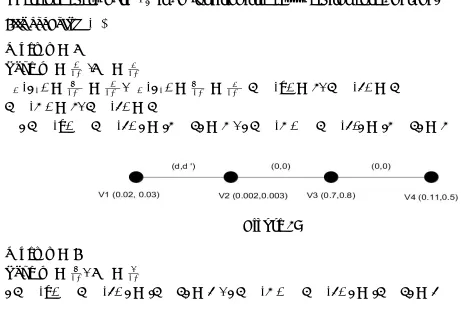
Illustration 3.1
When n = 4
Take m = 102 ,m0 = 103 µV(V1) = 10m1 =
2
102, νV(V1) = m 0 10 =
3
102 eµE (d) = 1, eµE (0) = 2
eνE (d
0
) = 1, eνE (0) = 2
∴ | eµE (d) − eµE (0) | = |1−2| = 1 , | eνE (d
0
[image:4.612.36.503.397.713.2]) − eνE (0)| = |1−2| = 1
Figure 1: When n = 5
Take m = 5 10, m
0 = 4
10
| eµE (d) − eµE (0) | = |2−2| = 0 , | eνE (d
0
Figure 2: Theorem 3.2
Every Cycle Cn (n ≥ 3)is an Intuitionistic fuzzy divisor cordial graph.
Proof:
Let v1, v2, . . . , vn be the vertices of a path Cn. Take two values say m, m
0
ε (0,1). Case 1:
When n is even,
Label n2 + 1 vertices vj by a membership value µV(vj) = 10mj, where j = 1, 2, . . . up to
n
2+ 1. Then label the remaining vertices by any membership value which is not a multiple of the membership value of adjacent vertices, without repeating any µV(vj), ∀ j
∴ eµE (d) =
n
2 eµE (0) =
n
2
∴|eµE (0) − eµE (d)| = |
n
2 −
n
2 | = 0. Hence | eµE (0) − eµE (d) | ≤ 1, holds.
Also label the same n2+ 1 vertices vj by a non-membership value νV(vj) = m
0
10j where j = 1,
2, . . . upto n2 + 1 . Then label the remaining vertices by any non-membership value which is not a multiple of the non-membership value of adjacent vertices, without repeating any νV(vj) , ∀j
∴ eνE (0) =
n
2 eµE (d
0 ) = n2
∴ | eνE (0) − eνE (d
0
) | = | n
2 −
n
2 | = 0 ∴ | eνE (0) − eνE (d
0
) | ≤ 1, hold. Case 2:
When n is odd,
Then label n+12 vertices vj by a membership value µV(vj) = 10mj, where j = 1, 2, . . . up
to n+12 . Then label the remaining n−12 vertices by any membership value which is not a multiple of the membership value of the adjacent vertices, without repeating any µV(vj),
∴ eµE (d) =
n+1 2 −1 eµE (0) =
n+1 2
∴ | eµE (0) − eµE (d) | = |
n+1 2 −
n+1
2 −1 | = 1. Hence | eµE (0) − eµE (d) | ≤ 1, holds.
Also label the same n+1
2 vertices vj by a non-membership value νV(vj) =
m0
10j where j =
1,2, . . . upto n+12 . Then label the remaining vertices by any non-membership value which is not a multiple of the non-membership value of adjacent vertices, without repeating any νV(vj) , ∀j
∴ eνE (d
0
) = n+12 −1 eµE (0) =
n+1 2
∴ | eνE (0) − eνE (d
0
) | = | n+1 2 −
n+1
2 −1 | = 1 ∴ | eνE (0) − eνE (d
0
) | ≤ 1, hold.
Therefore every path Cn is an Intuitionistic fuzzy divisor cordial graph.
Theorem 3.3
Every Star graph S1,n admits Intuitionistic Fuzzy divisor cordial labeling.
Proof:
Let v,u1,u2, . . ., un be the vertices of a star graph S1,n.
Take m,m’ ε (0,1), label µV(v) = 10m and νV(v) = m
0 10 Case 1: When n is even.
Label n
2 vertices uj by a membership value
µV(v)
10j and a non-membership value
νV(v)
10j . And
label the remaining vertices by a membership value which is not a multiple of µV(v) and
a non-membership value which is not a multiple of νV(v).
∴ eµE (d) =
n
2 , eµE (0) =
n
2 and eνE (d
0
) = n2, eνE (0) =
n
2 Case 2: When n is odd.
Label n+12 vertices in the similar way, then eµE (d) =
n+1
2 , eµE (0) =
n+1 2 −1 and eνE (d
0
) = n+12 , eνE (0) =
n+1 2 − 1
In both cases, conditions (1) and (2) of definition 3.1 holds.
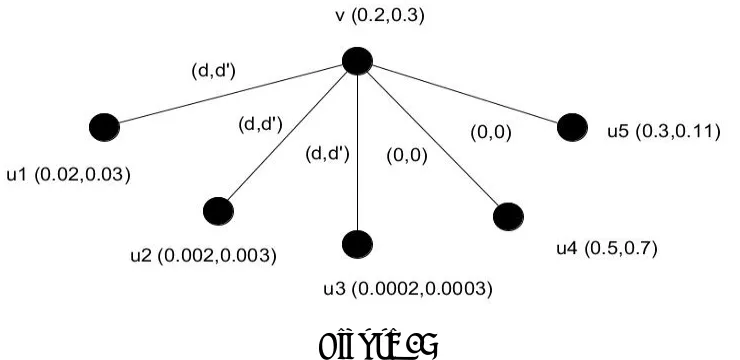
Hence Every star graph is an Intuitionistic fuzzy divisor cordial graph. Illustration 3.2
Figure 3:
Theorem 3.4
Wheel graph
W
nadmits Intuitionistic Fuzzy Divisor Cordial labeling.
Proof:
Let v,
u
1,
u
2,
. . .
,
u
n−1be the vertices of a wheel graph
W
n.
Take m, m’
ε
(0,1).
Fix v as the central vertex. A wheel graph with n vertices have 2(n
−
1) edges. Label the
vertices
u
1,
u
2,
. . .
,
u
n−1by a membership value
µ
V(
u
j) =
10mj, for j = 1, 2,
. . . n
−
1. And
label the vertex v by a non-membership value which is not a multiple of any of
µ
V(
u
j) ,
∀
j.
Also label the vertices
u
1,
u
2,
. . .
,
u
n−1by a non-membership value
ν
V(
u
j) =
m 010j
for j =
1, 2,
. . .
n
−
1. And label the central vertex v by a non-membership value which is not a
multiple of any of
ν
V(
uj
),
∀
j.
∴
e
µE(0) = n
−
1,
e
µE(d) = n
−
1.
e
νE(0) = n
−
1 and
e
νE(
d
0) = n
−
1.
∴
|
e
µE(0)
−
e
µE(d)
| ≤
1 and
|
e
µE(0)
−
e
µE(
d
0)
| ≤
1
Therefore Wheel graph
W
nis an Intuitionistic Fuzzy divisor cordial graph.
Illustration 3.3
This Illustration shows the Intuitionistic fuzzy divisor cordial labeling of wheel graph
W
5.
Figure 4:
4
Conclusion
In this paper we introduced the concept of intuitionistic fuzzy divisor cordial labeling of graphs. And we discussed some theorems that shows both paths and cycles obey intuitionistic fuzzy divisor cordial labeling. In the upcoming papers we planned to extend our study on some more special graphs.
5
Bibliography
1. M. Sumathi, A. Agwin Charles, Fuzzy Divisor Cordial Graph,International Journal of Human Resource Management, Vol.(5),Issue (6)(2016), pp: 1 - 7.
2. P. Lawrence Rozario Raj, R. Lawrence Joseph Manoharan, Some Results on Divisor Cordial Labeling of Graphs, International Journal of Innovative Science, Engineer-ing and Technology, Vol.(1), Issue (10) (2014), pp: 226 - 231.
3. Seema Mehra, Manjeet Singh, Some Results on Intuitionistic Fuzzy Magic Label-ing Graphs, Aryabhatta Journal of Mathematics and Informatics, Vol.(09), Issue (1)(2017), pp: 931 - 937.
5. S. Vimala, R. Jebesty Shajila, A note on fuzzy edge- vertex graceful labeling of star graph and Helm graph,Advances in Theoretical and Applied Mathematics , Vol.(11), Issue(4)(2016), pp: 331 - 338.