A pilot study of interprofessional palliative care education of medical students in the United Kingdom 2
and United States: 3
4
Corresponding Author 5
Dr Amy Gadoud 6
International Observatory on End of Life Care 7
Division of Health Research 8
C86 9
Furness Building 10
Lancaster University 11
Bailrigg 12
Lancaster 13
LA1 4YG 14
UK 15
16
01524 594 962 17
19
Word count - excluding title page, abstract, references, figures and tables 2994 20
21 22
23
24
1
TITLE: A pilot study of interprofessional palliative care education of medical students in 1
the United Kingdom and United States 2
Gadoud, Amy1, Lu, Wei-Hsin2, Strano-Paul, Lisa3, Lane, Susan4, Boland, Jason W5 3
1
International Observatory on End of Life Care, Lancaster University and Cumbria Partnership NHS Foundation Trust, UK 4
2
School of Medicine, Stony Brook University, New York, NY, United States, 5
3
Department of Internal Medicine, Stony Brook University, New York, NY, United States, 6
4
Department of Medicine, Stony Brook University, New York, NY, United States 7
5
Hull York Medical School, University of Hull, Hull, United Kingdom, 8
Running head: Interprofessional palliative care education 9
Abstract 10
Background: Educating medical students to care for patients at the end-of-life is increasingly 11
recognized as an essential component of training. Traditionally, medical student programs are 12
run by doctors, but patient care is delivered by an interprofessional team. Our programs in the 13
United Kingdom and United States independently developed a teaching experience led by an 14
interprofessional team of palliative care health professionals. Objectives: This study explores 15
the palliative care health professionals’ perceptions, regarding their unique role in medical 16
student palliative care education. Methods: This is the first study to ascertain views of an 17
interprofessional team delivering palliative care education to medical students.Focus groups 18
enable interaction between members of the group as well as the generation of consensus of 19
comments among group members. Results: Two major themes were identified: perceived 20
benefits and value of the experience, and the challenges and lessons learned from the 21
experiences. Conclusions: Despite different structures and settings, this experiential learning in 22
palliative care provided a rewarding interprofessional experience that has historically been 23
2
Key words: Interprofessional, palliative care, hospice care, medical students, nurses, education 1
2
Introduction 3
Increased emphasis has been placed on teaching medical students how to provide care for 4
terminally ill people.1-5 This is advocated in the UK, US and Australia curricula.6-8 Additionally, 5
there is a drive towards interprofessional learning and developing interprofessional 6
competencies.9-11 7
Background 8
Palliative care is a pertinent area to explore interprofessional learning as it has a strong ethos of 9
interprofessional teamwork.12 13 A variety of non-medical palliative care health professionals 10
(NMPCHPs) including nurses, social workers and physiotherapists, are involved in medical 11
student education in many institutions. A survey of US medical school curricula conducted in 12
the late 1990s demonstrated that training in palliative care was inadequate.14 Over the past two 13
decades, curricular changes related to EOLC have been implemented in many medical schools 14
in response to accreditation requirements. The majority of these curricular changes have 15
affected training in the preclinical years.14, 15 In the UK palliative care education is well 16
developed and includes interprofessional learning.2, 6 17
Palliative care is an approach that improves the quality of life for patients with a life-threatening 18
illness through a holistic approach to symptom and problem management, and encompasses the 19
last year(s) of life irrespective of diagnosis. In the US, patients qualify to receive hospice care 20
3
to accept palliative care for their illness.16 In the US most hospice care occurs in the home 1
although it may occur in hospice facilities. In the UK, hospice care refers to a building where 2
specialist palliative care can be delivered, rather than a distinct benefit.16, 17 From an educational 3
perspective the practical aspects of palliative and hospice care are comparable as medical 4
students have similar learning objectives and experiences in the care of patients with life-5
threatening illness. We use the term, palliative care, as defined by the World Health 6
Organisation: “an approach that improves the quality of life of patients and their families facing 7
the problems associated with life-threatening illness”13 and include hospice care as defined in 8
both the UK and US healthcare systems. 9
Context 10
Educating medical students to care for patients at the end-of-life is increasing recognized as an 11
essential component of training. Although many methods of achieving this educational 12
objective exist, traditionally these medical student programs are run by doctors, although patient 13
care is delivered in intraprofessional teams. In this study we explore the NMPCHPs’ 14
perceptions, regarding the interprofessional training of medical students in the palliative care 15
setting, as it occurs in two schools in two different countries. To our knowledge, this area has 16
not been explored in the literature. 17
UKMS Interprofessional Hospice Education: There are approx. 140 UKMS students per year 18
who receive training about interprofessional and palliative care in the third year cancer module. 19
This eight-week module includes palliative care (including palliative care of non-malignant 20
conditions). This is the primary opportunity for students to visit a hospice, learn about palliative 21
4
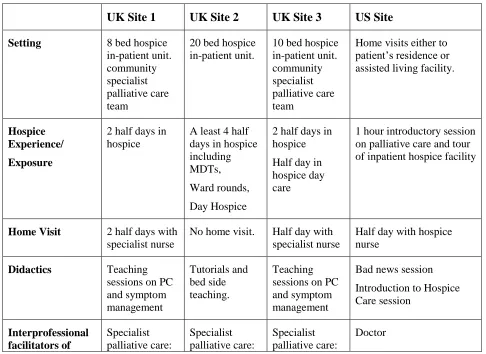
across all the UKMS sites, including writing a reflective essay, there are different experiences at 1
each of the three hospice sites (Table 1). 2
USMS Interprofessional Hospice Education: USMS students (approx.120 per year) experience a 3
half-day visit within the third-year Primary Care Clerkship (Table 1). Interpersonal and 4
communication skills are taught in small group sessions, students receive an introduction to an 5
inpatient hospice and hospice care, and visit hospice patients in their homes with a hospice 6
nurse. Students participate in the hands-on care of the hospice patient and engage in interviews 7
with patients and their family. Students submit a reflective essay. 8
The learning objectives for the students across all UKMS and USMS sites shared key 9
similarities, including: (1) gaining insight into the importance of teamwork in palliative care, (2) 10
understanding the scope of services that palliative care provides to the dying patient and his/her 11
caregivers, (3) interacting with dying patients and their caregivers, and (4) reflecting on the 12
experience. 13
14
Methods 15
Research design 16
This qualitative study used data collected from focus groups conducted with NMPCHPs who 17
teach medical students. 18
Data Collection 19
Focus groups enabled interaction between members of the group as well as the generation of 20
5
derived from the current literature to guide the discussions was used. Participants were recruited 1
from all NMPCHPs involved in medical student training in a palliative care setting (hospice, 2
community and hospital) at three clinical sites of a UK Medical School (UKMS) and a US 3
Medical School (USMS) site. 4
5
[image:6.612.64.550.367.721.2]6
Table 1 Description of the Programs and Sites 7
8
9
UK Site 1 UK Site 2 UK Site 3 US Site
Setting 8 bed hospice
in-patient unit. community specialist palliative care team
20 bed hospice in-patient unit.
10 bed hospice in-patient unit. community specialist palliative care team
Home visits either to patient’s residence or assisted living facility.
Hospice Experience/
Exposure
2 half days in hospice
A least 4 half days in hospice including MDTs,
Ward rounds,
Day Hospice
2 half days in hospice
Half day in hospice day care
1 hour introductory session on palliative care and tour of inpatient hospice facility
Home Visit 2 half days with
specialist nurse
No home visit. Half day with specialist nurse
Half day with hospice nurse
Didactics Teaching
sessions on PC and symptom management Tutorials and bed side teaching. Teaching sessions on PC and symptom management
Bad news session
6
student learning doctor, Nurses, chaplain,
Benefits advisor and Social Worker
doctor, Nurses
Bereavement Councilor
doctor, Nurse
Physiotherapist
Complimentary therapist
Nurse Practitioner
Hospice Nurse
1
2
Data Analysis 3
Focus groups were audio recorded and transcribed verbatim. The transcripts were analyzed 4
using constant comparative analysis by two authors (WHL and AG) to identify themes and 5
subthemes.19,20 Codes were labeled for facilitation of analysis using NVivo 8® (QSR 6
International Pty Ltd, Australia). To enhance internal validity, all authors used the coding 7
schema, agreed upon themes and subthemes to verify the accuracy of the coding. A final 8
analysis was conducted and re-confirmed by all authors. We compared each of the final codes 9
across each of the four sites. 10
Ethical Considerations 11
Institutional review board approval was obtained from Stony Brook Human Subjects 12
Committee Reference number 543131-2 and Hull York Medical School Ethics Committee Ref 13
1304. All NMPCHPs involved with teaching students were informed about the study by their 14
Lead Clinician/Team Leader. If they were interested they were then given a participant 15
information sheet and could ask questions before being consented, which included permission 16
for anonymous verbatim quotes. 17
18
7
A total of four 90-minute focus groups were conducted; one focus group at each site (UKMS=3; 1
USMS=1) (Table 2) and the majority of the participants were from a nursing background. 2
Table 2 Focus Group Participants 3
UK Site 1 UK Site 2 UK Site 3 US Site
1 palliative care nurse manager
4 specialist palliative care nurses
1 palliative care social worker
1 lecturer nurse practitioner
2 specialist palliative care nurses
1 lymphedema nurse
2 specialist palliative care nurses
1 palliative care physiotherapist
1 hospice nurse practitioner
5 hospice registered nurses
4
5
6
Two major themes regarding the palliative care programs and experiences were identified: (1) 7
perceived benefits and value of the experience and the NMPCHPs contributions to the 8
experience; and (2) the challenges and limitations of the experiences with suggestions for 9
overcoming these challenges. Several subthemes emerged from the two major themes. 10
Comparison across sites (UK and US) were strikingly similar. 11
Benefits and value of the experience 12
Provides a different perspective of palliative care. Medical students experience a unique 13
perspective of palliative care when they visit a patient’s home. Students realize the focus of care 14
8
The venue of care delivery was impactful as another participant explained: 1
“Some students are very surprised that death and dying occurs in the home...” 2
(US Site) 3
Nurses recognize their important role in orienting students and setting expectations prior to 4
bringing the student to meet the patient. 5
Provides a greater understanding of the significance of interprofessional teams. These
6
experiences offer medical students the opportunity to appreciate each profession’s unique 7
contributions to patient care. 8
Nurses reported that it was beneficial to have students accompany them and participate as a 9
member of the team “You are always learning when you have a student there. As you are 10
teaching you are learning. Many of the students have good advice, i.e. about medications.” 11
(US Site) 12
Gives patients a feeling of importance and opportunity to contribute. While the patients are 13
often more than happy to help the next generation of physicians, they also enjoy the ‘extra 14
attention’ they receive from medical students who are visiting. 15
“The majority of patients love when the medical students come, they love to tell 16
their stories and to have somebody sit there listening to them. It is therapeutic for 17
the patients; they comb their hair and primp themselves up a little because the 18
medical student is coming.” (US Site) 19
9
Readiness and interest of medical students. Although our programs strive to create positive 1
learning experiences for medical students, there have been instances where students were not 2
emotionally prepared to see a dying patient. The students were unsure what to do and seemed 3
nervous or frightened. In situations like these, the nurses often provide counseling to the student 4
afterwards and learn to ask students in advance if they have seen dying patients before so that 5
they can better prepare the students for the visits. 6
There are also other instances, while not often, where students demonstrate a lack of enthusiasm 7
by ‘yawning all the time’ and ‘showing no interest by slouching in every patient’s house’. 8
However, the nurses had mechanisms for dealing with this, for example using a little humor “… 9
yawning is okay but if you start snoring I am not going to be very happy”. (UK Site 3) 10
Concerns about patients feeling overwhelmed and expressing reservation. A limitation of the
11
experience is that it can be overwhelming for the patient when too many people are present 12
during the visit. Patients “might feel uncomfortable talking about very personal things. Hence 13
another vital role that nurses play is selecting suitable patients and ensuring that they are aware 14
and approve of having a medical student present at the visit. 15
“I think to say to a patient ‘do you mind if I bring a medical student’ is not very 16
empowering to say no so I say ‘I can come on this particular day with a medical 17
students or I can come on another day and I’ll be on my own’ and then they 18
choose and a lot will say ‘Oh no I’m quite happy for you to bring a medical 19
student with you’” (UK Site 1) 20
Lack of structure and the need for closing the feedback loop. A difficulty that the NMPCHPs
21
10
patients. This can be especially challenging when there are time constraints, and potential 1
changes in the health status of the patient. Moreover, the NMPCHPs are typically not provided 2
with the learning objectives for the experience and do not receive formal feedback from the 3
medical schools or students regarding whether or not the objectives were achieved. To make the 4
experience better structured preparatory sessions were suggested, along with: 5
“I think if we could get clearer outcomes…but its knowing what they’re expecting 6
to get from this and feedback afterwards because…I don’t know whether we’re 7
doing right or wrong.” (UK Site 1) 8
9
In addition, NMPCHPs sometimes find themselves in situations where they need to provide 10
emotional support for students who are not prepared for such visits. Thus, having more 11
information about the medical school program and the kinds of services and support it has to 12
offer would be very helpful in this process. 13
“I think there’s issues around support, you don’t know what they (medical students) are 14
bringing with them because you get very little detail about them. So if the students got a member 15
of their family that’s really ill, you often don’t know, so you have to do that sort of emotional 16
warning shot at the beginning of the session and I think sometimes that can be a big problem” 17
(UK Site 2) 18
19
Discussion 20
11
This study explored NMPCHPs’ perceptions of their contributions to the interprofessional 1
training of medical students in palliative care. 2
Two common themes emerged across the two programs: the perceived benefits and value of the 3
experience and the challenges and limitations of these experiences. Specifically, the NMPCHPs 4
viewed the benefits and value of the experience as providing a different perspective of palliative 5
care delivery, offering a greater understanding of the significance of interprofessional teams, 6
and giving patients a feeling of importance and the opportunity to contribute. These viewpoints 7
are similar to previous studies that report on medical students and patients’ perspectives.21-25 8
Qualitative studies on student perceptions of palliative care teaching showed that they found 9
their palliative care placement well supported, enjoyable, and a valuable learning opportunity. A 10
major cause of these positive perceptions was the supportive environment provided by the 11
staff.22 Students’ preconceived notions of hospice and hospice patients prior to the experience 12
were dispelled after visiting hospice patients in their homes.21 The home environment brought 13
comfort, joy, and a sense of security and support for the patient that were not consistent with the 14
students’ ideas that it would be a ‘gloomy’ place where someone was dying.21
This aligns with 15
the NMPCHPs’ views in the current study that the experience is markedly different from 16
classroom learning. 17
Students witness the impact of personal relationships that hospice personnel have on addressing 18
the emotional and spiritual needs of patients and their caregivers by alleviating caregiver stress 19
and patient anxiety.21 In this study, the NMPCHPs describe the benefit of these experiences as 20
an opportunity for medical students to appreciate the unique contribution that each profession 21
12
in teaching and do not find it too burdensome. They appreciate the opportunity to contribute to 1
students’ education and gain a feeling of importance from the experience.26 2
In terms of challenges and lessons learned from the experiences three subthemes emerged from 3
our findings. First, while our programs provided positive learning experiences, not all students 4
were fully equipped to interact or learn about dying patients. Available evidence suggests 5
medical students learn most from clinical encounters in palliative care and feel underprepared 6
and lacking in exposure to dying patients.5, 12, 27-32 Therefore, it is important for NMPCHPs to 7
understand that students coming to them may lack knowledge or interest about end-of-life care 8
and will need to develop mechanisms to overcome this challenge. Providing emotional support 9
for struggling students and the use of humor towards seemingly disinterested students were 10
ways that our NMPCHPs effectively addressed these challenges. 11
Interestingly, while some patients felt that having medical students visit them provided an 12
opportunity to contribute to their education and share their stories; for other patients it presented 13
a limitation. Some patients, as reported by the NMPCHP, expressed reservations and reluctance 14
in sharing personal accounts of their illness when there were too many people present. This can 15
be mitigated by NMPCHPs who are cognizant of this potential limitation and carefully select 16
appropriate patients. 17
Another barrier found in our study was that the NMPCHPs were not involved in developing the 18
curriculum, had no prior knowledge of student training in palliative care, and received minimal 19
feedback about student experiences. Similarly, a previously stated study showed that even 20
though staff wanted to contribute to undergraduate medical education they felt disengaged from 21
curriculum organization and had concerns about the students’ ability to cope.22
13
overcome these barriers would be to close the feedback loop through active and regular 1
communication between the NMPCHPs and program directors throughout the process of 2
curriculum development, implementation and revision. This would include orientation sessions, 3
post program follow-up and providing a list of available student support services. To ensure the 4
effective transformation of NMPCHPs from clinical experts to effective educators, ongoing 5
mentoring in addition to active participation in the learning cycle and feedback loop is needed.33 6
A striking finding was the similarity of themes identified in this study. Despite the differences 7
in definitions and practice of palliative care discussed in the introduction, NMPCHPs had 8
parallel philosophies and their aims and experiences for the students were markedly similar. 9
Therefore it is not surprising that common themes were identified in our two programs. 10
Strengths and limitations 11
To our knowledge this is the first study to explore medical students palliative care education 12
entirely from the NMPCHP perspective. It was conducted in two countries with different 13
healthcare systems and methods of medical education and therefore provides valuable insights 14
into the generalizability of the findings. Nevertheless, this study does have some limitations. 15
The students’ experiences at the different sites were relatively short and different, for example, 16
with regard to exposure to patients, team facilitation and didactics. Although the perceptions of 17
the NMPCHPs in their facilitation of medical student learning may have been site-specific, the 18
authors ensured that the identified themes were consistently seen across the sites and programs. 19
The focus group facilitator at the US site was involved with running the program which may 20
have inhibited the participants from commenting negatively about the palliative care program. 21
14
obtain the perceptions of a range of non-medical professionals; however, the majority of 1
professionals were nurses, which is a limitation. 2
Implications for future practice and research 3
NMPCHPs are commonly involved in the delivery of palliative care to patients. This study 4
shows it is feasible and beneficial to include NMPCHPs in the education of medical students. 5
The benefits extend beyond learning palliative care knowledge and skills as students participate 6
in the interprofessional workplace in a practical and experiential way.34 We would suggest that 7
the NMPCHPs views regarding topics they identify as important for the medical students to 8
learn be integrated into improving, planning and delivering undergraduate curricula in palliative 9
care and interprofessional learning. We recommend that NMPCHPs should have knowledge of 10
the students’ background in palliative care and how the students can access support services 11
when needed. NMPCHPs teaching in this setting would benefit from hearing about what the 12
students learn from their time spent with them, which could be accomplished effectively 13
through ongoing feedback. Utilizing NMPCHPs as educators is a practical and rewarding way 14
to achieve undergraduate medical education in both palliative and interprofessional care. It is 15
essential to provide support and mentorship of clinicians as they assume the role of clinical 16
educators in the interprofessional setting.33 17
Future research should determine if palliative care experiences result in lasting impact among 18
the students in terms of their ability to care for dying patients as medical practitioners. A 19
questionnaire completed during the first few years after graduating medical school might be 20
informative. Assessing the long term impact of such experiences may be difficult to achieve, 21
unless a more standardized approach to palliative care education is uniformly applied across 22
15
the feedback loop and engaging NMPCHPs in curriculum development and revision would have 1
in terms of their ability to teach future students. 2
Conclusions 3
Across the settings, interprofessional education of medical students was rewarding for staff and 4
provided an experiential learning opportunity in both palliative and interprofessional care. 5
Contributorship 6
AG, JW, LSP, SL designed the study and collected the data. WHL and AG were responsible for 7
the main analysis. AG is guarantor of the study and wrote the first draft of the paper but all 8
authors contributed to the manuscript and approved the final manuscript. 9
Funding Statement 10
No funding 11
Competing Interests 12
The authors declare there are no competing interests 13
Ethics approval 14
Institutional review board approval was obtained from Stony Brook Human Subjects 15
Committee Reference number 543131-2 and Hull York Medical School Ethics Committee Ref 16
1304. 17
Data sharing 18
16 References
1
2
1. Lloyd-Williams M, Dogra N. Attitudes of preclinical medical students towards caring for chronically ill 3
and dying patients: does palliative care teaching make a difference? Postgrad Med J 4
2004;80(939):31-4. 5
2. Gibbins J, McCoubrie R, Maher J, et al. Recognizing that it is part and parcel of what they do: 6
teaching palliative care to medical students in the UK. Palliative Medicine 2010;24(3):299-305. 7
3. Hegarty M, Currow D, Parker D, et al. Palliative Care in Undergraduate Curricula: Results of a 8
National Scoping Study [online]. Focus on Health Professional Education: A Multi-disciplinary 9
Journal 2010;12(2):97-109. 10
11
4. Anderson WG, Williams JE, Bost JE, et al. Exposure to death is associated with positive attitudes and 12
higher knowledge about end-of-life care in graduating medical students. J Palliat Med 13
2008;11(9):1227-33. 14
5. Radwany SM, Stovsky EJ, Frate DM, et al. A 4-Year Integrated Curriculum in Palliative Care for 15
Medical Undergraduates. American Journal of Hospice and Palliative Medicine 2011;28 (8):528-16
35. 17
6. General Medical Council. Tomorrows doctors: recommendations on undergraduate medical 18
education. Secondary Tomorrows doctors: recommendations on undergraduate medical 19
education 2009.
http://www.gmc-20
uk.org/education/undergraduate/tomorrows_doctors_2009.asp.
21
7. Liaison Committee on Medical Education. Functions and structure of a medical school. Standards for 22
accreditation of medical education programs leading to the M.D. degrees Secondary Functions 23
and structure of a medical school. Standards for accreditation of medical education programs 24
leading to the M.D. degrees 2016. http://lcme.org/publications/. 25
8. Queensland University of Technology in collaboration with Queensland Government, Flinders 26
University, Charles Darwin University, et al. Palliative care curriculum for undergraduates 27
(PCC4U). Secondary Palliative care curriculum for undergraduates (PCC4U) 2011. 28
http://www.pcc4u.org/.
29
9. Interprofessional Education Collaborative Expert Panel. Core competencies for interprofessional 30
collaborative practice: Report of an expert panel. In: Collaborative IE, ed. Washington, D.C.:, 31
2011. 32
10. Gamondi C, Larkin P, Payne S. Core competencies in palliative care: an EAPC White Paper on 33
palliative care education – part 1. European Journal of Palliative Care 2013;20(2):86-91. 34
11. Gamondi C, Larkin P, Payne S. Core competencies in palliative care: an EAPC White Paper on 35
palliative care education – part 2. European Journal of Palliative Care 2013;20(3):140-45. 36
12. MacLeod RD, Parkin C, Pullon S, et al. Early clinical exposure to people who are dying: learning to 37
care at the end of life. Medical Education 2003;37(1):51-58. 38
13. Sepúlveda C, Marlin A, Yoshida T, et al. Palliative Care: The World Health Organization's Global 39
Perspective. Journal of Pain and Symptom Management 2002;24(2):91-96. 40
14. Billings JA, Block S. Palliative care in undergraduate medical education: status report and future 41
directions. JAMA 1997; 278(9): 733-738. 42
15. Porter-Williamson K, von Gunten CF, Garman K, et al. Improving knowledge in palliative medicine 43
with a required hospice rotation for third-year medical students. Acad Med 2004; 79(8):777-44
782. 45
17
17. Morrison RS. Models of palliative care delivery in the United States. Curr Opin Support Palliat Care. 1
2013;7(2):201-6. 2
18. Morgan DL . Focus groups as qualitative research. Newbury Park, CA: Sage Publications, 1988.19. 3
Corbin JM, Strauss AL. Basics of qualitative research : techniques and procedures for developing 4
grounded theory / Juliet Corbin and Anselm Strauss: Sage Publications, Inc., 2008. 5
20. Patton MQ. How to Use Qualitative Methods in Evaluation: SAGE Publications, 1987. 6
21. Strano-Paul L, Lane S, Lu W-H, et al. Impact of a Home Hospice Visit Program on Third-Year Medical 7
Students: A qualitative analysis of student reflections. Journal of Palliative Care 2015;31 (1):5-8
12. 9
22. Arolker M, Barnes J, Gadoud A, et al. 'They've got to learn'--a qualitative study exploring the views 10
of patients and staff regarding medical student teaching in a hospice. Palliat Med 11
2010;24(4):419-26. 12
23. Gadoud A, Jones L, Johnson M, et al. Medical students talking to hospice patients. The Clinical 13
Teacher 2012;9(1):9-13. 14
24 Gadoud A, Adcock Y, Jones L, et al. Its not all doom and gloom”: Perceptions of medical students 15
talking to hospice patients. Jounal of Palliative Medicine 2013;16(9):1125-29. 16
25. Boland JW, Dikomitis L, Gadoud A. Medical students writing on death, dying and palliative care: a 17
qualitative analysis of reflective essays. BMJ Support Palliat Care 2016. 18
26. Harris DG, Coles B, Willoughby HM. Should we involve terminally ill patients in teaching medical 19
students? A systematic review of patient's views. BMJ Supportive & Palliative Care 2014. 20
27. Knight CF, Knight PF, Gellula MH, et al. Training our future physicians: A hospice rotation for 21
medical students. American Journal of Hospice and Palliative Medicine 1992;9(1):23-28. 22
28. Maxwell TL, Passow ES, Plumb J, et al. Experience with hospice: reflections from third-year medical 23
students. J Palliat Med 2002;5(5):721-7. 24
29. Cassileth BR, Brown C, Liberatore C, et al. Medical students' reactions to a hospice preceptorship. J 25
Cancer Educ 1989;4(4):261-3. 26
30. Fraser HC, Kutner JS, Pfeifer MP. Senior Medical Students' Perceptions of the Adequacy of 27
Education on End-of-Life Issues. Journal of Palliative Medicine 2001;4(3):337-43. 28
31. Morrison LJ, Thompson BM, Gill AC. A Required Third-Year Medical Student Palliative Care 29
Curriculum Impacts Knowledge and Attitudes. Journal of Palliative Medicine 2012;15(7):784-89. 30
32. Hull FM. Death, dying and the medical student. Medical Education 1991;25(6):491-96. 31
33. Pype P, Mertens F, Deveugele M, et al. 'I beg your pardon?' Nurses' experiences in facilitating 32
doctors' learning process--an interview study. Patient Educ Couns 2014;96(3):389-94. 33
34. Kusnoor AV, Stelljes LA. Interprofessional learning through shadowing: Insights and lessons learned. 34
Med Teach 2016:1-7. 35