warwick.ac.uk/lib-publications
Manuscript version: Author’s Accepted Manuscript
The version presented in WRAP is the author’s accepted manuscript and may differ from the
published version or Version of Record.
Persistent WRAP URL:
http://wrap.warwick.ac.uk/125316
How to cite:
Please refer to published version for the most recent bibliographic citation information.
If a published version is known of, the repository item page linked to above, will contain
details on accessing it.
Copyright and reuse:
The Warwick Research Archive Portal (WRAP) makes this work by researchers of the
University of Warwick available open access under the following conditions.
Copyright © and all moral rights to the version of the paper presented here belong to the
individual author(s) and/or other copyright owners. To the extent reasonable and
practicable the material made available in WRAP has been checked for eligibility before
being made available.
Copies of full items can be used for personal research or study, educational, or not-for-profit
purposes without prior permission or charge. Provided that the authors, title and full
bibliographic details are credited, a hyperlink and/or URL is given for the original metadata
page and the content is not changed in any way.
Publisher’s statement:
Please refer to the repository item page, publisher’s statement section, for further
information.
Abstract— As part of a large UK-funded autonomous vehicle
project (UK Autodrive), we examined pedestrian attitudes and road-crossing intentions using a real autonomous vehicle (AV) in an indoor arena. Two conceptual external human-machine interfaces (HMIs) were presented to display the vehicle’s manoeuvring intentions. Participants experienced a simulated road-crossing task to assess their interactions with the AV. Although neither HMI concept was entirely free of criticism, there were objective performance differences for a projection-based HMI concept, as well as critical subjective opinions in pedestrian responses to specific manoeuvring contexts. These provided insight into pedestrians’ safety concerns towards a vehicle where bi-directional communication with a driver is no longer possible, with suggestions for future vehicle HMI concepts.
I. INTRODUCTION
The IEEE community has demonstrated growing interest in the interaction between autonomous vehicles and vulnerable road users (VRUs) such as pedestrians and cyclists [1], usually focusing on the technology to detect pedestrians and their intention to cross [2]. Research has attempted to understand how vehicles should communicate their manoeuvring intention(s) to pedestrians and cyclists via external human-machine interaction (HMI) [3]. These interactions are particularly problematic when VRUs have to share the same environments with autonomous vehicles, for example, in semi-pedestrianised areas.
Lagström and Lundgren [4] have suggested that in the absence of an ability to communicate eye-to-eye or face-to-face with a driver, it is important and necessary to communicate the vehicle’s manoeuvring intentions to pedestrians. Google [5] have experimented with text and emoji-based visual interfaces, displaying e.g. vehicle speed or “do not cross” symbology on external vehicle-mounted screens for pedestrians. Alternatives also exist in the form of projection-based HMI concepts where relevant information is projected directly onto the road surface around the vehicle. Projection HMIs per se are not novel; Mercedes demonstrated a variant (described by [6]), London’s Barclay’s Cycle Hire / Santander Cycles (or “Boris Bikes”) have featured a projected image of a cyclist projected in front of the bicycle since 2015, and some vehicles project manufacturer logos etc. as “puddle lights” onto the ground under opened vehicle doors. A significant drawback of such technologies, however, is that without using potentially dangerously intense laser light to
* Research supported by UK Autodrive Project and Jaguar-Land Rover. Christopher G. Burns, Luis Oliveira and Stewart Birrell are with Experiential Engineering, WMG, The University of Warwick, Coventry CV4 7AL, UK (phone: +44-(0)2476-523950; (e-mail:
[email protected]; [email protected], and [email protected]).
project the symbology, projection HMIs simply do not work very well in rutted or strongly-textured road surfaces, or in bright daylight, and are largely best suited to either night or dimly-lit environments (e.g. an indoor car park or similar).
Some previous research in pedestrians’ interactions with autonomous vehicles has used virtual reality (VR) rather than in-vivo situations. Keferböck and Riener [6] investigated pedestrian actions when crossing a street with an incoming car at a pedestrian crossing with no traffic lights. Their study focused on how people negotiate the space with autonomous cars and the feedback given by an autonomous vehicle, for example, when it indicated that it was about to stop or to move off. Doric et al. [7] had participants estimate the speed and distance of passing vehicles as they had to cross the road in a virtual environment. Another study using a VR environment featured vehicles driving past a pedestrian crossing and evaluated the impact of vehicle’s external lights on the user experience [8]. A similar study used VR to simulate AVs with ‘eyes’ on the headlights that ‘see’ pedestrians and indicate an intention to stop [9]. Also using VR, Li et al. [10] and Burns et al. [11] indicated that vehicle kinematics are important factors when pedestrians make crossing decisions.
While there has been recent work on communication between vehicles and road users, especially at pedestrian crossings, very little published work exists on pedestrian interactions with actual, un-crewed autonomous vehicles in motion [3].
In the present study, we were interested in understanding the point and duration of the time period where participants would or would not choose to step into the shared pedestrian space based on an AV’s communication and manoeuvring. We hypothesised that if one of the HMI designs was measurably superior in communicating the vehicle’s manoeuvring intentions, the time duration where the participant would still be willing to step into the shared pedestrian space would be maximised, based on the nature of the manoeuvres themselves and the relative level of ambiguity of the HMI communication. Two HMIs were evaluated; it is hypothesised that as the “Absolute” HMI system we used displayed the precise location where the pod will commence a turn, ambiguities should be reduced versus the “Relative” HMI system, which used a system analogous to conventional car turn-signals.
Peter Thomas and Sumeet Iyer are with Jaguar-Land Rover UK, National Automotive Innovation Centre, Lord Bhattacharya Building, Lord Bhattacharya Way, University of Warwick, Coventry CV4 7AL,UK (e-mail:[email protected];
Pedestrian Decision-Making Responses to External
Human-Machine Interface Designs for Autonomous Vehicles *
Figure 1 – Study diagram
[image:3.595.53.287.596.729.2]Figure 2 - Test vehicle (with dashed livery) driving through Route 1
Figure 3 – Vehicle with “Absolute HMI” indicating the intended path (Route 1), from the point of view of participant 2.
Figure 4 – Vehicle with “Relative HMI” indicating turning right
II. METHODS
Testing took place at RDM Automotive’s indoor testing facility, the Urban Development Lab (UDL); a 30m x 20m warehouse space decorated with obstacles, mannequins, furniture props and moveable partitions to simulate walls. Simulated shop-front images were projected onto the outer walls to add visual complexity to the scene. The indoor arena was configured to simulate a semi-pedestrianised area, with a main “street” approximately 6m wide and 15m in length. On the right side of the arena, a series of six 3m x 4.5m rectangles were marked with tape or partitions. The first rectangle comprised four partition walls as a fixed obstacle. The second three squares were demarcated as parking spaces with coloured tape boundaries and chevron stripes. The first and last of these parking spaces were unoccupied while the second was occupied by another AV (figure 2). The 5th rectangle was unmarked and acted as a street corner into which our AV (hereafter, “the pod”) could turn. The sixth and final rectangle was populated with mannequins, furniture and a guard railing, resembling a café area. The arena layout and driven routes are illustrated in Figure 1, and photos of the actual test situations in Figure 2-4.
A. Participants
Participants were 34 employees at Jaguar-Land Rover’s Whitley headquarters building in the UK. Participant genders and ages were not recorded per JLR’s GDPR compliance policies, and ethical concerns were addressed via JLR’s internal review board. Volunteers were recruited from non-engineering roles, e.g. finance, design, project managers etc. Data from three participants was discarded due to technical failures during the timing data acquisition, and for one participant’s psychometric data collected via Google Forms on an iPad tablet. No participant incentives were used during recruitment.
Participant viewing location was a between-groups factor. One participant stood up by the café area, and a second participant stood on the opposite, left side of the arena, level with the empty “street corner” rectangle. Researchers chaperoned both participants at all times, and a safety officer from RDM Automotive was responsible for observing the vehicle behaviour and using a wireless emergency stop device if needed.
B. Vehicle
An Aurrigo PodZero low-speed autonomous transport vehicle acted as the main stimulus for participants (images and specifications can be viewed at www.aurrigo.com). The PodZero vehicle is 1.46m wide, 2.01m high, and 2.49m in length. Although capable of higher speeds, the pod drove around the arena at a constant 1.5m/sec.
C. Routes
approximately 15-17 seconds from the time the pod first moved off.
D. External human-machine interfaces
The autonomous pod was outfitted with two HMI concepts to indicate its manoeuvring “intentions”. For the “Absolute” HMI concept, a short-throw digital projector was mounted on the pod’s centre-line beneath the front windshield, projecting animated striped lines approximately 1 metre on the floor in front of the pod as it manoeuvred (see figure 3). These lines “bunched” together when the pod slowed or stopped, expanded away from each other under acceleration until a constant speed was achieved, and could flex to point right or left when the pod turned. The Absolute HMI also featured a large blue arrow projected onto the floor indicating the precise position where the pod would initiate a turn. The arrow was projected from the ceiling of the arena area and not from the pod itself as this would have been technically challenging to accomplish. However, participants were given the impression that the blue arrow was intrinsically tied to the pod’s manoeuvring and was being projected by the vehicle itself in the manner of a “Wizard of Oz” manipulation.
The pod was also fitted with RGB LED light strips on all four wheel-arch fairings (figure 4). These light strips were illuminated solid green when the pod was moving, flashed on-and-off amber similar to conventional car turn-signal lights when the pod turned a corner, or glowed red when the pod was stopped with brakes applied. The LED lighting was referred to as the “Relative” HMI concept.
E. Data collection
Each participant responded using an ASUS tablet PC running a custom Python script. The script was synchronised with the pod’s control software, and placed a large green button on the tablet touchscreen used as if it were a “dead man switch”. When the pod began to move off, participants pressed and held down the green button until they no longer felt it would be safe for them to step out, resulting in a timed duration as a dependent score. The timing values obtained were accurate +/- 0.25 seconds. Participants also completed the Trust in Automated Systems questionnaire [12], the “usefulness” and “satisfaction” scales from the System Acceptance Scale [13], and the “perceived intelligence” scale from the Godspeed Questionnaire [14].
Short qualitative responses were also obtained from participants via open-ended questions asking about positive and negative aspects of each HMI, their preferred method for presentation of the vehicle’s intended path of travel and behaviour, and the reason behind their choices. Responses were analysed using pivot tables in Excel together with the constant comparative method [15] to highlight relevant themes mentioned by participants.
F. Procedure
Participants were accompanied by experimenters at all times, and tested in pairs from groups of 4. The layout of the arena was explained and brief questions answered. They were instructed that they should not move from their location while observing the pod, and that a safety officer was present with an emergency stop device keyed to the pod. The participant’s task was to imagine that they wanted to walk to a shop front
projected on a wall several metres away, and that they should imagine that the arena in front of them, unless otherwise marked or obstructed, was a shared space where pedestrians or vehicles may be present. Participants were told to imagine they could walk anywhere *except* areas which were marked as a parking spot or otherwise obstructed by partitions or furniture, essentially pointing to a direct route to the target shopfront. Participants were instructed to press and hold the green button on the screen at the start of each lap, and to lift their finger off the green button when they would no longer feel happy or safe to start walking their route - i.e. participants held down the button for as long as they were willing to step out. Participants were lead to two specific viewing locations and watched a single demonstration of each of the three pod routes while the procedure was explained to them; they practised using the tablet PCs at this time. Participants’ attention was drawn to both the arrows and animations presented on the floor and the signalling lights on the wheel fairings, since during pilot testing we found that participants could focus exclusively on the vehicle itself and not notice projections on the floor. The order of the presentations was randomised for each pair of participants. After the practise sessions, each pair of participants was shown three repetitions of routes 1 and 2 and a single instance of route 3, for a total of seven presentations per HMI concept. After these seven scenarios were presented, the first pair of participants were led to a waiting area to complete the questionnaires while the second pair of participants began testing. The procedure was then repeated for the HMI concept the participant had not yet viewed, resulting in a between- and within-groups experimental design with repeated measures.
III. RESULTS
A. Route 1 – Simulated parking
The parking manoeuvre in Route 1 did not interfere with either participant’s route to the hypothetical destination. Comparing results from both participant viewpoints, no effect of participant location was present (F(1,29)=177.942, p=N.S., partial eta2=0.86). The Absolute HMI concept displayed the
lines and directional arrow on the floor (figure 3), and the Relative HMI activated its turn signals (figure 4), both starting at 8.5 seconds with the parking turn initiating at 11.5s. A significant effect of HMI type was present here (F(1,29)=29.8069, p<0.0001, partial eta2=0.507). For the
Absolute HMI concept (lines and arrow), 18 of 31 participants kept the response button depressed throughout the entire manoeuvre, indicating that they felt sufficiently happy/safe to have stepped out at any time; their cumulative mean response duration was 18.909s. For the Relative HMI condition (indicator LEDs), response durations were significantly shorter than for the Absolute HMI at 11.548s – indicating a reduced willingness to cross – with four individuals deciding they would not cross after less than 5 seconds exposure to the pod’s route, where it would have traversed less than 1/3rd of the total route.
B. Route 2 – Simulated turning into a lane
(F(1,29)=0.739, p=N.S., partial eta2=0.86), with decision
times for the Absolute HMI (10.722s) being very similar to the Relative HMI (10.512s) and within the previously specified +/- 0.25s system latency. Similarly, no effects of participant location were present (F(1,29)=1.486, p=N.S, partial eta2=0.049).
C. Route 3 – Pod drives past
This manoeuvre would interfere only with participants at location 2, where the pod drove past their position laterally, crossing their intended path to the hypothetical destination. In this scenario, the Absolute HMI displayed the “striped lines” in front of the pod in their “constant speed” setting. With no turns until the pod had passed both participants, the Relative HMI displayed steady green illumination on the fairings. Only a significant effect of participant location was present (F(1,29) = 76.661, p<0.0001, partial eta2=0.0.726); mean participant
crossing durations at location 2 were significantly shorter (9.3s) than at position 1 (26.05s). The lack of any turn indication would have been apparent after 8.5s and the failure to turn on the Route 2 path would have been apparent after 13s.
The majority of participants at location 1 never indicated that they felt it was not safe to cross, reflected in their high mean response time. Of the 16 participants standing at location 1, eleven never indicated that it was unsafe to cross when they were presented with the Absolute HMI (lines). For the Relative HMI (LEDs), 15 participants never indicated it was unsafe to cross. The average response time of participants at location 2 occurred after the turning indication would have been made for either Route 1 or 2 and before the pod would have started turning on either of these routes. All participants at location 2 made the ‘not happy to cross’ decision before the pod reached the point at which it would have turned on Route 2 (13s).
D. Psychometric Data
Overall, 55.9% of participants preferred the Absolute HMI when asked (19 out of 34). However, their trust in either HMI, as measured by the Jian et al. [11] inventory, was not significantly different for either the trust factor (items 6-12; t(32)=-0.467, p=N.S., 33.64 vs. 34.18), distrust factor (items 1-5; t(32)=-1.275, p=N.S., 12.09 vs. 13.39) or summed total trust scores (t(32)=-1.711, p=N.S., 45.73 vs. 47.58). With a maximum possible score of 84, mean summed trust scores for both HMI concepts were only slightly more than 50% of the maximum (42 points).
Participants did not find either HMI concept significantly more useful (t(32)=0.118, p=N.S.) or satisfying (t(32)=-0.739, p=N.S.) using the Van der Laan et al [12] Acceptance Scales. Neither HMI concept was rated significantly higher on the Godspeed [13] perceived intelligence scale (t(32)=-0.234, p=N.S.).
E. Qualitative data
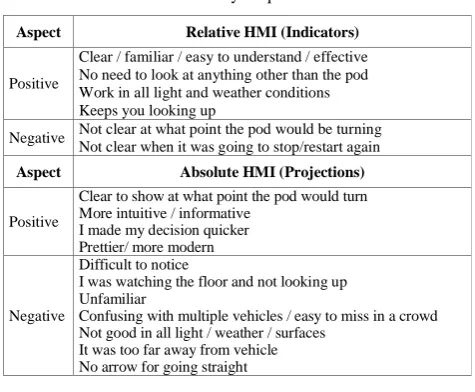
Participants expressed their opinions about the positive and negative aspects of each interface, as can be seen in Table 1. Overall, they considered the Relative HMI clear to see and easy to understand. For example, participant 6 (P6) declared that the indicators “were clear to understand as it is the current method of communicating to pedestrians a vehicle’s intent”. However, the Relative HMI lacked a precise indication of the path that the pod would take, as mentioned by P21: “I was
never sure if the vehicle was going to turn right on the road or into the parking bay so I am more likely to assume the worst and not move until sure”.
[image:5.595.305.543.289.485.2]The richness of information provided by the Absolute HMI was appreciated by participants, as they acknowledged that it was able to show intended precise direction and changes in speed when the vehicle was stopping or driving off. P22 stated that it “[a]dds valuable information, not only direction taken but exactly where (it) will turn”. However, a number of limitations were listed by participants. For example, they “[d]isliked having to watch the ground and the pod (…) it splits your attention and if you missed the arrows you could easily walk when it is unsafe to do so” (P32). Participants also wondered “how effective it would be in different environmental conditions, surfaces etc.” (P34). Even when presented with the Absolute HMI, P29 said they decided “to wait a few more seconds to be sure it’s safe and then go”.
Table 1 - Summary of qualitative data
Aspect Relative HMI (Indicators)
Positive
Clear / familiar / easy to understand / effective No need to look at anything other than the pod Work in all light and weather conditions Keeps you looking up
Negative Not clear at what point the pod would be turning Not clear when it was going to stop/restart again
Aspect Absolute HMI (Projections)
Positive
Clear to show at what point the pod would turn More intuitive / informative
I made my decision quicker Prettier/ more modern
Negative
Difficult to notice
I was watching the floor and not looking up Unfamiliar
Confusing with multiple vehicles / easy to miss in a crowd Not good in all light / weather / surfaces
It was too far away from vehicle No arrow for going straight
IV. DISCUSSION
Rothenbucher et al. [16] reported that 65 of 67 pedestrians would walk in front of an (apparently) autonomous vehicle (although they did not know it was an autonomous vehicle until they attempted to make eye contact with a non-existent driver, and the stimulus vehicle was not actually autonomous in any case), which they interpreted as trust in the AV’s programming. It has also been suggested that providing the user with knowledge of automation capabilities (in this case in-vehicle) can lead to a calibration of trust to appropriate levels [17]. These findings are not wholly in agreement with the present study for either behavioural decisions or psychometric self-reports; our trust inventory findings indicated ambivalence at best from a scoring perspective. Interestingly, our findings showed small indications of more “ingrained” road-crossing behaviours, which were irrespective of the HMI displayed; e.g. decisions being made prior to the HMI displaying any information at all. As our participants were adults with years of personal experience as pedestrians, cautious behaviours are unsurprising when working with an actual vehicle.
participants still indicated that it was unsafe to walk even with the pod showing its intention to take Route 1, which was not in conflict with the hypothetical walking path. Thus, either they did not fully understand the HMI or they opted not to cross for a reason unrelated to the HMI. It is also possible that they understood but did not fully trust the pod’s communication in some way. For the Relative HMI (indicators), participants suggested they would not cross at approximately the same instant the pod began to turn. Therefore, participants had to rely on the actual movement of the vehicle to be certain of its trajectory. This strategy seems similar to the observations in a recent study: pedestrians tend to infer the intentions of cars from their behaviours and movement patterns [18].
For Route 2, participants’ mean response times indicated they would not step out before the manoeuvring turn began, and, before the Absolute HMI had displayed the manoeuvring intention. We surmised that when the pod did not turn into the parking spot, participants did not want to risk stepping out, and may have been confused by the potential proximity of the Absolute HMI directional arrows for Routes 1 and 2, or by the ambiguity of the proximity of the parking space next to the arrow. The time difference between the pod not turning to park and actually turning the corner was very brief; perhaps 2 seconds. The parking space and street corner offered two potential routes, one of which could have been dangerous for the participant, and thus participant responses to either HMI concept here were almost identical, with the HMIs apparently insufficient to assuage pedestrians’ natural caution. The absence of significant timing differences between HMI concepts could also imply that although the participants understood the intended path of the pod would eventually conflict with their planned walking path, they felt safe to walk until the pod was physically much closer. Thus, it is possible that some part of their decision to step out remains based upon the proximity and speed of the pod rather than relying on the information from the HMI.
For Route 3, participants at location 1 apparently realised that the absence of any HMI would mean no intended turns, displayed crossing duration intentions almost three times as long as at location 2, and may have relied on the HMI for their judgements. For location 2, participants seemingly arrived at a conclusion much more quickly, thus realising that it would not be safe to step out as soon as they realised that the pod would not park or turn and would drive in front of them.
It is arguable that both of the HMI concepts were understood quite well for Routes 1 and 3, and indeed, a majority of participants stated that they preferred the Absolute HMI concept with evidence that the Absolute HMI concept was superior in a practical sense based on longer intended crossing time-durations for routes 1 and 3. It is also apparent that conventional car turn-signalling HMIs are inadequate for AVs and that there is room for alternative designs to be developed here. It also appears that in interactions where there is moderate ambiguity regarding the vehicle’s intentions (Route 2), participants tended to rely, or perhaps, “fall-back”, on innate judgements of speed and distance to determine the situational risk, and indeed, may have sensibly erred on the side of personal safety.
It seems apparent that HMI designs alone are not sufficient to evoke strong pedestrian confidence in autonomous vehicles, although in our study, pedestrians seemed unlikely to impede the pod, opting not to step into a roadway if there was any ambiguity of the vehicle’s intention. In itself, perhaps a small degree of ambiguity may actually be a somewhat desirable outcome, where pedestrians do not un-necessarily impede the pod, nor do pedestrians place themselves in potential danger when they feel it can be avoided simply by waiting.
CONCLUSION
This study presented a comparison of two different concepts for the communication of an AV’s manoeuvring intentions to pedestrians. One concept presented flashing LEDs similar to existing car indicators (Relative HMI), which would flash before the vehicle would turn. The second concept was the projection of animated striped lines on the floor in front of the vehicle with arrows indicating the precise position where the pod would initiate a turn (Absolute HMI).
We conclude that, for specific manoeuvres, participants could decide faster whether it was unsafe to walk in front of the vehicle when they were presented with the Absolute HMI. The arrows on the floor indicating the precise turning point could improve the efficiency of transit for pedestrians when negotiating the shared spaces with autonomous vehicles. However, the levels of trust, acceptance and perceived intelligence were not significantly different between the two interfaces despite the improved, objective behavioural decision durations (where “longer is better”). The lack of significant differences here was corroborated by the qualitative opinions – despite increased crossing performance intentions with the Absolute HMI concept in Routes 1 and 3 - which were divided between both interfaces in terms of the positive and negative aspects of each HMI presented to participants. Even though participants appreciated the precise indication of behaviour shown by the Absolute HMI, it still produced numerous negative comments. Participants were concerned about practical issues such as having to look at the ground and not at the vehicle, and pointed out the limitations of this method in different environments and weather conditions. Our results indicated that still more research is needed to define the ideal communication methods between AVs and pedestrians which are both efficient and perceived as trustworthy.
ACKNOWLEDGEMENTS
REFERENCES
[1] A. Rasouli, I. Kotseruba, and J. K. Tsotsos, “Agreeing to cross: How drivers and pedestrians communicate,” in 2017 IEEE Intelligent Vehicles Symposium (IV), 2017, no. Iv, pp. 264–269.
[2] W. Morales-Alvarez, M. J. Gomez-Silva, G. Fernandez-Lopez, F. GarcA-Fernandez, and C. Olaverri-Monreal, “Automatic Analysis of Pedestrian’s Body Language in the Interaction with Autonomous Vehicles,” in 2018 IEEE Intelligent Vehicles
Symposium (IV), 2018, vol. 2018–June, no. Iv, pp. 1–6. [3] N. Merat, T. Louw, R. Madigan, M. Wilbrink, and A.
Schieben, “What externally presented information do VRUs require when interacting with fully Automated Road Transport Systems in shared space?,” Accid. Anal. Prev., vol. 118, no. October 2016, pp. 244–252, Sep. 2018.
[4] T. Lagström and V. Lundgren, “AVIP - Autonomous vehiclesínteraction with pedestrians - An investigation of pedestrian-driver communication and development of a vehicle external interface,” Chalmers University of Technology, 2015.
[5] C. P. Urmson, I. J. Mahon, D. A. Dolgov, and J. Zhu, “Pedestrian notifications,” 03-Dec-2015.
[6] F. Keferböck and A. Riener, “Strategies for Negotiation between Autonomous Vehicles and Pedestrians,” in Mensch und Computer 2015 Workshopband, 2015, pp. 525–532.
[7] I. Doric et al., “A Novel Approach for Researching Crossing Behavior and Risk Acceptance,” Proc. 8th Int. Conf. Automot. User Interfaces Interact. Veh. Appl. Adjun. - Automotive’UI 16, pp. 39–44, 2016.
[8] M.-P. Böckle, A. P. Brenden, M. Klingegård, A. Habibovic, and M. Bout, “SAV2P – Exploring the Impact of an Interface for Shared Automated Vehicles on Pedestrians’ Experience,” Proc. 9th Int. Conf. Automot. User Interfaces Interact. Veh. Appl. Adjun. - AutomotiveUI ’17, pp. 136–140, 2017.
[9] C. Chang, K. Toda, D. Sakamoto, and T. Igarashi, “Eyes on a Car: an Interface Design for
Communication between an Autonomous Car and a Pedestrian,” Proc. 9th ACM Int. Conf. Automot. User Interfaces Interact. Veh. Appl. (AutomotiveUI ’17), no. Figure 1, pp. 65–73, 2017.
[10] Y. Li, M. Dikmen, T. G. Hussein, Y. Wang, and C. Burns. “To Cross or Not to Cross: Urgency-Based External Warning Displays on Autonomous Vehicles to Improve Pedestrian Crossing Safety,” in Proceedings of the 10th International Conference on Automotive User Interfaces and Interactive Vehicular Applications - AutomotiveUI ’18, 2018, pp. 188–197.
[11] C.G. Burns, L. Oliveira, V. Hung, P. Thomas, A. Mouzakitis, and S. Birrell, (2019). Pedestrian attitudes to shared-space interactions with Autonomous Vehicles – A virtual reality study. 10th International
Conference on Applied Human Factors and
Ergonomics (AHFE), Washington, USA, 24-28th July.
[12] J.-Y. Jian, A. M. Bisantz, and C. G. Drury,
“Foundations for an Empirically Determined Scale of Trust in Automated Systems,” Int. J. Cogn. Ergon., vol. 4, no. 1, pp. 53–71, Mar. 2000.
[13] J. D. Van Der Laan, A. Heino, and D. De Waard, “A simple procedure for the assessment of acceptance of advanced transport telematics,” Transp. Res. Part C Emerg. Technol., vol. 5, no. 1, pp. 1–10, 1997. [14] C. Bartneck, E. Croft, and D. Kulic, “Measuring the
anthropomorphism, animacy, likeability, perceived intelligence and perceived safety of robots,” in
Proceedings of Metrics for Human-Robot Interaction, Workshop in affiliation with the 3rd ACM/IEEE International Conference on Human-Robot Interaction (HRI 2008), 2008, pp. 37–43.
[15] B. G. Glaser, “The Constant Comparative Method of Qualitative Analysis,” Soc. Probl., vol. 12, no. 4, pp. 436–445, Apr. 1965.
[16] D. Rothenbücher, J. Li, D. Sirkin, B. Mok, and W. Ju, “Ghost driver: A Platform for Investigating Interactions Between Pedestrians and Driverless Vehicles,” in
Adjunct Proceedings of the 7th International Conference on Automotive User Interfaces and Interactive Vehicular Applications - AutomotiveUI ’15, 2015, pp. 44–49.
[17] S. Khastgir, S. Birrell, G. Dhadyalla and P. Jennings. 2018. Calibrating Trust through Knowledge:
Introducing the Concept of Informed Safety for Automation in Vehicles. Transportation Research Part C: Emerging Technologies, 96, 290-303.
[18] D. Dey and J. Terken, “Pedestrian Interaction with Vehicles: Roles of Explicit and Implicit