Embodied-linguistic conceptual representations during
metaphor processing
Pei Q. Liu
MSc
This thesis is submitted in partial fulfillment of the requirements for the degree of Doctor of Philosophy.
Dec 2018
Declaration
The thesis contains original work completed solely by the author under the supervision of Dr Louise Connell and Dr Dermot Lynott, and has not been submitted in the same form for the award of a higher degree at this institution or elsewhere.
This research was supported by a teaching studentship from Lancaster Uni-versity Psychology Department.
Name: Pei Q Liu
Signature:
Acknowledgements
Acknowledgements
As I consider these four years, I am filled with gratitude. Although this thesis is a result of many writing sessions at 6am, many error messages from R, and many episodes of the imposter syndrome, I realise that the most crucial things of my PhD are the things that I have not worked for.
My thanks first go to my supervisors, Dr Louise Connell and Dr Dermot Lynott. Thank you for putting your faith in me when I applied for the PhD. During these four years, you have motivated me with your uncompromising standard and your attention to detail. Meanwhile, you have been most generous in your support in different areas of my life. More importantly, I have not met a couple as devoted and compatible as you two. I admire you for being partners in your lives as well as your work. This PhD would not have been so enjoyable without your trust, consideration, and respect for each other. In so many ways, I consider myself fortunate to have you as my mentors and patterns.
I am also grateful to the Department. I do not need to exaggerate to say that the Psychology Department in Lancaster is the warmest department that I have ever known. It is because all the staff and PhD students are committed to create a supportive and inclusive environment. Special thanks to Szilvie, Han, Christian and Francesca for sacrificing their time to help me with my EEG studies; to Rob for being the statistics guru for the whole department; to Barrie and Simon for the ongoing technical support; to James B who has looked out for me from the first day I came to the PhD coffee and cakes reception in C62. There are still numerous people that I have not mentioned by name. Thank you for every kind smile, every encouraging word and every get-together.
Thanks and love to Christiana and John, who have made the office loving and fun. I am so glad we have stuck around from the first day until the end.
My profound gratefulness to my mom. She did her PhD in linguistics when I was a teenager, and I spent a lot of time with her fellow students. She allowed me to participate in their conversations, from which I apprehended the charm and exhiliaration of research. Those years with her and her fellow students planted the seed of academia in my heart, and from then on, she has never failed to encourage and guide me in my pursuit.
To Eric Ke Qiao: You have been with me in every step, always being the first pilot of my experiments and the first audience of my talks. You have comforted and supported me, and have given me more joy than I can ever imagine. Marrying you is the greatest achievement of my PhD.
I am your shield and your exceedingly great reward.
Abstract
Abstract
Although metaphor processing has fascinated linguists and psychologists alike, the conceptual representations involved have not been fully examined. In the present thesis, I propose metaphor processing should be viewed as an aspect of language processing, involving conceptual representations that are both embodied and linguistic. The thesis includes five self-contained papers, which showed a detailed picture of conceptual representation that was flexible and dynamic.
In the paper contained in Chapter 3, I proposed an operational definition of the effort to generate embodied simulation (i.e., the ease-of-simulation measure, or EoS). As a composite measure, EoS accounted for the speed of successful metaphor processing better than other rating tasks, which suggested that EoS could account for the underlying mechanism of metaphor processing, thus assumed to be embod-ied simulation. In papers reported in Chapters 4, 5 and 7, I studembod-ied influences of embodied simulation and linguistic distributional patterns on metaphor process-ing. These two components were both found to contribute to metaphor processing, and the interplay between them were were influenced by factors such as the depth of processing required and the time available for responses. Papers reported in Chapter 6 and 7 examined the EEG activations of embodied and linguistic com-ponents, in literal language processing and metaphor processing respectively. Both studies revealed that embodied and linguistic components performed various func-tions, each being activated at several time points. The linguistic component was activated first between 200ms-400ms after the stimulus onset, suggesting that it was involved in lexical and sublexical processing, which also supported the idea that it had a speed advantage compared to the embodied component. The lat-ter was activated around 400ms, being responsible for semantic representations. Moreover, both components were activated again at the later stage of processing, indicating that both components were used and integrated for decision making.
Authorship
Statement of Authorship
Here is a breakdown of contribution made by Pei Liu (the student), and Louise Connell and Dermot lynott (the supervisors) to each chapter. The order in which the names appear roughly indicates the proportion of contribution in declining order unless joint contribution is specified.
Chapters 1 and 2 (literature reviews)
• Principle author: Pei Liu
• Comments: Louise Connell and Dermot Lynott
Chapter 3 (submitted paper)
• Conception and creation of study: Louise Connell, Pei Liu, and Dermot Lynott
• Data collection: Pei Liu supervised by Louise Connell
• Writing manuscript: Pei Liu
• Revision: Pei Liu and Louise Connell
• Comments: Dermot Lynott
Chapter 4 (submitted paper)
• Conception and creation of study: Louise Connell, Pei Liu, and Dermot Lynott
• Data collection: Pei Liu supervised by Louise Connell
• Writing manuscript: Pei Liu
• Revision: Pei Liu and Louise Connell
• Comments: Dermot Lynott
Chapter 5 (empirical paper in preparation)
• Conception and creation of study: Pei Liu and Louise Connell (jointly)
• Data collection: Pei Liu supervised by Dermot Lynott
• Writing manuscript: Pei Liu
• Revision: Pei Liu and Louise Connell
Contents
Declaration . . . i
Acknowledgements . . . ii
Abstract . . . iv
Statement of Authorship . . . v
1 A New Look on Metaphor Processing 1 1.1 Introduction . . . 1
1.2 Metaphor Processing from the Grounded Perspective . . . 16
1.3 Grounded metaphor processing . . . 31
1.4 The present thesis: metaphor processing involving simulation-linguistic conceptual representations . . . 38
2 Using EEG to Study Metaphor Processing 42 2.1 Introduction . . . 42
2.2 EEG in psycholinguistics . . . 43
2.3 Critical evaluation of ERP components . . . 48
2.4 A better way for ERP . . . 55
3 Ease-of-Simulation Norms 63 3.1 Abstract . . . 2
3.2 Defining Ease of Simulation . . . 4
3.3 Norming Procedure . . . 7
3.4 Norms Validation . . . 14
3.5 General Discussion . . . 18
3.6 References . . . 22
4 Embodied and Linguistic Components in Metaphor Processing 97 4.1 Abstract . . . 2
4.3 Grounded Views of Language Processing . . . 8
4.4 Present Study . . . 11
4.5 Experiment 1: Sensibility Judgement Task . . . 15
4.6 Experiment 2: Interpretation Generation Task . . . 27
4.7 Cross-Experiment Analyses . . . 34
4.8 General Discussion . . . 38
4.9 References . . . 44
5 Linguistic Shortcut under Time Constraints 153 5.1 Abstract . . . 2
5.2 Grounded Views of Language Processing . . . 3
5.3 Present Study . . . 7
5.4 Pilot Study . . . 8
5.5 Experiment 1: Sensibility Judgement Task . . . 13
5.6 Experiment 2: Interpretation Generation Task . . . 29
5.7 Cross-Experiment Comparison . . . 40
5.8 General Discussion . . . 45
5.9 References . . . 51
6 ERP Markers of Embodied and Linguistic Components in a Prop-erty Verification Task 212 6.1 Abstract . . . 2
6.2 Embodied-Linguistic Conceptual Representations . . . 4
6.3 Present Study . . . 6
6.4 Experiment 1: Behavioural Modality Switching Costs . . . 8
6.5 Experiment 2: ERP Effects of Modality Switching Costs . . . 21
6.6 General Discussion . . . 36
6.7 References . . . 40
7 ERP Markers of Embodied and Linguistic Components during Metaphor Processing 271 7.1 Abstract . . . 2
7.2 Simulation and Linguistic Representation of Metaphors . . . 5
7.3 ERP Markers of Metaphor Processing . . . 7
7.4 Present Study . . . 8
7.6 Experiment 2: EEG Study . . . 23
7.7 General Discussion . . . 41
7.8 References . . . 47
8 General Discussions 335 8.1 Aims of thesis . . . 335
8.2 Evaluation of findings . . . 338
8.3 Contributions . . . 343
8.4 Limitations and future directions . . . 349
8.5 Concluding remarks . . . 356
List of Figures 358 List of Tables 362 R packages 364 Appendices 365 .1 Appendix A . . . 365
.2 Appendix B . . . 366
CHAPTER
1
A New Look on Metaphor Processing
1.1 Introduction
Metaphor is a use of language where a term or a phrase is applied to an ob-ject to which the term or phrase cannot be applied literally. Various parts of speech can all be used metaphorically, including nouns (e.g., My surgeon is a butcher), verbs (e.g., Susanflew down the street on her bike), or adjectives (e.g., bright fu-ture). Researchers have found that metaphors are pervasive in language, appearing more often than noticed (Coulson & Van Petten, 2002). Furthermore, compre-hension of metaphors can be automatic and irrepressible (Glucksberg, Gildea, & Bookin, 1982). In other words, metaphors do not seem to register as an artifice or require extra effort to process. Instead, they are an indispensable part of our daily language. If that is the case, how do people comprehend a metaphor? What gives rise to the metaphoric meaning?
the focus is on the theoretical and empirical work of psycholinguists and cogni-tive scientists. Through their effort, many factors have been identified as affecting metaphor processing (e.g., conventionality, familiarity or aptness); however, as I will argue later, the definitions of these factors have been inconsistent and am-biguous, which limits their utility in further understanding metaphor processing. Therefore, the goal of my thesis is to depart from this traditional approach and take a new perspective, which treats language processing as a process which re-lies on grounded conceptual representations. I will further argue that metaphor processing is an aspect of language processing, so it should rely on grounded con-ceptual representations in the same way. While this thesis will focus on metaphor processing, its findings should have wider implication on our understanding of language processing in general.
1.1.1 What makes metaphors easy to understand?
Researchers in the cognitive and psycholinguistic field set out to answer the question, what makes some metaphors easier to understand than others. Sev-eral factors have emerged throughout the years, such as salience, conventionality and aptness. They were found to affect the speed of processing, and were even suggested to change the mechanism of comprehension.
1.1.1.1 Salience
Salience has been proposed to capture the priority a meaning enjoys in lan-guage processing. Giora, in her Graded Salience Hypothesis (GSH), suggested that salience could be a result of “conventionality, frequency, familiarity or prototypical-ity” (Giora, 1997, 2002). Meanings that enjoy high salience (e.g.,bright student or bright daylight) are activated prior to those with low salience (e.g., bright solution
orbright cellar) regardless of its metaphoricity. Salient meanings were shown to be activated faster and with less difficulty in both behavioural (Giora & Fein, 1999) and electrophysiological studies (Coulson & Van Petten, 2002; De Grauwe, Swain, & Holcomb, 2010; Lai, Curran, & Menn, 2009; Laurent, Denhières, Passerieux, Iakimova, & Hardy-Baylé, 2006; Pynte, Besson, Robichon, & Poli, 1996).
non-salient meanings should activate the right hemisphere more (Mashal, Faust, & Hendler, 2005). When applied to metaphors, it suggests that only unfamiliar or novel metaphors will specifically involve the activation of the right hemisphere. Evidence for the lateralisation of metaphor processing has been drawn from pa-tients with hemispheric damage (Giora, Zaidel, & Soroker, 2000), neural imaging (Mashal et al., 2005; Pobric, Mashal, Faust, & Lavidor, 2008) and the divided visual field paradigm (Faust & Mashal, 2007).
and semantically unrelated word pairs). Having such a small size increased the risk of false positive and poor precision in estimating effect sizes.
Later studies were indeed better powered (e.g., Faust & Mashal, 2007), but a further problem was that these studies all have neglected the random variability in the materials. Since GSH broke down the barrier between literal and metaphoric language, many studies included distinct figures of speech and linguistic devices. For instance, Giora and colleagues’ (2000) study on hemispheric-damaged patients compared conventional metaphor processing with sarcasm processing, using com-pletely different stimuli. Other studies on metaphor processing also used entirely different sets of words for novel metaphors, conventional metaphors and literal word pairs (Faust & Mashal, 2007; Mashal et al., 2005, 2009). Thus, the effect of salience was confounded with the poorly controlled novelty, figurativeness and discourse. The evidence for the joint hypothesis, or the lack thereof, may be due to factors other than salience.
These attempts to test of role of salience lacked a clear metric against which degrees of salience can be measured. Therefore in later studies, the operational definition of salience was narrowed down to mainly conventionality or familiarity, which was quantified in a rating test (Arzouan, Goldstein, & Faust, 2007; Colum-bus et al., 2015; Davenport & Coulson, 2013; L. L. Jones & Estes, 2006). This move was detrimental to GSH because the concept of salience itself, the conglomerate of familiarity, conventionality, prototypicality and many other potentially crucial factors of metaphor processing, had to fade away from the focus of researchers and be replaced by more concrete and measurable factors. However, for the same reason, this move was beneficial to the research, because participants could devise a larger amount of materials that were better controlled in terms of metaphoricity, ambiguity and other confounding factors.
1.1.1.2 Conventionality
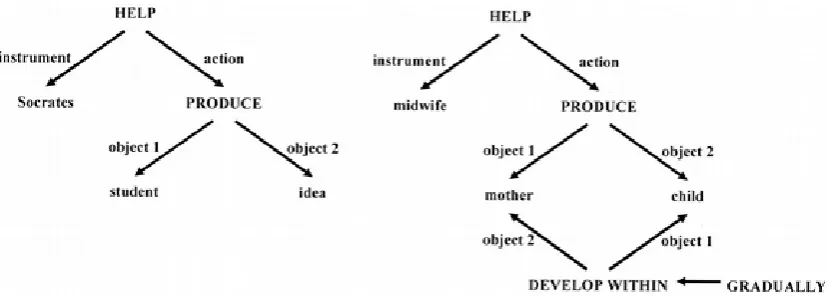
Figure 1.1: Structure of target and source domain in Socrates is a midwife (Bowdle & Gentner, 2005).
the source will be projected to the target, based on the specific dimension deter-mined by the target. For instance, in the metaphor Socrates was a midwife (Figure 1.1), the source (midwife) has several properties, such as “helping MOTHER” and “MOTHER producing CHILD”, while the target (Socrates) has properties such as “teaching STUDENTS” and “STUDENTS producing IDEAS”. These proper-ties are aligned based on their conceptual structures, but midwife also produces a property that is unique, that is, “MOTHER has CHILD developed within her”, which is not obvious to the target. By projecting this property to the target do-main, the relationship between student and idea can be deduced, that is: IDEA has been developing in STUDENT all along. Socrates did not simply teach an idea, but he helped students realise the idea that has been developing in the student.
[image:17.595.110.524.69.217.2]& Chatterjee, 2010; Chiappe, Kennedy, & Smykowski, 2003; L. L. Jones & Estes, 2005, 2006; Mashal, 2013; Pierce & Chiappe, 2008; Roncero & Almeida, 2014a, 2014b). When a metaphor such as“Socrates is a midwife” is novel, the association between the source (midwife) and the property (helping Object 1 produce Object 2) is weak. People cannot activate the property automatically when they encounter the sentence. Rather, they need to compare the conceptual structure of Socrates with the concept of midwife as we did above in order to arrive at this property. However, as the metaphor is encountered repeatedly, the property becomes more readily activated.
This process of repeated activation leads to the second component of the career of metaphor theory, that is metaphor processing based on categorisation. When a metaphor is conventionalised, the property that is readily activated be-comes an abstract category of which the source word is a prototypical member. A conventional metaphor, in fact, is processed as what Glucksberg and colleagues called a class-inclusion assertion. For example, after the metaphor Socrates is a midwife is conventionalised, people comprehend it as a sentence which means that “Socrates is a member of the metaphoric category in which midwife is a prototypical exemplar (i.e., people or instruments that assist the deliverance of something that exists in the object)”. In other words, understanding Socrates is a midwife effectively evokes the same mechanism which is used to understand A robin is a bird. The metaphoric category for which midwife represents becomes
Chatterjee, 2012; Desai, Binder, Conant, Mano, & Seidenberg, 2011; McGlone & Manfredi, 2001).
Another implication of the career of metaphor theory (especially metaphor processing by categorisation) is that other properties of class-inclusion assertions can be applied to conventional metaphors but no to novel metaphors. One of such properties is non-interchangeability between metaphors and similes. Simile is a figure of speech where one thing is likened to another (e.g., Figurative simile: Socrates is like a midwife. Literal simile: Copper is like tin.). It is processed solely by comparing the two concepts themselves, not the category of objects to which these concepts belong. In a literal simile such as Copper is like tin, it is particularly clear that both copper and tin refer to the substance of these two metals, which is why it is not appropriate to say Copper is tin (a class-inclusion assertion). However, it is acceptable to say Robin is a bird (a class-inclusion assertion) but unacceptable to sayRobin is like a bird(a simile), because the latter is comparing the concept of robin with the concept of bird without assigning robin to the category of bird.
read novel similes such asAn acrobat is like a butterfly and A figure skater is like a butterfly. After such a process of conventionalisation, participants found that a
similar figurative expression (e.g.,A ballerina is (like) a butterfly) more acceptable in the metaphor form than in the simile form. In other words, conventionality in-deed appeared to be a critical factor to determine whether a metaphor is processed using categorisation.
Problems with the career of metaphor theory are primarily rooted in its en-dorsement of the structure-mapping mapping. Since the structure-mapping theory suggests that it is the source term (e.g.,midwife) that provides the property (e.g., facilitate the deliverance of a baby) which gets projected to the target term (e.g., Socrates), the conventionality of a metaphor is ultimately decided by the
asso-ciation between the source term and the property, regardless of the target term (Campbell & Raney, 2015; Cardillo et al., 2010; Katz, Paivio, Marshark, & Clark, 1988; Roncero & Almeida, 2014a). In other words,Socrates is a midwifeis no more conventional than metaphors such as Noam Chomsky is a midwife or Beyoncé is a midwife (both of which is clearly not the case). Indeed, Thibodeau & Durgin (2011) have found that conventionality is dependent on the context, especially the immediate context of the target term.
cited in (Bowdle & Gentner, 2005; Gineste et al., 2000; D. Wilson & Carston, 2006)). For example, when readingSome ideas are diamonds, people often comes up with interpretations that ideas can be “creative” and “insightful”, which are not applicable to the concept of diamonds. If metaphor comprehension is the process whereby the properties of the source domain are projected to the target domain, the resulting representation of the target should only include the properties that originally belong to the source (e.g., ideas are “rare” or “precious”). Therefore, simple structure mapping cannot account for all the mechanism of metaphor pro-cessing without further assumptions about how emergent properties arise. Aside from issues related to structure mapping as discussed above, the importance of conventionality is further questioned by the results from research on dual refer-ence by Glucksberg and colleagues, which advocates for the importance of aptness in metaphor processing (see next section).
1.1.1.3 Aptness
In place of conventionality, many have argued that aptness (i.e., how well a metaphor expresses the speaker’s intention) is the critical factor that decides whether metaphors are processed by categorisation or by comparison. Numerous studies have found that when aptness is taken into account, the effect of con-ventionality on metaphor processing (e.g., the preference for a metaphor over a simile) disappeared (Chiappe & Kennedy, 1999; Chiappe et al., 2003; Glucksberg & Haught, 2006; Haught, 2013; L. L. Jones & Estes, 2005, 2006; Pierce & Chiappe, 2008; Roncero & Almeida, 2014b).
ap-propriately a metaphor can convey the speaker’s intention (Blasko & Connine, 1993; Campbell & Raney, 2015; Katz et al., 1988). However, researchers have also operationalised it, in relation to structure mapping, as how well the properties specified by the source can capture important aspects of the target (Chiappe & Kennedy, 1999; Chiappe et al., 2003; L. L. Jones & Estes, 2005, 2006; Pierce & Chiappe, 2008; Roncero & Almeida, 2014b). Instead of stressing the association between the property and the source as conventionality (e.g., midwife as someone who assists the deliverance of something which has been developing in the object), aptness emphasises the how appropriately the property fits the target term (i.e., Socrates). Since a property needs to be projected to a specific dimension of the
target, the better the property fits the target, the more apt the metaphor is deemed to be. An example often used to illustrate the point is the sentence A rooster is an alarm clock is more apt than A robin is an alarm clock, because the property of “reliably waking you up in the morning” fits rooster more appropriately than robin.
capacity (Pierce & Chiappe, 2008). People with a higher working memory capac-ity are better at interpreting metaphors and using the metaphoric form instead of the simile form. Furthermore, context has been found to be an important fac-tor which influences the aptness rating (Thibodeau & Durgin, 2011; Thibodeau, Sikos, & Durgin, 2017). The operational definition of aptness (i.e., how well the property fits the target of a metaphor) only takes into account still a very narrow context. Although it is an improvement over conventionality to incorporate the target into metaphor processing, it still treats aptness as an intrinsic feature of a metaphor in an isolated phrase/sentence. However, simply from the example above, we can conceive of scenarios where A robin is an alarm clock is highly apt (e.g., in the woods. Robins are among the first birds to start the dawn cho-rus. https://www.rspb.org.uk/birds-and-wildlife/wildlife-guides/bird-a-z/robin/ robin-redbreast-song/). In summary, although aptness was found to be a bet-ter predictor than conventionality, it could also be confounded by many exbet-ternal factors.
1.1.2 Challenges with psycholinguistic factors
In the previous section, I have introduced several factors that could facili-tate metaphor processing (i.e., salience, conventionality and aptness). Apart from the criticisms to each factor individually, they could be further challenged by some mutual problems.
which is an expression or concept that is frequently encountered, and at the other end completely novel, even though only conventionality, not familiarity, is seen as the critical factor in the career of metaphor. Throughout the literature, iarity/conventionality can be defined in two different ways, sometimes as famil-iarity towards the expression (Blasko & Connine, 1993; Bowdle & Gentner, 2005; Cardillo et al., 2012; Faust & Mashal, 2007; Glucksberg, 2003; Lai et al., 2009; Mashal, 2013; Mashal et al., 2005) and other times as familiarity to the concepts to which it refers (Bowdle & Gentner, 2005; Campbell & Raney, 2015; Cardillo et al., 2010; Gentner & Wolff, 1997; Giora, 1997; Jones & Estes, 2006; Peleg, Giora, & Fein, 2001). However, it is conceivable that such operational definitions could measure two different things. An expression could have high familiarity while the concept has low familiarity (e.g., hard Brexit; people may often encounter the term but hazy about what it means), and vice versa (e.g., warm reception; people may encounter the situation often but rarely use the term; for similar arguments, see (Andrews, Vigliocco, & Vinson, 2009; Brysbaert, Warriner, & Kuperman, 2014)).
concepts could greatly limit the utility of these ratings in the research of metaphor processing.
and will cause the problems related multicolinearity, such as imprecise estimation of regression coefficients and overfitting.
In summary, it is problematic to study metaphor processing using these single factors. The ambiguity in their definitions and their core interdependency are detrimental to our understanding of metaphor processing. Therefore, in my thesis, I decide to leave these factors behind to seek a better theoretical construct to account for the online processing of metaphors.
1.2 Metaphor Processing from the Grounded
Perspective
As the psycholinguistic research is troubled by many issues, in this the-sis I propose a new perspective which examines metaphor processing from the perspective of grounded conceptual representation.
1.2.1 Grounded Views of Conceptual Representations
peo-ple encounter the linguistic label “bright” with its context as well as the sensory (mainly visual) properties of bright objects. The neural activity evoked by the linguistic label happens synchronously with the neural activity evoked by the sen-sory properties. Thus, the neurons responsive to each type of information are “wired together”, which makes it faster to activate the circuits for representation next time when the concept is encountered (Hebb, 1949). During conceptual pro-cessing, these traces of neural activation get partially re-enacted, resulting in the simulation of sensory, motor, affective and other bodily experiences.
Linguistic distributional patterns and embodied simulation came from dis-tinct origins and philosophical backgrounds, until recently when they were found to be two interacting and complementing components (see Andrews, Vigliocco, & Vinson, 2009 for a review). In this section, I will review evidence for these two components and their interaction in detail, and in the next section I will explore its application to metaphor processing and some challenges along the way.
space, thus, can represent the meaning of a word using linguistic distributional patterns. These methods are powerful enough to capture many aspects of language processing, such as priming and reading times (Vigliocco et al., 2009), and the geo-graphical positions of cities in China and the Middle East (Louwerse, Hutchinson, & Cai, 2012), or even Tolkien’s Middle Earth (Louwerse & Benesh, 2012). Mean-while, co-occurrence frequency within a small five-word window can also predict important features in the real world. Co-occurrence frequency between sensory adjectives could to some extent distinguish their perceptual modalities (Louwerse & Connell, 2011). This is because objects, places, events or concepts that usually appear in the same situation should often appear close proximity in context.
Although the linguistic distributional pattern is powerful, it cannot be all there is to conceptual representation. If the meaning of a linguistic symbol is only defined by other linguistic symbols around it, we would be trapped in an endless loop. This is the famous grounding problem: at some point, linguistic symbols need to refer to objects and concepts in the real world (Harnad, 1990; Searle, 1980). Embodied simulation is proposed to solve this problem. It suggests that conceptual representation requires the partial activation of motor, sensory, affective and other systems of bodily experiences (Barsalou, 1999; Connell & Lynott, 2016; Glenberg & Gallese, 2012).
F. Goldberg, Perfetti, & Schneider, 2006; Kiefer, Sim, Herrnberger, Grothe, & Hoenig, 2008); same with taste-related words (e.g.,salt; Barrós-Loscertales et al., 2012) and colour words (e.g., yellow; R. F. Goldberg et al., 2006); action words referring to different parts of the body (e.g., face, arm or leg) would selectively activate the motor and premotor regions that corresponds with each body part (Boulenger et al., 2008; Desai, Conant, Binder, Park, & Seidenberg, 2013; Hauk, Johnsrude, & Pulvermüller, 2004; Speed, Dam, Hirath, Vigliocco, & Desai, 2017).
(Connell & Lynott, 2014a).
1.2.2 Interplay between linguistic distribution and
embod-ied simulation
Although linguistic distribution and embodied simulation were studied in-dependently, they should not be considered as mutually exclusive. Although as mentioned previously, linguistic distribution can capture important aspects of the real world, it is conceivable that linguistic distribution and embodied simulation do not entirely overlap for at least two reasons. First, some aspects of features of embodied experiences, which are often encountered by bodily perceptions, are less communicated through language (Brysbaert, Mandera, & Keuleers, 2018). The reason could be that these features are default and invariant to the concept. For example, the word sun does not co-occur with the word round (436 times per million times sun occurs according to the Web1T corpus) as often as the word moon does (918 times per million times moon occurs), even though the sun is always round but the moon is round visually only every 27 days. In this sense, the linguistic distributional pattern does not accurately depict the occurrence of sensorimotor properties in the real-world experiences, even though it can capture it (i.e.,round can co-occur with bothsun andmoon because both the sun and the moon can be round). Rather, the linguistic information is capable of highlight-ing important aspect of the real-world experiences, some of which in fact occur relatively rarely.
information mainly refers to our knowledge of abstraction and conceptual relation-ship. Take the concept of FOOD as an example. Andrews et al. (2009) showed that the embodied information from speaker-generated feature norms encodes mainly sensory and motor information such as bodily sensations (e.g.,hunger,thirst,taste) and actions (e.g.,swallow, ingest, enjoy); whereas the linguistic information from large corpus mainly encodes taxonomically or functionally related, abstract con-cepts such as drinks, lunch, diet. Because of the different types of information encoded in these components, the combined model can explain language process-ing better than either alone (see also Johns & Jones, 2012; Louwerse & Connell, 2011). Therefore, in order to fully represent a concept, both components need to be utilised. In this thesis, I will study metaphor processing with both of these com-ponents in view. Specifically, my research will have the specific question in view regarding the function of the linguistic component. However, before proceeding to this specific question, two more questions concerning grounded representations need to be addressed.
1.2.3 Questions concerning grounded representations
1.2.3.1 Is embodied simulation epiphenomenal?
to processing sensory and motor stimuli, there is another level of conceptual representation that is “amodal” and “symbolic” (not to be confused with the lin-guistic distributional patterns that deal with linlin-guistic symbols). This conceptual level interacts with the perceptual and motor level, but it could stand alone for conceptual representation without activating the sensorimotor level. Thus, the recruitment of modality-specific regions during conceptual representation could be explained by the spreading of neural activation from the amodal conceptual cores to the sensorimotor regions. In short, the argument against the embodied view goes like this: according to the embodied view, conceptual representation equates sensorimotor processing. Therefore, any evidence for the activation of other neural regions during conceptual processing counts as evidence for higher-level, stand-alone, amodal representation.
This argument, first and foremost, is a straw-man. Only the most radical re-ductionists will propose to do away with conceptual representation altogether and equate conceptual representations sensorimotor processing. For most proponents of the embodied view, conceptual representation can be hierarchically organised, with convergence zones processing information from multiple modalities (Simmons & Barsalou, 2003) and linguistic distributional patterns as symbolic placeholders (Zwaan, 2016).
mul-timodal neural regions and adjacent regions to the sensory and motor areas (e.g., Bonner & Grossman, 2012; Fernandino et al., 2016; Kiefer et al., 2008). Such findings could be evidence for the hierarchical organisation of embodied concepts. If conceptual representation is indeed symbolic or amodal, its interface with the sensorimotor areas should be arbitrarily organised (i.e., independent to where the modality-specific regions are). This is analogous to defining language as an arbi-trary symbolic system, in that the linguistic symbols (e.g.,horse) do not bear an analogous relationship with its referent (the four-legged farm animal with hooves and mane). It might be equally a logical fallacy to argue that anything short of such arbitrariness should be regarded embodied representation. The point is that it is the responsibility of the amodalists to define what amodal, symbolic concepts are, instead of the responsibility of the embodiists to rescue evidence for embodied simulation. Furthermore, the fact that it is difficult to draw a clear line between embodied and amodal concepts should be an argument in itself for abandoning the distinction between the separate levels of concepts and sensorimotor processing.
1.2.3.2 To what extent are linguistic symbols grounded?
a fully symbolic and abstract view by Kintsch & Dijk (1978), or radical embodied science by Chemero (2009))? Most researchers support a combinatorial view. For example, Harnad (1990) proposed that there is a group of “elementary symbols” which are grounded in sensorimotor experiences, while higher order symbols are related to sensorimotor experiences via these elementary symbols. If this proposal is true, people should be able to learn new symbols via the linguistic context and retain traces of sensorimotor experiences for embodied simulation during future conceptual representation.
experiences but not via the association between linguistic symbols.
The implication of these findings is great. It seems to suggest a more lim-ited role of embodiment, than researchers formerly think. Although research on embodied simulation has largely focused on concrete concepts, many researchers would agree that processing both concrete and abstract concepts relies on embod-ied simulation (Barsalou, 1999; Zwaan, 2014), not to mention that concrete con-cepts are defined as concon-cepts whose referents have sensorimotor features (Paivio, 1986). These novel word acquisition studies, in contrast, suggest that embod-ied simulation is not a necessary condition of conceptual representation even for many concrete concepts, thus pushing our position on the groundedness continuum more towards the disembodied end. If a student in a land-locked country has only learned about shark from a textbook, without every seeing a picture or watching a TV show about sharks, they will not simulate the concept of a shark in the sea (its colour, its speed, etc.) via their knowledge about the category membership of shark and their available sensorimotor experiences with a gold fish in a tank.
required to engage in deep processing repeatedly in various reading and writing tasks. Therefore, people are more likely to engage in embodied simulation in real life than in those studies. Second, in real life, few concepts are acquired through linguistic association alone, totally devoid of bodily experiences. Few, if any, of us learned our first language by memorising a dictionary. Even an abstract concept is often accompanied by a large amount of useful sensorimotor information, and children are able to learn abstract concepts by generalisation over similar senso-rimotor experiences (Colunga & Smith, 2003). For instance, we have learned the concept ofdemocracy by second- or first-hand experiences of going to the polling booth (i.e., seeing other people vote or voting ourselves); so is the case with other words such asmathematics,frustration, etc. In a word, conceptual representation, from its acquisition to its processing, relies on the interaction between embodied and linguistic components. Therefore, it is high time to study this interaction, which will be the focus of my thesis.
There are many open questions concerning the content and structure of con-ceptual representation. In this thesis on metaphor processing, I will focus on two characteristics of the combined, simulation-linguistic conceptual representation. First, linguistic distribution and embodied simulation are activated at different speeds; and second, they play different roles based on the task demands.
1.2.3.3 Linguistic shortcut hypothesis
conceptual processing activates multiple cortical regions associated with process-ing perceptual stimuli such as the parietal cortex (Louwerse & Hutchinson, 2012; Santos et al., 2011; Simmons, Hamann, Harenski, Hu, & Barsalou, 2008).
context and so their combined meaning can probably be simulated successfully, e.g., military plan), then it could either inform to accept the word combination immediately (i.e., based on the linguistic shortcut alone) or allow the embodied component to continue developing a detailed simulation of meaning.
sensibility judgement task. In summary, shallow processing could be a condition that encourages the use of the linguistic shortcut, which will be a hypothesis tested throughout this thesis.
1.3 Grounded metaphor processing
1.3.1 Grounded language processing
Grounded conceptual representation has been studied for more than two decades, with a special focus on literal, concrete language. This aspect of lan-guage processing is easy to study because we can safely assume that processing a sensory word (e.g., bright) mainly requires the reactivation and “re-living” of sensory experiences denoted by the word (i.e., emitting much light; Zwaan, 2004). Researchers have found both behavioural and imaging evidence in favour of this view. Meanwhile, some researchers have tried to bridge the gap between general language processing and metaphor processing. Most of them have tried to use a specific theory, the conceptual metaphor theory, as a way to explore simulation during metaphor processing. However, such an exploration has not been successful empirically. In the next section, I will discuss the conceptual metaphor theory and related empirical research in detail, and I will argue why this path will eventually lead to a dead end.
spread wings after reading The ranger saw the eagle in the sky) and preferring a matching image faster to a mismatch image (Engelen, Bouwmeester, Bruin, & Zwaan, 2011; Lynott & Connell, 2009; Spivey, Tanenhaus, Eberhard, & Sedivy, 2002; Zwaan & Pecher, 2012; Zwaan & Yaxley, 2003). Other behavioural stud-ies have also found that people can represent the spatial feature of concepts in an iconic manner (e.g., preferring the word attic above the word basement to the reversed arrangement; Zwaan & Yaxley, 2003) and the direction of an action described in a verb (e.g., being faster at moving the arm towards the body after readingopen the drawer; Glenberg & Kaschak, 2002). However, the iconicity effect could also be attributed to the linguistic distributional pattern (i.e., attic appears more often in context before basement than the reversed; Louwerse & Jeuniaux, 2008); and the action-sentence compatibility effect was found to be generally weak (Papesh, 2015), and related to the planning of motor response, instead of semantic processing or conceptual representation (Borreggine & Kaschak, 2006; T. Brouil-let, Heurley, Martin, & BrouilBrouil-let, 2010; T. M. C. Miller, Schmidt, Blankenburg, & Pulvermüller, 2018).
discourse (Chow et al., 2014; Kurby & Zacks, 2013). Such activations were cru-cially influenced by the context, such that a coherent representation of the context produced the strongest activations in the modality specific regions; and modality specific activations of a single word can be overridden by the context. For example, the word kick activates the motor and premotor cortex to different degrees when it was embedded in different context. It elicited greater activation when read in isolation than in a literal phrase such as kick the ball (Raposo et al., 2009).
1.3.2 Conceptual metaphor theory
IS SEEING, when we say “I see your point”, motor experiences of seeing a physical object is activated, but the object to be seen and thus known is the intentioned meaning of “you”.
The conceptual metaphor theory was used to account for the simulation process activated during metaphor comprehension. As a conceptual metaphor es-tablishes an analogous relationship between two concepts, people could use the conceptual structure, the sensory and motor properties, of one concept (i.e., the source domain) to understand the conceptual structure of another concept (i.e., the target domain), which is often more abstract (Gibbs, 2006; Gibbs, Costa Lima, & Francozo, 2004). For example, a linguistic metaphor such as “a bright student” is to draw an analogy between the sensorimotor experience of bright with the ab-stract concept of intellect. Thus, to understand “a bright student” is to ground the intellect of a student to the sensorimotor experience with something bright. According to our past experiences, if something is bright (e.g., the sun), we will be able to see things clearly because of it. As KNOWING IS SEEING according to the conceptual metaphor, a “bright” student who is able to see things clearly is a student whose intellect enables them to learn and know things quickly. In other words, people use linguistic metaphors in language in accordance with the concep-tual metaphor in our mind, such that the related sensorimotor experiences can be simulated for us to comprehend the abstract concept in the linguistic metaphor.
power) facilitates the physical action in the same direction (e.g., vertical upward
movement) but impedes actions in the opposite direction (Santana & Vega, 2011). This suggests that the motor properties of rising are activated when people process metaphoric actions even though the meaning of the metaphor does not include a physical vertical motion.
Although research on conceptual metaphor has offered many ingenious at-tempts to study the embodied simulation in metaphor processing, this approach is limited because it has constricted the definition of embodied simulation to the re-enactment of properties from the source domain. Although the behavioural ef-fect supports the activation of such source domain properties, there is no direct evidence showing the activation of neural regions specific to the processing of per-ceptual and motor stimuli during metaphor processing. The behavioural effects described above, which has been interpreted as a result of embodied simulation, can be accounted for by established principles of perception, language and memory (Casasanto & Gijssels, 2015). When people read about a metaphoric action (e.g., rise to power), their response could be facilitated because the word rise can prime
the upward response space. Therefore, even if there is the simulation of sensori-motor experiences of some sort, the evidence does not show that such a process is essential to metaphor comprehension.
run-ning) do not activate the motor and premotor cortices to the same extent as literal
use of the same verbs (Aziz-Zadeh, Wilson, Rizzolatti, & Iacoboni, 2006; Raposo et al., 2009; Romero Lauro, Mattavelli, Papagno, & Tettamanti, 2013). Not only so, metaphors do not activate the primary cortices any more than their literal counterpart. For example, if a rough day had recruited the somatosensory cortex more than a bad day, or a bright student had recruited the primary visual cor-tex more than a clever student, we might have been able to argue that metaphor processing involves the embodied simulation of sensorimotor experiences. How-ever, such evidence was not found. Comparison using fMRI between perceptual metaphors and their literal counterparts (e.g., She had a rough day vs She had a bad day) did not find greater activation in the primary sensorimotor cortices
(Citron & Goldberg, 2014; Desai et al., 2013; Romero Lauro et al., 2013; Yang & Shu, 2016). Although they have found activations in other regions associated with processing sensorimotor stimuli, these regions are also activated in other cognitive and perceptual processes not related to the specific sensory and motor modalities (Casasanto & Gijssels, 2015).
Mac-Gregor, Bouwsema, & Klepousniotou, 2015; Mashal, 2013; Raposo et al., 2009). The word bright may activate the primary visual cortex at the beginning of the processing, pertaining to its literal meaning (i.e., emitting much light), but people should be able to suppress this activation in the context of bright student, favour-ing the metaphoric meanfavour-ing (i.e., quick-witted and intelligent). In a metaphor that is conventional and apt, source domain properties should not have sustained activity which competes with the metaphoric meaning (Desai et al., 2013).
1.4 The present thesis: metaphor processing
in-volving simulation-linguistic conceptual
rep-resentations
While pointing out the lack of evidence for embodied conceptual metaphors, it is not my intention to suggest that metaphor comprehension is not grounded in any past bodily experiences. It is unprofitable for researchers to be limited by the current definition of simulation based on the conceptual metaphor theory. Instead, we should align our view of metaphor processing with the current understanding of grounded language processing, that is to define the simulation involved in metaphor processing simply as the partial re-enactment of sensory, motor, introspective, affective and other experiences related to the concept. In other words, when we use the phrase “a bright student”, we do not need to picture a student with a light-bulb flashing above their head; but we should still reactivate our physical, emotional and psychological experiences with a quick-witted student in order to achieve comprehension.
pat-terns. Specifically, I will investigate the conditions under which each component is involved, and their interplay to create conceptual representations.
1.4.1 Thesis Outline
Thus, in my thesis, I will first propose an index of ease of simulation and generate a body of metaphoric sentences that vary independently on the measure of ease of simulation and the linguistic distributional frequency (Chapter 3). On the one hand, the ease of simulation measure will capture metaphor comprehension as a whole, measuring the effort required to arrive at a successful representation. On the other hand, linguistic distributional frequency will be defined in a minimal fashion, capturing the distributional patterns of metaphors’ constituent words in close proximity, within a narrow five-word window (e.g., Louwerse & Connell, 2011). This treatment of linguistic distributional frequency will advocate strongly for the efficacy of the linguistic information in following chapters.
Studies in the following chapters (Chapter 5 and 7) will develop upon the same paradigm as the study in Chapter 4, in order to further examine the inter-play between ease of simulation and linguistic distributional frequency. Chapter 5 will continue to test the linguistic shortcut hypothesis and investigate the role linguistic distributional frequency plays under time constraint. If people use the distributional pattern of words as a shortcut to make judgments, the effect should be larger when the time resource is limited. Accordingly, the effect of embodied simulation will be smaller when the time resource is limited because to engage in embodied simulation is time-consuming.
Then in Chapters 6 and 7, I will search for the neurophysiological manifes-tations of the embodied and linguistic components using electroencephalography (EEG). Chapter 6 will identify these two components in literal language process-ing, and Chapter 7 will match them with metaphor processing. Using EEG will offer us greater insights into the online processing during metaphor comprehen-sion with high temporal resolution. However, the conventional practice among the EEG literature is problematic and prone to Type I error, for reasons discussed in the next chapter (Chapter 2). Therefore, apart from studying metaphor process-ing, another mission of my research in these chapters will be to develop a more rigorous way to analyse EEG data for psycholinguistic research.
CHAPTER
2
Using EEG to Study Metaphor Processing
2.1 Introduction
In my thesis, as discussed in the previous chapter, I will study the con-ceptual representation during metaphor with the specific question regarding the role of linguistic distributional patterns in mind. To test the linguistic shortcut hypothesis, it is important to validate a crucial condition for the linguistic compo-nent to become a shortcut: that is the linguistic compocompo-nent reaches the peak of its activation before the embodied component. In other words, it is necessary for the linguistic component to have a temporal advantage over the embodied component (though both components are activated simultaneously) for the linguistic compo-nent to become a valid guide for the processing of embodied simulation. Therefore, a crucial component of my research is the use of electroencephalography (EEG).
relies on the identification of event-related potential (ERP) components, which are segments of EEG waveforms circumscribed to a period of time and an area on the scalp. Several ERP components have been found to be associated with semantic processing and even embodied conceptual representations (e.g., N400 and late positivity complex). However, as well be discussed in this review, the study of ERP components suffers from great problems, such as high researcher degrees of freedom and the use of ANOVA. Therefore, it is a mission of my research to seek a more rigorous way to study EEG, by limiting researcher degrees of freedom and using better statistical tools (i.e., linear mixed-effect model plus Bayes factor). In this chapter, I will first review available findings of the ERP markers of conceptual representation and argue why the current way to study EEG lacks the needed rigour. Finally, I will propose a better way to analyse EEG data, which will be used in studies of Chapters 6 and 7 in my thesis.
2.2 EEG in psycholinguistics
in the brain (Otten & Rugg, 2005). For example, if participants are presented with concrete words (e.g.,weapon) and abstract words (e.g.,fashion) matched on other variables while their ERP is recorded, the differences in ERPs can be interpreted as the difference in concreteness (Barber, Otten, Kousta, & Vigliocco, 2013). If the amplitude to concrete words is larger than abstract words, we may infer that this change in amplitude reflects retrieval of sensorimotor features. If concrete and abstract words produces different topographies, we can also infer that the conceptual representation of these words relies on different neural population. It is now even possible to infer with some accuracy the neural activities from the scalp topography whereby knowing which area(s) in the brain is responsible for the processing (Koles, 1998; Slotnick, 2005), though it is not common practice among psycholinguists. Rather, the greatest advantage of EEG is its high temporal resolution. It could capture the online, immediate electrical activity on the scalp to the precision of several milliseconds.
2.2.1 The N400 component
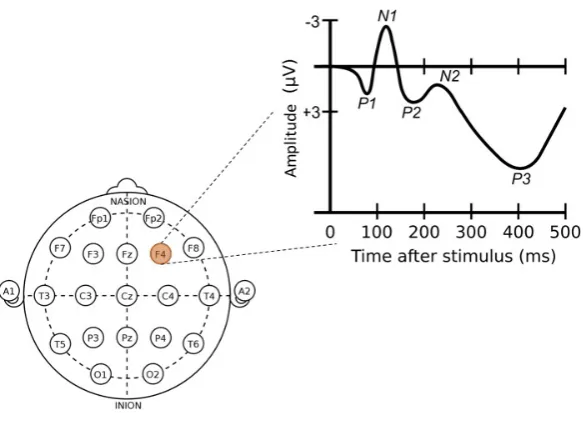
Figure 2.1: A schematic drawing of ERP from the right frontal electrode (F4). The crucial parameters of ERP are amplitude: the magnitude of the waveform in microVolts from 0 (i.e., the vertical axis of the waveform on the right); latency: the time between the stimulus onset (0 milliseconds) and the peak or start of a component, e.g. N1 (i.e., the horizontal axis); and scalp topography: amplitude of the whole scalp at a certain point of time. Pictures from Wikipedia.com.
[image:55.595.168.460.83.294.2]range of stimuli that can elicit an N400 effect, Kutas & Federmeier (2011) argued that N400 reflects the effort to integrate new stimuli into a multimodal, dynamic representation of concepts, which is shaped by both recent events and long-term memory (see also Baggio & Hagoort, 2011; Rabovsky & McRae, 2014).
N400 component has also been used to study metaphor processing. Metaphors (e.g., Every second of our time was attacked) were found to elicit an N400 effect compared to literal sentences (e.g., Every soldier in the frontline was attacked), which nevertheless was not as large as the effect of an anomalous
sentence (e.g., Every drop of rain was attacked; Arzouan et al., 2007; Forgacs, Bardolph, Amsel, DeLong, & Kutas, 2015; Lai et al., 2009). The more familiar or easily interpretable was a metaphor, the smaller was the effect (i.e.,Every point of my argument was attacked elicited a smaller N400 effect than Every second of our time was attacked). Furthermore, the N400 effect of metaphors can be attenuated by the context (Coulson & Van Petten, 2002; Lai & Curran, 2013). For example, people read prime-target pairs of sentences with the same final word (e.g.,bumpy) in a literal condition versus a metaphor condition. In the metaphor condition, people read the prime sentence (e.g.,I can see the path of his life) followed by the target Life can sometimes be bumpy. In contrast in the literal condition, people read the prime I can see the path of this road followed by Roads can sometimes be bumpy. The N400 effect between metaphors and literal sentences to the final
The N400 effect is, moreover, used to study embodied simulation. As Kutas & Federmeier (2011) suggested, the conceptual representation draws from percep-tion, memory and language and is instantly shaped by incoming events. Therefore, modality switching costs, which show that verification of sensory properties recruit modality-specific resources, should also elicit the N400 effect. Modality switching costs refer to the delay in response time to verify a property of one perceptual modality (bright) if the previous trial is of a different modality (loud; Pecher et al., 2003). Several studies have looked for the ERP manifestations of modality switching costs (Bernabeu, Willems, & Louwerse, 2017; Collins, Pecher, Zeelen-berg, & Coulson, 2011; Hald, Hocking, Vernon, Marshall, & Garnham, 2013; Hald, Marshall, Janssen, & Garnham, 2011). However, what they found was not a clear picture. Not only was a significant effect found in the time window for the N400 component, but also a so-called early N400-like effect around 300ms (Bernabeu et al., 2017; Hald et al., 2011), the N1-P2 complex around 200ms (Bernabeu et al., 2017; Hald et al., 2013, 2011), as well as the late positivity component (LPC) after 600ms (Bernabeu et al., 2017; Collins et al., 2011; Hald et al., 2011).
costs as an example. However, it should not be taken as a problem that exists only in these few studies, but reflecting the general practice across the EEG litera-ture. To understand the problem, it is necessary to critically evaluate our current understanding of ERP components.
2.3 Critical evaluation of ERP components
The problem with characterizing EEG with ERP components are two-fold. First, there is a discrepancy between what we generally call ERP components and what is supposed to represent: latent components. Second, ERP records contin-uous and clustered data (e.g., many data points from one participant), whereas ERP components are discrete and aggregated (i.e., averaging over many trials for one participant). These problems keep us from appropriately analysing and interpreting ERP results.
processing, specifically with the recruitment of modality-specific resources. The activity of this neural cluster will generate some electrical activities, which is called a latent ERP component. The latent component is directly associated with the neural cluster, and thus functionally significant.
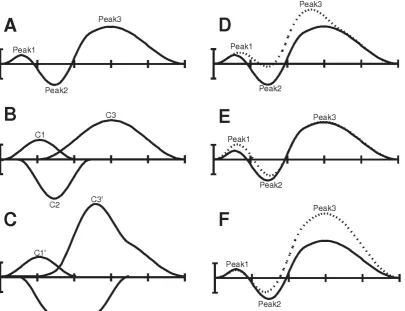
However, the latent component is not the ERP component we know, be-cause the ERP component obtained from the observed waveform measures the electrical activities generated by neurons in the whole brain. In other words, the observed component is a sum of all the latent components generated by differ-ent functionally significant neural clusters in the brain. In the ideal world, there would have been methods to reliably decompose the observed ERP waveform into latent components, but the reality is each observed waveform can be decomposed to several, if not infinite, latent components, each generated by one functionally devoted neural cluster (Figure 2.2; Luck, 2005).
Figure 2.3: Schematic illustration of components in semantic processing in Hauk(2016)
[image:61.595.213.419.68.381.2]2.3.1 Data structure of ERP.
The second problem of ERP components is that the structure of EEG data is largely overlooked. This problem in practice results in high researcher degrees of freedom, thereby adding the risk of an inflated probability of Type I error.
2.3.1.1 Continuity
The first characteristic of EEG data is that it is continuous. The data is recorded over the epoch at a high frequency (e.g., 1000Hz) and at different sites across the scalp (e.g., 128 channels). Therefore, the data is correlated across time and space. A data point at a certain time should be similar to the data point before and after it; a waveform of a certain channel should be similar to those of the adjacent channels. Such an intercorrelation poses a problem when researchers try to cut the continuous waveform into discrete components that is averaged across a time window and several channels during analysis.
are consistently larger than 100ms; or if a questionnaire contains 100 questions, it is unacceptable to only report 10 that has given a result in the direction expected.
We should similarly be aware of such risks when we conduct ERP studies, if not more so because of the great flexibility afforded by the sheer amount of data. For example, simply in order to choose a time/time window, there are three strategies available. Researchers could perform a peak-based analysis by selecting one time point when the waveform is at its peak/trough, a mean-based analysis which takes the mean amplitude within a time window, prescribed before analysis, upon visual inspection of the data, or inherited from previous studies. Otherwise, if there are no clear hypotheses for components, researchers could also analyse the whole waveform by slicing it into equal time intervals such as 50ms or 100ms slices. Similarly, to choose a scalp region, one can pick a cluster of electrodes upon visual inspection, or segregating the scalp into two halves (left/right, anterior or poste-rior), four quarters (left/right x anterior/posterior) or nine areas (left/mid/right x front/centre/back). The sheer number of choices available should be a cause of alert because of the flexibility it affords. Moreover, one of these choices, that is visual inspection, is particularly risky, because researchers are allowed to manually pick the time window and electrodes that are more likely to yield a big difference between conditions, whereas the data that do not seem to yield an effect will sim-ply be discarded. As these options are all equally allowed, although it is not the researchers’ intention to engage in dishonest behaviour, the risk of a Type I error ends up being higher than the critical value of 5%.
switch-ing costs, different time windows were chosen to test the early effect of modality switching costs. While Bernabeu et al. (2017), Hald et al. (2011) and Hald et al. (2013) examined the segment of ERP waveform between 190ms and 300ms or 160ms and 215ms based on visual inspection and found significant effects, Collins et al. (2011) chose a prescribed time window between 100ms and 200ms before the analysis and did not find the effect. Both choices are accepted by the research community based on the fact that these studies are all published in high-impact, peer-reviewed journals. All of these segments are labelled as the N1-P2 effect. However, these windows in fact barely overlapped. It is hard to accept that they reflect the same underlying processing.
2.3.1.2 Clustered data
Traditionally, the language-as-fixed-effect fallacy has been treated by matching the stimuli on a series of psycholinguistic factors that could potentially affect language processing such as frequency, length for items. Similarly, it is also possible to control the random variability of participants by matching them by age, gender, working memory capacity, etc. However, this option is increasingly impractical given the vast number of factors, known and unknown, that need to be matched which grows as our understanding of language processing accumulates (Cutler, 1981).
In summary, characterising ERP using components is dangerous because the components obtained from observed waveform does not necessarily correspond to the latent components. Thus, the observed ERP components do not accurately reflect the critical process we hope to study and are easily distorted by changes of those surrounding processes. Furthermore, severing continuous waveform into discrete components and analysing them in ANOVA run a high risk of inflating Type I error. However, these problems do not mean that studying ERP is futile by any means. Instead, we need to be very cautious when designing an ERP study and it is imperative for this thesis to seek for a more rigorous way to characterise ERP data.
2.4 A better way for ERP
nents are not accessible;
2. how to limit researcher degrees of freedom;
3. how to account for multilevel, clustered data. In this section, I would argue that the way to take care of all three problems is to conduct component-free analysis, and to adopt more advanced statistical methods such as linear mixed-effect models and Bayes factors.
2.4.1 Problem with latent component
As discussed previously, observed ERP waveforms do not directly reflect underlying processes. However, it is still possible to interpret ERP data in terms of cognitive processes as long we design better study. Luck (2005) offered six strategies to avoid ambiguity in interpreting ERP components, which are (1) fo-cusing on a specific component, (2) using well-studied experimental manipulations, (3) focusing on large components, (4) isolate components with difference waves, (5) focusing on components that are easily isolated, and (6) using component-independent designs. Among these strategies, (3), (4) and (6) are most relevant to my thesis. Strategy (3) does not merit much discussion because in this thesis we will pay attention mostly to N400 and LPC, both of which are large components. Here in this section, I would like to show how isolating components with difference waves (Strategy (4)) and using component-independent designs (Strategy (5)) are able to improve the analysis, with modality switching costs as an example.
study modality switching costs, we are interested in the effect of a switch of per-ceptual modality (e.g., loud bright) compared with a non-switch (e.g., red bright), and we expect that a recruiting modality-specific resources for semantic represen-tation should affect the amplitude of the N400 component. However, it is difficult to know whether the change in the amplitude of the observed waveform is a re-sult of a change in the N400 component or some other components (e.g., P3). To isolate the N400 component, we could construct difference waves by subtracting the waveform of the prime item (e.g.,loud) from the target trial (e.g., bright) for both the switching and non-switching conditions. The resulting waveform from the switching condition will reflect simply the effort to disengage from one perceptual modality (e.g., audition) and re-engage another perceptual modality (e.g., vision), while other processes of property verification are cancelled out; whereas the result-ing waveform from the non-switch condition will not reflect such an effort. There-fore, the difference between the difference waves of switching and non-switching conditions will simply reflect the effort to engage in modality-specific resources.
draw a theoretically significant conclusion if we find that the linguistic component can better predict the observed ERP waveform at an earlier time window than the embodied component.
In this thesis, I will adopt the latter strategy as the more economical choice, because it removes the unnecessary time and effort to create difference waves, especially as salvaging ERP components is not the aim of my research. It is also the more rigorous choice because it limits the researcher degrees of freedom, as will be discussed in the next section.
2.4.2 Problems with researcher degrees of freedom
The large flexibility in the analysis of ERP leads to problems with repli-cability. Conducting a component-independent analysis can effectively limit such flexibility. By putting away the need to identify discrete components, there is no room to alter the length of a time window or to choose various sites on the scalp. In my ERP studies, I will simply analyse the data one electrode at a time in uni-formed time windows of 50ms. The length of the time window is decided simply to reduce data to a manageable amount. It is theoretically possible to take finer slices (e.g., 10ms) or perform point-by-point analysis at each millisecond. However, I believe the 50ms slices will be able to serve the purpose of this thesis.
p-value, which is the probability of obtaining the data if no actual effect exists in
the population (i.e., if H0 is true). Problems of p-value have been demonstrated extensively (Jarosz & Wiley, 2014; Wagenmakers, 2007), the most fundamental being that NHST is comparing the data to a distribution that is never observed (where H0 is known to be true), due to whichp-values cannot inform us about the size of effect or the confidence we can hold for the alternative hypothesis, even if it was shown to be significant. On the flip side, if NHST yielded non-significant result, thep-value does not allow us to conclude that the alternative hypothesis is false.
Table 2.1: Interpretation of BF as evidence for H 1
BF01 BF10 Support for H1
1-.33 1-3 Anecdotal
.33-.10 3-10 Substantial .10-.03 10-30 Strong .03-.01 30-100 Very strong
<.01 >100 Decisive
error.
Bayes Factors denotes the ratio of probability of the data under both null and alternative hypothesis. The inverse of BF01 which quantifies how much more likely the data is under H1 than H0. That is, if the inverse ofBF01(i.e., BF10) is 5, it means the current data is five times more likely under the alternative hypothesis than the null hypothesis. This can already inform us about how confident we can be with the alternative hypothesis. We can be more confident with the alternative hypothesis ifBF10 = 100 than ifBF10= 10, while ifBF10 = 1, the data was equally likely under either hypothesis. Inversely, if BF10 is less than 1, we would be more confident about the null hypothesis than the alternative hypothesis. Therefore, BF offers the possibility to conclude that the alternative hypothesis is a bad model for the data. While the continuous scale of BF is useful enough, we could conveniently describe the results, using (Jeffreys, 1998) guideline to label BF (Table 2.1)