Manuscript version: Author’s Accepted Manuscript
The version presented in WRAP is the author’s accepted manuscript and may differ from the
published version or Version of Record.
Persistent WRAP URL:
http://wrap.warwick.ac.uk/119966
How to cite:
Please refer to published version for the most recent bibliographic citation information.
If a published version is known of, the repository item page linked to above, will contain
details on accessing it.
Copyright and reuse:
The Warwick Research Archive Portal (WRAP) makes this work by researchers of the
University of Warwick available open access under the following conditions.
Copyright © and all moral rights to the version of the paper presented here belong to the
individual author(s) and/or other copyright owners. To the extent reasonable and
practicable the material made available in WRAP has been checked for eligibility before
being made available.
Copies of full items can be used for personal research or study, educational, or not-for-profit
purposes without prior permission or charge. Provided that the authors, title and full
bibliographic details are credited, a hyperlink and/or URL is given for the original metadata
page and the content is not changed in any way.
Publisher’s statement:
Please refer to the repository item page, publisher’s statement section, for further
information.
Does cultural proximity contain terrorism di
↵
usion?
Tobias B¨ohmelt
Department of Government, University of Essex
Vincenzo Bove
Department of Politics and International Studies, University of Warwick
Abstract
What are the security consequences of population movements? This article seeks to provide a better understanding of when, how, and under what conditions terrorism di↵uses across countries via migration flows as a vehicle. We contribute to this debate by studying the influence of migrants’ cultural proximity to the native population of their host country. It is argued that cultural closeness can contain such terror-ism di↵usion. Similarities in societal norms, customs, or beliefs seem likely to induce trust in the social interactions between migrants and locals. This, in turn, makes it more difficult for terrorist organizations to exploit transnational population movements for radicalization and as a recruitment pool – one of the core mechanisms linking population flows with terrorism. Conversely, migrants from culturally distant societies may find it more challenging to integrate into their new homes. A fertile ground for terrorist organizations for the recruitment of new followers is thereby more likely. Our analyses present consis-tent evidence that the e↵ect of terrorism di↵using across countries weakenswhen accounting for cultural closeness between migrants and host societies. This key finding of our research has crucial implications for policy’s and scholars’ understanding of terrorism, the di↵usion of terrorism across countries, and the security consequences of population movements.
Introduction
The world’s migrant population has grown by more than 40 percent during the past 15 years and, indeed,
most states now have significantly more immigrants than in the 1990s (UN DESA, 2016). Not surprising,
international migration has become one of the most salient contemporary policy issues and its consequences
have attracted particular attention from policymakers and scholars alike. For instance, the literature generally
agrees that host countries benefit from migration economically (Dustmann & Frattini, 2014). However,
we must not ignore some of the more difficult political consequences of population movements, including
security concerns linked to migration. There is evidence that migrants can have an important role in global
security politics (Greenhill, 2010) and act as a conduit for transnational action, such as third-party military
intervention in civil wars (Bove & B¨ohmelt, 2019). Transnational migration may also challenge the stability
of receiving countries by making it harder for states to control their territory (e.g. Adamson, 2006; Helbling
& Leblang, 2019). Migration inflows may further a↵ect the ethnic composition of host nations (e.g. Dowty
& Loescher, 1996) or could facilitate the traveling of weapons, combatants, and ideologies across borders
(Lischer, 2015; Salehyan & Gleditsch, 2006). Additionally, population movements are frequently targeted by
combatants and terror organizations (Choi & Salehyan, 2013) and they might provoke retaliatory cross-border
incidents between neighbors (Salehyan, 2008).
The traditional focus in this literature focusing on the security implications of population movements
has recently shifted toward thetypes of migrants and the surroundingcontextual parameters, which drive the
impact of migration in diverse ways (see also Skeldon, 2008). Bove & B¨ohmelt (2016) find that a large number
of immigrants increases the odds of terrorism in the host countryonly when migrants stem from
terrorist-prone countries of origin. The underlying theoretical mechanism for this e↵ect is that migrant communities
tend to have common views, loyalties, as well as a strong sense of community, which form pre-existing
networks that can – more easily than in the case of other groups – be exploited by terrorist organizations for
radicalization and recruitment (Sageman, 2004, 2011). Following this research, several studies explore the
conditions under which migrants can actually give rise to security threats in recipient states, in particular
terrorism. Dreher et al. (2017) ask whether immigration a↵ects the risk of terrorism and B¨ohmelt & Bove
(forthcoming) analyze to what extent national migration policies moderate the di↵usion of terrorism.
The following article contributes to a better understanding of when, how, and under what conditions
ter-rorism di↵uses across countries via migration flows as a vehicle. Specifically, we investigate whether and how
migrants’ cultural proximityto the host society mitigates the di↵usion of terrorism via population movements.
Culture can be defined as a ‘system of meaning and value shared by a community, informing its way of life,
and enabling it to make sense of the world’ (Cohen, 1996, 109). Cultural proximity potentially has the power
to shape people’s societal norms, customs, and beliefs. In light of this, theoretically, we o↵er a thorough
account of the conditions under which migration can be a vehicle for terrorism to di↵use from one country to
empirical research on immigration and security often treats immigrants as homogeneous populations,
with-out fully considering the at times significant variation within migrant streams (see, e.g. Kubrin et al., 2018).
Merely pointing to the dichotomy of ‘all immigrants’ vs. ‘all natives’ does not comprehensively incorporate
the cultural diversity that may exist across and within such population groups (Ousey & Kubrin, 2018).
We overcome these limitations by directly modeling the rich diversity within migration flows, and between
immigrants and native populations, as we incorporate the cultural proximity of foreign-born individuals to
native populations into the relationship of migration flows and terrorism di↵usion.
We develop the argument that di↵usion of terrorism across countries via migration depends on the cultural
closeness between immigrants’ countries of origin and their destination state. A shared understanding and
a cultural bond between migrants and natives, i.e. cultural proximity contribute to a common identity and
increase the level of trust among individuals (see Guiso et al., 2006; Spolaore & Wacziarg, 2016), which
facilitates the integration of migrants into the host society. In turn, this should make it more difficult for
terrorist organizations to exploit migrant communities for radicalization and as a recruitment pool – one of the
key causal mechanisms that associate migration with terrorism (Sageman, 2004, 2011). Conversely, ‘people
of di↵erent cultures will have greater difficulty in interaction, in understanding, and valuation’ (Carnevale &
Choi, 2000, 16), and larger cultural distances erode trust and social cohesion within societies, making it more
difficult for migrants to integrate (Allport, 1954; Velasco Gonz´alez et al., 2008; Ghosn et al., 2019). These
conditions of marginalization can, as we contend, fuel migrants’ radicalization and make it easier for terrorist
organizations to recruit individuals (Lyons-Padilla et al., 2015).
Despite the lack of extensive data on when immigrants are the perpetrators – or rather the victims of
terrorist violence by, e.g. anti-migration groups in the destination country, – terrorist attacks are often
carried out by native-born citizens.1 In addition to taking an active part in terrorist violence, there is a
va-riety of indirect means of support that terrorist groups can obtain from immigrants. Immigration flows from
terrorist-prone countries could amplify the interaction between and interdependence of terrorist organizations
across countries. Social ties based on migration flows may also contribute to terrorism through the di↵usion
of ideologies and the exchange of information within migrant networks. Migration further increases the
expo-sure of domestic groups to prospects for mobilization and can allow for the exchange of ideas, resources, and
knowledge (Zimmermann & Rosenau, 2009; Bove & B¨ohmelt, 2016). We argue that regardless of whether the
support is direct or more indirect, this is facilitated by the marginalization of migrant groups. In the words
of Wenger & Mauer (2009, 9), ‘the failure of integration has an obvious, but pernicious consequence –
un-abated marginalization leaves diasporic communities vulnerable to exploitation by radicals.’ In an interview,
former jihadist David Vallat o↵ers examples of how marginalization and lack of integration, particularly of
French Muslims, imparted a sense on not being full citizens. The lack of economic and social assimilation
1Vidino et al. (2017), for example, explores acts of jihadist terrorism in Europe and North America between 2014 and
of immigrants or those living in immigrant communities often promotes a vicious cycle of victimization: ‘the
recruitment process across the world capitalizes on the sense of marginalization young people feel and that
creates a powerful rhetorical argument that the enemy is the state.’2
As a result, we claim that cultural proximity between migrants and host countries can moderate the
cross-national di↵usion of terrorism via migrants. Our empirical results are based on quantitative,
spatial-econometric analyses. We show that cultural closeness can indeed dampen the commonly perceived strong
link between migration movements and the di↵usion of terrorism: in fact, when directly considering cultural
proximity for our estimations, there is little evidence that migration is linked to terrorism di↵usion in
sig-nificant ways. This main result carries important implications for policy’s and scholars’ understanding of
terrorism.
Terrorism di
↵
usion via migration: The role of culture
The economic, political, and social determinants of terrorism are widely studied (e.g. Enders et al., 2011;
Young & Findley, 2011; Wilson & Piazza, 2013; Gaibulloev et al., 2017; Gaibulloev & Sandler, 2018). In this
literature, thedi↵usion of terrorism refers to a particular aspect, namely spatial links connecting countries to each other, which allow for the possibility that terrorism in one national context is influenced by terrorism
in other states. Braithwaite & Li (2007) shed light on the clustering of terrorist incidents in space as they
identify ‘hot spots’ of terrorist attacks, i.e. areas in which terrorism occurs much more frequently than in
others.3 In addition, Neumayer & Pl¨umper (2010) report spatial dependence of international terrorism along
civilizational lines, while Findley et al. (2012) examine the influence of state rivalries on terrorism traveling
across borders. Blomberg & Hess (2008) and Li & Schaub (2004) focus on the impact of globalization on the
di↵usion of terrorism between state pairs, whereas Braithwaite & Chu (2018) show that militants from civil
wars abroad a↵ect terrorism in other states.
Population movements are one form of spatial links that connect countries to each other, making it possible
that one national context and its level of terrorism are a↵ected by other countries and their degree of terrorist
violence (e.g. Buhaug & Gleditsch, 2008; Bove & B¨ohmelt, 2016; Braithwaite & Chu, 2018). However, we still
lack systematic research on the di↵usion of terrorism via migration that incorporates contextual factors and
moderating conditions that could enhance or hamper terrorism travelling across borders. In the following,
we add to this debate as we investigate one crucial aspect of population movements, which also allows us to
move beyond the rather simplistic view of migrants as homogeneous populations: the cultural closeness of
immigrants to their host countries. While migration can be a cross-national di↵usion path and immigrants
can be a vehicle (directly or indirectly) for terrorism to travel from one state to another, we contend that the
cultural proximity between migrants’ home and host countries matters and, in fact, can work against such
2Available online at: https://tinyurl.com/yx9zq84g.
di↵usion of terrorism.
The economic literature has long argued that cultural diversity, the range of citizens with di↵erent origins,
religions, and traditions living and interacting together, plays a pivotal (and mostly positive) role in shaping
economic growth (Alesina & Ferrara, 2005). Yet, depending on the circumstances, diversity can be associated
with both normatively adversarial and beneficial e↵ects. That is, although diversity can lead to positive
organizational synergies, a larger cultural distance is often characterized by di↵erent norms practiced, di↵erent
perceptions held, and more misunderstandings between, in our case, migrants and local populations (Bakaki
et al., 2016; Alesina & Ferrara, 2005). Particularly relevant to our research, by potentially being culturally
distant to the local population and eventually further a↵ecting cultural diversity in host societies, immigration
influences individual interactions in decisive ways: in fact, cultural barriers are usually seen as customary
impediments to interpersonal trust, solidarity, and social capital (see, e.g. Guiso et al., 2006).
In line with this mechanism, several studies show that immigrants from countries that are culturally
more similar to the host state are better able to integrate (e.g. De Wit & Koopmans, 2005; Maxwell, 2010;
Isphording, 2014). Conversely, cultural distance can be a major hurdle to social and economic interactions
across groups (Gokmen, 2017). Immigrants with culturally more distant backgrounds who are more concerned
over the preservation of their own identity are particularly less likely to assimilate (Dowty & Loescher, 1996),
fueling the fear of host societies that migration may threaten their existing cultural identity (Velasco Gonz´alez
et al., 2008). And indeed, the cultural distance between social groups is likely to be a core driver of locals’
negative attitudes and prejudice towards immigrants (e.g. Allport, 1954; Weiner, 1992; Mahfud et al., 2018).
Clearly, cultural proximity does not by default lead to trust-building among immigrants and natives, but it
serves as an important facilitating factor. When subscribing to the link between cultural proximity and trust,
this bond might ease migrants’ integration through, e.g. the social inclusion of migrants in receiving societies
and improved labor market participation. Cultural closeness between migrants and the local population of
the destination country is therefore likely to be a significant factor for the integration of immigrants (see also
Angelini et al., 2015).
A larger cultural distance of migrants to the population of their new home could marginalize the former
and aggravate their integration – which, in turn, leads to one of the main mechanisms associating migration
flows with terrorism di↵usion: radicalization and the recruitment of individuals by terrorist organizations
(Sageman, 2004, 2011). That is, cultural identity plays an important role in the radicalization of individuals
(for an overview, see, Lyons-Padilla et al., 2015). Immigrants who are culturally homeless lack a clear
feeling of belonging and are more likely to become marginalized, making them to be more attracted to
groups that o↵er a sense of inclusion, purpose, and identity. And this frequently constitutes the first step
toward developing a radical belief system (Hogg, 2011; Doosje et al., 2013; Lyons-Padilla et al., 2015).
Not surprisingly then, higher levels of prejudice toward immigrants have been associated with less cultural
marginalized communities to be attracted to groups o↵ering a feeling of identity – and immigrants with a
more culturally-distant background are not only more likely to feel a loss of significance, but are also then
more susceptible to radicalization (Wenger & Mauer, 2009; Lyons-Padilla et al., 2015). All this is facilitated
by strong social bonds that usually connect individuals within migrant populations. Sageman (2004, 2011)
contends here that these ties predating recruitment into terrorist organizations are the crucial element of
this process (see also Bove & B¨ohmelt, 2016): the existence of social bonds comes first and ideology follows
(Sageman, 2004, 133). The process of joining terrorist groups is then ‘through mutual emotional and social
support, development of a common identity, and encouragement to adopt a new faith. All these factors are
internal to the group’ (Sageman, 2004, 135). Terrorist organizations can exploit these social linkages within
migrant groups, particularly if migrants feel marginalized and excluded, for radicalization and to recruit
members (Sageman, 2011).
Particularly when immigrants are not fully integrated in host societies, resentment and anger can
facil-itate their recruitment – or the recruitment of their children – by terrorism organizations (Schmid, 2016).
For example, in both France and Belgium, many immigrants and their o↵spring live in deprived city
neigh-borhoods, ‘separated culturally but linked physically to the surrounding urban landscape,’ sparking a heated
debate on the link between terrorism and lack of assimilation.4 Brussels’ Molenbeek district, a melting pot
of di↵erent nationalities, illustrates this. Many recent terrorism attacks across Europe have been linked to
people residing in this area, and a main reason that has often been put forward for this is the lack of access
to important services, particularly active integration programs for migrants,.5 Consider also Cherif Kouachi,
involved with his brother in the 2015 Charlie Hebdo shooting. Raised in a northern suburb of Paris, he was
driven by a sense of social estrangement. According to Mohammed Benali, president of the local mosque,
he was of a ‘generation that felt excluded, discriminated against and, most of all, humiliated. They spoke
and felt French, but were regarded as Arabic; they were culturally confused.’ Similarly, Mohammad Sidique
Khan, the leader of the 7/7 bombings in London (2005), was caught ‘between no cultures’ and expressed his
rage through terrorist violence.6 In contrast, the promotion of immigration and assimilation is regarded as
the best deterrent against radicalizing people to join terrorist organizations.7
Marginalized migrants from terrorist-prone countries do not necessarily have a direct e↵ect on terrorist
activities by, e.g. taking an active part in terrorist attacks, but may support domestic terrorist group in
the adopted country in an indirect way, which eventually heightens the level of terrorism. Migration can
increase the exposure of domestic groups to prospects for mobilization, thus making emulation more likely
4Available online at: https://tinyurl.com/y23rk2gb
5For example, in Flanders, immigrants receive courses about Belgian values and languages, but the Flemish community does
not o↵er such classes in Brussels. As such, the mainly Arabic and French-speaking residents of Molenbeek have trouble finding jobs in Brussels as even low-level service jobs require proficiency in Dutch. Available online at:https://tinyurl.com/yxzjjryt
6Available online at: https://tinyurl.com/y3xvllx5
7See online at: https://tinyurl.com/y2gdguqa. And in the words of Sageman (2011, 96), ‘although each continent has
to emerge (Adamson, 2006). Similarly, members of immigrant communities may allow for the exchange of
ideas, as terrorist groups in the host country often lack the relevant experience to organize terrorist activities
(Salehyan & Gleditsch, 2006; Choi & Salehyan, 2013). As such, the connection between foreign and domestic
terrorist organizations mainly focuses on information exchange. Finally, migrant inflows could facilitate
the establishment of transnational links between terrorist groups, which induce cooperation, the pooling of
resources, and the access to knowledge that would be unavailable otherwise.8
Cultural proximity between immigrants and destination countries could o↵set this. We contend that this
process is aggravated if migrants are not culturally distant from, but closer to the host society and, thereby,
potentially more integrated and less marginalized. Cultural proximity between immigrants and natives is
a crucial intervening factor that moderates the impact of migration on terrorism di↵usion. On one hand,
assimilation and integration are likely stronger when immigrants are culturally closer to the native population
of the destination country. Integration promotes social, economic, and civic well-being (Vigdor, 2015). By
reducing the odds of failed assimilation, cultural proximity also lowers feelings of personal uncertainty,
injus-tice, and perceived intergroup threats that are among the key determinants of radicalization (see also Rahimi
& Graumans, 2015). On the other hand, cultural closeness can prevent the development of negative out-group
attitudes (Wenger & Mauer, 2009; Lyons-Padilla et al., 2015). To the extent that social integration matters
for predicting a group’s vulnerability to terrorist recruitment (Zimmermann & Rosenau, 2009; Sageman, 2004,
2011), and subscribing to the claim that cultural proximity facilitates assimilation and integration, terrorist
groups should find it more challenging to radicalize and recruit followers under those circumstances. This
should weaken the e↵ect of migration as a vehicle for the di↵usion of terrorism. Hence, cultural proximity
of migrants to their host country contains, and acts as a barrier to, the di↵usion of terrorism via population
movements. This leads to the following hypothesis:
Hypothesis: Cultural proximity weakens the di↵usion of terrorism across countries.
Research design
Data
We created a monadic (country-year as the unit of analysis) panel data set comprising OECD countries from
1980 to 2010. We concentrate on OECD states as possible destinations for migrants, but allow for migration
flows from anywhere in the world (see below). In other words, non-OECD states are not considered as
destinations of migration movements in our study, but all countries worldwide between are possible origins
of migration flows. Focusing on OECD host countries has the benefit of examining a set of states that is
8At the same time, our argument does not imply that all migrant groups are at risk of being recruited by terrorist groups. In
rather homogeneous in a number of socio-economic and political characteristics, e.g. levels of democracy,
development, and membership in international organizations. This helps to isolate the e↵ects stemming
from the spatial di↵usion of terrorism. Furthermore, OECD countries are among the top destinations of
international migration. As of 2015, more than half of the international-migrant population was hosted in
the OECD region (see UN DESA, 2016).
For our dependent variable, we measure the level of terrorism at the country level each year using the
Global Terrorism Database (GTD) that defines terrorism as ‘the premeditated use or threat to use violence
by individuals or sub-national groups against noncombatants in order to obtain a political or social objective
through the intimidation of a large audience beyond that of the immediate victims’ (Enders et al., 2011, 321).
We do not distinguish between national and transnational attacks as our argument applies to both cases (see
also Bove & B¨ohmelt, 2016; Sageman, 2004, 2011).9 Given the skewed distribution of the number of terrorist
incidents, our final outcome variable is the log-transformed number of terrorist attacks in a given year after
adding the value of 1.
Data on migrant populations are taken from the World Bank ( ¨Ozden et al., 2011, 17), which relies on
two main criteria to define migration: being born in or being a citizen of a foreign country. That said, the
place-of-birth definition is considered superior by the World Bank as ‘while nationality can change, place of
birth cannot’. And when data are available for both criteria, the World Bank gives priority to the birthplace
( ¨Ozden et al., 2011, 17). Furthermore, ¨Ozden et al. (2011) subtract the number of refugees from total
migrant numbers as the focus is mostly on economic migrants.10 The data are therefore consistent with our
theoretical argument, which pertains to diaspora communities or people who are permanently settled in a
country. Refugee flows are a temporary movement of people that flee violence to seek protection, but we focus
on the longer time horizon of migrants as opposed to refugees. Moreover, case-specific narratives highlight
that there is usually a longer period of radicalization and, hence, using the stock of immigrants rather than
recent entrants is a more suitable approach (see also Dreher et al., 2017, 5). In addition, while migration is a
phenomenon of global scope with a much wider reach, refugee flows are more localized, usually constrained to
neighboring countries.11 The estimates are derived from national census and population register records for
232 destinations (countries and country-like territories), including our OECD states.12 As each census round
was conducted during a 10-year window, we linearly interpolate all missing data between two consecutive
rounds. After accounting for missing values and temporally lagging all our explanatory items, our sample
comprises 32 potential host states from the OECD that we combine with more than 200 countries of origin
to create bilateral matrices of migration populations between sender and receiver nations each year between
9We return to this issue in the Online appendix.
10According to ¨Ozden et al. (2011, 14), ‘[w]hile refugees are generally enumerated in developed country censuses, this is not
always the case for developing countries. Refugees interned in camps are less likely to be surveyed at the time of census [...]. For the cases that rely on the Trends in International Migrant Stock database, the number of refugees is subtracted from the totals, with the intention of removing refugees in camps from the total.’
1980 and 2010.13 We use the data on migration for the construction of the spatial lags, which we describe in
the methodology section.
A central challenge for our empirical study is that the estimates may be biased by endogeneity stemming
from omitted variables. This becomes even more important for the spatial-econometric approach that we
describe below as we must distinguish a genuine di↵usion e↵ect from mere country-level influences and spatial
clustering (Franzese & Hays, 2007, 2008; Pl¨umper & Neumayer, 2010; Buhaug & Gleditsch, 2008). To mitigate
this concern, we control for several relevant country attributes that are both spatially clustered and potentially
related to terrorism (e.g. Enders et al., 2011; Krieger & Meierrieks, 2011; Young & Findley, 2011; Wilson &
Piazza, 2013; Gaibulloev et al., 2017; Gaibulloev & Sandler, 2018), which allows us to accurately identify a
real spatial di↵usion e↵ect – and it is our aim then to see how cultural proximity between migrants and host
societies alters this. First, Gaibulloev et al. (2017, 15) recommend controlling for a state’s involvement in
foreign policy. To this end, we consider a variable on alliance ties with the US, which is binary and based on
the Correlates of War Formal Alliance data set (Gibler, 2008).
Second, we include information on per-capita GDP and population as wealthier and less populous states
are likely to experience significantly less terrorism (Li, 2005; Piazza, 2006). Both items are log-transformed
and, as all other variables, lagged by one year. We also control for the level of democracy using the revised
and combined polity score from the Polity IV database (Marshall & Jaggers, 2015). The score potentially
assumes values between 10 and +10, while higher values denote more democratic forms of government.
Third, immigrants might select themselves into countries based on potential economic opportunities and
the generosity of local migration policies, and this has long been a concern in the cross-country migration
literature as it introduces selection bias. Income and democracy, therefore, not only control for alternative
mechanisms of terrorism, but also should correlate with migration flows (e.g. Breunig et al., 2012; Alarian
& Goodman, 2017; Helbling et al., 2017). We further control the number of immigrants (in percentage of
the population), and the level of immigration restrictions for the same reason. The number immigrants as a
share of the total population in a given country-year disentangles the e↵ect of the spatial variables we present
in the next section from the impact of immigration alone, which is theoretically and empirically di↵erent.
Migrants also select themselves into those destinations that already have larger diaspora communities.
Finally, as immigrants are more likely to move to countries with less stringent immigration policies in
terms of, e.g. regulations or control mechanisms (e.g. Breunig et al., 2012; Alarian & Goodman, 2017; Helbling
& Leblang, 2019), we include a control using the Immigration Policies in Comparison (IMPIC) data set (see
Helbling et al., 2017).14 These data o↵er information on the total level of restrictiveness of immigration
policies across four dimensions for all OECD countries between 1980 and 2010. The data are presented on a
scale between 0 and 1, where 1 is the maximum relative level of restrictiveness. We use the data’s aggregated
variable that combines internal and external regulations with control mechanisms.
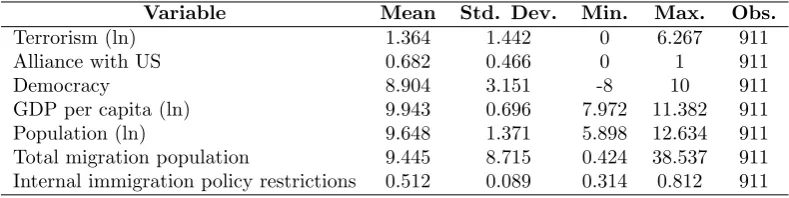
Table I. Descriptive statistics: Dependent variable and controls
Variable Mean Std. Dev. Min. Max. Obs.
Terrorism (ln) 1.364 1.442 0 6.267 911
Alliance with US 0.682 0.466 0 1 911
Democracy 8.904 3.151 -8 10 911
GDP per capita (ln) 9.943 0.696 7.972 11.382 911
Population (ln) 9.648 1.371 5.898 12.634 911
Total migration population 9.445 8.715 0.424 38.537 911 Internal immigration policy restrictions 0.512 0.089 0.314 0.812 911
Methodology
We estimate spatial temporal autoregressive models based on ordinary least squares (spatial-OLS) and specify
a weighting matrix on migrant-population movements and cultural proximity. The core part of this isWyt 1,
which is the spatial variable comprising the product of a row-standardized connectivity matrix (W) with the
temporally lagged dependent variable (yt 1).15 The elements (wi,j) in the weighting matrix measure the
relative connectivity of country j to country i (withwi,i=0). A positive and statistically significant e↵ect
constitutes a positive di↵usion e↵ect in that, in our case, terrorism in the sending state increases terrorism in
the recipient country. A negative and statistically significant e↵ect would capture a negative di↵usion e↵ect in
that, in our case, more terrorism in the sending state decreases terrorism in the recipient country. Following
Franzese & Hays (2008, 2007, 142), we control for a number of relevant ‘exogenous-external conditions or
common shocks and spatially correlated unit level factors.’ Next to the control variables we outlined above and
the temporally lagged dependent variable, country e↵ects are added to account for unobserved heterogeneities
that are specific to each country and to leverage changes occurring within units. Time e↵ects are entered to
control for temporal shocks or systemic e↵ects that might a↵ect terrorism, such as the 9/11 attacks.
The core of this methodological approach and, hence, our empirical analysis are three spatial lags. All
spatial items are based on a matrix that links countries via migrant populations.16 That is, the elements of
each variable’s matrix measure for each pair of countries in a given year the size of the migrant population
of a foreign state (country of origin) in the country under study (host state). While one (the first) spatial
lag’s underlying weights matrix is only based on migrant populations, the other two spatial lags rely on
weighting matrices that further include information about cultural proximity and distance, respectively,
between countries. Ultimately, for the first spatial lag that is only based on migration populations, each
elementwi,j of the connectivity matrix measures the migrant population in countryi that has countryj as
the state of origin int-1. In the absence of any migration population fromj ini,wi,j takes the value of 0.
This row-standardized matrix is multiplied with the temporally lagged dependent variable (yt 1) to create
the first spatial lag, which then measures the average degree of terrorism in other countries weighted by
migrant populations. As indicated above, we take the data on migrant populations from ¨Ozden et al. (2011)
15A potential impact on terrorism via a migration-di↵usion path plausibly requires some time to evolve; hence, we use the
temporally lagged dependent variable.
and we expect a positive and significant e↵ect for this first spatial lag.
The second spatial lag is similar to the first one except for an additional component added to the weighting
matrix. That is, each element wi,j of the second connectivity matrix captures the migrant population in
country i that has country j as the state of origin in t-1 – but only in culturally close countries. We
measure cultural proximity between two countriesi, j in the matrix via the cultural-di↵erences information
in Kandogan (2012), which is a revised variable of the standardized measure of cultural distance as introduced
in Kogut & Singh (1988).17 For countries’ cultural links in the connectivity matrix, we first paired each state
with all other countries and then merged the Kandogan (2012) variable into this dyadic data set. We reversed
the scale of that variable so that higher values pertain to more cultural similarities between states. Afterwards,
we divided the item into ten equally sized groups (quantiles), while the five most similar groups eventually
receive an entry of 1 in the elementswi,j of the connectivity matrix and the five least similar quantiles are
coded as 0 forwi,j. Finally, these entrieswi,j are multiplied by the migrant population in countryithat has
countryj as the state of origin int-1 in order to capture migrant flows betweeniandj, which are then two
states that are by construction culturally more similar to each other.
Our final spatial lag combines information about migrant stocks and cultural dissimilarity in its underlying
matrix. That is, using the reversed scale on cultural proximity (Kandogan, 2012) and the ten equally sized
groups, the five least similar quantiles are now coded as 1 in the elements wi,j of the connectivity matrix
(all other entries as 0). As above, we multiply these entries with the migrant population in countryi that
has country j as the state of origin in t-1, which then measures migrant populations across tow culturally
dissimilar states. In light of our theory, we expect an insignificant estimate for the culturally-similar spatial
lag, but a positive and significant impact stemming from our last spatial variable that focuses on culturally
distant states. Table II summarizes the descriptive statistics of the spatial variables and the temporally
lagged dependent variable. The weighted level of terrorism in all other countries is around 1.27, when the
weights are based on migrant populations only. When focusing on migrant flows from culturally proximate
countries, the value increases to 1.479, while it is around 1.473 for migration from culturally distant states.
[image:12.595.89.494.614.677.2]In the following, we assess whether these items shape terrorism ‘at home’ in systematic ways.
Table II. Descriptive statistics: Spatial lags and lagged dependent variable
Variable Mean Std. Dev. Min. Max. Obs.
Lagged dependent variable 1.401 1.459 0 6.267 911
Wy: Migrant inflow 1.271 0.425 0.539 2.536 911
Wy: Migrant inflow cultural proximity 1.479 0.753 0 3.365 911
Wy: Migrant inflow cultural distance 1.473 0.575 0 3.06 911
17The Online appendix describes the cultural-proximity data in more detail. Moreover, a robustness check is based ongenetic
Findings
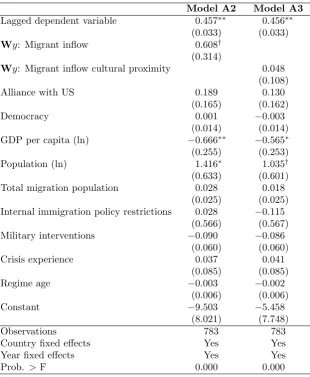
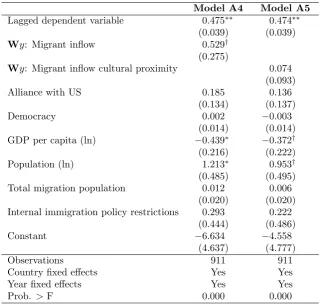
All models in Table III are identical in terms of controls and fixed e↵ects, but they di↵er in the spatial
variable(s) considered. Model 1 focuses onWy: Migrant inflow. Model 2 replaces that item by the spatial
lag that is weighted by migration inflowsandcultural proximity. Model 3 concentrates on terrorism weighted
by migration in culturally distant states. Finally, Model 4 comprises both Wy: Migrant inflow cultural
proximity andWy: Migrant inflow cultural distance. Due to the row standardization, the spatial lags can be
interpreted directly. However, as we include a temporally lagged dependent variable, our coefficient estimates
of the spatial lags only reflect the short-term e↵ect, i.e. the impact in a current year. Asymptotic long-term
influence of these items are calculated according to Pl¨umper et al. (2005, 336) and discussed in the text where
[image:13.595.66.524.301.634.2]relevant.
Table III. Terrorism di↵usion: The Role of cultural proximity
Model 1 Model 2 Model 3 Model 4
Lagged dependent variable 0.475⇤⇤ 0.474⇤⇤ 0.477⇤⇤ 0.475⇤⇤
(0.030) (0.030) (0.030) (0.030)
Wy: Migrant inflow 0.529† (0.271)
Wy: Migrant inflow cultural proximity 0.074 0.073
(0.093) (0.093)
Wy: Migrant inflow cultural distance 0.229† 0.228† (0.139) (0.139)
Alliance with US 0.185 0.136 0.152 0.162
(0.152) (0.150) (0.150) (0.151)
Democracy 0.002 0.003 0.003 0.002
(0.011) (0.011) (0.011) (0.011) GDP per capita (ln) 0.439⇤ 0.372† 0.389† 0.437⇤
(0.214) (0.215) (0.210) (0.218) Population (ln) 1.213⇤ 0.953† 1.000⇤ 1.047⇤
(0.514) (0.494) (0.493) (0.496) Total migration population 0.012 0.006 0.003 0.004
(0.018) (0.018) (0.018) (0.018) Internal immigration policy restrictions 0.293 0.222 0.223 0.303
(0.502) (0.508) (0.499) (0.509)
Constant 11.346† 7.753 8.516 8.838
(6.660) (6.376) (6.389) (6.403)
Observations 911 911 911 911
Country fixed e↵ects Yes Yes Yes Yes
Year fixed e↵ects Yes Yes Yes Yes
Prob. >F 0.000 0.000 0.000 0.000
Standard errors in parentheses. †p<0.10,⇤p<0.05,⇤⇤p<0.01
First,Wy: Migrant inflow is positively signed and significant at the 10 percent level in Model 1. This
finding mirrors and replicates Bove & B¨ohmelt (2016) in that it underlines that migration flows can be a
vehicle for terrorism to di↵use from one state to another. We can rule out that this is driven by geographical
proximity, since our analysis combines OECD-only host states with all other countries in the world. In
leads to a rise in terrorist attacks of about 1.67 events. As indicated above, this is merely the short-term e↵ect,
though. The asymptotic long-term marginal e↵ect of this first spatial lag is about 0.968 (coefficient estimate),
which translates into 2.6 attacks. While these results mirror existing findings on terrorism di↵usion via
population movements, therefore highlighting that the degree of terrorism ‘at home’ increases with migrants
from countries with a high level of terrorism, the first model does not take into account that states might
be linked via cultural ties to each other. In other words, our first estimation in Table III treats immigrants
as homogeneous populations, merely pointing to the dichotomy of ‘immigrants’ vs. ‘natives’ without fully
incorporating the cultural diversity that may exist across and within such populations (Ousey & Kubrin,
2018; Kubrin et al., 2018). To this end, Models 2-4 concentrate onWy: Migrant inflow cultural proximity
[image:14.595.163.446.302.598.2]andWy: Migrant inflow cultural distance.
Figure 1. Terrorism di↵usion: The role of cultural proximity
Wy: Migrant inflow
Wy: Migrant inflow cultural proximity
0 1 2 3 4
D
e
n
si
ty
1.5
-0.5 0.0 0.5 1.0
Marginal effect
Graph shows simulated marginal e↵ects di↵erences ofWy: Migrant inflowandWy: Migrant inflow cultural proximity, while holding all other covariates constant at their respective median.
In light of our hypothesis, we do not suggest that the cultural-proximity spatial lag should be negatively
signed and/or significant, but that it should weaken and, thus, render insignificant the original spatial variable.
As Model 2 shows, the spatial lag incorporating cultural closeness is now statistically insignificant, providing
little evidence for a strong – or any – influence stemming from migration populations on terrorism di↵usion
whendirectly modelling that migrants come from culturally close countries. Changing model specifications by
does not a↵ect this finding qualitatively: as the Online appendix demonstrates,Wy: Migrant inflow cultural
proximity remains statistically insignificant even then. The conclusion holds when examining the simulated
marginal e↵ects following King et al. (2000) in Figure 1: while the marginal-e↵ect estimates ofWy: Migrant
inflow center around 0.5 with only a small portion of the 1,000 simulated coefficients being 0 or negative
(less than 2.3 percent of the simulated marginal e↵ects), the simulated estimates of Wy: Migrant inflow
cultural proximity converge toward 0. Hence, we are unable to identify a statistically significant e↵ect once
we incorporate migrants’ cultural proximity to their host society: cultural closeness does indeed dampen the
di↵usion of terrorism via migration flows. Interestingly, the substantive finding of migration being a vehicle
for terrorism to di↵use across countries is unaltered forWy: Migrant inflow cultural distance. Substantively,
Model 3 and 4 emphasize that a one-unit increase inWy: Migrant inflow cultural distance is associated with
an increase in terrorist events by about 1.26. These results, in sum, emphasize in line with our theoretical
expectations that more cultural proximitycan address, contain, and indeed be a barrier to the di↵usion of
terrorism via migration. In other words, cultural proximity can dampen the di↵usion e↵ect of migration,
while cultural distance does not.
This conclusion is based on statistical significance, but statistical significance may be a poor criterion
for policy prescriptions (Ward et al., 2010). In their words, ‘a variable that might at first be thought to
represent an important conceptual breakthrough in our understanding of conflicts, owing to its statistical
significance, often only leads to a very modest improvement in our ability to predict’ outcomes (Ward et al.,
2010, 365). Put di↵erently, next to statistical significance, predictive power is an important factor to consider
and out-of-sample heuristics must not be ignored for deciding whether the inclusion of a variable contributes
to our understanding of, in our case, terrorism di↵usion or not. This implies that we should be able to
demonstrate not only thatWy: Migrant inflow cultural proximity exerts an e↵ect that is indistinguishable
from 0, but also that the inclusion of this variable leads to predictive gains that help us to generalize the
e↵ect of cultural proximity to out-of-sample contexts. Hence, not only shouldWy: Migrant inflow cultural
proximity render insignificant the original spatial variable, but also the underlying model should perform
better from a prediction point of view than the original setup when adding the information on cultural
proximity. We thus conducted a 4-fold cross-validation quasi-experimental exercise, which we repeated 10
times for Models 1, 2, and 4 above and an additional model that is similar to the estimations in Table III,
but we omit any of the spatial lags.
To this end, as an initial step, we randomly divided our sample into four segments of about the same size.
We then used three random segments to estimate the parameters, while the fourth segment was retained for
assessing the predictive power of either of the four models on the pooled subsets. We provide two
goodness-of-fit measures in this out-of-sample setup. First, Theil’s U is the square root of the ratio between the sum
of squared prediction errors of a model and the sum of squared prediction errors of a na¨ıve model, i.e. a
larger than 1, the model performs worse than the na¨ıve model; values of Theil’s U smaller than 1 indicate that
the ‘theoretically informed model’ performs better than the na¨ıve specification. Second, the mean squared
prediction error (MSPE) pertains to the expected value of the squared di↵erence between the observed values
[image:16.595.117.484.174.452.2]of the outcome variable and the predicted ones.
Table IV. 4-fold cross-validation
Constrained model Model 1 Model 2 Model 4
1 0.823 0.801 0.814 0.803
(0.462) (0.438) (0.451) (0.439)
2 0.820 0.823 0.806 0.818
(0.458) (0.461) (0.444) (0.456)
3 0.828 0.828 0.815 0.817
(0.468) (0.467) (0.453) (0.455)
4 0.821 0.813 0.819 0.817
(0.459) (0.450) (0.457) (0.455)
5 0.824 0.817 0.816 0.818
(0.463) (0.465) (0.454) (0.456)
6 0.816 0.806 0.813 0.807
(0.454) (0.443) (0.451) (0.445)
7 0.821 0.828 0.802 0.816
(0.459) (0.468) (0.438) (0.455)
8 0.802 0.812 0.820 0.815
(0.438) (0.450) (0.459) (0.452)
9 0.815 0.828 0.818 0.813
(0.453) (0.467) (0.456) (0.451)
10 0.830 0.826 0.818 0.817
(0.470) (0.465) (0.456) (0.455)
Mean Value 0.820 0.818 0.814 0.814
(0.458) (0.457) (0.452) (0.452)
Table entries are Theil’s U values with MSPEs in parentheses.
We calculated both measures for Models 1, 2, and 4 as well as a constrained model that does not include
any of the spatial lags. As indicated above, we repeated the cross-validation 10 times and, thus, obtain for
each model 10 di↵erent values for Theil’s U and the MSPE, respectively. We calculated the average values
for both model-fit statistics to arrive at global values. The results are summarized in Table IV. For the
constrained model, the average Theil’s U across all 10 iterations of the cross-validation is 0.820, while the
corresponding MSPE stands at 0.458. Interestingly, both the corresponding average Theil’s U and the MSPE
values are lower for Models 1, 2, and 4. As a result, the predictive power of our core variables of interest
is established as the prediction error tends to increase when omitting Wy: Migrant inflow, Wy: Migrant
inflow cultural proximity, orWy: Migrant inflow cultural distance.
In terms of control variables, our results are consistent with recent studies on the economic, political
and social causes of terrorism (e.g. Wilson & Piazza, 2013; Gaibulloev & Sandler, 2018). We find that
whereas larger countries attract more terrorist attacks, and thusPopulation (ln)is positively and significantly
correlated with the incidence of terrorism, higher income is associated to a lower degree of terrorism, asGDP
per capita (ln) is negatively signed (e.g. Young & Findley, 2011). Similarly, and consistent with earlier
displays temporal dependencies and a higher number of terrorist attacks in the previous year is correlated
with more terrorism in the current period. The Democracy variable is statistically insignificant as is the
alliance item, which is expected given our focus on OECD host countries. Finally, migration policies or the
(‘raw’) migration population in the host country do not seem to crucially shape the level of terrorism. While
omitting these variables from the models does not alter our results forWy: Migrant inflow cultural proximity
andWy: Migrant inflow cultural distance, the insignificance of their coefficient estimates not only highlights
yet again that migrants are not to blame for an increased risk of terrorism, but also that more restrictive
national migration policiesper se are unlikely to be all-encompassing instrument against terrorism.
In the Online appendix, we assess the robustness of our results along various avenues. First, we consider
genetic distance in lieu of cultural distance. Second, we include additional variables to our estimations.
Third, we run a series of models with bootstrapped standard errors. Fourth, we check whether the e↵ect of
democracy is non-linear. Fifth, although our theoretical focus is on the longer time horizon of migrants as
opposed to refugees, we control for refugee inflows. Sixth, we drop all country-years based on interpolated
migration data and distinguish between domestic and transnational terrorism.18 Finally, we examine
short-term migration influx, employ a di↵erent estimator, and compare explanatory variables across culturally-close
and distant dyads.
Conclusion
A recent strand of academic research finds that terrorism at home can be influenced by terrorism abroad, and
that population movements may facilitate this transnational di↵usion of terrorism (Bove & B¨ohmelt, 2016).
One central argument of these works suggests that strong social bonds facilitate the establishment of ‘terror
networks’ and a pre-established social framework is a key requirement for terror organizations radicalizing and
recruiting individuals (Sageman, 2004, 2011). As migration flows comprise social ties and linkages, terrorist
groups may exploit those networks of migrant communities for radicalization, as a recruitment pool, and to
obtain indirect support through the exchange of ideas, resources, or knowledge.
Yet, cultural proximity between countries may shape individual interactions in diverse ways – and, as
we contend, this has implications for terrorist organizations’ recruitment possibilities as well as individuals’
motives to directly or indirectly engage in terrorism. Migrants from culturally-close societies may have fewer
difficulties integrating into host societies. In turn, social cohesion within societies evolves more easily with
migrant communities from culturally closer places, which makes it more difficult for terrorist organization to
radicalize and recruit followers. Combining this mechanism with the arguments about terrorism di↵usion via
migration flows led to the theoretical expectation that cultural proximity can contain, and act as a barrier to,
such terrorism di↵usion. In fact, we find little evidence for migrants being an instrument for the transnational
18The results across the two types of terrorism di↵er. Given that there are di↵erent causes, consequences, and policy
di↵usionwhen accounting for and directly incorporating information on cultural closeness.
We build on existing arguments on how terrorism may di↵use via migration inflows, but we do not
isolate the role of each mechanism that might drive this e↵ect. There is a range of means of direct and
indirect support that terrorist groups can obtain from marginalized immigrants, but the main obstacle for
investigating them separately is the lack of comprehensive fine-grained data at the level of individuals or
organizations. Future work should further disaggregate individuals and organizations as spatial units, and
include information about their activities and positions in terrorist organizations, organizations’ links across
countries, and, most importantly, the possible role played by immigrants within these groups. In addition,
our data do not allow determining whether immigrants are the perpetrators or victims of terrorist violence.
There is ample evidence suggesting that foreign-born individuals are vulnerable to the violation of their rights
and are too often the targets of violent persecution from hostile local populations (Savun & Gineste, 2019;
B¨ohmelt et al., 2019). Within the broader micro-turn in the study of immigration, recent scholarship has
begun to compile new data on refugees’ involvement in acts of physical violence in their host state, either as
the victims or perpetrators of violence (see, e.g. Gineste & Savun, 2019). Similar coding e↵orts with detailed
information on the nationality and identity of victims and perpetrators of terrorism will allow scholars to
assess under which conditions immigrants are targeted by terrorist violence, when and how they o↵er direct
or indirect material support, and when they are exploited as a vehicle for such episodes of violence.
References
Adamson, Fiona (2006) Crossing borders: International migration and national security.International
Secu-rity 31(1): 165–199.
Alarian, Hannah & Sara Goodman (2017) Dual citizenship allowance and migration flow: An origin story.
Comparative Political Studies 50(1): 133–167.
Alesina, Alberto & Eliana Ferrara (2005) Ethnic diversity and economic performance. Journal of Economic
Literature 43(3): 762–800.
Allport, Gordon W (1954)The nature of prejudice. Boston, MA: Addison-Wesley.
Angelini, Viola; Laura Casi & Luca Corazzini (2015) Life satisfaction of immigrants: Does cultural
assimila-tion matter? Journal of Population Economics 28(3): 817–844.
Bakaki, Zorzeta; Tobias B¨ohmelt & Vincenzo Bove (2016) Barriers to coordination? Examining the impact
of culture on international mediation occurrence and e↵ectiveness. Political Studies 64(3): 492–512.
Blomberg, Brock & Gregory Hess (2008) The Lexus and the olive branch: Globalization, democratization,
and terrorism. In: Philip Keefer & Normal Loayza (eds) Terrorism, economic development, and political
B¨ohmelt, Tobias & Vincenzo Bove (forthcoming) How migration policies moderate the di↵usion of terrorism.
European Journal of Political Research. DOI: https://doi.org/10.1111/1475-6765.12339.
B¨ohmelt, Tobias; Vincenzo Bove & Kristian Gleditsch (2019) Blame the victims? refugees, state capacity,
and non-state actor violence. Journal of Peace Research 56(1): 73–87.
Bove, Vincenzo & Tobias B¨ohmelt (2016) Does immigration induce terrorism? Journal of Politics 78(2):
572–588.
Bove, Vincenzo & Tobias B¨ohmelt (2019) International migration and military intervention in civil war.
Political Science Research and Methods7(2): 271–287.
Braithwaite, Alex & Ti↵any Chu (2018) Civil conflicts abroad, foreign fighters, and terrorism at home.
Journal of Conflict Resolution 62(8): 1636–1660.
Braithwaite, Alex & Quan Li (2007) Transnational terrorism hot spots: Identification and impact evaluation.
Conflict Management and Peace Science 24(4): 281–296.
Breunig, Christian; Xun Cao & Adam Luedtke (2012) Global migration and political regime type: A
demo-cratic disadvantage. British Journal of Political Science 42(4): 825–854.
Buhaug, Halvard & Kristian Skrede Gleditsch (2008) Contagion or confusion? why conflicts cluster in space.
International Studies Quarterly 52(2): 215–233.
Carnevale, Peter & Dong-Won Choi (2000) Culture in the mediation of international disputes. International
Journal of Psychology 35(2): 105–110.
Choi, Seung-Whan & Idean Salehyan (2013) No good deed goes unpunished: Refugees, humanitarian aid,
and terrorism. Conflict Management and Peace Science 30(1): 53–75.
Cohen, Raymond (1996) Cultural aspects of international mediation. In: Jacob Bercovitch (ed.)Resolving
international conflicts: The theory and practice of international mediation. Boulder, CO: Lynne Rienner ,
107–128.
De Wit, Thom & Ruud Koopmans (2005) The integration of ethnic minorities into political culture: The
Netherlands, Germany, and Great Britain compared. Acta Politica 40(1): 50–73.
Doosje, Bertjan; Annemarie Loseman & Kees Bos (2013) Determinants of radicalization of Islamic youth in
the Netherlands: Personal uncertainty, perceived injustice, and perceived group threat. Journal of Social
Issues 69(3): 586–604.
Dowty, Alan & Gil Loescher (1996) Refugee flows as grounds for international action.International Security
Dreher, Axel; Martin Gassebner & Paul Schaudt (2017) The e↵ect of migration on terror: Made at home or
imported from abroad? CESifo Working Paper (6441).
Dustmann, Christian & Tommaso Frattini (2014) The fiscal e↵ects of immigration to the UK. Economic
Journal 124(580): F593–F643.
Enders, Walter; Todd Sandler & Khusrav Gaibulloev (2011) Domestic versus transnational terrorism: Data,
decomposition, and dynamics. Journal of Peace Research 48(3): 319–337.
Findley, Michael; James Piazza & Joseph Young (2012) Games rivals play: Terrorism in international rivalries.
Journal of Politics 74(1): 235–248.
Franzese, Robert & Jude Hays (2007) Spatial econometric models of cross-sectional interdependence in
po-litical science panel and time-series-cross-section data. Political Analysis 15(2): 140–164.
Franzese, Robert & Jude Hays (2008) Interdependence in comparative politics: Substance, theory, empirics,
substance. Comparative Political Studies 41(4/5): 742–780.
Gaibulloev, Khusrav; James Piazza & Todd Sandler (2017) Regime types and terrorism. International
Organization 71(3): 491–522.
Gaibulloev, Khusrav & Todd Sandler (2018) What we have learned about terrorism since 9/11. Journal of
Economic Literature 57(2): 275–328.
Ghosn, Faten; Alex Braithwaite & Ti↵any S Chu (2019) Violence, displacement, contact, and attitudes
toward hosting refugees. Journal of Peace Research 56(1): 118–133.
Gibler, Douglas (2008)International Military Alliances, 1648-2008. Washington, DC: CQ.
Gineste, Christian & Burcu Savun (2019) Introducing POSVAR: A dataset on refugee-related violence.
Jour-nal of Peace Research 56(1): 134–145.
Gokmen, Gunes (2017) Clash of civilizations and the impact of cultural di↵erences on trade. Journal of
Development Economics127(1): 449–458.
Greenhill, Kelly (2010) Weapons of Mass Migration: Forced Displacement, Coercion, and Foreign Policy.
Ithaca, NY: Cornell University Press.
Guiso, Luigi; Paola Sapienza & Luigi Zingales (2006) Does culture a↵ect economic outcomes? Journal of
Economic Perspectives 20(2): 23–48.
Helbling, Marc; Liv Bjerre; Friederike R¨omer & Malisa Zobel (2017) Measuring immigration policies: The
Helbling, Marc & David Leblang (2019) Controlling immigration? How regulations a↵ect migration flows.
European Journal of Political Research 58(1): 248–269.
Hogg, Michael (2011) Uncertainty-identity theory. In: Paul A M Van Lange, Anrie W Kruglanski & E Tory
Higgins (eds) Handbook of theories of social psychology. Thousand Oaks, CA: SAGE: 62–80.
Isphording, Ingo (2014) Disadvantages of linguistic origin? Evidence from immigrant literacy scores.
Eco-nomics Letters 123(2): 236–239.
Kandogan, Yener (2012) An improvement to Kogut and Singh measure of cultural distance considering the
relationship among di↵erent dimensions of culture.Research in International Business and Finance 26(2):
196–203.
King, Gary; Michael Tomz & Jason Wittenberg (2000) Making the most of statistical analyses: Improving
interpretation and presentation. American Journal of Political Science 44(2): 347–361.
Kogut, Bruce & Harbir Singh (1988) The e↵ect of national culture on the choice of entry mode. Journal of
International Business Studies 19(3): 411–432.
Krieger, Tim & Daniel Meierrieks (2011) What causes terrorism? Public Choice 147(1): 3–27.
Kubrin, Charis; John Hipp & Young-An Kim (2018) Di↵erent than the sum of its parts: Examining the
unique impacts of immigrant groups on neighborhood crime rates. Journal of Quantitative Criminology
34(1): 1–36.
Li, Quan (2005) Does democracy promote or reduce transnational terrorist incidents? Journal of Conflict
Resolution 49(2): 278–297.
Li, Quan & Drew Schaub (2004) Economic globalization and transnational terrorist incidents: A pooled time
series cross-sectional analysis. Journal of Conflict Resolution 48(2): 230–258.
Lischer, Sarah (2015)Dangerous sanctuaries: Refugee camps, civil war, and the dilemmas of humanitarian
aid. Ithaca, NY: Cornell University Press.
Lyons-Padilla, Sarah; Michele J Gelfand; Hedieh Mirahmadi; Mehreen Farooq & Marieke van Egmond (2015)
Belonging nowhere: Marginalization & radicalization risk among Muslim immigrants. Behavioral Science
& Policy 1(2): 1–12.
Mahfud, Yara; Constantina Badea & Ahogni Ngbala (2015) Cultural distance and prejudice against
immi-grants in France: The role of integration models. Revue Internationale de Psychologie Sociale 28(2):
Mahfud, Yara; Constantina Badea; Maykel Verkuyten & Kate Reynolds (2018) Multiculturalism and attitudes
toward immigrants: The impact of perceived cultural distance.Journal of Cross-Cultural Psychology 49(6):
945–958.
Marshall, Monty & Keith Jaggers (2015)Polity IV Project: Political regime characteristics and transitions,
1800-2014. Users’ Manual. College Park, MD: University of Maryland.
Maxwell, Rahsaan (2010) Evaluating migrant integration: Political attitudes across generations in Europe.
International Migration Review 44(1): 25–52.
Nemeth, Stephen; Jacob Mauslein & Craig Stapley (2014) The primacy of the local: Identifying terrorist hot
spots using geographic information systems. Journal of Politics 76(2): 304–317.
Neumayer, Eric & Thomas Pl¨umper (2010) Galton’s problem and contagion in international terrorism along
civilizational lines. Conflict Management and Peace Science 27(4): 308–325.
Ousey, Graham & Charis Kubrin (2018) Immigration and crime: Assessing a contentious issue. Annual
Review of Criminology 1(1): 63–84.
¨
Ozden, C¸ a˘glar; Christopher Parsons, Maurice Schi↵& Terrie Walmsley (2011) Where on earth is everybody?
The evolution of global bilateral migration 1960-2000. World Bank Economic Review 25(1): 12–56.
Piazza, James (2006) Rooted in poverty? Terrorism, poor economic development, and social cleavages.
Terrorism and Political Violence 18(1): 159–177.
Pl¨umper, Thomas & Eric Neumayer (2010) Model specification in the analysis of spatial dependence.
Euro-pean Journal of Political Research 49(3): 418–442.
Pl¨umper, Thomas; Vera Troeger & Philip Manow (2005) Panel data analysis in comparative politics.European
Journal of Political Research 44(2): 327–354.
Rahimi, Sadeq & Raissa Graumans (2015) Reconsidering the relationship between integration and
radical-ization. Journal for Deradicalization 5(1): 28–62.
Sageman, Marc (2004)Understanding terror networks. Philadelphia, PA: University of Pennsylvania Press.
Sageman, Marc (2011) Leaderless Jihad: Terror networks in the twenty-first century. Philadelphia, PA:
University of Pennsylvania Press.
Salehyan, Idean (2008) The externalities of civil strife: Refugees as a source of international conflict.American
Journal of Political Science 52(4): 787–801.
Salehyan, Idean & Kristian Skrede Gleditsch (2006) Refugees and the spread of civil war. International
Savun, Burcu & Christian Gineste (2019) From protection to persecution: Threat environment and refugee
scapegoating. Journal of Peace Research 56(1): 88–102.
Schmid, Alex (2016) Links between terrorism and migration. International Centre For Counter Terrorism
(ICCT) ICCT Research Paper.
Skeldon, Ronald (2008) International migration as a tool in development policy: A passing phase? Population
and Development Review 34(1): 1–18.
Spolaore, Enrico & Romain Wacziarg (2016) War and relatedness.Review of Economics and Statistics 98(5):
925–939.
UN DESA (2016)International migration report. New York: UN Department of Economic and Social A↵airs,
Population Division.
Velasco Gonz´alez, Karina; Maykel Verkuyten; Jeroen Weesie & Edwin Poppe (2008) Prejudice towards
Muslims in the Netherlands: Testing integrated threat theory. British Journal of Social Psychology 47(4):
667–685.
Vidino, Lorenzo; Francesco Marone & Eva Entenmann (2017)Fear thy neighbor: Radicalization and Jihadist
attacks in the West. Milano: Ledizioni Ledi.
Vigdor, Jacob (2015) The civic and cultural assimilation of immigrants to the United States. In: Benjamin
Powell (ed.) The Economics of Immigration: Market-Based Approaches, Social Science, and Public Policy.
Oxford: Oxford Scholarship Online.
Ward, Michael D; Brian Greenhill & Kristin Bakke (2010) The perils of policy by p-value: Predicting civil
conflicts. Journal of Peace Research 47(4): 363–375.
Weiner, Myron (1992) Security, stability, and international migration. International Security 17(3): 91–126.
Wenger, Andreas & Victor Mauer (2009)The radicalization of diasporas and terrorism. Z¨urich: Center for
Security Studies.
Wilson, Matthew & James Piazza (2013) Autocracies and terrorism: Conditioning e↵ects of authoritarian
regime type on terrorist attacks. American Journal of Political Science 57(4): 941–955.
Young, Joseph & Michael Findley (2011) Promise and pitfalls of terrorism research. International Studies
Review 13(3): 411–431.
Zimmermann, Doron & William Rosenau (2009) Introduction. In: Doron Zimmermann & William Rosenau
Does cultural proximity contain terrorism di
↵
usion? –
Online appendix
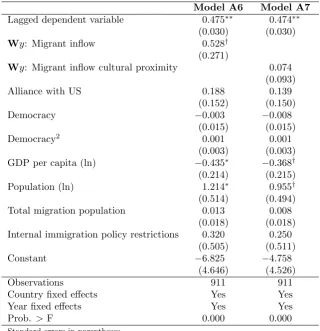
In this appendix, we provide additional information on the construction of the spatial lags, as well as further
information on the data for cultural proximity and distance. We have also performed additional tests to assess
the robustness of our findings. All these additional checks can be replicated with the data and model instructions.
They further increase the confidence in our finding that cultural proximity can contain, and act as a barrier to,
terrorism di↵usion via migration and include:
• We considergenetic distanceinstead of cultural distance.
• Additional control variablesthat capture alternative determinants of terrorism and may correlate with
the factors driving migration.
• We estimate a series of models with bootstrapped standard errors.
• We present models that examinecurvilinear e↵ects of democracy.
• Models whencontrolling for refugees.
• We drop all country-years based on interpolated migration data and re-estimate the core models using
non-interpolated data only.
• We distinguish between domesticandtransnationalforms of terrorism.
• Instead of the stock of migrants for the spatial lags, we considered yearly changes in the migrant
population.
• We re-estimated the core models usingthe number of terrorist attacksas the outcome variable with
negative binomial regression as an alternative estimator.
• We assessed the di↵erences in core explanatory variables acrossculturally-close and distant dyads.
A1. Additional information on the construction of the spatial lags
The core of our methodological approach and, hence, the empirical analysis is a set of three spatial lags. All
spatial items are based on a matrix that links countries via migrant populations. Given a monadic, country-year
unit of analysis, we created a data set comprising OECD countries only in 1980-2010. Data limitations of our
explanatory variables, primarily the immigration-policy variable and GDP per capita (ln), eventually lead to
the 911 observations. The matrix we use to capture country links via (1) migration and (2) migration as well
as cultural proximity is not based on a 911⇥911 matrix, though, as we would then only capture intra-OECD
migration and cultural links. Instead, we embedded the 911 OECD observations from our ‘core’ monadic data