http://dx.doi.org/10.4236/ijcns.2012.529071 Published Online September 2012 (http://www.SciRP.org/journal/ijcns)
Adaptation in Stochastic Dynamic Systems—Survey and
New Results III: Robust LQ Regulator Modification
Innokentiy V. Semushin
School of Mathematics and Information Technology, Ulyanovsk State University, Ulyanovsk, Russia Email: [email protected]
Received July 7,2012; revised August 3, 2012; accepted August 14, 2012
ABSTRACT
The paper is intended to provide algorithmic and computational support for solving the frequently encountered lin-ear-quadratic regulator (LQR) problems based on receding-horizon control methodology which is most applicable for adaptive and predictive control where Riccati iterations rather than solution of Algebraic Riccati Equations are needed. By extending the most efficient computational methods of LQG estimation to the LQR problems, some new algorithms are formulated and rigorously substantiated to prevent Riccati iterations divergence when cycled in computer imple-mentation. Specifically developed for robust LQR implementation are the two-stage Riccati scalarized iteration algo-rithms belonging to one of three classes: 1) Potter style (square-root); 2) Bierman style (LDLT); and 3) Kailath style (array) algorithms. They are based on scalarization, factorization and orthogonalization techniques, which allow more reliable LQR computations. Algorithmic templates offer customization flexibility, together with the utmost brevity, to both users and application programmers, and to ensure the independence of a specific computer language.
Keywords: Adaptive Control; Factorization; Least Squares; Linear Systems; LQG Estimator; LQ Regulator;
Orthogonalization; Receding Horizon Control; Scalarization
1. Introduction
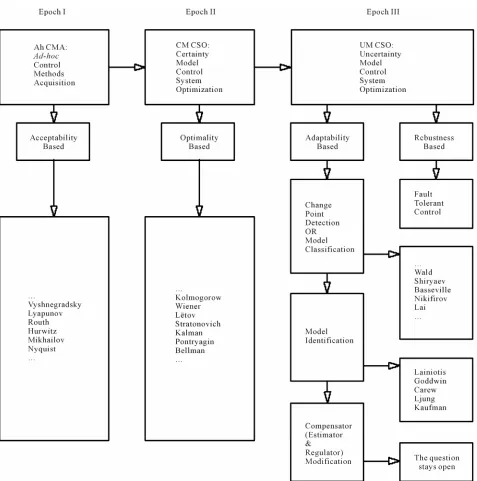
A thorough insight into the history of Automatic Control Systems theory gained by reading volumes such as the Systems and Control Encyclopedia [1] convinces us that ACS theory as a model-based science has passed through the three epochs of its development (Figure 1). The con- temporary epoch III is the epoch of uncertainty system optimization. It has grown into two mutually comple- mentary branches: adaptability and robustness. The latter percepts the uncertainty as a nuisance factor not to be identified but only compensated in a rough manner that leads to Fault Tolerant Control. On the contrary, the first branch brings three problems to be solved: 1) quickest Change Point Detection or more generally, Model Clas- sification; 2) reliable Model Identification; and 3) ade- quate System Modification. In Gibson’s view [2], these three functions are the determinant attributes of each adaptive system.
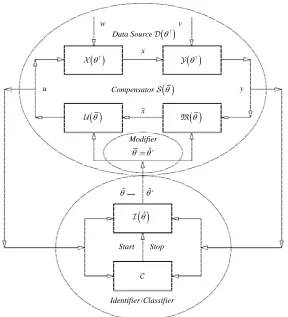
In accordance with this view, adaptability is realized as interoperability of the three units called Modifier/
Identifier/Classifier, MIC for short [3,4]. In the corre-sponding Figure 2, Classifier detects Data Source pa-rameter change points in order to give the well-timed Start for Identifier. Identifier seeks to estimate the Data Source parameters whose new unknown values †
may result from the change, each change is considered as a system fault. While Identifier is implementing this fea-ture, Classifier seeks to detect the point when the pa-rameter estimates ˆ have approached their reasonable (near-to-optimum) value ˆ
ˆ
in order to give the well- timed Stop for Identifier. At this point, Modifier begins to perform Compensator modification formally viewed as assigning the final value to the Compensator's parameter .
Different solutions for Classifier have been proposed, from the very simple [5] to sophisticated ones based on changepoint detection methods recently surveyed in [6] and developed in [7].
An abundance of solutions available for Identifier can be conventionally aggregated into the five functionally distinguishable categories [3]:
(C1) Bayesian Adaptive Model approach [8,9] has led to the modern multiple model adaptive estimation (MMAE) method based on a bank of parallel Kalman filters (KF), each KF designed to correspond a particular fault status of the system [10].
Figure 1. Three epochs of automatic control systems history.
the unknown parameters [11]. The augmented dynamic equations become nonlinear. If linearized, they lead to the Extended Kalman Filter (EKF) [12,13]. The EKF implements a Kalman filter for a system dynamics that results from the linearization of the original non-linear augmented filter dynamics around the preceding state estimates.
(C3) Analytical Relations based Adaptive Model ap-proach uses the analytical relations between the optimal system equations and the Data Source (DS) statistics. They are used with the current estimates of unknown DS statistics (parameters) substituted for the exact (unknown)
values. Usually, this requires a convergent numerical method to be developed [14]. The most distinctive fea-ture of this approach is that it provides no feedback on the system performance index (the adaptation loop is open).
w v
Data Source†
†
†
M
Compensator
ˆ :
Modifier
ˆ
ˆ
ˆ
Start Stop
u y
x
x
[image:3.595.155.443.84.401.2]/ Identifier Classifier
Figure 2. Adaptive stochastic control system structure: stands for Plant; for Sensor; for Regulator; for Estimator.
M
one as the system parameters estimator able to minimize the adopted PI. They are the focus of particularly intense scrutiny, and among them most theoretically substanti-ated and practically developed is Ljungian Minimum Prediction Error (MPE) method [15,16]. A less known method belonging to the same category is the Auxiliary Performance Index (API) method which renders possible least squares fitting the adaptive model state to the pure albeit hidden DS state, not to the measured (incomplete and noisy) output [3,4].
(C5) Characteristic Matching Adaptive Model approa- ch is usually based on introducing into model equations a fictitious noise with its root-mean-square (RMS) adjust-able [17,18] for a better fitting of the model. This ap-proach is adjacent to robust system control [19].
The above generalized categories are not necessarily pure, i.e. they can be met in combinations as it is the case of (C2) + (C5) in [20] or (C1) + (C2) in [21]. More to it, the same five categories hold for Classifier solutions, e.g. [22-24].
Given Classifier running as a “hot-line alert system”, a next successive adaptation period can emerge spontane-ously as a model identification phase followed by a com- pensator (Estimator & Regulator) modification phase (cf.
Figures 1 and 2). For the basic Figure 2, it is claimed that in automatic control, a regulator is a device which has the function of maintaining a designated characteris-tic of the plant behaviour by transforming the estimates of plant internal states into the control inputs applied (through an actuator) to the plant. A state estimator is typically a computer-implemented mathematical model that models a real system composed of the plant and a sensor in order to provide an estimate of plant’s internal state, given measurements of the input and output of the real system, which is called Data Source in Figure 2.
The present paper in intended to provide algorithmic and computational perspective for answering questions on how to perform Regulator Modification phase in adaptive control systems (the lower right side block in
Figure 1). It is absolutely understandable that this phase should be based on the regulator design methods, so that the very regulator modification can be treated as a re-design procedure. In this respect, we restrict ourselves to the case of discrete LQG control problem, that is, the control problem with Linear discrete-time plant and sen-sor models, and Quadratic performance index, and Gaus-sian random disturbances.
two matrix nonlinear Riccati Difference Equations (RDE), which are dual to each other.
The forward RDE is used in the synthesis of LQG-es-timator (LQGE, that is, Kalman Filter, KF), and the
backward RDE for the design of Linear-Quadratic Regu-lator (LQR). KF and LQR are designed independently of each other (the separation principle [25]). The latter is cascaded with the first, thus closing the feedback loop (the compesator in Figure 2). LQR for the LQG-control law is identical to its counterpart for the LQ deterministic control law (the certainty-equivalence principle, [26], p. 228).
Textbooks on LQG-control contain these well-known theoretical facts. However, not every one covers the computational aspects of RDE. Often, classic textbooks confine themselves to giving references about care or
dare functions of MATLAB® [27,28] thus meaning algebraic Riccati equations (ARE) [29] which can be either continuous-time ARE (care), or discrete-time ARE (dare). Solution of ARE is the critical task for stabilizing the compensator design. For discrete-time systems, the solution to DARE coincides with the steady- state solution of the RDE approached as the control ho-rizon tends to infinity [30]. Generalized Riccati theory is the key tool to robust control [31].
Many textbooks on Automatic Control Systems con-tain sometimes not only the presentation or derivation of RDE, but also a summary of numerical solutions of ARE as well. For example, [32] says (Section 11.5) that cita-tion of published works on solucita-tions and features of ARE (as of 1986) may amount to a book of its own. It men-tions an iterative method and considers, in some more detail, the iterative solution and eigenvalue methods as well.
However, the main source of information on Riccati equations is the vast research literature [33]. Great atten-tion paid to ARE arises from the fact that the direct RDE iterations, even if they are taken in the robustified form (Joseph style), do not exhibit fast convergence to the steady-state positive-definite solution.
The study and development of computational methods for ARE have evolved vigorously for many years. Of the great many publications, we mention only a few: [34-37] for the LQ-regulator solution and [38-44] for the LQG- estimator design. Based on these methods, solvers for ARE have been implemented in such software packages as Maple [45], Mathematica [46], MATLAB [47-49] and in computer libraries as BLAS (level I-III), EISPACK and LINPACK, as well as in their successor LAPACK [50,51]. Many Riccati solvers are written in FORTRAN, and also in Python [52]. The number of publications on ARE solvers has continued to grow [53-55].
Efficient use of existing methods within the software packages and libraries is mostly meant for off line
appli-cations owing to their high comptutational cost. For in-stance, at each Kleinmann iteration step [56], the com-putationally expensive Lyapunov equation has to be solved ([26], pp. 34-121). Newton’s method [57] requires solving a Lyapunov equation in the main step ([54], p. 6). Schur method [34], the most popular one amongst the eigenvalue methods, also needs considerable computa-tion efforts and addicomputa-tional details to make this approach work satisfactorily.
All these methods are intended for solving ARE, and so their ultimate end is to find a stabilizable regulator solution [58]. However, sometimes there is no need for solving ARE. Such a category of problems includes the Model Predictive Control, or MPC [26,59] exploiting the idea of finite receding horizon control (RHC) [26]. In finite RHC, the attainment of the steady-state Riccati solution is not the case due to the very sense of words “finite horizon” and “system adaptation” as can be seen from the generalized adaptive stochastic control system structure (in Figure 2, reproduced from [4]). This ex-plains why we do not consider the above surveyed methods of solving ARE advisable for regulator modifi-cation (re-design) in the adaptive control structure of
Figure 2.
In this paper, we consider the duality relations between the two RDE, that are at the heart of LQGE on the one part, and LQR on the other part, to secure further ad-vancement in the algorithms for Linear-Quadratic Regu-lator Optimization [51]. In doing so, we expect the com-putational methods, which have been derived for the LQG-Estimator implementation over the preceding dec-ades and recently surveyed in [60], to be successfully extended to the LQR re-design where a stepwise solution for the (backward) RDE, rather than ARE, is of primary importance.
In Section 2 we formulate Problem 1 of determining the LQG control law for the system composed of the plant and sensor both linearly modeled and subjected to additive Gaussian white noises [26,61].
Section 3 describes Problem 2 of LQG receding hori-zon control in line with [26].
Solutions to the above two problems are presented in Section 4 in order to compare both forward and back-ward RDEs and then to move to a single Riccati iteration (aiming at the backward RDE) which is given in Section 5 in an intermediate abstract notation.
In Section 6, we split the single Riccati iteration into two consequtive stages in order to construct two separate computational procedures called “Riciup Riccati Instant Update” and “Rictup Riccati Temporal Up-date,” which we use as the starting point for their nu-merical robustification.
stages for the three robust modification styles: Potter style in Section 8, Bierman style in Section 9 and Kailath style in Section 10.
Section 11 provides a brief look at the typical applica-tions of the results discussed in this paper, together with a characterization of related challenges.
The paper closes with the concluding remarks about the novelty of the new algorithmic insights.
2. LQG Control Problem
The overall system model includes: an n-dimentional stochastic discrete-time plant state equation
1 1
0 0
,
0,1, ; ,
i i i i
0
,
i i i
x t t t x t B
i x t x
t u t w t
P
(1)
and a m-dimentional measurement (sensor) equation
i , i1, 2,,
i i i
y t H t x t v t (2)
where
0 ,w t
1 ,
v t
i > 0R t w t
0and
1 2
are two mutually independent noise sequences of independent Gaussian (normal) zero mean random vectors represent-ing the state disturbance w and the measurement error v, characterized by covariance matrices i (posi-tive semi-definite) and (positive definite) cor- respondingly and independent of Gaussian initial state
,v t ,
0Q t
x t of mean x0 and covariance matrix P0. Control
0N k k
u u t
, t ,,u t
input 0,N is assumed to be sought as a sequence N of r-dimentional con-trol vectors which are applied to (1) to minimize the mean square performance index, PI (the expected cost) on a finite horizon of N time steps:
0 1u t u
ku t
0 0 0,
2 2
0
, ,
k k
N
N
k t k t
k
J t x t u
E x t u t
2
1 .
f N
x t
(3)
where the equivalence symbol reads “is equal by defini-tion to”. It is assumed that any nonzero input u t
kwithin the prediction horizon incurres a cost. This am- ounts to assuming that each weighting matrix
tk
T 0t t
t
, which is symmetric, is positive definite (PD):
k k . Further, it is assumed that the in-stantaneous cost at time k (the term within parentheses in (3)) is nonnegative. Together with the above PD con-dition, this is equivalent to the semi-positive definiteness of each symmetric matrix
tk
tk T:
tk 0.The terminal (or final) cost
1 2 f N 0
x t is also assumed
nonnegative, hence (f T
f f
final
).Remark 1. Expectation operator E
in (3) isde-fined w.r.t. probability measures induced by
0
0, 0
x t x P and w ti
0,Q t
i
,
0,
v t R t
i i
Remark 2. Metric in (3) is chosen to be elliptic: .
2k
T
k t k k k
x t x t t x t
and so on. By means of it, one can regulate the impor-tance of any summand in criterion (3). For example, the more costly is a single (the j-th) control input uj
tk0 k N
within the prediction control horizon (PCH,
tk), the greater should be its weight defined as the j-th di-agonal element of matrix in comparison with others.
t k ,
tk , fSelecting
N
t
as identity matrices brings us back to classical spherical distance measures. In signal processing, one needs sometimes to emphasize specific directions/dimentional components where statis-tical facts are more relevant. This is called ICA (Inde-pendent Component Analysis) [62].
Remark 3. The length of PCH, N in (3), approaching
infinity ( ) is not a judicious choice for adaptive systems. Infinitely large N would mean the intention to attain a steady-state mode of control, when no unforeseen model changes are considered anymore. This is in deep contradiction with the very sense of adaptation. Thus, N
must be finite. A question arises: what finite value of N
can be selected? Obviously, it depends on the mechanism which the unforeseen changes are subject to. By assump-tion, these changes should not occur very frequently compared with the control system transition time in order let the adaptor keep up with the dynamics of changes. If the changes mechanism operates as an independent actor, it is reasonable to take N equal or greater than the ex-pected time interval between the neighbouring model change points.
Remark 4. Weighting matrices k and tk
can be time-dependent within the PCH. There are many ways to do so. A reasonable one would be a matrix or-dering: both weighting matrix sequences are chosen in decreasing order (Version 1)
0 1
0 1
N
N
t t t
t t t
(4)
or in increasing order (Version 2)
0 1
0 1
N
N
t t t
t t t
t
t1
(5)
where the matrix inequality is interpreted as the standard positive matrix inequality: 0 , meaning
t0
t1 0 and so on.
Remark 5. In adaptive systems, our knowledge of
PCH. Common sense seems to tell us that this fact givesus reasons for prefering the decreasing version (4). In this case, the instantaneous cost at a farther time tk as part of penalty criterion (3), will be less than at preceding times. Working with decreasing sequences (4) can be also justified on grounds of RHC. As described in Sec-tion 3, all the control inputs except for the first one, which are found to minimize the overal RHC cost, are discarded anyway.
On the other hand, the choice of (4) can mean under-estimating the risk of farther erroneous states x t
k
u t
t 0
0 f
0,
=
and wrong controls k caused just by our vague
knowl-edge of how the matrices describing models (1), (2) will behave in future. To mitigate the risk, one should prefer the increasing version (5).
Thus, it becomes clear that the cost behaviour of con-trol, especially of RHC, is a serious issue deserving a special study and experimenting which is planned to be made beyond the scope of this paper.
The standard LQG control problem (P1) is stated as follows.
Problem P1 Consider (1) and (2) as the linear models of a plant and a sensor subject to Gaussian excitations w
and v. Define the quadratic performance index (3) with the symmetric matrices , k and
. Find an optimal physically feasible control input
tk > 0
N
u u
to the plant (1), initialized from the event
t x t0, 0
u t
, minimizing the performance index (3).
Remark 6. The notion “physically feasible” applied to control inputs here and below infers cause-and-effect relationships between control inputs i and system outputs
y ti
i
t
: the first can not appear before the lat-ter.
3. Receding Horizon (LQG) Control
RHC was introduced by French engineer Richalet and his colleagues in 1978 [59] to relax the computational diffi-culties of steady-state control [26]. In the LQG frame-work, the RHC problem (P2) looks as follows.
Problem P2 Consider (1) and (2) as the linear models
of a plant and a sensor subject to Gaussian noise inputs w
and v.
RHC Procedure: At time , define the quadratic PI
,
2 2
=
, ,
k k
i i i i N
i N
k t k t
k i
J t x t u
E x t u t
21 f i N
x t
0
(6)
for symmetric matrices
tk > ,
tk 0 and f 0t
,u ti N
. At i, find an optimal physically feasible sequence
i i N,
i , i 1 ,u u t u t starting with the
event t x ti, i , minimizing the performance index (6). Apply to the plant (1) the initial control vector u
t1 i
t
i of the optimal sequence whose subsequent N vectors are discarded. Repeat the procedure at time to select
i1u t
from the next optimal sequence
1 2
1
1, 1 i , i , , i N
i i N
u u t u t u t
t x t,
t t t
.
Although so defined RH LQG control can be hardly considered “optimal” in a rigor sense, it has attractive features [26] thus prompting suggestions that the RHC be used as the basis in the adaptive control structure (of
Figure 2) for robust regulator computations as done in
the sections that follow.
4. Riccati-Based Solution
From the comparison of P1 and P2 statements, in order to obtain criterion (6) from criterion (3) one should ad-vance the (zero-indexed) event 0 0 , which is ini-tial for the whole control sequence in P1, i steps:
0 i0 i, and so u0,N ui 0,i N i i N, .
There-fore all the subsequent results concerning regulation problems will be formulated for P1. They can be shifted in parallel i steps ahead to obtain the corresponding cor-rect result for P2.
u
0,1, ,
i N
Theorem 1 [26]. Optimal LQG-control law is
decom-posed into two independent series-connected parts 4.1 and 4.2:
4.1. Optimal (Kalman) Filter, KF Equations
1) For the KF computes the extrapo-lated estimates xˆ
ti1 for x t
i 1i
t i1
. They are obtained
through the temporal update, from to t , of the fil-tered estimates x tˆ
i as
1
1
ˆ ti ti,t x ti ˆ i B t ui ti
x (7)
with x tˆ 0 : x0 E x t0
and the covariance matri- ces
1
1,
1,
T
i i i i i i i
P t Q t t t P t t t
where
0 : 0 0 0 0 0
T
P t P E x t x x t x .
1, 2, ,
i N
2) For the KF computes the so-called filtered (that is measurement updated) estimates x tˆ
i . They are obtained through the measurement update using
i i
z z t with covariances R t
i > 0 at ti, as
ˆ ti x tˆ i Kf ti ziH t x ti ˆ i
filter f
x (8)
) with the filter gain (
T
T
1f i i i i i i i
K t P t H t R t H t P t H t
i i f
i i
i .P t P t K t H t P t
regulator r
, i0,1,,N.
,
i r i
ut G t
r i
G t
1 ,4.2. Optimal Linear-Quadratic Regulator, LQR Equations
Minimum expected cost for completing the control proc-ess on the regulation horizon is provided by the follow-ing LQR ( ):
i r
i ˆ
iu t G t x t (9) Control function of stochastic LQR
(10) is identical to the control function of deterministic LQR, and for matrix in (10) the following algorithm holds:
N f
t
(11a)
1 , Ti i i i i
A t t B t t B t
(11b)
1
1 1
1 1, ,
i i
T
i i i i i
t B t
,
T
i i i
t t t
A t B t t t t
1,
1 1,
,T
i i i i i i i
(11c)
M t t t t t t t (11d)
1
1 , T
r i i i i
K t A t B t t (11e)
ti1,ti
i i M ti
, ,1, 0
t0 i 0, (11f)
r i r i
G t K t
t
t . (11g)
Remark 7. In (11), items (11b) to (11g) cycle for
, although found at , 1
iN N by
(11g) is out of use (end of computations).
Remark8. Matrix
ti
in (11) satisfies the back- ward RDE
1 1 1 1 1 1 , , , Ti i i i i
T
i i i i i
i t i
t t
t B t t B t t
t t
1
, 1, ,1, 0 T
i i
B t B t t
i N N
1t t t
(12)
with the final condition N f N
t
at i when
the inverse-time computations start. Equation (12) is dual to the following forward RDE for matrix P tj
:
j jT
j j
j j
1 1 1 , , , jj j j
T
1
0,1, ,T
j j j j j
P t
H t P t
Q t t
P t H
t P t
R t t
H t H t P t
j N t t P
j 0
(13)
with the initial condition
13 0 at where
13 P0G n s
1,
T T T
stands for the term within braces in (13).
5. Singly Taken Formal Riccati Iteration
Consider a single Riccati iteration (RI) as a formal pro-cedure in abstract matrix notations including an arbitrary matrix G of compatible size ( dim ):
V A X XG C G XG G X A
X
(14)
s s
C T 0
C C
,
where X > 0 0
:
, and V . As seen from Equations (12) and (13), iterations (14) are repeated for both KF and LQR with the assignment operation X X between the iterative repetitions. From here on, we omit the case of KF which is well- known and widely presented in literature [60] and direct our attention towards the LQR.
For the case of LQR, let us introduce the following correspondences between the formal and actual specifi-cations:
1 1 , , , , , , , , , , .i i i i
i i i
r r i r r i f f
X t V t A t t
X t G B t C t
K t G G t V s r
K
(15)
Substituting (15) into (14) yields (12), i.e. backward RDE for
ti in algorithm (11) with the terminalcondition
tN1 f iN
1,
T T
r
taken at . Considering formal symbols Kr and Gr in (15) leads to the equivalent form
C G XG G X
, T
r
K (16)
X V A X XGK A
r r
G K A
(17)
(18)
of procedure (14). Let us represent the computations (16), (17) and (18) as a procedure denoted by
C G X V A s X, , , , , ,Gr
Ric
:
with the assignment X Vf at iN and by cycling the procedure Ric for i = N down to 0 in such a way as to take input parameters in accordance with (15), we get the output parameters in accordance with (15).
Remark 9. In reality, the last statement is true only
theoretically, that is in the absence of computer roundoff errors. Formula (17) constitutes a real danger for matrix
6. Two-Stage Riccati Iterations
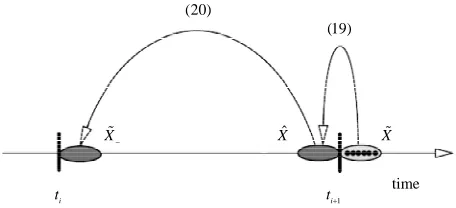
Just as the discrete KF naturally operates in two stages 1) and 2) (stated in Theorem 1, Subsection 4.1), a single Riccati iteration Ric (16), (17), (18) can be used in two consecutive stages shown schematically in Figure
3
ˆ ,
r
X X XGK
ˆ .
T
(19)
X V A XA (20)
We name them correspondingly as follows:
Stage I:
, ˆ,
r
C G X s X K
, ,
Riciup
Name: Riccati instant update: (16) (19), and
Stage II:
ˆ , ,
r r
X K s X G
Rictup
, , ,
V A
Name: Riccati temporal update: (20) (18).
Remark 10. Notation such as (16) (19) hereafter
reads: “(16) computed and then (19) computed”.
Lemma 1. For all positive definite matrices X nd C
algorithm (16) 19) of Stage I is equivalent to the following algorithm (21)
a (
1
ˆ T
Z Z GC G
1
ˆ ˆ
(21) in the sense that Z X with any matrix Gn s
when Z1X.
Proof. It can be found in [40], pp. 26-27.
7. Riccati Scalarized Instant Update
When is a non-diagonal matrix, the square-root free Cholesky decomposition C C C with the unit
lower triangular matrix C and diagonal matrix
> 0 C
T
CL D L
L
1,d2,,d
C s , , proves to be useful.
With that purpose denote Y G C , where Y is a
solution to the lower triangular matrix equation
C . Then instead of algorithm (16) (19) for
Stage I we obtain its equivalent
D g d
T
G dia
dk > 0
T
L
T
ˆ T T .
T
L Y
1 C
X XXY D Y XY Y X (22)
Considering matrix Yy y1 2ys
:
columnwise per- mits one to use the following Algorithms 1 and 2.
Algorithm 1 (scalarized, direct). 1) Initialization: X0 X .
2) Scalarized (columnwise) input: for k1 to s cycle
1
1 1
k k k k
k k
X X X
1
1 , . T k T k k k k k
d y X y
y y X
ˆ : (23)
3) Concluding assignment: X Xs
1
.
Algorithm 2 (scalarized, inverse). 1) Initialization: Z0: Z X
X Xˆ X
[image:8.595.309.537.88.192.2]1 i t i t time (20) (19) .
Figure 3. Backward Riccati recursion. Initialization i := N; X := Vf; while (i≥ 0) do {(19); (20); i := i − 1}.
2) Scalarized (columnwise) input:
1
k to s cycle for
1
1 .
T k Zk y d yk k k
ˆ :
Z (24)
Z Z
3) Concluding assignment: s.
Lemma 2. Algorithms 1 and 2 are equivalent to each
other.
Proof. All Xk and Zk in (23), (24) are mutually inverse of each other by virtue of Lemma 1, and so,
1
ˆ ˆ
ZX .
Theorem 2 (Verification of Algorithm 1 for Equation
(22)). Algorithm 1 is true, i.e., it can be used instead of (22).
Proof. By reason of Lemma 1, equality (22) is equiva-lent to equality (21) taking into account transcriptions
, . Thereby (21) is as follows:
GY CD
1 1 1 1 1 1 1 0 ˆ 0 . T s T s s s T k k k k
d y
Z Z y y
d y
Z y d y
ˆAlgorithm 2 gives the same value Z. It is equivalent to algorithm 1 (by virtue of Lemma 2). Hence, algorithm 1 results in matrix Xˆ, which is produced by procedure (16) (19) (Riciup) and also by (22).
Let us introduce the scalarized procedure Ricsiup:
Stage I: , , , ˆ,
r
C G X s X K
Ricsiup
T C C C
CL D L LC DC
T T
C
L Y G
: 1
k
Name: Riccati scalarized instant update (instead of (16) (19))
begin
obtain , obtain Y
begin
k s
while do cycle
:
T T
k
p y X
begin continue
: k Tyk
d p a scalar :
k
K pT a row
ˆ : k k
X XXy K matrix Xˆ
ˆ :
X X update X
k k
: 1 increment
end finish
1
T T
: sT
K K K collect KT
T C r
L K K obtain Kr
end
Theorem 3. Algorithm Ricsiup is equivalent to
algorithm Riciup.
Proof. In cycle while, there is implemented the proved algorithm 1, which forms ˆX. To complete the proof, it is sufficient to substitute C C C into (16)
and verify that
T
CL D L
T C r
K L K where the intermediate matrix
C
1
T T
K D Y XY Y X
ˆ has been introduced.
Remark 11. In the transition from Riciup to
Ricsiup, there is eliminated the operation of matrix inversion in formula (16). However, the origin of nu-merical instability (that is computation of X in cycle
while which is a scalar (k-th) step of (19)) calls, as be-fore, for further algebraically equivalent modifications.
8. Potter Style Modification
Applying Cholesky decomposition (for definiteness, the lower triangular one, as described, for instance, in [60]) to the symmetric matrices ˆX, X, X, V and Vf
,
, .
T
T T
f
, we change to operations with their square roots (denoted by generic symbol S):
ˆ ˆ
ˆ T, T,
V V f f
X SS X SS
V S S V S
X S S
S
(25)
Modified procedure srRicsiup operates with the square roots of (25) like it was first introduced in [63]:
Stage I:
, , , ˆ,
r
S s S K
C C
CL LC DC
T C
L Y
: 1
k
:
C G
srRicsiup
Name: square-root Riccati scalarized instant update (instead of (16) (19)):
begin
T C
D L obtain ,
T
G obtain Y
begin
while ks do cycle
begin continue
T k
f S y a column
: Tf
dk f a scalar
1: 1 dk
a scalar
: T T
k
K f S a row
ˆ : T T
k
S S K f Sˆ
ˆ :
S S
matrix
S
: 1
k k
update
increment
end finish
1
:
T T T
s
K K K collect KT
T C r
L K K obtain Kr
end
Correspondingly, we change from procedure Rictup
to srRictup using orthogonal transformations:
Stage II: , , ,ˆ , ,
V r r
S A S K s S G
srRictup
ˆ , 0
T T
r r
T V
S S A
G K A
S
Name: square-root Riccati temporal update orthogonalized (instead of (20) (18)):
(26)
where is one of the orthogonal transformations (Hau- sholder or Givens or Gram-Schmidt) reducing matrix in the right-hand side of (26) to the upper triangular form.
Theorem 4. Algorithm srRicsiup is equivalent to
algorithm Ricsiup and algorithm srRictup is equi- valent to algorithm Rictup.
Proof. Selecting from (25) the proper substitution for matrix X in algorithm Ricsiup and then factoring
X
difference Xy K k k (denoted Xˆ for each k in Ricsiup) into SSˆ ˆT with SˆS
IffT
yields
2: T T .
f I ff I ff
This results in the quadratic equation with respect to
1
12 2 1 0.
k k
d d
From its two solutions one selects
1 11 dk
as being numerically stable, and introduces the interme-diate notation . The first equation in (26) can be proved by premultiplying it by itself transposed. The product coincides with (20).
Remark 12. Some comparative insight into numerical
9. Bierman Style Modification
The algorithm to be presented here is conceptually the Bierman’s algorithm originally developed for the U-D
matrix decomposition used for the KF covariance fac-torizations. It was motivated by the work of Agee and Turner about the one-rank modification of the UDUT
Cholesky factorization [40] which we convert into the
LDLT formulation as follows.
Theorem 5 (Agee-Turner PD Factorization Update).
Let
T LDL TcaaT
1, , n
Ddiag d d
a a n dimP
PLDL
where L is unit lower triangular, ,
c is a scalar,
1, 2, ,
, and . Tn
a a
If P is PD (positive definite), then factors L (unit lower triangular) and D0 (diagonal) can be calcu-lated in the following algorithm:
1) Initialization: 1 .
2) Computation: for to cycle:
c c
1
i n1
a) 2
iai
i i
b) for to n cycle:
d d c 1 k i :
k k i ki
a a a l
;
i) ;
ii) ki ki i i k i; In matrices L, nontrivial
entries exist only below their unit diagonal.
l l c a a d
c) i1 i i i
3) Concluding assignment:
c c d d .
2
dn dnc an n
Proof. The algorithm is validated by representing .
T
x Px as a sum of complete squares with substitution of the equation P=P caa T, PLDL T in this quadratic form. Details can be found in [40] or [60].
We apply Bierman’s algorithm to LQR design in the context of Remark 11, thereby presenting another modi-fication of procedure Ricsiup named here ldRis-ciup that avoids potentially unstable numerical differ-encing. What is required for that is conversion of the aforesaid UD Bierman’s algorithm into its LD analogue and writing it in terms of LQR. In doing this, we obtain the following result.
Theorem 6 (Bierman style ldRisciup algorithm).
Let X:XXy K k k written as Xˆ :XXy K k k
ˆ :
fol-lowed by X X in procedure Ricsiup be using factorizations Xˆ LDLˆ ˆ ˆT and X LDL T where any and all L are unit lower triangular and any and all D posi-tive diagonal. Then Ricsiup is equivalent to the fol-lowing procedure.
Stage I:
, , ˆ ˆ, ,
r
D s L D K
T C C C
CL D L LC DC
T T
C
L Y G
: 1 k
, ,
C G L
1dRicsiup
Name: L-D Riccati scalarized instant update (instead of (16) (19)):
begin
obtain ,
obtain Y
begin
k s
while do cycle
1, ,
:T T
n k
begin continue
f f L y
f
1, ,
:T n
v v v Df
: dk
Kk: 00vn
i n
for down to 1 do
begin
: v fi i
: 1
ˆ :i i
d d
: fi
1
j i to n do for
begin
,
ˆ : T
ji ji j k
l l K
, : ,
T T
Kj k Kj kl vji i
: end
end ˆ :
L L; D:Dˆ L D
: 1
k k
update and
increment
end finish
1
:
T T T
s
K K K collect KT
T C r
L K K obtain Kr
end
Remark 13. Recall that k is the k-th column of
matrix Y and k is the k -th diagonal element of matrix
D, both introduced in Section 7;
y d
, T j k
K is the j-th element of column T
k
K that exists within each repetition of cy-cle while.
Proof. Given in [60] similarly to the UD-version of [40].
Forming the matrices
L Dˆ ˆ, L D ,
ˆ
L L
from
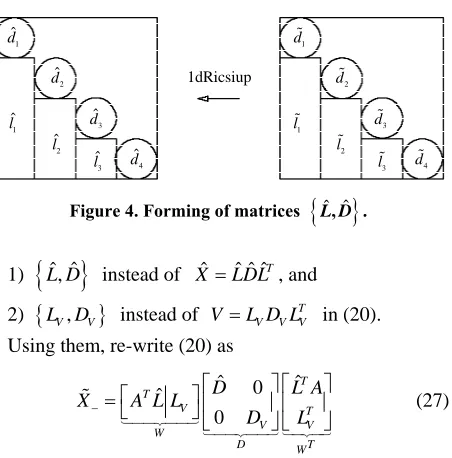
is illus-trated schematically by Figure 4. It shows that: 1) this computation is columnwise starting from the last column and moving backwards; 2) the diagonal positions are used to store elements of D because the predetermined unit diagonals of both and need no storing; (3) output data
L Dˆ ˆ, can supersede
L D ,
in the same array; and (4) the upper triangular part of the array is zero and so may not be stored thus saving memory.We now turn to the LQ implementation of Stage II in the form of a new procedure ldRictup which is to be equivalent to Rictup.
1
ˆ d
2
ˆ
d
3
ˆ
d
4
ˆ d
1
d
1
ˆ l
2
ˆ
l
3
ˆ l
1
l
1dRicsiup d2 3
d
4
d
2
l
3
l
[image:11.595.63.289.78.307.2]
Figure 4. Forming of matrices L Dˆ ˆ,
L Dˆ, ˆ ˆ ˆ ˆT.
1) ˆ
instead of X LDL
L DV, TV V V
V L D L
, and
2) V
instead of in (20). Using them, re-write (20) asˆ 0 ˆT
T
V V
D WT
D L A
D L
ˆ 0
T V W
X A L L
(27)
The problem of Stage II sounds as follows: Given are factors W and D for which (27) holds, find factors L
and D, L unit lower triangular and D positive di-agonal, such that for matrix X
T
to be represented in the factored form XL D L the following factorization holds: X LDLT
. In other words, we seek to have an
algorithm yielding the pair
L D, so as to immediately get results: LL and DD. So, in equationT
LDL
, , n
w w
T
WDW , the left hand side is given and the right hand side is what we wish to find. This is exactly what is known as Weighted Gram-Schmidt Orthogonalization (WG-SO). It is presented in [40] (pp. 125-126) in the
UD-version. For our needs, we convert it into the LD- version as follows.
Lemma 3. Let
1 be a linear independentset of (column) M-vectors, M n, and let D1,,DM be positive scalars in a diagonal matrix
1 M
. If 1 are defined by thefollowing algorithm, then none of the v’s are zero and for :
, ,
D diag D
0
k vj
D
j
T
v D
v,,vn
k
MG-SO: -
W D L D, ,
1
k
:
k k
v w
1
k
1dMG SOrt
Name: L-D Modified Weighted Gram-Schmidt Orthogonalization:
begin
for to n do
for to n do
begin
: T
k k k
D v Dv
1 j k
for to n do
begin
: T
jk j k k
L v Dv D
:
j j jk k
v v L v
[image:11.595.313.530.197.385.2]end end end
i 0V t
Proof. Can be obtained by a straightforward calcula-tion.
Remark 14. The above procedure is called modified
because it works columnwise (Figure 5).
Finally for the case of , we obtain
, , , , ,ˆ ˆ , , ,
V V r r
L D A L D K s L D G
1dRictup
Stage II:
Name: L-D Riccati temporal update orthogonalized (instead of (20) (18)):
Compute 1
ˆT T
n T
V
L A
W w w
L
2
M n
(with ).
Compute
1
ˆ 0
, , .
0
M
V
D
D diag D D
D
Call ldMG-SOrt W D L D, ,
r r
G K A
.
Compute .
10. Kailath Style Modification
There exists another a comparatively new class of algo-rithms in Kalman filtering (LQG estimation) area [65], the so-called array algorithms. They alleviate some computational problems associated with Riccati itera-tions by using the well-known QR-decomposition in nu-merical linear algebra with an appropriate orthogonal matrix Q where R is upper triangular (R indicates here the right corner of a matrix). Below, we show how to adapt such algorithms for LQR implementations, and we refer to them as Kailath style paying thus a tribute to works by Kailath and co-authors [43]. Starting out again from Remark 11, we choose now (from several alterna-tives recently serveyed in [60]) a square-root array
modification.
Theorem 7 (Kailath style asrRisciup algorithm).
Let X:X Xy K k k written as Xˆ :XXy K k k ˆ
:
fol-lowed by X X
ˆ ˆ
ˆ T
[image:11.595.310.535.641.724.2]in procedure Ricsiup be using fac-torizations like in (25), that is X SS and X SS T
with both S lower triangular. Then Ricsiup is equiva-lent to the following procedure.
Stage I:
, , , ˆ,
r
S s S K
C C
CL LC DC
T C
L Y
: 1
k
C G asrRicsiup
Name: array square-root Riccati scalarized instant update (instead of (16) (19)):
begin
T C
D L obtain ,
T
G obtain Y
begin
while ks do cycle
begin continue
: dk
1, , n
T: T kf f f S y
0
T k
Q
f S
:
S S
1
: 0
k T
K
S
(T)
ˆ
S update
:
k k increment
end finish
1
T T
: sT
K K K collect KT
T C r
L K K obtain Kr
end
Proof. Assignment operator (T) in the above algorithm contains two arrays: pre-array B (on the right) and post-array A (on the left). At each cycle, let the latter be obtained from the first in the upper triangular form by means of an appropriate orthogomal transformation k (it may be Hausholder reflections or Givens rotations):
k
Q
AQ B. Since Q Qk k , we have and
via straightforward calculations, we are done.
T T T
A A
I
B B
Stage II in this modification coincides with Stage II in the Potter style modification, that is expression (26).
11. Applications Challenges
Possible applications of adaptation capability of stochas-tic systems are numerous and can be found in almost every field of modern engineering. While considering applicability of the above results, one should select the cases that seem to fit perfectly in the pattern of Figure 2. In this pattern, the very necessity for adaptation is con-sidered as a factual constraint the occurrence of which in time is comparatively rare resulting from an abrupt fault against the long lasting nominal mode of system opera-tion. This can be exemplified by the development and implementation of a high integrity navigation system based on the combined use of an inertial measurement unit aided by different outer sources of data [20,66] some
of which are fault-susceptible or working in an accident- prone situation.
Famous industrial/technological study cases to be brought forward as applications to theoretical/computa- tional work are those on advanced MPC collected in [59].
Overall, we have to admit that practical problems are much more challenging than theoretical ones. One barrier to overcome is the nonlinearity of the original system (Data Source) models. The traditional remedy for this is to invoke a linearized perturbation model or equation of the first variation about a nominal (or reference) solution to the nonlinear model on the assumption that such a solution is known (as in [67]) or delivered by an External (more precise) Data Source. In the strict sense, equation (1) has been written yet in the form of perturbation model, as it can be seen from criterion (3). The latter case, combining the use of the Global Positioning System (GPS acting as an external data source) and an inertial measurement unit for vehicle applications, can be viewed as a modeling technique for online estimation of the error between the reference model and the real dynamics [68].
Another challenge to be considered is a set of con-straints representing the physical limitations of the proc-ess variables as is the case in MPC and optimization for papermaking machines [69].
12. Concluding Remarks
The emphasis in this paper has been on the robust linear quadratic regulator computations where the single Ric-cati iteration algorithm is an integral part and where seeking a steady-state Riccati solution (Algebraic Riccari Equation) does not apply.
Main novelty of the results is technical: we have shown that linear algebra methods of input scalarization, matrix factorization and array orthogonalization earlier known for the robustified linear quadratic estimators due to [40, 63,65] and many other works, now are successfully ex-tended to the robust LQR computation problems includ-ing LQ Regulator Modification phase in the adaptive control systems. The new algorithmic LQ regulator for-mulations based on these methods enhance LQR numeric robustness and generate a productive perspective for fur-ther investigations into the regulator modification (re- design) methods within the structure of adaptive control.
Further research is encouraged into the advancement of new insights about the numerics of LQR/ARE/DARE procedures, thus leading to Adaptive Control System CAD that is expected to include all three ACS phases—
Modifier/Identifier/Classifier.