Implementing a Personal Software Process (PSP
SM
)
Course: A Case Study
Sakgasit Ramingwong, Lachana Ramingwong
Department of Computer Engineering, Faculty of Engineering, Chiang Mai University, Chiang Mai, Thailand. Email: [email protected], [email protected]
Received April 5th, 2012; revised May 2nd, 2012; accepted May 13th, 2012
ABSTRACT
In order to remain competitive in software industry, software engineers need to continuously improve their proficiency.
Personal Software Process (PSPSM) provides a strong concept which helps software engineers inspecting and improving
themselves. Yet, when being applied on an undergraduate computer engineering course, several complex mathematical calculations from PSP official exercises could encumber the performance of students who do not possess adequate mathematics background. This paper reports a result of implementing PSP course for undergraduate computer engi-neering students in Chiang Mai University, Thailand.
Keywords: Software Engineering; Personal Software Process; Process Improvement; Case Study
1. Introduction
Personal Software Process (PSPSM) is a software
devel-opment process which focuses on improving quality of software development in an individual level. It was de-veloped by Watt S. Humphrey and Software Engineering Institute, Carnegie Mellon University in 1989 and has been adopted by a large number of software profession-als worldwide [1]. PSP utilizes actual historical data of a software engineer in order to provide precise effort esti-mation as well as self-propose guidelines which aim to prevent potential errors and maximize the engineers’ proficiency. Efficiency of implementing PSP is highly based on each engineer’s discipline and consistency.
An official PSP training course consists of two parts: PSP fundamental and PSP advanced courses [2,3]. Each course involves five full days of training. In total, both courses involve approximately 80 hours of training. The morning sessions include theories and lectures while the afternoon session focus on exercise and workshops. Nine assignments, which comprise eight programming and one written report, are assigned for the trainees.
Improvement of software development process has recently become an emerging trend in Thailand. Several leading universities, such as Naresuan University, Kaset- sart University and Chiang Mai University, currently include PSP in their undergraduate and graduate curricu-lum [4,5]. Generally, each semester of both Thai under-graduate and under-graduate study consists of approximately 15 weeks. Chiang Mai University made a first attempt to
implement the official PSP academic material in an un-dergraduate course in 2010. In order to keep the course as similar to the official training as possible, the aca-demic materials were minimally adjusted. Nevertheless, several difficult issues surfaced during the course. One of the strongest feedbacks from the students was some ex-ercises were too difficult. As a result, several students were demotivated, causing them unable to keep up with the subsequent exercises. This left rooms for improve-ment for forthcoming course impleimprove-mentation.
The second section of this paper describes overview of PSP. Then, a case study of attempting to implement the official PSP material in a Thai undergraduate course is described in the third section. The fourth section high-lights challenges encountered from the course as well as possible solutions. Finally, the fifth section concludes the paper.
2. PSP Overview
en-gineer.
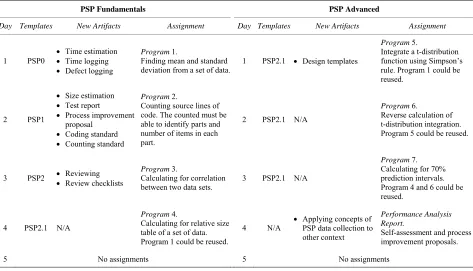
Software Engineering Institute (SEI) officially pro-vides two PSP training courses. Firstly, PSP fundamen-tals training includes principles of PSP, introducing of PSP processes, templates, and data collection. Four pro-gramming assignments are given to the trainees. At the end of the course, the trainee should be familiarized with PSP process and templates. Then, PSP advanced involves introduction of formal designs, further data collection and higher level of data interpretation. Three programming projects are assigned. Additionally, one written self-as- sessment report based on PSP data from all projects is given at the end of the course. Details of PSP
assign-ments on both official courses are illustrated in Table 1.
The accuracy of both time and size estimation of the trainees is likely to increase [1]. This is due to the grow-ing amount of their historical data, as long as the engi-neers are consistent with their performance.
3. A Case Study on Implementing Official
PSP Course in Thailand
Software Park Thailand arranged a PSP Academic Initia-tives program in 2010 [6]. This program aimed to
intro-duce international standards, i.e. PSP and Capability
Maturity Model (CMMI), to academic section. More than twenty lecturers from leading Thai universities joined the courses. At the end of the program, more than half of them are officially accredited as certified PSP Develop-ers by SEI.
During late 2010, Chiang Mai University, as one of the certified developer from PSP Academic Initiatives, made a first attempt to implement the PSP courses for under-graduate computer engineering students. The students obtained a free academic version of PSP materials which is slightly different from the official training materials [7]. Since the academic version had different preset PSP
templates (for example, PSP0.1 for Program 2 and PSP1
for Program 3) and one extra exercise, the students were
instructed to change the preset templates to match with the settings in the official student workbook. The last
assignment, Program 8, which was not included in the
official training, was also removed. However, an extra assignment similar to a prerequisite project of Software Park Thailand’s PSP Academic Initiative was added to
the assignment list as Program 0. This program involved
a simple source line counting which could be later reused in Program 2. Program 0did not require any data
collec-tion or estimacollec-tion since its objective was to simply test the students’ programming skills. As a result, the com-puter engineering students were given a total of nine
as-signments, i.e. eight programming and one written report.
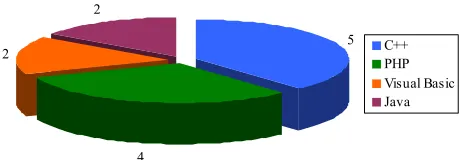
Thirteen senior undergraduate computer engineering students enrolled in the course. All of them completed at least three course involving programming using various computer languages and are moderately to highly skilled in programming. The students used C++, PHP, Java and Visual Basic in this class. The distribution of language
they used is displayed in Figure 1.
Table 1. Details assignments on PSP official courses.
PSP Fundamentals PSP Advanced
Day Templates New Artifacts Assignment Day Templates New Artifacts Assignment
1 PSP0
Time estimation Time logging Defect logging
Program 1.
Finding mean and standard deviation from a set of data.
1 PSP2.1 Design templates
Program 5.
Integrate a t-distribution function using Simpson’s rule. Program 1 could be reused.
2 PSP1
Size estimation Test report
Process improvement proposal
Coding standard Counting standard
Program 2.
Counting source lines of code. The counted must be able to identify parts and number of items in each part.
2 PSP2.1 N/A
Program 6.
Reverse calculation of t-distribution integration. Program 5 could be reused.
3 PSP2 Reviewing Review checklists
Program 3.
Calculating for correlation between two data sets.
3 PSP2.1 N/A
Program 7. Calculating for 70% prediction intervals. Program 4 and 6 could be reused.
4 PSP2.1 N/A
Program 4.
[image:2.595.63.536.468.739.2]Calculating for relative size table of a set of data. Program 1 could be reused.
4 N/A Applying concepts of PSP data collection to other context
Performance Analysis Report.
Self-assessment and process improvement proposals.
The Thai education system, both undergraduate and graduate, is semester based. There are two semesters in an educational year. Each semester involves approxi-mately 15 weeks of study, excluding the examination weeks. Each subject is lectured for three hours per week, resulting in a total of 45 hours per semester. In order to cope with this academic system, the contents in PSP ma-terials in this case study were moderately tailored. The assignments were given at week number 2, 3, 4, 6, 7, 9, 11, 12 and 14. It can be seen that there were five weeks (excluding the first introductory week) without assign-ments. On the weeks with assignments, all students needed to submit the projects within five days after in-structed. Late penalties were applied to the students who missed the deadline. The assignments were worth 80% of the course score. In the end, all students appeared to
successfully clear all assignments. Figures 2 and 3
sig-nify average program size (only codes which were added or modified are counted) and average development time of the class, respectively.
Interestingly, although implementing PSP, especially based on the official material, is likely to improve the accuracy of effort estimation, statistics from this class
show otherwise. Figure 4 illustrates average error on
program size estimation of the class as well as its linear regression (the students were not required to estimate
their Program 1’s size thus there were no data at that
point). In addition, students’ average error on develop-ment time estimation and its linear regression are shown in Figure 5. The errors of estimation are calculated as in (1) [1].
Actual Data Estimation
%Error 100
Estimation
(1)
Obviously, the overall estimating ability of the class was not improving. In contrast, the accuracy of the class forecasting on both program size and development time seemed to go down.
It might be possible to argue that the estimation accu-racy of the program size was fluctuated. More data might be needed in order to accurately interpret the result. On
the other hand, from Program 4, the precision of time
estimation error had gone down significantly.
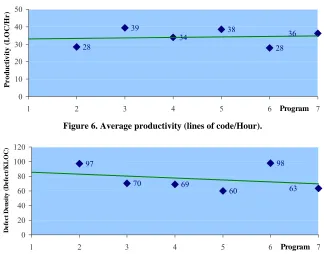
Figure 6 illustrates average productivity (added or modified source lines of code per hour) of the class. It can be seen that the productivity slightly continually in-creased. This is an adequate result since productivity could harshly drop after the official designing activities were added to the development process.
Average defect density (defects per 1000 lines of code)
of the class is shown in Figure 7. This is probably the
most outstanding result of this class since the defect density
4 2
2
[image:3.595.308.539.347.427.2]5 C++ PHP Visual Basic Java
Figure 1. Distribution of programming language used in PSP course.
54
69
95
60
94 102
0 20 40 60 80 100 120
1 2 3 4 5 6 Program
Adde
d
&
M
o
di
fi
ed C
o
de
(
L
O
C
)
7
Figure 2. Average added and modified program size (lines of code).
130 145 135
187
124 135
189
0 50 100 150 200
1 2 3 4 5 6 Program 7
D
ev
el
o
p
m
en
t T
ime
(Ho
u
rs
[image:3.595.136.458.474.582.2])
[image:3.595.137.462.614.721.2]23.78% -4.99% 61.25% 9.99% 12.54% 48.55% -10.00% 0.00% 10.00% 20.00% 30.00% 40.00% 50.00% 60.00% 70.00%
1 2 3 4 5 6 Program 7
A dd & M o di fi e d Si z e E st im a ti on E r ror ( % )
Figure 4. Average error on added and modified size estimation (%).
14.06% 8.82% 5.37% 29.87% 45.04% -3.74% 54.07% -10.00% 0.00% 10.00% 20.00% 30.00% 40.00% 50.00% 60.00%
1 2 3 4 5 6 Program 7
A d d & M o di fi e d Si z e Es ti m a ti o n Er r o r (% )
Figure 5. Average error on development time estimation (%).
28 34 38 28 39 36 0 10 20 30 40 50
1 2 3 4 5 6 Program 7
[image:4.595.138.458.89.191.2]P r o d u c ti v ity (LO C /H r )
Figure 6. Average productivity (lines of code/Hour).
97 69 60 98 70 63 0 20 40 60 80 100 120
1 2 3 4 5 6 Program
[image:4.595.141.460.223.327.2]D ef ec t D en sit y ( D ef ec t/ K L O C ) 7
Figure 7. Average defect density (defects/1000 Lines of code).
steadily dropped throughout the course. The dropping figure suggests that the quality of development process increased. This might be a benefit from design and re-view processes as well as personal process improvement proposals.
4. Challenges and Possible Solutions
A number of challenges surfaced during this
implemen-tation of PSP course. Some of them were raised by the students while others were obtained by observation. Among these challenges, two issues were considered as the most serious matters.
4.1. Complexity of Exercises
[image:4.595.135.459.352.606.2]after finishing the courses. Almost all of the exercises are related to statistical tools which are used for data analysis and prediction. This involves several complex and repeti-tive use of equations. The complexity of the exercises continuously rises towards the end of the course. A small miscalculation in an early project can cause major errors in later projects. (2) and (3) are examples of complex
calculation in the Program 6 which resulted in the
sec-ond highest development time estimation error [7].
_ 1
1,3,5
_ 2
2,4,6...
0 4
3
2
num seg
i
num seg
i
W
p F F iW
F iW F x
(2)
1 2
2
1/2
1
2 1
*π
2
dof dof
x F x
dof dof
dof
(3)
About half of the students complained about the so-phisticated mathematical calculation. A few of them ap-peared to lose motivation. One student even admitted that, after a number of errors found in testing, he gave up his attempt and copied parts of the code from his colleague. This could result in unusable data and ultimately lead to failure of class objectives.
In order to solve this problem, alternative exercises might be considered. Since PSP mainly focuses on proc-esses, a set of continual projects which needs a consid-erable development time and are partly reusable might be sufficient. Yet, the hidden objective of developing the students’ own PSP tools might be voided if this solution is implemented.
4.2. Continuation of the Course
Due to the difference in course duration and occurrence, the exercises in this case study were tailored. Unfortu-nately, this seems to cause interruption between projects, especially on the weeks without assignments. Some stu-dents informed that they were unable to remember parts of their projects.
On the official training program, the trainees are re-quired to develop programs everyday. Comparing a half-day and a one-week gap, it is rather obvious that the official course is more suitable to develop a series of connected programs. Yet, the impact of this particular problem might be lessened if the students are encouraged to focus more on design and documentation. In fact, op-timistically, having a long gap between assignments is more similar to actual software development, especially when the programmers need to fix a deployed system or release a new version.
4.3. Other
There were also other problems that were encountered during the PSP implementation in this case. For example, many of the students had a habit of compiling as soon as finishing a line of code. If the students are strict with PSP concept, they might need to switch to the student work-book and record this activity very often. This might cause to frequent interruption to their work. In this case,
this challenge was mitigated by setting up a protocol, i.e.
if no defect was found during the compiling, the student needed not to record this process.
It was also found that the students did not spend enough time to review their designs and code. This re-sulted in ineffective defect prevention which is one of the main objectives of PSP. Also, a few of them were unable to submit the project within deadlines. This might be caused by their poor time management skills. Both prob-lems need the students to increase their focus on the tasks as well as plan their development ahead.
English capability is another challenge which hindered the performance of the course. Some students were un-able to follow the instructions properly, especially on the late assignments. Translating parts of the materials into student’s native language might be an solution to this problem.
5. Conclusion
A PSP course was implemented in Chiang Mai Univer-sity, Thailand. A group of undergraduate computer engi-neering attended and finally finished the class. The re-sults of the class were rather interesting. While the esti-mation of source code size and development time should theoretically be increasingly more accurate, the statistics from this case study suggested otherwise. Several factors, especially complex mathematical calculations in the ex-ercises and continuation of the course, were identified as the main issues behind this. This suggests that some tai-loring effort might be needed in order to efficiently im-plementing PSP in particular scenarios.
REFERENCES
[1] W. S. Humphrey, “PSP(SM): A Self-Improvement Proc-ess for Software Engineers,” Addison-Wesley Profes-sional, Upper Saddle River, 2005.
[2] Software Engineering Institute, “Personal Software Proc-ess (PSP) Fundamentals,” Carnegie Mellon University, Pittsburgh, 2011.
[3] Software Engineering Institute, “Personal Software Proc-ess (PSP) Advanced,” Carnegie Mellon University, Pitts-burgh, 2011.
[5] Department of Computer Engineering, “219342 Software Process and Quality Assurance,” Kasetsart University, Bangkok, 2011.
[6] Software Park Thailand, “PSP Academic Initiative,”
Software Park Thailand, Pak Kret City, 2011.