ISSN Print: 2327-4352
DOI: 10.4236/jamp.2018.67130 Jul. 27, 2018 1540 Journal of Applied Mathematics and Physics
Average Speed in Projectile Motion and in
General Motion of a Particle
Chloe T. Calderon, Pirooz Mohazzabi
Department of Mathematics and Physics, University of Wisconsin-Parkside, Kenosha, WI, USA
Abstract
We calculate the average speed of a projectile in the absence of air resistance, a quantity that is missing from the treatment of the problem in the literature. We then show that this quantity is equal to the time-average instantaneous speed of the projectile, but different from its space-average instantaneous speed. It is then shown that this behavior is shared by general motion of all particles regardless of the dimensionality of motion and the nature of the forces involved. The equality of average speed and time-average instantaneous speed can be useful in situations where the calculation of one is more difficult than the other. Thus, making it more efficient to calculate one by calculating the other.
Keywords
Average Speed, Time-Average, Space-Average, Instantaneous Speed, Projectile Motion, General Motion
1. Introduction
Projectile motion, one of the simplest examples of two-dimensional motion in classical mechanics, has been extensively studied and thoroughly discussed in the literature and textbooks at different levels. Introductory treatment of projectile motion normally ignores air resistance and treats the problem using either differential and integral calculus [1]-[6] or algebra and trigonometry [7] [8], or even without trigonometry [9]. More advanced treatments of the problem include air resistance [10] [11] [12] [13]. However, to the best of the author’s knowledge and based on extensive literature search, the average speed of a projectile during its motion has not been discussed in the literature at any level. Although this may seem trivial at first sight, it is an important concept in correlating different methods of averaging the speed of an object during its How to cite this paper: Calderon, C.T. and
Mohazzabi, P. (2018) Average Speed in Projectile Motion and in General Motion of a Particle. Journal of Applied Mathematics and Physics, 6, 1540-1548.
https://doi.org/10.4236/jamp.2018.67130
Received: July 3, 2018 Accepted: July 24, 2018 Published: July 27, 2018
Copyright © 2018 by authors and Scientific Research Publishing Inc. This work is licensed under the Creative Commons Attribution International License (CC BY 4.0).
http://creativecommons.org/licenses/by/4.0/
DOI: 10.4236/jamp.2018.67130 1541 Journal of Applied Mathematics and Physics whether the average of the instantaneous speed of an object during its motion is the same as its average speed. In general, the answer is definitely NO. For example, if an object travels half of a distance with speed v1 and the other half
with speed v2, the average of these speeds is
(
v v1+ 2)
2 whereas the average speed which, by definition is the total distance divided by total time, can be shown to be given by1 2
1 2
2
ave v v
s
v v
=
+ (3) Later on in this article we shall refer to the former average as the space-average of the speed.
In what follows, we show that the space-average of instantaneous speed of a particle is not, in general, equal to its average speed, however, the time-average of instantaneous speed is always equal to the average speed regardless of the nature of the motion. But first, we find the average speed, the time-average of instantaneous speed, and the space-average of instantaneous speed for a projectile in the absence of air resistance.
2. Projectile Motion
2.1. Average Speed
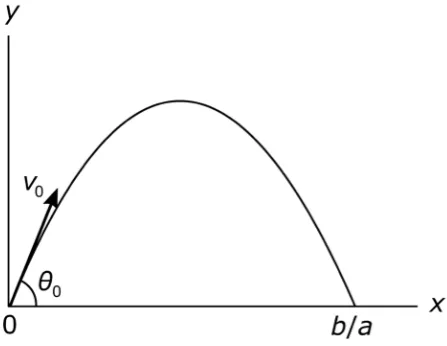
In the absence of air resistance, the components of the equation of motion for a projectile launched with an initial speed v0 at an angle of elevation θ0
(Figure 1) are given by
2
0 0
0 0
1 ,
2 ,
x y
x x y y
x v t y gt v t
v v v gt v
= = − +
= = − + (4)
where v0x=v0cosθ0 and v0y =v0sinθ0. Elimination of t between the equations
for x and y results in the equation of the trajectory,
0 2 2
0 0
2
y
x x
v g
y x x
v v
= − + (5)
DOI: 10.4236/jamp.2018.67130 1542 Journal of Applied Mathematics and Physics
Figure 1. Trajectory of a projectile in the absence of air resistance. The constants a and b
are defined by Equation (6).
0 2
0 0
and 2
y
x x
v g
a b
v v
= = (6)
the equation of the trajectory reduces to 2
y= −ax +bx (7) which is the equation of a parabola with x intercepts at x = 0 and x = b/a, as shown in Figure 1.
The element of arc length of a plane curve with equation y f x=
( )
is given by2
d
d 1 d
d y
L x
x
= +
(8) Using Equation (7), we obtain
(
)
2dL= 1 2+ ax b− dx (9)
Therefore, the total distance traveled by the projectile during its flight (returning to the same level from which it was launched) is given by
(
)
20 1 2 d
b a
L=
∫
+ ax b x− (10)Finally, changing the variable to u=2ax b− , we obtain
2 2
0
1 1 d 1 1 d
2
b b
b
L u u u u
a − a
=
∫
+ =∫
+ (11)Evaluation of this integral is elementary and can be found in any table of integrals [14]. Thus, we obtain
(
)
2 2
1 1 ln 1
2
L b b b b
a
= + + + +
(12)
DOI: 10.4236/jamp.2018.67130 1543 Journal of Applied Mathematics and Physics after some simple algebraic manipulations we find
2
0 0 0
0 0
cos 1 sin
1 ln
2 sin cos
ave v
s θ θ
θ θ
+
= +
(16)
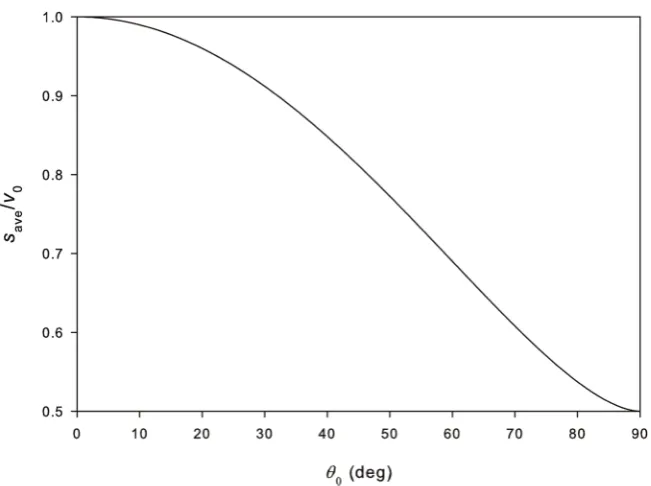
Equation (16) describes the average speed of a projectile in the absence of air resistance in terms of its initial speed and the launch angle. In fact, any projectile motion is completely defined by these two parameters. An inspection of the second term on the right-hand side of this equation shows that it becomes indeterminate for θ =0 0 and θ =0 π 2 because
0
2
0 0
0
0 0
cos 1 sin 0
lim ln
sin cos 0
θ
θ θ
θ θ
→
+ =
(17) and
0
2
0 0
π2
0 0
cos 1 sin
lim ln 0
sin cos
θ
θ θ
θ θ
→
+ = × ∞
(18) However, one can use the L’Hôpital rule to evaluate these limits, which turn out to be 1 and 0, respectively. Therefore, for θ =0 0 and θ =0 π 2, we obtain
0
ave
s =v and save=v0 2 from Equation (16), respectively. Remembering that
in our analysis we have assumed that the projectile returns to the same level that it started, these results can easily be verified using Equations (4). A graph of the average speed as a function of launch angle is shown in Figure 2.
2.2. Time-Average Instantaneous Speed
From Equation (4), the instantaneous speed of a projectile at a time t is given by
(
)
22
0x 0y
v= v + gt v− (19)
Using the definition of the average of a function f x
( )
over an interval[ ]
a b, [15],( )
1 b d
ab a
f f x x
b a
=
DOI: 10.4236/jamp.2018.67130 1544 Journal of Applied Mathematics and Physics
Figure 2. Average speed of a projectile as a function of launch angle according to Equa-tion (16).
we calculate the time-average of the instantaneous speed of the projectile during its motion,
(
)
22
0 0
0
1 T d
t x y
v v gt v t
T
=
∫
+ − (21)where the time of flight T is given by Equation (13). Substituting for T and changing the variable of integration to u gt v= − 0y, we obtain
0 2 2
0 0 0
1 v y d
t x
y
v v u u
v
=
∫
+ (22)Evaluation of this integral is again elementary and the result is
2 2
2
0 0 0
2 2 0
0 0
0 0
1 ln
2
y x y
x
t x y
y x
v v v
v
v v v
v v
+ +
= + +
(23)
Substituting 2 2 2 0 0x 0y
v =v +v , v0x=v0cosθ0, and v0y=v0sinθ0, this equation
reduces to Equation (16). Therefore, the average speed and the time-average instantaneous speed of a projectile in the absence of air resistance are the same.
2.3. Space-Average Instantaneous Speed
According to the law of conservation of mechanical energy, the speed of a projectile in the absence of air resistance is a function of its height, y. Therefore, the space dependence of the speed of the projectile is given by
2 0 2
v= v − gy (24)
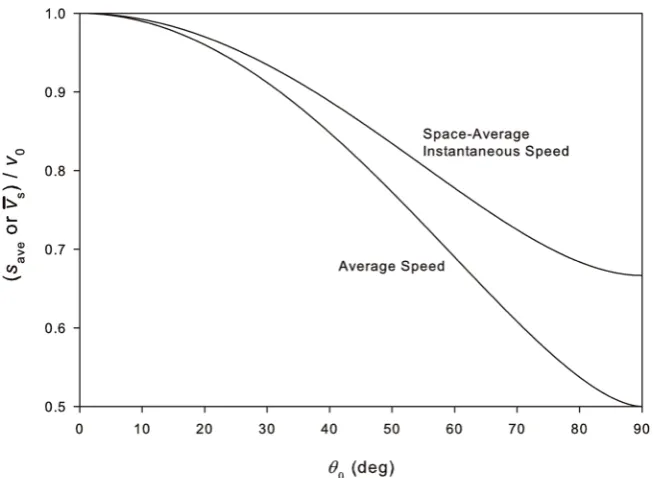
DOI: 10.4236/jamp.2018.67130 1545 Journal of Applied Mathematics and Physics its initial speed and launch angle. A graph of this equation together with that of Equation (16) are shown in Figure 3 for comparison. As can be seen, these two speeds are different. Therefore, the space-average of instantaneous speed of the projectile is not equal to its average speed. Again, we point out that Equation (27) becomes indeterminate (0/0) at θ =0 0, but
0 0 0
limv vs
θ → = (28)
3. Average Speed, Time-Average Instantaneous Speed, and
Space-Average Instantaneous Speed in General Motion
We now show that the average speed and the time-average instantaneous speed of a particle in any general motion are always the same but they are different from the space-average instantaneous speed. [image:6.595.210.537.453.692.2]Consider the general motion of a particle in three dimensions, described by its
DOI: 10.4236/jamp.2018.67130 1546 Journal of Applied Mathematics and Physics position vector r r=
( )
t . The total distance that the particle travels in a time interval t t2− 1 is given by( )
2 1 d t t
L=
∫
r t (29)and the average speed is
( )
2 1
2 1 2 1
1 t d
ave L t
s t
t t t t
= =
− −
∫
r (30) On the other hand, the instantaneous speed (or magnitude of velocity) of the particle at any time is given by( )
d d t v t= r (31)
and the time-average of the instantaneous speed during the time interval t t2−1
is
( )
2 2
1 1
2 1 2 1
d
1 d 1 d
d
t t
t t t
t
v v t t
t t t t t
= =
−
∫
−∫
r
(32)
But since dt is a positive scalar, the right-hand side of this equation reduces to that of Equation (30). Therefore,
ave t
s =v (33)
which means that for any general motion of a particle in any dimensions the average speed is equal to the time-average of its instantaneous speeds over any time interval.
On the other hand, the space-average instantaneous speed of a particle in its general motion is given by
d d d d path s path L t v L =
∫
∫
r (34)where dL is the element of length along the path of the particle. This results does not in general reduce to Equation (30) as evidenced by the analysis of the projectile motion.
4. Discussion and Summary
According to Equation (16), the average speed of a projectile in the absence of air resistance varies between v0 and v0/2 depending on the launch angle θ0. At
0 0
θ = the average speed is maximum (v0) and at θ0=90 it is minimum (v 0/2).
The average speed of 3v0/4, midpoint between the minimum and maximum
occurs at θ0=52.8.
DOI: 10.4236/jamp.2018.67130 1547 Journal of Applied Mathematics and Physics calculation of time-average instantaneous speed in this case would otherwise be more involved.
This work is intended to complement the existing wealth of literature on projectile motion as well as proving that the average speed and the time-average instantaneous speed of a particle are always the same in any general motion, but different from the space-average instantaneous speed.
Conflicts of Interest
The authors declare no conflicts of interest regarding the publication of this pa-per.
References
[1] Halliday, D., Resnick, R. and Walker, J. (2005) Fundamentals of Physics. 7th Edi-tion, Wiley, New York, 64-67.
[2] Serway, R.A. and Jewett Jr., J.W. (2014) Physics for Scientists and Engineers. 9th Edition, Brooks/Colem Boston, 84-91.
[3] Knight, R.D. (2008) Physics for Scientists and Engineers. 2nd Edition, Pear-son/Addison-Wesley, San Francisco, 97-102.
[4] Weidner, R.T. (1985) Physics. Allyn & Bacon, Massachusetts, 68-73.
[5] Tipler, P.A. and Mosca, G. (2004) Physics for Scientists and Engineers. 5th Edition, Volume 1, Freeman and Company, New York, 65-72.
[6] Fishbane, P.M., Gasiorowicz, S. and Thornton, S.T. (1993) Physics for Scientists and Engineers. Prentice-Hall, Englewood Cliffs, 71-76.
[7] Giancoli, D.C. (1980) Physics. Prentice-Hall, Englewood Cliffs, 51-54.
[8] Giambattista, A., McCarthy-Richardson, B. and Richardson, R.C. (2017) College Physics. McGraw-Hill, New York, 120-126.
[9] Mohazzabi, P. and Kohneh, Z.A. (2005) Projectile Motion without Trigonometric Functions. The Physics Teacher, 43, 114-115. https://doi.org/10.1119/1.1855750
[10] Barger, V.D. and Olsson, M.G. (1995) Classical Mechanics. 2nd Edition, McGraw-Hill, New York, 30-31.
DOI: 10.4236/jamp.2018.67130 1548 Journal of Applied Mathematics and Physics
[12] Mohazzabi, P. (2018) When Does Air Resistance Become Significant in Projectile Motion? The Physics Teacher, 56, 168-169. https://doi.org/10.1119/1.5025298
[13] Mohazzabi, P. and Fields, J.C. (2004) High-Altitude Projectile Motion. Canadian Journal of Physics, 82, 197-204. https://doi.org/10.1139/p04-001
[14] Korn, G.A. and Korn, T.M. (1968) Mathematical Handbook for Scientists and En-gineers. 2nd Enlarged and Revised Edition, McGraw-Hill, New York, 943.