Received 25 January 2019 Accepted 1 February 2019
Edited by H. Stoeckli-Evans, University of Neuchaˆtel, Switzerland
Keywords:crystal structure; nickel(II); square-planar; Schiff base; Ni Ni interaction; Hirsh-feld surfaces analysis.
CCDC reference:1890705
Supporting information:this article has supporting information at journals.iucr.org/e
Crystal structure and Hirshfeld surfaces analysis of
the nickel(II) complex of the Shiff base ligand
6,6
000-{(1
E
,1
000E
)-[ethane-1,2-diylbis(azanylylidene)]-
bis(methanylylidene)}bis[2-(trifluoromethoxy)-phenol]
Sibel Demir Kanmazalp,aSeher Meral,bNecmi Dege,c* Aysen Alaman Agarband Igor O. Fritskyd*
aGaziantep University, Technical Sciences, 27310, Gaziantep, Turkey,bOndokuz Mayıs University, Faculty of Arts and
Sciences, Department of Chemistry, 55139, Kurupelit, Samsun, Turkey,cOndokuz Mayıs University, Faculty of Arts and
Sciences, Department of Physics, 55139, Kurupelit, Samsun, Turkey, anddDepartment of Chemistry, Taras Shevchenko
National University of Kyiv, Volodymyrska 64/13, 01601 Kyiv, Ukraine. *Correspondence e-mail: [email protected], [email protected]
In the title complex, (6,60-{(1E,10E
)-[ethane-1,2-diylbis(azanylylidene)]bis-(methanylylidene)}bis[2-(trifluoromethoxy)phenol]-4
O,N,N0,O0)nickel(II),
[Ni(C18H12F6N2O4)], the nickel(II) ion has a square-planar coordination sphere, being ligated by two N and two O atoms of the Schiff base ligand 6,60-{(1E,10E
)- [ethane-1,2-diylbis(azanylylidene)]bis(methanylylidene)}bis[2-(trifluoro-methoxy)phenol] (L). Inversion-related molecules are linked by a short Ni Ni interaction of 3.2945 (6) A˚ forming a dimer. In the crystal, the dimers stack up the aaxis, with a closest Ni Ni separation ofca3.791 A˚ . There are no other significant intermolecular interactions present. However, the Hirshfeld surface analysis and the two-dimensional fingerprint plots indicate that the packing is dominated by H F/F H, H H, O H/H O and C H/H C contacts.
1. Chemical context
Schiff bases complexes with metals are the focus of many areas of research such as the interaction of biomolecules with metals and the biological effects of metal complexes. Their —OH and C N groups are involved in the formation of covalent bonding with the metal atom; besides, these molecules are known to be easy to synthesize giving a high yield under mild conditions by solvent or solvent-free methods (Tiwari et al., 2011; Kumar et al., 2009; Kundu et al., 2009). 2-Hydroxy-benzaldehyde has been used to synthesize salen-type Schiff bases, which consist of an ONNO tetradentate ligand and form five- and six-membered chelate rings with a metal atom (Atkinset al., 1985; Gupta & Sutar, 2008). The redox character of the metal atom as well as its thermodynamic and kinetic properties results in an increase in the activity of salen-type compounds compared to organic compounds (Rijt & Sadler, 2009). Nickel is encountered in nature as a toxic metal and therefore synthesizing compounds to selectively remove toxic materials is an important subject of research (Gupta et al., 2008). In this study, the title nickel(II) complex was synthe-sized from the salen-type Schiff base, 6,60-{(1E,10E
)-[ethane- 1,2-diylbis(azanylylidene)]bis(methanylylidene)}bis[2-(tri-fluoromethoxy)phenol] (L), using nickel acetate and we report herein its crystal structure and the analysis of the Hirshfeld surface.
2. Structural commentary
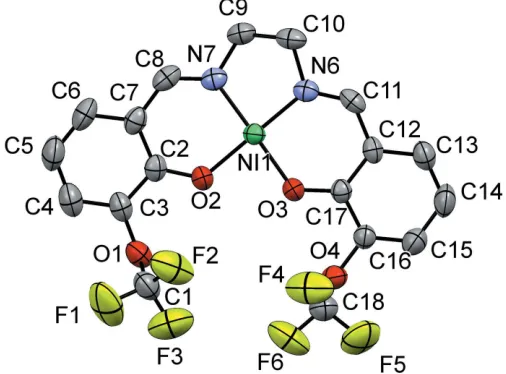
The molecular structure of the asymmetric unit of the title compound (I) is shown in Fig. 1. Inversion-related complex molecules are linked by an Ni1 Ni1i intermetallic d8 d8
interaction of 3.2945 (6) A˚ [Fig. 2; symmetry code (i):x+ 1, y + 1,z+ 1]. The nickel ion Ni1 is coordinated by two imine N atoms, N6 and N7, and by two phenoxo O atoms, O2 and O3, of the tetradentate Schiff base ligand L. The bond lengths, Ni—O2 and Ni—O3 [1.845 (2) and 1.840 (2) A˚ , respectively], and Ni—N6 and Ni—N7 [1.839 (3) and 1.843 (3) A˚ , respectively] are close to the values observed for nickel complexes of similar ligands (see section Database survey). The coordinating atoms, N6, N7, O2, O3, are essen-tially planar with no atom deviating from its mean plane by more than 0.0325 A˚ . The4factor for four-coordinated metal atoms is = 0.04, indicating an almost perfect square-planar coordination sphere for atom Ni1 (4= 0 for a perfect square-planar geometry, = 1 for a perfect tetrahedral geometry; Yang
et al., 2007).
3. Supramolecular features
In the crystal, the dimers stack up thea-axis direction with a Ni1i Ni1ii separation of ca. 3.791 A˚ [see Fig. 2; symmetry codes: (i):x+ 1,y+ 1,z+ 1; (ii)x+ 1,y,z]. There are no
other significant intermolecular interactions present; both C— H F and C—H O interactions exceed the sum of their van der Walls radii.
4. Database survey
A search of the Cambridge Structural Database (CSD, Version 5.40, November 2018; Groom et al., 2016) for a 2,20 -[ethane-1,2-diylbis(iminomethylidene)]bis(phenolato)]-nickel(II) moiety but with different substituents on the aromatic rings gave over 60 hits. Apart from the search skeleton (CSD refcode SAENNI), whose structure was first reported by Shkol’nikova et al. (1970), the majority of the compounds involve bis(6-methoxyphenolato) and bis(6-eth-oxyphenalato) groups [see supporting information files S1(H), S2(OMe) and S3(OEt)]. A common feature of these complexes is the dimer formation with an Ni Ni separation of betweenca3.2 to 3.9 A˚ . The same dimeric arrangement is found in the title complex, where this separation is 3.2945 (6) A˚ . In the majority of these complexes, the Ni— Niminebond lengths vary from ca1.837 to 1.956 A˚ while the Ni—Ophenoxobond lengths vary from ca1.834 to 1.936 A˚ . In the title complex, the Ni—Nimine[1.839 (3) and 1.843 (3) A˚ ] and Ni—Ophenoxo[1.840 (2) and 1.845 (2) A˚ ] bond lengths fall within these limits.
5. Hirshfeld surface analysis
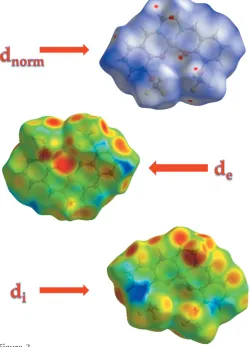
The Hirshfeld surface analysis (Spackman & Jayatilaka, 2009) and the associated two-dimensional fingerprint plots (McKinnon et al., 2007) were performed with Crystal-Explorer17(Turneret al., 2017). Hirshfeld surfaces enable the visualization of intermolecular interactions by using different colours and colour intensity to represent short or long contacts and indicate of the relative strength of the interactions. The red regions indicate areas of close contacts shorter than the sum of van der Waals radii, while the blue and white regions represent contacts having distances greater and equal to the
research communications
Acta Cryst.(2019). E75, 328–331 Demir Kanmazalpet al. [Ni(C
[image:2.610.313.567.71.223.2] [image:2.610.44.297.80.163.2]18H12F6N2O4)]
329
Figure 2
A view along thecaxis of the crystal packing of the title compound. The various Ni Ni interactions are shown as green lines and dashed red lines. H atoms have been omitted for clarity.
Figure 1
[image:2.610.44.297.516.703.2]sum of van der Waals radii, respectively. The three-dimen-sional Hirshfeld surfaces calculated for the title compound are depicted in Figs. 3 and 4. A quantitative estimate of the intermolecular interactions in the crystal structure of the title compound was obtained using Hirshfeld analysis with 2D
fingerprint plots (Fig. 5). As can be seen from the individual fingerprint plots (Fig. 5), the most dominant contribution to the Hirshfeld surface is from F H/H F interactions, with a value equal to 36.3%. The scattering points spread up tode=
[image:3.610.309.567.69.279.2]di = 1.4 A˚ . The other dominant forces are H H (17.2%), O H (12.4%) and C H (11.3%) contacts. The electrostatic potential energy in the range0.031 to 0.256 a.u., obtained using the STO-3G basis set at the Hartree–Fock level of theory, is illustrated in Fig. 6. The C—H O and C—H F donors and acceptors are shown as blue and red areas around the atoms with positive (donor) and negative (acceptors) electrostatic potentials.
Figure 4
Hirshfeld surface mapped overdnorm, showing the weak intermolecular C—H O and C—H F contacts.
Figure 5
[image:3.610.47.297.75.422.2]Total two-dimensional fingerprint plot (left) and the individual contribu-tions to the Hirshfeld surface, together with areas of Hirshfeld surfaces involved in the intermolecular contacts (right).
Figure 6
Electrostatic potential surface for the title compound.
Figure 3
[image:3.610.118.549.524.726.2] [image:3.610.47.300.540.712.2]6. Synthesis and crystallization
The title Schiff base ligand (L), was synthesized by conden-sation of 2-hydroxy-3-trifluoromethoxybenzaldehyde (0.0095 mmol) and 1,2-ethanediamine (0.0095 mmol) in ethanol under reflux forca18 h. The yellow product obtained was washed with ether and dried at room temperature. Ni(CH3COO)24H2O (0.0080 mmol) dissolved in 20 ml of ethanol was added slowly to an ethanol (20 ml) solution ofL (0.0080 mmol) and the mixture was refluxed for ca 6 h. The orange product obtained was filtered off and washed with toluene. Red rod-like crystals of the title complex were obtained by slow evaporation of a solution in ethanol at room temperature (yield 82%, m.p. > 673 K).
7. Refinement
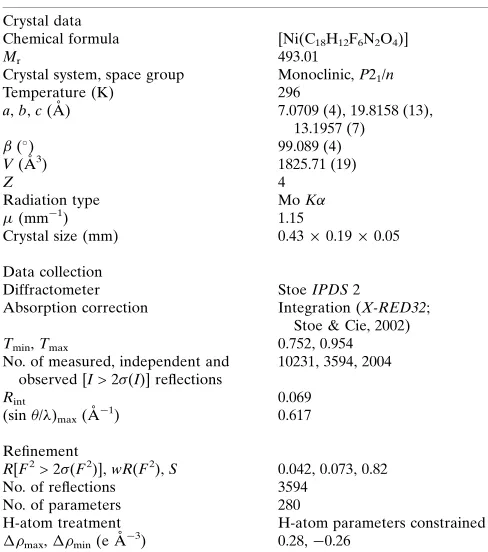
Crystal data, data collection and structure refinement details are summarized in Table 1. All H atoms were positioned with idealized geometry and refined as riding: C—H = 0.93–0.97 A˚ withUiso(H) = 1.2Ueq(C).
Funding information
This work was supported by OMU BAP (Scientific Research Projects Unit of Ondokuz Mayıs University) under project No. PYOFEN.1904.18.003.
References
Atkins, R., Brewer, G., Kokot, E., Mockler, G. M. & Sinn, E. (1985).
Inorg. Chem.24, 127–134.
Farrugia, L. J. (2012).J. Appl. Cryst.45, 849–854.
Groom, C. R., Bruno, I. J., Lightfoot, M. P. & Ward, S. C. (2016).Acta Cryst.B72, 171–179.
Gupta, K. C. & Sutar, A. K. (2008).Coord. Chem. Rev.252, 1420– 1450.
Gupta, V. K., Singh, A. K. & Pal, M. K. (2008).Anal. Chim. Acta,624, 223–231.
Kumar, S., Dhar, D. N. & Saxena, P. N. (2009).J. Sci. Ind. Res.68, 181– 187.
Kundu, A., Shakil, N. K., Saxena, D. B., Pankaj, , Kumar, J. & Walia, S. (2009).J. Environ. Sci. Health Part B,44, 428–434.
Macrae, C. F., Bruno, I. J., Chisholm, J. A., Edgington, P. R., McCabe, P., Pidcock, E., Rodriguez-Monge, L., Taylor, R., van de Streek, J. & Wood, P. A. (2008).J. Appl. Cryst.41, 466–470.
McKinnon, J. J., Jayatilaka, D. & Spackman, M. A. (2007). Chem. Commun.pp. 3814–3816.
Rijt, S. H. van & Sadler, P. J. (2009).Drug Discov. Today,14, 1089– 1097.
Sheldrick, G. M. (2015a).Acta Cryst.A71, 3–8. Sheldrick, G. M. (2015b).Acta Cryst.C71, 3–8.
Shkol’nikova, L. M., Yumal’, E. M., Shugam, E. A. & Voblikova, V. A. (1970).Zh. Strukt. Khim. (Russ. J. Struct. Chem.),11, 886. Spackman, M. A. & Jayatilaka, D. (2009).CrystEngComm,11, 19–32. Spek, A. L. (2009).Acta Cryst.D65, 148–155.
Stoe & Cie (2002). X-AREA and X-RED32. Stoe & Cie GmBh, Darmstadt, Germany.
Tiwari, A. D., Mishra, A. K., Mishra, S. B., Mamba, B. B., Maji, B. & Bhattacharya, S. (2011).Spectrochim. Acta A,79, 1050–1056. Turner, M. J., McKinnon, J. J., Wolff, S. K., Grimwood, D. J.,
Spackman, P. R., Jayatilaka, D. & Spackman, M. A. (2017).
CrystalExplorer17. University of Western Australia. http://hirsh-feldsurface.net
Yang, L., Powell, D. R. & Houser, R. P. (2007).Dalton Trans.pp. 955– 964.
research communications
Acta Cryst.(2019). E75, 328–331 Demir Kanmazalpet al. [Ni(C
[image:4.610.313.557.90.366.2]18H12F6N2O4)]
331
Table 1
Experimental details.
Crystal data
Chemical formula [Ni(C18H12F6N2O4)]
Mr 493.01
Crystal system, space group Monoclinic,P21/n
Temperature (K) 296
a,b,c(A˚ ) 7.0709 (4), 19.8158 (13),
13.1957 (7)
(
) 99.089 (4)
V(A˚3) 1825.71 (19)
Z 4
Radiation type MoK
(mm1) 1.15
Crystal size (mm) 0.430.190.05
Data collection
Diffractometer StoeIPDS2
Absorption correction Integration (X-RED32;
Stoe & Cie, 2002)
Tmin,Tmax 0.752, 0.954
No. of measured, independent and observed [I> 2(I)] reflections
10231, 3594, 2004
Rint 0.069
(sin/)max(A˚ 1
) 0.617
Refinement
R[F2> 2(F2)],wR(F2),S 0.042, 0.073, 0.82
No. of reflections 3594
No. of parameters 280
H-atom treatment H-atom parameters constrained
max,min(e A˚ 3
) 0.28,0.26
sup-1
Acta Cryst. (2019). E75, 328-331
supporting information
Acta Cryst. (2019). E75, 328-331 [https://doi.org/10.1107/S2056989019001919]
Crystal structure and Hirshfeld surfaces analysis of the nickel(II) complex of the
Shiff base ligand 6,6
′
-{(1
E
,1
′
E
)-[ethane-1,2-diylbis(azanylylidene)]bis-(methanylylidene)}bis[2-(trifluoromethoxy)phenol]
Sibel Demir Kanmazalp, Seher Meral, Necmi Dege, Aysen Alaman Agar and Igor O. Fritsky
Computing details
Data collection: X-AREA (Stoe & Cie, 2002); cell refinement: X-AREA (Stoe & Cie, 2002); data reduction: X-RED32
(Stoe & Cie, 2002); program(s) used to solve structure: SHELXT2018 (Sheldrick, 2015a); program(s) used to refine
structure: SHELXL2018 (Sheldrick, 2015b); molecular graphics: ORTEP-3 for Windows (Farrugia, 2012) and Mercury
(Macrae et al., 2008); software used to prepare material for publication: SHELXL2018 (Sheldrick, 2015b), WinGX
(Farrugia, 2012) and PLATON (Spek, 2009).
(6,6′-{(1E,1′
E)-[Ethane-1,2-diylbis(azanylylidene)]bis(methanylylidene)}bis[2-(trifluoromethoxy)phenol]-κ4O,N,N′,O′)nickel(II), [Ni(C
18H12F6N2O4)]
Crystal data
[Ni(C18H12F6N2O4)] Mr = 493.01
Monoclinic, P21/n a = 7.0709 (4) Å
b = 19.8158 (13) Å
c = 13.1957 (7) Å
β = 99.089 (4)°
V = 1825.71 (19) Å3 Z = 4
F(000) = 992
Dx = 1.794 Mg m−3
Mo Kα radiation, λ = 0.71073 Å Cell parameters from 7677 reflections
θ = 1.9–29.8°
µ = 1.15 mm−1 T = 296 K Rod, red
0.43 × 0.19 × 0.05 mm
Data collection
Stoe IPDS 2 diffractometer
Radiation source: sealed X-ray tube, 12 x 0.4 mm long-fine focus
Detector resolution: 6.67 pixels mm-1
rotation method scans
Absorption correction: integration (X-RED32; Stoe & Cie, 2002)
Tmin = 0.752, Tmax = 0.954
10231 measured reflections 3594 independent reflections 2004 reflections with I > 2σ(I)
Rint = 0.069
θmax = 26.0°, θmin = 1.9°
h = −8→8
k = −22→24
supporting information
sup-2
Acta Cryst. (2019). E75, 328-331
Refinement
Refinement on F2
Least-squares matrix: full
R[F2 > 2σ(F2)] = 0.042 wR(F2) = 0.073 S = 0.82 3594 reflections 280 parameters 0 restraints
Primary atom site location: structure-invariant direct methods
Secondary atom site location: difference Fourier map
Hydrogen site location: inferred from neighbouring sites
H-atom parameters constrained
w = 1/[σ2(F
o2) + (0.0208P)2]
where P = (Fo2 + 2Fc2)/3
(Δ/σ)max < 0.001
Δρmax = 0.28 e Å−3
Δρmin = −0.26 e Å−3
Special details
Geometry. All esds (except the esd in the dihedral angle between two l.s. planes) are estimated using the full covariance matrix. The cell esds are taken into account individually in the estimation of esds in distances, angles and torsion angles; correlations between esds in cell parameters are only used when they are defined by crystal symmetry. An approximate (isotropic) treatment of cell esds is used for estimating esds involving l.s. planes.
Refinement. Refinement of F2 against ALL reflections. The weighted R-factor wR and goodness of fit S are based on F2,
conventional R-factors R are based on F, with F set to zero for negative F2. The threshold expression of F2 > 2sigma(F2) is
used only for calculating R-factors(gt) etc. and is not relevant to the choice of reflections for refinement. R-factors based on F2 are statistically about twice as large as those based on F, and R- factors based on ALL data will be even larger.
Fractional atomic coordinates and isotropic or equivalent isotropic displacement parameters (Å2)
x y z Uiso*/Ueq
Ni1 0.26730 (6) 0.49434 (2) 0.49904 (4) 0.03711 (13)
O3 0.2821 (4) 0.40837 (12) 0.55236 (18) 0.0425 (6)
O2 0.3199 (3) 0.45369 (12) 0.38085 (18) 0.0449 (7)
O4 0.3829 (4) 0.28127 (12) 0.60619 (19) 0.0507 (7)
O1 0.4119 (4) 0.37488 (14) 0.22988 (19) 0.0566 (7)
N6 0.2039 (4) 0.53396 (14) 0.6151 (2) 0.0411 (8)
N7 0.2627 (4) 0.58028 (15) 0.4452 (3) 0.0438 (8)
F2 0.1222 (5) 0.33925 (16) 0.2439 (3) 0.1148 (12)
F4 0.1024 (4) 0.26758 (15) 0.5082 (2) 0.1128 (12)
F6 0.3485 (5) 0.21399 (17) 0.4791 (2) 0.1136 (11)
F5 0.2146 (5) 0.18837 (15) 0.6022 (3) 0.1122 (11)
C17 0.2694 (5) 0.39078 (18) 0.6458 (3) 0.0381 (9)
C2 0.3145 (5) 0.4817 (2) 0.2913 (3) 0.0434 (10)
F1 0.2352 (5) 0.31439 (18) 0.1122 (2) 0.1288 (14)
C12 0.2217 (5) 0.4342 (2) 0.7222 (3) 0.0413 (9)
C11 0.1888 (4) 0.5050 (2) 0.7009 (3) 0.0443 (10)
H11 0.154060 0.531744 0.752904 0.053*
F3 0.3513 (6) 0.27078 (17) 0.2496 (3) 0.1309 (13)
C3 0.3510 (6) 0.4423 (2) 0.2078 (3) 0.0501 (10)
C7 0.2774 (5) 0.5505 (2) 0.2689 (3) 0.0470 (10)
C16 0.3104 (5) 0.32354 (19) 0.6763 (3) 0.0437 (9)
C8 0.2613 (5) 0.5966 (2) 0.3501 (3) 0.0496 (11)
H8 0.248688 0.642164 0.333355 0.060*
C10 0.1626 (6) 0.60683 (18) 0.6044 (3) 0.0524 (11)
sup-3
Acta Cryst. (2019). E75, 328-331
H10B 0.026750 0.614357 0.582588 0.063*
C9 0.2752 (6) 0.63223 (18) 0.5249 (3) 0.0508 (11)
H9A 0.221970 0.674426 0.495980 0.061*
H9B 0.407695 0.639754 0.555126 0.061*
C13 0.2102 (6) 0.4102 (2) 0.8210 (3) 0.0566 (11)
H13 0.175958 0.439462 0.870112 0.068*
C1 0.2811 (8) 0.3271 (3) 0.2096 (4) 0.0674 (13)
C18 0.2617 (7) 0.2405 (2) 0.5502 (4) 0.0616 (12)
C15 0.3026 (6) 0.3011 (2) 0.7727 (3) 0.0619 (12)
H15 0.333337 0.256546 0.790046 0.074*
C6 0.2706 (6) 0.5749 (2) 0.1687 (4) 0.0646 (13)
H6 0.245387 0.620387 0.155453 0.078*
C14 0.2486 (7) 0.3447 (3) 0.8456 (3) 0.0709 (14)
H14 0.238953 0.328986 0.910957 0.085*
C4 0.3449 (7) 0.4673 (3) 0.1098 (3) 0.0675 (13)
H4 0.371002 0.439315 0.057199 0.081*
C5 0.3000 (7) 0.5337 (3) 0.0908 (4) 0.0748 (15)
H5 0.289649 0.550545 0.024387 0.090*
Atomic displacement parameters (Å2)
U11 U22 U33 U12 U13 U23
Ni1 0.0390 (2) 0.0343 (2) 0.0376 (2) 0.0013 (3) 0.00489 (16) −0.0016 (3)
O3 0.0528 (16) 0.0404 (14) 0.0359 (15) 0.0000 (12) 0.0115 (12) −0.0022 (11)
O2 0.0556 (16) 0.0446 (15) 0.0351 (15) −0.0001 (12) 0.0089 (13) −0.0010 (12)
O4 0.0550 (17) 0.0421 (15) 0.0554 (17) 0.0010 (13) 0.0096 (14) −0.0003 (13)
O1 0.0583 (18) 0.0611 (19) 0.0513 (16) −0.0040 (15) 0.0117 (14) −0.0148 (14)
N6 0.0360 (17) 0.0402 (17) 0.0457 (19) 0.0028 (14) 0.0020 (15) −0.0035 (15)
N7 0.0380 (18) 0.0406 (19) 0.051 (2) 0.0021 (14) 0.0015 (15) 0.0006 (16)
F2 0.094 (2) 0.101 (2) 0.168 (3) −0.0372 (19) 0.077 (2) −0.050 (2)
F4 0.090 (2) 0.088 (2) 0.140 (3) 0.0169 (17) −0.047 (2) −0.0251 (19)
F6 0.119 (3) 0.116 (3) 0.108 (2) 0.001 (2) 0.023 (2) −0.058 (2)
F5 0.134 (3) 0.068 (2) 0.133 (3) −0.0416 (19) 0.017 (2) 0.0097 (19)
C17 0.036 (2) 0.043 (2) 0.035 (2) −0.0044 (17) 0.0062 (17) 0.0002 (17)
C2 0.037 (2) 0.053 (3) 0.040 (2) −0.0071 (18) 0.0055 (17) 0.0028 (19)
F1 0.153 (3) 0.159 (3) 0.077 (2) −0.078 (3) 0.025 (2) −0.052 (2)
C12 0.038 (2) 0.054 (3) 0.032 (2) −0.0006 (19) 0.0047 (17) 0.0009 (18)
C11 0.0370 (19) 0.054 (3) 0.042 (2) 0.003 (2) 0.0070 (16) −0.017 (2)
F3 0.160 (3) 0.065 (2) 0.167 (3) −0.002 (2) 0.023 (3) 0.004 (2)
C3 0.046 (2) 0.068 (3) 0.037 (2) −0.007 (2) 0.0087 (19) −0.005 (2)
C7 0.041 (2) 0.052 (3) 0.046 (2) −0.009 (2) 0.003 (2) 0.010 (2)
C16 0.048 (2) 0.044 (2) 0.039 (2) −0.0041 (18) 0.0069 (18) 0.0016 (18)
C8 0.039 (2) 0.041 (2) 0.067 (3) −0.0015 (19) 0.004 (2) 0.015 (2)
C10 0.052 (3) 0.038 (2) 0.065 (3) 0.0063 (18) 0.002 (2) −0.012 (2)
C9 0.054 (3) 0.035 (2) 0.062 (3) −0.0007 (19) 0.006 (2) −0.0013 (18)
C13 0.063 (3) 0.069 (3) 0.039 (2) −0.008 (2) 0.012 (2) −0.005 (2)
C1 0.081 (4) 0.070 (4) 0.055 (3) −0.011 (3) 0.022 (3) −0.015 (3)
supporting information
sup-4
Acta Cryst. (2019). E75, 328-331
C15 0.079 (3) 0.052 (3) 0.055 (3) −0.004 (2) 0.010 (2) 0.010 (2)
C6 0.068 (3) 0.066 (3) 0.059 (3) −0.001 (2) 0.006 (2) 0.029 (2)
C14 0.091 (4) 0.081 (4) 0.042 (3) −0.003 (3) 0.015 (2) 0.017 (3)
C4 0.070 (3) 0.091 (4) 0.044 (3) −0.008 (3) 0.016 (2) −0.002 (2)
C5 0.092 (4) 0.088 (4) 0.045 (3) −0.008 (3) 0.012 (3) 0.018 (3)
Geometric parameters (Å, º)
Ni1—N6 1.839 (3) C12—C11 1.443 (5)
Ni1—O3 1.840 (2) C11—H11 0.9300
Ni1—N7 1.843 (3) F3—C1 1.299 (5)
Ni1—O2 1.845 (2) C3—C4 1.379 (5)
O3—C17 1.297 (4) C7—C6 1.401 (5)
O2—C2 1.301 (4) C7—C8 1.427 (6)
O4—C18 1.316 (5) C16—C15 1.357 (5)
O4—C16 1.403 (4) C8—H8 0.9300
O1—C1 1.321 (5) C10—C9 1.501 (6)
O1—C3 1.419 (5) C10—H10A 0.9700
N6—C11 1.288 (5) C10—H10B 0.9700
N6—C10 1.475 (4) C9—H9A 0.9700
N7—C8 1.295 (5) C9—H9B 0.9700
N7—C9 1.464 (5) C13—C14 1.354 (6)
F2—C1 1.298 (5) C13—H13 0.9300
F4—C18 1.291 (5) C15—C14 1.390 (6)
F6—C18 1.311 (5) C15—H15 0.9300
F5—C18 1.313 (5) C6—C5 1.355 (6)
C17—C12 1.407 (5) C6—H6 0.9300
C17—C16 1.409 (5) C14—H14 0.9300
C2—C3 1.409 (5) C4—C5 1.367 (6)
C2—C7 1.410 (5) C4—H4 0.9300
F1—C1 1.300 (5) C5—H5 0.9300
C12—C13 1.402 (5)
N6—Ni1—O3 94.78 (12) N6—C10—H10A 110.5
N6—Ni1—N7 86.27 (14) C9—C10—H10A 110.5
O3—Ni1—N7 177.70 (14) N6—C10—H10B 110.5
N6—Ni1—O2 177.53 (13) C9—C10—H10B 110.5
O3—Ni1—O2 84.95 (11) H10A—C10—H10B 108.7
N7—Ni1—O2 94.08 (14) N7—C9—C10 106.7 (3)
C17—O3—Ni1 127.1 (2) N7—C9—H9A 110.4
C2—O2—Ni1 126.9 (2) C10—C9—H9A 110.4
C18—O4—C16 117.5 (3) N7—C9—H9B 110.4
C1—O1—C3 116.9 (3) C10—C9—H9B 110.4
C11—N6—C10 118.5 (4) H9A—C9—H9B 108.6
C11—N6—Ni1 127.4 (3) C14—C13—C12 120.6 (4)
C10—N6—Ni1 114.1 (3) C14—C13—H13 119.7
C8—N7—C9 120.7 (3) C12—C13—H13 119.7
sup-5
Acta Cryst. (2019). E75, 328-331
C9—N7—Ni1 112.2 (2) F2—C1—F1 106.6 (4)
O3—C17—C12 125.3 (3) F3—C1—F1 104.7 (4)
O3—C17—C16 118.9 (3) F2—C1—O1 114.4 (4)
C12—C17—C16 115.8 (3) F3—C1—O1 108.8 (4)
O2—C2—C3 119.4 (4) F1—C1—O1 113.4 (4)
O2—C2—C7 125.6 (4) F4—C18—F6 109.6 (4)
C3—C2—C7 115.0 (4) F4—C18—F5 106.0 (4)
C13—C12—C17 121.0 (4) F6—C18—F5 104.2 (4)
C13—C12—C11 118.7 (4) F4—C18—O4 115.7 (4)
C17—C12—C11 120.3 (3) F6—C18—O4 108.1 (4)
N6—C11—C12 124.8 (4) F5—C18—O4 112.7 (4)
N6—C11—H11 117.6 C16—C15—C14 120.1 (4)
C12—C11—H11 117.6 C16—C15—H15 119.9
C4—C3—C2 123.5 (4) C14—C15—H15 119.9
C4—C3—O1 119.7 (4) C5—C6—C7 121.4 (4)
C2—C3—O1 116.7 (3) C5—C6—H6 119.3
C6—C7—C2 120.6 (4) C7—C6—H6 119.3
C6—C7—C8 119.5 (4) C13—C14—C15 119.7 (4)
C2—C7—C8 119.7 (4) C13—C14—H14 120.1
C15—C16—O4 119.7 (4) C15—C14—H14 120.1
C15—C16—C17 122.7 (4) C5—C4—C3 119.4 (5)
O4—C16—C17 117.2 (3) C5—C4—H4 120.3
N7—C8—C7 125.4 (4) C3—C4—H4 120.3
N7—C8—H8 117.3 C6—C5—C4 120.0 (5)
C7—C8—H8 117.3 C6—C5—H5 120.0
N6—C10—C9 106.1 (3) C4—C5—H5 120.0
N6—Ni1—O3—C17 −6.3 (3) C18—O4—C16—C15 88.3 (4)
O2—Ni1—O3—C17 176.1 (3) C18—O4—C16—C17 −98.9 (4)
O3—Ni1—O2—C2 171.3 (3) O3—C17—C16—C15 179.3 (4)
N7—Ni1—O2—C2 −10.8 (3) C12—C17—C16—C15 0.8 (6)
O3—Ni1—N6—C11 2.6 (3) O3—C17—C16—O4 6.7 (5)
N7—Ni1—N6—C11 −175.3 (3) C12—C17—C16—O4 −171.8 (3)
O3—Ni1—N6—C10 −175.9 (2) C9—N7—C8—C7 170.4 (3)
N7—Ni1—N6—C10 6.2 (2) Ni1—N7—C8—C7 −5.0 (6)
N6—Ni1—N7—C8 −166.3 (3) C6—C7—C8—N7 179.0 (4)
O2—Ni1—N7—C8 11.3 (3) C2—C7—C8—N7 −5.8 (6)
N6—Ni1—N7—C9 18.0 (2) C11—N6—C10—C9 153.9 (3)
O2—Ni1—N7—C9 −164.5 (2) Ni1—N6—C10—C9 −27.4 (3)
Ni1—O3—C17—C12 7.0 (5) C8—N7—C9—C10 147.0 (3)
Ni1—O3—C17—C16 −171.4 (2) Ni1—N7—C9—C10 −36.9 (3)
Ni1—O2—C2—C3 −177.2 (3) N6—C10—C9—N7 39.5 (4)
Ni1—O2—C2—C7 3.9 (5) C17—C12—C13—C14 1.3 (6)
O3—C17—C12—C13 179.5 (3) C11—C12—C13—C14 −177.0 (4)
C16—C17—C12—C13 −2.1 (5) C3—O1—C1—F2 −48.2 (6)
O3—C17—C12—C11 −2.2 (6) C3—O1—C1—F3 −169.5 (4)
C16—C17—C12—C11 176.1 (3) C3—O1—C1—F1 74.4 (6)
supporting information
sup-6
Acta Cryst. (2019). E75, 328-331
Ni1—N6—C11—C12 0.6 (5) C16—O4—C18—F6 169.7 (3)
C13—C12—C11—N6 176.5 (3) C16—O4—C18—F5 −75.7 (5)
C17—C12—C11—N6 −1.7 (5) O4—C16—C15—C14 173.7 (4)
O2—C2—C3—C4 178.7 (4) C17—C16—C15—C14 1.4 (6)
C7—C2—C3—C4 −2.3 (6) C2—C7—C6—C5 −0.3 (7)
O2—C2—C3—O1 −6.5 (5) C8—C7—C6—C5 174.9 (4)
C7—C2—C3—O1 172.5 (3) C12—C13—C14—C15 0.9 (7)
C1—O1—C3—C4 −84.6 (5) C16—C15—C14—C13 −2.2 (7)
C1—O1—C3—C2 100.4 (4) C2—C3—C4—C5 −0.5 (7)
O2—C2—C7—C6 −178.5 (4) O1—C3—C4—C5 −175.1 (4)
C3—C2—C7—C6 2.6 (6) C7—C6—C5—C4 −2.6 (8)
O2—C2—C7—C8 6.4 (6) C3—C4—C5—C6 3.0 (8)
C3—C2—C7—C8 −172.5 (3)
Hydrogen-bond geometry (Å, º)
D—H···A D—H H···A D···A D—H···A
C10—H10B···O3i 0.97 2.63 3.494 (4) 149
C9—H9A···F4i 0.97 2.56 3.301 (5) 133
C6—H6···F6ii 0.93 2.58 3.405 (5) 148