Modelling of the Process of Solid-Liquid Extraction
of Total Polyphenols from Soybeans
Stela Jokić, Darko Velić, Mate Bilić, Ana BuCić-koJić, Mirela PlANiNić
and Srećko ToMAS
Faculty of Food Technology, university of J. J. Strossmayer in osijek, osijek, Croatia
Abstract
Jokić S., Velić D., Bilić M., Bucić-Kojić A., Planinić M., Tomas S. (2010): Modelling of the process of solid-liquid extraction of total polyphenols from soybeans. Czech J. Food Sci., 28: 206–212.
The influence of the solvent, temperature, and extraction time on the extractability of total polyphenols from milled soybeans variety Ika was investigated. The study was performed in order to select the most suitable solvent (water; 50, 60, 70, and 80% aqueous ethanol) for achieving the highest yield of total polyphenols. The most effective solvent (50% aqueous ethanol solution) was used for monitoring the kinetics and modelling of solid-liquid extraction of total polyphenols from soybeans, average particle size 0.459 mm, at solid-liquid ratio of 20 ml/g (ratio of the solvent volume per g of raw material). The total polyphenols content in the soybean extract was determined spectrophotometrically using Folin-Ciocalteu micro-methods at 765 nm. The applicability of different mathematical models (Peleg, Page, and Logarithmic models) to describe the kinetics of the solid-liquid extraction process of total polyphenols from soybeans was studied as well. The results exhibited a significant influence of the solvent and temperature on the kinetics and extraction yield of total polyphenols from soybeans. The best extraction yield of total polyphenols was obtained using 50% aqueous ethanol solution at 80°C after 120 min (4.322 mg GAE/gdb). The extraction yield of total polyphenols in soybean extracts increased by increasing the extraction temperature and extending the duration of the extraction process. The mathematical models applied showed a good agreement with the experimental results, which allows their application in modelling and optimisation of solid-liquid extraction process for the extraction of total polyphenols from soybeans.
Keywords: solid-liquid extraction; soybeans; total polyphenols; modelling; optimisation
Supported by the Ministry of Science, Education and Sport of the Republic of Croatia, Projects No.113-0000000-3497 and No. 113-1130471-0338.
In the past several years, soy and its constituents received considerable attention because of their potential to reduce the formation and progression of certain types of cancers including cancer of the breast, prostate, and colon, and of some chronic diseases such as cardiovascular disease, osteoporo-sis, Alzheimer’s disease, etc. (Head 1998; Messina 1999). Soybeans are widely accepted as a “healthy
food” and some of their pharmacological effects could be attributed to the presence of phenolic substances. These valuable constituents should be considered as an important feature of soybeans, besides protein and oil contents (Malenčić et al. 2007).
increased in recent years because many of these substances found in plant tissues are potential anti-oxidants and their consumption may significantly contribute to human health (Naczk & Shahidi 2006). To prevent oxidation of fats and oils, anti-oxidants are widely used in foods and cosmetics (Cuvelier et al. 1996).
Extraction is a very important stage in the iso-lation as well as identification of phenolic com-pounds. Consequently, many authors have studied the influence of different extraction conditions (Stangler Herodež et al. 2003; Achouri et al. 2005; Lapornik et al. 2005; Spigno et al. 2007; Bucić-Kojić et al. 2007) on the extraction yields of phenolic compounds from natural sources. However, there is still no available standardised procedure for simultaneous extraction of all phe-nolics. Therefore, there is a need for systematic research related to the determination of food phe-nolics (Naczk & Shahidi 2004).
Literature data on modelling and simulation of solid-liquid extraction of total polyphenols from soybeans are scarce. Therefore, there is a need for mathematical modelling of this process. The mathematical models are useful engineering tools which greatly facilitate the simulation, optimisa-tion, design, and control of processes and contrib-ute to the utilisation of energy, time, raw material, and solvent. For this reason, the aim of this work was to examine the influence of the solvent on the extraction yield of total polyphenols, and the temperature influence on the extraction kinetics. Because of the similarity between the extraction and sorption kinetics (Bucić-Kojić et al. 2007), the goal was to examine the applicability of Peleg´s, Page’s, and Logarithmic equations for modelling solid-liquid extraction of total polyphenols from soybeans variety Ika.
MATERIAL AND METHODS
Material. The extraction was performed on con-ventionally grown soybeans variety “Ika” from the Agricultural Institute of Osijek. The first step was to remove foreign materials, such as sticks, stems, leaves, damaged seeds, and dirt from soybeans. The material was milled in a grinder (HR 2860, Philips), and after grinding, it was immediately stored at +4°C until the extraction. Dry matter content of the soybeans was determined by drying 5 g of milled soybeans at 105°C to the constant
weight. The analyses were done in duplicates and the average dry matter content was noted as per-centage. The moisture content was about 9%, i.e. the content of dry matter was about 91% in the sample of soybeans used in this study. The average particle size, d = 0.459 mm, was determined using sieve sets (Retsch AS 200, Haan, Germany).
Extraction. In the test tubes, 0.5 g of the soy-bean sample was mixed with 20 ml of solvent. The extraction process was conducted on laboratory scale using a water bath (Julabo SW-23, Germany) for 120 minutes. During the extraction process, the test tubes containing the reaction mixture were incubated in the water bath with twenty-second shaking of each test tube in 15 min intervals with Vortex (Vibromix 10, Tehtnica, Slovenia). All ex-traction runs were performed in duplicates. The extracts obtained were separated after extraction from rough particles by decantation and were centrifuged (Sigma 2-16, Germany) at 15 000 g for 5 minutes. The supernatant was decanted and made up to the defined volume (20 ml). The supernatant was used for the determination of total polyphenols.
influence of solvent: The efficiency of total polyphenols extraction using different solvents (water and 50, 60, 70, and 80% aqueous ethanol so-lutions) at a temperature of 80°C was examined. influence of extraction temperature: The extrac-tion was performed at different temperatures (25, 40, 50, 60, 70, and 80°C) with 50% aqueous ethanol solution which proved to be the most effective solvent for this experimental condition.
influence of extraction time: The extraction was performed at different extraction times (5, 10, 15, 20, 30, 40, 60, 90, and 120 min) at each extraction temperature with 50% aqueous ethanol solution.
in duplicates and calculated from the calibration curve obtained with gallic acid, which was used as a standard. Final results were recalculated and expressed as gallic acid equivalents per dry basis of soybeans (mg GAE/gdb).
Kinetics of solid-liquid-extraction. The extrac-tion curves (concentraextrac-tion of total polyphenols vs. time) have similar shape as the sorption curves (moisture content vs. time), which gave the pos-sibility of using the same mathematical models for describing the kinetics.
The model proposed by Peleg (1988) was adapted for the extraction and used in the form:
c(t) = t (1)
k
1 + k2 × t where:
c(t) – concentration of total polyphenols at time t (mg GAE/gdb)
t – extraction time (min)
k1 – Peleg’s rate constant (min gdb/mg GAE) k2 – Peleg’s capacity constant (gdb/mg GAE)
The Peleg rate constant k1 relates to the extrac-tion rate (B0) at the very beginning (t = t0):
B0 = 1 (mg GAE/gdb min) (2)
k1
The Peleg capacity constant k2 relates to maxi-mum extraction yield, i.e. equilibrium concentra-tion of total polyphenols extracted (ce) when t →∞. Eq. (2) gives the relation between equilibrium concentration and k2 constant:
c t →∞ = ce = 1 (mg GAE/gdb) (3)
k2
The model proposed by Page was used, as follows:
c(t) = exp (–ktn) (4)
where:
k, n – constants of Page’s model
c(t) – concentration of total polyphenols at time t (mg GAE/gdb)
t – extraction time (min)
Logarithmic model was used as follows:
c(t) = a log t + b (5)
where:
a, b – Logarithmic model constants
c(t) – concentration of total polyphenols at time t (mg GAE/gdb)
t – extraction time (min)
Statistical analysis. Statistica 8.0 (Stat Soft Inc., USA) was used to analyse the experimental data. The parameters of the proposed models were determined from the experimental data using non-linear regression (Quasi-Newton method). The concordance between the experimental data and calculated value was established by the cor-relation coefficient (R) and the root mean squared deviation (RMSD) as follows:
RMSD =
√
1∑
n (experiment – calculated)2 (6)ni=1
RESULTS AND DISCUSSION
The aim of this study was to examine the influ-ence of different solvents (water, and 50, 60, 70, and 80% aqueous ethanol solutions), extraction temperatures (26, 40, 50, 60, 70, and 80°C), and extraction times (5, 10, 15, 20, 30, 40, 60, 90, and 120 min) on the extractability of total polyphenols from the soybeans variety Ika. Dry matter content was determined in all experimental runs and the total polyphenol concentration was expressed on dry basis, which generally provides a more accurate and reliable data comparison.
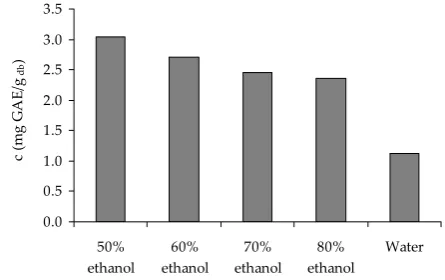
The results show (Figure 1) that the highest con-centration of total polyphenols was obtained by applying 50% aqueous ethanol solution (3.045 mg GAE/gdb), while further increase of the ethanol concentration significantly contributed to a de-crease of the extractability of total polyphenols from the soybean samples. The lowest extraction efficiency was obtained by using water as a solvent (1.119 mg GAE/gdb). An aqueous ethanol solution (50, 60, 70, or 80%) was selected as solvent due to
0.0 0.5 1.0 1.5 2.0 2.5 3.0 3.5
50% ethanol
60% ethanol
70% ethanol
80% ethanol
Water
Solvent
c
ȱ
(m
g
ȱ
G
A
E/
gȱdb
[image:3.595.301.524.581.721.2])
the environmental safety, low cost, and lower toxic-ity as compared to other solvents (e.g. methanol). Although for the food purposes water represented the best solvent selection, it water extracted as a polar solvent other undesirable macromolecules as well (protein, polysaccharide, etc.) especially at higher temperatures and pressures (Rostagno et al. 2003; Tsao & Deng 2004).
Spigno et al. (2007) found that a higher content of water in the ethanol/water solution (concentration of aqueous ethanol solution below 50%) reduced the extraction of polyphenols. Also, Rostango et al. (2004) found that it is necessary to add a certain amount of water (30–40%) to the extrac-tion solvent in order to improve the extracextrac-tion of phenolic compounds. The water content above 60% resulted in the reduction of the extraction yields of the same components. Using pure ethanol as solvent reduced the extraction efficiency since polyphenols, due to a number of hydroxyl groups (such as flavonoids, especially those containing sugars in the molecule), are hydrophilic, and as such generally more soluble in water-ethanol solu-tions than in pure alcohol. The reason for the low content of phenolic substances in water extracts can also reside in the increased activity of enzymes (polyphenol oxidase, PPO) that degrade phenolic substances, while in alcoholic media are these enzymes inactive (Lapornik et al. 2005).
Similar data on the extraction yield of phenolic substances from soybeans have been published by Malenčić et al. (2007), however, specific differ-ences exist because of different methodologies of
the experimental works as well as different varie-ties of the soybean samples.
According to the fact that 50% aqueous ethanol solution proved to be the most effective solvent, it was used as a solvent in further analyses for the kinetics of solid-liquid extraction at different temperatures (26, 40, 50, 60, 70, and 80°C) during 120 minutes.
The results show (Figures 2, 4 and 6) that the maximum extraction degree was achieved at the extraction temperature of 80°C and extraction time of 120 min (4.322 mg GAE/gdb), while for the same extraction time the lowest amount of total polyphenols was extracted at 26°C (3.256 mg GAE/gdb). With the increase of the extraction tem-perature and extraction time, the amount of total polyphenols extracted from soybeans variety Ika also increased. The temperature increase resulted in most cases in an increase of the diffusion rate and solubility of the extracted substances while, on the other hand it should be taken into account that some important biologically active substances degrade at high temperatures (Cacace & Mazza 2003).
The extraction curves (concentration of total polyphenols vs. time) have a similar shape as the sorption curves (moisture content vs. time), and due to that fact all these curves can be described using mathematical models of the mass transfer. Therefore, to describe the extraction kinetics, three mathematical models were used, those proposed by Peleg and Page, and the Logarithmic model. The constant value, correlation coefficient (R)
0.0 0.5 1.0 1.5 2.0 2.5 3.0 3.5 4.0 4.5
0 20 40 60 80 100 120
tȱ(min)
cȱ
(m
g
ȱ
G
A
E/
gdb
)
ȱ
26°C 40°C
50°C 60°C
[image:4.595.310.520.536.694.2]70°C 80°C
Figure 2. The temperature influence on extraction kinetic of total polyphenol extracted by 50% aqueous ethanol so-lution from soybeans (symbols: experimental data; lines: approximation according to Peleg’s model)
0.0 0.5 1.0 1.5 2.0 2.5 3.0 3.5 4.0 4.5 5.0
0 1 2 3 4 5
cexp.ȱ(mgȱGAE/gdb)
cmod
.
ȱ
(m
g
ȱ
G
A
E/
gdb
)
26°C 40°C
50°C 60°C
70°C 80°C
Figure 3. Correlation between all the experimentally
obtained values of total polyphenols concentration vs.
and the root mean squared deviation (RMSD) were obtained for each mathematical model using Statistica 8.0 non-linear methods.
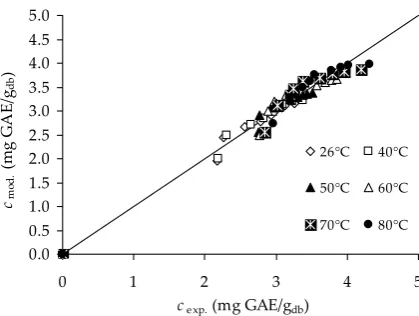
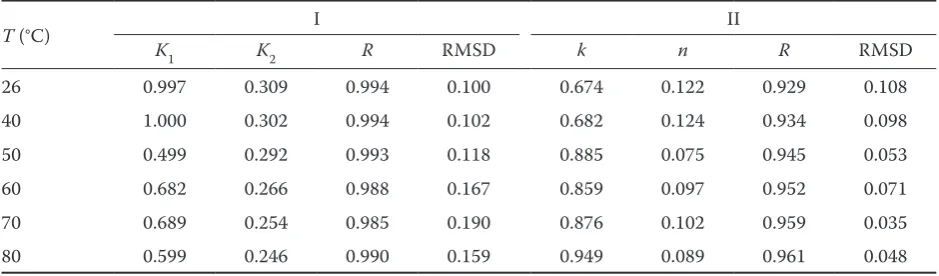
The calculated parameters of Peleg’s model (con-stants k1 and k2), correlation coefficient (R), and the root mean squared deviation (RMSD) are shown in Table 1. The correlation coefficients were high in all experiments (0.985–0.994), and the root mean squared deviations (RMSD) were in the range from 0.100 to 0.190, which implied a good agreement between the experimental and calculated data. Figure 2 shows the extraction curves constructed on the basis of Peleg’s model constants and their comparison with the experimental data. The figure demonstrates a good agreement of the experimental data with the approximation data using Peleg’s model for solid-liquid extraction of total polyphenols from milled soybeans. Similar results were obtained for solid-liquid extraction of total polyphenols from grape seeds (Bucić-Kojić et al. 2007). The Peleg’s
model proved to be suitable to model the solid-liquid extraction kinetics with total polyphenols from milled soybeans, which was proved by high correlation coefficients in all experiments and can be also seen from the correlation of the experi-mental and calculated values of total polyphenol concentrations using this model (Figure 3).
The results of Page’s model are shown in Table 1. The values of correlation coefficient (R) were lower than in Peleg’s and Logarithmic models and were in the range from 0.929 to 0.961.
The values of correlation coefficients obtained with the Logarithmic model (Table 2) were ap-proximately equal to the values of Peleg’s model (0.972–0.989), while with the former model, the lowest values were obtained of the root mean squared deviation (0.052–0.082) as compared to the other models.
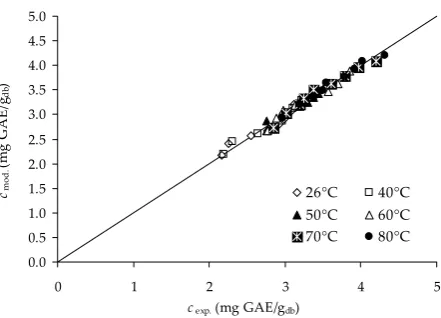
[image:5.595.308.524.82.223.2]In accordance with the Peleg’s model, Page’s and Logarithmic models (Figures 4 and 6) showed a
Table 1. Values of Peleg’s constants I (k1 and k2) and Peleg’s constants II (k and n)for solid-liquid extraction with correlation coefficient (R) and the root mean squared deviation (RMSD)
T (°C) k I II
1 k2 R RMSD k n R RMSD
26 0.997 0.309 0.994 0.100 0.674 0.122 0.929 0.108
40 1.000 0.302 0.994 0.102 0.682 0.124 0.934 0.098
50 0.499 0.292 0.993 0.118 0.885 0.075 0.945 0.053
60 0.682 0.266 0.988 0.167 0.859 0.097 0.952 0.071
70 0.689 0.254 0.985 0.190 0.876 0.102 0.959 0.035
80 0.599 0.246 0.990 0.159 0.949 0.089 0.961 0.048
0.0 0.5 1.0 1.5 2.0 2.5 3.0 3.5 4.0 4.5
0 20 40 60 80 100 120
tȱ(min)
c
ȱ
(m
g
ȱ
G
A
E/
gdb
)
26°C 40°C
50°C 60°C
70°C 80°C
0.0 0.5 1.0 1.5 2.0 2.5 3.0 3.5 4.0 4.5 5.0
0 1 2 3 4 5
cexp.ȱ(mgȱGAE/gdb)
cmod
.
ȱ
(m
g
ȱ
G
A
E/
gdb
)
26°C 40°C
50°C 60°C
70°C 80°C
Figure 5. Correlation between all the experimentally
obtained values of total polyphenols concentration vs.
[image:5.595.62.291.87.225.2]calculated concentrations using Page’s model at different extraction temperatures
[image:5.595.63.533.620.758.2]good agreement with the experimental results. According to the high correlation coefficients (R) in all experiments, these models showed to be suitable to model the solid-liquid extraction kinetics of total polyphenols extraction from milled soybeans, which can be also evident from Figures 5 and 7.
The extraction curves (Figures 2, 4 and 6) indi-cated the experimental increase in the extraction yield in time. From these results, a high initial rate of polyphenols extraction can be observed in the extraction curves, followed by a slower extraction rate, and asymptotically approaching the equilib-rium concentration. More precisely, in the first 40 min, depending on the extraction temperature, from 86% to 94% polyphenols were extracted of the total amount extracted after 120 min under the given conditions.
CONCLUSION
The experimental results showed that the condi-tions during the extraction process had a significant influence on the extractability of total polyphenols from the soybeans variety Ika. It was observed that the solvent and extraction temperature had a significant impact on the kinetics and extraction yield of total polyphenols from milled soybeans of average particle size d = 0.459 mm at solid-liquid ratio 20 ml/g.
The highest efficiency of total polyphenols ex-traction, at a temperature of 50°C and 60 min of extraction was achieved with 50% aqueous ethanol solution (3.045 mg GAE/gdb). Applying 50% aqueous ethanol solution, 2.72 times higher amount of total polyphenols was obtained in comparison with that extracted with water. Furthermore, the exponential growth of the extraction yield in time was observed at all extraction temperatures examined.
The extraction yield of total polyphenols in soy-bean extracts was increased with the increase of extraction temperature and extended duration of the extraction process. The highest concentration of total polyphenols in the extract of soybean samples variety Ika was achieved at extraction tem-perature of 80°C after 120 min (4.322 mg GAE/gdb). In the first 40 min, depending on the extraction temperature, from 86% to 94% of polyphenols was extracted of the total amount obtained after 120 min under the experimental conditions.
[image:6.595.308.529.81.240.2]On the basis of statistical indicators, the ap-plied models: Peleg (R = 0.985–0.994, RMSD =
Table 2. Values of Logarithmic model’s constants (a and
b) for solid-liquid extraction with correlation coefficient
(R) and the root mean squared deviation (RMSD)
T (°C) a b R RMSD
26 0.360 1.588 0.972 0.082
40 0.378 1.586 0.980 0.071
50 0.268 2.245 0.979 0.052
60 0.384 2.044 0.980 0.073
70 0.425 2.050 0.986 0.067
80 0.405 2.269 0.989 0.055
Figure 7. Correlation between all the experimentally obtained values of total polyphenols concentration vs. calculated concentrations using Logarithmic’s model at different extraction temperatures
Figure 6. The temperature influence on extraction kinetic of total polyphenol extracted by 50% aqueous ethanol so-lution from soybeans (symbols: experimental data; lines: approximation according to Logarithmic’s model)
0.0 0.5 1.0 1.5 2.0 2.5 3.0 3.5 4.0 4.5
5 25 45 65 85 105 125
t ȱ(min)ȱ
cȱ
(m
g
ȱ
G
A
E/
gdb
)
26°C 40°C
50°C 60°C
70°C 80°C
0.0 0.5 1.0 1.5 2.0 2.5 3.0 3.5 4.0 4.5 5.0
0 1 2 3 4 5
cexp.ȱ(mgȱGAE/gdb) cmod
.
ȱ
(m
g
ȱ
G
A
E/
gdb
)
ȱ
26°C 40°C
50°C 60°C
[image:6.595.63.291.128.248.2]Corresponding author:
Stela Jokić, B.Sc. University of J. J. Strossmayer in Osijek, Faculty of Food Technology, Franje Kuhaca 18, P.O. Box 709, 31 000 Osijek, Croatia
tel.: + 385 981 666 629, e-mail: [email protected] 0.100–0.190), Page (R = 0.929–0.961, RMSD = 0.035–0.108), and Logarithmic (R = 0.972–0.989, RMSD = 0.052–0.082) showed a good agreement between the experimental and model calculated data, which allows the application of the above mentioned models for the purpose of modelling and optimisation of the process of solid-liquid extraction of total polyphenols from milled soy-beans variety Ika
References
Achouri A., Boye J.I., Belanger D. (2005): Soybean isoflavones: Efficacy of extraction conditions and ef-fect of food type on extractability. Food Research International, 38: 1199–1204.
Bucić-Kojić A., Planinić M., Tomas S., Bilić M., Velić D. (2007): Study of solid-liquid extraction kinet-ics of total polyphenols from grape seeds. Journal of Food Engineering, 81: 236–242.
Cacace J.E., Mazza G. (2003): Mass transfer process during extraction of phenolic compounds from milled berries. Journal of Food Engineering, 59: 379–389. Cuvelier M.E., Richard H., Berset C. (1996):
Antioxi-dative activity and phenolic composition of pilot-plant and commercial extracts of sage and rosemary. Journal of the American Oil Chemists’ Society, 73: 645–652. Head K.A. (1998): Isoflavones and other soy constitu-ents in human health and disease. Alternative Medi-cine Review, 3: 433–450.
Lapornik B., Prošek M., Golc Wondra A. (2005): Comparison of extracts prepared from plant by-prod-ucts using different solvent and extraction time. Jour-nal of Food Engineering, 71: 214–222.
Malenčić D., Popović M., Miladinović J. (2007): Phenolic content and antioxidant properties of
soy-bean(Glycine max (L.) Merr.)seeds. Molecules, 12:
576–581.
Messina M.J. (1999): Legumes and soybeans grown foods: overview of their nutritional profiles and
health. American Journal of Clinical Nutrition,70:
439–450.
Naczk M., Shahidi F. (2004): Extraction and analysis
of phenolics in food.Journal of Chromatography A,
1054: 95–111.
Naczk M., Shahidi F. (2006): Phenolics in cereals, fruits and vegetables: Occurrence, extraction and analysis. Journal of Pharmaceutical and Biomedical Analysis,
41: 1523–1542.
Peleg M. (1988): An empirical model for the description of moisture sorption curves. Journal of Food Science,
53: 1216–1219.
Rostagno M.A., Palma M., Barroso C.G. (2003): Ultrasound-assisted extraction of soy isoflavones.
Journal of Chromatography A, 1012: 119–128.
Rostango M.A., Palma M., Barroso C.G. (2004): Pressurized liquid extraction of isoflavones from soy-beans. Analytica Chimica Acta, 522: 169–177. Spigno G., Tramelli L., De Faveri D.M. (2007): Effects
of extraction time, temperature and solvent on concen-tration and antioxidant activity of grape marc pheno-lics. Journal of Food Engineering, 81: 200–208. Stangler Herodež Š., Hadolin M., Škerget M.,
Knez Ž. (2003): Solvent extraction study of antioxi-dants from balm (Melissa officinalis L.) leaves.Food Chemistry, 80: 275–282.
Tsao R., Deng Z. (2004): Separation procedures for naturally occurring antioxidant phytochemicals.
Jour-nal of Chromatography B, 812: 85–99.
Waterhouse A.L. (2009): Determination of total phe-nolics. In: Wrolstad R.E. (ed.): Current Protocols in Food Analytics Chemistry. John Wiley & Sons Inc., New York: I1.1.1–I1.1.8.