Analysis of the Current Status of Ecomaterials in Japan
Kohmei Halada
1, Katsutoshi Yamada
1, Kiyoshi Ijima
1and Yoshihiko Soeno
21Ecomaterials Center, National Institute for Materials Science, Tsukuba 305-0047, Japan 2Graduate Student, Department of Engineering, Hosei University, Koganei 184-8584, Japan
Ecomaterials were categorized based on their life cycle and eco-efficiency. Taking ecomaterials in their broadest sense, as ‘‘materials for the environment’’, there are ‘‘function materials for environmental protection’’ and ‘‘materials for advanced energy systems’’. These materials improve services such as maintaining the living environment, or rendering energy. ‘‘Materials of life-cycle design’’ which are ecomaterials in the strict sense, are characterized by the stages in life-cycle where the focus of reduction of the environmental burden is given to: ‘‘materials with a green environmental profile’’, ‘‘materials of higher material efficiency’’, ‘‘materials of higher recyclability’’, ‘‘materials of hazardous substance free’’. On the basis of this classification, the present state of Website home pages and commercialized ecomaterial described in the environmental report book of the enterprise was investigated. There were many ‘‘materials of higher material efficiency’’ and ‘‘materials of hazardous substance free’’, and these were respectively 39%, and 31% of the total. ‘‘Materials of green environmental profile’’ composed 21%, and ‘‘materials of higher recyclability’’ gleamed 5%. The ‘‘materials of life-cycle design’’ are obviously well represented in the market, appealing as they do to the consumer.
(Received March 6, 2003; Accepted May 1, 2003)
Keywords: ecomaterials, life-cycle analysis, eco-efficiency, recyclable, home-pages
1. Introduction
Ecomaterials are the materials which contribute to the solution of the global environment issues. The 21st century is called ‘‘the century of the environment’’. Various activities are underway to a sustainable society which harmonizes with the environment, such as the implementation of the Kyoto Protocol of CO2elimination, and the Johannesburg environ-mental summit in September of 2002. Material scientists and engineers play an important role by developing ecomaterials for a sustainable society.
The concept of Ecomaterials was proposed1) the year before the 1992 Rio summit was held. The term refers to materials developed as a result of concerns for the global environment. At the first stage of ecomaterial development, three indices of ecomaterials were pointed out.1)
(1) Expanding human frontiers: activities of mankind in development.
(2) Co-existence with the eco-sphere: to minimize harmful impact upon the environment.
(3) Optimizing amenities: to create a comfortable life in symbiosis with nature.
These indices are used to explain the ecomaterials not as special ones with some peculiar characters or functions, but rather to show that all materials should evolve into ecomaterials. Five international conferences on ecomaterials have been held up to now. Ecomaterials are evolving, due to materials engineering, from ideas into practical solutions. Halada and Yamamoto2)give a good review of ecomaterial and pointed out 4 key types,i.e. ‘‘hazardous substance free material’’, ‘‘materials with green environmental profile’’, ‘‘recyclable materials’’, and ‘‘materials with high material-efficiency’’ for ecomaterial of life-cycle design. Furthermore, two contributing fields of materials,i.e.‘‘function materials for environmental protection’’ and ‘‘materials for advanced energy systems’’, were introduced as ecomaterials in a broader sense.
In this paper, categorization with these key items is
discussed from the viewpoint of life-cycle eco-efficiency. And, practical development of ecomaterials in Japan is analyzed by classifying published ecomaterials taken from the Website home pages of each company.
2. Materials for the Environment
Before discussing ecomaterials, we need to first overview the environmental issues related with materials. Materials technology touches upon two sides of the environmental issues associated with materials. One problem can be termed ‘‘the problem of gigatons’’, that is, the problem of huge quantity of materials currently used. For example, 2400 million tons resources per year are consumed in Japan. This corresponds to about 2 tons per capta per month. About 1800 million tons, excluding fuel, food, and water, find their way onto the cramped land of Japan every year. Beyond these materials, a hidden material flow comes about through imported raw materials. WRI’s international collaboration work3)found that nearly the same amount of hidden material flow occurs in Japan. The hidden material of this analysis may be underestimated. Halada estimated4)the fundamental data of TMR(Total Materials Requirement) for metallic ores in 2001. About 3 billion tons per year of natural resources are moved with causing by the consumption of iron. Gold is the king, moving the greatest amount of natural resources, while its consumption is less than 3 k tons. Generally speaking, rare metals and noble metals have greater hidden flows. These materials are used in the various part of industry such as catalysis and devices. The recycling of these materials is important from the viewpoint of resources. Recycling of one kg palladium saves about 2000 tons of natural resources.
The other environmental problem regarding substances and materials is the problem of picograms, or what can be termed the counterattack of various toxic substances. New substances are taken out and human beings have increased the quantity of production. Cases where it has had a bad influence on the earth’s environment or the human body,
Special Issue on Growth of Ecomaterials as a Key to Eco-Society
without the ability to properly control toxicity, is well reported. Moreover, as IT technology develops, increasingly diffuse and hard to manage cases, like the lead in solder, are also seen. Although chromium plating of the steel plate for automobiles is safe, there is the possibility that shredder processing etc. will create small quantities of toxic sub-stances. Thus, the judgment of toxicity in using materials become severer, from the direct damage in using into the potential of damage after use and immature recycling process. Design and selection of substance is crucial to our immediate future, when considering discarded or recycled material used in semiconductor device now wide-spread throughout the world.
Against these problems, materials technology has not been totally powerless. Various types of materials which are expected to reduce the environmental burden have been developed. These materials, which can contribute to reduc-tion of the environmental burden, and which can solve environmental issues, are called ‘‘materials for the environ-ment’’. A rough classification of the types of materials for the environment was already given by Halada and Yamamoto2) as ‘‘function materials for environmental protection’’, ‘‘ma-terials for advanced energy systems’’, and ‘‘material of life-cycle designing’’.
‘‘Function materials for environmental protection’’ were the pioneer of materials for the environment. Before 1970s, materials engineering frequently faced the problem of pollution of environment caused by the processing of huge amount of raw material including hazardous substances. For pollution control measures and for development of green energy, materials have played some valuable roles. Catalysis for removing CxHy and NOx from automobile exhaust,
materials for solar cells, and thermo-electric materials to utilize waste heat are all examples. These materials are classified into two types5) as ‘‘Functional materials for environmental protection’’ and ‘‘Materials for advanced energy systems’’. In the last decade of the 20th century, a new approach to environmental management had developed due to the concept of liability from the cradle to the grave. Therefore, materials technology has focused on the new area of ‘‘Materials for life-cycle design for the environment’’. The last type of materials are called ‘‘ecomaterials’’ in the strict meaning of environmentally conscious and benign materials. The role of material for the environment has changed from an ‘‘end-of-pipe’’ approach to a ‘‘life-cycle consideration’’ approach. The key items of ‘‘materials of life-cycle design’’
were also pointed out by Halada and Yamamoto2) as
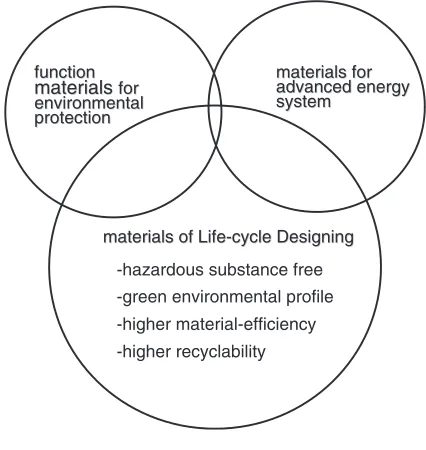
‘‘hazardous substance-free’’, ‘‘green environmental profile’’, ‘‘recyclable’’, and ‘‘high material-efficiency’’. This relation-ship is illustrated in Fig. 1.
3. Ecomaterial & Eco-efficiency
Let us consider these keywords from the viewpoint of eco-efficiency and life-cycle. Eco-eco-efficiency (EE) can be ex-pressed as
EE¼ service
life-cycle environmental burden ð1Þ
The life-cycle environmental burden is the accumulated
environmental burden through the life-cycle of a given product. The accumulated environmental burden is concep-tually illustrated in Fig. 2. When BP is the burden in production,BU the burden through usage,BE the burden of End-of-Life, and (BR) is the deduction of burden by recycling, the life-cycle environmental burden BL is ex-pressed as
BL ¼BPþBUþBEBR ð2Þ
WhileBUmainly depends on the input flow of energyf,BP,
BE,BR depend on the amount and kind of materials which compose the subjected product. Therefore, these environ-mental burdens are given as fbU, mbP, mbE,
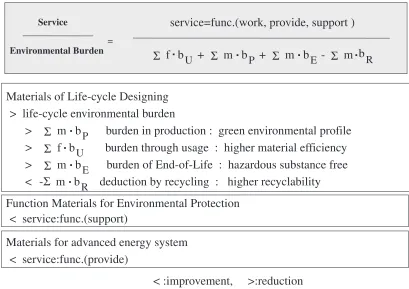
mbR, for BU,BP,BE,BR respectively, where small ‘‘b’’ means the burden associated with the unit of material as shown in Fig. 3. As the materials of life-cycle design reduce the environmental burden, contribution of ecomaterial for the environment is defined as that amount which it can reduce. Aside from the life-cycle design type, the eco-efficiency of function materials for environmental protection, and of materials for advanced energy systems are also considered. They improve the service related to support of the
environ--hazardous substance free
-higher recyclability -higher material-efficiency -green environmental profile
function
function
materials for materials for
environmental
environmental
protection
protection
materials for
materials for
advanced energy
advanced energy
system
system
materials of Life-cycle Designing
materials of Life-cycle Designing
Fig. 1 Groups of Materials for the Environment.
time of life
accumulated environmental burden production usage end of life worst case
B
BPP
B
BUU
B
BEE
-B
-BRR
(burden in production)
(burden through usage)
(burden at End-of-life)
(deduction by recycling)
Fig. 2 Accumulation of the environmental burden during the life of
[image:2.595.319.532.73.298.2] [image:2.595.309.549.332.482.2]ment and providing energy. They are summarized in Fig. 4.
3.1 Materials of green environmental profile
Material of green environmental profile are those with small environmental load from resources mining through material manufacturing, reducing the environmental burden in the production stage. Wooden materials and bio-plastics are obtained from renewable resources which create less
environmental burden than material derived from depleting minerals and fossil fuel. As soil is also naturally reproductive, soil-ceramic is another approach to renewable resources for industrial materials. Both of these case are expected to utilize the human-and-environmental-friendly structure which they have in nature to improve the item ofservice:func.(support) in formula (1).
The materials from by-products or from waste in the
usage
(service)
production
End-of-life
processing
released material
into eco-sphere
recycled material
in techno-sphere
resourceconsumption
energy consumption
consumed resource
from eco-sphere
emission
life-cycle environmental burden =
burden in production + burden through usage
+ burden of End-of-Life - deduction by recycling
m
f
m
m: transferred material flow
f: input flow in usage
Fig. 3 Simplified relation of the life-time environmental burden.
Environmental Burden =
Service
service=func.(work, provide, support )
Σ
f
.
b
U
+
Σ
m
.
b
P
+
Σ
m
.
b
E
-
Σ
m
.
Materials of Life-cycle Designing
> life-cycle environmental burden
>
Σ
m
.
b
P
burden in production : green environmental profile
>
Σ
f
.
b
U
burden through usage : higher material efficiency
>
Σ
m
.
b
E
burden of End-of-Life : hazardous substance free
< -
Σ
m
.
b
R
deduction by recycling : higher recyclability
Function Materials for Environmental Protection
< service:func.(support)
Materials for advanced energy system
< service:func.(provide)
< :improvement, >:reduction
b
R
Fig. 4 Relation of the keywords of ecomaterials and the environmental burden in each life stage. ‘‘>’’ means the reduction of
[image:3.595.96.513.78.212.2] [image:3.595.92.501.363.652.2]technological processes reduce the environmental burden. Such materials require less resources from the eco-sphere, and reduce the substances released back into the eco-sphere. Eco-cement is typical example, produced of municipal sludge or incineration ash. This eliminates the need to mine limestone and reduce landfilling of incinerated waste.
Development of a new process may also reduce the environmental burden in production. A polymer-coated steel can named TULC has been developed, enabling a dry-type forming of can to eliminate water pollution and to save energy.
3.2 Materials of Hazardous substance-free
The ecomaterial related material flow m in Fig. 3 is stands for material of hazardous substance-free, which reduces the environmental burden or energy input in the treatment needed at end of life (EoL). Hazardous substance-free material is the first priority of material selection by product manufacturers. Pb-free solder, Pb-free machining alloys, Cr-free surface treated steels, plastics with harmless fire retardant, these are typical development in this approach. For Pb-free solder, load-mapping projects of lead free solder alloys were organized in the USA, Japan and the EU, and many products with Pb-free solder have now been released in the market. Many kinds of gears and mechanical parts also contains dispersed Pb, which acts as a lubricant to enable accurate cutting. Pb-free machinable steel have been devel-oped, steel in which Pb is substituted by other elements or mechanism. The chromate layer on the surface of electro-galvalized steel sheet, which has superior characteristics of rust-resistant, creates the danger that a very small part of the chrome oxide might change into six-valent chromium ions in the process of shredding and incinerations. Therefore, steel makers have developed Cr-free pre-coated electro-galva-nized steel sheet. In order to prevent fire, plastics frequently contain flame-retarding additives, most commonly in the form of organic halogen compounds. Instead of the organic halogen silicon-based flame retardant has been developed.
3.3 Materials of higher recyclability
Higher recyclablity is the other keyword for ecomaterials in the field of industrial materials. Higher recyclability reduces the environmental burden of end-of-life treatment and the burden of production of new material. It is usually believed that the collection system or the recycling process presents the greatest problem in recycling. Recently, the DfE(design for environment) approach has focused on importance of the product design to enhance recycling. Materials-design also faces a similar problem, because almost all materials are used as some type of macro-composite, such as surface treating, addition of second element, painting, joining and so on. Thus, recyclable design is also important in the field of materials. Most traditional alloys contain many additive elements to improve their properties. The additives frequently hinder recycling. A new approach to improve recyclability is to control the properties not by adding elements but by controlling micro-structure. In the field of composite, where it is difficult to recycling by separating components, recyclability is also sought. Attempts have been made to create composites which consist of the
same composition but with a different character, and also create functionally graded composite using elements which are harmless for recycling.
3.4 Materials of higher material efficiency
Materials of higher material efficiency reduce BU in formula (2). The environmental burden BU is somewhat different from the burden of other stages. AsBUis strongly related with energy or fuel consumptionf, the usage of the product, and the effect of the reduction of the environmental burden is practically combined with the mechanical or thermal design of the product. It can be also said that the material of higher material efficiency is the material which implements product design to serve the environment. AsBU is expressed asfbU, when f is input flow of energy or fuel and bU is the environmental burden for a unit energy consumption, the reduction ofBUis achieved in two ways: by reducing bUper service and by reducing (f/service). Light-ening of the structure of movement is a typical approach of reducing (f/service). Thermal insulation of housing also reduces the energy input f while allowing comfortable living. For the reduction of bUper service, materials which can contribute to the improvement of power train system or can help realize a new static energy system such as fuel cells are expected.
4. Analysis of Current Ecomaterials in Japanese Industry
4.1 Procedure
Japanese companies with more than 5000 employees were targeted and research was conducted on them through the internet; these were examined in decreasing order of the number of their employees in each industrial group. Ecomaterials already on the market were chosen from Website homepages as well as from environmental reports of the companies, and then were classified into the six categories. In this paper, such ecomaterials as are already on the market were counted, while those materials just in the R&D process and not yet on the market were not counted. The seventy companies thus chosen were categorized into sixteen industrial groups. Two rubber, one paper and two pharmaceutical companies were made to come under the same industrial group for the sake of convenience because of the small number of the specimen. In each industrial group, average number of ecomaterials produced by a company was obtained by dividing the total numbers of the Ecomaterials in all the categories by the number of companies of the industrial group.
4.2 Results and discussion
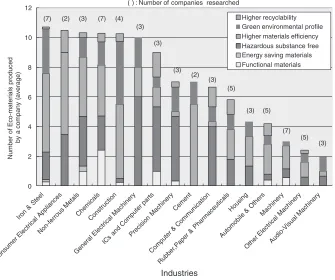
home pages. The result of the ecomaterials survey is shown in Fig. 5. Five raw materials manufacturing groups were found among the top ten industrial groups having high ‘Number of Ecomaterials produced by a company (average)’. They are Iron and steel, Non-ferrous metals, Chemicals, ICs and computer parts and Cement industries. Raw materials are very important in the discussion of ecomaterials. The characteristics of the ecomaterials of a raw materials manufacturing company are determined by the raw material it produces. The characteristics are as follows.
Iron and steel industry
Thirteen ‘‘materials of hazardous substance free’’ were produced by seven companies in the industry, namely, Pb-free materials, Chromate-Pb-free materials and chlorine-Pb-free plastics. Many ‘‘materials of higher material efficiency’’ and ‘‘materials of green environmental profile’’ were found as the result of effective R&D by many companies. As to ‘‘materials of higher recyclability’’, only one material – of stainless machine – is found in one company among the seven companies, reflecting the contention by iron and steel manufacturers that steels are already recyclable ecomaterials.
Non-ferrous metals industry
Three ‘‘materials of hazardous substance free’’ are produced in this industry, namely of non-halogen materials, Pb-free materials and chlorine-free plastics.
Chemical industry
Many ‘‘functional material for environment protection’’ are on the market by this industry and contribute to the direct
protection of the environment. Typical items are, ‘‘filter materials and catalysts for cleaning up air and water’’, ‘‘active carbon for absorbing systems’’ and ‘‘hollow fiber membrane for cleaning up water’’. The same can be said about energy saving type Ecomaterials.
ICs and computer parts industry
The industry places the most emphasis on ‘‘materials of hazardous substance free’’. ‘‘Materials of higher recyclabil-ity’’ and green environmental type Ecomaterials are mainly used in transportation of their products. It seems that higher material efficiency type materials are not featured as important products.
Cement industry
Many kinds of high materials efficiency type cement of good quality and long life have been developed. Several reuse-of-waste type ecomaterials such as blast furnace cement are on sale. However no ecomaterials of other categories could be found.
Electrical appliances, electrical machinery and precision machinery industries
As seen in the case of personal computers and printers, the marketing of hazardous free products is given a very high priority. Many higher ‘‘materials efficiency types’’ are being developed with the aim of advancing product quality. Due to the enactment of the law promoting recycling of electrical appliances in Japan, efforts are presumably focused mainly on the change of design of the combinations and connecting methods. Consequently, ‘‘materials of higher recyclability’’ 0
2 4 6 8 10 12
Iron & Steel
Consumer Electrical Appliances
Non-ferrous Metals Chemicals
Construction
General Electric al Machine
ry
ICs an d Co
mputer parts
Precisi on Machinery
Cement
Computer & Communication
Rubber,Paper & Pharma
ceuticals Housing
Automo bile &
Others Machinery
Other Electrical Machinery
Audio-Visual Machin ery
Industries
Number of
Eco-materials
produced
by a
company (average)
Higher recyclability Green environmental profile Higher materials efficiency Hazardous substance free Energy saving materials Functional materials (7) (2) (3) (7) (4)
(3)
(3)
(3)
(3) (5)
(3) (5)
(7) (5)
(3) ( ) : Number of companies researched
(2)
[image:5.595.135.470.75.355.2]are rather scare.
Construction industry
Many ‘‘materials of higher material efficiency’’ can be seen, serving to ensure the longevity of construction and structure. ‘‘Materials of green environmental profile’’ are often used to facilitate the reuse of crashed construction waste after the destruction of old and ‘out of use’ construc-tion. However the result in this area is still inadequate and more research activities are urgently needed for a solution of this very important problem.
Others
In the case of rubber, paper and pharmaceutical compa-nies, the ecomaterials pattern was similar to that of raw materials manufacturing companies. Housing, automobile and others, and machinery companies have not so many ecomaterials. Considering the large influence on the earth environment of these industries, a great deal of research is required in these fields.
Total
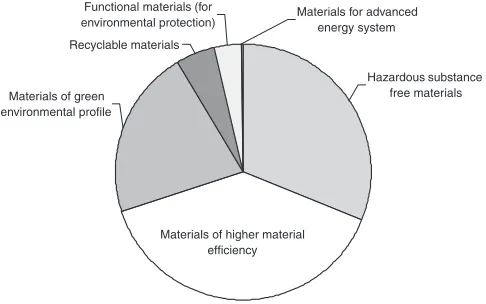
The total results are shown in Fig. 6. Both of ‘‘materials of hazardous substance-free’’ and ‘‘materials of higher material efficiency’’ were predominant with about 30%. Next in line are ‘‘materials of green environmental profile’’ at about 20%. ‘‘Material of higher recyclability’’ composed about 10%. This can be said to be a proportion which is less than the expectation, considering the shift to recycling-based society in Japan. ‘‘Function materials for environmental protection’’ and ‘‘materials for advanced energy systems’’ gave lower proportion. In the case of these materials, there are many things used in assembly as parts in plants and processes, and it seems to be difficult to introduce these materials to the general public by the medium for a Website home page, the object of this investigation. On the other hand, it is noticeable that several percentages were occupied by ‘‘function materi-als for environmental protection’’ in advertisements on the Website home pages. This means the environmental protec-tion is already no longer confined to any special plants or
equipments, but rather is connected with products daily used by consumers. And, that smaller share of ‘‘recyclable material’’, contrary to expectation, means that the tendency that the present cycloid type is entirely advanced, and the change of the selection between existing materials in the design is dominant.
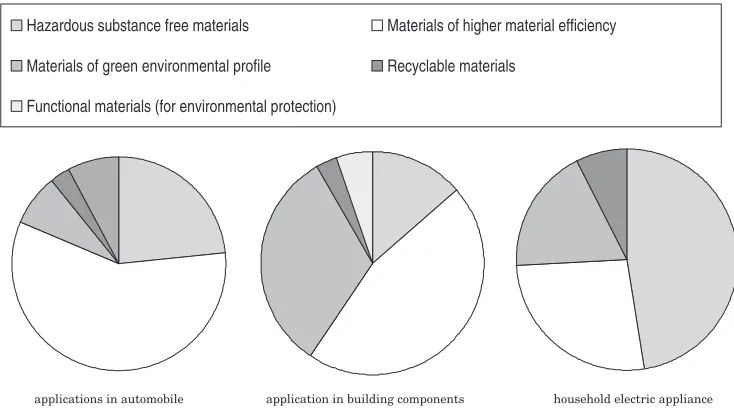
Figure 7 shows each tendency of applications in auto-mobiles, household electric appliances, and application in building components. In the automobile, ‘‘materials of higher material efficiency’’, connected with improvement in fuel consumption, occupied well over half. In other hand, in home electric appliance applications, ‘‘materials of hazardous substance-free’’ came in at approximately half. This result on home electric appliances seems to be correspond to the process of the disposal brought about by the consumers. In the applications of building, there were many ‘‘materials of higher material efficiency’’ (as well as the automobiles) in order to reduce the energy charge in thermal control such as through thermal insulation and cooling. And, ‘‘materials of green environmental profile’’ also showed large value in housing, about 30% and other application field shows large use the material. These show that the ecomaterials are distributed in accordance with features proper to the given field to use.
Overall, ‘‘materials of life-cycle design’’ made up 96%, when observed in three large classifications of ‘‘materials of life-cycle design’’, ‘‘functional materials for environment protection’’ and ‘‘materials of advanced energy systems’’. This does not mean that ‘‘functional materials for environ-ment protection’’ and ‘‘materials of advanced energy sys-tems’’ are not developed. It was difficult to untangle the development of ‘‘functional materials for environment protection’’ and ‘‘materials of advanced energy systems’’ for extraction from the home page, as these categories would offer information to the designer who was more technical than the general consumer. However, ‘‘materials of life-cycle design’’ can be said to be surely fixed as an environment performance for the general consumer. It will be required that it is expressed in the form in which ‘‘functional materials for environment protection’’ and ‘‘materials of advanced energy systems’’ need to also be more comprehensible to the consumer in future. Some examples are purification of the environment regarding expectation and life to the fuel cell, etc. It can be expected that the role and appeal of ‘‘functional materials for environment protection’’ and ‘‘materials of advanced energy systems’’ to the consumer will directly increases, with environmentally-friendly energy devices advancing steadily. As they belong to the group of improving ‘‘service’’ in the eco-efficiency considerations, we will be judged to reach a new status of development and dissemina-tion of ecomaterials if ‘‘funcdissemina-tional materials for environment protection’’ and ‘‘materials of advanced energy systems’’ will be appealed in products for consumers.
5. Conclusion
Ecomaterial was categorized by considering its life-cycle and eco-efficiency, and counted from companies Website home pages and the environmental report books of the enterprise. This was done to check how ecomaterials are Recyclable materials
Functional materials (for environmental protection)
Materials of higher material efficiency
Hazardous substance free materials Materials of green
environmental profile
Materials for advanced energy system
Fig. 6 Share of each type of ecomaterials published in environmental
[image:6.595.48.291.607.759.2]distributed in the market in Japan. ‘‘Materials of life-cycle design’’ are expanding in respect to replacing material now used with that with lower environmental burdens through life-cycle enhancement. Especially the ratio of ‘‘materials of higher material efficiency’’ and ‘‘materials of hazardous substance-free’’ is high. ‘‘Materials of higher recyclability’’ have not so remarkable appeal for consumers contrary to expectation. It seems that there are many cases which give recyclability to a product not through material technology, but by its design in the current status. Future development is desired in ‘‘functional materials for environment protection’’ and ‘‘materials of advanced energy systems’’ without being yet extensible directly to the user.
REFERENCES
1) K. Halada and R. Yamamoto: Bull. Japan Inst. Metals31(1992) 505–
511 [in Japanese].
2) K. Halada and R. Yamamoto: MRS Bulletin26(2001) 871–879.
3) World Resource Institute:Resource Flows, (Washington D.C., 1977).
4) K. Halada, K. Ijima, N. Katagiri and M. Ohkura: J. Japan Inst. Metals
65(2001) 564–570 [in Japanese].
5) K. Halada: Energy and Resources23(2002) 21–26 [in Japanese].
6) Nippon Steel:Nippon Steel Environmental report 2001, (2001).
7) NKK:2001 Environmental Report(2001).
8) Kawasaki Steel Corp.:Environmental report 2001, (2001).
9) Sumitomo Metals:Environmental report 2001, (2001).
10) Kobe Steel:Environmental Report 2001, (2001).
11) Nisshin Steel:Environmental report 2000, (2001).
12) Hitachi Metals, Ltd.:Environmental Report 2001, (2001).
13) Furukawa Electric:Environmental Report 2001, (2001).
14) Mitsubishi Materials:2000 Environmental Report, (2001).
15) Taiheiyo Cement:Environmental Report 2001, (2001).
16) Mitsubishi Chemical Corp.: Responsible Care Activities Report-RC
Report FY2001, (2001).
17) Asahi KASEI Co. Ltd.: Responsible Care Report: Environmental
Preservation, Product Safety, Operational Safety and Health 2001 Edition, (2001).
18) Teijin Co., Ltd.: Environment, Safety and Health: 2001 TEIJIN
GROUP Report on the Environment, Safety and Health (Record for Fiscal 2000), (2001).
19) Mitsubishi Heavy Industries, Ltd.: 2001 Environmenntal Report,
(2001).
20) Komatsu, Ltd.:KOMATSU Environmental Activities 2001, (2001).
21) Kubota Corp.:Environmental Report 2001, (2001).
22) Koyo Seiko Co.:Environmental Report 2001, (2001).
23) NSK Ltd.:Environmental Report 2001, (2001).
24) Canon Ltd.:Canon Environmental Report 2001, (2001).
25) Olympus Optical Co., Ltd.:Environmental Report 2001, (2001).
26) Seiko Epson Ltd.:Seiko Epson 2001 Environmental Report, (2001).
27) Toyota Motor Corp.:2001 Environmental Report, (2001).
28) Nissan Motors Ltd.:NISSAN Environmental and Social Report 2001,
(2001).
29) Honda Motors Ltd.: Honda Environmental Annual Report 2001,
(2001).
30) AISIN SEIKI Co., Ltd.:Environmental report 2001, (2001).
31) Fuji Heavy Industries Ltd.:2001 Environmental Report, (2001).
32) Kyocera Corp.:2001 Environmental Report, (2001).
33) Toppan Printing Co., Ltd.:Toppan Environmental Report 2001, (2001).
34) TDK Corp.:TDK’s Environmental Report 2001, (2001).
35) Hitachi Group:Hitachi Group Environment report 2001, (2001).
36) Toshiba Corp.:Toshiba Environmental Report 2001, (2001).
37) Mitsubishi Electric Co.,Ltd.: Environmental Sustainability Report
2001, (2001).
38) Ricoh Co., Ltd.:Ricoh Group Sustainability Report 2001, (2001).
39) Omron Corp.:Environmental Report 2001, (2001).
40) Yokogawa Electric Corp.: Yokogawa Group Environmental Report
2001, (2001).
41) Fuji Zerox Co., Ltd.:Environmental Report 2001, (2001).
42) Matsushita Electric Group:Environmental Sustainability Report 2001,
(2001).
43) Sharp Corp.:SHARPS Environmental Report 2001, (2001).
44) Pioneer Corp.:Environmental Report 2001, (2001).
45) Fujitsu Ltd.:2001 Environmental Report, (2001).
46) NEC Corp.:Annual Environmental Report 2001, (2001).
47) TERUMO Corp.:TERUMO Environmental Report 2001, (2001).
48) Victor Company of Japan, Ltd.: Environmental Report 2001
[in Japanese], (2001).
49) Yamaha Corp.:Environmental data sheet 2001[in Japanese], (2001).
50) Hitachi Cable Ltd.:Environmental Report 2001[in Japanese], (2001).
51) Sumitomo Osaka Cement:Environmental Report 2001[in Japanese],
(2001).
52) Ube Group:Responsible Care Report 2001, The UBE Group Working
for the Environment, Safety and Health, (2001) [in Japanese].
53) Mitsubishi Rayon: Environmental and Safety Report 2001
[in Japanese], (2001).
54) Bridgestone Co., Ltd.: Environmental Report 2001 [in Japanese],
(2001).
55) Yokohama Rubber:Environmental Report 2001[in Japanese], (2001).
56) Oji Paper Co., Ltd.:Environmental Report 2001[in Japanese], (2001).
57) Sankyo Co., Ltd.:Environmental Report 2001[in Japanese], (2001).
Hazardous substance free materials Materials of higher material efficiency
Materials of green environmental profile Recyclable materials
Functional materials (for environmental protection)
applications in automobile application in building components household electric appliance
[image:7.595.113.480.72.278.2]