in determination of the development strategy of regions, it is necessary to stem from the knowledge of development trends of human resources. Analyses of the region’s demographic development represent an important basis for solution of the problems in eco-nomic and social area. Ecoeco-nomic and social changes which take place since the beginning of 90’s in the czech republic bring changes of the style of life and it reflects also in the demographical development (Pělucha et al. 2006). The marriage rate decreases, the age limit for parenting shifts, the birth-rate is lower and thereby also the age structure of inhabit-ants worsens and the population grows older. From the view-point of territorial structure, especially young people move to towns and the countryside depopulates. These trends are not specific for the czech republic, similar problems are solved by also other countries of the European Union and big at-tention is paid to them of right in the frame of the EU. in the area of the policy of rural development,
the main aim is to prevent displacing of rural areas, modulation of poverty, support of employment and equal opportunities and the improvement of work and life conditions of rural population (new regional policies 2002).
Aims And methodology
The paper which stems from solution of the research intention of the FEM deals with some unfavorable aspects of demographic development in rural space of the czech republic where mainly in small munici-palities there is an efflux of inhabitants in produc-tive age; fast aging of the population which leads to gradual depopulation. Then this fact leads to other unfavourable changes – a decrease of entrepreneurial activities, a reduction of investment, a decrease of social services, worsening of the total infrastructure, increase of unemployment in a given area and thereby
human resources development in rural areas
of the Czech Republic
Vývoj lidských zdrojů ve venkovském prostoru ČR
L. Svatošová
Czech University of Life Sciences, Prague Czech Republic
Abstract: regional development strategy has to be designed with knowledge of human resources’ development trends. Monitoring of this factor is of concern namely in rural areas where disfavourable demographic situation may occur. Leaving this problem unsolved would constitute depopulation of certain endangered regions. The paper is focused on analysis of human resources’ condition and development granding groups of settlements by size.
Key words: regional policy, human resources, statistical analyses
Abstrakt: Při stanovení rozvojové strategie regionů je nutno vycházet ze znalosti vývojových trendů lidských zdrojů. Sledování vývoje tohoto faktoru má zejména význam ve venkovském prostoru, kde v některých oblastech může docházet k nepříznivě demografické situaci. Pokud by tento problém nebyl odpovídajícím způsobem řešen, může vést až postupné-mu vylidňování takto ohrožených oblastí. Příspěvek je zaměřen na analýzu stavu a vývoje lidských zdrojů ve venkovském prostoru Čr s ohledem na velikostní skupiny obcí.
Klíčová slova: regionální politika, lidské zdroje, statistické analýzy
again to efflux of inhabitants in production age. The remedies for which demographical analyses are a basis should be realized immediately; depopulation of this way endangered area used to be usually an irreversible process or very hardly retrievable in the long time horizon (hrabánková et al. 2006).
An analysis stems from comparison of the age struc-ture, natural addition, migration and equipment of the particular size groups of municipalities in the cr regions. The aim is regional comparison and determination of the most endangered areas.
Results And disCussion
share of inhabitants according to size groups of municipalities in the CR regions
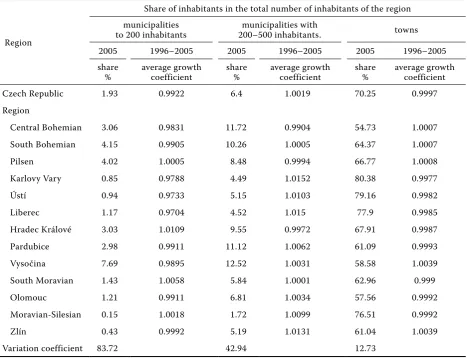
The share of inhabitants living in municipalities to 200 people has a very high variability; from the view-point of development tendencies, there is a light decrease in all regions, respectively stagnation. At the republic average, it is dealt with almost 2%
of inhabitants, regional differences are relatively significant. The highest share of inhabitants living in municipalities to 200 inhabitants is in the region Vysočina – 7.69%, in the region South-Bohemia and Pilsen this share is of about 4%. A very low share of inhabitants in small municipalities (under 1%) is in the regions Karlovy Vary, Ústí, zlín and Moravian-Silesian. A slightly higher share of inhabitants living in municipalities from 200 to 500 inhabitants – a share above 10% – is shown by regions central Bohemia, South Bohemia, Pardubice and Vysočina, a very low share in the region Moravian-Silesian (Table 1).
Age structure according to size groups of municipalities
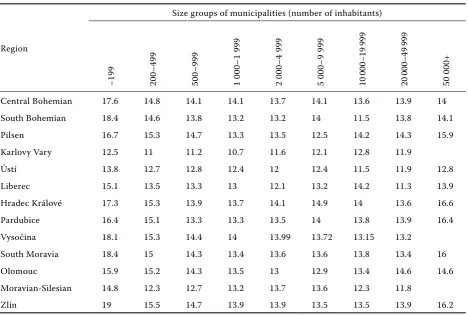
[image:2.595.65.533.407.765.2]if we monitor the age structure of population in segmentation according to size groups of municipali-ties, there are quite evident general trends – a higher share of inhabitants in postproduction age in small municipalities and large towns above 5 000 inhabit-ants (Table 2).
Table 1. Share of inhabitants living in selected size groups of municipalities and its development
region
Share of inhabitants in the total number of inhabitants of the region municipalities
to 200 inhabitants 200–500 inhabitants.municipalities with towns
2005 1996–2005 2005 1996–2005 2005 1996–2005
share
% average growth coefficient share % average growth coefficient share % average growth coefficient
czech republic 1.93 0.9922 6.4 1.0019 70.25 0.9997
region
central Bohemian 3.06 0.9831 11.72 0.9904 54.73 1.0007
South Bohemian 4.15 0.9905 10.26 1.0005 64.37 1.0007
Pilsen 4.02 1.0005 8.48 0.9994 66.77 1.0008
Karlovy Vary 0.85 0.9788 4.49 1.0152 80.38 0.9977
Ústí 0.94 0.9733 5.15 1.0103 79.16 0.9982
Liberec 1.17 0.9704 4.52 1.015 77.9 0.9985
hradec Králové 3.03 1.0109 9.55 0.9972 67.91 0.9987
Pardubice 2.98 0.9911 11.12 1.0062 61.09 0.9993
Vysočina 7.69 0.9895 12.52 1.0031 58.58 1.0039
South Moravian 1.43 1.0058 5.84 1.0001 62.96 0.999
olomouc 1.21 0.9911 6.81 1.0034 57.56 0.9992
Moravian-Silesian 0.15 1.0018 1.72 1.0099 76.51 0.9992
zlín 0.43 0.9992 5.19 1.0131 61.04 1.0039
The share of inhabitants in productive age develops completely to the contrary; in small municipalities this share is lower than in bigger villages and towns. The difference is in average 2–3 percent points. in town population the situation is different in towns with more than 50 000 inhabitants. These towns have a higher share of inhabitants both in produc-tive age and in post-producproduc-tive age. Present trends in life style and especially on market with flats show themselves. in purchase of new apartment, the price of apartment is higher in towns and for young fami-lies it is more advantageous to buy living in villages near towns. Towns remain a seat of inhabitants with already secured living (contracts of lease, coopera-tive apartment, private ownership), further a seat of inhabitants of middle age for whom a higher price of apartment is not an obstruction, and inhabitants of older age groups who already do not want to change their style of life (Table 3).
increases of inhabitants according to size groups of municipalities
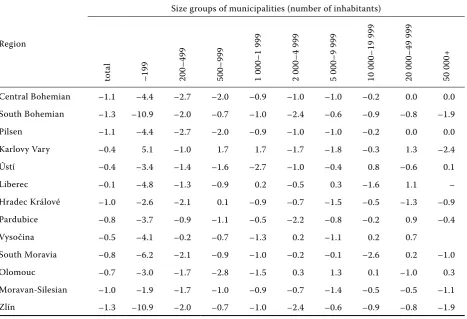
Tipical tendencies of demographical development show themselves also in values of the natural increase of inhabitants. The natural increase of inhabitants is
expressed as a difference of the number of born and the number of departees in the given year. Although from the view-point of the long-term development a more favourable situation happens in recent years when the number of born people grows, still the natural increase is negative in all cr regions. A worse situation is in the regions of central Bohemia, South Bohemia, Pilsen and zlín; it develops the most favourably in the regions Karlovy Vary, Ústí and Liberec. if we monitor the natural increase ac-cording to size groups of municipalities (Table 4), practically in all regions there are significant differ-ences in size of increases in municipalities to 200 inhabitants. The factor of population aging shows itself here very significantly. The worst situation in this direction is recorded in the regions South Bohemian and zlín.
[image:3.595.64.533.453.768.2]The present situation of housing, labour market and services in the given region reflects in the mi-gration of inhabitants which we monitor by means of the increase by moving (moved-in – moved-out in the given year). generally there is an efflux of inhabitants from large towns; increases are recorded in smaller towns and villages near towns. The high-est positive increases by moving shows the region central Bohemia and the highest negative increases the region olomouc.
Table 2. The share of inhabitants of age above 65 years according to size groups of municipalities – in 2005
region
Size groups of municipalities (number of inhabitants)
–1
99
20
0–
49
9
50
0–
99
9
1
00
0–
1
99
9
2
00
0–
4
99
9
5
00
0–
9
99
9
10
00
0–
19
99
9
20
00
0–
49
99
9
50
0
00
+
central Bohemian 17.6 14.8 14.1 14.1 13.7 14.1 13.6 13.9 14
South Bohemian 18.4 14.6 13.8 13.2 13.2 14 11.5 13.8 14.1
Pilsen 16.7 15.3 14.7 13.3 13.5 12.5 14.2 14.3 15.9
Karlovy Vary 12.5 11 11.2 10.7 11.6 12.1 12.8 11.9
Ústí 13.8 12.7 12.8 12.4 12 12.4 11.5 11.9 12.8
Liberec 15.1 13.5 13.3 13 12.1 13.2 14.2 11.3 13.9
hradec Králové 17.3 15.3 13.9 13.7 14.1 14.9 14 13.6 16.6
Pardubice 16.4 15.1 13.3 13.3 13.5 14 13.8 13.9 16.4
Vysočina 18.1 15.3 14.4 14 13.99 13.72 13.15 13.2
South Moravia 18.4 15 14.3 13.4 13.6 13.6 13.8 13.4 16
olomouc 15.9 15.2 14.3 13.5 13 12.9 13.4 14.6 14.6
Moravian-Silesian 14.8 12.3 12.7 13.2 13.7 13.6 12.3 11.8
Table 4. natural increase per 1 000 inhabitants according to size groups of municipalities – in 2005
region
Size groups of municipalities (number of inhabitants)
to ta l –1 99 20 0– 49 9 50 0– 99 9 1 00 0– 1 99 9 2 00 0– 4 99 9 5 00 0– 9 99 9 10 0 00 –1 9 99 9 20 0 00 –4 9 99 9 50 0 00 +
central Bohemian –1.1 –4.4 –2.7 –2.0 –0.9 –1.0 –1.0 –0.2 0.0 0.0
South Bohemian –1.3 –10.9 –2.0 –0.7 –1.0 –2.4 –0.6 –0.9 –0.8 –1.9
Pilsen –1.1 –4.4 –2.7 –2.0 –0.9 –1.0 –1.0 –0.2 0.0 0.0
Karlovy Vary –0.4 5.1 –1.0 1.7 1.7 –1.7 –1.8 –0.3 1.3 –2.4
Ústí –0.4 –3.4 –1.4 –1.6 –2.7 –1.0 –0.4 0.8 –0.6 0.1
Liberec –0.1 –4.8 –1.3 –0.9 0.2 –0.5 0.3 –1.6 1.1 –
hradec Králové –1.0 –2.6 –2.1 0.1 –0.9 –0.7 –1.5 –0.5 –1.3 –0.9
Pardubice –0.8 –3.7 –0.9 –1.1 –0.5 –2.2 –0.8 –0.2 0.9 –0.4
Vysočina –0.5 –4.1 –0.2 –0.7 –1.3 0.2 –1.1 0.2 0.7
South Moravia –0.8 –6.2 –2.1 –0.9 –1.0 –0.2 –0.1 –2.6 0.2 –1.0
olomouc –0.7 –3.0 –1.7 –2.8 –1.5 0.3 1.3 0.1 –1.0 0.3
Moravan-Silesian –1.0 –1.9 –1.7 –1.0 –0.9 –0.7 –1.4 –0.5 –0.5 –1.1
[image:4.595.65.533.451.770.2]zlín –1.3 –10.9 –2.0 –0.7 –1.0 –2.4 –0.6 –0.9 –0.8 –1.9
Table 3. Share of inhabitants in production age (15–64 years) according to size groups of municipalities
region
Size groups of municipalities (number of inhabitants)
–1 99 20 0– 49 9 50 0– 99 9 1 00 0– 1 99 9 2 00 0– 4 99 9 5 00 0– 9 99 9 10 0 00 –1 9 99 9 20 0 00 –4 9 99 9 50 0 00 +
central Bohemian 68.3 70 70.6 70 70.8 70.4 71.8 71.8 71.4
South Bohemian 68 69.8 70.3 70.7 71 70.6 72.6 71.2 71.9
Pilsen 69.4 69.9 70.1 70.8 70.9 71.7 71.2 71.6 71
Karlovy Vary 71.8 73.4 71.8 71.3 71.6 71.8 72.4 71.9
Ústí 71.8 71.9 71.3 71.5 71.1 71.2 72.3 71.9 71.8
Liberec 70.5 71.1 70.6 70.6 70.8 71 70.9 72.8
hradec Králové 71.6 68.2 69 70.2 70.4 70 69.8 70.9 71.4
Pardubice 68.7 68.9 70.1 70.2 69.9 70.3 70.5 70.5 70.2
Vysočina 66.7 67.9 70 69.7 69.5 70.8 70.6 71.9
South Moravia 67 69 69.9 70.5 71 71.2 71.7 72.3 70.6
olomouc 69.5 69 69.7 70.6 71.1 71.5 71.5 71.4 71.5
Moravian-Silesian 69.8 70.8 71.1 71 70.8 70.8 71.3 72.3
municipality amenities
The improvement or maintenance of the demo-graphical situation of particular parts of region is subject to security of good life and work conditions in the area, respective in municipalities. At first it means to secure jobs in all parts of the region – es-pecially by support of small and middle enterprise in municipalities, by support of development of farmer activities. Further, these efforts have to be complemented with strive for the development or at least maintenance of the existing infrastructure of given areas. if the region interests in the preven-tion of displacement from endangered areas and vice versa in bringing new inhabitants in these areas, it is necessary to build an infrastructure of the given area, so that from view-point of quality of life the area would become accessible or even attractive for inhabitants.
As one of the important factors of development of municipalities and security of municipality ameni-ties we consider fitting with an elementary school and an office of the doctor (general practitioner). in municipalities to 200 inhabitants, in vast majority of regions 1–2% municipalities have an elementary school. in the regions Ústí, olomouc and zlín, none of villages of this size have an elementary school. A higher share was recorded in the Moravian-Silesian region (7%), the South Moravian region (3%) and the region Karlovy Vary (5%). A worse situation is in fit-ting with an office of the doctor. no municipality in Karlovy Vary, Liberec, olomouc, Moravian-Silesian and zlín regions has an office of the doctor; in other regions, it is dealt with 1–3% of municipalities. An exception is the region Ústí where a basic medical care is secured in 11% of small municipalities.
An elementary school is in 10–20% of municipali-ties with 200–500 inhabitants in most regions; more than 20% of municipalities fitted with an elementary school are in the regions Vysočina (28%), Liberec (27%) and hradec Králové. offices of the general practitioner are represented here in lower extent – the worst situation is in the region Vysočina (6%); the highest share is shown by the region zlín (24%). in other regions, this share makes about 16%.
in municipalities with 500–1000 inhabitants, most regions have an elementary school in 70% of mu-nicipalities; the better amenities are in the regions Vysočina (93%), Pardubice (82%) and Liberec (81%). The worst situation is in the region hradec Králové (45%) and Ústí (55%). The share of municipalities fit-ted with an office of the general practitioner shows a higher variability – the region Pardubice has an office of the general practitioner only in 26% of
municipali-ties, by contrast the region hradec Králové in 84% of municipalities.
Large regional differences are in municipalities to 200 inhabitants in fitting with a water supply and a sewer system with sewage works and the gas supply. in the regions central Bohemia and Pilsen, the share of municipalities fitted with the water supply is lower than 50%. in the regions Ústí and Liberec, this share makes more than 90%. The share of municipalities with the sewer system with a connection to sewage works does not reach 10% in most of municipalities; in the region zlín even no municipality has it. An exception are the regions Karlovy Vary (20%), Ústí (19%) and olomouc (22%). As regards the gas supply in these municipalities, than the regions South Moravia, olomouc and zlín have the gas supply in more than 70% of municipali-ties; the region Liberec only in 3% of municipalities. A low gas supply is also in small municipalities in the region South Bohemia (11%) and the region central Bohemia (16%).
ConClusion
if we compare the total situation in small mu-nicipalities in cr regions, then the most favourable situation according to the age structure of population and municipality amenities is in the regions Karlovy Vary and Ústí which belong to the regions with the lowest share of inhabitants living in small villages. A similar situation is also in the Moravian-Silesian region. From regions where the share of inhabitants living in small villages is higher, a relatively good state of age structure and amenities is in the region Pardubice, South Moravia and Pilsen. Vice versa in regions with traditionally higher share of inhabitants living in small villages, as it is the region Vysočina and South Bohemia it is possible to talk of the jeopardy of settlement of rural areas. in small municipali-ties, there is a high share of elderly inhabitants and amenities are at a very low level. A similar situation is in the region zlín where the share of inhabitants living in small villages is one of the lowest and at the same time there is an unsatisfactory age struc-ture of inhabitants and lower amenities. The risk of displacement from these areas is high and it would be necessary to find the ways to reform this state as soon as possible.
regional development observation). Monography, České Budějovice; iSBn 80-7040-835-9.
nová regionální politika (new regional policies) (2002). Ministry for Local Development of the cr, Prague; iSBn 80-903064-1-1.
Pělucha M. et al. (2006): rozvoj venkova v programo-vém období 2007–2013 v kontextu reforem SzP EU (countryside development in the 2007–2013 pro-gramme period in connection to EUcAP reform). institute for Structural Policy, irEAS, Prague; iSBn 80-86684-42-3.
Arrived on 9th January 2008
steps should be made as soon as possible so that the risks of displacement of rural areas would be mini-mized and so that the traditional rural settlement would stay preserved.
RefeRenCes
hrabánková M., Svatošová L., Boháčková i. (2006): Vybrané diagnostické metody pro sledování regi-onálního rozvoje (Selected diagnostic methods for
Contact address:
Libuše Svatošová, czech University of Life Science in Prague, Kamýcká 129, 165 21 Prague 6-Suchdol, czech republic