INTRODUCTION
Recently, requirements concerning contamination of groceries and food due to the use of unsuitable work-ing equipment are growwork-ing and become important in all branches of food processing. The meat industry is one of those sectors of national economy where the observance of all hygienic principles during the production and distribution is really essential.
In the Czech Republic, the meat industry is the second largest economic branch of food processing industry. According to the structure of revenues (Tab-le 1), the meat industry occupies the second place, just after the production of other food products; the production of beverages is in the third place. These three branches show the highest intensity of growth in sales of their own products and services. In 2000, the total share of these three branches in the revenues of
food processing industry was 64.57% and increased to 67.49% in 2003. In the meat industry, this increase can be explained on the base of an expanding offer of a very wide assortment of innovated meat products as well as a better marketing.
Besides several big companies, there are many small and medium businesses in the meat processing industry, which only hardly resist the strong com-petition. The position and importance of the meat industry within the framework of national economy can be defined as follows (Krčová 2000):
– It is directly linked with the primary agricultural production so that it represents the second level of the vertical line, which converts the raw material of animal origin to food.
– It preserves and processes animals to meat and meat products so that it creates preconditions for the nourishment of people.
Categorization of work equipment used
in the meat industry
Kategorizace pracovních prostředků používaných
v masném průmyslu
R. PRESOVÁ, O. TVRDOŇ
Mendel University of Agriculture and Forestry, Brno, Czech Republic
Abstract: This paper deals with the meat industry in the Czech Republic, the equipment which is used for meat cutting and processing for sale and for production of smoked goods. It determines individual categories of this equipment according to the use and describes materials used for manufacturing of clothing of butchers and also the complementary tools impro-ving labour safety during technology operations. Next it presents materials used for making metal tools and describes the situation in the market of butcher´s equipment in the Czech Republic.
Key words: meat industry, branches of national economy, categories, tools, working clothes, protective instruments, mar-ket, productions, complementary tools
Abstrakt: Příspěvek pojednává o postavení masného průmyslu v ČR, potřebách v masném průmyslu, používaných pracov-níky při bourání a zpracování masa pro jateční účely a pro uzenářské výrobky. Vymezuje kategorii řeznických potřeb podle účelu a druhu použití. Přibližuje materiály z nichž je vyroben oděv řezníků a doplňkové předměty pro bezpečnou práci v technologických postupech. Dále uvádí materiály používané pro výrobu kovových předmětů jako nezbytných nástrojů jednotlivých pracovních operací. Seznamuje se situací na trhu s řeznickými potřebami v ČR.
Klíčová slova: masný průmysl, odvětví národního hospodářství, kategorie, předměty, pracovní oděv, ochranné pomůcky, trh, výroba, podnikatelské subjekty, doplňkové nástroje
– It processes animal carcasses and thus increases the value of final produce.
The processing of slaughter animals to meat prod-ucts is a technologically very complicated activity, which dynamically develops from year to year. High
[image:2.595.65.531.177.748.2]requirements and sophistication of work result from the nature of meat and from its structure because it is highly susceptible to microbial contamination; other reasons are also the expenses, which must be spent in association with purchasing of livestock and other necessary inputs used in the meat processing
Table 1. Revenues from sales of products and service in years 2000–2003
Group of products
Revenues
Difference 2003–2000 mill. CZK
Index 2003/ 2000
(%)
2000 2001 2002 2003
mill. CZK (current
prices) %
mill. CZK (current
prices) %
mill. CZK (current
prices) %
mill. CZK (current
prices) % 15.1 Production,
processing and conservation of meat and meat products
50 155.60 20.94 56 084.10 21.72 58 794.60 22.40 59 387.80 23.55 9 232.20 118.41
15.2 Processing and conservation of fish and fish products
1 856.40 0.77 2 163.70 0.84 1 886.40 0.72 1 812.90 0.72 –43.50 97.66
15.3 Processing and conservation of fruit, vegetables and pulses
7 203.50 3.01 5 956.70 2.31 6 704.30 2.55 5 692.60 2.26 –1 510.90 79.03
15.4 Production of vegetable and animal fats and oils
11 471.10 4.79 12 556.50 4.86 12 213.20 4.65 11 597.80 4.60 126.70 101.10
15.5 Processing of milk, production of dairy products and ice creams
37 900.60 15.82 39 508.80 15.30 39 106.00 14.90 37 202.40 14.75 -698.20 98.16
15.6 Production of flour-milling and
starch products 8 030.80 3.35 8 823.20 3.42 7 291.10 2.78 7 123.90 2.82 -906.90 88.71 15.7 Production
of feedstuff 18 404.30 7.68 22 869.50 8.86 20 862.90 7.95 18 566.80 7.36 162.50 100.88 15.8 Production
of other food
products 56 589.90 23.62 57 829.90 22.39 61 757.30 23.53 59 389.90 23.55 2 800.00 104.95 15.9 Production
of beverages 47 937.40 20.01 52 450.40 20.31 53 864.90 20.52 51 420.50 20.39 3 483.10 107.27 15. Production
of food and
industry. All these factors force us to strive for the maximum yields of meat and meat products not only in the meat industry but also in the food industry and gastronomy (Ingr 2004).
The advances in chemical industry contributed to increase in the quality of processing meat to butcher’s products and smoked goods. And another change was that at the same time meat as a raw material was partially substituted by some new substitutes and ad-ditives. It is rather difficult to master qualitatively the different technological procedures in meat industry and for that reason, it is also important to improve not only technological problems but also to invest into the modern laboratory equipment that enables a systematic checking and control of quality of pro-duced foodstuffs (Kadlec 2002, 2004).
MATERIAL AND METHODS
Tools, overalls and other protective working equip-ment represent the necessary equipequip-ment for people working in the slaughterhouses, meat processing facilities and other operations of the meat industry. These aids also help to protect meat and meat products against the bacterial contamination. This category of working aids and means is very wide and involves all things that are used by workers in the individual working operations and situations, e.g. knives, hangs and hooks for hanging meat, sharpening steel, meat choppers, meat saws, holders of price labels etc. This category involves also all types of machinery, especially those parts of these machines, which come in contact with the meat and different containers, dishes, roast plates utensils and others aids.
The current trend is oriented at a more and more intensive protection of hygienic quality and safety of food. The consumers should be protected against the microbial contamination and for that reason, the requirements concerning hygiene of individual ope-ra-tions are increasing not only in the meat industry but also in catering facilities and similar establishments.
The objective of this paper is to describe the cate-gorization of tools and things used in the meat in-dustry and to discuss the importance of requirements placed on these working and protective means, tools and clothing. The methodology stems from this ob-jective. The authors use methods of identification, comparison and synthesis of data as a pre-requisition of the final drawing of conclusions, which are pre-sented in this paper. Data published by the Research
Board of the State Health Institute Brno, the Czech Statistical Office in Prague and the concrete infor-mation obtained in the Kučera Meat Processing Co. were used as a base for this analysis. Important data were obtained also on web pages of several Czech meat processing companies.
THE OBJECT CATEGORIZATION
The butchery is a profession, which requires the corresponding qualification, dexterity, skill and physi-cal ability to manage all the operations concerning meat and meat processing in slaughterhouses and butcher´s shops. The butcher is either a person who processes and sells meat in a butcher’s shop or a person who chops and processes it in an industrial way in the slaughterhouse. Nowadays, this is mostly the occupation of men because it is a very hard and physically demanding activity. If there are any women working in this profession, they usually perform only the final treatment of meat because the weight of carcass halves and quarters highly exceeds the allowed limit of manipulating weight for women (15 kilograms).
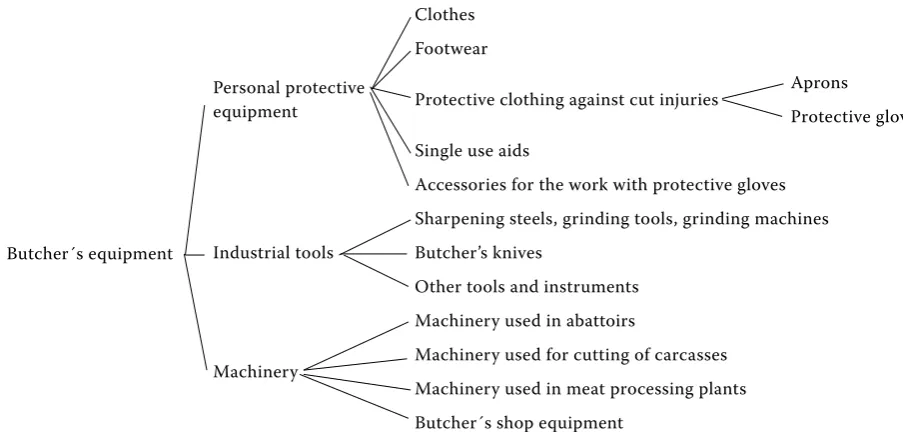
The butcher tools represent a highly specialized as-sortment of commercial goods. As compared with the assortments of other types of consumer’s, industrial and textile goods, there are not many producers and distributors of these products and for that reason they are mostly imported (Langmaier 2002). Individual categories of tools used in the meat industry are pre-sented in Figure 1.
Personal protective aids
Each employee who works in food processing indus-try must be adequately equipped with all necessary work-clothing and tools needed to accomplish his/her work. The basic categories are clothes, footwear, protective anti-cut instruments, knives, baskets for knives, sharpening steel and other things. These aids are generally called products for the work with meat and meat products.
Butcher’s clothing
The work-clothing and accessories must meet hygi-enic requirements and conditions concerning products that come into contact with foodstuffs1 on the one
1 Directive ES 2002/99 determining veterinary requirements for production, processing and distribution of animal
hand and satisfy criteria of labour safety on the other. Hygienic regulations determinate the principles of handling with foodstuffs and concern above all work clothing. The standard work-clothing is of white colour and should be made of 100% cotton or a combination of cotton, viscose and thermofibres. The priorities are also a nice look and easy cleaning. In some plants, the workers must use the thermo wear because of very low temperatures. In such facilities, butchers wear thermo jackets, blouses and trousers.
Protective aprons
Butchers slaughtering animals and processing animal carcasses use two different types of rubberized aprons. The first one is made of rubber and its mechanical resistance is low. The second type is also made of rubber but its resistance is higher. The workers use these aprons as a fundamental protection against water and blood when washing cadavers of slaugh-tered animals. These operations do not require highly resistant aprons. For operations requiring a higher degree of protection, the aprons are made of strong polymerized material which is rubberized either on one or on both sides.
Footwear
Shoes used in slaughterhouses and chopping facili-ties must meet the requirements defined in standards
of labour safety2. In slaughterhouse facilities people
wear most frequently high leg boots (wellingtons). In boning rooms, the workers use heavy duty boots without shoelaces and/or polyethylene shoes. The use of shoelaces is not allowed because they can be easilly contaminated. These shoes are of white colour and are made of materials resistant to animal fats and albumins. This property is important because it prolongs the durability of footwear. Albumins are relatively aggressive and can destroy the surface of shoes. If the shoes were made of low-quality mate-rial, they would loose elasticity and the insulating capacity. The result would be a cracked surface and brownish-yellow colour of shoes. Shoe soles are made of antiskid materials. The toecap should be reinforced with steel to avoid accidental injuries.
Protective work-clothing against cut injuries
This work-clothing protects butchers working with cutting tools. Protected are those body parts, which are most exposed to the injury (i. e. trunk and hands). There are special protective aids for these body parts, which are really indispensable.
Protective aprons
Aprons protect the chest and the belly. They are made of stainless steel and aluminum. These aprons are manufactured as networks of interconnected rings,
2 ČSN EN 345 Specification of footwear safety for professional use.
Butcher´s equipment
Personal protective equipment
Clothes Footwear
Protective clothing against cut injuries Aprons
Protective gloves Single use aids
Accessories for the work with protective gloves
Industrial tools
Sharpening steels, grinding tools, grinding machines Butcher’s knives
Other tools and instruments
Machinery
Machinery used in abattoirs
[image:4.595.64.516.74.290.2]Machinery used for cutting of carcasses Machinery used in meat processing plants Butcher´s shop equipment
which protect butchers against injury by knife, saw and other sharp tools. The rings can have various diameters, most frequently about 7 millimeters. The disadvantage of aluminum aprons is that they produce aluminum dust, which results from friction of aluminum plates during the working movements and strongly pollutes the clothing worn below the apron.
These aprons are produced in different sizes. The largest one is called “kazak” and protects body from neck to knees.
Protective gloves
Protective gloves are made of a dense network of rings welded from stainless steel. The ring diameter varies (from 3 to 5 mm) according to its location in the glove. The size of gloves is dependent on the size of hands. The size of gloves is indicated by dif-ferent colours of drawstrings. The colour sequence from the smallest to the largest ones is as follows: brown, green, white, red, blue, orange and olive-brown. Another system of differentiation of gloves is based on the length of the attached sleeve. Most frequently, the gloves are without sleeves but there are also gloves with sleeves 8, 15, 19, 21, 30 and 40 cm long. The longest ones reach to shoulders. Gloves with the adequate length of protective sleeves are used to avoid the risk of injury.
Single-use aids
The single-use protective aids are used very often. For example, they involve various headgears, forearm gauntlets, dust masks, facecloths, latex gloves etc. Their advantages are easy use, expediency and low price. The headgear is made of non-woven textile of different colours, sizes and shapes. Nowadays, they have replaced nearly completely textile caps. The single-use forearm protectors cover the arm from wrist to elbow. They cover the butcher’s clothing and protect it against too frequent contacts with the processed food. Very frequent are also protective shoe covers that are used by the visitors and protect their shoes against dirt.
Accessories for the work with protective gloves
These aids are essential when in working protec-tive gloves. These cotton gloves should eliminate the touch of bare skin with the metal and maintain the temperature of hands. In addition to cotton gloves, it is also possible to use insulative gloves, which are made of polyethylene (40 µm). They function as a thermoregulation and prevent wetting of cotton
glo-ves. The gloves are firmly and comfortably fastened with rubber strings (“spiders”). These spiders are elastic and prevent any sliding of gloves on the hands. On the other side, however, they allow an easy move-ment of fingers and wrists. The use of these aids is dependent on the type of working activities.
Thermoregulative gloves
These cotton-knitted gloves are designed to protect the hand in which the worker holds the knife. They keep the hand warm and obstruct any possible slip of the knife during the work with meat. The usage of these gloves depends on skills and willingness of a worker. Some workers do not use them at all.
Category of industrial tools
Butcher's tools involve all kinds of instuments and tools used for processing of meat. They are as follows: knives, sharpening steel, meat axes, bone saws and all other tools used for processing and cutting of meat. They facilitate the working operations, make them quicker and guarantee the quality of work. Most of these procedures can be carried out in several dif-ferent ways but it is always necessary to remember that they have to be performed in accordance with technological and hygienic requirements.
Sharpening steels, grinding tools, grinding machines
The butchers have to have knives sharp enough to do a good job. Sharpening steels, whetstones and grinding machines are used to sharpen and align the razor-edges of knives.
Knowledge and experience is required for a high quality whet especially when the sharpening proce-dure is done using simple tools.
In plants with a higher number of workers, there are usually professional grinding machines, which are equipped with different types of sharpening, aligning and polishing discs. However, the sharpening steels are used here as well. The nickname “kliklak” is used for a special type of sharpening steel, which permits a quick and very good alignment of blade. These sharpening steels are used above all in cutting rooms for their easy and simple use and good final effect.
Category of butcher’s knives
For any butcher, the most important tool is his/her knife. Several domestic and foreign meat producers offer butcher’s knives exist in the Czech market. The most desired knives are of Swiss and German origin. Nowadays there are many different knives used only for a special operation, e.g. boning knives, sticking knives, flying knives, skinning knives, knives for processing of poultry and fish meat etc. (Internal documents of Giesser Messer, KDS and Martin Kučera).
Sticking knives
Sticking knives are specially constructed for process-ing of meat in all technological steps, i.e. from slaugh-tering to cutting. They have a strong, straight and rigid blade of the length ranging from 16 to 21 cm. The end of the blade may have two shapes. One of them is “classical” and the edge of the blade is gradu-ally skewed upwards. The specific feature of the other is in that the end of the blade is sharpened on both sides (edges).
Skinning knives
The construction of skinning knifes enables to remove skins from carcasses. They are of a curved shape and have strengthened points. This type of knife does not perforate or disrupt the skin and enables to work effectively and safely.
Boning knives
Boning knives are used most frequently. Work opera-tions in cutting rooms usually do not require a high degree of accuracy, swiftness and quality. However, the cutting operations cannot be substituted by any kind of machinery and for that reason, boning knives have many and often very different shapes. These knives are made of stainless steel and usually are manufactured in different lengths. According to the elasticity of the blade it is possible to divide these knives into three groups: elastic, medium elastic and
firm. The straight blades are manufactured only with a firm blade. Some butchers, however, prefer curved knives with elastic or medium elastic blades. Sales results confirm that these types of knives are more demanded than straight knives with a firm blade.
Portioning knives
Portioning knives with a longer blade are used to shape the meat and to prepare it for sale. According to the requirements of customers and the method of meat treatment, it is necessary to choose the optimal length, rigidity, shape and treatment of the blade. The length of the blade of universal knives ranges usually from 20 to 26 centimeters and the steel is of medium rigidity. The blade is smooth or there are edged furrows on both sides.
Knives for special operations
Knives for poultry and fish treatment belong to a special category, which has been developed exactly for that kind of meat treatment. Poultry meat is very delicate and for that reason, the length and strength of blade was modified. Special knives have ben developed also for fish (scale stripping and meat filleting).
During the meat treatment, an emphasis is given to its esthetic and final appearance. Special knives have been developed for cutting of sausages, smoked products, bacon, and salami. They are manufactured with smooth blades, curly blades, partially serrated blades etc.
“Rippenzieher” is a beef rib treatment knife. It has two different forms. The first one resembles a loop and has an exchangeable nylon string, which separates the meat from ribs. The second one has a bended blade attached to two iron holders with a plastic handle.
Other tools and instruments
Other tools and aids involve working desks, pads and blocks. They are used during the whole process of meat treatment. The trestleboards are made of high-molecular polyethylene (HDPE). This poly-ethylene has a great advantage because it does no allow the knives to penetrate inside and to grooves in its surface (Mleziva 2000). The HDPE material is absolutely non-absorbing and simplifies the process of cleaning so that it replaced wood, which was used earlier (Kolektiv autorů 2004).
manipula-tion to be quick and easy. They are made of high quality steel. Dosing shovels of various shapes, sizes and capacities are used to dose ingredients when processing different kinds of meat. In bigger meat processing plants, they use large shovels for manipu-lation with ice in freezing chambers and in cooling boxes. These shovels are also made of high-molecular polyethylene.
Hygienic baskets for knives are being used recently in bigger meat processing plants. The main reason of their small expansion is their price. At present, hygienic regulations do not require their use in the Czech Republic. This gadget is a common component of equipment of every worker working with knives in Germany so far. It is a portable holder for deposition of knives when they are not used. It is made of premium stainless steel. The size of such a basket depends on the number of the deposited knives. Most frequent are the baskets for eight knives and one sharpening steel or for twelve knives and two sharpening steels. Some of the baskets are constructed also with a box for counter-cutting gloves. It is possible to lock the baskets or to hook them at the working desk. Before, during and after the work, the baskets with knives and sharpening steels should be sterilized.
Machinery
The machinery is used throughout all stages of meat processing. In the slaughterhouses, circular saws and blade saws are used for portioning of car-casses and pneumatic machines are used for rib treat-ment. Different types of machines are used for the meachnical separation of meat. The work tools are constructed in such a way that they can work under low temperatures because the meat is usually stored in deep freeze chambers between the individual steps of processing.
Machinery used in abattoirs
The butchers use several types of machinery. These are chiefly electric stunners and movable conveyers to hang the bodies of slaughtered animals. The cutting rooms are equipped with machinery for skinning and surface treatment of cadavers (e.g. steam baths and brushes to remove bristles, hairs and skin).
Machinery used for cutting and meat processing
Each meat processing plant should have many dif-ferent machines and facilites, e.g. band saws, circular saws, electric movable conveyers with automated
container feeders, meat cutters, smoked meat slicers, blenders, filling machines, smokehouses, canneries etc.
Equipment of a meat shop
The basic equipment of butcher´s shops involves refrigerating chambers, cooling containers, fridges, deep freezers, freezing counters and all other kinds of equipment ensuring a high hygienic standard of selling meat and meat products. The accessories are the same as the ones used in slaughterhouses and meat processing plants.
Many final meat products are prepared in accordance with the wishes of customers directly in shops. Meat is usually cut to required portions or it is procesed like sausages, bratwursts, salami and other smoked products. The tools used for all kind of activities in the shops are completely the same as those used in production plants.
Analysis of tools and aids market in the Czech Republic
Aids for meat processing are offered by several small and medium enterprises in the Czech Republic. Most of them offer a specialized assortment, which is used for special operations. A complete assortment of tools for meat processing on all stages of process is not offered by any Czech company. The largest offer has the business company Masoprofit Ltd. with headquarters in Prague and Řezpof Ltd. with head-quarters in Pilsen. Another company offering meat instruments is Řeznické Potřeby Kučera.
The companies do not offer single products in wider assortment, but prefer their own products in the effort to maximize the turnovers from their customers. This is a limiting factor for the customers because they do not have a possibility of satisfactory selection.
The size of Czech market does not allow the pen-etration of new competitors. This fact influences the profit margin. For example in Germany, the profit margin from the most widely used knives to largest purchasers is about 0.5 EUR. In the Czech Republic, this profit margin ranges from 1.0 to 1.8 EUR. The average price of most widely used knives in Germany is 5.0 to 5.5 EUR. In the Czech Republic, it is 6.0 to 7.4 EUR.
CONCLUSION
Based on the topic of this paper, we can declare that the categorization of protective instruments and objects used in the meat industry has not been elaborated even if this is a problem on an operational aspect. The assortment of objects sold for meat busi-ness is quite wide because each object carries out unsubstitutable role in the meatpacking and pork butcher’s business. The assortment of butcher’s knives is really broad. This is a presumption for fast, supe-rior and also safe work. The analysis has shown that there are only few producers on the Czech market. The competition is created particularly by foreign producers and suppliers. To obtain a comprehensive image about objects and tools used in meat business, a marketing research has to be made. Acquired findings from elaboration of this paper are utilizable in the classes of commodity science at economic schools. It helps to broaden the students´ knowledge about products in the meat industry.
The results presented in the paper are part of the research plan, ID 62156 48904; Czech Republic in the processes of integration and globalization and development of agricultural sector and sector of services under new conditions of European inte-grated market, thematic circle 03; Development of business sphere relations related to changes of lifestyle and consumer behaviour of Czech inhabitants and changes in corporate environment in the processes of integration and globalization, carried out under the financial support of state resources via the Ministry of Education, Youth, and Sports.
REFERENCES
ČSN EN 345 – Specifikace bezpečnostní obuvi pro profesionální použití.
Ingr I. (2004): Produkce zpracování masa. MZLU, Brno; ISBN 80-7157-719-7.
Kadlec P. (2002): Technologie potravin I. FIRMA – JK; ISNB 80-7080-510-2.
Kadlec P. (2002a): Technologie potravin II. FIRMA – JK; ISNB 80-7080-509-9.
Kolektiv autorů (2004): Předměty běžného užívání přicházející do styku s potravinami a pokrmy, Stát-ní zdravotStát-ní ústav, Brno, VVP: PBU/2003/3. Krčová K. (2000): Postavení masného průmyslu v
po-travinové vertikále. [Diplomová práce], MZLU, Brno.
Langmaier F. (2002): Nauka o zboží. Univerzita To-máše Bati, Zlín; ISBN 80-7318.
Mleziva J., Šňupálek J. (2000): Polymery – výroba, struktura, vlastnosti a použití. Sobotáles, Praha. Němec D. (2002): Základy výrobních technologií.
Uni-verzita Tomáše Bati, Zlín; ISBN 80-7318-090-1. Riedl J. (2005): Podmínky úspěšného prodeje nástrojů
používaných v masném průmyslu. [Diplomová práce], MZLU, Brno.
Směrnice 2002/93/ES stanovující veterinární poža-davky, kterými se řídí výroba, zpracování a dis-tribuce produktů živočišného původu pro lidskou spotřebu.
Interní materiály firmy Giesser Messer GmbH, SRN; Dick GmbH, SRN; Wenger, SUI.
Interní materiály firmy KDS Sedlčany a. s.
Interní materiály firmy Martin Kučera, Pohořelice.
Arrived on 13th May 2005
Contactaddress:
Ing. Radmila Presová, doc. JUDr. Ing. Oldřich Tvrdoň, CSc., Mendelova zemědělská a lesnická univerzita, Zemědělská 1, 613 00 Brno, Česká republika