An Analytical Mechanism of the Vacancy Diffusion Process of an Atomic Chain
and Its Effects on the Creep Properties
Tomonori Watanabe
Graduate School of Science & Technology, Chiba University, Chiba 263-8522, Japan
In order to reveal the microscopical mechanism which causes the plastic deformation induced by the vacancy diffusion process, we model and analyze mathematically the motion of the atom with the vacancy in an atomic chain. We describe the dynamics of the atom with the vacancy by a kind of the diffusion equation which includes the essential effects on the plastic deformation, namely, the thermal effect, the interactions of atoms, the friction of the environment and the external force. Strippingoff the fluctuation of the prime motion by the perturbation expansion, we can get the situation where the essential motion of the atom with the vacancy is represented by the propagation of the kink wave which responds to the external force and the temperature, though the system is described by the diffusion process. Then deriving the strain of the atomic chain, we show the strain against time behaves viscoelastically like the typical response, for instance, that of the Voigt model. The properties of the temperature and the applied stress coincide with the well-known results of the primary creep phenomenon.
(Received July 22, 2002; Accepted October 30, 2002)
Keywords: vacancy diffusion process, atomic chain, creep properties, mathematical analysis, perturbation expansion, Voigt model
1. Introduction
Diffusion process plays a decisive role in understanding the various phenomena in material science. Vacancy me-chanism diffusion is one of the diffusion process, which makes the atoms migrate by jumping into near-neighbor vacancies. This gives us the rich picture to understand the micro-mechanics of materials.1)
Recently, the micro-mechanics has been greatly discussed, specifically, to develop the nano-scale electrical devices.2)In fact, the nano-scale metallic contact formed by the several atomic chains is created and examined mainly in terms of the quantum behavior.3)Therefore, it is important to analyze the mechanical properties of the atomic chain for the develop-ment and practical use of the nano-scale metallic contact and for understandingand applyingthe mechanical properties of the materials microscopically.
In the present paper, we discuss the dynamics of the atom with the vacancy in order to understand the mechanical behavior of nano-scale metallic contact. The main purpose of this paper is to reveal the mechanism which causes the plastic deformation induced by the diffusion process. Indeed, several approaches have been performed to understand the mechan-ical properties of nano-scale metallic contact. For instance, by runningthe molecular dynamics simulations, we can see the strain response of the atomic chain under the static tensile force,2) and a detailed description of the evolution of the atomic structure of metallic nanocontacts and of the mechanical deformation processes that take place duringan elongation process.4) By usingthe idealized atomic chain model (which includes the effect of the vacancy and the external force only), the dynamics of the atom in the atomic chain is analytically shown5) and the interestingproperties (for example, discommensurations, devil’s staircases and so forth) of the idealized atomic model are discussed.6)In this study, compared with these approaches, we analyze the simple andpracticalatomic chain model which includes the vacancy, the thermal effect, the interactions of the atoms, the friction of the environment and the external force as the
essential effects on the plastic deformation. We treat the model analytically and mathematically (not numerically), applyingthe theory of soliton system.7) Then we expect to interpret apparently how the microscopical diffusion process causes the mechanical behavior of the materials.
2. Atomic Chain Model
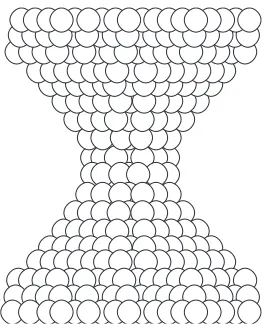
In this section, we model the motion of the atom in the atomic chain and derive the equation which represents the dynamics of the atom with the vacancy in the atomic chain. We consider the nano-scale metallic contact which is made by stretchingthe material in one direction. An example is shown in Fig. 1. In this figure, a sphere represents one atom. A neck has an ordered structure, for instance, like a perfect fcc structure. Namely, this means the nano-scale metallic contact consists of several atomic chain layers. We focus on one of the atomic chain layers at equal spacing a in the metallic nanocontact, that is, one arrangement of the atoms spacingbin the atomic layers in Fig. 2. (More detail of this
Fig. 1 An example of a metallic nanocontact. A sphere represents one atom. A neck has an ordered structure, for instance, like a perfect fcc structure.
Special Issue on Diffusion in Materials and Its Application —Recent Development—
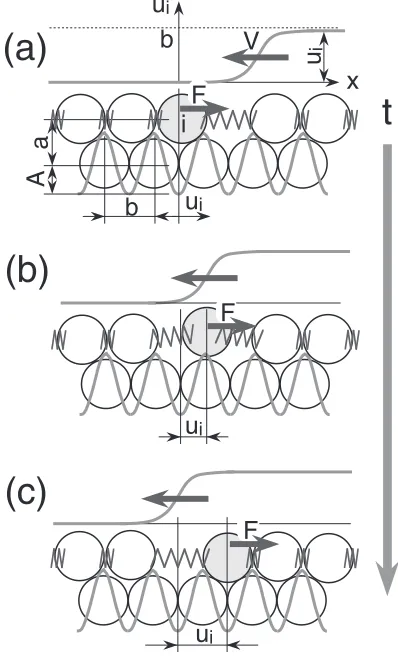
[image:1.595.361.492.585.749.2]description is discussed in the papers.2,4)) We consider the dynamics of the atom in the atomic chain in Fig. 3. Supposingone space exists as the vacancy which is made by missingthe particle in the atomic chain (Fig.3(a)), we consider the motion of the ith atom i¼1;2;. . .;N (N: the total number of the atoms in the chain) which is located at the nearest-neighbor of the vacancy with the interactions of the other atoms. We assume that the interaction derived from the nearest-neighbor atoms of the same chain is described by the harmonic oscillation and that the interactions derived from the atoms of the other chains are represented by the periodical potential force. Frenkel-Kontorova model5)is the typical and well-known model which is based on the above assumption. It has been used for the various analysis and provides the
interestingresults.6)
In this study, for the more practical analysis, we consider, addingto the above effects, the thermal effect, the friction of the environment and the external force as the essential effects on the mechanical properties. More precisely, we consider the followingsituation. The ith atom exists with the interactions of the atoms and the thermal force. Then it changes the displacement ui from the equilibrium point by the external forceF against the friction of the environment. We show this behavior of theith atom in Figs.3(a)–(c). Then, we will find that the change of the displacement ui can be represented by the propagation of the kink type wave (Here we mention the nature of the external forceF). The external forceF should be given naturally by the interaction among atoms which originates from the macroscopic force added to the material surface. Indeed, recently, the force and con-ductance have been measured experimentally usingthe scanningtunnelingmicroscope supplemented by a force sensor.8,9)However, in this study, we do not consider how the external forceF is concretely related with the macroscopic force, because we would like to discuss not the external force
F but the dynamics driven by the external force F. We assume that the external force F works on each atom uniformly (the direction is equal to the x direction in Fig. 3. In this figure, we explicitly show the force which works on theith atom for convenience).
From the above observation of the atomic chain, we can obtain the Langevin equation as the equation of the motion which describes the dynamics of the ith atom with the vacancy;
0¼ duiðtÞ dt þ
K
b2 uiþ1ðtÞ 2uiðtÞ þui1ðtÞ
@Ui
@ui
þFþiðtÞ;
ð1Þ
where;K;Uiandiare the frictional coefficient, the spring coefficient, the potential energy ofith atom and the thermal fluctuation. The properties of the thermal effect are given by Gaussian white noise:
hiðtÞiav¼0;
hiðtÞjðt0Þiav¼2kBTijðtt0Þ;
ð2Þ
where h iav means the ensemble average. kB and T are
Boltzmann constant and temperature. Here, we mention that in the left hand side of eq. (1) we suppose the inertia is sufficiently small because we consider the motion is very slow against time due to the large friction of the environ-ment.10)
In eq. (1), we give the periodical potential Ui
ðA=pÞð1cospuiÞ, ðp2=bÞ with the Peierls force A. Supposingthe lattice spacingb is sufficiently small, by the limitingprocedure: uðib;tÞ !uðx;tÞ as b! þ0 with
uðib;tÞ uiðtÞandxib, we obtain the partial differential equation:
0¼ @uðx;tÞ
@t þK
@2uðx;tÞ
@x2 Asinpuðx;tÞ þFþðx;tÞ; ð3Þ
where we have
i+1
a
b
F
i
i-1
Fig. 2 Atomic chain layers in the metallic nanocontact.
t
A
b
u
iV
F
u
ia
i
x
b
u
i(a)
F
u
i(b)
F
u
i(c)
[image:2.595.74.266.72.204.2] [image:2.595.68.267.255.583.2]hðx;tÞiav¼0;
hðx;tÞðx0;t0Þiav¼2kBTðxx0Þðtt0Þ:
ð4Þ
In this study, we discuss the mechanical properties of the atomic chain by analyzingeq. (3).
3. Dynamics of the Atom Induced by the Vacancy
Diffusion Process
The dynamics of the atom in the atomic chain with the vacancy is described by eq. (3). Here we can find eq. (3) is a kind of the diffusion equations which generally work to uniformize the field, for example, like the Fick’ Law. However, referringto the former section (Figs.3(a)–(c)), we should consider that the atom with the vacancy propagates like the kink wave in response to the external forceF. In this section, we show how the kink wave is derived from the diffusion eq. (3), by applyingthe analysis of the singular perturbation method.11)
Now supposingthat eq. (3) has the travelingwave solution, we consider the transformation:
¼xþ Z t
0
vðt0Þdt0; ¼t:
We expand eq. (3) as
uðx;tÞ ¼u0ð Þ þu1ð ; Þ þ2u2ð ; Þ þOð3Þ;
vðtÞ ¼v0þv1ðÞ þ2v2ðÞ þOð3Þ;
where is the perturbation parameter and Oð Þ means Landau’s symbol for the higher order terms. Then we obtain the followingequations inOð0ÞandOð1Þwith respect tou;
0¼ v0 du0ð Þ
d þK d2u0ð Þ
d 2 f u0ð Þ
þF; ð5Þ @u1ð ; Þ
@ þLu1ð ; Þ ¼ v1ðÞ
du0ð Þ
d þð ; Þ; ð6Þ
where
f u0ð Þ
Asinpu0ð Þ;
and the operatorLis given by
L K @
2
@ 2þv0ðÞ
@ @ þf
0u
0 ð Þ:
We suppose that the operatorL and the adjoint operatorLA
satisfy the complete orthonormal function system;
L bð Þ ¼0; L lð Þ ¼l lð Þ;
LAAbð Þ ¼0; LAAlð Þ ¼lAlð Þ;
wherelis the eigenvalue and landAl are the eigenfunc-tions. We choose the eigenfunctions to be normalized so that
Al l0
¼ðll0Þ; Ab b
¼1; Ab l
¼0¼ Al b
;
where we shall use the brackets to indicate the inner product:
hujvi Z1
1
uð Þvð Þd :
Then the closure relation must be
ð 0Þ ¼Abð 0Þ bð Þ þ
Z 1
1
Alð 0Þ lð Þdl: We expand eq. (5) as
u0ð Þ ¼uð00Þð Þ þ!u
ð1Þ
0 ð Þ þ! 2uð2Þ
0 ð Þ þOð! 3Þ;
v0¼vð00Þþ!v
ð1Þ
0 þ! 2vð2Þ
0 þOð! 3Þ;
where ! is the perturbation parameter, consideringthat
F¼!Fð1Þ. Here we requirevð0Þ
0 0because of the balance
against the external force. (The direction of the kink wave propagation should be physically equal to that of the external force.) Then we obtain the followingequations inOð!0Þand
Oð!1Þwith respect tou0; 0¼Kd
2uð0Þ
0 ð Þ d 2 f u
ð0Þ
0 ð Þ
; ð7Þ
Lð0Þuð01Þð Þ ¼ vð01Þdu
ð0Þ
0 ð Þ d þF
ð1Þ;
ð8Þ
where the operatorLð0Þis given by
Lð0Þ K @
2
@ 2þf
0 uð0Þ
0
:
Let the eigenvaluesðl0Þand the eigenfunctionsbð0Þandðl0Þ
be
Lð0Þðb0Þð Þ ¼0; Lð0Þlð0Þð Þ ¼lð0Þðl0Þð Þ; ðbiÞ ðbjÞ
D E
¼0; ðliÞ ðljÞ
D E
¼0; ði6¼jÞ:
Because the operator is self-adjoint, ðb0Þ ¼ ðb0Þ. These relations are useful to the practical calculation.
From eqs. (7) and (8), we evaluate the ensemble averaged values;
uð ; Þ
h iav¼uð00Þð Þavþ2hu2ð Þiðav0ÞþOð!; 3Þ;
vðÞ
h iav¼!v
ð1Þ
0 þ! 2 v
2ðÞ
h iðav1ÞþOð!2; 3Þ:
Here we can regard eq. (7) as the specialized equation of the sine-Gordon equation which is a kind of soliton equations and exactly solvable.7) Actually, we obtain the kink type wave solution:
u0ð0Þð Þ ¼u0ð0Þð Þav
¼4
parctanðe Þ;
ffiffiffiffiffiffiffi
Ap K
r
:
ð9Þ
We have the eigenfunctions;
ðb0Þ¼ ðb0Þ¼ ffiffiffiffi
2 r
sech ; ð10Þ
ð0Þ
k ¼
eik kþitanh
ffiffiffiffiffiffiffiffiffiffiffiffiffiffiffiffiffiffiffiffiffiffiffiffi 2k2þ2
q ; ð11Þ
ðk0Þ¼ ð0kÞ ¼e
ik kitanh
ffiffiffiffiffiffiffiffiffiffiffiffiffiffiffiffiffiffiffiffiffiffiffiffi 2k2þ2
q ; ð12Þ
and the eigenvalues:
ðk0Þ¼K
pðk
From eq. (8), we have the relations;
vð01Þ ¼ 1 Nð0Þ
ð0Þ
b ð ÞF
ð1Þ
;
Nð0Þ ¼ ð0Þ
b ð Þ
du
ð0Þ
0 ð Þ d
* +
:
Then we obtain
vð01Þ ¼ p 4F
ð1Þ¼ p
4A ffiffiffiffiffiffiffi
KA p
s
Fð1Þ; ð13Þ
Nð0Þ ¼2
p
ffiffiffiffiffiffi 2
p
: ð14Þ
Now in order to observe the behavior of solution (9), we normalize each variable appropriately, that is,
ðu;x;tÞ7!ðuu~;xx~;tt~Þ where uu~, xx~ and tt~ are the normalized variables. Then we have the normalized displacement functionuu~ðxx~;tt~Þ:
~
u
uðxx~;tt~Þ ¼arctanðexx~þtt~Þ:
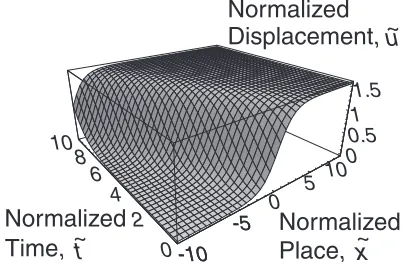
The time evolution of this displacement function is shown in Fig.4. We can see that the kink wave is propagated without dissipating. Thus it is concluded that the propagating movement of the atom with the vacancy is derived from the diffusion eq. (3) by strippingoff the fluctuations from the essential motion. Moreover, the ensemble averaged velocity of the travelingwave, which will be minutely shown by eq. (17) in the next section, depends on the external forceFand the temperature T. Namely, the atom with the vacancy responds to the external force and the temperature. It migrates faster with increasing the external force and the temperature, though it derives form the diffusion process. This behavior can be qualitatively reasonable6,12) and will lead one to understandingthe mechanism of the dynamics of the atom with the vacancy induced by the diffusion process.
4. Derivation of the Strain
In this section, we derive the strain of the atomic chain. Applyingto the results of the former section, we can calculate the higher order terms;
u2ð Þ
h iðav0Þ¼sech
4K
tanh
4 1þ sech2
3
; ð15Þ
v2 h iðav1Þ ¼
p2Fð1Þ 1þJ
2
32K2 ; ð16Þ
where
J¼2
Z 1
0
dv
sinh2ðvÞ 1 1 ð1þv2Þ1=2
¼0:1494094 . . .:
Thus we have the ensemble averaged displacement:
uð ; Þ
h iav¼uð00Þð Þavþ2hu2ð Þiðav0ÞþOð!; 3
Þ
¼ 4
parctanðe Þ þ
2 u 2ð Þ
h iðav0ÞþOð!; 3Þ;
and the ensemble averaged velocityhvðÞiav:
vðÞ
h iav¼!vð 1Þ
0 þ! 2 v
2ðÞ
h iðav1ÞþOð!2; 3Þ
¼!pF
ð1Þ
4 1þ 1þJ
2
p
8K kBT
0 B B @ 1 C C
AþOð!2; 3Þ:
ð17Þ
From these results, since we are interested in the essential properties of the dynamics, we shall define the strain of the atomic chain by
"ðx;tÞ uðx;tÞ
a
’2b
aarctan expððxþv0tÞÞ
;
ð18Þ
where the velocityv0is given by the lowest term ofhvðÞiav;
v0
pF
4 1þ 1þJ
2
p
8K kBT
0 B B @ 1 C C A:
5. Mechanical Properties under the Constant Applied Force
In this section, we discuss the mechanical properties of the atomic chain under the constant applied stress, — the creep response —, by analyzingstrain (18).
From the derivation of strain (18) by timet, we obtain the relation:
@"ðx;tÞ
@t ¼ v0b
a sin a
b "ðx;tÞ
: ð19Þ
Here consideringthe initial strain and the practical strain under the constant applied force are respectively represented by"ð0Þðx
0Þand"ð1Þðx0;tÞwith the constantx0, we describe the
strain"by
"ðx0;tÞ ¼"ð0Þðx0Þ þ"ð1Þðx0;tÞ:
Usingthis strain into relation (19) and linearizingit, we have the differential equation of"ð1Þðx
0;tÞ:
-10 -5 10 0 4 6 8 10 0 0.5 1 1.5 -10 -5 0 5
Normalized
Place
,
Time
,
Normalized
Normalized 2
Displacement
, u
~
x
~
t
~
[image:4.595.67.268.76.210.2] [image:4.595.49.288.262.403.2]d"ð1Þðx
0;tÞ dt ¼
v0b
a sin a
b "
ð0Þðx
0Þ
þv0cos
a b "
ð0Þ
ðx0Þ
"ð1Þðx0;tÞ: ð20Þ
This equation is the first order ordinary differential equation of"ð1Þ. Moreover, lettingthe initial strain be
1 2
b a < "
ð0Þðx
0Þ<
b
a; ð21Þ
we can find eq. (20) agrees with the Voigt model12)which describes the creep viscoelasticity;
d"VðtÞ
dt ¼ V
G
"VðtÞ; ð22Þ
where "V andV are the strain and the stress of the Voigt model, andGandare constants. This result indicates that the atomic chain under the constant applied force behaves viscoelastically like the solution of the Voigt model.
Furthermore, we define the external stressbyF=b2, (namely, the external stressis proportional to the external forceF), and regard"VðtÞandVas"ð1ÞðtÞandrespectively, (that is "VðtÞ ¼"ð1ÞðtÞ and V ¼). Then, comparingthe equation derived from the atomic chain model (20) with the Voigt model, we have the relations;
GðÞ ¼ a
b
1
tan a
b"
ð0Þðx
0Þ
; ð23Þ
ðTÞ ¼ 2aA
b2sin a
b "
ð0Þðx
0Þ
ffiffiffiffiffiffiffiKA
p
s þ
1þJ 2 8 0 B B @
1 C C AkBT 0
B B @
1 C C A
: ð24Þ
These relations indicateGanddepend on the external stress
and the temperature T. This result suggests the initial inclination of the creep curve becomes steep with increasing the external forceF or the temperatureT.
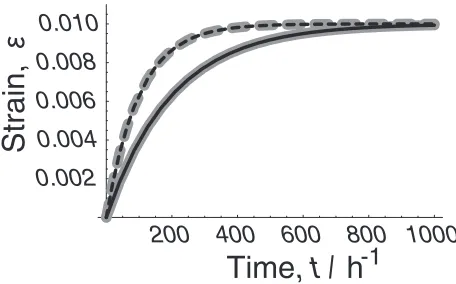
We show strain "ð1Þ against the time under the constant
applied load by usingeq. (18) in Fig.5. In this figure, we use
the values; v0¼0:005h1, "ð0Þ¼0:99 and b=a¼1. For
the comparison, the gray line shows the strain of the Voigt model "VðtÞon the same condition. Two dotted lines (black and gray) correspond with the respective strains on the conditionv0¼0:01h1. This figure shows the strain of the
atomic chain model under the constant applied load behaves as the viscoelastic response like the primary creep phenom-enon. Because the dotted lines mean the higher temperature or applied force, compared with the smooth lines, the strain rate becomes high with increasing the temperature or applied force. This behavior qualitatively agrees with the experi-mental result about the dependence of the primary creep curve on the temperature and the applied force.12)Therefore, it is concluded that the dynamics of the atom with the vacancy in the atomic chain induces the viscoelastic proper-ties like the primary creep phenomenon.
6. Conclusions
In the present paper, we mainly purpose to reveal the mechanism which causes the plastic deformation induced by the vacancy diffusion process.
We model the dynamics of the atom with the vacancy in the atomic chain. We derive a kind of the diffusion equation which describes the motion of the atom with the vacancy includingthe essential effects on the plastic deformation, namely, the thermal effect, the interactions of the atoms, the friction of the environment and the external force. We analyze the obtained diffusion equation mathematically. Strippingoff the fluctuation of the prime motion by means of the perturbation expansion, we can get the situation where the essential motion of the atom with the vacancy is represented by the propagation of the kink wave which responds to the external force and the temperature, though the system is described by the diffusion process.
Then we discuss the viscoelastic properties of the atomic chain by analyzingthe strain of the atomic chain under the constant applied force. The behavior of the creep curve induced from the atomic chain agrees with that of the primary creep phenomenon which is represented experimentally and typically by the Voigt model. The strain rate becomes high with increasingthe temperature or the applied force.
Although it is well-known that the vacancy diffusion process affects the creep properties of the materials, we believe that it is important to show analytically how the vacancy acts on the dynamics of the atomic chain and the other factors (namely, the interactions of the atoms, the friction of the environment and the external force) relate to the diffusion process of the atomic chain, and how such microscopical factors cause the creep properties. We hope that the materials presented here can be useful and valuable for further investigation in related problems, especially, the study and application of nano-scale metallic contact.
Acknowledgments
The author expresses his sincere gratitude to Professor Dr. Tamotsu Majima (Chiba University), Professor Dr. Tetsuji Tokihiro (the University of Tokyo), Professor Dr. Junkichi Satsuma (the University of Tokyo), Professor Dr. Katsuhiro
200
400
600
800 1000
0.002
0.004
0.006
0.008
0.010
Time
, t /
h
Strain
,
-1
Fig. 5 Strain response of the atomic chain under the constant load on the condition that v0¼0:005h1, "ð0Þ¼0:99 and b=a¼1. For the
[image:5.595.54.282.585.727.2]Nishinari (Ryukoku University) and Professor Dr. Yasuhiro Ohta (Hiroshima University) for stimulatingdiscussions, valuable comments and warm support with magnificent hearts.
REFERENCES
1) For example; J. D. Verhoeven:Fundamentals of Physical Metallurgy, (John Wiley & Sons, 1975).
2) T. Kitamura, Y. Umeno and M. Nishida: Trans. JSME A, 67, 654 (2000) pp. 19–24 and references therein.
3) For example; U. Landman, W. D. Luedtke, B. E. Salisbury and R. L. Whetten: Phys. Rev. Lett.77(1996) 1362–1365.
4) M. R. Srensen, M. Brandbyge and K. W. Jacobsen: Phys. Rev. B57
(1998) 3283–3294.
5) J. Frenkel and T. Kontorova: J. Phys.1(1939) 137–149.
6) P. M. Chaikin and T. C. Lubensky:Principles of Condensed Matter Physics, (Cambridge University Press, 1995).
7) M. J. Ablowitz and H. Segur: Solitons and the Inverse Scattering Transform, (Society for Industrial and Applied Mathematics, 1981). 8) N. Agra€ t, G. Rubio and S. Vieira: Phys. Rev. Lett.74(1995) 3995–
3998.
9) G. Rubio, N. Agra€ t and S. Vieira: Phys. Rev. Lett.76(1996) 2302– 2305.
10) K. Sekimoto: J. Phys. Soc. Jpn.66(1997) 1234–1237. 11) D. J. Kaup: Phys. Rev. B27(1983) 6787–6795.