Computer simulation of the teat-cup liner stress
and strain tensor
I. Karas, R. Gálik, Š. Pogran, M. Šesták
Department of Production Engineering, Faculty of Engineering, Slovak University
of Agriculture in Nitra, Nitra, Slovak Republic
ABSTRACT
Karas I., Gálik R., Pogran Š., Šesták M., 2013. Computer simulation of the teat-cup liner stress and strain tensor. Res. Agr. Eng., 59: 114–119.
The three-notch black pressed teat-cup liners were selected into the set of the analysed teat-cup liners, and, for com-parison purposes, teat-cup liners produced from silicone mixture. Wall thicknesses of the analysed teat-cup liners were adjusted by smoothing of the middle working part in length of 30 mm. The working part thickness thus changed from the original 2.37 to 0.41 mm for a teat-cup liner produced from black mixture and from the original thickness of 2.30 to 0.40 mm for a silicone teat-cup liner. A possibility of maximum closure of teat-cup liners in the pressing tact was assessed at the working suction of 50 kPa, the flow of distilled water through a measurement device reached the value of 4.4 l/min. Under laboratory conditions, with the above criteria fulfilled, the following stress relations were detected at teat tips: black teat-cup liner 30.25 kPa, silicone teat-cup liner 23.14 kPa. From the acquired results follows that the silicone teat-cup liner showed, from the aspect of suction loss, a more favourable value by 7.11 kPa. Physical-mechanical qualities of the analysed teat-cup liners were further used for the computer simulation of the teat-cup liners stress and strain tensor.
Keywords: tensile test; suction; closing stopper; reduced stress
The polymeric materials used in technical sphere are not, in most cases, clear. They contain various additives which can, to a large degree, in a positive as well as negative sense influence their resistance against the impact of many factors. Degradation of polymeric materials through action of various fac-tors was the subject of intensive study. Relatively little attention has been paid so far to the study of mechanism and kinetics of the degradation of tech-nical rubber as a result of combined effects: chemi-cal, atmospheric, dynamic and static loading. These effects on polymeric material – the technical rubber – are evident when it is used in agricultural sector during milk acquisition. As soon as Doležel (1981) claimed that most authors give only qualitative or
especial-ly dealt with the determining of physical-mechanical qualities of tested teat-cup liners, with diagnostics of the state of teat-cup liners, effect of teat-cup lin-ers aging on their wear and tear, analysis of pressure conditions, as well as with the quality of milk and the sanitation of milking equipment. In addition to technical aspects in milking process, the teat-cup liners are considerably influenced by the environ-ment as well. Microclimate in housing objects was also dealt with by many authors, including: Pogran (2000), Karas, Gálik (2004) and Šoch et al. (2007). The aim of this work is to verify a possibility of maxi-mum decrease of suction at teat tips in the tact of pressing, using teat-cup liners with adjusted thick-ness of their working part. The computer simulation in the segment of the system Pro Engineering, in the FEM part (Final Elements Method), was chosen to determine stresses in the active part of a teat-cup liner and its spatial strains.
MATERIAL AND METHODS
Two kinds of teat-cup liners were chosen for the experiment; they were adjusted by smoothing as follows:
–
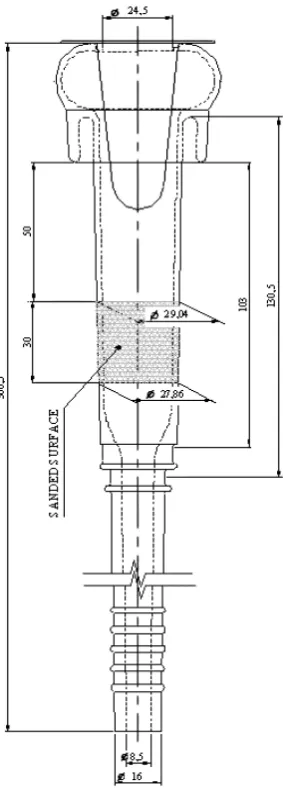
teat-cup liners produced from black mixture (Fig. 1); – teat-cup liners produced from silicone mixture(Fig. 2).
To observe the effect of the change of thickness of a teat-cup liner on the change of suction at a teat point, the wall thickness of the teat-cup liner’s working part was adjusted by smoothing as follows: – teat-cup liner from black mixture: from the
orig-inal 2.37 to 0.41 mm;
– teat-cup liner from silicone mixture: from the original 2.30 to 0.40 mm.
To determine individual parameters, two elec-tronic measuring instruments were used:
MC-12 A (Hartman Luxury Audio Group, North-ridge, Canada), Alfatronic MK-II (Alfatronic, Prague, Czech Republic), as well as a milking simu-lation device. The operation principle lies in bring-ing the liquid to the artificial udder through a dis-tributor from a container with exact flow regulation. Experimental measurements were carried out with distilled water with the 4.4 l/minflow, and the work-ing suction of 50 kPa. Decisive parameters from mechanical qualities, which sufficiently describe internal relation of normal and tangential tensions, as well as the nature of strain, were acquired from a classic tension test carried out at a selected
sam-ple from the most loading part of the teat-cup liner shaft. Tensile tests were carried out in cooperation with the Research Institute of Processing and Appli-cation of Plastic Materials in Nitra, Slovak Republic. The standard STN 62 1431 (1980), which specifies a method for determining the ultimate stress in ten-sion and elongation, was observed in its full extent. The second part of the work deals with computer simulation of strain of the observed teat-cup liners. The computer simulation within the segments of the system Pro Engineering in the FEM part was carried out already for the above two types of teat-cup lin-ers: adjusted teat-cup liners from black mixture and adjusted teat-cup liners from silicone mixture. The loading was described by axial pull at 120 N. The pressing tact with a closed sub-teat chamber (clos-ing stopper) was simulated. Of further used work(clos-ing suctions in sub-teat chamber, the limiting and me-dium values were chosen as follows: minimum suc-tion – 35 kPa, medium sucsuc-tion – 45 kPa, maximum suction – 50 kPa. The touch of a teat-cup liner with a teat root was simulated by fixing – all six levels of looseness were taken, with closing stopper and teat-cup liner being considered in support as one piece.
In order to apply the final elements calculation method, the teat-cup liner was sampled into a sub-stitute model. It was expected that in its working ex-tent a teat-cup liner is approximately linear, i.e. that the size of stress, or displacement (turning) in any point is directly proportional to external load. This will be met by observing the Hooke’s law and under the condition of sufficiently small deformations in all directions. The teat-cup liner was then substituted by a system of elements of known qualities, connected in discrete points or in small areas, which were also considered as points. All elements share a prevailing dimension of length and the way of connection to the remaining elements in discrete points. Through forces and displacements in these points (knots) a mutual action of elements in the system is mediated as well. Solving linear tasks, it was anticipated that deformations, compared to the system dimensions, are small. It means that conditions of equilibrium for the dimensions of the system may be written and that dimensional changes of the system caused by load do not noticeably influence their validity. The primacy of super position was observed, i.e. that the
Young’s
tension and deformations caused in the system, as a result of a series of loads, will be acquired by adding the increments of individual loads. Loads and dis-placements of elements and the whole system must meet basic elasticity and strength equations:
– conditions of equilibrium, – conditions of compatibility,
– relation between stress and deformation.
Conditions of equilibrium are valid for any part of the body.
RESULTS AND DISCUSSION
Computer simulation for a teat-cup liner from black mixture
The results present a determined course of re-duced stress along deformation zone of the
teat-cup liner and the strain which is indicated in the cross-section surface of active working area. Fig. 3 presents a deformation shape of the teat-cup liner wall with the thickness of s = 2.37 mm. Suction in the sub-teat chamber corresponded to the value of 50 kPa. Tact of pressing was monitored. Maximum reduced stress reached 9.02 MPa and it is in the area of the greatest deformation of teat-cup liner. From the aspect of material strength, corresponding to the tension diagram, it was found out that the teat-cup liner shows deformations in linear area and thus its permanent deformation is not expected.
Deformation with a very thin wall of the teat-cup liner, in the value of 0.41 mm and the working suc-tion of 50 kPa is shown in Fig. 4.
[image:3.595.351.493.86.482.2]The wall adjustment area is clearly visible in ax-onometric view. The course of reduced stresses, in comparison with the previous figure, indicates that in the place of “cut” the extrusion of stresses to
[image:3.595.124.253.87.483.2]Fig. 8. Peripheral deformation of the wall of adjusted teat-cup liner
[image:4.595.344.491.306.494.2]Fig. 3. Deformation effect of an unadjusted teat-cup liner full wall
Fig. 4. Deformation with a very thin adjusted wall of the teat-cup liner
[image:4.595.96.256.308.485.2]Fig. 5. Shape of deformation curve of teat-cup liner’s cross section
Fig. 6. Deformation effect of full wall of an unadjusted silicone teat-cup liner
Fig. 7. Deformation with a course of reduced stresses of adjusted silicone teat-cup liner
1.289e+00 1.160e+00 1.031e+00 9.024e–01 7.735e–01 6.446e–01 5.157e–01 3.868e–01 2.578e–01 1.289e–01 6.760e–12
1.611e+01 1.450e+01 1.289e+01 1.128e+01 9.667e+00 8.056e+00 6.445e+00 4.834e+00 3.222e+00 1.611e+00 1.530e–12
1.611e+01 1.450e+01 1.289e+01 1.128e+01 9.667e+00 8.056e+00 6.445e+00 4.834e+00 3.222e+00 1.611e+00 1.530e–12
1.452e+00 1.307e+00 1.162e+00 1.016e+00 8.712e–01 7.260e–01 5.808e–01 4.356e–01 2.904e–01 1.452e–01 9.925e–07
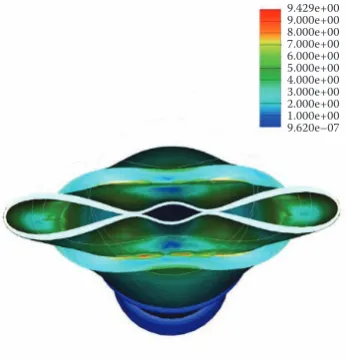
9.429e+00 9.000e+00 8.000e+00 7.000e+00 6.000e+00 5.000e+00 4.000e+00 3.000e+00 2.000e+00 1.000e+00 9.620e–07
[image:4.595.334.508.536.717.2] [image:4.595.104.248.538.726.2]the area of material compaction will occur. In this case, the teat-cup liner works in the linear area of material behaviour (Fig. 4). Deformation effect of the teat-cup liner’s wall (Fig. 5), the shape of defor-mation was depicted by computer graphics in the teat-cup liner’s cross section, with a visibly marked wall thickness; equivalent stresses are also added. Fig. 5 shows computer visualisation of the shape of the teat-cup liner’s transversal deformation, in the tact of pressing, at 50 kPa suction, in the sub-teat chamber and at the teat-cup liner thickness of s = 0.41 mm. Reduced stress shows values which cor-respond to the linear area of material behaviour. It demonstrated that in the middle of the upper and lower “beam” of the teat-cup liner mutual connec-tion of the internal surfaces of the teat-cup liner oc-curs. The assumption of the teat-cup liner closing and, consequently, of a marked decrease of suction at teat tip, was not confirmed. The construction of the teat-cup liner holder and the shape of inter-wall chamber do not allow total closing of the teat-cup liner’s margins. Some of our simulations with sym-metrical peripheral load of a teat-cup liner showed that there will occur a peripheral deformation in the cut area Fig. 5.
Laboratory measurements of suction at teat tip (stopper)
Following the methodology, 20 measurements with a teat-cup liner adjusted at the 0.41 mm thick-ness of working area were carried out. The flow of distilled water was 4.4 l/minand working suction reached 50 kPa. Under the given conditions an av-erage value of suction for teat-cup liner from black mixture reached 30.25 kPa at teat tip.
Results of computer simulation for teat-cup liner from silicone mixture
Simulation for a teat-cup liner with 2.30 mm wall thickness and suction in sub-teat chamber of 50 kPa is given in Fig. 6.
Simulation variation for the wall thickness of 0.40 mm and the maximum suction of 50 kPa in sub-teat chamber showed that in the area with low-er wall thickness a marked deformation occurred, with a course of reduced stresses as in Fig. 7.
Transversal, peripheral deformation of the teat-cup liner’s wall, marked by computer graphics, is in Fig. 8.
In comparison with the previous material from black pressed mixture, probably as a consequence of bet-ter elasticity qualities, the pressing of wall “sides” is greater, the stiffness of side supports lower.
From Fig. 8 it is evident that there was a better closing of internal periphery of teat-cup liner’s wall as well as, however, a greater wall flattening in comparison with the teat-cup liner produced from black mixture. Total closing of teat-cup liner was not achieved. The leak of suction in the sides of pe-rimeter deformation is visible.
Result of laboratory measurement of suction at teat tip (stopper)
The assessment of suction at teat tip (stopper) was carried out under the same conditions as with a teat-cup liner from black mixture, i.e. water flow 4.4 l/min, suction 50 kPa, thickness of the analysed teat-cup liner was 0.40 mm. At teat tip, the average value for a teat-cup liner from silicone reached 23.14 kPa.
The qualities of teat-cup liners may significantly influence the technical-technological process of milking. During milking, milkers’ teats are strained and traumatised especially by suction, quality of ma-terial from which a teat-cup liner is produced, as well as by the teat-cup liner’s shape (Caruolo 1983). The greater fluctuation of suction lowers the milk-ing efficiency and, together with an unsuitably set milking machine, unfavourably influences the well-being and health of milkers. The problem of suction fluctuation in sub-teat chamber and its influence on milkers was dealt with by several researchers (Reits- ma, Breckman 1983; Bramley et al. 1987). Dif-ferential shapes of real teat-cup liners and acquired simulation shapes of adjusted thicknesses of walls are sufficiently identical. The comparison of simula-tion results of teat-cup liners produced from various materials showed the following:
– in the tact of pressing stresses do not exceed to the limit of material yielding,
– a total closure of sub-teat chamber in the tact of pressing does not occur in any practical, varia-tion of the analysed teat-cup liners,
– peripheral deformation of the teat-cup liner’s wall reaches values in the symmetry axis.
References
on new infection of the udder. In: Proceedings 17th
An-nual Meeting of National Mastitis Council, Inc., Lousville: 291–300.
Caruolo E.V., 1983. Measuring the force of massage pro-duced by the teatcup liner. Journal of Dairy Science, 66: 2441–2445.
Doležel B., 1981. Odolnost plastů a pryže. [Resistance of Plastics and Rubbers.] Prague, SNTL: 712.
Gálik R., 2001. Zmena pevnosti ceckových gúm po starnutí v prevádzkových podmienkach. [Changing the Strength Teat Cup Liners after Aging at Operating Conditions.] Prague, Czech University of Agriculture in Prague: 13–16. Groda B., 1984. Mechanické vlastnosti a diagnostika stavu strukových gum. [Mechanical properties and diagnostics teat cup liners.] Zemědělská technika, 30: 719–732. Karas I., 1996. Analýza tlakových pomerov kombinovaných
dojacích jednotiek BOU MATIC, STRANGKO a SURGE. [Pressure ratio of the combined analysis of milking units BOU MATIC, STRANGKO and SURGE.] Acta Techno-logica Agriculturae, 37: 169–175.
Karas I., Gálik R., 2004. Contact and non-contact ther-mometry in the milk acquisition process. Czech Journal of Animal Sciences, 49: 1–7.
Karas I., Said J., Gálik R., Horváth J., 2006. The modern techniques using to revision of milking process. The Iraqi Journal of Agricultural Sciences, 37: 59–62.
Kejík C., Mašková A. 1989. Termovizní měření povrcho-vých teplot vemene v průběhu strojního dojení. [Infrared measurements of surface pulsation udder during milking machine.] Zemědělská technika, 35: 225–230.
Kingwill R.G., Dodd F.H., Neave F.K., 1989. Maschine milking and mastisis. In: Maschine Milking. Technical Bulletin 1. Reading, NIRD: 231–285.
Los J., Mašková A., Fryč J., 2002a. Analýza fyzikálně-mechanických vlastností strukových návleček. [Analysis of physical-mechanical properties of teat cup liners.] In: Theoretical and applicatory problems of agricultural en-gineering in the process of adaptation to EU research pro-grammes. Polanica, Instytut Inžynierii Rolniczej: 507–510. Los J., Mašková A., Fryč J., Kukla R., 2002b. Vliv čistících a desinfekčních prostředků na fyzikálně-mechanické vlastnosti strukových návleček. [Effect of detergents and disinfectants on physical and mechanical properties of teat
cup liners’.] In: Proceeding Animal Production in Sustain-able Agriculture. Nitra: 65–71.
Pogran Š., 2000. Vplyv strešnej konštrukcie na tvorbu vnú-torného prostredia ustajňovacích objektov. [Effect of roof structure to create an internal environment of buildings housing facilities.] Acta Technologica Agriciculturae, 3: 15–18.
Preisler V., Talich S., 1989. Kvalitativní kriteria pro hod- nocení dojících souprav. [Qualitative criteria for the evalua-tion of sets of milking.] In: Mezinárodní symposium k pro-cesu strojního získávaní mléka. [International symposium on the process of obtaining milk by milking machinery.] Brno: 579–585.
Přikryl M., 1989. Analysis of operation and assessment of use of mobile milking equipment. In: Balkema A.A., Maschine Milking. Rotterdam/Brookfield: 981–984. Reitsma S.Y., Breckman D.K., 1983. Measurement and
analysis of milking machine teatcup operation. American Society of Agricultural Engineers, 83: 3038.
Stirl A., Kremp R., Mey F., 1988. Diagnose von Melkanla-gen. Agrartechnik 38: 415–419.
STN 62 1431, 1980. Stanovenie tvrdosti Shore A. [Determi-nation of hardness Shore A.] Slovak Office of Standards, Metrology and Testing.
Šoch M., Lendelova J., Vospoupal B., Brouček J., Šťast-ná J., Písek L., Pálka V., Kozlová P., Novák P., 2007. Vliv separované kejdy použité jako plastické stelivo na zdravotní stav a tepelnou pohodu krav. [Influence of the separated liquid manure used as plastic litter on health and thermal comfort of the cows.] In: Proceedings International Conference on Agricultural and Rural Development Agri-Environment and Animal Welfare. Nitra, Slovak University of Agriculture: 626–633.
Vegricht J., 1995. Kvalita mléka a sanitace dojících zařízení [The quality of milk and sanitizing milking equipment.] Mechanizace zemědělství, ŽV Speciál 1: 30–35.
Voigt J., 1986. Die Stabilisierung der Kunststoffe gegen Licht und Wärme. Berlin, Springer Verlag: 96–98.
Worstorff H., Stanzel H., 1977. Unersuchungen zur Bewegung des Zitzengummis in Abhangigkeit von Ein-faltdruck, Polszyklus und Vakumhohe in Melkanlagen. Drundlagen der Landtechnik, 27: 8–12.
Received for publication May 2, 2012 Accepted after corrections September 20, 2012
Corresponding author:
Doc. Ing. Roman Gálik, PhD., Slovak University of Agriculture in Nitra, Faculty of Engineering, Department of Production Engineering, Tr. A. Hlinku 2, 947 76 Nitra, Slovak Republic