Crystal structure of (2
E
)-1-(1-benzo-
furan-2-yl)-3-(2-bromophenyl)prop-2-en-1-one monohydrate
S. Satheeshchandra* and Nandakumar Shetty
Department of Physics, S. D. M College (Autonomous), Ujire 574 240, India. *Correspondence e-mail: [email protected]
Received 15 September 2015; accepted 7 October 2015
Edited by H. Stoeckli-Evans, University of Neuchaˆtel, Switzerland
The title compound, C17H11BrO2H2O, crystallizes as a
monohydrate in the chiral orthorhombic space group P212121, and has non-linear optical (NLO) properties. The
molecule has anEconformation about the C C bond and is relatively planar with the benzofuran and bromophenyl rings being inclined to one another by 10.60 (14). In the crystal, the water molecule is linked to the organic molecule by O— H O hydrogen bonds, forming anR22(7) ring motif while C—
H O hydrogen bonds lead to the formation of helices along theb-axis direction.
Keywords:crystal structure; benzofuran; chiral; NLO properties; hydrogen bonding.
CCDC reference:1430039
1. Related literature
For background to chalcones and their biological and other properties, see: Choudaryet al.(1999); Jayaramaet al.(2013); Tomazelaet al.(2000); Guet al.(2008). For the crystal struc-ture of a similar compound, see: Benmekhbiet al.(2009).
2. Experimental
2.1. Crystal data
C17H11BrO2H2O Mr= 345.18
Orthorhombic,P212121 a= 4.8614 (4) A˚
b= 13.8220 (15) A˚
c= 21.755 (2) A˚
V= 1461.8 (2) A˚3
Z= 4
MoKradiation
= 2.82 mm1
T= 296 K
0.400.300.25 mm
2.2. Data collection
Bruker Kappa APEXII CCD diffractometer
Absorption correction: multi-scan (SADABS; Bruker, 2004)
Tmin= 0.399,Tmax= 0.539
3636 measured reflections 3636 independent reflections 2134 reflections withI> 2(I)
Rint= 0.034
2.3. Refinement
R[F2> 2(F2)] = 0.042 wR(F2) = 0.102
S= 1.01 3636 reflections 196 parameters 3 restraints
H atoms treated by a mixture of independent and constrained refinement
max= 0.42 e A˚
3
min=0.29 e A˚
3
Absolute structure: Flack (1983), 1497 Friedel pairs
Absolute structure parameter:
[image:1.610.309.566.364.421.2]0.011 (11)
Table 1
Hydrogen-bond geometry (A˚ ,).
D—H A D—H H A D A D—H A
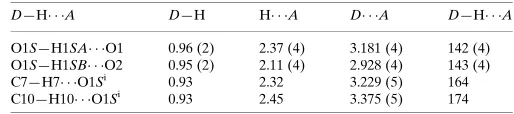
O1S—H1SA O1 0.96 (2) 2.37 (4) 3.181 (4) 142 (4) O1S—H1SB O2 0.95 (2) 2.11 (4) 2.928 (4) 143 (4) C7—H7 O1Si
0.93 2.32 3.229 (5) 164 C10—H10 O1Si 0.93 2.45 3.375 (5) 174
Symmetry code: (i)xþ1;y1 2;zþ
1 2.
Data collection:APEX2(Bruker, 2004); cell refinement:APEX2and
SAINT(Bruker, 2004); data reduction:SAINTandXPREP(Bruker, 2004); program(s) used to solve structure:SIR92 (Altomareet al., 1994); program(s) used to refine structure:SHELXL97(Sheldrick, 2008); molecular graphics:Mercury (Macraeet al., 2008); software used to prepare material for publication:SHELXL97.
Acknowledgements
We are grateful to Professor Jayarama A, Department of Physics & Karnataka Government Research Center (KGRC), Sahyadri College of Engineering & Management, Mangalore, for supporting this study.
Supporting information for this paper is available from the IUCr electronic archives (Reference: SU5214).
References
Altomare, A., Cascarano, G., Giacovazzo, C., Guagliardi, A., Burla, M. C., Polidori, G. & Camalli, M. (1994).J. Appl. Cryst.27, 435.
Benmekhbi, L., Belhouas, R., Bouacida, S., Mosbah, S. & Bencharif, L. (2009).
Acta Cryst.E65, o1472–o1473.
Bruker (2004).APEX2,SAINT,XPREPandSADABS. Bruker AXS Inc., Madison, Wisconsin, USA.
Choudary, B. M., Lakshmi Kantam, M., Venkat Reddy, C. R., Koteswara Rao, K. & Figueras, F. (1999).J. Mol. Catal. A Chem.146, 279–284.
Flack, H. D. (1983).Acta Cryst.A39, 876–881.
data reports
o840
Satheeshchandra and Shetty doi:10.1107/S2056989015018897 Acta Cryst.(2015).E71, o840–o841Gu, B., Ji, W., Patil, P. S. & Dharmaprakash, S. M. (2008).J. Appl. Phys.103, 103511–103516.
Jayarama, A., Ravindra, H. J., Menezes, A. P., Dharmaprakash, S. M. & Ng, S. W. (2013).J. Mol. Catal. A Chem.1051, 285–291.
Macrae, C. F., Bruno, I. J., Chisholm, J. A., Edgington, P. R., McCabe, P., Pidcock, E., Rodriguez-Monge, L., Taylor, R., van de Streek, J. & Wood, P. A. (2008).J. Appl. Cryst.41, 466–470.
Sheldrick, G. M. (2008).Acta Cryst.A64, 112–122.
Tomazela, D. M., Pupo, M. T., Passador, E. A. P., da Silva, M. F. das G. F., Vieira, P. C., Fernandes, J. B., Fo, E. R., Oliva, G. & Pirani, J. R. (2000).
supporting information
sup-1 Acta Cryst. (2015). E71, o840–o841
supporting information
Acta Cryst. (2015). E71, o840–o841 [https://doi.org/10.1107/S2056989015018897]
Crystal structure of (2
E
)-1-(1-benzofuran-2-yl)-3-(2-bromophenyl)prop-2-en-1-one monohydrate
S. Satheeshchandra and Nandakumar Shetty
S1. Commentary
Chalcones are among the most abundant and ubiquitous group of natural products (Tomazela, et al., 2000). Some of the chalcone derivatives shows high second-harmonic generation conversion efficiency (Gu et al., 2008; Choudary et al., 1999; Jayarama et al., 2013). The title compound crystallizes in a non-centrosymmteric space group and exhibits inter-esting nonlinear optical properties.
In the title compound, Fig. 1, the benzofuran and bromophenyl groups are linked by a prop-2-en-1-one group. The
benzofuran and bromophenyl rings are slightly non-planar with a dihedral angle of 10.60 (14) °. The torsion angle C7–
C8–C9–O2 is 175.9 (4)° indicating that the O3 methoxy group is coplanar with the attached benzofuran ring. The C═C
double bond shows an E conformation.
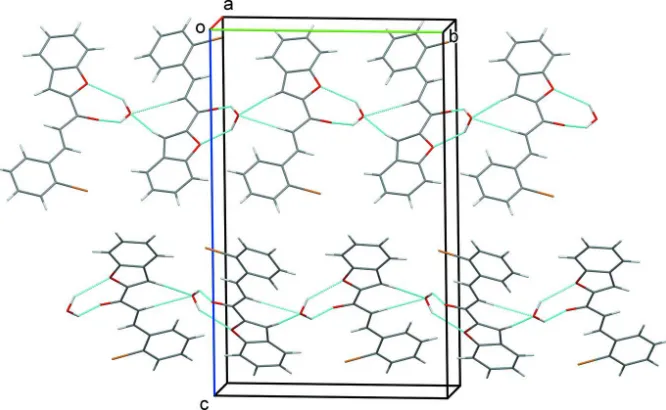
In the crystal, the water molecule is linked to the organic molecule by O—H···O hydrogen bonds forming an R2
2(7) ring
motif (Table 1 and Fig. 2). The organic molecule is linked to the water molecule by C—H..O hydrogen bonds so forming
helices along the b-axis direction (Table and Fig. 2).
S2. Synthesis and crystallization
2-Benzofuranyl methyl ketone (0.01 mol) and 2-bromobenzaldehyde (0.01 mol) were dissolved in methanol (60 ml).
Sodium hydroxide (2 ml, 20%) was then added drop wise to the solution which was then stirred for 1.5 h. The contents of
the flask were cooled using ice-cold water, and the resulting powder content was collected by filtration. The compound
was dried and re-crystallized twice using acetone as solvent, yielding golden-yellow block-like crystals.
S3. Refinement
Crystal data, data collection and structure refinement details are summarized in Table 2. The water H atoms were located
in a difference Fourier map. They were refined with distance restraints: O—H = 0.88 (2) Å, H···H = 1.43 (2) Å with
Uiso(H) = 1.5Ueq(O). The C-bound H atoms were placed in calculated positions and included in the refinement in the
Figure 1
A view of the molecular structure of title compound, with atom labelling. Displacement ellipsoids are drawn at the 50%
probability level.
Figure 2
A view along the a-axis of the crystal packing of the title compound. The intermolecular interactions are represented by dashed lines (see Table 1).
(2E)-1-(1-Benzofuran-2-yl)-3-(2-bromophenyl)prop-2-en-1-one monohydrate
Crystal data
C17H11BrO2·H2O
Mr = 345.18
Orthorhombic, P212121
Hall symbol: P 2ac 2ab
a = 4.8614 (4) Å
b = 13.8220 (15) Å
V = 1461.8 (2) Å3
Z = 4
F(000) = 696
Dx = 1.568 Mg m−3
[image:4.610.139.472.328.533.2]supporting information
sup-3 Acta Cryst. (2015). E71, o840–o841
µ = 2.82 mm−1
T = 296 K
Block, golden-yellow 0.40 × 0.30 × 0.25 mm
Data collection
Bruker Kappa APEXII CCD diffractometer
Radiation source: fine-focus sealed tube Graphite monochromator
ω and φ scan
Absorption correction: multi-scan (SADABS; Bruker, 2004)
Tmin = 0.399, Tmax = 0.539
3636 measured reflections 3636 independent reflections 2134 reflections with I > 2σ(I)
Rint = 0.034
θmax = 28.4°, θmin = 3.0°
h = −6→5
k = −18→18
l = −28→29
Refinement
Refinement on F2
Least-squares matrix: full
R[F2 > 2σ(F2)] = 0.042
wR(F2) = 0.102
S = 1.01 3636 reflections 196 parameters 3 restraints
Primary atom site location: structure-invariant direct methods
Secondary atom site location: difference Fourier map
Hydrogen site location: inferred from neighbouring sites
H atoms treated by a mixture of independent and constrained refinement
w = 1/[σ2(F
o2) + (0.0372P)2 + 0.0197P]
where P = (Fo2 + 2Fc2)/3
(Δ/σ)max = 0.001
Δρmax = 0.42 e Å−3
Δρmin = −0.29 e Å−3
Absolute structure: Flack (1983), 1497 Friedel pairs
Absolute structure parameter: −0.011 (11)
Special details
Geometry. All esds (except the esd in the dihedral angle between two l.s. planes) are estimated using the full covariance
matrix. The cell esds are taken into account individually in the estimation of esds in distances, angles and torsion angles; correlations between esds in cell parameters are only used when they are defined by crystal symmetry. An approximate (isotropic) treatment of cell esds is used for estimating esds involving l.s. planes.
Refinement. Refinement of F2 against ALL reflections. The weighted R-factor wR and goodness of fit S are based on F2,
conventional R-factors R are based on F, with F set to zero for negative F2. The threshold expression of F2 > 2sigma(F2) is
used only for calculating R-factors(gt) etc. and is not relevant to the choice of reflections for refinement. R-factors based on F2 are statistically about twice as large as those based on F, and R- factors based on ALL data will be even larger.
Fractional atomic coordinates and isotropic or equivalent isotropic displacement parameters (Å2)
x y z Uiso*/Ueq
Br1 1.34723 (10) 0.98219 (3) 0.06738 (2) 0.0902 (2) O1 0.3289 (4) 0.93267 (17) 0.32535 (10) 0.0513 (5) O2 0.6697 (5) 0.99535 (19) 0.23842 (13) 0.0720 (7)
C1 0.1694 (7) 0.8801 (2) 0.36525 (14) 0.0463 (8)
C2 −0.0186 (7) 0.9171 (3) 0.40591 (16) 0.0593 (10)
H2 −0.0523 0.9831 0.4093 0.071*
C3 −0.1522 (7) 0.8509 (3) 0.44089 (16) 0.0634 (10)
H3 −0.2812 0.8724 0.4694 0.076*
C4 −0.1034 (7) 0.7519 (3) 0.43576 (17) 0.0607 (9)
H4 −0.2020 0.7091 0.4603 0.073*
C5 0.0860 (7) 0.7169 (3) 0.39547 (16) 0.0587 (10)
C6 0.2301 (6) 0.7824 (3) 0.35908 (14) 0.0444 (8)
C7 0.4402 (6) 0.7757 (3) 0.31357 (15) 0.0468 (8)
H7 0.5256 0.7195 0.2997 0.056*
C8 0.4907 (6) 0.8671 (3) 0.29448 (15) 0.0463 (9)
C9 0.6756 (7) 0.9078 (3) 0.24929 (15) 0.0503 (8)
C10 0.8640 (6) 0.8424 (2) 0.21760 (14) 0.0446 (7)
H10 0.8712 0.7779 0.2297 0.054*
C11 1.0223 (6) 0.8713 (3) 0.17288 (16) 0.0480 (8)
H11 1.0081 0.9361 0.1619 0.058*
C12 1.2190 (6) 0.8136 (3) 0.13815 (14) 0.0439 (8) C13 1.2629 (7) 0.7170 (3) 0.15197 (16) 0.0523 (9)
H13 1.1617 0.6892 0.1837 0.063*
C14 1.4478 (7) 0.6610 (3) 0.12115 (19) 0.0615 (10)
H14 1.4691 0.5961 0.1315 0.074*
C15 1.6028 (7) 0.7008 (3) 0.07476 (17) 0.0603 (10)
H15 1.7313 0.6633 0.0539 0.072*
C16 1.5667 (7) 0.7964 (3) 0.05931 (16) 0.0557 (9)
H16 1.6695 0.8239 0.0278 0.067*
C17 1.3787 (7) 0.8507 (3) 0.09068 (14) 0.0493 (8) O1S 0.1601 (7) 1.1082 (2) 0.23870 (17) 0.0950 (10)
H1SA 0.179 (11) 1.078 (4) 0.2780 (12) 0.143*
H1SB 0.300 (9) 1.070 (3) 0.220 (2) 0.143*
Atomic displacement parameters (Å2)
U11 U22 U33 U12 U13 U23
supporting information
sup-5 Acta Cryst. (2015). E71, o840–o841
Geometric parameters (Å, º)
Br1—C17 1.893 (4) C9—C10 1.460 (5)
O1—C1 1.372 (4) C10—C11 1.303 (4)
O1—C8 1.375 (4) C10—H10 0.9300
O2—C9 1.234 (4) C11—C12 1.456 (4)
C1—C2 1.370 (5) C11—H11 0.9300
C1—C6 1.390 (5) C12—C13 1.385 (5)
C2—C3 1.356 (5) C12—C17 1.390 (4)
C2—H2 0.9300 C13—C14 1.363 (5)
C3—C4 1.393 (5) C13—H13 0.9300
C3—H3 0.9300 C14—C15 1.374 (5)
C4—C5 1.361 (5) C14—H14 0.9300
C4—H4 0.9300 C15—C16 1.375 (5)
C5—C6 1.392 (5) C15—H15 0.9300
C5—H5 0.9300 C16—C17 1.366 (5)
C6—C7 1.426 (4) C16—H16 0.9300
C7—C8 1.353 (5) O1S—H1SA 0.958 (19)
C7—H7 0.9300 O1S—H1SB 0.954 (19)
C8—C9 1.446 (5)
C1—O1—C8 106.5 (3) C8—C9—C10 118.1 (3)
C2—C1—O1 126.0 (3) C11—C10—C9 122.2 (3)
C2—C1—C6 124.5 (3) C11—C10—H10 118.9
O1—C1—C6 109.5 (3) C9—C10—H10 118.9
C3—C2—C1 115.5 (4) C10—C11—C12 127.4 (4)
C3—C2—H2 122.2 C10—C11—H11 116.3
C1—C2—H2 122.2 C12—C11—H11 116.3
C2—C3—C4 122.4 (3) C13—C12—C17 115.6 (3)
C2—C3—H3 118.8 C13—C12—C11 121.1 (3)
C4—C3—H3 118.8 C17—C12—C11 123.4 (3)
C5—C4—C3 121.1 (3) C14—C13—C12 122.8 (3)
C5—C4—H4 119.4 C14—C13—H13 118.6
C3—C4—H4 119.4 C12—C13—H13 118.6
C4—C5—C6 118.4 (4) C13—C14—C15 119.7 (4)
C4—C5—H5 120.8 C13—C14—H14 120.2
C6—C5—H5 120.8 C15—C14—H14 120.2
C1—C6—C5 118.1 (3) C14—C15—C16 119.7 (3)
C1—C6—C7 106.4 (3) C14—C15—H15 120.2
C5—C6—C7 135.5 (4) C16—C15—H15 120.2
C8—C7—C6 106.4 (3) C17—C16—C15 119.4 (3)
C8—C7—H7 126.8 C17—C16—H16 120.3
C6—C7—H7 126.8 C15—C16—H16 120.3
C7—C8—O1 111.2 (3) C16—C17—C12 122.8 (3)
C7—C8—C9 133.2 (3) C16—C17—Br1 116.6 (3)
O1—C8—C9 115.6 (3) C12—C17—Br1 120.6 (3)
O2—C9—C8 119.8 (3) H1SA—O1S—H1SB 94 (2)
C8—O1—C1—C2 178.7 (3) O1—C8—C9—O2 −3.8 (5)
C8—O1—C1—C6 −0.4 (3) C7—C8—C9—C10 −3.6 (6)
O1—C1—C2—C3 −179.9 (3) O1—C8—C9—C10 176.5 (3)
C6—C1—C2—C3 −1.0 (5) O2—C9—C10—C11 −5.2 (5)
C1—C2—C3—C4 −0.3 (5) C8—C9—C10—C11 174.5 (3)
C2—C3—C4—C5 1.0 (6) C9—C10—C11—C12 179.5 (3)
C3—C4—C5—C6 −0.3 (5) C10—C11—C12—C13 −2.0 (5)
C2—C1—C6—C5 1.6 (5) C10—C11—C12—C17 179.6 (3)
O1—C1—C6—C5 −179.3 (3) C17—C12—C13—C14 −0.5 (5)
C2—C1—C6—C7 −178.3 (3) C11—C12—C13—C14 −179.0 (3)
O1—C1—C6—C7 0.8 (3) C12—C13—C14—C15 1.0 (5)
C4—C5—C6—C1 −0.9 (5) C13—C14—C15—C16 −1.0 (5)
C4—C5—C6—C7 179.0 (3) C14—C15—C16—C17 0.5 (5)
C1—C6—C7—C8 −0.9 (3) C15—C16—C17—C12 −0.1 (5)
C5—C6—C7—C8 179.1 (3) C15—C16—C17—Br1 178.9 (3)
C6—C7—C8—O1 0.8 (4) C13—C12—C17—C16 0.1 (5)
C6—C7—C8—C9 −179.1 (3) C11—C12—C17—C16 178.6 (3)
C1—O1—C8—C7 −0.3 (4) C13—C12—C17—Br1 −178.9 (2)
C1—O1—C8—C9 179.6 (3) C11—C12—C17—Br1 −0.4 (4)
C7—C8—C9—O2 176.0 (3)
Hydrogen-bond geometry (Å, º)
D—H···A D—H H···A D···A D—H···A
O1S—H1SA···O1 0.96 (2) 2.37 (4) 3.181 (4) 142 (4)
O1S—H1SB···O2 0.95 (2) 2.11 (4) 2.928 (4) 143 (4)
C7—H7···O1Si 0.93 2.32 3.229 (5) 164
C10—H10···O1Si 0.93 2.45 3.375 (5) 174