Approved for public release; further dissemination unlimited
Preprint UCRL-JC-135302
Effect of Interior Surface Finish on the
Break-Up of Copper Shaped Charge
Liners
A.J. Schwartz, E.L. Baker
This article was submitted to
18th International Symposium on Ballistics, San Antonio, TX, November 15-19, 1999
August 11, 1999
Lawrence Livermore National Laboratory
DISCLAIMER
This document was prepared as an account of work sponsored by an agency of the United States Government. Neither the United States Government nor the University of California nor any of their employees, makes any warranty, express or implied, or assumes any legal liability or responsibility for the accuracy, completeness, or usefulness of any information, apparatus, product, or process disclosed, or represents that its use would not infringe privately owned rights. Reference herein to any specific commercial product, process, or service by trade name, trademark, manufacturer, or otherwise, does not necessarily constitute or imply its endorsement, recommendation, or favoring by the United States Government or the University of California. The views and opinions of authors expressed herein do not necessarily state or reflect those of the United States Government or the University of California, and shall not be used for advertising or product endorsement purposes.
This is a preprint of a paper intended for publication in a journal or proceedings. Since changes may be made before publication, this preprint is made available with the understanding that it will not be cited or reproduced without the permission of the author.
This report has been reproduced directly from the best available copy.
Available to DOE and DOE contractors from the Office of Scientific and Technical Information
P.O. Box 62, Oak Ridge, TN 37831 Prices available from (423) 576-8401
http://apollo.osti.gov/bridge/
Available to the public from the National Technical Information Service
U.S. Department of Commerce 5285 Port Royal Rd., Springfield, VA 22161 http://www.ntis.gov/
OR
Lawrence Livermore National Laboratory Technical Information Department’s Digital Library
18TH INTERNATIONAL SYMPOSIUM ON BALLISTICS SAN ANTONIO, TEXAS, USA, 15-19 NOVEMBER 1999
EFFECT OF INTERIOR SURFACE FINISH ON THE BREAK-UP OF COPPER SHAPED CHARGE LINERS
Adam J. Schwartz1 and Ernest L. Baker2
1) Lawrence Livermore National Laboratory, Livermore, CA 94550 2) U.S. Army, TACOM-ARDEC, Picatinny Arsenal, NJ USA 07806-5000
A series of experiments aimed at understanding the influence of the liner interior surface finish on the break-up of shaped charge jets has been completed. The experiments used a standard 81-mm shaped charge design, loaded with LX-14 high explosive; incorporating high-precision copper shaped charged liners. The results indicate that a significant reduction of jet break-up time occurs between a surface finish of 99.30 microinches and 375.65 microinches. Surface finishes of 4.78, 44.54 and 99.30 microinches produced significantly better ductility and associated break-up times than the 375.65-microinch finish. The baseline production process high-precision liners were measured to have an average surface finish of 44.54 microinches. The results show that for the shaped charge warhead geometry and explosive combination investigated, some care must be taken in respect to surface finish, but that very fine surface finishes do not significantly improve the jet ductility and associated break-up times.
INTRODUCTION
LINER SURFACE FINISH
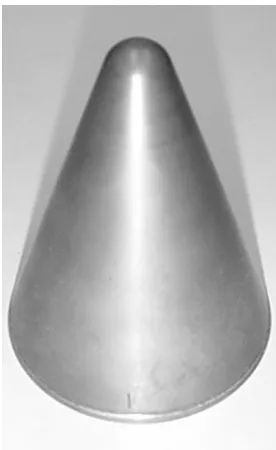
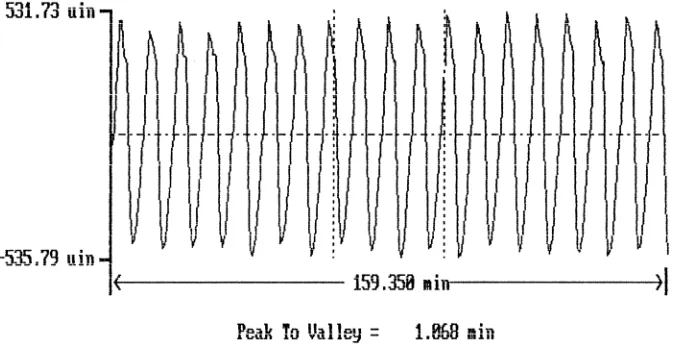
A series of experiments aimed at understanding the influence of the liner interior surface finish on the break-up of shaped charge jets was conducted using four different liner finishes using standard 81-mm 42 degree copper shaped charge liners [9]. Figure 1a presents a photograph of the standard 81-mm shaped charge liner. The purpose of these experiments was to quantify the potential positive or negative influences on the resulting jet break-up caused by finer or coarser surface finishes beyond standard machining. Three non-standard surface finishes, referred to as fine, medium and coarse, were characterized as shown in Table I in addition to the standard production machining. The non-standard liners were machined from conventional high-precision liners at the LLNL precision machine shop. A very small amount of material was removed from the standard liners on the order of 5/10000 inches. Significant attention was paid to assuring that the liners had a constant mass, 225±1.0g, as well as constant high explosive-side surface finish at 22.6 microinches. The resulting surfaces were subsequently measured using a precision surface finish analyzer. Figures 2-4 present the results of the surface finish measurement for the three non-production finish liners.
[image:4.612.229.367.331.556.2]
Figure 1. Standard 81mm shaped charge liner.
TABLE I. SURFACE FINISH IN MICROINCHES
Part Number Pole Middle Waist Average Mass (g)
Figure 2. Surface finish trace of the pole region of fine-finish liner. This liner exhibited an average surface finish of 4.78 microinches.
Figure 3. Surface finish trace of the waist region of medium-finish liner. This liner had an average surface finish of 99.30 microinches.
[image:5.612.105.442.509.684.2]EXPERIMENTAL SETUP
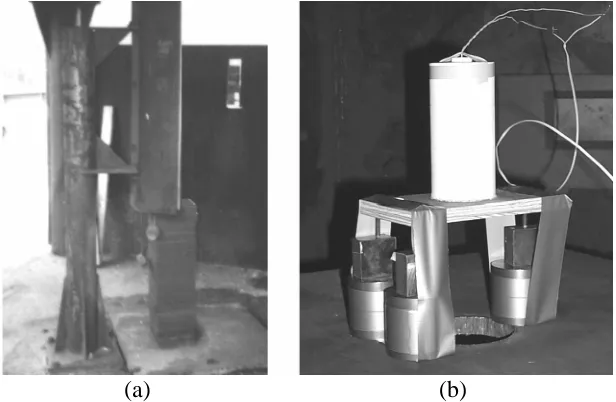
[image:6.612.141.449.305.506.2]The experiments used a standard 81-mm shaped charge design, loaded with LX-14 high explosive. The liners were loaded by forming a preform cavity in a slightly oversize billet and then pressing the liners into the preform cavity under full pressure. The liners were prepared with a fine coat of estane on the explosive contact surface of the liner in order to assure liner to billet cohesion. The resulting shaped charge billets were precision machined to final dimensions and subsequently tested in a bare billet configuration to avoid potential body/billet effects. Photographs of the test stand and explosive billet configuration are shown in Figure 5 (a and b). Liners of each of the surface finishes were tested and recorded using flash x-ray radiographs at relatively long standoff (20 charge diameters) in order to observe jet break-up and post break-up jet characteristics. Reduction of the jet x-rays was accomplished using a high-precision digitizing light table and specialized software developed specifically for shaped charge jet x-ray data reduction.
(a) (b)
Figure 5. (a) Bottom of the test stand, and (b) top of the test stand revealing the explosive billet test configuration.
EXPERIMENTAL RESULTS
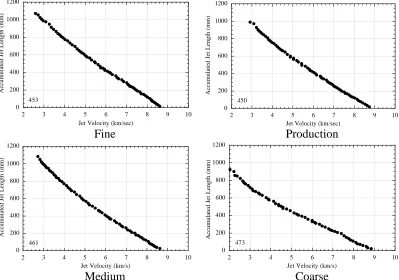
Figure 6 presents jet length versus jet velocity for the four different surface finishes. Figure 7 presents jet break-up time versus jet velocity for the four different surface finishes. The average break-up time of the 4.78-microinch surface finish shaped charge was 177.9µs. The average break-up time of the 44.54-microinch surface finish shaped charge was 169.2µs. The average break-up time of the 99.30-microinch surface finish shaped charge was 183.3µs. The average break-up time of the 375.65-microinch surface finish shaped charge was 138.1µs.
0 200 400 600 800 1000 1200
2 3 4 5 6 7 8 9 10
Accumulated Jet Length (mm)
Jet Velocity (km/sec) 453 0 200 400 600 800 1000 1200
2 3 4 5 6 7 8 9 10
Accumulated Jet Length (mm)
Jet Velocity (km/sec) 450 Fine Production 0 200 400 600 800 1000 1200
2 3 4 5 6 7 8 9 10
Accumulated Jet Length (mm)
Jet Velocity (km/s) 461 0 200 400 600 800 1000 1200
2 3 4 5 6 7 8 9 10
Accumulated Jet Length (mm)
Jet Velocity (km/s) 473
Medium Coarse
Figure 6. Jet length versus jet velocity for different surface finish shaped charges.
80 100 120 140 160 180 200 220 240
2 3 4 5 6 7 8 9 10
Jet Break-Up Time (
µ
s)
Jet Velocity (km/sec) 453 80 100 120 140 160 180 200 220 240
2 3 4 5 6 7 8 9 10
Jet Break-Up Time (
µ
s)
Jet Velocity (km/sec) 450 Fine Production 80 100 120 140 160 180 200 220 240
2 3 4 5 6 7 8 9 10
Jet Break-Up Time (
µ
s)
Jet Velocity (km/s) 461 80 100 120 140 160 180 200 220 240
2 3 4 5 6 7 8 9 10
Jet Break-Up Time (
µ
s)
Jet Velocity (km/s) 473
[image:7.612.98.497.87.367.2]Medium Coarse
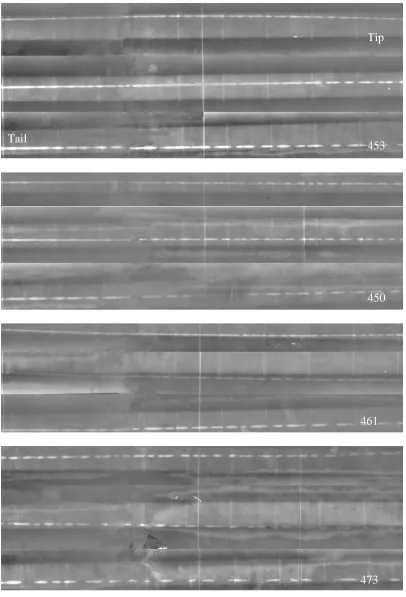
453 Tip
Tail
450
461
4777
[image:8.612.94.500.81.678.2]473
DISCUSSION
Analysis of accumulated jet length as a function of jet velocity in Figure 5 indicates that the fine (#453), production (#450), and medium (#461) surface finishes all had an accumulated jet length of approximately 1000 mm at a cut-off velocity of 3 km/sec. However, the accumulated jet length of the coarse finish liner (#473) reached a maximum of approximately 920 mm at 2 km/sec, and only 720 mm at 3 km/sec. This indicates a dramatic decrease in performance with coarser surface finishes. The results in Figure 6 also indicate that a significant reduction of jet break-up time occurs between a surface finish of 99.30 microinches and 375.65 microinches. Surface finishes of 4.78 (fine), 44.54 (production) and 99.30 (medium) microinches produced significantly better ductility and associated break-up times than the 375.65-microinch finish (coarse). The average break-break-up times of the fine, production, and medium liners do not show a linear relationship with surface finish, however, the break-up times at the front of the jet do increase with decreasing roughness. The significance of this is not fully understood, although a correlation of the tip break-up time and the average break-up time was observed in the data in [2].
Although jet straightness was not ideal, the fine, production, and medium surface finishes all revealed ductile behavior with high aspect ratio particles as shown in Figure 8. The coarse surface finish liner exhibited quite brittle behavior. Jet particles were shorter and wider, and were observed to tumble in late times. The resolution of the radiographs was not sufficient to extract a precise particle size distribution for comparison of the effects of surface finish with computational models.
CONCLUSIONS
The results show that for the shaped charge warhead geometry and explosive combination investigated, some care must be taken in respect to surface finish, but that very fine surface finishes do not provide significant improvement of jet ductility and associated break-up times. To further validate this conclusion, another series of surface finish liner experiments are being conducted. Finally, the results of this study indicate that the previous liner material studies are independent of liner surface finish effects.
ACKNOWLEDGMENTS
REFERENCES
1. Lassila, D.H., E.L. Baker, D.K. Chan, W.E. King, and A.J. Schwartz. 1996. “Effect of Sulfur on the Ductility of Copper Shaped-Charge Jets,” Proceedings of the 16th International Ballistics Symposium, San Francisco, CA, USA, 23-27 September 1996, H.R. Bailey, L. Holden, eds. Arlington, VA: American Defense Preparedness Association, Vol. 1, pp. 31-38.
2 . Schwartz, A.J., D.H. Lassila, and E.L. Baker. 1998. “Analysis of Intergranular Impurity Concentration and the Effects on the Ductility of Copper Shaped Charge Jets.” Proceedings of the 17th International Ballistics Symposium, Midrand, South Africa, 23-27 March 1998, C. Van Niekerk, ed. Moreleta Park, SA: South African Ballistics Organisation, Vol. 2, pp. 439-446. 3. Wang, T., W. Ruan, L. Wang, and T. Zhao. 1996. “The Effect of Residual Impurities on the
Behavior of Depleted Uranium Jets.” Proceedings of the 16th International Ballistics Symposium, San Francisco, CA, USA, 23-27 September 1996, H.R. Bailey, L. Holden, eds. Arlington, VA: American Defense Preparedness Association, Vol. 2, pp. 605.
4 . Duffy, M.L., and S.T. Golaski. 1987. “Effect of Liner Grain Size on Shaped Charge Jet Performance and Characteristics,” U.S. Army Ballistic Research Laboratory Technical Report No. BRL-TR-2800.
5. Cowan, K.G., P.R. Greenwook, R. Cornish, and B. Bourne. 1998. “Hydrocode and Analytical Code Modeling of the Effect of Liner Material Grain Size on Shaped Charge Jet Break-up Parameters.” Proceedings of the 17th International Ballistics Symposium, Midrand, South Africa, 23-27, March 1998, C. Van Niekerk, ed. Moreleta Park, SA: South African Ballistics Organisation, Vol. 2, pp. 217-224.
6. Baker, E.L., A. Daniels, G.P. Voorhis, T. Vuong, and J. Pearson. 1998. "Development of Molybdenum Shaped Charge Liners." Proceedings of the TMS Symposium on Molybdenum and Molybdenum Alloys, San Antonio, TX, 15-19 February 1998, A. Crowson, E.S. Chen, J.A. Shields, and P.R. Subramanian, eds. Warrendale, PA: TMS, pp. 173-182.
7. Lichtenberger, A., N. Verstraete, D. Salignon, M.T. Daumas, and J. Collard. 1996. “Shaped Charges with Molybdenum Liner.” Proceedings of the 16th International Ballistics Symposium, San Francisco, CA, USA, 23-27 September 1996, H.R. Bailey, L. Holden, eds. Arlington, VA: American Defense Preparedness Association, Vol. 1, pp. 49-57.
8. Karlsson, S., S. Savage, A. Watterstam, and B. Janzon. 1996. “Metallurgical Investigation of Hot Isostatically Pressed Copper.” Proceedings of the 16th International Ballistics Symposium, San Francisco, CA, USA, 23-27 September 1996, H.R. Bailey, L. Holden, eds. Arlington, VA: American Defense Preparedness Association, Vol. 2, pp. 607-612.