Abstract— Cloud providers have platforms for users to design, deploy and run applications located in the cloud. Additionally, computing power and storage are also being provided on the cloud. These provisions available on the cloud makes it most suitable for e-leaning purposes. E-learning provides a web-based forum for instructors and students to meet. Both hardware and software systems are required for this purpose. This can easily be implemented using available cloud infrastructure. This study examines current trends in the cloud e-learning areas and provides a useful guide for future research direction. The results showed that benefit of cloud computing was discussed by over 85% of the papers considered, cloud Architecture for e-learning was considered by over 65% of all the papers, around 27% of all the papers discussed e-learning Architecture, benefit of e-learning was considered by 27%, while only 4% discussed the HochschuleFurtwangen University E-learning Cloud Infrastructure.
Index Terms — Cloud, cloud computing; E-learning; Multi-tenancy; Virtualization
I. INTRODUCTION
LOUD is a computing paradigm that enabled convenient,
ubiquitous and on demand access to a pool of shared computing resources such as storage, servers, applications as a pay as you use model with little management effort from the service provider [1]. E-learning involves all manner of learning and teaching in an electronic form. The information system could be a networked type or stand alone, but it serves as the medium through which the learning process is carried out. The e-learning process could be carried in classrooms or outside the class using the information and communications system which continues to advance on a regular basis. E-learning uses computers, networks and the Internet to provide education, knowledge and skills to relevant persons. There are various media through which e-learning information is transferred such as using the Internet, audio and video CDs, local and satellite TV broadcast. The e-leaning process can be done on an individual basis or through an instructor through audio,
Manuscript received October 05, 2018; revised October 05, 2008. This work was supported in part by Center of ICT/ICE Research, CUCRID Building, Covenant University, Ota, Nigeria.
A. Kilanko is with the Department of Computer and Information Sciences,
Covenant University, Ota, Nigeria. (+2348033760204;
A. Falade is with the Department of Computer and Information Sciences,
Covenant University, Ota, Nigeria. (E-mail;
I. Odun-Ayo is with the Department of Computer and Information Sciences, Covenant University, Ota, Nigeria. (E-mail;[email protected])
video, text and animations.
E-learning has various applications that are implemented using the web, the internet, computer-enabled environment and various virtual and collaborative means [2] [3] [4]. The E-learning process mainly utilizes the Internet and using relevant technologies to design, develop, implement and maintain the learning environment [4] [5]. Although the e-learning process has greatly improved learning, it is not expected to completely replace traditional methods of learning. E-learning is widely used for distant training, organizational training and educational applications. E-learning applications are available both on commercial or proprietary basis and open source. Learning content can be hosted on several platforms, such as web servers, cloud servers, among others. Cloud computing provides a mutually beneficial springboard for cloud providers and users to enhance IT service delivery. Cloud computing renders on demand, scalable, and elastic services that can be hosted in on the Internet. Cloud computing is scalable and renders virtualized resources and made available to users or customers [2]. Cloud service providers (CSP) utilizing data centers with state-of-the-art technology, offer IT services to users at a cost. The cloud infrastructure has compute and storage capacity and it’s also a platform for hosting applications. Software as a service is a software distribution model, through web delivery, enabling user to access applications on the Internet [3]. Software applications are offered as a service over the Internet instead of users purchasing licensed software. PaaS provides facilities to support the entire application development life cycle and the deployment of such applications on the platform provided by the CSP [4].
The user is able to create and deploy an application using the APIs provided by the CSP. This frees the user from the need for an operating system or other computing infrastructure. In IaaS, storage and computer resources through the process of virtualization and multi-tenancy, is provided to the user. Clouds can be deployed in four primary ways. There are private, public, community and hybrid clouds. Private clouds are owned by individual organizations with full control over the entire infrastructure. The facility can be on premise or off premises and may be managed by a third party. It is considered more secure than other deployment types. Public clouds are owned by major cloud providers who operate extensive and expensive data centres across geographical locations. They provide users with storage, compute and other services on demand and on a pay-as-you-go basis. Community cloud is use to host several organizations with a shared common interest. It is either managed by the community or a third party. Several organizations share infrastructure based on some policy regarding security, compliance and other issues [5]. Hybrids
E-learning on the Cloud – An Analysis
Abiodun Kilanko, Falade Adesola and Isaac Odun-Ayo Member, IAENG
cloud is a combination of private, public or community cloud. They remain a unique entity but enjoy the benefits of the constituent deployment types.
E-learning based on the cloud makes use of cloud hardware and software infrastructure to enhance the traditional methods of learning. The e-learning educational material are ported to the cloud and placed in a virtual environment by the designers or service providers and thereafter made available to the users. The unique characteristics of cloud computing has provided the relevant infrastructure to e-learning, making it valuable to students, teachers and researchers alike. Applying Cloud computing allows the e-learning process to focus on teaching rather than on complex IT hardware and software management. There are numerous benefits which cloud computing offers to e-learning in terms of storage, computing power, virtualization and multi-tenancy which is relevant to offering educational services [4]
The aim of this paper is to discuss the process of Cloud based learning. The paper provides an insight into e-learning and highlight events currently going on in the industry to enhance e-learning. The remaining part of the paper is organized as follows; Section 2 examines related work. Section 3 discusses the benefits of cloud computing in e-learning. Section 4 discusses the architecture of e-learning in relation to Cloud computing. Section 5 highlights current trends by examining Hochschule Furtwangen University (HFU). Section 6 concludes the paper and makes future recommendation.
II. RELATEDWORKS
E-learning using cloud computing in [6] examines the benefits of using the cloud for e-leaning. Several institutions cannot afford the huge investments involved in e-learning making the cloud a viable option. Efficiency of cloud computing are measured in e-learning systems [2], observes that e-learning requires huge investments in hardware and software. The cloud becomes a useful tool to save cost. The paper examines the efficiency of e-learning on cloud computing based on some metrics. A novel approach for adopting cloud-based e-learning system in [4] proposed steps that institutions could follow in adopting cloud computing for e-learning. Two subsystems were proposed for the utilization of the e-learning cloud. The cloud computing framework which has been adapted and applied in virtual learning environment provides a case study in Arab Academy for Science, Technology & Maritime Transport (AASTMT) in [7] proposes a model for implementing e-learning on the cloud. The framework was implemented and feedback showed a favorable outcome.
A cloud based e-learning system architecture computing in [3] observed that information and communications technology (ICT) is enhancing education. An e-learning cloud was created using certain metrics and the benefits was also discussed. Cloud computing adoption in education and antecedents of cloud computing has led to achieve knowledge management. In [8] implements knowledge management practices in cloud computing. The model was validated using a survey and the conclusion was on the need for increased awareness. A perspective on
e-learning and cloud computing in [9] discusses e-e-learning from the perspective of virtual laboratories. A cloud virtual laboratory system is proposed to improve learning using the cloud infrastructure.
Cloud based e-Learning systems and computing: a review in [10] observed that it has become essential to utilize the cloud with a view to providing e-learning services. The availability of efficient cloud infrastructure will ensure that both the cloud providers and consumers benefit from e-leaning on the cloud. Features of the model was discussed and implemented. The result will enhance teacher ability to evaluate student’s understanding. Cloud computing for E-learning in [11] highlights the services available on the cloud and also discusses the benefits of using the cloud for e-learning. The study of [12] offers concise description of cloud services as a pay per use business model and further introduced their own private cloud with Hochschule Furtwangen University (HFU) staff and students as target users and made offerings for each of the cloud service models (IaaS, PaaS, and SaaS) in their private cloud..
III. CLOUDCOMPUTINGBENEFITSIN E-LEARNING Cloud computing has the following benefits on e-learning [2] [5] [10] [13]:
• Infrastructure: The use of hardware and software solutions based on the e-learning infrastructure provisioned by the CSP.
• Services: The use of an e-learning solution provided in SaaS by the service provider.
• Content: The use and development of an e-learning solution based on platform provided by the CSP through PaaS.
• Low Cost. Those using e-learning applications do not need to have statof-thart systems to connect to e-learning resources. Cloud-based e-e-learning can be done easily through mobile phones and PCs with relevant connections to the Internet.
• Improved Performance. In the application of SaaS, the CSP has control of software and infrastructure including maintenance. Since most applications and processes related to cloud-based e-learning are resident on the cloud, there is improved performance in the e-learning process.
• Regular Software Update: A Cloud user operating an e-learning platform does not need to bother about software updates and other maintenance issues.
• Improved Document Format Compatibility: Some documents do not open on certain applications due to format incompatibility. An e-learning application or other software will resolve this issue on the Cloud through the CSP.
• Benefits for Students: Cloud application are hosted on the Internet and can be accessed anywhere at any time simultaneously. This implies that students can take online courses, online examinations, send their projects and assignments to their instructors and also get feedback on all these things.
power and storage for e-learning purposes.
• High Availability of Services. Cloud computing provides on demand and scalable services that is available at all time in several places to users, enhancing the effectiveness of e-learning.
• Benefits for Teachers. Teachers involved in e-learning also enjoy numerous benefits. They can interact with students, prepare online courses and also examine students.
IV. E-LEARNINGABSTRACTIONSARCHITECTURE The e-learning cloud is unique cloud technology that allows for all the software and hardware components for developing the e-learning environment in a futuristic manner. By utilizing the cloud characteristics of virtualization, the educational materials can be made available to students, teachers and researchers [2] [4] [5] [10]. The e-learning architecture is shown in [5], the user is exposed to e-learning resources on the e-learning cloud.
The basic e-learning is new to education, utilizing IT resources. On the other hand, cloud-based e-learning provides a unique opportunity to students, faculty and researcher in any academic environment because of the benefits provided by the cloud infrastructure. The students can connect to the e-learning resources anywhere on campus to obtain study materials. Faculty members can also take advantage of the e-learning cloud to prepare lecture notes and also interact with the students. Finally, the research community has access to a virtualized infrastructure with adequate network bandwidth and compute power for research purposes. The services provided by an e-learning cloud is shown in [5]
The Cloud computing e-learning architecture is divided into five layers namely; infrastructure, software, resource management, service and application. This is depicted in [2] [3] [10]
Infrastructure Layer
This layer provides the teaching and information infrastructure. This includes the application software, the internet, information system and others. The teaching materials are obtained from the traditional methods and transferred to the cloud environment. In the Cloud services middleware, the infrastructure layer is the lowest layer. The computing resources are also available in this layer. Virtualization technology enable the storage, servers and the network to be accessed by other levels. The physical host pool is scalable and dynamic; hence, new instances are easily provisioned to improve the computing power provided by the middleware. The infrastructure layer is shown in [3]
There is also a monitoring module. The module keeps track of execution of request, real time configuration information and resource utilization.
Software Layer
The software layer comprises mainly of the application and system software making up the middleware. Based on the technology of the middleware, various resources are made available to allow developers design, develop and deploy applications and make such applications available to
users.
Resource Management Layer
This layer is relevant for ensuring necessary interface between the hardware and software. Based on virtualization, schedule strategy, on-demand usage, the free flow and distribution of software over the various hardware resources can be achieved. The modules associated with this layer are as follows.
• Policy module: the policy module establishes for teaching, learning, resource scheduling and for the runtime.
• Arbitration module: the arbitration module is used to make policies, complete user request and resolve and confliction resource issues.
• Provision module: this module initiates the allocation of resources based on collaboration with the processes in the preceding modules.
Service Layer
The service layer provides the services offered by the three primary service types in Cloud computing. This layer enables cloud users to utilize the various cloud resources available for their products.
Business Application Layer
The business layers allow for the coordination of teaching resources on the cloud. This is done through sharing of resources and other interactive processes. The interactive process is meant for faculty members based on the teaching and learning requirements of the student. Adjustments can be made from feedbacks based on the underlying resources and the progress of learning. This layer is made up of assessment and management component, content production, and educational objectives content delivery technology.
Virtualization Layer
The virtualization layer deals with the virtual machines utilized in the cloud model. Cloud resources such as servers, storage and networks are provisioned in an elastic manner using visualization to ensure that the cloud e-learning process offers the best services. Virtualization is a server solutions that allow simultaneous interleave operation systems known as guests to run at the same time on the host computer.
V. THEHOCHSCHULEFURTWANGENUNIVERSITY E-LEARNINGCLOUDARCHITECTURE
A. The HFU E-Learning Infrastructure
access for e-learning process through a Servlet Container Platform and on-demand collaborations software
The PC pool has 18 computers with Ubuntu Operating System and KVM, while other pools have Debian OS and Xen hypervisor configuration. The PC and Server pools are utilized by faculty and students for teaching and learning purposes, while research and development is done on the research pool. Pools management is done through CloudIA’s Cloud Management System (CMS)
The CMS is broken into various layers to allow for scalability and maintenance. A security, management and monitoring component are available in all the layers to ensure efficient services. The description of the layers is as follows;
User Interface Layer: this is like an access layer for all the user of the CMS users, enabling both the users and administrators alike to access the system.
Business Layer: this layer deals with the economics of cloud computing by allowing price and service level agreements issues to be optimized. It also allows virtual machines to be reserved by users in advance, including control of the virtual machines (VMs).
System Layer: this is an operational layer that provides the environment to optimize the quality of service, job queues and management of user accounts.
Resource Interface Layer: this is the layer responsible for the hardware. Relevant interfaces are provided to connect to the databases, the virtual environment and other systems such as Xen, Amazon EC2, Amazon S3 and Nagios.
Monitoring and Management Component: this layer allows for adequate management and monitoring of all the other layers to ensure reliability of the system. This system administrator is able to mitigate against likely failures, resolve SLA issues and optimize the utilization of resources.
Components of Security: to ensure transaction, integrity, recovery privacy and security of user data , a security layer is provided.
B The HFU and Single Sign on Using Shibboleth To prevent duplicating user management, the HFU system utilizes the single sign on using (SSO) Shibboleth for authentication purposes [14]. This includes access to the CloudIA platform services such as servlet container Platform (SCP) and CollabSoft. Shibboleth provides the needed interface between the existing infrastructure and the HFU cloud services. Shibboleth’s primary tools are the service provider, identity provider (IdP), and discovery service for localization of the IdP. Federation is simple to provide because a user can process authentication through
the home IdP, while the authorization is also granted through the service provider of the same home IdP. Shibboleth provides access to the CloudIA platform. A major requirement of Shibboleth is that all service providers produce a certificate that is valid. Based on the fact that the certificates are processed dynamically, the certificate of an instance is available at runtime. Consequently, the CloudIA has a record of all pre-set certificates for the service providers [14].
Virtual Machine Creation.
There is a front-end in the system which allows students to log in, create, delete or suspend virtual machines based on their needs using a wizard. A student is provided with a maximum of three VMs and a maximum of 1Gb per VM with one hundred hours of CPU time per semester. There are two unique features: creator and monitoring of VMs in CloudIA. Also, users can decide on the type of applications they want to install during the VM creation, instead of the usual preconfigured VM images.
Platform-as-a-Service: Servlet Container Platform. A servlet container platform (SCP) is implemented using PaaS for HFU courses. The courses include middleware such as, web framework and Java framework. The SCP enables students to design and deploy their applications to the e-learning infrastructure without having to install and configure software
Software-as-a-Service: On A Demand Collaboration Software
There is an online learning and training (OLAT) provided on the HFU infrastructure. The OLAT allows for easy online course system supported by the versions of the system subversion (SVN) and the jabber instant messenger server based on XMPP. The OLAT allows users to create custom environment by enabling users to create working groups and adding relevant functionalities like chat and forums. Based on the high demand for OLAT and that it takes a whole day for installation and configuration, there was a need to have the CollabSoft. The CollabSoft is an OLAT system that is available on-demand and it is installed in a custom VM [16]. The CollabSoft VM image comprises an apache server, the versioning system subversion, a database server, the Tomcat servlet container with the OLAT and an instant messaging server. The HFU Architecture is shown in [14].
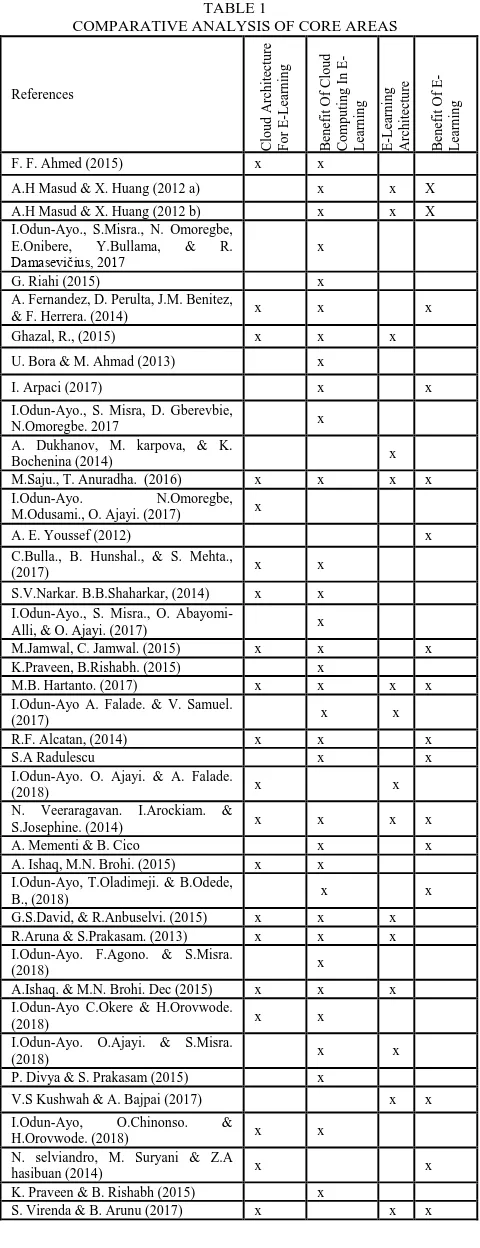
VI. ANALYSIS AND DISCURSION
TABLE 1
COMPARATIVE ANALYSIS OF CORE AREAS
References
Cl
o
u
d
Arc
h
it
ect
u
re
Fo
r E
-L
earn
in
g
Ben
efi
t Of Cl
o
u
d
Co
mp
u
ti
n
g
In E
-L
earn
in
g
E
-L
earn
in
g
A
rch
it
ect
u
re
Ben
efi
t Of E
-L
earn
in
g
F. F. Ahmed (2015) x x
A.H Masud & X. Huang (2012 a) x x X
A.H Masud & X. Huang (2012 b) x x X
I.Odun-Ayo., S.Misra., N. Omoregbe, E.Onibere, Y.Bullama, & R. Damasevičius, 2017
x
G. Riahi (2015) x
A. Fernandez, D. Perulta, J.M. Benitez,
& F. Herrera. (2014) x x x
Ghazal, R., (2015) x x x
U. Bora & M. Ahmad (2013) x
I. Arpaci (2017) x x
I.Odun-Ayo., S. Misra, D. Gberevbie,
N.Omoregbe. 2017 x
A. Dukhanov, M. karpova, & K.
Bochenina (2014) x
M.Saju., T. Anuradha. (2016) x x x x
I.Odun-Ayo. N.Omoregbe,
M.Odusami., O. Ajayi. (2017) x
A. E. Youssef (2012) x
C.Bulla., B. Hunshal., & S. Mehta.,
(2017) x x
S.V.Narkar. B.B.Shaharkar, (2014) x x
I.Odun-Ayo., S. Misra., O.
Abayomi-Alli, & O. Ajayi. (2017) x
M.Jamwal, C. Jamwal. (2015) x x x
K.Praveen, B.Rishabh. (2015) x
M.B. Hartanto. (2017) x x x x
I.Odun-Ayo A. Falade. & V. Samuel.
(2017) x x
R.F. Alcatan, (2014) x x x
S.A Radulescu x x
I.Odun-Ayo. O. Ajayi. & A. Falade.
(2018) x x
N. Veeraragavan. I.Arockiam. &
S.Josephine. (2014) x x x x
A. Mementi & B. Cico x x
A. Ishaq, M.N. Brohi. (2015) x x
I.Odun-Ayo, T.Oladimeji. & B.Odede,
B., (2018) x x
G.S.David, & R.Anbuselvi. (2015) x x x
R.Aruna & S.Prakasam. (2013) x x x
I.Odun-Ayo. F.Agono. & S.Misra.
(2018) x
A.Ishaq. & M.N. Brohi. Dec (2015) x x x
I.Odun-Ayo C.Okere & H.Orovwode.
(2018) x x
I.Odun-Ayo. O.Ajayi. & S.Misra.
(2018) x x
P. Divya & S. Prakasam (2015) x
V.S Kushwah & A. Bajpai (2017) x x
I.Odun-Ayo, O.Chinonso. &
H.Orovwode. (2018) x x
N. selviandro, M. Suryani & Z.A
hasibuan (2014) x x
K. Praveen & B. Rishabh (2015) x
S. Virenda & B. Arunu (2017) x x x
85% of the papers considered, cloud Architecture for e-learning was considered by over 65% of all the papers, around 27% of all the papers discussed e-learning Architecture, benefit of e-learning was considered by 27%, while only 4% discussed the HochschuleFurtwangen University E-learning Cloud Infrastructure. Benefit of cloud computing in e-learning is the most discussed and the HochschuleFurtwangen University E-learning Cloud
Architecture is the least considered. It is not surprising that benefits of cloud computing received the highest consideration. This shows the advantages of cloud computing to e-learning compared to all other platforms.
VII. CONCLUSION
E-learning involves the utilization of hardware and software provided through the Internet to users for the purpose of improving education. E-learning has a unique architectural layer such as application, management, software and others. A typical application of cloud-based e-learning in a university environment adopted by HFU was discussed. Cloud computing is definitely enhancing the way e-learning is being conducted. Most e-learning infrastructure in Africa are not cloud-based. It is recommended that further studies be conducted in this area.
ACKNOWLEDGMENT
This is to acknowledge the sponsorship and support provided by Covenant University through the Centre for Research, Innovation and Discovery (CUCRID).
REFERENCES
[1] P. Mell, & T. Grance, (2011) “The NIST Definition of Cloud
Computing”, NIST Special Publication 800-145
[2] P. Pocatilu, F. Alecu, & M. Vetrici, (2010), “Measuring the Efficiency
of Cloud Computing for E-learning Systems”, WSEAS Transactions on Computers, Issue 1, Volume 9, January 2010, ISSN: 1109-2750,
[3] Md. A.H. Masud, X. Huang, (2012), “An E-learning System
Architecture based on Cloud Computing”, World Academy of Science, Engineering and Technology International Journal of Computer, Electrical, Automation, Control and Information Engineering Vol: 6, No: 2, 2012.
[4] Md. A. H. Masud, X. Huang, (2012), “A Novel Approach for
Adopting Cloud-based E-learning System”, 2012 IEEE/ACIS 11th International Conference on Computer and Information Science. DOI 10.1109/ICIS.2012.10.
[5] G. Riahi, (2015), “E-Learning Systems Based On Cloud Computing:
A Review”, The 2015 International Conference on Soft Computing and Software Engineering (SCSE 2015). Procedia Computer Science 62 (2015) 352 – 359.
[6] U. Bora, M. Ahmed, (2013), “E-Learning using Cloud Computing”,
International Journal of Science and Modern Engineering (IJISME) ISSN: 2319-6386, Volume-1, Issue-2, January 2013.
[7] I. Arpaci, (2017), “Antecedents and Consequences of Cloud
Computing Adoption in Education to Achieve Knowledge Management”, Computers in Human Behavior 70 (2017) 382 – 390
[8] Ș. A. Rădulescu, (2014), “A perspective on E-Learning and Cloud
Computing”, WCLTA 2013, Procedia - Social and Behavioral Sciences 141 (2014) 1084 – 1088.
[9] F.F. Ahmed, (2015), “Comparative Analysis for Cloud Based
e-learning”, International Conference on Communication, Management and Information Technology (ICCMIT 2015), Procedia Computer Science 65 (2015) 368 – 376.
[10] S. Ceron-Figueroa, I. Lopez-Yanez, W. Alhalabi, O. Camacho-Nieto,
Y. Villuendas-Rey, M. Aldape-Perez, & C. Yanez-Marquez, (2017), “Instance-based ontology matching for e-learning material using associative pattern classifiers”, Computers in Human Behavior 69 (2017) 218 – 225
[11] A. Dukhanov, M. Karpova, K. Bochenina, (2014), “Design Virtual
Learning Labs for Courses in Computational Science with use of Cloud Computing Technologies”, ICCS 2014. 14th International Conference on Computational Science, Procedia Computer Science, Volume 29, 2014, Pages 2472–2482.
[12] Doelitzscher, F., Sulistio, A., Reich, C. et al. Computing (2011) 91:
23. https://doi.org/10.1007/s00607-010-0106-z
[13] M. S. Jamwal, & C. Jamwal, (2015), “Cloud Computing for
Technology (ACSIT) Print ISSN: 9907; Online ISSN: 2393-9915; Volume 2, Number 8; April-June, 2015 pp. 26-29.
[14] A. E. Youssef, (2012) Exploring Cloud Computing Services and
Applications, Journal of Emerging Trends in Computing and Information Sciences, VOL. 3, NO. 6, July 2012.
[15] A. Fernández, D. Peralta, J.M. Benita, & F. Herrera, (2014)
‘E-learning and educational data mining in cloud computing: an overview’, Int. J. Learning Technology, Vol. 9, No. 1, pp 25-52.
[16] M. Saju & T. Anuradha, (2016) “E-Learning with Cloud Computing:
A Next Generation Technological Learning”, International Research Journal of Computer Science (IRJCS), Issue 08, Volume 3 (August 2016).
[17] C. Bulla, B. Hunshal & S. Mehta, (2016) “Adoption of Cloud
Computing in Education System”: A Survey, ISSN 2321 3361 © 2016 IJESC, DOI 10.4010/2016.1532
[18] S. V. Narkar & B. B. Shaharkar, (2014), “Cloud-based Education: For
Improving Efficiency, Cost and Convenience”, International Journal of Computer Applications® (IJCA) (0975 – 8887), National Seminar on Recent Trends in Cloud Computing, NSRCC-2014
[19] K. Praveen & B. Rishabh (2015), “Application of cloud computing in
the field of education” International Journal of Engineering Sciences & Research Technology (IJESRT) ISSN: 2277-9655 [Kumar, 4. (7): July, 2015]
[20] M. B. Hartanto (2017), “The Development of E-Learning Systems
Application Based on Cloud Computing for Higher Education” 3rd International Conferences on Information Technology and Business (ICITB), 7th Dec 2017 ⁞29
[21] I. Odun-Ayo, C. Okereke, and H. Orovwode (2018) "Cloud and
Application Programming Interface - Issues and Developments," Lecture Notes in Engineering and Computer Science: Proceedings of The World Congress on Engineering 2018, 4-6 July, 2018, London, U.K., pp169-174
[22] I. Odun-Ayo, O. Ajayi, N. Omoregbe, (2017), “Cloud Service Level
Agreements –Issues and Development”, Proceedings of the International Conference on Next-Generation Computing and Information Systems (ICNGCIS, 2017) Model Institute of Engineering and Technology Jammu, India 11-12 December 2017, pp. 1-6. DOI 10.1109/ICNGCIS.2017.18
[23] I. Odun-Ayo, O. Ajayi, N. Omoregbe, (2017), “Virtualization in
Cloud Computing: Developments and Trends”, Proceedings of the International Conference on Next-Generation Computing and Information Systems (ICNGCIS, 2017) Model Institute of Engineering and Technology Jammu, India 11-12 December 2017, pp. 24-28 DOI 10.1109/ICNGCIS.2017.10
[24] I. Odun-Ayo, O. Ajayi, and S. Misra (2018) "Cloud Computing
Security: Issues and Developments," Lecture Notes in Engineering and Computer Science: Proceedings of The World Congress on Engineering 2018, 4-6 July, 2018, London, U.K., pp175-181
[25] I. Odun-Ayo, A. Falade, and V. Samuel, (2018), "Cloud Computing
and Open Source Software: Issues and Developments," Lecture Notes in Engineering and Computer Science: Proceedings of The International Multiconference of Engineers and Computer Scientists 2018, 14-16 March, 2018, Hong Kong, pp140-145
[26] I. Odun-Ayo, O. Ajayi, and A. Falade, (2018), "Cloud Computing and
Quality of Service: Issues and Developments," Lecture Notes in Engineering and Computer Science: Proceedings of The International MultiConference of Engineers and Computer Scientists 2018, 14-16 March, 2018, Hong Kong, pp179-184
[27] I. Odun-Ayo, F. Agono, & S. Misra, (2018), "Cloud Migration: Issues
and Developments," Lecture Notes in Engineering and Computer Science: Proceedings of The International MultiConference of Engineers and Computer Scientists 2018, 14-16 March, 2018, Hong Kong, pp231-236
[28] R. Aruna. & S. Prakasam, Ph. D “Enhancing Cloud based E- Learning
using Knowledge Sharing System” International Journal of Computer Applications (0975 – 8887) Volume 84 – No 9, December 2013
[29] I. Odun-Ayo, O. Ajayi, N. Omoregbe, (2017), “An Overview of Data
Storage in Cloud Computing.”, Proceedings of the International Conference on Next-Generation Computing and Information Systems (ICNGCIS, 2017) Model Institute of Engineering and Technology
Jammu, India 11-12 December 2017, pp. 29-34. DOI
10.1109/ICNGCIS.2017.9
[30] A. Ishaq & M.N. Brohi, PhD “Literature Review of Cloud Computing
in Education Sector: A survey with respect to Qatar” International Journal of Computer Applications (0975 – 8887) Volume 132 – No.17, December2015
[31] I. Odun-Ayo, B. Odede, and R. Ahuja (2018) “Cloud Applications
Management- Issues and Developments”, Lecture Notes in Computer
Science (including subseries Lecture Notes in Artificial Intelligence and Lecture Notes in Bioinformatics) 10963 LNCS, pp. 683-694
[32] N. Veeraragavan, L. Arockiam, Ph.D. & S. E. Josephine (2014) “A
Novel Edu-Cloud Sec Framework for E-Learning System” International Journal of Computer Applications (0975 – 8887) (2014)
[33] P. Divya. & S. Prakasam M.C.A, Ph.D. “Effectiveness of Cloud based
E-Learning System (ECBELS)” International Journal of Computer Applications (0975 – 8887) Volume 119 – No.6, June 2015
[34] I. Odun-Ayo, T. Oladimeji & B. Odede, (2018), "Cloud Computing
Economics: Issues and Developments," Lecture Notes in Engineering
and Computer Science: Proceedings of The International
Multiconference of Engineers and Computer Scientists 2018, 14-16 March, 2018, Hong Kong, pp190-195
[35] V. S. Kushwah & A. Bajpai “Cloud Computing: A Future
e-Learning Environment” ISSN: 2393-9028 (PRINT) | ISSN: 2348-2281 (ONLINE) (IJRECE) VOL. 5 ISSUE 4 OCT.-DEC. 2017
[36] I. Odun-Ayo, S. Misra, N. Omoregbe, E. Onibere, Y. Bulama, & R.
Damasevičius (2017) “Cloud-Based Security Driven Human Resource Management System” Paper presented at the Eighth International Conference on the Applications Digital Information and Web Technologies (ICADIWT 2017) Organized by Universidad Autonoma de Ciudad Juarez, Juarez City, Mexico March 29- 31, 2017 pp. 96 – 106.
[37] I. Odun-Ayo, S. Misra, D. Gberevbie & N. Omoregbe (2017) “Cloud
Computing and E-Governance: Current Issues and Developments” Paper presented at the 4th Covenant University Conference On E-Governance in Nigeria (CUCEN 2017) Organized by Covenant University, Ota, Ogun State, Nigeria. 7th – 9th June 2017. pp. 46 – 64.
[38] R. F. AlCattan (Jun 2014) “Integration of Cloud Computing and
Web2.0 Collaboration Technologies in E-Learning” International Journal of Computer Trends and Technology (IJCTT) – volume 12 number 1 – Jun 2014
[39] A. Memeti & B. Çiço “Decentralized e-Learning Environment Using
Cloud Computing Models”
[40] I. Odun-Ayo, N. Omoregbe, M. Odusami & O. Ajayi (2017) “Cloud
Ownership and Reliability - Issues and Developments” Paper presented at 10th International Conference on Security, Privacy and Anonymity in Computation, Communication and Storage (SpaCCS 2017). Organized by Guangzhou University, Guangzhou, China. 12th – 15th December 2017.
[41] I. Odun-Ayo, S. Misra, O. Abayomi-Alli & O. Ajayi (2017) “Cloud
Multi-Tenancy: Issues and Developments” Paper presented at the 4th IEEE/ACM International Conference on Big Data Computing, Applications and Technologies, (BDCAT 2017). Organized by University of Texas, Texas, USA. 5th – 8th December 2017. pp. 209 – 214.
[42] I. Odun-Ayo, M. Ananya, F. Agono and R. Goddy-Worlu (2018)
“Cloud Computing Architecture: A Critical Analysis”, IEEE Proceedings of the 2018 18th International Conference on Computational Science and Its Applications (ICCSA 2018),
Melbourne, Australia 2 – 5 July 2018, pp. 1-7 doi:
10.1109/ICCSA.2018.8439638
[43] I. Odun-Ayo, C. Okereke, and H. Orovwode (2018) "Cloud
Computing and Internet of Things: Issues and Developments," Lecture Notes in Engineering and Computer Science: Proceedings of The World Congress on Engineering 2018, 4-6 July, 2018, London, U.K., pp182-187
[44] A. Ishaq & N.M. Brohi (2015) “Cloud computing in education sector
with security and privacy issue: a proposed framework” International Journal of Advances in Engineering & Technology, Dec., 2015. (IJAET) ISSN: 22311963 Vol. 8, Issue 6, pp. 889-898
[45] G. S. David &. R. Anbuselvi (2015) “An Architecture for Cloud
Computing in Higher Education” International Conference on Soft-Computing and Network Security (ICSNS -2015), Feb. 25 – 27, 2015
[46] S. Virendra & B. Aruna “Cloud Computing: A Future e-Learning
Environment” ISSN: 2393-9028 (PRINT) | ISSN: 2348-2281 (ONLINE) (IJRECE) VOL. 5 ISSUE 4 OCT.-DEC. 2017
[47] N. Selviandro, M. Suryani & Z. A. Hasibuan, (2014) “Open