Analysis of Possible Security Attacks and Security
Challenges Facing Vehicular-Ad Hoc Networks
Ibraheem Abdelazeem Ibraheem, Weibin Zhang*, Abdeldime M.S. Abdelgader and Feng Shu
Abstract—Vehicular Ad-Hoc Network (VANET) is a technology that has been recently designed as one of the emerging future communications systems, a critical specialist used to support Intelligent Transportation Systems (ITS) by implementing a wide range of automotive applications and services. The primary objectives of VANET are to improve road safety and driving conditions. In addition, it supply many services including tol-l payment services, navigation, warning messages, congestion avoidance, alarm signals, and convenient internet access. The vehicle networks facing many different challenges and attacks due to lack of permanent infrastructure and high mobility. To maintain the network carefully against attackers, the security design of VANET must ensure integrity, authentication and con-fidentiality services. Moreover, as that network is very dynamic, making it a unique type of network, it is important to consider how this affects network security. Hence, this paper discusses the components and characteristics of vehicular networks. It has also presents survey of security challenges facing vehicle networks and security requirements. Moreover, it summarizes and analyses the possible attacks and a set of security weaknesses exist in VANET.
I. INTRODUCTION
Vehicular Ad-Hoc network (VANET) is a technology that combines the capabilities of new wireless networks with vehicles [1]. VANET creates a strong network between moving vehicles and roadside units(RSU) [2], [3], [4]. It is a type of mobile Ad-Hoc networks (MANETs) that establishe communication between adjacent vehicles and nearby fixed devices, which is generally described as a side by (RSU)[5]. VANET can makes an important connection between the dynamic node by using different network equipment such as the IEEE 802.11 b / g wife, WiMAX IEEE 802.10, bucktooth and IRA[6].
The idea of the network is designed to provide a wide range of applications proposed by the group of engineers from (Delphi Delco) Electronics and IBM in 1998 [2], [3]. With the development in wireless communications technology, the concept of network vehicles has attracted interests all over the world. The goal of VANET is to allow communication between vehicles, and access to acceptable road safety and transport sector management. VANET connections are also subject to much faster fermentation, multi-path delay prop-agation and more Doppler frequency propprop-agation than other
Manuscript received June 12, 2019; revised July 14, 2019.
Ibraheem Abdelazeem Ibraheem, Weibin Zhang and Feng Shu are with the School of Electronic and Optical Engineering, Nanjing University of Science and Technology, Nanjing 210094 e-mail:[email protected], Weibin email:[email protected].
Abdeldime M.S. Abdelgader is with Karary University, Khartoum, 12304, Sudan. Email: [email protected]
wireless systems. Applications supported by VANET includes life safety applications, safety warning applications, electronic fee packages, internet access, group communications, and online service finders [7], [8].
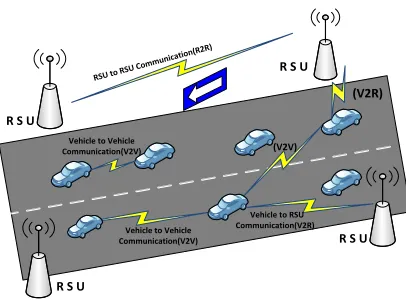
In recent years, many new projects has been started and targeted to realize the dream of car networks and effective implementation of vehicle networks[5]. The vehicles are connected to each other (V2V) or with the Road Side Unit (V2R) by single hop or multiple protocols over the vehicle network of the contract. The probe is a small, low-cost, low-power device capable of sensing the environment, distributing data, and wirelessly communicating with certain base stations or end users. These contacts are qualified for various applications to enhance road safety and effective transportation [9], [10], [11].
Since VANET is a technology that create a mobile network,
R S U
R S U
R S U
R S U Vehicle to Vehicle
Communication(V2V)
(V2V)
Vehicle to Vehicle Communication(V2V)
Vehicle to RSU Communication(V2R)
[image:1.612.335.538.480.634.2](V2R)
Fig. 1: VANET Components
step aside of the signal range and fall off the network, other vehicles can link in, connecting vehicles to one another consequently generates mobile internet [12]. The (RSU) is tasked as a router between vehicles on the road and linked to other network devices [6]. Each vehicle can connect with other cars using the Dedicated Short Range Communication (DSRC) short radio signals (5.9 GHz), and can reach the range of one kilometer. This connection is a dedicated connection, that meaning each connected node can move generously, without the dial to the wires. Each vehicle has an onboard unit (OBU), and this unit links the car with the RSU by DSRC radios, and another device called Tamper Proof Device (TPD) , wich is a device that fields the vehicle confidences, all the information about the vehicle like keys, drivers identity, trip details, speed, and rout.
The Intelligent Transport System (ITS) supported the oper-ation of informoper-ation exchange in dedicated networks around the vehicle from V2V or with its proximity to the base station (RSU). The nature of the open access medium in VANET makes it vulnerable to many attacks. However, security is the significant requirement in VANET [13], [14], [15]. To fortification VANET parts from attacks with methods such as denial of service attacks (DOS), many insurance methods are proposed. There are many Constraints in VANET they are listed in the following points.
• Security Requirements
Make sure that the authorized user creates the connection. Denial of service attack (DOS) can cause the network to be dropped. Failure to report indicates that the nodes cannot be undone because the user does not forward a message, choosing the correct sequence is necessary, and it is requisite to complete structured data to eliminate counterfeit messages [9].
• Attacks in VANET
Tapping is a public attack on secrecy, and routing attacks are attacks that destroy the network layer routing protocol node vulnerability to hijack a session only after the connection is established. Usually, the driver himself is the owner of the vehicle, so obtaining the owner’s identity can threaten privacy [13].
• Attackers on VANET
Predictable attacks are characterized by their unique and passive use: Active attackers create signals or packets while passive attackers perceive the network only, wicked and rational malicious attackers have no personal advan-tage after the attack, they damage the network operation . Inside and Out: Insiders are real members of the system while outsiders are hackers, thus an incomplete number of attacks [14].
• Technical Problem
It is difficult to manage the network and control over-crowding in the network, in VANET electromagnetic waves are used to communicate, and this environment is affected [15]. As network topology and channel con-dition change rapidly, and due to high transportability, the environmental impact must be taken into account in
VANET.
This paper presented the components and characteristics of vehicular network and discussed the security challenges fac-ing vehicle network that raise many problems and provided comprehensive information on VANET various security re-quirements. In addition to detailing security requirements and potential attacks and classifying them. The rest of the paper is organized as.
SectionII represents structure and characteristics of VANET. The VANET security requirements are presented in section
III. SectionIVsummarizes the different attack classifications on VANET. Finally, sectionVconcludes the paper and future direction of the action plan.
II. STRUCTURE ANDCHARACTERISTICS OFVANET
A. Component of VANET
VANET is a self-organization wireless network, hence the building of vehicular ad hoc network included several hard-ware and softhard-ware components. In this section, the charac-teristics and environment under which vehicular network is designed are described. The user is the prime component of the vehicular network, and this network aims to avail and serve the right information around the road to the user [7]. VANET contains the following structures:
1) Vehicles
Vehicles are the nodes of the vehicular networks. VANET produces the wireless communication between vehicles (V2V) and between vehicles and infrastructure arrival point (V2I).
2) Infrastructure
Infrastructure in relation to the outside environments contains the roadside base stations. Which are the road-side units and they are situated at a devoted location like a cross or near parking spaces Their primary functions are to increase the communication zone of the ad hoc network by re-stretch the information to others and to work safety applications like low bridge warning, accident warning, etc .
3) Communication Channels
Radio waves are the shape of electromagnetic radiation that plays an active role in protocol performance to limit the number of nodes within a single conflict range with wavelengths in the electromagnetic spectrum longer than the infrared light. Radio waves have frequencies of 190 GHz to 3 kHz [16].
B. VANET Characteristics
1) High Mobility and Rapidly Changing Network
2) Unbounded Network Size
Network size in VANET has no geographical limit, it can consist of towns, cities, or even countries. Information exchange in this quick network is much repeated because it gets signals from other vehicles as well as RSUs [2]. Careful and timely transferred information can only minimize the hazard on the road. VANET supplies such standards enabling a driver to get information on time and avert accidents [18].
3) Wireless Communication
Nodes are wirelessly connected and exchange their information
4) High Computability Ability
The computational capacity of the node is increased, due to computational funds and sensors [16].
5) Hard Delay Constraints
Safety messages are the aim of VANET. Therefore, safety messages should be given high priority and must be transferred on time [19].
The above unique characteristics breed new challenges that need to be resolved in the vehicular network environments. The main problems of the vehicular network can be abbrevi-ated, as follows:
• The signal strength difference received causes an inter-mittent connection.
• High mobility causes repeated neighborhood fluctuation. • Hidden or exposed peripheral problems occur as a
con-cern of packet loss.
• Mounting channel load (High-intensity environment). To solve these problems, a number of efforts have been made. The literature contains a significant amount of studies classifying these challenges in all parts. The studies research to address all layers related issues ranging from lower layers (physical and MAC layers) enhancement to upper layers application developments.
III. SECURITY REQUIREMENTS FOR VANET
In VANET, security is required as VANET packets hold dangerous life information and it is fundamental that these packets must come to the drivers without any modification or admission of data. Similarly, the accountability of drivers should also be recognized [9]. That they notify the traffic setting appropriately and within time. However, VANET must content following security requirements.
• Availability
Vehicular networks will provide requisite real-time for many purposes so they must be available all the time. These applications need an immediate reaction from sensor networks or Ad-Hoc if there is some delay in seconds for different forms network, the annihilation of the result can occur,or the message can become in utile [16].
• Authentication
Authentication includes the process of checking the
transmitter identity, and setting if he has the rights to connect through the network, meaning to be able to send and receive messages through the network VANET, It is important that the data which propagates in the organism must be correct and created by an authentic client because in VANET nodes respond access, to the data established from the other end [7], [11].
• Privacy
Personal information about vehicles and drivers must be safe and confined such as real identity, destination, and speed from unauthorized access [8]. The requirement of privacy is necessary in group communications, as this security requirement is the warranty that data will only be read by confirmed users where hardly group members are unable to understand such data.
• Integrity
All messages that are sent and received through the network must be secure against modification attacks in order, to trust messages contents. In a vehicular network, data integrity is one of the most critical security aims, and it must be maintained while communicating V2V or vehicle to roadside unit V2R [11]. Message content should not be modified during it goes from sender to receiver, if the source is an authentic user of the network but message contents has been changed then there is no necessity to check the authenticity of the source user. The message meaning is very vital while connecting in safety and no safety applications of the vehicular network.
• Non-Repudiation (NR)
Particular authority is assured for sender identification, the vehicle could be specified from the documented messages it sends. In this security based system, a sender can be set easily. This averts deception from rejecting their crimes because even if the attack happens, (NR) will smooth the ability to observe the attacker[18].
IV. CATEGORIZE ATTACKS AND THREATS:
Attacks on VANET impact in his modality, to cure with these attacks, many researchers classify these attacks [18], it can be in general classified into three major groups, those that pose a threat to availability, a threat to authenticity, a threat to driver confidentiality, and diversity. Confidentiality, integrity and availability(CIA)are the main modules of security aims. The increasing research attention, potential applications, and security problem in VANET prime to the requirements to appraise the attacks on security goals. This section, as shown in Figure2presents the survey of attacks on security objectives and labels in particulars the nature of attacks and the behavior of attackers through different scenarios in the network [9].
TABLE I: Classifications of Attacks.
Attack Name Attack Type Attack Effects
Timing Attack Insider Attack, malicious Integrity
Man-in-the-Middle Insider Attack Confidentiality, Privacy, and Integrity
Bogus Information Insider Attack Authentication
Black Hole Outsider, passive Attack Availability
Malware Insider Attack, malicious Availability
Monitoring Attack Monitors Road Activity Authenticity and Privacy
Sybil Attack Insider, network Attack Authentication and Privacy
Spamming Insider Attack, malicious Availability
Wormhole/Tunneling Outsider, malicious, monitoring Attack Authentication and Confidentiality
Dos Malicious, active, insider, network Attack Availability
Security Attacks in
VANET Attacks on
Confidentiality
Attacks on Availability Monitoring
Attack
Traffic Analysis Attack
Man in the Middle Attack (MIMA)
Attacks on the Integrity
Incorrect
Data Injecting Message
Fabrication Attack
Message Alteration Attack
Denial of Service Attack (DOS)
Distributed Denial of
Service Attack( DDOS)
Malware
Attack Tampering Broadcast Attack
Black-Hole
Attack Spamming Attack
Fig. 2: Possible Attacks on Security Requirements
in [19]. Categorized attacks there are treated to requirements VANET (authenticity, confidentiality,and availability). While researchers in [20]. Categorized attackers into three classes: Selfish Driver, malicious attacker, and pranksters. Also, there are different calcification suggested by researchers in [21]. They distributed attacks as Network AttackN A,Social attack (SA), monitoring aAttack (M A), timing attack(T A), social attack (SA), and application attack. Another classification
indicated in [22]. Attacks were described in three categories: Active vs Passive, insider vs outsider, and malicious. Rational vs Each category defines different types of attacks. In this section, we discuss some of these attacks.
A. Attacks on Confidentiality
One of the important issues for vehicle users is not to disclose the identity and privacy of the site, which includes blocking the exact location in time and space to protect the users by hiding the request of the user and it cannot be distinguished from the requests of other users [19]. Another part of confidentiality is to analyze the traffic flow from V2V or from vehicle to RSU communication, in which attackers are just saved and monitored on the communication between vehicles and the needed information is collected. Possible attacks concerning to confidentiality are offered, below through different scenarios [8].
1) Monitoring Attack: In this form of attack, the
total network is checked, and the attacker listens to all communications in the V2V and the car to a roadside unit (V2R) [23]. When any data relevant to its needs are heard, this data is directed to the person mind. For instance, in the case of a policy process, the police planned an operation against a certain criminal in a specific area. To transport the process, the police must connect with each other to pass details, such as precise location and run time. The attackers snoop on all communications and inform the criminals about the next police operation.
2) Traffic Analysis Attack: This attack is considered to
[image:4.612.72.278.362.574.2]for its desired objective.
3) Man in the Middle Attack(M IM A): In the MIMA the
attacker is after listening to the contact between the vehicles and carries out the wrong or changed message insertion between vehicles. Valid vehicles think they are directly connected with each other and that the attacker protests traffic and controls all communication between them [13], [24].
B. Attacks on the Integrity
The integrity of communication guarantee that the message is not changed in transit and that the messages the driver receives are not deceptive [25]. In a vehicular networks, data integrity is one of the key security goals, and it must be looked after while communicating V2V or vehicle to RSU V2R. If the source is the original user of the system but message contents are varied then there is no requirement to check the authenticity of the source user. Message content is very significant while communicating in safety and no safety requests of the vehicular network [10], [19]. Potential safety related attacks are listed below.
1) Message Alteration Attack: This type of attack contains
both modifying the authentic content of messages and sent data, delaying the transmission of information messages, or repeating messages previously transmitted [13].
2) Message Fabrication Attack: Here, attackers transmit
false data in a network, these kinds of attacks begin by selfish drivers. They manufacture messages using propagation methods and then initiate an attack by sending these messages to the network it can be fabricated in two forms [19]. In order to be competent to drive more quickly, the attacker (the selfish driver) appears to be an emergency car. The other option is that untrue information around the attacker’s identity, speed and position are directed to other vehicles or RSU.
3) Incorrect Data Injecting Attack: In this attack, the
attacker (E) controls communication by inserting other data into the true message from the vehicle (A) to vehicle (B) [7]. As the message moves to many nodes, the targets of the attack is to reach many leaps, affecting the other nodes of the malicious contract and to send the message back to others [25].
C. Attacks on Availability
The network must be available every time, vehicle networks aim to help users through their possible applications, but if the network is not available for communication, the major purpose of the network becomes unavailing. Attacks related to availability are displayed below in different scenarios [2], [7], [24].
1) Denial of Service Attack (DOS): In DOS the attack is
one of the highest attacks in connection to the availability of the network [25]. Its target is to stop the original vehicles from accessing the networks services, and this is achieved by jamming the channel in the wireless environment, so that the attacker can benefit from the network, resources, the entire network and create problems sending high-frequency signals, which does not allow the vehicles to send and receive messages of peace or lack of safety on the network. In vehicular networks, DOS attack has three various forms [24].
• Channel communication division:
Where the attacker benefits from the limited current limited capacity of the wave standard, thus interrupting the connection between vehicles.
• The attacker consumes the vehicles:
Resources and therefore it is unable to perform other tasks because it is always preoccupied.
• The attacker can hinder the messages and drop it.
2) Distributed Denial of Service Attack: The Distributed
Denial of Service(DDoS) attack is more severe than the DOS attack in a vehicle environment because the attack technicality is in a distributed fashion. In this issue attackers prefaced attacks from many places. may use different time periods to launch attacks [26]. The nature of the attack and the time slots ofV2V may vary for this particular attacker.
3) Malware Attack: In this event, attackers are usually
malicious insiders before an outsider. Malware attacks are just like viruses as viruses in VANET obstruct the average employment of the network. When there are software updates in VANET elements or RSU VANET becomes infectious by these attacks frequently [27].
4) Black-Hole Attack: Here attack, the attackers car is
a black hole in the net, they often create and break the connection by rejecting the multiple node redirection [24]. The black-hole attack is a different kind of attacks, and can be found in the vehicle networks in two different forms. One user starts communication with other users of the system and it is suddenly dropped out of the connection. And another case where other users refuse to share a new user or connect to the system [7].
5) Spamming Attack: To expend the bandwidth of network
and to raise the transmission latency, the attacker sends spam messages in the network due to the rareness of needful infrastructure and centralized management. Controlling of this kind is difficult. In this attack, the attacker distributes spam messages to a group of users Those messages are of no concern to the user just like announcement messages [28].
6) Broadcast Tampering Attack: The nature of this attack
plays with the broadcast safety message and probably inserts false safety messages.
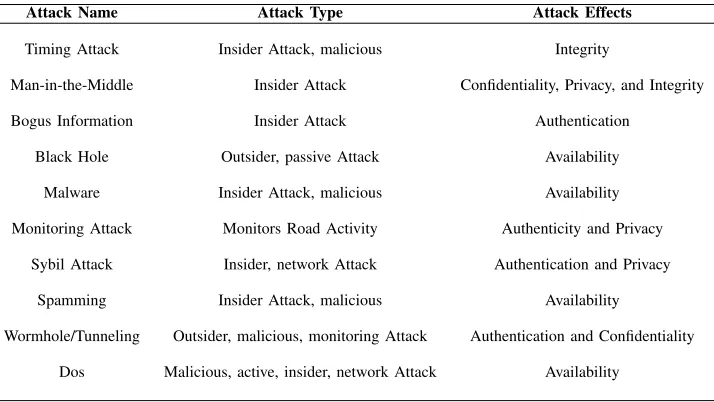
The authors in [30]. Were inspected and discussed concern-ing VANET vulnerabilities where attacks were categorized into several categories. It has been noted that this classification de-pends on insiders, slander, strangers and surveillance attacks. This classification is summarized in the tableI.
V. CONCLUSION
This paper presented the components and characteristics of VANET, the security challenges it faced and provided comprehensive information on the various potential attacks and their classification. Vehicle networks are fertile ground for attackers who try to intercept the network with their malicious attacks. Security in VANET and the level of guaranteed imple-mentation seriously affect the safety of persons and proprieties. Recently, many researchers examined security attacks and tried to find solutions. Others try to define security in the wireless connection nodes that are connected, and data is changed over wireless channels. Thus, the requirement for reliable connections. In order to make the development of VANET systems worth the effort, it must meet the various security requirements and conditions. In future work, many solutions can be propose that can improve the security of VANET by using the properties of the physical layer and the random wireless channels in the process of creating and distributing the encryption key.
ACKNOWLEDGMENT
This work is supported by the National Key R&D Program of China (No. 2018YFB1601101 of 2018YFB1601100).
REFERENCES
[1] P. Tyagi and D. Dembla, “Investigating the security threats in vehicular ad hoc networks (vanets): towards security engineering for safer on-road transportation,” inAdvances in Computing, Communications and Informatics (ICACCI, 2014 International Conference on. IEEE, 2014, pp. 2084–2090.
[2] G. Karagiannis, O. Altintas, E. Ekici, G. Heijenk, B. Jarupan, K. Lin, and T. Weil, “Vehicular networking: A survey and tutorial on requirements, architectures, challenges, standards and solutions,”IEEE communica-tions surveys & tutorials, vol. 13, no. 4, pp. 584–616, 2011.
[3] R. Lind, R. Schumacher, R. Reger, R. Olney, H. Yen, M. Laur, and R. Freeman, “The network vehicle-a glimpse into the future of mobile multi-media,” SAE Technical Paper, Tech. Rep., 1998.
[4] R. S. Raw, M. Kumar, and N. Singh, “Security challenges, issues and their solutions for vanet,”International Journal of Network Security & Its Applications, vol. 5, no. 5, p. 95, 2013.
[5] J. Blum and A. Eskandarian, “The threat of intelligent collisions,”IT professional, vol. 6, no. 1, pp. 24–29, 2004.
[6] M. N. Mejri, J. Ben-Othman, and M. Hamdi, “Survey on vanet security challenges and possible cryptographic solutions,”Vehicular Communi-cations, vol. 1, no. 2, pp. 53–66, 2014.
[7] I. A. Sumra, H. B. Hasbullah, and J.-l. B. AbManan, “Attacks on security goals (confidentiality, integrity, availability) in vanet: a survey,” inVehicular Ad-Hoc Networks for Smart Cities. Springer, 2015, pp. 51–61.
[8] M. Altayeb and I. Mahgoub, “A survey of vehicular ad hoc networks routing protocols,” International Journal of Innovation and Applied Studies, vol. 3, no. 3, pp. 829–846, 2013.
[9] D. Chadha, “Reena,vehicular ad hoc network (vanets): A review,,”Int. J. Innov. Res. Comput. Commun. Eng, vol. 3, no. 3, pp. 2339–2346, 2015.
[10] F. Hui, “A survey on the characterization of vehicular ad hoc networks routing solutions,” inECS, vol. 257, 2005, pp. 1–15.
[11] N. R. Siddiqui, K. A. Khaliq, and J. Pannek, “Vanet security analysis on the basis of attacks in authentication,” in Dynamics in Logistics. Springer, 2017, pp. 491–502.
[12] Z. Y. Rawashdeh and S. M. Mahmud, “Communications in vehicular networks,”Mobile Ad-Hoc Networks: Applications, Cap, vol. 2, pp. 20– 40, 2011.
[13] J. M. De Fuentes, A. I. Gonz´alez-Tablas, and A. Ribagorda, “Overview of security issues in vehicular ad-hoc networks,” in Handbook of re-search on mobility and computing: Evolving technologies and ubiquitous impacts. IGI Global, 2011, pp. 894–911.
[14] M. Raya and J.-P. Hubaux, “Securing vehicular ad hoc networks,”
Journal of computer security, vol. 15, no. 1, pp. 39–68, 2007. [15] H. Moustafa and Y. Zhang,Vehicular networks: techniques, standards,
and applications. Auerbach publications, 2009.
[16] I. Bhardwaj and S. Khara, “An analytic study of security solutions for vanet,”International Journal of Computer Applications, vol. 132, no. 10, pp. 1–7, 2015.
[17] K. Plossl, T. Nowey, and C. Mletzko, “Towards a security architecture for vehicular ad hoc networks,” inAvailability, Reliability and Security, 2006. ARES 2006. The First International Conference on. IEEE, 2006, pp. 8–pp.
[18] A. Kumar, M. Bansalet al., “A review on vanet security attacks and their countermeasure,”Signal Processing, Computing and Control (ISPCC), vol. 2017, pp. 580–585, 2017.
[19] A. Rawat, S. Sharma, and R. Sushil, “Vanet: Security attacks and its possible solutions,”Journal of Information and Operations Management, vol. 3, no. 1, p. 301, 2012.
[20] G. Samara, W. A. Al-Salihy, and R. Sures, “Security issues and challenges of vehicular ad hoc networks (vanet),” in New Trends in Information Science and Service Science (NISS), 2010 4th International Conference on. IEEE, 2010, pp. 393–398.
[21] I. A. Sumra, H. Hasbullah, J. Lail, and M. Rehman, “Trust and trusted computing in vanet,”Computer Science Journal, vol. 1, no. 1, 2011. [22] M. Raya, P. Papadimitratos, and J.-P. Hubaux, “Securing vehicular
communications,”IEEE wireless communications, vol. 13, no. 5, 2006. [23] R. Akalu, “Privacy, consent and vehicular ad hoc networks (vanets),”
Computer Law & Security Review, vol. 34, no. 1, pp. 37–46, 2018. [24] A. M. Abdelgader, F. Shu, W. Zhu, and K. Ayoub, “Security challenges
and trends in vehicular communications,” in Systems, Process and Control (ICSPC), 2017 IEEE Conference on. IEEE, 2017, pp. 105–110. [25] R. G. Engoulou, M. Bella¨ıche, S. Pierre, and A. Quintero, “Vanet security surveys,”Computer Communications, vol. 44, pp. 1–13, 2014. [26] H. Hasbullah, I. A. Soomroet al., “Denial of service (dos) attack and its possible solutions in vanet,”World Academy of Science, Engineering and Technology, International Journal of Electrical, Computer, Energetic, Electronic and Communication Engineering, vol. 4, no. 5, pp. 813–817, 2010.
[27] F. Sabahi, “The security of vehicular adhoc networks,” in2011 Third In-ternational Conference on Computational Intelligence, Communication Systems and Networks. IEEE, 2011, pp. 338–342.
[28] A. M. Malla and R. K. Sahu, “Security attacks with an effective solution for dos attacks in vanet,” International Journal of Computer Applications, vol. 66, no. 22, 2013.
[29] H. Guo and G. Liu, “Research of security for vehicular ad hoc net-works,” inComputer, Mechatronics, Control and Electronic Engineering (CMCE), 2010 International Conference on, vol. 5. IEEE, 2010, pp. 144–147.