Abstract—Selective Laser Sintering is one of the most advanced and promising technologies of Additive Manufacturing known to mankind. The accessibility of SLS to the college students, faculty and independent researchers is limited due to prohibitively high costs. Through this paper an attempt has been made to chalk out the methodology used to design a SLS Printer for polymers thereby addressing the accessibility problem. Alternatively, this methodology is relevant to anyone, who is interested in SLS Technology and building a machine based on it. Through a careful study, it was established that laser system is one of the highest contributors to the overall asset cost. Therefore, it was treated as a primary target for cost reduction . Diode laser was used as an alternative to commonly used CO2 laser. This selection led to a significant cost saving. The effect of the loss of power on account of using a Diode Laser is offset by an infrared heating system. The infrared heating system increases the scanning speed and prevents thermal defects such as warping and delamination leading to more uniform and accurate prints. An innovative blend of Nylon-12 was used for enhancing the compatibility of material with the blue diode laser. Through a series of systematic experiments and subsequent iterations an optimum composition and scanning parameters were established. The printed part had a tolerance of 0.3mm which is sufficient for post processing.
Index Terms—Additive Manufacturing, Diode Laser Sintering, Low Cost Selective Laser Sintering, Polymer Sintering, Selective Laser Sintering
I. INTRODUCTION
ith the advent of Computer Aided Engineering, design of components has become increasingly intricate and complex. To keep up with these rapid advancements in the field of design, the concept of Additive Manufacturing was developed. Additive Manufacturing is a process wherein the required object is built one layer at a time. Most commonly, three techniques come under the purview of Additive Manufacturing: Fused Deposition Modelling (FDM); Selective Laser Sintering (SLS); Stereo lithography (SLA). Of the three techniques, hardly any limitations exist to the material that might be processed by SLS [1]. Therefore, it may be believed within reason that Selective
Manuscript received March 24, 2019; revised April 6, 2019.
Omkar Deshpande was a student at Maharashtra Institute of Technology, Pune e-mail: [email protected]).
Ameya Kulkarni was a student at Maharashtra Institute of Technology, Pune e-mail: [email protected]).
Pranav Patil was a student at Maharashtra Institute of Technology, Pune e-mail: [email protected]).
Pratyush Nagare was a student at Maharashtra Institute of Technology, Pune e-mail: [email protected]).
Laser Sintering holds the most promise of the three for wide spread use.
The principles on which the experimental setup was built are laid out in the following sections. The intent in building an experimental setup was to assist the students and professors in their research since the commercial machines are very costly. High costs of buying as well as running a SLS machine detracts the students from innovation as they have limited access to such machines. The experimental setup was designed and built to attack this problem.
The entire design process was centered on the use of a diode laser system, complemented by IR heating system followed by intensive experimentation.
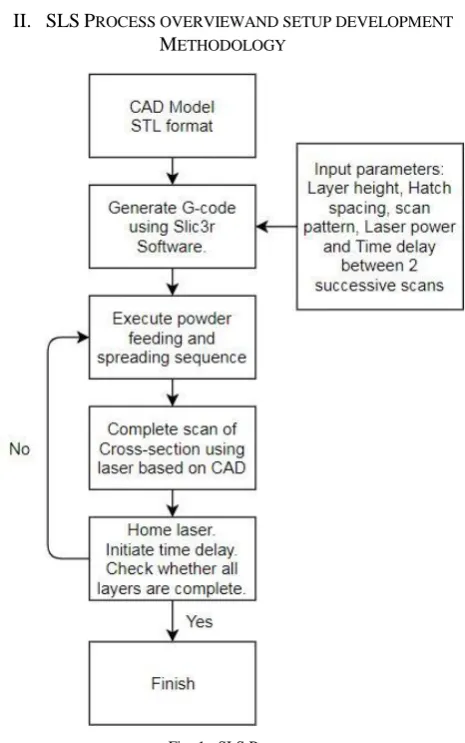
II. SLSPROCESS OVERVIEWAND SETUP DEVELOPMENT
[image:1.595.315.548.350.722.2]METHODOLOGY
Fig. 1. SLS Process
Step 1: Define the Material Range: The machine systems and parameters are a function of the materials that can be
Design and Development of Experimental
Setup for Polymer Selective Laser Sintering
Omkar Deshpande, Ameya Kulkarni, Pranav Patil, Pratyush Nagare
sintered. Therefore, the primary step involved in designing a Selective Laser Sintering Machine is to establish the target material. Polymers are usually compatible with low power lasers since their sintering temperatures are lower than that of metals and are attainable with low power diode lasers. Moreover, Polymer-Metal mixtures can also be sintered using low power diode lasers since, only the polymer particles get sintered thereby forming matrix around un-sintered metal particles. The objective of developing the experimental setup has been restricted to Polymer Sintering. Polymer-Metal mixture sintering has been left for further research.
Step 2: Selection of Heater and Pre-Heating temperature: Heating the build chamber offers a distinct advantage to the diode laser based SLS machines. Low Cost Diode lasers are inherently low powered and therefore the way to obtain perfect prints is to slow down the scan speed. In order to offset the increased Cycle Times due to the usage of a low powered laser, a Radiant Heater is used. The powder is heated nearly up to the sintering temperature with a radiant heater (20-30 deg C difference), while the balance temperature difference is achieved with the help of a diode laser. Additionally, this helps to avoid thermal defects in the printed parts.
Step 3: Calculate the desired Laser Power: After the target material has been established, the required laser power is calculated. These calculations take into account absorptivity, specific heat and a host of other parameters as described in Section IV.C. From the calculated laser power, suitable laser module is selected.
Step 4: Set the Build Volume: Build volume is the maximum volume (expressed in terms of Length x Breadth x Height) of the theoretical part that can be printed with the machine. The Build Volume and has been decided on the basis of the commercially available machines.
Step 5: Design of X-Y Gantry: The Linear Motion Systems (LMS) are used for providing motion to the laser head in the XY plane. The criteria for selecting the LMS has been laid down on the basis of functionality. The appropriate LMS is then selected accordingly. For the purpose of the Experimental Setup, Linear Motion Rails have been used to provide good accuracy to the X-Y Motion.
Step 6: Build and Feed Piston Design: The Build and Feed Piston represent the section of the Experimental Setup where the Powder is housed and sintered. Design of Build and Feed Piston is crucial as the piston needs to advance in such a way that the piston plate always remains in a horizontal plane to maintain a uniform layer height. The desired layer height influences the linear motion system selection. The available systems were evaluated and optimum arrangement was decided.
Step 7: Powder Re-Coater Arrangement: After every print cycle, the Piston from the aforementioned Build Piston moves down by distance equal to the layer height. Therefore, the topmost layer is void and need to be uniformly filled with powder. This powder material is provided by the Feed Piston which houses a reservoir of Powder. This Feed Piston actuates in such a way that the powder material raises above the datum of the Build-Feed Arrangement by a distance greater than the Layer Height (In order to account for compression and other unforeseen losses). Powder-feeding arrangement is responsible for layer recoating cycle. The
Powder Recoater, then levels the excess powder material and with void in the Feed Piston. After evaluating pro and cons of different re-coater mechanisms, an appropriate one is selected.
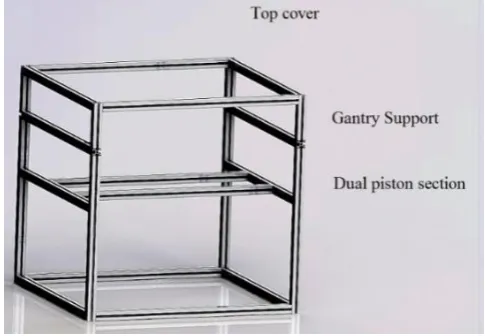
Step 8: Machine Frame Design: After establishing the dimensions of the aforementioned sub-assemblies, suitable frame dimensions are selected. The strength of the structural members and its aptness for the application is evaluated using Hypermesh TM .
Step 9: Powder Preparation: Nylon-12 powder with 50-micron particle size is used along with necessary additives to increase its compatibility with the laser.
III. MATERIALS
Selective laser sintering can be used to process almost any metal, provided it is available in a powdered form and that powder particles tend to fuse or sinter when sufficient heat is transferred. [1] The SLS Process is highly versatile in terms of the material compatibility and therefore has an edge over other AM Processes. Among these materials, the most common are: wax, paraffin, polymer-metal powders, or various types of steel alloys, polymers, nylon and carbonates. [4]
Nylon polyamide-12 was selected as base polymer material for experimentation and testing on this machine for a host of reasons. Firstly, Nylon PA-12 has an established history as a laser sintering material. PA-12 remains by far the most widely used laser sintering polymer on account of its ease of processability and relative low cost [3]. Secondly, the commercial laser sintering polyamide 12 material has a relatively large temperature window and whilst there is an optimum processing temperature which gives the highest mechanical properties, a deviation of several degrees can generally be accommodated. [3]
Amorphous polymers, like polycarbonate (PC) powders, are able to produce parts with very good dimensional accuracy, feature resolution and surface finish (depending on the grain size). However, they get only partially consolidated during the process. As a consequence, these parts are only useful for applications that do not require part strength and durability. [1] Semi crystalline polymers, like nylons (polyamide PA), on the contrary, can be sintered to fully dense parts with mechanical properties that approximate those of injection molded parts. The good mechanical properties of these nylon-based parts make them particularly suited for high strength functional prototypes. [1].
IV. LASER SYSTEM
A. Laser System
The primary objective of this project is to develop a low-cost selective laser sintering 3D printer capable of printing objects using nylon PA-12 polymer at practical speeds. Hence material compatibility, size and compactness, handling, maintenance and cost are the important criteria while selecting a particular laser system. The following section discusses the selection of the laser for the machine and calculations for the power capacity of the selected laser.
B. Selection of laser
diode laser 4) Fiber Laser. Considering the cost aspect, fiber laser is not an economical choice. ND-YAG laser is generally not compatible with polymers, hence is not selected. [4] Though CO2 laser has an infrared wavelength
and couples with most of the materials [4], it is bulky and very difficult to handle due to its long gas-tube and reflecting mirrors assemblies and chiller. Hence it was not selected. Diode laser couples with polymer powders and it is very compact in size. Power controlling of diode laser is easier than that of CO2 laser. Diode lasers are highly
compatible with existing open source FDM electronics. Additionally, it is less cumbersome to deal with than the CO2
laser with all its paraphernalia. Hence it is the optimum choice for the Experimental Setup.
C. Laser-power Calculations
Basic heat transfer equations are used for calculating laser power capacity.
Assumptions:
1. Particle properties like the specific heat capacity (Cp) [1700 (J/kg-K)] and density (ρ) [1130 (kg/m3)] are assumed to be the same as that of the bulk material.
2. Sintering temperature (Tf) is assumed to be 10°C below melting point [185°C]. The sintering temperature for the powders depend upon several factors like density of the powders, its composition, particle size, morphology. Initial powder temperature (Ti) is assumed to be 150°C. This has been justified in section V.
3. Energy losses in energy transfer to neighboring particles or surrounding are neglected.
4. Absorptivity (A) is assumed to be 0.1, Spot size diameter (D) = 700 μm
Williams and Deckard’s work with polycarbonate noted that, independent of the energy density applied, an increase in spot size produced parts with increased densities and strengths. This was attributed to a larger area being exposed to a more uniform, less intense laser irradiation with increased spot size. This physical diameter of laser beam on current commercial machines (normally 0.5-0.7 mm) cannot be changed [3]
5. Layer Thickness (h) = 150 μm scan speed = 30 mm/sec Pulse energy to sinter a spot size of diameter D and layer thickness, h
En= Mass flow rate * Sensible heat/ Absorptivity
*π *d2*h*
En = 0.028213124 J
Power required for sintering a spot of spot size diameter=Energy/exposure time
Exposure time= Spot diameter/ Scan speed Exposure time= 0.7 (mm) / 30 (mm/sec) Exposure time= 0.023333 sec
Power required for sintering a spot= 0.028213/ 0.0233 Power required for sintering a spot= 1.2091 W
Increasing power, decreasing scan-speed and decreasing scan spacing all result in an increase in part density and
tensile strength. This has been attributed to a decrease in viscosity of the material which lowers porosity, and this increases density. However, if the laser power is too high, shear stresses between layers are formed as a result of increased liquid flow and the part may curl or become distorted. [3] Hence optimal balance between scan speed and laser power needs to be achieved through experimentation. Considering unaccounted heat losses and cost-aspects, 2 W diode laser which is commonly available with 445 nm wavelength (blue-color) was selected for the machine. PA-12 powder is naturally available in white color which has poor absorptivity for 445 nm wavelength. Hence black pigments were mixed with PA-12 powder to improve absorptivity which is discussed in section IX.
V. POWDER HEATING ARRANGEMENT
The presence of thermal effects during the SLS process gives rise to the defects such as delamination, warpage and shrinkage. Delamination of a part occurs when the subsequent layer gets improperly sintered with the previous layer. Therefore, the overall part strength is greatly weakened and leads to part failure. Another thermal defect-warpage occurs when the sintered layers curl up to form a curved surface, concave up. Uneven cooling of the part during its layer by layer sintering leads to warping and shrinkage.
Heating the build chamber offers a distinct advantage to the diode laser based SLS machines. Diode lasers are inherently low powered and therefore the only way to obtain perfect prints is to greatly slow down the scan speed. The general thumb rule is higher scan speed equals a greater laser power. However, if the powder is preheated to a temperature just below the sintering temperature, then the laser will have to increase the temperature of the powder only by the balance amount. This will help in boosting the scan speed.
An empirical approach, commonly used for PA12, determines the part bed temperature by gradually raising the temperature up to a point at which the material starts to ‘‘glisten’’ as it begins to melt (known as the ‘‘glaze point’’), then subtracting 12 deg C. The value for subtraction is specific to this particular material. Whilst knowing the melting temperature of the material can provide a useful starting point, the actual temperature needs to be found by taking other factors into account which ultimately results in a systematic trial-and-error process. [3] Hence in our machine, powder is preheated up to 150 deg C which was decided after several controlled trials.
There are two heating systems that come into play while achieving a flawless print: 1. Heating of Powder during pre-printing stage to boost scan speed and 2. Heating of layer while sintering in order to achieve uniform cooling
Heating of powder during pre-printing stage: Preheating the powder to a certain temperature below the sintering temperature not only helps to reduce the overall laser power required for sintering but also helps in uniform cooling. There are three methods for the same - 1. Using a Blow Heater 2. Using a Heated Build Plate 3. Using Band Heaters These type of heaters are not used in the Experimental Setup. The incorporation of these heaters will be a part of the subsequent improvements on the machine.
up the top few layers to the pre-sintering temperature. Heating up the powder by using the techniques mentioned in the above section, leads to a temperature gradient. To achieve the desired temperature at the topmost layer, the temperature of the build plate must be much higher than that. Depending on the volume of powder present between the topmost layer and the build plate, the temperature may exceed the sintering temperature. In such cases, the layer immediate to the build plate may form a blob of mass leading to large wastages of valuable powder. In order to work around this problem, a radiant heater was incorporated. The radiant heater maintains the temperature at the top few layers to the desired temperature just below the sintering temperature. This not only assists in reduction of laser power required for sintering but also makes the cooling much more uniform.
Fig. 2. Powder Heating Arrangement – An Infrared Heater is used to heat the PA-12 powder to a temp just below sintering point
The prints from such an arrangement were satisfactory and as per our requirements. The same can be found in Table III.
VI. XYGANTRY
Any Cartesian Machine has three basic mutually perpendicular axes of motion. The axis responsible for the laser head motion is designated as the X axis while the axis perpendicular to the X-axis in the same plane is designated as Y-axis. Factors considered while deciding printing build volume were: 1. Quantity of powder required and corresponding cost 2. Total cost of printer corresponding to decided build volume 3. Variety of sizes which can be printed 4. Market survey of existing SLS printers. Considering these factors, build volume of 200mm x 200mm x 200mm was decided and further design and calculations were started. Timing belt and pulley system is selected as motion transfer system as extra mounting fixtures are not required for this system. Since X-Y gantry requires highly accurate motion, rail-guide system was selected as motion guiding system.
VII. POWDER FEEDING SYSTEM
The role of the Powder feeding system is to deposit a fresh layer of powder with the help of powder re-coater for every new layer sequence in a timely, smooth, uniform and repeatable manner. These two systems work in tandem resulting a fresh layer of powder deposited on the print bed for every layer sequence. One of the two kinds of Powder
feeding systems are used in the SLS machines- A Dual Piston system or A Hopper arrangement (Single Piston)
Hopper Arrangement: This system mainly consists of a Hopper (with pre-heating arrangement), which contains the powder, a powder metering arrangement, and a powder re-coater. The volume of the hopper is decided based on the maximum volume of the part which can be printed. Band heaters are attached to the hopper so the powder can be heated before it is spread on the print bed. A powder metering arrangement ensures that only required amount powder is spread by the re-coater for each layer. This reduces powder wastage. The re-coater then spreads this metered powder on the print bed so the laser can sinter the new layer. Different sensors are used to ensure that this process is carried out according to the pre-determined sequence with correct delay times.
Dual Piston System: This system consists of two pistons which work in tandem. One of the pistons moves the print plate in Z direction while the other piston moves the Feed Plate. Initially the feed piston is at the bottom most position and this compartment is filled with the powder, while the print piston is at the topmost position. When the first layer is sintered, the feed piston moves up by distance equal to the layer height while the print piston moves down by the same distance. The re-coater then spreads the surplus powder from the feed piston on the Print bed.
TABLEI
COMPARISON BETWEEN DUAL PISTON AND HOPPER ARRANGEMENT
Dual Piston Hopper arrangement
Simple design. Two motors work in synchronization
Complex design. A hopper, metering system and spreader need to work in unison
Easy powder metering. Can be controlled easily just by adjusting lead screw motion
Metering is complex. Powder wastage is also more
Occupies more volume in the Printer
It is a compact system
Electronics and coding of the system is easier Only the 2 motors need to rotate in opposite direction in tandem
Electronics and coding is relatively complex
Different sub-systems need to work in a pre-determined sequence to achieve the purpose
Preheating the power before the recoating sequence is tough
A. Design of Actuation System for the piston-cylinder arrangement
[image:5.595.329.533.130.222.2]The design of the actuation system should be such that the minimum step size is 10 times (or more) smaller than the minimum feature size 100 μm so that the control over thickness of the layer is more accurate. Thus, ball screw/lead screw- stepper motor assemblies were chosen to move the pistons up and down with a resolution of 100 μm. This provides a leeway of 50 μm between the theoretically achievable and practically desired minimum feature size.
Fig. 3 Dual Piston Arrangement
B. Design considerations in re-coater system design
The function of the recoating system is to deposit a fresh layer of powder from the feeder piston to the build piston. The fresh layer of powder from the feeder piston has a thickness 10-12% higher the layer thickness desired (inorder to accommodate for the compression and losses). The layer thickness determines the quality and density of the parts. Results for the influence of layer thickness on the porosity and layer bonding have been obtained [7]. It was concluded that smaller layer thickness leads to stronger bonding between the layers and decreases the porosity of the parts. Finding an optimum layer thickness is necessary depending on which application is desired. The minimum layer thickness that can be used effectively is determined by the average particle size of the powder. If the chosen layer thickness is lesser than the threshold thickness (empirically established), the roller will drag non-melted large particles or chunks of melted particles, displacing the previous sintered layers from their position. Consequently, layer thickness for denser product must be set to the minimum layer thickness and vice versa. The system was designed to obtain a layer thickness of approximately 150 microns.
The recoater is the major component which determines the layer thickness. Considerations while designing re-coater system were: 1. Uniformity in the layer distribution 2. Rigid, Reliable and Repeatable arrangement 3. Excellent Wear Resistance to the abrasion of the powder during the recoating cycles. 4. Smooth finish of the Roller in order to obtain a better surface layer 5. The recoater motion as well as its operation should not be affected by the external heating systems.
Blades vs rollers for powder spreading: Bed quality is characterized by the surface roughness and solid volume fraction of the bed. Higher recoater transitional velocity leads to lower bed surface quality. A recoater can be of two types- Cylindrical roller and Knife edged blade. A cylindrical roller outperforms blade in terms of bed quality at the correct operating conditions. It has been demonstrated
[image:5.595.57.297.190.307.2][7] that spreading the particles with a roller produces a bed with a higher quality (i.e. a lower void fraction) compared to a blade type spreader. This is related to the geometry of the two spreaders which directly changes the bed-spreader contact dynamic and consequently affects the quality of the bed.
[image:5.595.315.544.258.346.2]Fig. 4. Roller Mechanism – Comparison between the bed-spreader contact dynamics of roller and blade
Fig. 5. Powder re-coating arrangement
VIII. FRAME
Design Considerations:
1. Strength and stiffness: considering the weight of heavy components and jerks produced due sudden acceleration changes
2. Modularity and ease of assembly: it enables accommodation of manufacturing errors, easy replacements of components without need of dissembling the machine and enables future modifications.
Piston section: These members carry the weight of the entire Dual Piston assembly and the powder as well.
[image:5.595.313.556.524.692.2]Fig. 7.a. CAD Model
Fig. 7.b. Actual Prototype
IX. POWDER PREPARATION
As explained in Section III, Nylon (PA-12) powder has been chosen for the experimental setup. PA-12 is widely used for Additive Manufacturing as it has applications ranging from Automobile Industry to the Healthcare Industry.
Naturally PA-12 powder is white in colour. The diode laser has a power rating of 2W and a wavelength of 445nm. The laser beam being blue in colour is not absorbed by the white powder. Therefore, an additive is needed to be blended with the powder to boost the absorptivity of the material. Average Grain size of the used powder material is 50 micro-meters. Carbon Black has been used as an additive for our print material. The key to achieve perfect prints and optimum scan speed is blending the adequate carbon % in the PA-12. The powder is prepared in two steps. Firstly, charcoal is pulverized in a ball mill followed by separation of fine carbon-black in a vibrational sieve. Then carbon black is mixed with nylon powder by measuring accurate amounts.
X. TESTING AND EXPERIMENTATION
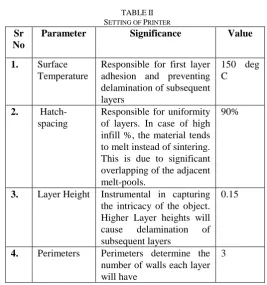
For the purpose of experimentation, the following settings
were used-
TABLEII SETTING OF PRINTER
Sr No
Parameter Significance Value 1. Surface
Temperature
Responsible for first layer adhesion and preventing delamination of subsequent layers
150 deg C
2. Hatch-spacing
Responsible for uniformity of layers. In case of high infill %, the material tends to melt instead of sintering. This is due to significant overlapping of the adjacent melt-pools.
90%
3. Layer Height Instrumental in capturing the intricacy of the object. Higher Layer heights will cause delamination of subsequent layers
0.15
4. Perimeters Perimeters determine the number of walls each layer will have
3
A. Discussion on Set-Parameters
Surface Temperature: The first layer is the most crucial
layer in the entire object. It is highly essential for the layer to completely adhere to the surface. If the layer does not adhere to the surface i.e. the edges of the layer lift off from the surface, the recoater will carry the layer with it during the re-coating sequence. The print in such cases is deemed to have failed. To prevent such lifting off of the edges or warping, surface layer is heated to a temperature exceeding the glass transition temperature of the material. As demonstrated in the Laser Selection Section, the temperature of the layer after laser incidence is dependent upon the Ambient Temperature. Higher the ambient temperature, quicker it will reach the sintering temperature. Thus, use of a Heating Arrangement will not only ensure layer adhesion but will also ensure stronger prints.
Infill percentage: Hatch spacing is defined as the
distance between two adjacent laser scans. For the layers to be planar i.e. with no warping, the infill should consider the hatch spacing of the laser and the melt pool width. Whenever a laser is incident on the loose material, it creates a heat zone in the material of a specific width. The width of the heated zone depends on the time of laser incidence. Higher the time of incidence, greater will be the width of the heat zone. Therefore, the hatch spacing should be such that the heat zone created by the subsequent hatches should just overlap. This will ensure, uniformity in print layers and will yield perfect prints. Excessive overlap will lead to a rapid spike in temperature which will cause melting of the layers. Various hatch spacings were tested and based on the experimental results, an Infill of 90% was set in the Slic3r software.
Layer Height: Layer height gives the distance by which
[image:6.595.294.562.64.350.2]Whenever the laser beam is incident on the material, the heat zone traverses in the lateral and Z direction. The heat zone in the Z direction is termed as the laser penetration. Theoretically the laser penetration should lie between the following range - 1*(Layer Height) < Laser Penetration < 2*(Layer Height). The above expression ensures that the sintering occurs not only in the lateral direction but also in the Z direction. Sintering in the Z direction will ensure subsequent layers adhere to each other. Failure in setting appropriate layer height will lead to weaker prints and delamination. In the experimental setup the layer height has been set at 0.15 mm as the particle size of the PA-12 powder is 0.05mm. Layer height of 0.15 mm will theoretically ensure that there will a mean of 3 particles in each layer.
Perimeter: Perimeter is the number of times the laser
traverses around the boundary of the print. In other words, the number of perimeters will specify the number of walls the print will have. The perimeters impart rigidity to the outer surfaces of the object. Typically, Additive Manufacturing Machines use 3-5 Perimeters. The number of perimeters has been set at 3 for the experimental setup.
Experimentation: The print layer quality was analysed for
various scan speeds and carbon % (in the PA-12 powder). Following are the values of the parameters at which the print layers were analyzed:
TABLEIII VARIATION OF PARAMETERS
Sr No .
Scan Speed
(mm/ sec)
Carbon
% Comments Actual Photo
1. 20 0.5
The layer melts, Print
fails
2. 20 2
The layer melt, Print
fails
3. 25 0.5
Layer warps, Print fails
4. 25 2
Layer warps, Print fails
5. 30 0.5
Layer is planar, Print is successful
but distorted
6
. 30 2
Layer warps, Print is distorted
7. 35 0.5
Layer planar,
Print successful
but weak
8. 35 2
Layer is planar, Print is successful
9. 40 0.5
Layer is planar,
Print successful
but very weak
10. 40 2
Layer is Planar,
Print successful
but very weak
Fig. 8. Printed Objects
B. Future scope for improvement
Materials: To be compatible with low powered diode
laser finely crushed charcoal was blended with the PA-12 powder. As an alternate to charcoal powder one may use carbon soot or dyes. The usage of the fore mentioned depends on the availability and the associated costs, if any.
Heating using ring heater: In order to make the heating
more efficient the ring type heater or rectangular type can be used. The usage of such ring or rectangle type heaters will lead to increased cost. The powder can be pre heated in the feeder piston, thereby reducing the delay time between the deposition of the powder and actual start of sintering which is kept to heat the powder before sintering.
Laser Type: The laser of increased power can be used to
obtain higher scan speeds at added costs. Moreover, infrared laser can be used as it is suitable for all colors of powder due to the wavelength. The usage of aforementioned laser depends on the associated costs and the bulkiness of the lasers
Feeder: The Hopper arrangement can replace the dual
piston arrangement so as to reduce space and allowing a larger bed size keeping the overall dimension of the printer same. But this will also require modifications in electronics as well as complications in the design at an added cost.
Anti-clockwise vibrating Roller: A counter rotating roller
leading to more cost and complications in the design. ACKNOWLEDGMENT
The authors thank the Department of Mechanical engineering of Maharashtra Institute of Technology, Pune for providing access to labs and machine-shop to work on the experimental setup. They also acknowledge Prof. Atul Palange and Prof. Ganesh Borikar for their able guidance and support throughout the project. The authors would also like to pay their regards to Mr. Nitin Chaphalkar and Prof Nitin Narappanawar for their invaluable guidance throughout the course of this work.
REFERENCES
[1] J.P. Kruth, X. Wang, T. Laoui, L. Froyen, (2003) "Lasers and materials in selective laser sintering", Assembly Automation, Vol. 23 Issue: 4, pp.357-371.
[2] Goodridge, R., Tuck, C. and Hague, R. (2012). Laser sintering of polyamides and other polymers. Progress in Materials Science, 57(2), pp.229-267.
[3] Deshpa V and Gheorghe I.Gh (2011). Study of selective laser sintering – A qualitative and objective approach. The scientific Bulletin of VALAHIA University- MATERIALS and MECHANICS-Nr.6 (year 9) 2011
[4] Gray, D. F. Lasers for selective Laser Sintering LIA Handbook of Laser Materials Processing. 2001. Laser Institute of America. Magnolia Publishing. Inc. pp. 557-559.
[5] 21 Amorim F L, Lohrengel A, Neubert V, Higa C F and Czelusniak T 2014 Selective laser sintering of Mo-CuNi composite to be used as EDM electrode Rapid Prototyping J. 20 59–68
[6] 20 Savalani M M, Hao L, Dickens P M, Zhang Y, Tanner K E and Harris R A 2012 The effects and interactions of fabrication parameters on the properties of selective laser sintered hydroxyapatite polyamide composite biomaterials Rapid Prototyping J. 18 16–27 [7] Haeri, S. (2017). Optimisation of blade type spreaders for powder bed