91 (1998) 7–17
Comparative analysis between police batons
a ,
*
b cPierre Gervais
, Pierre Baudin , Bruce Cruikshank , Dennis
d
L. Dahlstedt
a
Sports Biomechanics Lab., Faculty of Physical Education and Recreation, University of Alberta, Edmonton, Alberta, Canada, T6G 2H9
b
School of Recreation and Physical Education, Acadia University, Wolfville, Nova Scotia, Canada, B0P 1X0
c
Edmonton Police Service, 9620-103A Avenue, Edmonton, Alberta, Canada, T5H 0H7
d
Campus Security Services, University of Alberta, Edmonton, Alberta, Canada, T6G 2H9
Received 3 February 1997; accepted 8 October 1997
Abstract
The main purpose of this study was to compare various sizes of an extendible baton with the standard issue PVC duty baton. This project also included a side handle baton and a traditional wooden duty baton. Comparison was made on those quantifiable mechanical variables that were deemed significant with respect to trauma and the intended use of the baton as an intermediate weapon. These variables included impact force, impact pressure and movement kinematics while performing striking swings with these police batons. The three ASP expandable batons, the side handle baton and wood duty baton all produced smaller impact forces compared to that achieved with the PVC duty baton. In a model of impact pressure, the extendible batons produced, on average, higher impact peak pressures than those produced with the PVC duty baton. Differences were also observed between striking swing speed, frequency, and reach among the various batons tested which could influence an officer’s ability to effectively utilize the batons as intermediate weapons. 1998 Elsevier Science Ireland Ltd.
Keywords: Batons; Biomechanics; Impact force; Impact pressure
1. Introduction
It has been proposed that the tactical or extendible police baton could be an attractive
*Corresponding author.
functional alternative to the duty baton that is currently being used by the vast majority of North American police officers and other law enforcement professionals such as university campus security personnel. A primary justification for the adoption of the tactical baton is that this less conspicuous intermediate weapon will be carried more frequently by the law enforcement professions thus providing greater protection to the professional and potentially less risk to the law breaking individual(s) and the public by reducing the potential use of a firearm. It has also been suggested by the manufactures and members of the local law enforcement agencies that the tactical baton, being lighter and better balanced than traditional batons, is a more manageable device to wield thus making it more suitable perhaps to smaller, less physically robust officers with the benefits previously stated. The tactical baton is also less conspicuous than the traditional baton, a requirement of certain environments such as a university campus.
The manufacturers of the expandable batons (tactical batons) describe the baton as an effective impact instrument. A concern that has been expressed about the extendible baton is that due to it being made of a metal alloy (as opposed to a PVC compound or wood as in the traditional duty baton) it may potentially cause greater harm to an assailant than the traditional baton upon impact. In considering the consequences of impact with an extendible baton or a PVC baton a number of mechanical factors must be considered.
A considerable amount of research on soft tissue injuries has focused on restraint systems and risk of injury given a high or low mass with a high or low velocity of impact. Viano and Lau confirmed that the velocity of compression brought about by the impacting device was a determining factor in soft tissue injuries [1]. They also warned that the compression forces which deform the soft tissue can cause fractures when the force level exceeds the tolerance of the underlying skeletal structure. To effectively control or stop an assailant’s hostilities the impacting device, the baton, must be swung to strike with a large force achieved through a fast delivery. Woo and Chapman assert that in sporting activities where the objective is to generate high end point velocities such as seen in kicking or striking, a proximal to distal pattern of segmental sequencing is usually observed [2].
In karate, Walker proposed that the objective of a strike was to maximize the deformation damage at the area of contact [6]. Mechanically this relates to (1) the amount of energy lost to deformation (or the work done) during the impact, and (2) to the impact forces and stresses imposed. As described by Walker, the work done during the impact is equal to the change in energy or energy dissipated during impact and is given by:
2
M M
12e 1 2 2
]] ]]]
DE5 V
2 M11M2
where e is the coefficient of restitution, M M the masses of the colliding objects and V1 2 the velocity of the colliding objects.
To evaluate the effectiveness of a baton to control or subdue an attacker where the assailant is hit determines the magnitude of the coefficient of restitution (e). Soft tissue and fat have a higher e value (i.e. more elasticity) than bone covered by a thin layer of skin but a smaller e than would be found if the same strike were made on a large muscle group that was maximally contracted in anticipation of the blow. As is pointed out by Walker even though contact on e.g. the forearm just above the wrist may produce a greater impact deformation, due to the small e, a strike to a higher e area such as the proximal end of the forearm ‘may result in more pain to the opponent’ [6]. In looking at the above equation it is apparent that the speed of the blow is a critical factor. To maximize the effectiveness of a strike, holding the other factors constant, the strike should occur at maximum velocity in the swing of the baton. In a karate punch, Walker found that maximum velocity occurs at 70–75% of the fully extended arm. Therefore the punch is taught to be stopped within the opponent. Velocity can be complemented by stepping towards the attacker during the striking swing and / or striking when the opponent lunges towards the striker.
A final mechanical consideration on risk of injury as a result of a collision is that of the peak pressure. In considering the effectiveness of shoe cushioning, the designer may look at whether the design produces any high pressure areas that over an extended period of time will produce musculo–skeletal stresses. In contrast where the objective is to disable an attacker and to increase the effectiveness of a strike with a baton, increasing the impact pressure is highly desirable. In boxing a blow is spread over a rather large glove yet in the karate punch impact is primarily with two knuckles and the force is applied at a single point [6]. To achieve the same impact result as a karate fighter a boxer may have to strike harder or with greater frequency.
In summary, from the perceived objective of successful defence against and disabling an attacker, how the baton is swung (speed), where an individual is struck (e) and the amount of force and pressure will determine the overall effectiveness of a strike or series of strikes with a baton. Since it is ethically impossible to directly ascertain the consequences of an impact with the baton on human subjects, evaluation must be inferred through those variables that are quantifiable and have relevant mechanical determinants.
the tactical batons (expandable batons) was conducted as a comparative analysis to the current standard issue traditional duty baton. It was not the intent of this research assessment to measure the risks or make recommendations on the injury risks associated with the use of any of these batons. Since the dimensions of the tactical batons are different from the traditional duty baton, their use may alter their effectiveness depending on the accommodating movement pattern changes employed during a strike. Therefore, a comparison between the movement patterns during a strike with the tactical batons and the standard issue duty baton was also conducted.
2. Methods
The objective of this investigation was to compare the strike and movement pattern performed by skilled law enforcement professionals with the traditional duty baton and the extendible tactical batons. The batons investigated for the purpose of comparison to the traditional duty baton are listed in Table 1. A total of four skilled subjects, two women and two men, from the Edmonton Police service and University of Alberta’s campus security volunteered to participate in this study. Data was collected for two seperate tasks using the different batons:
2.1. Impact swing
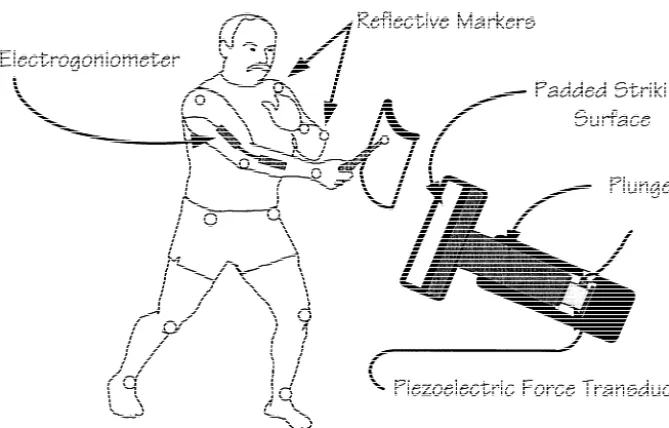
[image:4.480.68.426.512.613.2]Subjects were fitted with Penny and Gilles flexible strain gauge Electrogoniometers over the wrist and elbow joints of their swing arm. These electrogoniometers monitored joint angle changes during the course of a swing with the baton. Although the subjects were fitted with an electrogoniometer to monitor wrist flexion and wrist adduction / abduction these data did not provide any additional insights into the movement and are therefore not reported here. Subjects were asked to swing and strike a force measuring device that was mounted on a concrete wall. The device could be adjusted for height. Fig. 1 provides an illustration of the experimental set-up. The impact device consisted of a metal rod which moved freely within a cylinder. At the base of the cylinder the rod made contact with a piezoelectric dynamic force transducer. At the contact site, at the other end of the rod, there was a 1031535 cm rounded piece of wood which was
Table 1
Characteristics of the police batons investigated
Baton Length Contacting end circumference Material
(cm) (cm)
Standard issue 66.0 3.1 PVC
traditional duty
Traditional duty 66.0 3.1 Wood
Side handle 61.0 3.1 Aluminum
ASP (16‘) tactical 40.6 1.1 Aerospace grade steel alloy
ASP (21‘) tactical 53.3 1.1 Aerospace grade steel alloy
Fig. 1. Experimental set-up.
bolted to a small steel plate that was welded to the rod. In order to protect the subjects, the measuring device and the batons the contact site was padded with dense foam material. Subjects were allowed a warm up to acclimatize to the experimental protocol. A sufficient rest period was provided between trials. The subjects were instructed to first attempt a strike at a self determined magnitude of 70% of their maximum. Following this, subjects were asked to perform two maximum effort impact swings making contact with the centre of the impact measuring device. The force data from the transducer and the joint angle data were collected via an analogue to digital board connected to an i386 laboratory computer. Data were sampled at 5000 Hz. Subjects repeated the three test trials with all the batons for a total of 18 trials each.
2.2. Forehand and forehand /backhand swings
were subsequently digitized and the three-dimensional spatial locations of each joint centre and of the baton were reconstructed from the two 2D views using the direct linear transformation (DLT) method [7]. The video tape data were sampled at 60 Hz. Data were smoothed using a quintic spline. Temporal data as well as joint angle displacement and baton linear displacement data were determined. Data reduction and analysis was conducted using the Ariel performance analysis system.
3. Results and discussion
The purpose of this study was to investigate the relative mechanical differences between the standard issue duty baton (PVC) and the tactical (expandable) batons. The measurable mechanical variables related to the effective use of the baton as an intermediate weapon are associated with the speed of the baton, the force applied in a strike and the impact pressure during a strike to an assailant.
3.1. Impact force and pressure
At the time of this study the PVC duty baton was the acceptable impact weapon used by the Edmonton Police Service therefore comparison was made with its mechanical variables. Also, with respect to the objective of controlling an attacker’s hostilities the efficacy of the other batons relative to a proven and accepted baton appears warranted. In reporting the results, relative measures are given unless explicitly stated otherwise. The impact measuring device had to be padded. The extent to which this padding attenuated the impact forces would have required study well beyond the confines of this present project. In addition knowledge of absolute impact force magnitudes would not necessarily contribute to assessment of injury potential since there appears to be little or no normative data on human tolerances to these types of blows.
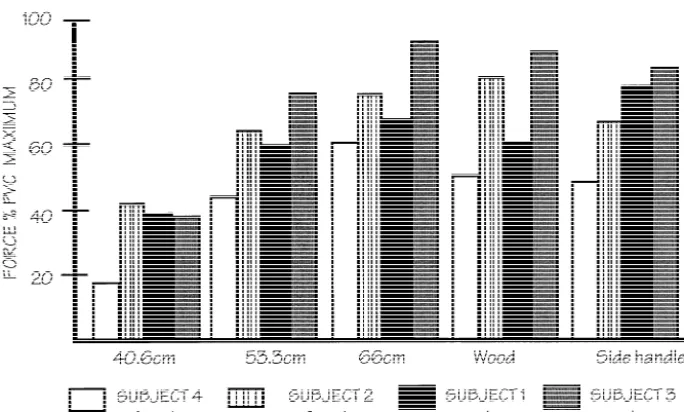
Subjects performed three trials with each baton for the impact force tests. The first trial, which was 70% of the subject’s maximum, was used primarily as acclimatization for the subject and was not used in subsequent analysis. Unless otherwise stated, the results refer to the averages of the other two trials. All subjects produced less impact force with the other batons when compared to the peak impact force produced with the traditional duty baton (Fig. 2). The combined average values of all subjects and trials (n58) suggests that the 66-cm ASP tactical baton, followed closely by the wooden and side handle batons, produced the greatest relative impact forces. The 40.6-cm tactical baton accounted for the least impact peak forces. These results support the concept that to effect a greater deformation (DE ) that the impacting mass can be influential, the
Fig. 2. Average peak impact forces expressed as a percent of the maximum impact force for the PVC traditional duty baton.
diameter over a contact length of 6 cm. This would result in the following expression for pressure:
Peak pressure5peak impact force3contact area
where
2pr
]] contact area56 cm3
2
r5radius of that part of the baton which makes contact in the impact blow. Force values were those measured in the impact test trials.
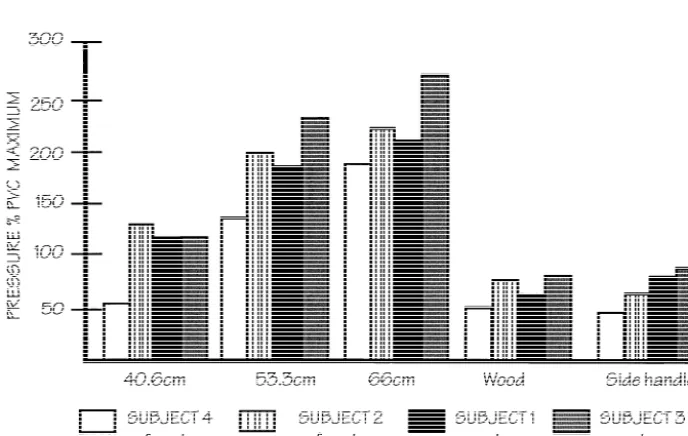
Fig. 3. Average peak impact pressures expressed as a percent of the maximum impact pressure for the PVC traditional duty baton.
produced smaller peak impact forces. Each of these batons has the same contact dimensions as that of the PVC baton. It is clear that these batons would produce comparatively less peak impact pressures relative to the other batons tested.
3.2. Kinematics
To disable or subdue an attacker the officer using the tactical baton can strike with maximum impact causing pain or temporary disability. Alternatively, the officer can disable the attacker with a series of rapid submaximal blows. Considering these factors, maximum force will be achieved at or near maximum arm extension speed (with the exception of the side handle baton because of the different swing technique). This has been found to occur at approximately 70–75% of arm extension in the karate punch [6]. Timing the contact and maximizing speed could assure that the law enforcement professional is not already slowing the baton when contact is made with the assailant which would reduce the effectiveness of the device.
In Table 2 it can be seen that the subjects made contact when the arm was not fully extended. There was slightly more extension observed for the 53.3-cm and 66-cm tactical batons. On the basis of elbow range of motion data presented in Table 3, contact and peak force were made earliest, on average, with the PVC baton and latest with the 66- cm tactical baton.
Table 2
Impact swing kinematics: mean values
Traditional batons Tactical batons
PVC Wood 40.6 cm 53.3 cm 66.0 cm
Elbow angle at contact 130.48 134.88 133.78 137.48 136.58 Contact as percentage of full swing 66.5% 69.7% 67.6% 67.0% 73.4% Peak force as percentage of full swing 68.6% 72.8% 71.4% 71.2% 74.4%
earlier in the swing than when maximum force was reached for the impact swings. One can speculate that with the lack of an explicit target maximum force, as reflected by speed, is reached earlier in the swing and uses up to 40% of the swing to slow the baton down. With the absence of a target or contact this slowing down is a natural protective mechanism against the momentum of the baton. However, this practice may be in contradiction to the concept of specificity of training.
The impact strikes as performed in the laboratory may be considered as ideal representations of these skills. In the field other factors may be as equally important as maximum force or pressure with respect to an officer’s safety and that of the public when it comes to controlling an assailant’s hostilities. The frequency of the blows or the quick repetitiveness of the blows an officer can deliver to the assailant, the safer the situation. Striking swings with the PVC baton and 66-cm expandable baton on average took the longest to complete. With the exception of one subject (subject 3) it took the officers longer to complete the swing with the PVC for the forehand and forehand / backhand strikes. Two subjects in the forehand / backhand took equally as long to complete the entire swing with 66-cm tactical baton as they did with the PVC. Due to its reduced moments of inertia (rotational resistance) resulting from its reduced weight and shorter length, the 40.6-cm tactical baton, on average, provided for the most rapid swings. Therefore, although it may not produce the greatest forces the potential frequency of strikes is greatest in the 40.6-cm baton followed closely by the 53.3-cm baton. However, the proximity of the officer to the assailant may put that officer at greater risk. An officer’s safety may be compromised if they have to get too close to the assailant to deliver a blow. The closer the officer comes the fewer the potential options and possible reaction time they may have to an unexpected threatening move or event from the attacker.
The maximum forward reach that was achieved with each strike with each baton is given in Table 4. Measured from the subject’s shoulder to the end of the baton, the
Table 3
Maximum baton velocity expressed as a percent of arm extension (mean values) Traditional batons Tactical batons
PVC Wood 40.6 cm 53.3 cm 66.0 cm
Forehand strike 59.0% 60.6% 61.6% 65.6% 59.1%
[image:9.480.66.428.548.612.2]Table 4
Maximum forward reach: measured from shoulder to the end of the baton Traditional batons Tactical batons
PVC Wood 40.6 cm 53.3 cm 66.0 cm
Forehand strike 91 cm 89 cm 77 cm 86 cm 96 cm
Forehand / backhand strike 92 cm 94 cm 82 cm 91 cm 100 cm
66-cm tactical baton had the greatest forward reach during the course of the strikes investigated. Even though the PVC is longer there was a tendency on the part of the subjects to choke up on the baton thus reducing its effective length. As expected the 40.6-cm tactical baton provided the smallest forward reach. The 53.3-cm tactical baton had a mean reach of only 5 cm and 1 cm less than the PVC for the forehand and forehand / backhand strikes respectively.
4. Summary
The main purpose of this project was to conduct a biomechanical comparison between various sizes of expandable tactical batons and the standard issue PVC duty baton. Comparison was made on those quantifiable mechanical variables that were deemed significant with respect to trauma and the intended use of the baton as an intermediate weapon. The study proceeded under the assumption that the baton, if used as intended, will be an impact device that can effectively control an assailant’s hostilities.
The three ASP tactical batons, the side handle baton and wood duty baton all produced smaller impact forces compared to that achieved with the PVC duty baton. In a theoretical model of impact pressure, the expandable batons produced on average higher impact peak pressures than those produced with the PVC baton. The impact pressures ranged from approximately 50% to 135%, 110% to 230%, and 125% to 275% of the PVC maximum for the 40.6-cm, 53.3-cm and 66-cm extendable tactical batons, respectively. It must be stressed that these measures were collected under ideal laboratory conditions. The recorded impact forces and pressure values, would in most likelihood far exceed the impact loads that could be generated in the field during an actual confrontation with an assailant. In addition to these considerations the amount of mechanical work done on the assailant, which dictates the resulting stresses, is dependent on the material or tissue struck. A large muscle group which is fully contracted will experience far less trauma than if the same blow were delivered to an area with little muscle or adipose tissue over the bone.
actually deliver a maximal blow or a series of blows. The 66-cm expandable baton afforded the greatest reach and the 40.6-cm expandable baton the least. The 53.3-cm expandable, PVC and wooden baton differed between 1 cm and 5 cm with respect to reach.
In summary, a large number of interdependent factors which relate to the effective and appropriate use of these intermediate weapons must be considered in their evaluation. In light of their intended use, no single factor can conclusively dictate a baton’s superiority over another with respect to the inherent risks to an officer or an assailant.
References
[1] D.C. Viano, I.V. Lau, A viscous tolerance criterion for soft tissue injury assessment, J. Biomech. 21 (1988) 387–399.
[2] H. Woo, A.E. Chapman, A 3D kinematic analysis of the squash forehand stroke. Proceedings of the XIII Int. Congress of Biomechanics. Perth, Australia, 1991, pp. 148–148.
[3] Nike, Athletic shoe cushioning. Nike Sport Research Review. 1988, (Sept. / Oct.).
[4] D.D. Arnheim, Modern Principles of Athletic Training. Time Mirror / Mosby College Publishing, Toronto, 1989.
[5] ASP Tactical Baton, Product description, Armament Systems and Procedures, Box 1794, Appleton, WI. [6] J.D. Walker, Karate strikes, Am. J. Physics 43 (1975) 845–849.
[7] Y.I. Abdel-Aziz, H.M. Karara, Direct linear transformation from comparator coordinates into object space coordinates in close-range photogrammetry, Am. Soc. Photogrammetry, Symposium on Close-Range Photogrammetry, Falls Church, VA, 1971.