Original Article
Anthocyanins attenuate
post-operative cognitive dysfunction via
upregulation of SIRT3 in diabetes mellitus mice
Yiping Bai1, Huaju Tian2, Liming Luan3, Sulan Tan1, Daiying Zhang2
1Department of Anesthesiology, Affiliated Hospital of Southwest Medical University, Luzhou, China;2Department
of Operating Room, Affiliated Hospital of Southwest Medical University, Luzhou, China;3Department of
Anesthesiology, Vanderbilt University Medical Center, Nashville, TN, USA
Received October 25, 2018; Accepted December 9, 2018; Epub January 15, 2019; Published January 30, 2019
Abstract: Objective: The study aimed to determine the protective effect of anthocyanins on post-operative cognitive dysfunction via upregulation of SIRT3 in diabetes mellitus mice. Methods: A total of 96 healthy adult male BALB/c mice (30-50g) were randomly divided into 4 groups (n=24 each). These included the following groups: the control group with no surgery, the sham group of type 2 diabetic mice established first, followed by splenectomy, and the anthocyanin group as a model of type 2 diabetic mice. Mice were continuously gavaged with anthocyanins 100 mg/ kg/d for 2 weeks prior to splenectomy. An additional SIRT3-knockout group was established as the diabetic mice model, SIRT3 was knocked out prior to the same administration of anthocyanins with anthocyanin group. To detect spatial memory and learning abilities, 8 mice in each group were randomly chosen for Morris water-maze (MWM) test on day 8, 10, 14 after splenectomy to determine the time duration of escape latency, total quadrant crossing, and original quadrant. Levels of TNF-α and IL-1β in hippocampuses were detected by ELISA kits. Results: 1. Morris Water-Maze test results. At day 10 and 14, mice in the Sham group compared to the Control group, the escape latency was significantly prolonged, and total quadrant crossing and time in original quadrant were shortened (P < 0.05). When mice in the Anthocyanin group were compared to the Sham group, the escape latency was significantly shortened, and total quadrant crossing and time in original quadrant were prolonged. Mice in the SIRT3-knockout group was compared to the Anthocyanin and Control group, and the escape latency was significantly prolonged, and total quadrant crossing and time in original quadrant were shortened (P < 0.05). 2. Pro-inflammatory cytokines in the hippocampus of mice. At day 8, 10 and 14, mice in the Sham group was compared to the Control group, TNF-α and IL-1β were significantly increased (P < 0.05). When mice in the Anthocyanin group were compared to the Sham group, TNF-α and IL-1β were significantly decreased. When mice in the SIRT3-knockout group were compared to the Anthocyanin and Control group, TNF-α and IL-1β were significantly increased (P < 0.05). Conclusions: Anthocyanins may play a protective effect of post-operative cognitive dysfunction via upregulation of SIRT3 in diabetes mellitus mice.
Keywords: Anthocyanins, POCD, SIRT3, diabetes mellitus
Introduction
Post-operative cognitive dysfunction (POCD) is a complication of the central nervous system caused by anesthesia and/or surgery, mainly manifested as the decline of learning and memory ability, personality and social behavior ability [1]. POCD incidence overall in elders appears in the order of 10-38% [2-5] within the first 2 to 3 months and 3-24% at 6 to 12 mon- ths after major surgery [4, 6, 7]. However pa- tients with diabetes are overall at 26% in-
cogni-tive dysfunction of Alzheimer’s disease from a neuroinflammatory and oxidative stress per-spective [11-13], and sirtuins 3 (SIRT3) is close-ly associated with the regulation of neuroin-flammatory and oxidative stress perspective [14-16]. However, the effect of anthocyanins in POCD impairment in diabetes mellitus (DM) populations and the function of SIRT3 in POCD are without robust evidence. This study was aim to illustrate the protective effect of antho-cyanins on POCD in DM mice with possible SIRT3 pathway.
Materials and methods
Animals and groups
Our animal protocol was approved by the Ani- mal Care and Use Committee at Southwest Medical University in accordance with the re- quirements of the Chinese Animal Care Com- mittee. All of the animals used in this study were in compliance with the Guide for the Care and Use of Laboratory Animals published by the US National Institutes of Health (NIH Publication No. 85-23, revised 1996).
A total of 96 healthy adult male BALB/c mice (30-50 g) were randomly divided into 4 groups (n=24 each). Control group: no surgery, Sham group: the model of type 2 diabetic mice was established first (streptozyme 20-40 mg/kg/ day was administered by tail vein for 5 days, and hyperlipidemia was kept for several days. After 5 days, modeling success was confirmed when fasting blood glucose > 10 mmol/L or random blood glucose > 16.7 mmol/L), fol-lowed by splenectomy. Anthocyanin group: the model of type 2 diabetic mice was first estab-lished, and then they were continuously gava- ged with purple sweet potato anthocyanin (PSPA) 100 mg/kg/d for 2 weeks prior to sple-nectomy. SIRT3-knockout group: same estab-lish of diabetic mice model, SIRT3 was knocked out prior to the same administration of antho-cyanins with Anthocyanin group.
PSPA preparation
The PSP cultivars Anhui Zi was obtained from the Academy of Agricultural Sciences in Xuzhou (Jiangsu, China). Based on previously described methods [17], 5 to 8 mm PSP slices were dried under the condition of 50°C (moisture content in dry products < 12%). Subsequently, the dry PSP slices were made into powder.
Morris water-maze (MWM) test
MWM has become the most frequently used one as it can circumvent sensory and motor defects which may interfere with experimental results, thus can more accurately reflect spatial memory of mice. In MWM, navigation sessions can evaluate the learning and memory ability, while space exploration session can measure the spatial association ability, recall ability, and explore ability [19].
In each group, 8 mice were randomly chosen for MWM test on day 8, 10, 14 after splenecto-my. In order to detect spatial memory and learning abilities, first, navigation training ses-sions were performed, in which mice facing the wall of the pool were released into the water from one of four quadrants. A platform was placed in the center of test field. Mice were allowed to locate the platform and land on it within 60 seconds. If the mouse failed to do it within 60 seconds, they were picked up and maintained on the platform. Those mice were assigned as having a 60 second escape laten-cy. After landing on the platform, each mouse was kept on it for 15 seconds to strengthen the memory of the platform. This session was con-ducted four times each day for each mouse, with the entry from one of the four quadrants each time. The escape latency was recorded and averaged. After the navigation training, the platform was removed. The test session began from the contralateral quadrant of original plat-form quadrant with mice facing the wall of the pool. The time duration in the original platform quadrant and the frequency of crossing were recorded and calculated.
Enzyme-linked immunosorbent assay (ELISA)
After the MWM test, mice were sacrificed; hip-pocampuses were harvested, grinded with ho- mogenizer and prepared for 10% homogenates by ultrasonic. The homogenates were centri-fuged at 2500 r/min at 4°C for 10 minutes. Levels of TNF-α and IL-1β were detected by ELISA kits (Rapidbio, California, USA) according to the manufacturer’s instructions.
Statistical analysis
plus post hoc Bonferroni comparison. Unless otherwise noted, data are presented as the mean (SD). Significance was defined as a two-sided P-value < 0.05.
Results
Morris Water-Maze test results
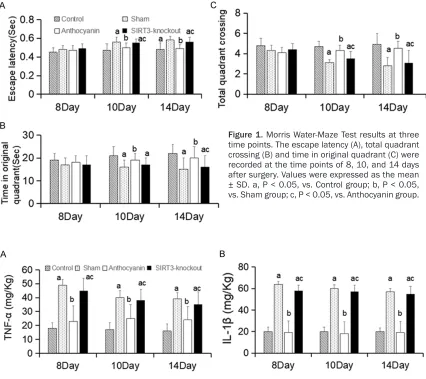
At day 10 and 14, mice in the Sham group were compared to the Control group and the escape latency was significantly prolonged, and total quadrant crossing and time in original quadrant were shortened (P < 0.05). Mice in the An- thocyanin group was compared to the Sham group and the escape latency was significantly shortened, and total quadrant crossing and time in original quadran were prolonged. Mice in the SIRT3-knockout group were compared to
the Anthocyanin and Control group, and the escape latency was significantly prolonged, and total quadrant crossing and time in original quadrant were shortened (P < 0.05) (Figure 1).
Pro-inflammatory cytokines in the hippocam-pus of mice
At day 8, 10, and 14, mice in the Sham group were compared to the Control group, TNF-αand IL-1β were significantly increased (P < 0.05) and mice in the Anthocyanin group were com-pared to the Sham group, and TNF-α and IL-1β were significantly decreased. Mice in the SIRT3-knockout group were compared to the An- thocyanin and Control group, where TNF-α and IL-1β were significantly increased (P < 0.05) (Figure2).
[image:3.612.93.519.74.453.2]Figure 2. Pro-inflammatory cytokines in the hippocampus of mice. Levels of TNF-α (A) and IL-1β (B) in the hippocam -puses were detected by ELISA kits. Values were expressed as the Mean ± SD. a, P < 0.05, vs. Control group; b, P < 0.05, vs. Sham group; c, P < 0.05, vs. Anthocyanin group.
Discussion
Our aim was to test the hypothesis that antho-cyanins may have a protective effect on POCD in DM mice after surgery via down regulation of SIRT3. The goal of this study was to examine the effects of anthocyanins on POCD effects in DM mice and determine the cognitive functions of mice in the anthocyanin group. Mice were significantly improved at day 8, day 10, and day 14 after surgery in comparison to the Sham group. These results showed that the anthocya-nins may alleviate long-term POCD symptom in DM mice. Furthermore, after administration of anti-SIRT3, there was no significant difference of cognitive functions at these three time points between the anthocyanin group and the anti-SIRT3 group, which showed that anthocyanins might play a protective role against POCD in DM mice after surgery via up regulation of SIRT3. There are a few studies showing that anthocya-nins may reduce the incidence of POCD via decrease of neuroinflammation and oxidative stress [19, 20].
How anthocyanins play a protective effect on POCD in DM mice after surgery was a focus of this study. Expression of IL-1β, TNF-α were up regulated in the Sham group in which there was the highest incidence of POCD among the three groups, and an increase of IL-1β and TNF-α was alleviated after administration of anthocyanins and showed a lower incidence of POCD com-pared with the Sham group. TNF-α can activate neural glial cells and has pivotal roles in neuro-modulation [21, 22]. Recently, Sun D et al. demonstrated that administration of dobuta-mine hydrochloride alleviated development of early POCD in aged patients via inhibiting the release of TNF-α [23]. IL-1β also plays an impor-tant role in the development of POCD, Barrientos RM demonstrated that the learning and memory in rat could be impaired by inject-ing IL-1β into the hippocampus [24]. Symptoms of POCD could be alleviated by the knockout of IL-1β receptor in mice [22].
The role of SIRT3 in the regulation of TNF-α and IL-1β pretreated with anthocyanins in Sirt3 blocked DM mice was also examined. Inflam- matory medium (TNF-α, IL-1β) and the inci-dence of POCD was significantly higher in Anti-Sirt3 than in the Anthocyanin group. Anti-Sirt3 may play an important role in the development of
POCD and may regulate the release of inflam-matory mediators. The close relationship be- tween SIRT3 and inflammatory mediators [25-27], and Li, JJ et al. [28] further found that SIRT3 could mediate the expression of TNF-α and IL-1β, which were closely associated with POCD.
There are also limitations of this study. There are quite a few studies about the association between inflammatory mediators and POCD, therefore we still have no robust evidence about the association between anthocyanins and POCD, SIRT3, and POCD. Further research is needed in the future.
In conclusion, the present study demonstrated the protective effect of anthocyanins for sple-nectomy-induced POCD in DM mice, possibly via up regulation of the activity of SIRT3, and eventually, by suppressing neuro-inflammation in the brain.
Acknowledgements
This study was financially supported by Sichuan provincial health and family planning commis-sion, grant no.17PJ325.
Disclosure of conflict of interest
None.
Address correspondence to: Dr. Daiying Zhang, Department of Operation Room, Affiliated Hospital of Southwest Medical University, 25 Taiping Street, Luzhou 646000, China. Tel: +8613608288989; E-mail: [email protected]
References
[1] Hansen MV. Chronobiology, cognitive function and depressive symptoms in surgical patient. Dan Med J 2014; 61: B4914.
[2] Van Dijk D, Keizer AM, Diephuis JC, Durand C, Vos LJ, Hijman R. Neurocognitive dyfunction after coronary artery bypass surgery: a system-atic review. J Thorac Cardiovasc Surg 2000; 120: 632-9.
[3] Monk TG, Weldon C, Garvan CW, Dede DE, Van der Aa MT, Heilman KM, Gravenstein JS. Pre-dictors of cognitive dysfunction after major noncardiac surgery. Anesthesiology 2008; 108: 18-30.
Pre-existing cognitive impairment is associated with post-operative cognitive dysfunction after hip joint replacement surgery. Anesthesiology 2015; 122: 1224-34.
[5] Shoair OA, Grasso MPI, Lahaye LA, Daniel R, Biddle CJ, Slattum PW. Incidence and risk fac-tors for post-operative cognitive dysfunction in older adults undergoing major noncardiac sur-gery: a prospective study. J Anaesthesiol Clin Pharmacol 2015; 31: 30-6.
[6] Leiendecker J, Höcker J, Meybohm P, Fudickar A, Bein B. Post-operative neurocognitive func-tion and microembolus detecfunc-tion in patients undergoing neck dissection: a pilot study. Eur J Anaesthesiology 2010; 27: 417-24.
[7] Newman MF, Kirchner JL, Phillips-Bute B, Gav-er V, Grocott H, Jones RH, Mark DB, Reves JG, Blumenthal JA. Longitudinal assessment of neurocognitive function after coronary-artery bypass surgery. N Engl J Med 2001; 344: 395-402.
[8] Feinkohl I, Winterer G, Pischon T. Diabetes is associated with risk of post-operative cogni-tive dysfunction: a meta-analysis. Diabetes Metab Res Rev 2017; 33.
[9] Trompet S, De Craen AJ, Slagboom P, Shep-herd J, Blauw GJ, Murphy MB, Bollen EL, Buck-ley BM, Ford I, Gaw A, Macfarlane PW, Packard CJ, Stott DJ, Jukema JW, Westendorp RG; PROSPER Group. Genetic variation in the inter-leukin-1 beta-converting enzyme associates with cognitive function. The PROSPER study. Brain 2018; 131: 1069-1077.
[10] Wan Y, Xu J, Ma D, Zeng Y, Cibelli M, Maze M. Post-operative impairment of cognitive func-tion in rats: a possible role for cytokine-mediat-ed inflammation in the hippocampus. Anes -thesiology 2007; 106: 436-443.
[11] Pacheco SM, Soares MSP, Gutierres JM, Gerz-son MFB, Carvalho FB, Azambuja JH, Schet-inger MRC, Stefanello FM, Spanevello RM. An-thocyanins as a potential pharmacological agent to manage memory deficit, oxidative stress and alterations in ion pump activity in-duced by experimental sporadic dementia of Alzheimer’s type. J Nutr Biochem 2018; 56: 193-204.
[12] Celik E, Sanlier N. Effects of nutrient and bio-active food components on Alzheimer’s dis-ease and epigenetic. Crit Rev Food Sci Nutr 2017; 11: 1-12.
[13] González-Reyes RE, Nava-Mesa MO, Vargas-Sánchez K, Ariza-Salamanca D, Mora-Muñoz L. Involvement of astrocytes in alzheimer’s dis-ease from a neuroinflammatory and oxidative stress perspective. Front Mol Neurosci 2017; 10: 427
[14] Xu M, Xue RQ, Lu Y, Yong SY, Wu Q, Cui YL, Zuo XT, Yu XJ, Zhao M, Zang WJ. Choline amelio-rates cardiac hypertrophy by regulating
meta-bolic remodelling and UPRmt through SIRT3-AMPK pathway. Cardiovasc Res 2018; 27: 1093.
[15] Parodi-Rullán RM, Chapa-Dubocq XR, Javadov S. Acetylation of mitochondrial proteins in the heart: the role of SIRT3. Front Physiol 2018; 9: 1094.
[16] Sidorova-Darmos E, Sommer R, Eubanks JH. The role of SIRT3 in the brain under physiologi-cal and pathologiphysiologi-cal conditions. Front Cell Neurosci 2018; 12: 196.
[17] Liu X, Mu T, Sun H, Zhang M, Chen J. Optimisa-tion of aqueous two-phase extracOptimisa-tion of antho-cyanins from purple sweet potatoes by re-sponse surface methodology. Food Chem 2013; 141: 3034-3041.
[18] Tian Y, Guo S, Zhang Y, Xu Y, Zhao P, Zhao X. Effects of hydrogen-rich saline on hepatecto-my-Induced post-operative cognitive dysfunc-tion in old mice. Mol Neurobiol 2017; 54: 2579-2584.
[19] Zhao WX, Zhang JH, Cao JB, Wang W, Wang DX, Zhang XY, Yu J, Zhang YY, Zhang YZ, Mi WD. Acetaminophen attenuates lipopolysaccha-ride-induced cognitive impairment through an-tioxidant activity. J Neuroinflammation 2017; 14: 17.
[20] Huang L, Huang K, Ning H. Hispidulin prevents sevoflurane-Induced memory dysfunction in aged rats. Biomed Pharmacother 2018; 97: 412-422.
[21] Huang Y, Mucke L. Alzheimer mechanisms and therapeutic strategies. Cell 2012; 148: 1204-1222.
[22] Cibelli M, Fidalgo AR, Terrando N, Ma D, Mo-naco C, Feldmann M, Takata M, Lever IJ, Nan-chahal J, Fanselow MS, Maze M. Role of inter-leukin-1 beta in post-operative cognitive dys- function. Ann Neurol 2010; 68: 360-368. [23] Sun D, Yang L, Wu Y, Liu R, Han J, Wang L.
Ef-fect of intravenous infusion of dobutamine hy-drochloride on the development of early post-operative cognitive dysfunction in elderly patients via inhibiting the release of tumor ne-crosis factor-α. Eur J Pharmacol 2014; 741: 150-155.
[24] Barrientos RM, Higgins EA, Sprunger DB, Wat-kins LR, Rudy JW, Maier SF. Memory for con-text is impaired by a post concon-text exposure in-jection of interleukin-1 beta into dorsal hippocampus. Behav Brain Res 2012; 134: 291-298.
[26] Xia W, Geng K. A sirtuin activator and an anti-inflammatory molecule-multifaceted roles of adjudin and its potential applications for ag-ing-related diseases. Semin Cell Dev Biol 2016; 11 59: 71-78.
[27] Li R, Xin T, Li D, Wang C, Zhu H, Zhou H. Thera-peutic effect of Sirtuin 3 on ameliorating non-alcoholic fatty liver disease: the role of the ERK-CREB pathway and Bnip3-mediated mi-tophagy. Redox Biol 2018; 18: 229-243.