1This article does not deal with the important particle
separ-ation techniques of filtrsepar-ation, flotsepar-ation and the use of membranes which are dealt with elsewhere in the Encyclopedia.
plants. The long-term goal of the process is to replace packed towers in conventional absorber}stripper operations. Practical problems related to membrane fouling and lifetime are the principal limitations.
The Future
Since the 1970s there has been a period of very rapid growth for the membrane separation industry. Total sales for all membrane applications have grown ap-proximately 400-fold to the US$3}4;109 per year
level. In the areas of microRltration, ultraRltration, reverse osmosis, electrodialysis and dialysis, the tech-nology is relatively mature. SigniRcant growth is still occurring, however, as membranes continue to dis-place more conventional separation techniques. The most rapidly expanding area is gas separation, which has grown to a US$150;106per year business in just
a few years. Gas separation is poised to grow a fur-ther two- or three-fold as the technology is used more widely in the reRnery, petrochemical and natural gas processing areas. If the development of ceramic oxy-gen-permeable membranes for syngas membrane re-actors is successful, a membrane process that could change the basis of the chemical industry would then be available.
Further Reading
Amjad Z (1993)Reverse Osmosis. New York: Van Nos-trand-Reinhold.
Baker RW, Cussler EL, Eykamp Wet al. (1991)Membrane Separation Systems. Park Ridge, NJ: Noyes Data Corp. Bakish R (ed.) (1991) Proceedings of the International Conference on Pervaporation Processes in the Chemical Industry, Heidelburg. Englewood, NJ: Bakish Materials Corp.
Bakish R (ed.) (1992) Proceedings of the International Conference on Pervaporation Processes in the Chemical Industry, Ottawa. Englewood, NJ: Bakish Materials Corp.
Bakish R (ed.) (1995)Proceedings of the International Co-nference on Pervaporation Processes in the Chemical In-dustry, Reno, NV. Englewood, NJ: Bakish Materials Corp. Brock TD (1983)Membrane Filtration. Madison, WI: Sci.
Tech. Inc.
Cheryan M (1986) UltraTltration Handbook. Lancaster, PA: Tecnomic Pub. Company.
Crespo JG and BoKddeker KW (eds) (1994)Membrane Pro-cesses in Separation and PuriTcation. Dordrecht: Kluwer Academic.
Ho WS and Sirkar KK (eds) (1992)Membrane Handbook. ew York: Van Nostrand Reinhold.
Mulder M (1991)Basic Principles of Membrane Techno-logy. Dordrecht: Kluwer Academic.
Parekh BS (ed.) (1988)Reverse Osmosis Technology. New York: Marcel Dekker.
Paul DR and Yampol’skii YP (eds) (1994)Polymeric Gas Separation Membranes. Boca Raton, FL: CRC Press. Porter MC (ed.) (1990)Handbook of Industrial Membrane
Technology. Park Ridge, NJ: Noyes Publications. Rautenbach R and Albrecht R (1989)Membrane Processes,
Chichester: John Wiley&Sons.
Toshima N (ed.) (1992)Polymers for Gas Separation. New York: VCH.
PARTICLE SIZE SEPARATIONS
J. Janc\a, Universite& de La Rochelle, La Rochelle, France
Copyright^ 2000 Academic Press
Historical Development
In 1556, an extraordinary book entitledDe Re Metal-lica, Libri XII appeared in Basel. The author was a German physician, naturalist and mineralogist, call-ing himself Georgius Agricola (originally called Georg Bauer), living in JaHchymov, Bohemia, from 1494 to 1555. Agricola described, in a fascinating manner, the contemporary advances in metals and
minerals recovery and gave us a very detailed report on the sophisticated technologies of his epoch. This late medieval period saw a true expansion of science and technology in Europe. Winston Churchill once said: ‘2from this date, 1492, a new era in the history of mankind takes its beginning’. As many metal re-covery processes used at that time were based on various separations of particulate matter andDe Re Metallica, Libri XII seems to be the Rrst printed review of separation technologies, it isRtting to ac-knowledge Agricola’s publication priority in thisReld and to consider his book as the beginning of a modern scientiRc approach to particle size separations.
Figure 1 Mediaeval device for the recovery of gold particles and minerals from sand, clay, and soil blends by combining the sedimentation and quasi-horizontal stream of water, accom-panied by vigorous manual stirring of the mud cake. (Bottom) The author of the bookDe Re Metallica, Libri XII, Georgius Agricola.
a stream of running water to separate gold particles from other solid material (soil, clay, sand, etc.). Astonishingly, this technology dates back to at least 4000 to 5000BC.
Original scientiRc discoveries, outstanding inven-tions and innovainven-tions in technology representing the
important achievements at a given moment reSect continuity of imagination throughout the long history of civilization. When looking for the background and genesis of modern and powerful separation method-ologies and technmethod-ologies, very often natural analogies can be found at a macroscopic level. An image of a river meandering through the countryside and re-moving soil, clay, sand, and stones from a river bank, carrying them off in the stream, and depositing them later at other places, is one such example. On the other hand, although ancient technologies can have essentially the same goal (separation), in a man-ner similar to that in which ‘cat’s cradle’ is equivalent to a sophisticated electronic computer game, the in-tellectual progress is evident.
Dry and wet sieving, sedimentation, andRltration are probably the most ancient, intelligently applied, separation processes on which the foundations of modern separation science stand. These processes were originally exploited for the separations of disin-tegrated matter whose average ‘particle’ size was somewhere between millimetre and centimetre frac-tions, sometimes even bigger. Slowly, the need to separate smaller and smaller particle size material became apparent. The old-fashioned but transformed methods still afforded positive answers to ques-tions which appeared in relation to the new separ-ation problems. However, these transformsepar-ations gave rise to newer methods which, together with the dis-covery and invention of completely new principles, symbolize the state of the art of particle separation.
Particles, Sizes, and Methods
In order to make clear what this article deals with, the useful and necessary terms, limits and conditions must be deRned.Particles, within the frames of this text, is an ensemble of single subjects of disintegrated matter which is dispersed in a continuumSuid orin vacuo. One particle, regardless of its size, is usually not identical with one molecule but with a large number of molecules aggregated by physical forces. In the case of polymeric matter, however, one macro-molecule can be identiRed with one particle, under certain conditions. The second important attribute which deRnes one particle is that, physically, it repre-sents a subject delimited in three-dimensional space by a phase discontinuity. The particles, representing one discontinuous phase which can be solid or liquid, are dispersed in a second continuous phase which is gaseous or liquid.
chemical character of the surrounding dispersingSuid but also of the imposed physical conditions: obvious ones, such as, e.g., the temperature, and less obvious as, e.g., the electric charge, etc. Moreover, it has to be taken into account that the results of the measure-ments of the particle size can strongly depend on the method of its determination. As a result, the ques-tions are not only what the size that we obtain from a particular measuring method means and whether the result corresponds to a true size, but also what kind of effective size we measure by applying any particular method. Not only one but many effec-tive sizes obtained by different measuring methods can correspond to the physical reality (they all can be ‘true’). This is due to the fact that the measured data can contain various information on the particle-dispersing Suid and particle}particle interac-tions, on the sizeSuctuations in time, on the transport behaviour of the particles in the dispersing Suid, etc. Although all these phenomena can complicate the de-termination of a deRnite particle size, they provide much useful information on the whole dispersed par-ticulate system. Having in mind these complications, we can deRne the range of particle sizes of practical interest as lying within the range from a diameter of few nanometres to thousands of micrometres.
The deRnition and limitation of the particles and the particle size ranges, as outlined, determine the relevant separationmethods. Those methods can be considered relevant that are directly related to the separation according to differences in particle size or concerned indirectly due to the fact that they can provide complementary information necessary to an accurate interpretation of the experimental data obtained from particle size-based separations.
Objectives and Methods
The aim of any separation, including particle size separation, is either analytical or preparative. Ana-lytical separationsare generally used to increase the sensitivity or selectivity of the subsequent analytical measurement, or to obtain more speciRc information about the analysed sample. Very often, the original sample is a complicated mixture making the analysis possible only with a prior separation step. Hence, the original multicomponent sample to be analysed must Rrst be separated into more or less pure fractions. Whenever the samples are of particulate character and/or of biochemical or biological origin, direct analysis without preliminary separation is often im-possible. An accurate analytical result can be ob-tained from any analytical separation method by em-ploying an appropriate treatment and interpretation of the experimental data. Separation is usually based on the differences in extensive properties, such as
the mass or size of the particles, or according to intensive properties, such as density, electrophoretic mobility, etc. If the relationship between the seation parameters and the size of the separated par-ticles is known or can be predetermined by using an appropriate calibration procedure, the characteristics of an unknown analysed sample can be evaluated quantitatively. The particle size distributions of the analysed samples are determined conveniently from the record of a coupled detector: a fractogram. De-tailed information concerning the associated proper-ties of the separated and characterized particles and/or composition of the analysed system which can be ex-tracted from the fractogram represents more sophisti-cated application of a particular separation method.
Preparative separations are aimed at obtaining a signiRcant quantity of the separated fractions from the original sample. The fractions are subsequently used for research or technological purposes, for de-tailed analysis of various effective sizes, for the determination of the structure or chemical composi-tion of the particles of a given size, etc. The practical preparative separations can range from laboratory microscale, which cannot be experimentally distin-guished from analytical separations, up to industrial macroseparation units.
Analytical and preparative separations are funda-mentally identical so that, consequently, we do not distinguish between them and all separation methods are described and discussed from the point of view of the principles involved by making comments on their speciRc applications only if the discussed technique exhibits particular characteristics predetermining it for a special analytical or preparative purpose.
The most suitable and widespread methodologies for particle size separations described below, starting from the most versatile to more speciRc ones, are:
E Reld-Sow fractionation
E size-exclusion chromatography
E hydrodynamic chromatography
E centrifugation
E electrophoresis
Besides these modern techniques, some classical pro-cedures mentioned above such as wet or dry sieving, Rltration, etc., should not be forgotten.
Field-Flow Fractionation
Figure 2 Schematic representation of the general principle and experimental arrangement of field-flow fractionation: (1) pump; (2) injector; (3) separation channel; (4) external field; (5) hydrodynamic flow; (6) detector.
Principle of Separation
Separation in FFF is based on the action of effec-tive physical or chemical forces across the separation channel in which the particles are transported due to theSow of a carrier liquid. TheReld interacts with the particles, separating and concentrating them at the appropriate positions inside the channel. The concen-tration gradient so formed induces an opposition dif-fusion Sux. When equilibrium is reached, a stable concentration distribution of the particles across the channel is established. Simultaneously, a Sow velo-city proRle is formed across the channel in the longi-tudinal Sow of the carrier liquid. As a result, the particles are transported longitudinally at differ-ent velocities depending on the transverse positions of their zones and are thus separated. This principle is shown in Figure 2. The carrier liquid is pumped through the sample injector to the fractionation chan-nel. The detector connected at the end allows the recording of the fractogram.
Separation Mechanisms
Two particular mechanisms,polarizationand focus-ing, can govern the separation. The components of the fractionated sample can be differently com-pressed to the accumulation wall of the channel or focused at different levels. Polarization and fo-cusing FFF have many common characteristics such as the experimental procedures, instrumentation, data treatment, and the range of potential applica-tions. The separation is carried out in one liquid phase. The absence of a stationary phase of large surface area can be of fundamental importance for the fractionation of biological particles whose stabil-ity against degradation can be sensitive to interac-tions with the surfaces. The strength of theReld can be easily controlled to manipulate the retention. Many operational variables can be programmed.
The polarization FFF methods are classiRed with regard to the character of the appliedReld, while the
focusing FFFmethods are classiRed according to the combination of various Relds and gradients. Al-though some earlier separation methods are also based on the coupled action of Reld forces and hy-drodynamicSow, the beginning of FFF proper can be attributed to Giddings who in 1966 described the general concept of polarization FFF. Focusing FFF was originally described in 1982.
Polarization FFF methods make use of the forma-tion of an exponential concentraforma-tion distribuforma-tion of each sample component across the channel with the maximum concentration at the accumulation wall which is a consequence of constant and position-independent velocity of transversal migration of the affected species due to the Reld forces. This con-centration distribution is combined with the velocity proRle formed in theSowing liquid.
Focusing FFF methods make use of transversal migration of each sample component under the ef-fect of driving forces that vary across the channel. The particles are focused at the levels where the intensity of the effective forces is zero and are transported longitudinally according to their posi-tions within the establishedSow velocity proRle. The concentration distribution within a zone of a focused sample component can be described by a nearly Gaussian distribution function.
Retention
The retention ratioRis deRned as the average velo-city of a retained sample component divided by the average velocity of the carrier liquid which is equal to the average velocity of an unretained sample compon-ent:
R" r,ave
(x)
FFF is usually carried out in channels of simple geometry allowing calculation of the rigorous rela-tionship between the retention ratio and the size of the separated particles. If this relationship is difR -cult to determine, a calibration can be applied. The particle size distribution (PSD) in both cases is deter-mined from the fractogram.
Zone Dispersion
The separation process is accompanied by the zone spreading which has a tendency to disperse the con-centration distribution already achieved by the separ-ation. The conventional parameter describing the efRciency of the separation is the height equiva-lent to a theoretical plateH:
H"L
VRFigure 3 Dependence of the efficiency of FFF, expressed as the height equivalent to a theoretical plateH, on the average linear velocity of the carrier liquid(x).
Figure 4 Design of sedimentation FFF channel: (1) flow in; (2) channel; (3) rotation; (4) flow; (5) flow out.
where VR is the retention volume and is the
stan-dard deviation of the elution curve. The width of the elution curve reSects several contributions: longitudi-nal diffusion, nonequilibrium and relaxation processes, and spreading due to the external parts of the whole separation system such as injector, de-tector, connecting capillaries, etc. The sum of all contributions results in a curve shown in Figure 3 which exhibits a minimum. As the diffusion coef-Rcients of the particles are very low, the longitudinal diffusion is practically negligible and the optimal efRciency (the minimum on the resulting curve) is situated at very lowSow velocity. The instrumental and relaxation spreading can be minimized by opti-mizing the experimental conditions.
Applications of Polarization FFF
The character of the applied Reld determines the particular methods of polarization FFF. The most important of them are:
E sedimentation FFF
E Sow FFF
E electric FFF
E thermal FFF
Sedimentation FFFis based on the action of gravi-tational or centrifugal forces on the suspended par-ticles. The sedimentation velocity is proportional to the product of the effective volume and density difference between the suspended particles and the carrier liquid. The channel is placed inside a cen-trifuge rotor, as shown inFigure 4. The technique can be used for the separation, analysis and
characteriza-tion of polymer latex particles, inorganic particles, emulsions, etc. The fractionation of colloidal par-ticles in river water, diesel exhaust soot, and of the nuclear energy-related materials, are typical examples of the use of sedimentation FFF in the investigation of environmental samples. Droplets of liquid emulsions can also be separated and analysed. Biopolymers and particles of biological origin (cells) belong to the most interesting group of objects to be separated by sedi-mentation FFF. The performance of sedisedi-mentation FFF is superior to, or as good as, those of other separation methods. A complication in interpreting the experimental data is due to the fact that the retention is proportional to the product of particle size and density. When performing the fractionation in one carrier liquid only, the density must be as-sumed constant for all particles. However, it is pos-sible to determine the size and density of the particles independently if the fractionations are performed in carrier liquids of various densities.
An example of a typical application of sedimenta-tion FFF shown in Figure 5 allowed detection of a bimodal PSD in a sample of a polymer latex. The order of the elution from the small to the large dia-meter particles corresponds to the polarization mech-anism.Figure 6shows a rapid, high resolution sedi-mentation FFF of the polymer latex particles. In this case, the mechanism of steric FFF dominates, and the order of the elution is inverted.
Figure 5 Fractogram of poly(glycidyl methacrylate) latex show-ing a bimodal character of the PSD.
Figure 6 Fractogram of high-speed high resolution sedimenta-tion FFF of latex beads.
Figure 7 Design of flow FFF channel: (1) flow in; (2) flow out; (3) cross-flow input; (4) membrane; (5) spacer; (6) membrane; (7) cross-flow output; (8) porous supports.
membranes Rxed on porous supports. The carrier liquid can permeate through the membranes but the separated particles cannot. Separations of various kinds of particles such as proteins, biological cells, colloidal silica, polymer latexes, etc., have been described.
Electric FFFuses an electric potential drop across the channel to generate theSux of the charged par-ticles. The walls of the channel are formed by semipermeable membranes as inSow FFF. The par-ticles exhibiting only small difference in elec-trophoretic mobilities but PSD and, consequently, important differences in diffusion coefR -cients, can be determined. The advantage of electric FFF compared with electrophoretic separations, e.g., with capillary electrophoresis, is that high electric Reld strength can be achieved at low absolute values
of the electric potential due to the small distance between the walls of the channel. Electric FFF is especially suited to the separation of biological cells as well as to charged polymer latexes and other colloidal particles. The fractionation of the charged particles represents a vast applicationReld for explo-ration.
Thermal FFF was the Rrst experimentally imple-mented technique, introduced several years ago. Until now, it has been used mostly for the fractionation of macromolecules. Only very recently have attempts been made to apply this method to the fractionation of particles. The potential of thermal FFF justiRes a description here, regardless of its recent limited use in particle separations. The temperature differ-ence between two metallic bars, forming channel walls with highly polished surfaces and separated by a spacer in which the channel proper is cut, produces aSux in the sample components, known as the Soret effect, usually towards the cold wall. The par-ticle sizes can be evaluated from an experimental fractogram by using an empirical calibration curve constructed with a series of samples of known sizes. This calibration can be used to determine the charac-teristics of an unknown sample of the same chemical composition and structure, with the same temper-ature gradient applied. The pressurized separation systems permit operation above the normal boiling point of the solvent used. The fractionations can be achieved in few minutes or seconds. The performance parameters favour thermal FFF over competitive methods.
Applications of Focusing FFF
[image:6.568.71.263.481.684.2]Figure 8 Schematic representation of the channel for focusing FFF in coupled electric and gravitational fields: (1) flow in; (2) flow out; (3) channel walls forming electrodes; (4) spacer.
Figure 9 Fractogram of two samples of polystyrene latex par-ticles showing a good resolution obtained by focusing FFF while no detectable resolution was achieved under static conditions: (1) injection; (2) stop-flow period; peaks corresponding to particle diameters of 9.87m (3) and 40.1m (4).
and gradients. The gradients proposed and exploited are:
E effective property gradient of the carrier liquid
E cross-Sow velocity gradient
E lift forces
E shear stress
E gradient of the nonhomogeneousReld action Focusing can appear due to the effective prop-erty gradient of the carrier liquid in the direction across the channel combined with the primary or secondary transversal Reld. The density gradient in sedimentation}Sotation focusingReld-Sow fractiona-tion (SFFFFF) or the pH gradient in isoelectric focus-ingReld-Sow fractionation (IEFFFF) has already been implemented for separation of polystyrene latex par-ticles and of biological samples. Separation by SFFFFF is carried out according to the density dif-ference of the latex particles. An electricReld can be applied to generate the density gradient in a suspen-sion of charged silica particles. The separation by IEFFFF is carried out according to the isoelectric point differences by using the electric Reld to generate the pH gradient and to focus the sample components. A simple design of a channel for SFFFFF is shown inFigure 8and an example of the separation of two latex particles according to small density dif-ference is demonstrated inFigure 9. The separation is very rapid and much less expensive when compared to isopycnic centrifugation.
The effective property gradient of the carrier liquid, e.g., the density gradient, can be preformed at the beginning of the channel and combined with the primary or secondary Reld forces. A step density gradient is formed in such cases but the preforming is not limited to a density gradient.
The focusing appears in thegradient of transverse
Uow velocityof the carrier liquid which opposes the action of theReld. The longitudinalSow of the liquid is imposed simultaneously. This elutriation focusing Reld-Sow fractionation (EFFFF) method has been in-vestigated experimentally by using a trapezoidal cross-section channel to fractionate micrometre-size polystyrene latex particles but the use of the rectangu-lar cross-section channel is possible.
Thehydrodynamic lift forces that appear at high Sow rates of the carrier liquid combined with the primaryReld are able to concentrate the suspended particles into the focused layers. The retention of the particles under the simultaneous effect of the primary Reld and lift forces generated by the high longitudinalSow rate can vary with the nature of the various applied primaryReld forces.
entropy changes generated motion, it should be ap-plicable to soft particles as well.
A nonhomogeneous high-gradient magnetic Teld
can be used to separate various paramagnetic and diamagnetic particles of biological origin by a mecha-nism of focusing FFF. A concentration of para-magnetic particles near the centre of a cylindrical capillary and the focusing of diamagnetic particles in a free volume of the capillary should occur. No experimental results have yet been published.
Other gradients and a variety of theRelds can be combined to produce the focusing and to apply these phenomena for PSD analysis. This review of the mechanisms used in focusing FFF should give an idea of their potential.
Size-Exclusion Chromatography
Size-exclusion chromatography (SEC) is utilized for the fractionation and analytical characterization of macromolecules but also for the separation of par-ticles. The term gel-permeation chromatography (GPC) is used simultaneously in the literature with almost equal frequency. Other terms employed to describe this separation method are steric-exclusion liquid chromatography, steric-exclusion chromato-graphy, gelRltration, gel-Rltration chromatography, gel chromatography, gel-exclusion chromatography, and molecular-sieve chromatography. Each reSects an effort to express the basic mechanism govern-ing the separation but the appropriate choice is more a question of individual preference.
The historical origins of SEC date from the late 1950s and early 1960s. Using cross-linked dextran gels swollen in aqueous media, Porath and Flodin separ-ated various proteins according to their sizes. The ‘soft gel’ column packing used in these experiments was applicable only at low pressure and, consequently, at lowSow rates resulting in very long separation times. The Rrst successful separation of a synthetic polymer by SEC was described by Vaughan who succeeded in separating low molar mass polystyrene in benzene on a weakly cross-linked polystyrene gel. Some years later, Moore described the separation of polymers on moderately cross-linked polystyrene gel column pack-ings.
TheRrst rigid macroporous packing, suited also for the separation of particles, was porous silica intro-duced in 1966 by De Vries and co-workers. This packing was fully compatible with both aqueous and organic solvents, exhibited a very good mechanical stability, but its use was restricted by strong nonsteric exclusion interactions between the silica surface and a number of separated species. In 1974, the appear-ance of the packings of small porous particles with
a typical diameter around 10m, instead of 50}100m particle diameter used in conventional SEC columns, resulted in an important technological improvement in SEC. The high pressure technology, the lowering of the column volume due to the use of small particle diameter packings and the high efR -ciency of the columns allowed the separation time to be reduced from hours to minutes. Other porous silica microparticle packings, introduced by Kirkland, Unger, and others, were resistant to the high pressure and compatible with the quasi-totality of the solvents. The undesired interactions were suppressed by organic grafting or by organic coating of the porous silica.
Principle of Separation
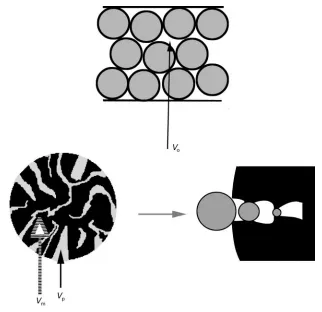
The separation mechanism can be explained on the basis of a speciRc distribution of the separated par-ticles between the eluent outside the porous parpar-ticles of the column packing (mobile phase) and the solvent Rlling the pores (stationary phase). This distribution is due to the steric exclusion of the separated particles from a part of the pores according to the ratio of their size to the size of the pores. The particles whose sizes are larger than the size of the largest pores cannot permeate the pores, passing only through the inter-stitial volume, i.e., through the void volume between the particles of the column packing, whereas very small particles may permeate all the pores. Particles of intermediate size are, to a greater or lesser extent, excluded from the pores. Hence, the elution proceeds from the largest particles to the smallest ones. This mechanism is schematically demonstrated in Figure 10.
The total volume of a packed chromatographic column,Vt, is given by the sum of the total volume of
the pores,Vp, the volume of the matrix proper of the
porous particles,Vm, and the interstitial or void
vol-ume,Vo, between the porous particles:
Vt"Vp#Vm#Vo
The retention volumes,VR, of the separated particles
lie withinVo andVo#Vp. VR of a uniform particle
size fraction of the sample is deRned as a volume of the eluent that passes through the column from the moment of the sample injection to the moment when the given particles leave the separation system at their maximal concentration. The retention can alterna-tively be expressed in time units as the retention time
tR. The particles permeating the pores are excluded
from some of the pores and partially permeate the accessible pores. The retention volume of a given species can be written as:
Figure 10 Schematic representation of the chromatographic column for SEC. Column with the void volume between the spherical particles of the column packing, the structure of one porous particle with the pore and matrix volumes, and the imaginary shape of one pore allowing the total permeation of smallest separated particles, partial permeation of intermediate size particles, and exclusion of largest particles.
where Ksecis the formal analogue of the distribution
coefRcient between the mobile and stationary phases.
Separation Mechanisms
Many attempts have been made to explain the mecha-nism of separation in SEC but steric exclusion (or size exclusion) is accepted to be the main process govern-ing the separation. This mechanism is based on a thermodynamic equilibrium between stationary and mobile phases. As the nature of the solvent is the same in both phases, the question is to explain the depend-ence of the distribution coefRcient Ksec on the size
of the separated species. One of the simplest ap-proaches uses the above-mentioned geometrical mod-els; nevertheless, the retention volume is determined not only by the accessibility of a part of the volume of the individual pores but also by the size distribution of the entire system of pores in the column packing ma-terial. The distribution coefRcient for an indi-vidual pore depends on the ratio of the pore size to the size of the separated particles and can be expressed by:
Ksec"
cp
co
where the concentrationscpandcorefer to the pores
and the interstitial volume. If the pore size distribu-tion of the column packing particles is taken into consideration, the retention volume is given by:
VR"Vo#
rmax
R
K(R,r)sec(r) dr
where(r)dris the total volume of the pores whose radii lie withinrand r#dr, andRis an equivalent radius of the retained particles. Hence, the retention volume of a given particulate species is determined coincidentally by the accessibility of a part of the volume of the individual pores and by the size distri-bution of the entire system of pores inside the column packing particles. Although different column pack-ings exhibit almost identical dependences of VR on
separated particles size, porosimetric measurements indicate various pore size distributions. This means that the relationship between the pore size distribu-tion and the retendistribu-tion volume of the separated species is not so straightforward.
structure of the SEC column packing is approximated by a system of cylindrical capillaries. The separated species move down the pores by the action of theSow but cannot get nearer to the pore wall than a distance determined by their radius. Consequently, they move at a velocity higher than the average velocity of the liquid Sow due to a parabolicSow}velocity proRle established in an imaginary cylindrical pore. Hence, the retention is determined by the ratio of the pore to the particle diameter. There are several factors that militate against this separation mechanism. The model assumes that the liquid canSow through the pores, which will not be true in most cases with polymeric gel particles used as column packing ma-terials. Moreover, even in those cases when the pores are open to throughSow, their diameter in compari-son with the size of the interstitial voids cannot allow the Sow rate to be high enough to explain the real values of the retention volumes. For the same reason, the frequently used explanation of the SEC mecha-nism of separation by an oversimpliRed model of molecular sieving is not accurate. This model, how-ever, explains quite well the separation of large par-ticles in hydrodynamic chromatography where either very large open pores are present in the particles of column packing or the packing particles are not por-ous and the separation by Sow is performed in the interstitial volume only.
More complicated mechanisms based on the inter-actions between the separated species and the station-ary phase may occur in an SEC column in addition to the steric exclusion mechanism: adsorption, liquid}liquid partition, electrostatic repulsions be-tween the separated particles and the packing mater-ial, etc. The pure SEC separation mechanism can be operating only if the column packing material and the solvent are chosen to suppress these secondary ef-fects. If the distribution coefRcient Ksec is larger
than 1, it is certain that other interactions, e.g., ad-sorption, beside the steric exclusion mechanism come into play and increase the retention. Unfortunately, if
Ksec lies between 0 and 1, it does not mean that
secondary interactions are deRnitely not interfering. Although such interactions are secondary, they can either improve or worsen the resulting separation. From the thermodynamic point of view, the separ-ation is carried out near equilibrium conditions and the distribution coefRcient can be described by:
Ksec"exp
!H3 RT
expS3 R
Dawkins and Hemming considered the enthalpic term on the right-hand side of this equation as a dis-tribution coefRcient, the value of which is unity,
provided that size exclusion is the only effective mechanism. In such a case, the entropic term repre-sents the pure size-exclusion mechanism. If other attractive interactions come into play H3becomes negative and, if some repulsive interactions are in-volved,H3is positive.
Other mechanisms explaining the separation in SEC have been proposed but most of them apply exclusively to the separation of macromolecules. The details can be found in the specialized literature. The above-presented approaches give an accurate basic idea of the separation of particles by SEC.
Applications of SEC
SEC allows, with respect to the basic separation mechanism, separation of particles according to dif-ferences in their effective sizes. Its application to the separation of particles in the submicron size range is limited only by the availability of column packing materials having sufRciently large pore size dia-meters. In order to cover as large a range of sizes of commonly fractionated particles as possible, the col-umn packing material should have the pore size dis-tribution from a few tenths of nanometres to hundreds of nanometres. For technical reasons, it is only possible to prepare the packings with a limited range of pore sizes and the SEC separation system is composed of an assembly of several columns in series, packed with several particle packing materials of dif-ferent porosities, or another possibility is to use only one column packed with a mixture of several different packing materials with various poros-ities. The selectivity and the resolution of such a separation system is, however, lower than a system with a more homogeneous distribution of the pore dimensions.
Besides standard particle size separations, SEC has been successfully applied to the analytical character-ization of micelles and submicron particles. Under the appropriate experimental conditions it can be used for separations in organic solvents as well as in water, at elevated temperatures, etc. An interesting applica-tion of SEC is so-called inverse SEC. The differ-ence, as compared to conventional SEC, lies in the column packing particles being analysed from the viewpoint of the pore size distribution or average pore size dimensions, using a series of well-character-ized size standards.
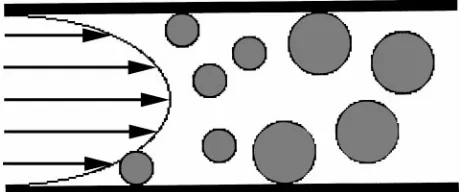
Figure 11 Schematic representation of the HC separation prin-ciple. Larger particles are excluded from the wall and can freely migrate only in a part of the volume of the capillary column. As a result, their elution times are shorter compared with the elution times of smaller particles.
scattered light. The coupling of the concentration-sensitive detector and a size-concentration-sensitive detector, to-gether with the use of an appropriate calibration procedure for the separation system, allows extrac-tion of more informaextrac-tion on PSD and other structural parameters of the particles under study.
Hydrodynamic Chromatography
Hydrodynamic chromatography (HC), as a new method for the separation of the particles of submic-rometre sizes, was described by Small in 1974. HC is not a variant of SEC although some processes can participate in the separation mechanisms of both methods. It is not a subtechnique of FFF although the hydrodynamic phenomena can actively participate in the separation mechanism of FFF whose fundamental characteristic is the selective migration of the separated species due to an effective Reld. Formally, HC could be considered as a limiting case of FFF when the intensity of an effective externalReld is zero.
Principle of Separation
The name of the method designates the principal mechanism governing the separation: hydrodynamic phenomena appearing inSuidsSowing through por-ous media or in capillaries. The separation in HC is performed in a carrier liquidSowing either through the void volume of a packed column or inside an open capillary of small diameter. The separated particles are carried by theSow with a velocity higher than the average velocity of the carrier liquid due to the tend-ency of the particles to concentrate in a radial posi-tion where the streamline velocity is higher compared with the average velocity of the liquid. Such a radial position corresponds to an energy minimum of the particles migrating within the Reld of shear forces. The driving forces which cause the radialSux of the separated particles can be of very diverse character. Another phenomenon participating in the separation processes can be the steric exclusion of the particles from a part of the volume within which the carrier liquid can Sow near the column packing surface or near the wall of an open capillary. The velocity of the carrier liquid decreases to zero toward these surfaces and only small separated particles which can ap-proach the surface of the column packing or capillary wall can elute with slow velocity in the vicinity of these surfaces. This situation is demonstrated in Figure 11for a model case of the HC carried out in an open capillary.
Separation Mechanisms
According to Small, the separation in HC is governed by three contributing effects: hydrodynamic forces,
electrostatic repulsions, and Van der Walls forces. The density of the separated particles inSuences only their mobility and rotational moments. Soft particles can be deformed due to the high shear stress and this effect can inSuence their retention volumes.
A model of the separation by Sow was originally proposed by DiMarzio and Guttman to explain reten-tion in SEC. Their model approximates the structure of a packed chromatographic column to a complex system of capillaries in which the separation is caused by the same steric exclusion phenomenon as shown in Figure 11. The average velocity of the carrier liquid in a cylindrical capillary is given by:
(r)"PR
2
8L
wherePis the pressure drop along the capillary of the lengthLand the radiusR,is the viscosity of the carrier liquid andris the radial coordinate. The average velo-city of uniform-sized particles is given by:
ave" P
4L
R2!(R!a) 2
2 !a
whereais the radius of the separated particles. The last term of the equation represents the rotational moment of the particles which reduces the velocity of their axial migration. The resulting retention is deRned, similarly as in FFF, by the ratio of both velocities:
R" ave
(r)
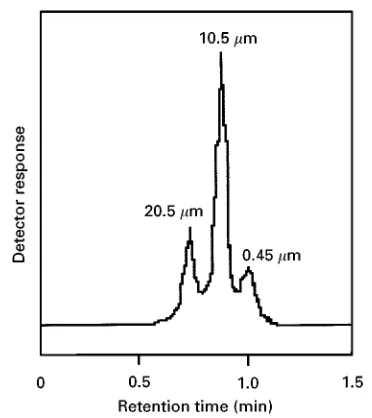
Figure 12 Separation of different size polymer latexes by HC. annular volume which is determined by the radial
forces generated by theSow of the carrier liquid. The particles carried by the Sow undergo the effect of the radial force which concentrates them within the annular volume. This force is due to the combination of the rotational and translational movements of the particles and is analogous to the Magnuson effect.
The electrostatic double layer on the surface of the separated particles inSuences their effective sizes. The electrostatic double layer, on the surface of the chromatographic packing or of the wall of the capil-lary column, reduces the accessible volume of the column due to the repulsion of separated particles of the same charge. The increased concentration of ions (ionic force) in the carrier liquid causes the screening of the surface electric charges and, consequently, re-duces all electrostatic interactions. On the other hand, the reduced repulsions allow the separated par-ticles to approach within a small distance at which the attractive Van der Walls force become effec-tive. As a result, the hydrodynamic phenomena and electrostatic repulsions dominate the separation mechanism at a low ionic force of the carrier liquid, while at a high ionic force, the separation is domin-ated by hydrodynamic forces and adsorption phe-nomena. The order of the elution can be inverted, the particles can form aggregates, and the separation can be completely perturbed by these effects.
Applications of HC
HC is widely used for the separations of particles of very different character, starting from inorganic particles, polymer latexes, and biological cells, to synthetic and natural molecules, oil emulsions, etc. Modern short capillary columns allow substantial reduction in the separation time and an increase in the efRciency and resolution. Although HC was originally developed for the separations of microm-etre-sized particles, the size range of applications has recently been lowered to tens of nanometres. The example in Figure 12 shows the chromatogram of three polymer latex size standards separated on an open capillary column. The separation was accomp-lished in one minute.
Centrifugation
Starting in the early 1920s with the famous work of Svedberg, centrifugation became probably the most popular method for separation of particles. Based on extensive knowledge and experience of the sedi-mentation of particles in a natural gravitationalReld, centrifugation, using more intense inertial forces
gen-erated at slow rotational speeds, allowed the separ-ations of relatively small particles. The invention of the ultracentrifuge (which uses extremely high speeds of rotation, allowing a reduction in the size limits of the separated species) and of new coupled detectors, upgraded a simple sedimentation fractionation tech-nique into powerful separation methodology applic-able to preparative separations as well as for analyti-cal characterization of particles and macromolecules. The impressive progress in theory, methodology, techniques and applications was of a long-lasting nature, from the 1920s to the 1970s. Thereafter, some stagnation appeared but the beginning of the 1990 represented a renaissance era for analytical and preparative ultracentrifugation and derived techniques.
Principle of Separation
A particle suspended in a Suid settles under the ef-fect of gravitational or inertial centrifugal force which is proportional to the effective mass of the particle, i.e., the difference between its true mass
m and the mass of the same volume V of the sus-pending liquid, according to Archimedes principle:
F1"(mu!Vu)
whereuis the acceleration due to the gravitational or centrifugal Reld forces and is the density of the suspending liquid. ForceF1is opposed by the force of
frictionF2 which is proportional to the velocity of
sedimentationUwith a constant of proportionalityf, called the friction coefRcient:
With the exception of the initial short period of time during which the sedimentation velocity of the par-ticle increases until the steady state is reached at which both forces are equal, the velocity of sedi-mentation in a homogeneous liquid is constant. Stokes calculated the friction coefRcient of hard spherical particles and obtained:
f"6 r
for a particle of the radiusrsedimenting in a liquid of the viscosity . Einstein derived the relationship be-tween the friction and diffusion coefRcients:
D"kT/f
It is evident that the sedimentation processes in ho-mogeneous suspending liquids separate the particles according to their effective masses and if the particles are uniform with respect to their densities, the separation proceeds strictly according to the dif-ferences in particle size. The analysis of PSD can be realized on the basis of the measurement of the sedi-mentation velocity during the sedisedi-mentation process or from the equilibrium concentration distribution. Nevertheless, it has to be stressed that although cen-trifugation is, in principle, the separation method, the size-based separation of the particles can be rather complicated because various size particles sediment together and form a complex, superposed concentra-tion gradient in which all size particles are always present in various relative proportions. On the other hand, if the separated particles exhibit nonuniformity in both size and density, size separation can be a rather difRcult task.
Sedimentation processes can generate the forma-tion of a density gradient in a complex, multicompo-nent suspending liquid. The particles suspended in such a density-gradient forming liquid can undergo focusing phenomena and, as a result, they can be separated according to differences in densities. Recent theoretical and experimentalRndings demon-strate that the size polydispersity in such cases in-Suences the width of the focused zones. Evidently, therefore, if the particles exhibit polydispersity in size and density, the separation is complicated.
Modern theoretical approaches as well as the ex-perimental results demonstrate that sedimentation and focusing can appear together even in a simple suspending liquid because the size polydispersity of the separated particles is itself able to generate the isoperichoric (from Greek: isos"equal and
perichoron"environment) focusing phenomena. It can complicate the use of centrifugation as a simple tool for particle size separation. On the other hand,
although not yet fully mastered and understood, these new approaches offer a challenge for fundamental research and development.
Separation Mechanisms
Sedimentation processes lead to the formation of a concentration gradient. Fickian diffusion, Brownian motion, general entropic tendency and re-pulsive interactions counterbalance the concentration gradient formed. The sedimentation of an ensemble of particles progresses until an equilibrium concentra-tion distribuconcentra-tion is achieved due to the opposed sedimentation and dispersiveSuxes. The equilibrium can be described by the differential transport equation:
!Ddc
dx!Uc"0
wherecis the concentration of the sedimenting par-ticles and dc/dxis the concentration gradient formed in the direction of the sedimentation. There exist some limits to the validity of this equation but the details are beyond the scope of this review. The ther-modynamic approach deRnes the equilibrium on the basis of the chemical potential of the sedimenting speciesi:
mi(1!i(x))2xdx! k
i
c
I dck"0
where i is the molar volume of the sedimenting species andis the angular velocity of the centrifuge rotor. The concentration distribution of uniform-size particles at equilibrium in a homogeneous liquid is exponential. When different but uniform-size colloidal particles sediment separately by forming the exponential concentration distributions, the larger size particles are compressed close to the bottom of the sedimentation cell. This situation is demonstrated inFigure 13. On the other hand, the sedimentation of the colloidal particles exhibiting some PSD can lead to very different equilibrium concentration dis-tributions of the particles of different sizes. Lar-ger size particles can be compressed closer to the bottom of the sedimentation cell but they can form focused zones at higher levels as well. These two situations are demonstrated inFigure 14.
Figure 13 Schematic representation of the sedimentation of different size particles. Concentration distribution is more compressed to the bottom of the sedimentation cell for larger size particles (left) and centre of gravity of the concentration distribution is closer to the bottom compared with smaller size particles (right).
Figure 14 Schematic representation of the sedimentation of a mixture of different size particles. The exponential concentration distribution of larger and smaller size particles can be either superposed (left) or larger size particles can be focused within the density gradient formed by the exponential concentration distribution of smaller particles (right).
of the sedimentation cell, and thus size fractionation exists. It is impossible, in principle, to achieve more complete size separation of particles by simple centrifugation.
In the second case shown in Figure 14, larger par-ticles are focused in the density gradient due to the equilibrium exponential concentration distribution of smaller particles. The concentration distribution of larger focused particles approaches a Gaussian distri-bution function.
The two imaginary cases shown in Figure 14 dem-onstrate two limit situations which can appear in actual centrifugation experiments in a homogeneous suspending liquid. The focusing phenomenon is, of
course, actively exploited in isopycnic (or more gener-ally isoperichoric) focusing separations of particles. In such cases, a two- or multicomponent liquid is used to form the density gradient and larger particles are separated according to density differences.
[image:14.568.147.426.504.671.2]Figure 16 Electropherograms of the individual polyaniline (PANI) and silica composite particles and of the separated mix-ture of both obtained by capillary electrophoresis.
Figure 15 Isoperichoric focusing of coloured polyaniline par-ticles in the density gradient formed by colourless silica parpar-ticles in thin-layer isoperichoric focusing (TLIF) cell in a centrifugation experiment.
Applications of Centrifugation
When taking into account the potential and limita-tions of sedimentation processes, centrifugation can be successfully applied and, in reality, is widely used for the separation of colloidal particles of very dif-ferent character: inorganic, polymer and biological, and also for the separations of macromolecules. An example of the use of centrifugation is in Figure 15 which shows the zone of the coloured polyaniline particles focused from a bidisperse mixture with col-ourless silica particles. This focusing experiment was, indeed, intended not to separate the polyaniline par-ticles from the silica parpar-ticles of comparable size but to prove the existence of the focusing phenomenon under the given experimental conditions. However, the size separation of the particles using this phenom-enon is real.
Electrophoresis
Electrophoresis is a separation technique based on differential transport of electrically charged spe-cies. The discovery of electricity was paralleled with an understanding of electrophoretic phenomena and consequently, this separation technique can be con-sidered as classical.
Over the last two decades, all electrophoretic tech-niques have undergone an explosive growth, espe-cially as concerns the analytical applications of the capillary version of electrophoresis. Nevertheless,
there are only few publications describing the ap-plications of this technique to the separation of charged particles. This can be explained by the fact that separation in electrophoresis is primarily based on differences in electric charge density which is inherently related to the size of the separated par-ticles. As described in the section on HC, the ef-fective size of the particles includes the thickness of the electric double layer which varies with the ionic force of the suspending liquid. This means that when-ever the size separation concerns the particles in their natural environment, their effective size includes the electrostatic double layer and separation can be carried out by using electrophoretic transport pro-cesses. As the electric charge contains information on the nature of the particle surface, separation by elec-trophoresis is certainly a useful technique when used appropriately.
Future Development
A search for the historical origins of a scientiRc dis-covery is often a difRcult task but, with regard to the rapid advances in separation science in general, and of particle size separations in particular, the long-term prediction of progress is almost a ‘mission im-possible’. However, cautious examination of the state of the art and of potential exigencies concerning par-ticle size separations, allows a few statements about what is likely to happen in the near future to be made. Further increases in efRciency, resolution and selectivity represent a permanent challenge in particle size separations. An ideal is to separate two partic-ulate species differing by a minimal increment in terms of a ‘construction’ unit, e.g., one molecule or atom, and not only in terms of ‘size increment’ which is a rather arbitrary choice.
Increase of the separation speed can be an impor-tant factor whenever the separated particles exhibit an evolution in time and it is necessary to capture information on the actual PSD at a given moment. Many biological concepts are approached in this way. The ways to be explored lead to more extensive use of supercritical Suids allowing substantial increase of transport coefRcients.
Most recent methods and techniques of particle size separations exploit simple physical and physicochemical principles single driving forces lead-ing to the separation. Coupllead-ing of two or more phys-ical Relds and Reld gradients as selective driving forces and their combinations with nonselective transport due to the carrier Suid Sow seems to be a recently emerging approach.
Large-scale particle size separations represent im-portant parts of many industrial technologies. The performance of a large-scale separation is often lower in comparison with an essentially identical technique applied under analytical-scale conditions. The optim-ization of large-scale separation processes in order to approach the performances comparable with analyti-cal-scale conditions. The optimization of large-scale separation processes in order to approach the perfor-mances comparable with analytical-scale separations has a potentially important economic impact.
The permanent search for noninvasive conditions in particle size separations is an important Reld of activity related to fundamental research in the life sciences and also to many important biotechnologies.
These directions of potential future progress in the domain of particle size separations are certainly not exhaustive but they represent an overview of, prob-ably, the most important activities in research and development.
Further Reading
Agricolae D (1556)De Re Metallica,Libri XII. Basileae. Barth HG (ed.) (1984)Modern Methods of Particle Size
Analysis. New York: John Wiley.
Belenkii BG and Vilenchik LZ (1983) Modern Liquid Chromatography of Macromolecules. Amsterdam: Elsevier.
Dawkins JV (1978) In: Epton RE (ed.)Chromatography of Synthetic and Biological Polymers, vol. 1. Chichester: Ellis Horwood.
Dawkins JV (ed.) (1983)Developments in Polymer Charac-terization}4. London: Applied Science.
Dawkins JV (1989) Size exclusion chromatography. In: Booth C and Price C (eds) Comprehensive Polymer Science, vol. 10 Oxford: Pergamon Press.
Grossman PD and Colburn JC (eds) (1992)Capillary Elec-trophoresis:Theory and Practice. New York: Academic Press.
Janc\a J (ed.) (1984)Steric Exclusion Liquid Chromatogra-phy of Polymers. New York: Marcel Dekker.
Janc\a J (1987) Field-Uow Fractionation: Analysis of Macromolecules and Particles. New York: Marcel Dekker.
Janc\a J (1995) Isoperichoric focusingReld-Sow fractiona-tion based on coupling of primary and secondaryReld action. In: Provder T, Barth HG and Urban MW (eds)
Chromatographic Characterization of Polymers, Hy-phenated and Multidimensional Techniques. Advances in Chemistry Series 247. Washington DC: American Chemical Society.
Kolin A (1977) Reminiscences about the genesis of isoelec-tric focusing and generalization of the idea. In: Radola BJ and Graesslin D (eds) Electrofocusing and Iso-tachophoresis. Berlin: de Gruyter.
Orr C and Groves MJ (eds) (1978)Particle Size Analysis. London: Heyden.
Silebi CA and McHugh AJ (1978) In: Becker P and Yundef-reund MN (eds).Emulsions,Lattices,and Dispersions. New York: Marcel Dekker.
Small H (1974) Hydrodynamic chromatography: A tech-nique for size analysis of colloidal particles.Journal of Colloid and Interface Science48: 147}161.