INSERT – INFANTRY
(English)
Issued on authority of the Chief of the Land Staff
OPI: DAD 6 01-06-00
WARNING
ALTHOUGH NOT CLASSIFIED, THIS PUBLICATION, OR ANY PART OF IT, MAY BE EXEMPT FROM DISCLOSURE TO THE PUBLIC UNDER THE ACCESS TO INFO ACT. ALL ELMS OF INFO CONTAINED HEREIN MUST BE CLOSELY SCRUTINIZED TO ASCERTAIN WHETHER OR NOT THE PUBLICATION OR ANY PART OF IT MAY BE RELEASED.
LIST OF EFFECTIVE PAGES
Insert latest changed page; dispose of superseded pages in accordance with applicable orders.
NOTE
The portion of the text affected by the latest change is indicated by a black vertical line in the margin of the page. Changes to illustrations are indicated by miniature pointing hands or black vertical lines.
Dates of issue for original and changed pages are: Original…..
Ch……….. 0 1
2000-06-01 Ch…….. Ch……..
2 3
Zero in Change No. column indicates an original page. Total number of pages in this publication is 109 consisting of the following:
Page No. Change No. Page No. Change No.
Title 0
ii-iv 0
8-1 to 8-105 0
TABLE OF CONTENTS
LIST OF FIGURES
FIGURE 8-1 EXAMPLE OF A TIME ESTIMATE FOR A PLATOON ATTACK...8-5 FIGURE 8-2 PLATOON ASSAULT FROM A FLANK...8-10 FIGURE 8-3 TANK HUNTING TEAM COMPOSITION...8-19 FIGURE 8-4 EXAMPLE OF A SECT ANTI-ARMOUR AMBUSH...8-19 FIGURE 8-5 TANK DEAD SPACES...8-20 FIGURE 8-6 ANGLE OF ATTACK FOR ANTI-ARMOUR WEAPONS..8-20 FIGURE 8-7 CREW LAYOUT AND CRITICAL POINTS OF
ENGAGEMENT...8-21 FIGURE 8-8 COMPARATIVE CHART – DAY AND NIGHT
WITHDRAWALS...8-26 FIGURE 8-9 CONTROL MEASURES DURING THE WITHDRAWAL..8-27 FIGURE 8-10 LAYOUT FOR FORWARD PASSAGE OF LINES...8-31 FIGURE 8-11 LAYOUT FOR REARWARD PASSAGE OF LINES...8-32 FIGURE 8-12 TYPICAL WOODS CLEARING DEPLOYMENT...8-46 FIGURE 8-13 PL ASSAULT DURING A WOODS CLEARING
OPERATION...8-47 FIGURE 8-14 STAGE 1 AND 2 OF ORV OCCUPATION...8-53 FIGURE 8-15 STAGE 3 OF ORV OCCUPATION...8-54 FIGURE 8-16 FINAL STAGE OF ORV OCCUPATION...8-55 FIGURE 8-17 SUGGESTED LAYOUT FOR TRIANGULAR
PART 8 – ARM INSERT TAM 807 – INFANTRY 807.01 – COMMAND 1. Battle Procedure
Step 1 The commander (comd) receives a warning order (Wng O)
Step 2 Upon receipt of a Wng O, the comd conducts a quick map study and time estimate
Step 3 The comd receives orders from the higher comd: - seeks clarification as req
- coord with staff
Step 4 The comd conducts a msn analysis:
- ident the higher (two up) comd’s intent and immediate superior’s concept of ops - ident assigned and implied tasks - ident limitations which may relate to:
- time - space - resources
- the way the msn will be executed - if applicable, political restrictions - if applicable, the open fire policy and/or
rules of engagement (ROE)
- continuously determines if the sit has changed sufficiently to warrant a review of the estimate - ident essential tasks and produces a restated msn Step 5 The comd issues the initial Wng O immediately or as
- the loc and time of orders
- the degree of warning or earliest time of mov of the main body (e.g., no move before . . . ) - any restrictions on recce
- any special admin instructions affecting the resting or feeding of troops, regrouping, issue of ammo, need for special eqpt, moves to assy areas, etc.
- acknowledgement
Step 6 The comd makes a detailed time estimate, leaving two-thirds of the available time for subordinates to conduct their own battle procedure
Step 7 The comd conducts a map study and prep an outline plan
Step 8 The comd prep a recce plan:
- ident questions to be answered at each loc and en rte
- views the ground from the en’s perspective, secur permitting
- considers: - the threat - time available
- number of locs to be visited - rtes available
- necessity for a protection party Step 9 The recce party conducts the recce IAW the plan, but
adjustments may be made as nec
Step 10 The comd completes the remainder of the estimate Step 11 The comd issues a supplementary Wng O, confirming
info in the initial Wng O and adding new info as nec Step 12 The comd completes the plan and prep and issues
orders:
- ensures orders are given at a loc that reduces travel time and, if possible, allows obsn of the zone/sector and promotes op secur
- enhances presentation of orders through the use of visual aids (e.g., terrain models and diagrams), time permitting
- ensures key personnel (pers) attend orders group (O Gp) and are seated logically
- introduces newly attached comds - uses the proper format for orders - christens the ground
- if the orders are complex, holds a short talk-through of the task execution at the start of the orders ‘EXECUTION’ paragraph (Concept Of Operations)
- ident the higher comd’s intent
- clearly states msn and tasks of subordinates IAW msn analysis
- ensures there is no repetition of instructions unless it is vital to clarify a task
- confirms subordinate comds understand their instructions
- issues all supporting documentation nec to coord the task
- ensures subordinate comds perform lateral coord before leaving
Step 13 The comd coord the activities and requirements of subordinates, including rehearsals if time and sit permit Step 14 The comd supervises the depl, taking appropriate and
2. Time Estimate Critical
Questions
1. By what time must the msn be accomplished?
2. How much time is available to complete the msn?
3. What must be done at all levels in the time available?
4. What tasks can be done simultaneously? 5. How fast is the sit changing?
6. Can I afford to do complete battle procedure, or do I streamline? 7. How long do you have assets? (1/3, 2/3
principles?)
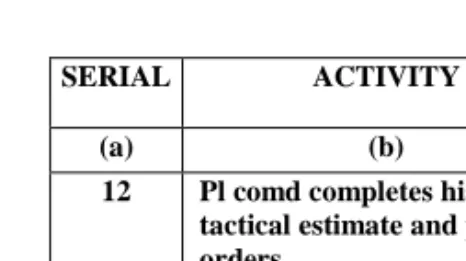
SERIAL ACTIVITY TIME
REQUIRED
TIME (HOURS)
(a) (b) (c) (d)
1 Obj to be captured by . . . 2 Time spent to capture obj 3 Move from line of departure
(LD) to aslt posn 4 H hour is at . . .
5 Move from forming up place to LD
6 Move from assy area to forming up place
7 Move from assy area at . . . 8 Sect comds give orders and
complete prep
9 Sect comds complete their battle procedures and prep their orders
SERIAL ACTIVITY TIME REQUIRED
TIME (HOURS)
(a) (b) (c) (d)
12 Pl comd completes his tactical estimate and prep his orders
13 Pl comd moves to pl RV 14 Pl comd makes a recce 15 Pl comd makes a time
estimate, a map study and a recce plan
[image:9.612.32.265.32.162.2]16 Cbt tm/coy comd’s O Gp ends
FIGURE 8-1 EXAMPLE OF A TIME ESTIMATE FOR A PLATOON ATTACK
807.02 - OFFENSIVE OPERATIONS 1. Hasty Attack
PLATOON COMMANDER Adv and
Hasty Atk
Adv − Maintain the direction of adv − Proper use of ground features − Maintain secur through: − depl of scouts
− depl of pl support (sp) wpns (over watch)
− use of proper fmns − timely passage of info to sect
comd/wpns det comd Battle Drill 1
- Reaction to sect coming under effective en fire
− Move to a vantage point to observe the en and send contact report
− Conduct cbt estimate (COPPED) − Info pl 2IC of RV and loc of O
Gp
− Info lead sect comd of loc/RV for O Gp
− Send SITREP to coy comd − Give orders
− Info pl 2IC of orders − Request fire msn (sp) Battle Drill 2
- The Hasty Atk
− Control pl from RV to aslt posn − Ensure pl formed up in proper
aslt fmn
− Maintain initiative and motivation
− Ensure effective fire sp − Control fire and mov of the aslt
gp
− Amend fire sp as req − Give limit of exploitation Battle Drill 3
- Consolidation
− Indicate the consolidation posn − Give arcs of fire to sects and sp
wpns
− Send SITREP to coy comd
2. Radio Orders, see TAM 109 PLATOON 21C Adv and
Hasty Atk
Taking the lead
− Obtain all relevant info from previous pl 2IC (lead pl) − Supervise routine of the fol: − implement Wng O − wpn and eqpt checks − ammo distribution
− Supervise depl at halts Battle Drill 1
- Reaction to sect coming under effective en fire
− Supervise depl and concealment of rear sects
− Dispatch sect comds to RV for O Gp and bring pl to pl RV − Make sure he is briefed by pl
comd and wpn det is briefed Battle Drill 2
- The Hasty Atk
− Assist in forming up aslt fmn and maint initiative-comd fire base as req (if joins aslt gp) – move in rear gp
− Ensure spacing, speed, fmns are acted upon
− Flank protection − Controls depth on aslt − Prep to assume command at all
times Battle Drill 3
- Consolidation −
Move up quickly on success − Pass ammo and cas rep to CSM − Redistribute ammo, organize pl
HQ and wpn det − Arrange cas evac
− Brief guards for PW evac (coy collection pt)
SECTION COMMANDER Adv and
Hasty Atk
Battle Drill 1 - Prep for battle
Battle Drill 2 - Reaction to effective en fire
− Give order “take cover,” double tap, dash, down, crawl, observe, fire, communicate, move Battle Drill 3
- Locating the en
− Target indication: − direct method − clock ray − ref point − spec fire − tracer
− change posn (gp or indiv) to draw fire
− hand angles
− use of binoculars or C7 optical sight
Battle Drill 4 - Winning the fire fight
− Give fire control order using GRIT:
− gp − range − indication − type of fire:
− normal: C7-5 rds/min, C9-50 rds/min
− rapid: C7-20 rds/min, C9-100 rds/min
− auto: bursts of rapid fire (close quarter battle)
− snap: watch and shoot − Maintain suppressing fire − Types of fire control orders: − full
− brief − delayed − indv Battle Drill 5
- Approach
− To do: − change mag − quick Battle Orders
−sect move to ammo point −Ensure/remember:
−en neutralized during approach −maintain momentum −remain alert for the unexpected −may have to use own fire sp − Use:
−indirect fire
− SRAAW, Smoke, Gren Launcher
Battle Drill 6 - Aslt
− Fire and mov − Maintain momentum − Command and control (C2) Battle Drill 7
- Consolidation
− Form a def; prep for C atk − Prep hasty def, sect comd to cfm
indiv posns and arcs, particularly LMG and AAW
− Verify and redistribute ammo − Search obj if time permits − Estb Link with other sects − Secur
− Cas/PW
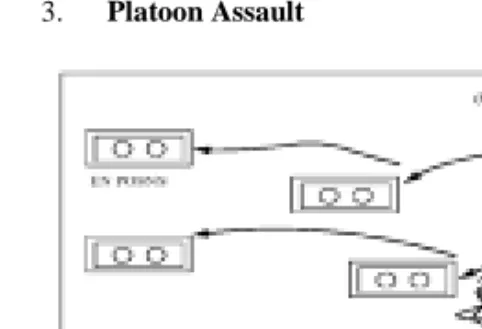
3. Platoon Assault
FIGURE 8-2 PLATOON ASSAULT FROM A FLANK 4. Deliberate Attack
PLATOON/SECTION COMMANDER Mounting
stage
Detailed prep − Detailed recce by comds down to sect level
− Use of detailed models for orders and briefings
− All ranks briefing by coy and pl comds
− Rehearsals, including night rehearsals if applicable − Deception measures
Aslt stage Approach − Guides may be used to bring elms up to the atk posn and the fire base
− Rtes, atk posns and LD should be marked and secured ahead of time
NOTE (1) FIRE BASE
LOC WITH THE LEAD SECT (2) SMOKE
TO COVER THE APPROAC H TO THE ATK POSN (3) ASLT
Aslt
− Navigational aids, such as MGs firing on fixed lines along the flanks and arty fire on the obj, may be used to help keep direction
− Since control is more difficult at night, objs should be limited to avoid soldiers and sects getting lost
− Avoid passing one aslt gp through another to prevent confusion and cas from friendly fire
− Avoid converging on en wpns flashes when assaulting a posn − Avoid the explosion of grenades
above ground level − Every effort must be made to
distinguish friend from foe before engaging
Consolidation General − Indicate consolidation posn as stated in your orders
− Give arcs of fire to sects and sp wpns
− Send SITREP to pl/coy comd
5. Deliberate Attack Orders, see TAM 109.03 PLATOON 2IC Deliberate
Atk
Mounting − Pass Wng O to sect comds; initiate concurrent activity − Dispatch O Gp
Approach − Assist in control of fmns and concealment
− Assist in forming up for aslt Aslt − Control pl HQ and reserve sect
(if applicable)
− Control pl mor (if applicable) − Control fire base (if applicable) − Prep to assume command at all
times
− Maintain strict control of pl HQ (if not at the fire base) − Read the battle and enforce pl
comd`s decisions
− Supervise reserve sect in the mop up
Consolidation − Bring up rear of pl quickly − Check ammo and redistribute − Arrange cas evac and PWs − Supervise digging of pl HQ − Send ammo and cas rep; info pl
comd
− Receive briefing from pl comd
6. The Pursuit
Pursuit Definition − A series of rapid advs and hasty atks to continue the dislocation of the en
Pursuit vs Adv to Contact
− They are alike as far as tactics and grouping are concerned
Adv to Contact Pursuit
− The en strength has not been tested − Follows the defeat of an en whose
strength has been depleted; risks can be taken to hasten his final defeat
− The sub-unit takes risks that it does not normally take when the en sit is uncertain
− Large en posns may be bypassed, gaps exploited, and the battle group (BG) thrusts deeply into en territory without excessive concern for its own flanks and rear − Battle procedure is accelerated to
maintain the pace − Sub-unit comds receive
verbal/radio instructions giving them greater freedom of action Sect/Pl Level − Translated into bold off action but
it does not affect the manner in which the battle drills are executed 807.03 – DEFENSIVE OPERATIONS
PLATOON COMMANDER Recce − Ensure your posn conforms to the overall
intentions of the coy OC/combat team (cbt tm) comd
− Estb and follow a track plan − Maintain concealment − Make a sketch of the terrain − Conduct an estimate − Determine posn of sp wpns − Estb sect locs
− Liaise with other elms in your loc
− Issue preliminary orders
Occupation − Occupy the hide with call signs in the proper order − Brief all pers on the track plan
− Brief all pers on concealment
− Ensure sentries are in place by day/night and the pl CP is manned
− Supervise prep of the hide − Early warning
− Contact pl 2IC on arrival
− Study the occupation plan and make changes if nec − Order sect comds to occupy the posn
− Receive final brief from pl 2IC − Take command of the posn
− Tour posn and confirm plan/arcs with sect comds − Give confirmatory orders
− Ensure loc of flanking units is known to all − Info superior when ready
− Ensure camouflage (cam) is maintained − Confirm state of readiness of wpns and sentries − Confirm loc and arcs of fire of sp wpns − Supervise noise and light discipline − Indiv range cards
− Confirm priority of work and duty roster − Sect range cards
− Liaise with flanking units − Pl range cards
1. Defence Preliminary Orders, see TAM 109.05 2. Defence Confirmatory Orders, see TAM 109.06
PLATOON 2IC
Def General − Prior to occupation ensure: −cam and conceal in the assy area −distribution of eqpt
−inspect wpns and eqpt −pass info to pl −Occupation:
−supervise layout of pl HQ and digging
−supervise setting out and concealment of admin area −coord construction of obstacles
(obs) Def
Routine
−Control feeding arrangements −Inspect sanitary arrangements −Organize carrying parties −Estb duty roster for manning pl
observation post (OP)
−Ensure to be briefed at all times by the pl comd
−Prep to assist pl comd at all times
3. Frontages/Fields of Fire Frontages are determined by the often-conflicting requirements of assigned tasks, depth, mutual sp, control and ground
− Sects can have 4 trenches 10 m apart
− Approx 150-200 m between sects
Trenches must be sited with good fields of fire (normally not less than 100 m) and ideally a little beyond the max effective range of the wpn
− In very close country, 50 m may have to suffice
SECTION COMMANDER Def General − Pl comd sites indiv posn
− Check posns
− Get indiv to check posn − Start digging
Ensure − Sect wpns cover arcs − Sect is not surprised by the en − All know the alarm schemes − Sect trenches are properly dug − Sect is concealed from air and ground − Track discipline is strictly observed − Sentry roster is made out
− Proper routine is observed − Range cards/all likely tgts recorded Know − Open fire policy
− Task of sect
− When an atk is expected
− Are covering troops forward of posn? − Layout of pl posn
− Loc of neighbouring posns − Loc of coy/pl HQ
− Surveillance and target acquisition orders
− Time by which sect must be dug in − Ptls, timings, rtes in and out − Allocation of tools to sect − Additional tasks − Track plan
− C atk plan recced, rehearsed − Ensure
enforcement of: − cam
− rge cards − noise/light − duty roster
− wpn readiness and sentries − priority of
work − ensure
occupation of OP
− eqpt (eqpt) layout/inspecti on
Routine
− Pass on info to superiors and to subordinates
Stand-to − Why?
− to check battle readiness − if posn is vulnerable
− if atk has been launched or is expected − When?
− after completion of posn to confirm locs, cam
− during the conduct of a clearing patrol (ptl)
4. Defence Preliminary Orders, see TAM 110.05 5. Defence Confirmatory Orders, see TAM 110.06 807.04 - THE DELAY see TAM 104.02
1. Demolition Guard see TAM 103.03
2. Example Of A Bridge Demolition Guard Layout, see TAM 103.04 807.05 - TANK HUNTING
1. Tank (tk) hunting teams are deployed to destroy tks in close terrain such as defiles, gaps, densely wooded or forested areas and when fighting in built-up areas. They may use short range anti-armour weapons (SRAAWs), mines, unconventional devices such as Molotov cocktails, and they make expedient use of obs to accomplish their aim.
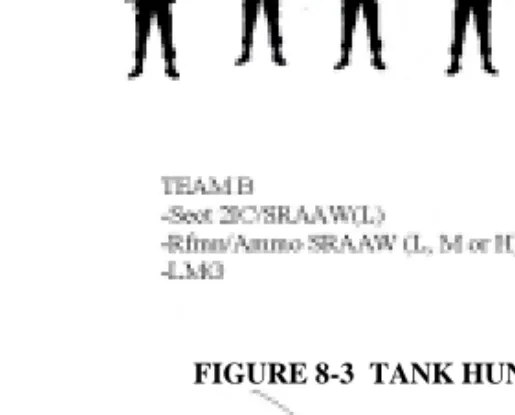
FIGURE 8-3 TANK HUNTING TEAM COMPOSITION
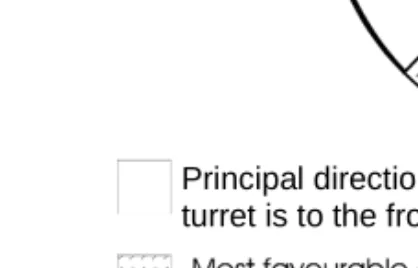
[image:23.612.38.296.192.400.2]Principal direction of fire and observation when turret is to the front and the hatches are closed
FIGURE 8-5 TANK DEAD SPACES
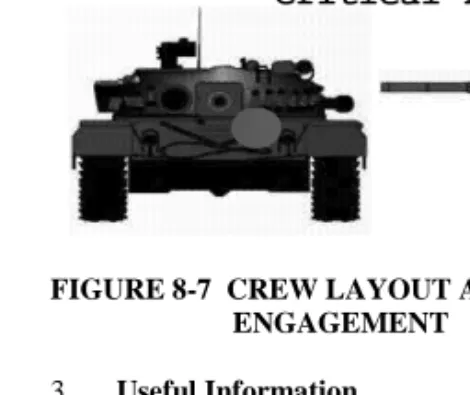
[image:24.612.62.271.267.401.2]FIGURE 8-7 CREW LAYOUT AND CRITICAL POINTS OF ENGAGEMENT
3. Useful Information
ERYX – wire guided 50 – 600 m 900 mm rolled homogeneous armour (RHA), all known armour including reactive armour. 84mm
HEAT- RAP FFV-501
500 m stationary 400 m moving
400 mm
84mm
HEDP FFV – 502
500 m stationary 300 m moving
150 mm (approx)
NM-72, HEAT 220 m 300 mm
Steep ditches More than 600 Escarpments and
barriers
More than 1.5 m high Ravines and trenches Wider than 5 m
Lakes, marshes, ponds
Significantly reduces speed Deep snow More than 1 m Reduces speed Arty, Mor and smoke Armour will close
hatches 807.06 - TRANSITIONAL PHASES
1. Advance to Contact
Adv − Maintain the direction of the adv − Proper use of ground features − Maintain secur through:
−depl of scouts
−depl of sp wpns (over watch) − Use of proper fmns
− Timely passage of info to sect comd/wpn det
− Comd Anticipatory Orders
May Include:
− Axis of adv − Reference points − Bounds − Possible en locs
− Actions if under effective en fire − Confirmation that everyone understands Adv In Contact, Use
Fire and Mov Taking Into Consideration:
− That bounds depend upon posns of fire and obsn
− Visual contact is maintained between gps and teams within gps
− Use hand signals when appropriate − Give sufficient time and cover by fire
for gps and teams to move to the next bound
2. Meeting Engagement
Definition − A meeting engagement occurs when a moving force, incompletely deployed for battle, engages an en at an unexpected time and place
Basic Principle − The seizure and retention of the initiative; thus the comd can regain or retain freedom of action and subsequently adopt the best course of action to accomplish his original msn Pl/Sect Level − Reaction to a meeting engagement is
quick and violent
− Confusion may ensue and there is a need to regain control through decisive orders and strong leadership
− Sect/pl comd must assess the sit quickly, accurately, and then pass this info to the pl/coy comd
3. Link-up
Definition − Where forces are to meet in en controlled territory
Aim − To estb contact on the ground between forces which may have the same or differing msns
Consideration − Generally off in nature
− Speed in estb the link-up is crucial − Speed reduces the possibility of en reaction and minimizes the period of vulnerability
Sect/Pl − Drills are applied aggressively to maintain the adv
− During the last phase of the link-up, the point sect and pl must estb contact with the other force as early as possible and avoid the danger of exchanging fire with them
Control Measures − Axis of adv or boundaries for the link-up
− Objs to be held and/or captured by each of the forces taking part
− The locs where contact between the forces will be estab
− The timing of the op for the forces involved
− Liaison teams ident
− Passwords and visual identification signs
− Report lines and reference points − Contact frequencies (freqs), radio
authentication procedures and codes − No fire line (NFL) / restrictive fire line
(RFL) report times 4. Withdrawal
PLATOON COMMANDER
Battle Procedure − Conduct a recce briefing for the recce gp (pl 2IC and guide)
− Recce the pl/coy check point and RV − Recce rtes
During the Wdr − Ensure obsn posts and ptls have returned
− Ensure suitable forces remain to deny posn to the en until ordered − Sects pass through the pl check pt at
times allotted − Move to pl RV
− Sect comd accounts for all pers and eqpt at the RV
− Pl moves to coy RV through coy check point on order of pl comd
− Report pl to OC at coy RV − Pl comd is last off of the posn On the New Def Posn − Post sentries and ensure concealment
− Establish a track plan
− Make detailed recce ensuring the fol: − ground appreciation
− and pl wpns
− all sp wpns sited from the ground − tie in with neighbouring pl (left to right) − all trenches marked
Arrival of the Pl − Meet the pl − Lead pl to the posn
− Brief pl comd and take over from acting pl 2IC
5. Withdrawal Orders, see TAM 108.07 PLATOON 2IC
Prior − Assemble sect 2ICs or pick runners − Ensure to carry proper eqpt (map,
compass, marking tape, etc.) − Attend pl comd orders if time permits
SECTION COMMANDER
Disengagement − Sect comd goes personally to each trench collecting sect pers and move back to check pt /RV, sect withdrawal (wdr) complete
− Fire and mov may be nec, if in contact − Sect comd always last to leave − One pers confirms numbers at check pt − RV used to re-org before proceeding;
will not always stop
− Consider what to do in case of cas or en indirect fire
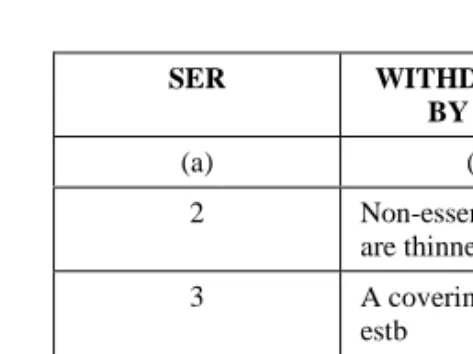
SER WITHDRAWAL
BY DAY
WITHDRAWAL BY NIGHT
(a) (b) (c)
1 Recce parties deploy to intermediate or new posns
SER WITHDRAWAL BY DAY
WITHDRAWAL BY NIGHT
(a) (b) (c)
2 Non-essential elms are thinned out
Non-essential elms are thinned out 3 A covering force is
estb
A covering force is estb
4 Ptls are wdr Troops in depth are wdr
5 Forward troops in contact are wdr
Ptls are wdr
6 Troops in depth are wdr through the covering force
[image:30.612.30.267.28.205.2]Forward troops in contact are wdr through the covering force
6. Withdrawal Orders, see TAM 109.07
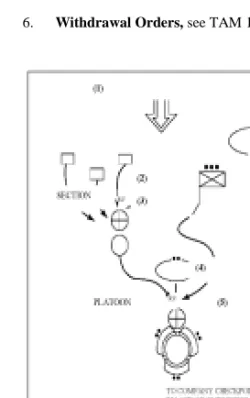
NOTE 1. Sect trenches manned until
disengagement/timings. 2. Sect pers pass through the sect checkpoint and move directly to the sect RV. They do not stop at the sect checkpoint. A sect member counts as the sect passes by.
3. Sect comd estb physical control, ensures his sect is complete and commences the next phase of the wdr on time.
[image:31.612.34.285.46.445.2]4. Sect pass through pl checkpoint at times allotted; they are counted as they pass by and they do not stop. Usually manned by a sect member and a wpn det member. 5. Pl RV secur is the responsibility of the first elm to arrive. PL comd estb physical control, checks that his pl is complete and commences with the next phase. FIGURE 8-9 CONTROL MEASURES DURING THE
WITHDRAWAL 7. Relief in Place
PLATOON COMMANDER
Battle Procedure − Determine composition of the recce party (as many comds as possible)
Recce − Prep a written recce plan
− loc of OPs − contact points − track discipline − pl posn
− arcs of fire, DF, FPF − loc of obs
− ptl rtes and timings − range cards
− Verify concerning the en: − identity, strength, eqpt − intentions
− habits, ptls, shelling
− activities during the past 24 hrs − Clarify and coord:
− the conduct of the relief − change of command
− who provides fire sp and when − safety
− groupings and order of march − material replacement − comms and freqs − traffic control Control measures − Pl assy area
− Pl check point
− Timetable of all moves (ptls, etc.) − Time relief to be completed by
− Remain with command post throughout the relief
− Send pl guide to remain at coy check point − Signal OC when you are ready to assume
command
− Ensure all pers know when you have assumed comd and the relieved pl is clear of the posn
8. Relief in Place Orders, see TAM 108.08 PLATOON 2IC General − Ensure Wng O passed
− Supervise prep
− Organize pl comd’s O Gp − Ensure pl prep for op Conduct of relief − Move pl to coy check point
− Adhere to all mov timings − Meet counterpart on posn
− Accompany outgoing pl 2IC around posn − Get all info on posn as to:
− disposn, routine, admin areas, loc of stores and rations, resupply, med evac and wdr rtes − Report posn clear of outgoing
− Check stand-to action − Organize pl HQ
SECTION COMMANDER During Relief in
Place
− Outgoing sect comd meets incoming sect pers and leads them, by pairs, to their locs − Soldiers exchange places; outgoing sect on
stand-to
− Avoid detection; crawl if req
− Incoming sect pers stay clear of outgoing pers kit
− Once all in place, outgoing and incoming sect comd move to each trench and brief all troops on:
− Arcs of fire
− important details of the def − range cards
9. Relief in Place Orders, see TAM 109.08 10. Passage Of Line
PLATOON COMMANDER
Battle Procedure − Estb contact with the local force and recce: − rte
− point of contact − assy areas − obs and breaches − atk posn − LD
− loc of command posts (pl and coy) − cas evac
− OP and ptls − Coord:
− admin sp and responsibilities − marking of rtes, LD, atk posn, etc. − provision of guides
− fire sp and areas of responsibility − C2 responsibilities
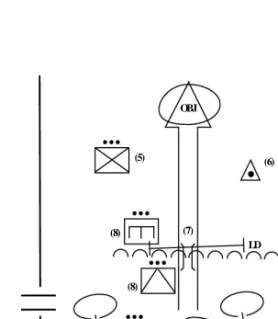
OBJ (5) (6) (8) (7) (8) (8) (8) (8) (5) ATK POSN (4) (2) (3) (2) (1) ASSY AREA LD A ECH NOTES 1. Assy area loc at rear of in place troops. All rtes reserved.
2. Admin sp from in place unit to include:
a. refuelling; b. cas evac; c. pw assistance;
and d. veh recovery. 3. Share admin areas. 4. Traffic con provided by unit in place and marking of:
a. rtes; b. atk posn; and c. LD.
5. Close to in place unit for protection.
6. Ptls and OPs under command of atk unit. 7. Exact time or condition when forward area becomes
responsibility of atk force. 8. Tactical sp from in place force:
a. direct/indirect fire sp; b. obsn eqpt; c. secur of LD;
and
[image:35.612.29.307.39.358.2]NOTES 1. Troops in place provide max fire sp. 2. Gaps and rtes are ident and guides from troops in place are provided.
3. Traffic control and multiple rtes are provided.
4. RV or assy area is estb in rear for wdr unit. (NOT in the in-place force echelon area)
5. Troops in place provide cas evac, veh recovery, petroleum, oil, and lubricants (POL), and decontamination resources.
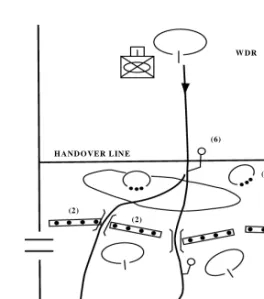
[image:36.612.32.296.24.324.2]6. Exchange of LOs and agreement of recognition measures. 7. Liaison teams from both gps man strong points.
FIGURE 8-11 LAYOUT FOR REARWARD PASSAGE OF LINES
(7) W DR
H AND O VER LIN E
(6)
(7)
(2)
(2)
(1)
(1) (3)
(4)
(5) R V
807.07 - OPERATIONS IN SPECIFIC ENVIRONMENTS 1. Fighting in Built-up Areas
General Fighting In Built-up Areas (FIBUA)
Eqpt − Webbing stripped down to allow easy mov
− Rucksacks used for carriage of ammo and eqpt
− Other special eqpt: − ladders
− grappling hooks and sash cords − wire cutters and gloves − sledge hammers − collapsible stretchers − first aid kits − flashlights
− field telephones with wire − extra ammo (tracer rounds,
grenades, etc.) − extra water − extra field dressings − rope and carabiners − flags (green, red, yellow, and
blue)
− chem light (red, green, yellow, and blue)
− prepared mouse hole charges Command
and Control
− All radios on coy net − Sect comds giving SITREPs − Use of remote antennas in dense
− Use of linkman on entry points for comms and as a guide for comds and follow-on forces − Coloured arm bands for comds
and 2ICs:
−Green - sect comds −amber - comds above sect
level
−blue - dmin pts and pers such as CSM, pl 2ICs
− During the atk:
−first bldg secure becomes coy RV pt and aid post −CSM and coy 2IC remain to
the rear with coy aid post −pl comd of reserve pl forward
with coy comd − Forward passage of lines:
−incoming pl moves via marked entry pts, directed by the in place pl 2IC
−met by pl comd, who will brief and launch the lead sect −Coy vehicle allocated to CSM
for resupply and cas evac
Control Coord − Marking:
−entry pts marked with coloured panels/lts (green)
−cas marked at night with glow stick (yellow)
−cleared rooms marked with chalk/white mine tape in a standard loc
−gaps in wire obs marked with tape or lts
−cleared bldgs and progress during atk shown by coloured tape or flags (green) −forward line of own troops
Simple Plan − Maint a firm base − Short bounds and limited
objs
Coord − Boundary report lines − Rapid consolidation after
each obj
− Alternate means of control, comms
Thoroughness − Meticulous clearance − Prevent en from
re-infiltrating Mov
Momentum and Max Covering Fire
− Leap frogging of aslt elms − Rapid consolidation and
passage of lines − Reserves well forward − Rapid resupply Incendiarism
and Devastation
− Threat of fire, especially for defender
− Careful selection of bldg types for def
− Fire fighting capabilities − Rubble will restrict mov Restricted
Fields of Fire
− Well constructed bunkers for fire posns
− Wpns sited well back from openings
− Secondary posns req − Def and harassing fire Booby Traps − Engineer/pioneer (pnr) sp
well forward
− Located at strong points, shelter areas, avenues of approach
Considerations
Civilians − Need for target discrimination
Logistics − Ammo-quantity, breakdown − Specific eqpt
− Stockpiles in strong points − Resupply plan
Medical − Coy collection point − Evac plan
− Extra pers for cas evac Eqpt Sp − Received forward
− Eqpt collection pt in a secure loc
Service Support
Other − Liaison with civ authority − Civilian police (CIVPOL) in
for refugees 2. Fighting In Built-up Areas, see TAM 102.04 3. Fighting In Built-up Areas – The Attack
Isolation Forces estb around a built-up area (BUA), on key areas and vantage pts
− Sp break-in pt and forces − Prevent reinforcement of BUA
by en
− Cause attrition and en to wdr from BUA
− All elms under one comd Seize a
foothold in BUA
− Consider deception plan − Max fire sp to suppress en − Usually aslt on a narrow frontage Break-in
Seize
immediate obj −
Sect – first one or two rooms, possess first floor
Clearances: clearing the en from assigned areas based on secure objs from break-in point
− Bring in reserve sect to consolidate
− Short bounds
− Emphasis on momentum − Clearance tasks sect/pl level − Meticulous searches − Control measures – sectors,
boundaries, report lines, and numbering of buildings − Measures to prevent
re-infiltration Fighting Through Consolidation/ re-org: brief consolidation after each limited obj and after main obj has been secured
− Prep for C atk − Prep to sp other atks − PW
− Cas evac using safe rtes − Resupply ammo well forward − Evac of civilians
Sect/Pl Org Aslt sects: two sects assaulting the BUA
− Create the initial break-in − Secure initial obj
− Estb a firm base for the pl to expand upon
− Prep to sp the continuation of the aslt or other atks
Covering and Cut-Off Sects: Pl weapons detachment with 2IC
− Fire sp to aslt sect
− Suppress en posn around break-in pt
− Cut-off reinforcement or withdrawal
− Prep to re-join pl to consolidate and sp continuation of the atk Reserve sect − Prep to assume the lead aslt
Sect Org Covering Gp: sect LMG and sect 2IC
− 2IC may carry second LMG − Fire sp to aslt gp
− Suppress en posn immed above and around entry pt
− Cut-off reinforcement or withdrawal
− Prep to re-join sect to consolidate and sp continuation of the aslt Aslt Gp:
2x2 pers aslt tm
− 1x aslt tm grenades entry pt and enters building
Command Gp: sect comd linkman
− Comd gp then enters followed up by 2nd aslt tm
− Inside, aslt teams clear rooms and corridors under control of sect comd
− Secure immediate obj for pl − Linkman marks entry pt,
maintains contact with pl comd, acts as a guide
4. House Clearing Orders, see TAM 110.04 5. Fighting In Built-up Area – The Defence
− chicken wire 100 m − wheel barrows 12 − crowbars 12 − hammers 12 − rope 150 m − ladders 4 − axes 6 − chainsaws 4 − fire extinguishers 20 − mouse hole charges 15 − 1 lb demo charges 10 − Eqpt for propping of
buildings must be ordered. Perimeter
Posts
Posns on perimeter of built-up area
− Gives warning and info on en strength, intentions, and main effort − Destroys en recce and
investment forces
− Destroys en aslt forces in assy areas and forming up places − Covers obs
− Forces en to deploy and atk − One comd (likely armoured) − Wdr once en depl to def
localities or to form part of the res forces
− Wdr should be planned in detail and rehearsed
Disruption/ Delaying force
− Causes en attrition
− Delays, confuses, disrupts en − Channels en into killing zones
Covers gaps between def localities and fwd perimeter posts
− Disguises the def layout − Employs “hit and run” tactics
as en attempts to estb foothold − Small inf tms conduct
ambushes and tk hunting ptls − Consider use of snipers/armour/
mor fire controllers (MFCs) Strong Points
Occupied by sects and pls Well prep Logistically self-sufficient
− Based on 2 or 3 bldgs − Sited in depth, with mutually
supporting fire posns Strong Points
and Def Localities
Def Localities At least coy strength All arms involved Local reserves
− Based on 2 or 3 strong points − Sited in depth and mutually
supporting − All round def so that
penetration between strong points should be impossible Central Reserve Mobile Reserve Located in depth Conducts C-atks and recaptures overrun localities Destroys en penetration between localities May reinforce fwd posns as nec
− Pre-planned options, rtes, fire posns and rehearsals − Maintain depl rtes − Trigger for commitment of
Tactical Requirements
− Size
− Construction – sturdy, limited fire hazard
− Surroundings: − fields of fire
− dominating features/buildings − en and friendly force
approaches − outside areas Def Prep
Selection of Strong Points
Tactical Factors
− Depl troops (tps) in fire tms − Cover all approaches with obsn
and fire
− Seal off unused approaches − Avoid concentrating or
over-stretching tps
− Posns sited in depth and mutually supporting − Covered rtes for resupply,
reinforcement and wdr Prep of
Strong Points
Civilians Utilities
− Gas and electricity turned off − Water left on and all containers
filled
− Wet house defs to reduce fires − Use of hospitals and gas
stations
− Use of civilian communications External
Defences
− Arcs of fire assigned − Construct fire posns and cam − Clear fields of fire
− Ensure mutual sp − Demolish outer bldgs − Obs to prevent en approaching
walls
− Remove climbing additions of houses
− Obs to block vehicles approaches
− Clear windows of glass and cover with mesh wire or boards if not in use
− Entry pts not in use to be blocked
− Streets not in use to be blocked − Block sewer entries
− Slit trenches outside − Trenches outside for firing
SRAAWs with covered wdr rtes to bldg
− Dummy posns if time permits Internal
Defences
− Construct sandbag walls around fire posns and build a bunker − Water to dampen sandbags to
reduce wpn signature and prevent fires
− Thicken walls and floors with sandbags, especially around fire posns
− Shore up ceilings, including the cellar
− Mouse holes in walls for comms and mov
− Block mouse holes when not needed
− Remove or block stairways − Create internal obs by
removing floor boards or placing nail boards under windows
− Use cellars for protection during shelling and for storage of food, water, ammo − Gren holes between floors − Sandbag floors
− Fire precautions
− store water and fire fighting eqpt,
− remove combustible mat Other
Considerations
− Unoccupied houses: −block entrances −booby trap rooms or bldg − Siting of wpns:
−well back from openings −priority in siting is protection
of wpn
−good fields of fire through secondary and alternate posns
− Loopholes: −cam
−create false loopholes to make detection difficult −cone shaped with narrow side
on outside of wall −use on internal walls to fire
between rooms 6. Fighting in Wooded Areas
General Command and Control
− Use of remote antennas in dense wooded and undulating areas
− Use of land lines − Use observers at key
− All radios on coy net − Sect comds giving SITREPs
Control Coord − Markings:
−cas marked for easy recognition and retrieval (glow sticks by night) −cleared areas marked in a
standard method −gaps in wire obs marked
with tape or lts −marry-up points indicated −booby traps and mines
marked with coloured tape or flags
−FLOT marked with a flag on a pole
Simple Plan − Maintain a firm base − Short bounds and limited objs Coord − Boundaries, report lines
− Rapid consolidation after each limited obj
− Alternate means of control, coord and comms Thoroughness − Meticulous clearance
− Prevent en from re-infiltrating Considerations
Mov/Moment um and Max Covering Fire
− Leap frogging of aslt elms − Rapid consolidation and
Incendiarism and Devastation
− Threat of fire, especially for defender
− Fire fighting capabilities − Thick brush, fallen trees will
restrict mov Restricted
Fields of Fire and Obsn
− Wpns sited well back from openings
− Secondary posns req Booby Traps − Engineers/pnrs sp well
forward with local protection − Located at strong points,
shelter areas, avenues of approach
Logistics − Ammo – quantity, breakdown − Specific eqpt
− Stockpiles if possible − Resupply plan Medical − Coy collection point
− Evac plan
− Extra pers for cas evac Eqpt Sp − Receive forward
− Eqpt collection pt in a secure area
Service Support
Other − Liaison with civ authority − CIVPOL present for refugees
7. Fighting In Wooded Areas – The Attack Speed − Rehearse drills
− Include all possible en moves Thoroughness − If woods cannot be cleared in one sweep, plans must be made to prevent en from entering cleared areas Planning
− Atk down hill
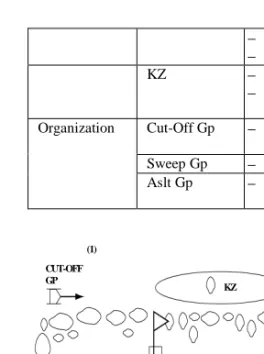
− Allow en to wdr along his rtes KZ − En should be forced into KZ
− Friendly forces should not have to enter the KZ Cut-Off Gp − MGs, LAV, APC, and A
armour
Sweep Gp − One or two sects Organization
Aslt Gp − Remainder of atk force, including specialists
NOTE 1. Cut-off gp augmented by sect APC
2. Aslt GP – remaining sects not in sweep gp commanded by pl comd if more than one sect 3. Pl HQ stays between and/or behind sweep gp 4. Sweep gp – 1 or 2 sects, commanded by pl comd if more than 1sect
[image:50.612.29.293.26.381.2]5. KZs – assigned to each cut-off gp 6. Cut-off gp made up of wpns detachment, augmented by sect LMGs or APCs. FIGURE 8-12 TYPICAL WOODS CLEARING DEPLOYMENT
NOTE 1. Aslt gp on order from pl comd moves to atk posn 2. With the aide of the sweep gp the aslt gp lines up as close as possible to 90o with the en 3. Pl HQ remains in loc or moves to the rear of sweep gp, which is now acting as fire sp. 4. The en now will be cleared or forced out of the woods into a KZ.
FIGURE 8-13 PL ASSAULT DURING A WOODS CLEARING OPERATION
8. Section Orders for Woods Clearing 1. SITUATION
EN FORCES FRIENDLY FORCES ATTACHMENTS/ DETACHMENTS Strengths Loc Weapons Eqpt Morale Obs DFs Air Threat NBC Likely Intentions
Coy comd’s intent Pl msn
Pl concept of ops Locs and further actions of neighbouring forces that may affect this op
2. MISSION. Sect msn from EXECUTION para of pl comd’s orders
3. EXECUTION.
Concept of Ops: How will sect achieve its msn? Gen outline
Taskings: Given to subordinates in turn: (1) Sweep gp
(2) Aslt gp: LMGs and 2IC (3) Cut-off times and weapons
Coord Instrs: (Include variations from normal SOPs)
Timings: Mov: To assy area To atk posn To LD To entry pt
Clearing of wood: Sig to aslt Sig all clear
Clearance of wood: Sweep times Aslt times Secur Sect objs Wood clear:
Signal to cut-off gp Consolidation plan Arcs Tasks for linkman
Obs: Locs Responsibility Marking gap
Action on: Cas PWs
P Info/Media:
4. SERVICE SUPPORT SOP
VARIATIONS
SVC SP MED TPT/REC
Dress Eqpt Wpns Veh loading Replen plan Ammo Rations Water POL NBC Batteries
Locs of Coy Aid Post Carrying parties Cas evac plan Med packs Stretchers Morphine
Loc of ech Rec plan
5. COMMAND AND SIGNALS
HQs PASSWORDS RAD
Loc of pl Comd Loc of pl 2IC Altn comd Recognition signals Passwords Freqs Code words Nicknames 6. QUESTIONS?
9. Fighting In Wooded Areas – The Defence Selection of Strong
Points
Ops − Sited fwd of wood
− Indirect fire observers − Surroundings:
−fields of fire/obsn −dominating
features −en and friendly
Obs − Block rtes; channel en: −fields of fire/obsn
−en and friendly force approaches −tk hunting tms
Ambushes − Placed between fwd edge of wood and main def posn; ideally pl strength − Cover all approaches with obsn and
fire
− Seal off unused approaches − Use extraction parties − Wdr rehearsed Prep Main Posns − Arcs of fire assigned
− Construct fire posns and cam − Clear fields of fire
− Ensure mutual sp C2 − Coord rte use
− Detailed knowledge of rtes − Alternate means of comms Recce − All rtes recced
− Ambush sited in defilade − Ops fwd of main posn
807.08 - PATROLLING 1. Fighting Patrol
Purpose − Inflict damage on the en − Provide secur to the unit
− Estab and/or maintain contact with friendly and en forces
− Deny vital ground to the en
Msns − Raid – to destroy or capture pers or eqpt, destroy installations, liberate pers
− Estb and Maintain Contact – both within friendly or en lines
− Ambush – against en ptls, carrying parties, foot columns, vehicle convoys
− Provide Protection – escort of technical specialists on specific msns
− Destroy Vehicles/Eqpt – destroy en tks, APCs and self-propelled guns in def posns or leaguers Org − Ptl HQ – Ptl comd, ptl 2IC, communicator, nav tm,
MFC or FOO − Secur Elm
− Secur Tm A – point and scouts − Secur Tm B – left flank secur − Secur Tm C – right flank secur − Secur Tm D – rear secur
− Aslt Elm – Sect comd, communicator, wire cutting tm /pers, searchers/ search tm, demolition tm(s) and cas and PW tm(s)
− Sp Elm – Sect comd, communicator, MG tm, anti-tk tm
18 Steps For Ptl Planning
− 1. Receive Wng O − 2. Make an initial map recce − 3. Make an initial time estimate − 4. Issue initial Wng O − 5. Receive orders
− 6. Make a detailed map recce − 7. Make a detailed time estimate
− 8. Make a preliminary plan–ptl org, general rtes, selection of pers and eqpt
− 9. Issue detailed Wng O − 10. Coord
− 11. Make a recce plan − 12. Conduct recce
− 14. Issue ptl orders − 15. Supervise prep
− 16. Conduct rehearsals and inspections − 17. Ensure forced rest
− 18. Conduct final briefings and inspections Prep by 2IC − Notifies all pers of the msn and Wng O details
− Ensures tasks detailed in Wng O are completed − Coord loc and time of O Gp
− Draws special eqpt − Draw and issue ammo
− Draw and issue rations and arrange for additional feeding
− Maintenance, testing and checking of wpns and eqpt
− Initial inspections of eqpt − Standard rehearsals of estb SOPs Occupation
of an ORV
Notes:
After the secur halt, the ptl comd moves forward to recce the tentative ORV with the Nav Tm, Secur Tm A, Secur Tm B and communicator. They perform a listening halt and sweep the ORV site. One member from Secur Tm A and one from Secur Tm B each go left or right. Secur Tm B mans the 8 and 4 o’clock posns (bottom corners). Secur Tm A completes the box search, meet at 12 o’clock posns and then mans the 12 and 6 o’clock posns.
NAV TM PTL COMD COMMS SECUR TM A SECUR TM B ORV RECCE
PARTY
SECUR TEAM B MBR
SECUR TEAM A MBR
COMD
LISTENING HALT
LONG HALT
MAIN BODY
[image:57.612.37.290.42.409.2]Note:
[image:58.612.45.281.49.341.2]Ptl comd, communicator and Nav Tm return to the main body, brief the ptl and move ptl to the ORV. The ptl halts just short of the ORV while ptl comd moves forward to confirm that nothing has changed with the ORV.
FIGURE 8-15 STAGE 3 OF ORV OCCUPATION 12
8
6
SECUR TEAM B
SECUR TEAM A
SECUR TEAM A
ORV
4
SECUR TEAM B
Note:
[image:59.612.38.302.28.356.2]The ptl moves into the ORV, with sp elm manning the 8 to 12 o’clock posn (left), aslt elm manning the 4 to 12 o’clock posn (right) and secur teams manning the base of the triangle. Note: if the aslt elm is not large enough to cover entire area, a secur tm may be tasked to assist. FIGURE 8-16 FINAL STAGE OF ORV OCCUPATION
HQ
SECUR ELM
SP
ELM
ASSLT
ELM
ENEMY
Ptl Base – A ptl base should be estb when there exists:
- a requirement to cease all mov during daylight hours to avoid detection
- a need to rest and reorganize after extended mov
- a requirement for reorganization after a ptl has infiltrated the en in small gaps
- a requirement to provide a base of ops from which further ptls can be launched
Passive Secur Measures
− Select:
− terrain with little tactical value
− terrain that would impede foot mov (i.e., steep terrain, ravines)
− areas offering dense vegetation − remote from human habitation − area close to a water source
− terrain suitable for radio communication − Avoid:
− en posns, known or suspected − built-up areas
− prominent features, topographical crests, ridgelines, lakes and streams, valleys − roads and trails
− lines of drift (area the en may tend to move through)
− open woods and clearings Active Secur
Measures
− estb an OP/LP system covering all likely en approaches
− estb comms with OP/LP for early warning − develop a plan for wdr in the event of discovery − select an alternate ptl base for occupation − estb an alert plan with a certain percentage of
pers awake at all times
− use the chain of command to enforce strict light, noise and cam discipline
Routine in Ptl Base
− upon occupation all ptl members stand-to − clearing ptls clear the perimeter and sect comds
report clear to the ptl comd
− Sect comd deploy OPs/LPs as detailed by the ptl comd
− Sect comd report OPs/LPs posted − Ptl comd orders stand-down − estb track plan
− eating and rest
− cleaning of wpns on rotation − resupply parties
− prior to last light wdr OPs/LPs and stand-to − conduct clearing ptls
− stand-down after last light
− night routine of three sentry posns (one per sect) manned all night, each with C9/C6 and doubled staggered piquets
Note:
[image:62.612.37.301.20.419.2]OPs do not always have to be positioned at the cardinal points on the triangle. They can also be located at the 6 o’clock, 10 o’clock, and 2 o’clock posns. Their loc will largely depend on the terrain the ptl is operating in.
FIGURE 8-17 SUGGESTED LAYOUT FOR TRIANGULAR PATROL BASE
12h
C-6
C-9
OP\LP
OP/LP
COMD
2IC
SIG
NAV TM
SECUR ELM
6h
M18A1
Claymore
DWS
OP/LP
NoteNote
C-9
ASLT
SECT
Note
SP
SECT
Ptl Base Occupation Deception Methods – when occupying the ptl base, the fol methods can be used to conceal the loc of the ptl base and deceive en trackers/scouts
FIGURE 8-18 DOG LEG METHOD (STANDARD OCCUPATION)
FIGURE 8-19 FISH HOOK METHOD
6
PTL
BASE
[image:63.612.63.234.233.417.2]FIGURE 8-20 BOX METHOD Tips for
Patrolling
− Be alert for en signs, e.g., heavy track pattern, timber cutting, smell and unoccupied sentry posts − The en will be looking for your signs, so hide
them
− When near villages, be particularly alert for dogs as they may give you away
− When estb a night loc/ptl base, break track and double back to observe if there is any en following-up
− On ptl in close country at night stop, look and listen at frequent intervals
− If contact appears imminent, use bounds; always have one gp on the ground and in posn to provide covering fire
− When advancing silently, record possible mor and arty targets en rte
− When searching for the en, remember he needs water; search rivers, creeks and water holes for en signs
2. Raid
Purpose − A Raid is an atk that includes a planned wdr from the obj. It is normally deliberate in nature but can be hasty
− A Raid can be conducted to destroy or capture en pers or eqpt, rescue friendly pers, gain intelligence or to gain the initiative Considerations
for planning
− There is always a planned wdr from the obj. The plan should include a signal to wdr, well planned rtes to a release point (RP) or ORV, elms to cover the wdr and assist in breaking contact, and a way to evac cas, PWs and captured eqpt from the obj
− The raiding unit must be large enough to provide for secur elms to isolate the obj from reinforcement or wdr. Secur elms are the first to be in place and the last to wdr
Tasks of Elms − Secur Elms: A, B, C, D − secur of the obj − early warning
− prevent en escaping from or reinforcing the obj − protect aslt and sp elms during the wdr − Aslt Elm:
− consists of demolition tm (two pers), search tm (two pers), specialist teams, and aid and litter tm.
− tasked with aslt, control and destruction of the obj
− extraction of cas from the obj back to the ORV − search the obj
− control and backload PWs − protection of specialist elms − Sp Elm:
− this elm is organized according to the msn and must have the proper fire power and wpns to perform its assigned tasks
− neutralise/destroy en on obj − stop/switch fire on order of ptl comd − protection of the aslt elm
− sp the wdr of the aslt elm if req
Note:
The sequence of events for both raids and ambushes are similar, with the layouts of pers and the “action during the aslt” being, in most cases, msn specific. Plans should be kept as simple as possible to avoid confusion. It is also important to note that because of the violence of action a raid or ambush will produce, friendly pers must be kept well out of the KZ. The danger area of wpns and the effects of their detonation must always be considered when siting pers.
ASSAULT
RP
ORV
Vantage Pt (VP)Secur Tm B
Secur Tm A mans the vantage point (VP). Placing the RP/VP near the aslt and/or sp locs reduces mov
Secur Tm C
Secur Tm D
[image:67.612.35.299.29.358.2]3. Ambush
Types − Immediate:
− set with a min of planning in order to engage in imminent en action
− may be a def technique by a ptl
− success depends on comd’s initiative, prior rehearsals of proven drills, tm work, silent signals, good battle discipline, swift and silent mov, fire control
− Deliberate:
− planned and executed as a separate op − ptl has time to plan, prep and rehearse in detail − size of ambushing force may vary from a small
four pers ambush to a major op involving an inf bn General − Usually a brief encounter and does not reqr the
capture and holding of ground
− May be sprung in front of and behind the en forward edge of the battle area
− A series of successful ambushes will make the en apprehensive and cautious in his movs
Immediate Ambush Drill
− The decision to ambush may depend on the orders given to the ptl comd. The fol sequence can be applied when orders permit ambushing: − 1. Lead elm indicates en approaching − 2. Ptl comd gives signal for immediate ambush − 3. Leading elms adopt hasty fire posns, with
concealment as a primary concern
− 4. Rear elms have more time to select good fire posns
Planning Factors for Deliberate Ambush
− Surprise: Achieved by: − selection of unlikely ambush sites
− avoiding set patterns in layout and techniques used in ambushing
− attention to secur
− taking advantage of darkness and poor weather − En: Consider:
− en likely method of mov
− known en counter-ambush techniques
− size of en work parties, ration parties and similar detachments
− en system of escort, e.g., when escorting supplies or convoys
− Friendly Forces:
− the ambush must be coord with other friendly forces near the ambush site
− Ground: Select: − covered lines of approach
− cover from view within the ambush site − suitable loc for OPs
− likely en escape rtes − effective fields of fire − obs both natural and artificial
− suitable base/admin area in case of prolonged ambush
− Time and Space: Consider: − distance to be covered − method of transportation − rte selection
− Eqpt: Consider: − communication eqpt − weapons
− command detonated devices, explosives − wire, gun stakes
− vehicles
− intrusion and early warning devices − night obsn devices and illumination means − dress and personal eqpt
− Assessment of Tasks: Consider: − ptl organization and numbers req − command and control
− secur and cut-off − aslt
− fire support Ambush
Layouts
Secur Tm B
Secur Tm C
SUPPORT/ASSAULT
ELEMENTS
RP
ORV
Straight Line Ambush- In this layout the aslt and sup elms are parallel to the long axis of the KZ and subject the obj to heavy flanking fire. A disadvantage, is that the lateral dispersion of the target may be too great for full coverage. Secur Tm A mans the VP
VP
[image:71.612.40.289.50.367.2]RP
A
SS
A
U
LT
SU
PP
O
R
T
Secur Tm D Secur Tm C
V Shaped Ambush- In this layout the sup and aslt elms deploy on either side of the KZ, forming a V with the KZ in the middle. Care is taken to ensure neither gp (within the “V”) fires into the other. Secur tms must be under cover. This ambush best suits open terrain but can be applied anywhere if the terrain and situation permit. Secur Tm A mans the VP.
ORV
V
P
[image:72.612.49.289.52.342.2]Secur Tm B
ASSAULT
S
U
P
P
O
R
T
Secur Tm B
Secur Tm C
RP
ORV
L Shaped Ambush- In this layout the aslt and secur elms are positioned in a similar fashion to a basic raid. Secur tms must be under cover. The VP is manned by Secur Tm A.
VP
[image:73.612.46.280.40.319.2]Secur Tm D
Tips for Ambushing
− Keep it simple
− Prep eqpt to be used prior to departure − Consider the use of IR glowsticks to ident
replenishment point and ORV
− Upon returning to the ORV make sure ammo is redistributed
− Use a running password when returning to the RV and ORV
− Plan a primary rte which allows the ptl to enter the ambush site from the rear, in line with the ORV
− Avoid obvious ambush sites and vary your pattern − Prep/rehearse the ptl to aslt through the obj. If
you must search the obj do it quickly but thoroughly
− Ensure an alternate open fire signal is available should the primary fail
− Shoot low, particularly where obsn is limited in close country at night. Do not overlook the value of tracer rounds and fixing bayonets to keep the barrel down
− Cover dead ground in the KZ with grenades, claymores and indirect fire wpns
− Consider/select ground that makes it difficult for an en to aslt you from a flank
− Consider the use of natural obs (e.g., dead fall or slippery rocks) to provide early warning. − Consider the use of silent adjustment of arty and
mors to cover your wdr, if req
− Cut gun stakes in a secure area and use sandbags to muffle the noise of banging them into the ground
− Have your trip flare set to ignite when a claymore fires
− Drag the en out of the KZ when searching them − Consider a second initiation shortly after the first
if mov is detected in the KZ
− Use a camera or take fingerprints to later ident dead en
− On wdr, fire a claymore from the VP back into the ambush site to stop any possible en follow-up 807.09 - PLATOON WEAPONS
1. C6 General Purpose Machine-gun (Sure-Fire) CHARACTERISTICS Range − Max (eff): Bipod 800 m
− Sustained Fire 1800 m − Tracer burnout 1200 m Method of
Fire
− Indirect − Direct Types of
Tgt
− Traversing (wider than deep) − Point
Rate of Fire − Normal − Rapid − Cyclic
− 50 rds/min − 100 rds/min − 650-1000 rds/min Burst
Length
− Short − Long
− 3-5 rds − 8-10 rds
− Primary − Direct area neutralizing fire
Role
− Secondary − Pt fire against soft targets
− Anti aircraft fire − Speculative fire − Indirect area neutralizing
Portability − Man packed by two pers crew; three pers over long distances
− Wt Gun 10.9 kg Barrel 2.8 kg Tripod 13.6 kg 220 rds belt 5.4 kg
PRINCIPLES OF EMPLOYMENT
Mutual Sp One gun able to sp another gun’s field of fire
Coord Coord at all levels
Interlocking Arcs Prevent gaps in KZ
Sited in Pairs Two or more guns cover same targets, KZ
Sited in Defilade Provide protection from en Direct fire and obsn
Sited to Produce Enfilade Match long, narrow pattern of beaten zone over target. Usually achieved by siting to the flank of axis of adv Protection and
Concealment
Sited in defilade, with good trench construction
Economy Match weapon and ammo type to target
TACTICAL EMPLOYMENT (TASKS) During the
approach
− Flank protection en rte − Securing of atk posns − Part of a deception plan − Direct/indirect fire on en possible
locs/OPs Atk
Aslt − Neutralize en posn up to last safe moment
− Act as/as part of the cut-off gp − React to opportunity tgts Consolidation − Engage en wdr rte
− Flank protection − Depth targets
Main task − Provide FPF and mutual sp between coy/pl posn Def
Secondary tasks
− Cover likely debussing pt − Cover en atk posn − Cover likely en approach − Cover obs/ mine fields − Cover hel landing zone
(LZ)/drop zone (DZ) − En fire sp gp
Adv to contact − Offer fire sp over difficult ground
− Flank protection − Quick atk tasks as per atk Transitional
Ops
Wdr/delaying ops
− Cover mov of friendly forces to and from posns
− Used in res dml gd on home bank to cover hel LZ/DZ
Machine-Gun Targets
Atk − En posns:
− on obj − on flanks − in depth
Def − Likely atk posn/forward atk posn − Obs
− Handover lines (especially in dml gd tasks)
− Inf and soft skin veh rtes − Likely en OP posns − Armd KZ Wdr − Infiltration rtes
− Choke pts − En atk posns
− Covering fire for troops/standing ptls
− Harassing fire on en posns − Deception plan
Adv − Likely en ambush loc − Flank protection − Covering flanks of defiles − Edges of open areas in FIBUA
DUTIES OF GUN CONTROL CLOSE
INDIRECT FIRE Site/Gun/
Tripod
− Select tgt at 500 m; use laser range finder, if available, or estimation
− Tgt should be at same height as gun with no crosswind
− Centralize the cross-level bubble − Adjust onto target by fire as accurately as
possible
− Centralize the elevation bubble using the elevation fine-scale knob
− Locate and undo the three screws in the face of the elevation fine scale. Set the indice to the tangent elevation for the rge you are at. For a tgt at 500 m, the setting is 0804 mils.; for a tgt at 1450 m, tangent elevation of 0832 mils. Tighten the screws
− Undo the bearing scale clamp lever. Turn the telescope until the hairline in the centre bisects the centre of the tgt
− Loosen the three screws in the face of the bearing fine scale knob and adjust all indices to 0 − The sight should now be in adjustment with gun
and adjustment
− Should be done only once Orientation
of C2 Sight
− It is nec to set the bearing scales on the sight to correspond with the grid bearing along which the barrel is pointing. To do this use the aiming lamp and post to do the fol:
−Take a bearing through the barrel of the gun with a compass
−If using a prismatic compass, convert this bearing into a grid bearing and make adjustment for compass error, if nec − Turn the telescope on the sight until the vertical
−Undo the fine scale locking clamp, butterfly nut and unscrew the three screws; slip the scale rings to read the bearing to tgt by setting the fine scale numbers against the INNER INDICE; tighten the three screws, lock the butterfly nut and rotate the fine scale knob BACK TO ZERO. Undo the coarse scale locking screw, set the coarse scale ring against the LOWER INDICE, lock the coarse scale ring and rotate the fine scale knob back onto the fine bearing number
−Do up the bearing clamp levers −Record the reading from the coarse upper
bearing scale indice and the fine outer bearing scale indice. The sight must have all indices aligned to take the recorded bearing; MARK AS A RECORDED BEARING
−When taking a bearing with a compass, ensure you move 10 m away to counter the magnetic attraction. The cross level bubble and the elevation bubble of the sight should be central in their housing throughout the procedure (ideally, the MG should be sited on as level ground as possible)
Laying onto Map Info
− Using a protractor, find the grid bearing from the gun to the tgt and apply it to the C2
−Sight
−Obtain gun-to-target rge from the map
−Using the rge table, find the elevation for that rge −Apply rge and nec corrections for the height difference to the sight
−Lay gun onto the aiming post and level bubbles (as per normal drill)