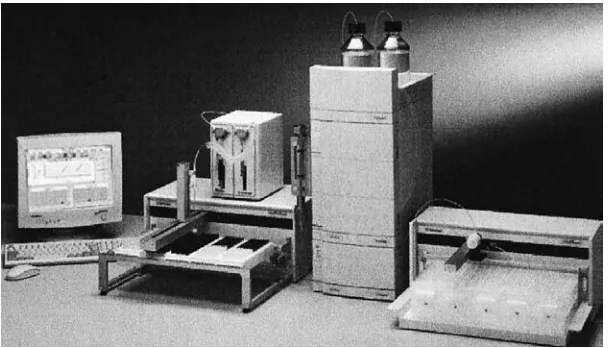
Figure 1 A fully automated HPLC system including an autoinjector, a pump, a detector and a collector controlled by centralized software.
CHROMATOGRAPHY
Automation
E. VeHrette, Gilson, Villiers-le-Bel, France
Copyright^ 2000 Academic Press
The last 20 years have seen an important increase in published papers on chromatography, reporting fully automated systems or complete online techniques. This shows a strong interest in automation in chromatography to obtain faster, safer, more cost-effective and convenient analytical procedures, that satisfy regulatory compliance and good laborat-ory practice directives. Automation in chromatogra-phy takes place in the more general laboratory auto-mation context, which is the application of comput-ing, robotics, electronics and mechanical engineering technologies to laboratory problems for enhanced throughput, reproducibility and traceability. This has been made possible as a result of considerable im-provements in equipment and techniques, from autosamplers, sample processors and reliable eluent delivery devices, to universal or more speciRc de-tectors, collectors, single point control software able to collect and handle accurate data (Figure 1) and, last but not least, laboratory information manage-ment systems.
The chromatographic techniques whose automa-tion is principally discussed in this article are gas chromatography (GC), high performance liquid
chromatography (HPLC) and supercritical Suid chromatography (SFC). Other chromatographic methods such as planar chromatography can also be automated, but full automation is more difRcult to achieve.
One of the most important aspects of automation is the introduction of interfaces between instruments and computers, and centralized user-friendly soft-ware for system control and data handling. The main qualities required for interfaces, designed to collect analog signals and digitize them to reSect detector output accurately, are good sampling rates and high resolution. Other important aspects of automation are directly related to the evolution of individual instruments, and the possibility of coupling them on-line. This article is not an exhaustive description of automation in chromatography, but highlights the principal trends in this Reld. It emphasizes sample preparation and application in chromatographic sys-tems, multidimensionality and fully automated solu-tions widely used today such as high throughput screening and preparative chromatography.
Autosamplers
and SFC are generally of Cartesian displacement or of carousel types.
High Performance Liquid Chromatography
HPLC is considered to be the major chromatographic technique available today for involatile or heat-sensi-tive substances. Sample injection is commonly per-formed using a switching valve via an external or internal sampling loop. Sample containers range from simple vials with a wide range of volumes to dif-ferent types of microtitre plates (96 and 384 wells), with the option of temperature control. Using 384-well microtitre plates, some modern instruments can store and handle over 4600 samples unattended. Many autosamplers have three injection modes, total, partial and centred loop Rlling, depending on the sample volume limitations. In recent years the need for faster analysis has been a major consideration; therefore, the shortest time required between two injections (injector cycle time) appears to be an im-portant criterion for autoinjectors, and may be less than 20 s in the fastest. Other important criteria are injection precision and the level of carryover, with typical values below 0.3% (relative standard devi-ation) and 0.02% respectively for the best instru-ments.
Gas Chromatography
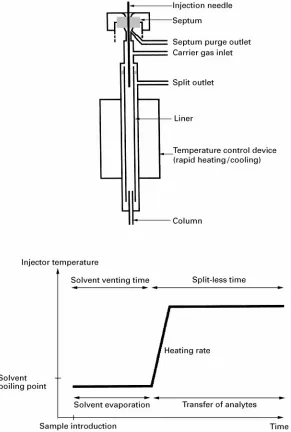
Because of its extremely high separation efR ci-ency, speed of analysis and wide range of sensitive detectors, GC and particularly capillary GC is an appropriate procedure for analysing many com-pounds in a great variety of applications, provided these compounds are volatile, thermally stable and with reasonable polarities to avoid problems encoun-tered with derivatization procedures. However, until recently its major critical point was the injection of large volumes, especially when traces of organic com-pounds have to be analysed, and the suitability of the sample solvent. The injector inSuences accuracy, pre-cision, resolution and analyte recovery. The use of new automatic injection devices has provided the means to enhance the limit of detection signiRcantly. Five modes of operation (split, split-less, direct, cold on-column injection, and programmed temperature vaporizer) allow maximum injector Sexibility. Among these, the programmed temperature vaporizer (PTV) is of major utility for the automated injection of large sample volumes (Figure 2). This technique is based on the selective elimination of the solvent, while simultaneously trapping the components with a much lower volatility. Liquid samples are introduced into a large capacity, sorbent-packed liner inserted in the injector head. By temperature-programming
the liner, the solvent is vented through the split exit while analytes are retained. The split valve is then closed and the injector is rapidly heated to transfer the analytes to the GC column. With such a technique, injection volumes in split-less capillary GC can be increased up to 1 mL and this procedure therefore brings enormous improvements in limits of detection.
Static or dynamic headspace sampling, is another interesting way of injecting volatile compounds from complex matrices into a GC. In this process, the vapour in equilibrium above a sample held at constant temperature in a sealed vial is drawn and analysed. Headspace GC is used to analyse a wide range of compounds in solid and liquid complex matrices, and fully automated devices are available today with computer-activated heating and pneumatic systems.
Sample Preparation
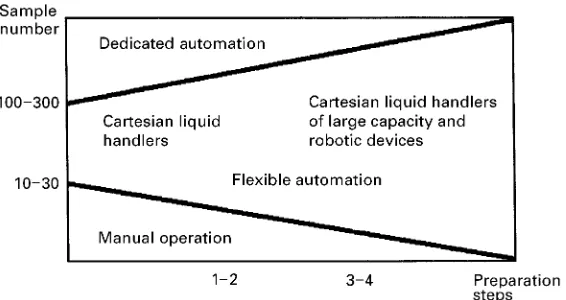
For a long time, sample preparation has been con-sidered to be the bottleneck of the analysis. However, the advances of automation in this area have until recently been distinctly more modest compared with other areas. The move towards automation in sample preparation occurred for several reasons, including higher productivity, fewer and more skilled laborat-ory personnel, better analytical results and less haz-ardous conditions. Basically, there are two almost complementary types of equipment, anthropomor-phic arms and Cartesian liquid handlers, used accord-ing to the nature and quantity of samples to be pro-cessed and the preparation complexity (Figure 3). Anthropomorphic arms are capable of grabbing ob-jects and moving them from one place to another with high accuracy. They need a set of dedicated stations to carry out different operations such as grinding, homogenizing, drying, weighing, etc. The principal preparation steps used with Cartesian (XYZ) samplers are dilution, addition of reagents or internal standards and mixing. With additional equipment they can also perform temperature con-trol, evaporation orRltration.
Solid-phase Extraction (SPE)
SPE has become a technique of choice for sample clean-up and trace enrichment in theRelds of phar-maceutical, clinical, food and environmental analysis. Indeed, it offers better versatility and selectivity than other sample preparation techniques. Compared with liquid}liquid extraction, it is quicker, it requires much less solvent, it prevents possible formation of emulsions, sample volumes can be smaller, and it is
Figure 2 Schematic representation of a PTV injector and temperature profile of injection.
much more amenable to automation. The US Envir-onmental Protection Agency has adopted more than 20 SPE methods as alternatives to liquid}liquid ex-traction. SPE formats range from traditional dispos-able extraction columns and membrane discs to 96-well plates and SPE pipette tip conRgurations. Today, a wide range of sorbents is available to increase selec-tivity and/or simplify the SPE procedure, from silica-to polymer-based phases, including speciality phases with mixed-mode functionality.
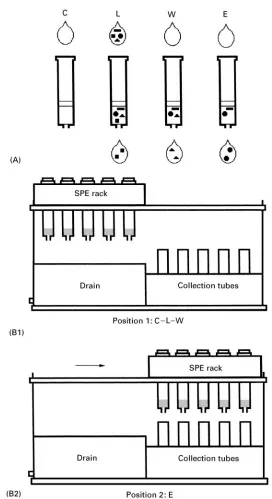
An experimental SPE procedure typically follows four steps}conditioning, loading, washing and elut-ing. With ofSine systems using disposable col-umns, liquids go through the extraction columns
either by aspiration (vacuum manifolds), or by posi-tive air pressure; the latter can be completely auto-mated.Figure 4shows typical SPE automation, based on the mobility of a dedicated rack consisting of three parts. After elution and aRnal mixing step, the eluate can be automatically introduced into the chromato-graph via an injection valve for analysis.
Figure 3 Diagram of estimated automation requirements according to sample number and preparation complexity.
propose a Sexible process to develop new methods such as the possibility for multicollection, multi-mo-dal SPE or column drying, and more recently the possibility of using 96-well SPE microplates with a multiple probe equipment.
In online conRgurations, an extraction cartridge is inserted as part of the chromatographic equipment, and is directly connected to the high pressure stream of the mobile phase. Such automated SPE equipment can use either the same cartridge for multiple extrac-tions, or carry out automatic cartridge exchange. Online SPE processes are also known for pre-column concentration techniques, and may involve column switching or coupled-column procedures. The online approach provides high throughput and preserves the sample integrity, but the technique is still dependent on particular applications and the reproducibility of packing materials.
Solid-phase Microextraction (SPME)
SPME, introduced by Pawliszyn in the early 1990s, is a sample preparation and introduction method in which analytes migrate from a liquid, headspace or air sample on to a polymer (principally polydimethyl-siloxane or polyacrylate) that is coated on a fused silica rod. TheRbre is then displaced into a thermal or solvent desorption interface for analysis respectively by GC or HPLC. All these steps can be fully auto-mated using autosamplers speciRcally adapted to SPME, such as the recent in-tube SPME device for HPLC. This technique, which is used repeatedly, pro-vides fast, easy-to-use and inexpensive sampling, and eliminates organic solvents. Initially applied to the analysis of relatively volatile environmental pollu-tants in simple matrices, it now allows sampling of a broader range of analytes, including drugs in more complex media, with improved analytical perform-ance.
Valve Switching Devices for Sample Preparation
Valve switching devices allow variable combinations of columns, mobile phases and/or detectors, which contribute to the overall system selectivity. When large numbers of substances are present in complex samples like biologicalSuids, and the compounds of interest are at very low concentrations, such devices are used sequentially to carry out sample clean-up and trace enrichment. Different set-ups are avail-able depending on the type of application, permitting the transformation of ofSine multi-step methods to single-step procedures. The simplest conRguration uses one pre-column between the sample injector and a six-port valve which rotates after venting the un-wanted components to waste (straight-Sush mode). A more powerful process can be achieved by operat-ing in backSush mode, but necessitates additional equipment. In recent years, switching devices have regained interest due to the introduction of the bi-modal restricted access sorbents. Designed for the deproteinization of biological samples, restricted ac-cess sorbents are characterized by a hydrophilic ex-ternal surface incorporating reversed-phase coated pores. Interfering proteins are excluded from the pores by hydrophilic and size exclusion interactions, and low molecular analytes like drugs and metab-olites are extracted and enriched on the bonded phase in the sorbent pores. This new type of separation medium is best used in the form of an extraction cartridge Rtted to the six-port valve of a sampling injector, before analysis with a more conventional column.
A schematic diagram of a fully automated set-up including an auto-injector with two switching valves is shown on Figure 5, where a preliminary online Rltration step is performed to extend the lifetime of the cartridge when analysing crude samples. After
Figure 4 Automated solid-phase extraction based on ASPECTM(Gilson) technology. (A) The four basic steps: conditioning (C), loading (L), washing (W) and eluting (E). (B1) Conditioning, loading and washing over the drain container. (B2) Eluting into the collection tubes.
injection theRltration device is regenerated with suit-able solvents in backSush mode. Membrane-based sample clean-up such as dialysis, electrodialysis and ultraRltration is another efRcient and innova-tive way of discarding macromolecular and micropar-ticulate matters before analysis. These devices can be automated and associated online with a chro-matographic system, mostly HPLC, using switching valves.
Figure 5 Online filtration and clean-up of biological fluid samples using valve-switching devices. AC, Analytical column; D, detector; F, filtration cartridge; IP, injection port; MB, mobile phase; RA, restricted-access sorbent cartridge; W, waste.
Figure 6 Online dialysis and trace enrichment of liquid samples using ASTEDTM(Gilson) technology. AC, Analytical column, DB, dialyser block; DC, donor channel; DE, dilutor eluent; EC, enrichment cartridge; IP, injection port; MP, mobile phase; R, reagent rack; RC, recipient channel; RE, recipient eluent; RR, result rack; SP, dual-syringe pump; SR, sample rack; T, tray; W, waste.
Supercritical Fluid Extraction (SFE)
SupercriticalSuids have physical and chemical prop-erties that make them particularly useful for extrac-tion of analytes from solid and liquid matrices. Above their critical temperature, they can be compressed to increase their density and therefore their solvating power; moreover, they keep gas-like viscosity and diffusivity, and they can easily be evaporated by lowering the pressure. Because of these properties, SFE has received much attention as an alternative to
Soxhlet extraction. Automated SFE can be incorpor-ated online with various analytical techniques such as HPLC, GC or SFC.
Multidimensionality
In the analysis of complex samples, a single analytical column combined with a selective detector does not always provide the required sensitivity and selectiv-ity. Automated multidimensional chromatography has emerged as a convenient answer to these
[image:6.568.125.447.478.673.2]problems. Multidimensional separation techniques constitute a powerful class of methods in which two or more independent steps are linked together. Roughly, multidimensionality includes two major branches: hyphenation and coupled-column tech-niques. A hyphenated instrument can be described as the combination of two (or more) instruments auto-mated as a single integrated unit via a hardware inter-face whose function is to reconcile the output limita-tions of one instrument and the input limitalimita-tions of the other.
Couplings of Chromatographs and Spectral Technique Devices
In recent years, numerous publications have de-scribed coupled techniques associating chromato-graphic instruments like HPLC, GC or SFC with sophisticated detectors or spectrometric devices, such as mass spectrometers (MS), MS coupled with diode array detector (DAD), MS-MS, Fourier transform infrared and nuclear magnetic resonance. However, for these online couplings, complete automation is generally required, and they are only feasible if suit-able interfaces are availsuit-able. Among these combina-tions, GC-MS and HPLC-MS are the most widely used in laboratories.
Gas Chromatography+Mass Spectrometry MS data provide the qualitative information for identiRcation and characterization of sample components that is lacking in most other GC detectors. The availability of highly inert, durable and selective fused-silica col-umns and the ease of coupling GC systems with relatively low cost mass spectrometers make GC-MS a method of choice for numerous analyses, and this automated combination is now a routine analytical technique in many laboratories. The main restriction is that the analytes must be sufRciently volatile and thermostable for transfer to the vapour phase without decomposition, or that they can be de-rivatized to provide these properties.
High performance liquid chromatography+mass spectrometry Of all LC detectors, MS is a very powerful conRrmatory tool for screening applica-tions, and is widely used for impurity identiRcation or quantiRcation of drugs and metabolites in biological Suids. Nevertheless, no method of interfacing HPLC and MS exists that can be universally applied to all types of analyses. However, considerable progress has been made recently in the development of soft ionization techniques such as matrix-assisted laser desorption ionization, and also in sample
introduc-tion devices like particle beam, electrospray/ion spray or atmospheric pressure chemical ionization inter-faces. When nonvolatile buffers like phosphates or ion-pairing agents are used, removal of these addi-tives can be automatically performed, changing the phase system with additional equipment, using coupled-column and valve-switching techniques.
Couplings of Chromatographic Systems
These techniques are versatile and powerful, and are well suited to the separation of multicomponent mix-tures. They include zone-cutting methods, in which fractions from one chromatographic column are usu-ally transferred via a loop installed on a switching valve, to one (or more) secondary column(s) in series for additional separation(s), or to another chromato-graphic system. In LC-LC, a special area of interest of column-switching is the resolution of enantiomeric drugs in biologicalSuids, by coupling chiral systems to conventional reversed-phase columns. Other useful associations combine size exclusion or ion chromatography with reversed-phase chromatogra-phy. Parallel settings using switching valves are also possible for column and mobile-phase selection. Such systems have been reported for fully automated, rapid and easy method development to analyse differ-ent types of compounds, including enantiomers.
LC-GC is a very convenient combination which associates the selectivity of LC with the high efR -ciency capillary GC. Moreover, GC possesses many sensitive and speciRc detectors. Such a coupled tech-nique enables the analysis of samples with complex matrices, and considerably prolongs the GC column lifetime. TheRrst set-up was described by Majors in 1980; since then important improvements in develop-ment have been achieved. With this transfer tech-nique, speciRc attention must be paid to interfaces. Several interfaces are available to couple the two systems online, such as on-column, loop-type and PTV interfaces which permit the transfer of large volume samples into the gas chromatograph. Inser-tion of a short trapping column between HPLC and GC also enables direct coupling from reversed-phase systems.
Fully Automated Dedicated Systems
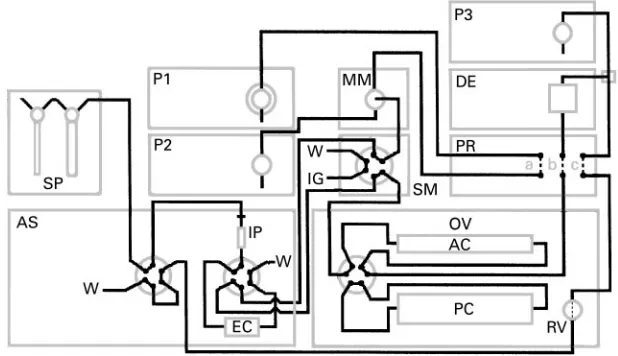
Figure 7 Automated analytical/preparative supercritical fluid chromatography on packed columns, with a solvent-less injection mode, based on Series SF3TM(Gilson) technology. AC, Analytical column; AS, dual-valve autosampler; DE, detector; EC, enrichment cartridge; IG, inert gas; IP, injection port; MM, mixing module; OV, oven; PC, preparative column; PR, pressure regulator (a, upstream pressure and pulse damper; b, heat exchanger; c, downstream pressure regulator); P1, liquid carbon dioxide pump; P2, modifier pump; P3, collection solvent pump; RV, pressure relief valve; SM, switching valve module; SP, dual-syringe pump; W, waste.
such as online systems available in biotechnology, which involve automated process monitoring for the determination of small organic molecules, and inter-active controls of the physicochemical and biochemi-cal growth conditions in culture media. In many Relds, including combinatorial chemistry, preparative separations are certainly widely used and require the most complete online solutions.
Preparative Chromatography
The objective of preparative chromatography is to obtain sufRcient quantities of compounds at the required purity, with the highest throughput and at the lowest price. Material to be puriRed can be simple or more complex, such as fermentation broths and natural products. In such instances, fully automated preparative HPLC on a laboratory scale (milligrams to grams) is one of the best separation techniques for this objective, and also because of its Sexibility to accommodate frequent application changes and vari-able quantity ranges.
The requirements of a preparative HPLC system differ according to the quantity of product to be collected, and the nature and number of samples to be puriRed. However it should provide reliable and com-plete automation for unattended operations with error-handling methods, and total traceability of all events, including the collected fractions. Fraction collectors are key instruments in preparative HPLC, and should be selected according to their collection facilities and fractionation software. Devices exist that can perform peak collection with automatic
tracking of the baseline drift. With such instruments, collection is initiated if the detector signal is above user-set parameters in relation to threshold level and peak width. The graphic sample tracking which is feasible with some recent centralized software is also an important feature in preparative chromatography. Indeed, it can provide useful information to the user on sample identiRcation, collection positions and associated chromatograms.
Since the introduction of independent program-ming of mobile-phase pressure, composition, and Sow rate, SFC with packed columns has received considerable interest for several reasons, including its suitability and exceptional performances in prepara-tive works. Consequently, this technique may become a serious competitor to preparative HPLC in the near future.Figure 7 shows a completely automated sys-tem for analytical and preparative SFC. A versatile dual-valve autosampler of large capacity is used to perform both injection and collection. A solvent-less injection mode and a column-switching procedure are realized by two extra six-port valves. Such a system performs analytical development and switches easily and quickly to preparative chromatography for linear scale-up, and back to analytical for the purity check of the collected fractions. All these steps are auto-matically monitored by centralized software.
Analysis and Puri\cation in Combinatorial Chemistry
Combinatorial chemistry appeared a few years ago in the pharmaceutical and biotechnological industries as
a novel approach to Rnding new drugs, and has undergone outstanding development since then. It is deRned by a variety of automated high throughput synthesis techniques, to produce large numbers of small organic molecules, for screening these com-pounds against several biological targets for drug discovery. Combinatorial chemistry includes three basic steps } synthesis, candidate screening and library product puriRcation } but chromatography is principally involved in the last two.
In drug candidate screening, library product veriR -cation can be performed with various analytical tech-niques. Among these, gradient reversed-phase HPLC with UV detection is widely used. Such a system, Rtted with an autoinjector which accommodates microtitre plates, provides a robust and highly auto-mated approach. Fast HPLC methods (generally of less than 5 min) generate up to 300 analyses per day per system and are required to produce libraries of products with widely differing polarity. These generic methods use short C18 columns with sharp
slope gradients from acidiRed water to acidiRed or-ganic solvents, highSow rates and UV detection set at 220 or 254 nm. Automated HPLC-MS, HPLC-DAD-MS and HPLC-HPLC-DAD-MS-HPLC-DAD-MS have also become important routine tools for the combinatorial chemist, because they provide structural information to identify the compounds which have been synthesized.
Automated puriRcation to an extremely high level with sample quantities of up to 100 mg can be achieved with a preparative HPLC system equipped with an autoinjector and a fraction collector. The technique uses the same packing material and mobile phases as those used in analytical separation. Fast and easy clean-up can also be performed using SPE car-tridges or microplates. Samples may therefore be pro-cessed in parallel with an automated device for opti-mum throughput. And last but not least, preparative SFC, although with limited applications so far, also provides a high productivity approach to puriRcation, and in the near future should acquire a much bigger place in combinatorial chemistry.
Future Trends
Automation in chromatography has been a major preoccupation in recent years, mostly for pharma-ceutical and clinical laboratories, and this will cer-tainly be more intensive in the future, with concomi-tant developments in other Relds like chemical, agrochemical, food or environmental analysis. The main goal is to provide more analyses giving the maximum and the most accurate information in the shortest time, at the lowest cost. This is the current situation in pharmaceutical and biomedical research
for high throughput screening in combinatorial chem-istry, genomics or proteomics. Future trends in auto-mation will surely follow the evolution of instru-ments, including mixed-mode techniques like capil-lary electrochromatography, more efRcient inter-faces, and more versatile and user-friendly software. They will also follow the progress in chromato-graphic media like restricted-access sorbents or ad-vanced stationary phases with sub 3m particles for LC, and new materials for sample preparation such as 96-well SPE extraction plates.
Miniaturization in chromatography, including automated micro- and nano-techniques, is certainly an important step towards this goal, and a good example is given by the fast separation of complex mixtures with miniature gas chromatographs, which can now be performed in the Reld. Moreover, in addition to allowing the analysis of very limited vol-ume samples with good sensitivity, and to reduce mobile-phase consumption, miniaturization tends to reduce work space, robot displacements and liquid transfers and consequently overall analysis time. The evidence of the release on the market of 384-well SPE extraction plates will obviously conRrm this trend. Down-sizing even further, the use of 1536-well microtitre plates automated by sample processors equipped with distribution heads and chip format technology will certainly be expanded in the very near future. This goal involves reRnement of the technique to carry out continuous separations with sub-second time resolution and attomole detection limits.
See also: II/Chromatography: Liquid Chromatography -Gas Chromatography. Chromatography: -Gas: Historical Development; Detectors: Mass Spectrometry.
Chromatography: Liquid: Detectors: Mass
Spectro-metry; Instrumentation; Large-Scale Liquid Chromatogra-phy. Multidimentional ChromatograChromatogra-phy. Electrophoresis: Capillary Electrophoresis. Extraction: Solid-Phase ex-traction; Solid-Phase Microexex-traction; Supercritical Fluid Extraction.
Further Reading
Anton K and Berger C (eds) (1998) Supercritical Fluid Chromatography with Packed Columns } Techniques and Applications. Chromatographic Sciences series. New York: Marcel Dekker.
Grob K (1995) Review: development of the transfer tech-niques for on-line high-performance liquid chromatog-raphy } capillary gas chromatography. Journal of Chromatography A703: 265.
Niessen WMA and Tinke AP (1995) Review: liquid chromatography}mass spectrometry. General principles and instrumentation. Journal of Chromatography A703: 37.
Poole CF and Poole SK (1991) Chromatography Today. Amsterdam: Elsevier.
Prinzis S, Fraudeau C, Hutchinson G and Paulus M (1997) Gilson Guide to SPE Automation. Villiers-le-Bel, France: Gilson.
Stevenson D and Wilson ID (eds) (1994)Sample Prepara-tion for Biomedical and Environmental Analysis. New York: Plenum Press.
Convective Transport in Chromatographic Media
A. E. Rodrigues, LSRE Faculty of Engineering,
University of Porto,Porto,Portugal
Copyright^ 2000 Academic Press
New liquid chromatographic media have been de-veloped in the last decade containing large pores for convective mass transport and smaller diffusive pores to provide adsorption capacity. These per-meable packings are at the heart of perfusion chromatography, patented in 1991, leading to better column efRciency and speed of separation with applications in the rapid analysis of biological macro-molecules and preparative scale puriRcation of pro-teins. This improved column efRciency is based on the concept of augmented diffusivity by con-vection, available from parallel development in the chemical reaction engineering area.
The analysis of column performance requires an extended van Deemter equation for the HETP (height equivalent to a theoretical plate) as a function of the superRcial velocity. A methodology for obtaining basic data for design of perfusive chromatography is suggested involving elution chromatography of pro-teins in nonretained and frontal chromatography experiments.
Permeable Chromatographic Media
Packing materials in bead form can be grouped into four classes: homogeneous cross-linked polysaccharides (e.g. agarose), macroporous poly-mers based on synthetic polypoly-mers (e.g. POROS par-ticles used in perfusive chromatography with large pores of 600}800 nm and diffusive pores of 50}100 nm), tentacular adsorbents allowing faster interaction between proteins to be separated and functional groups and materials based on the concept of ‘soft gel in a rigid shell’ combining the good capacity of soft gels with the rigidity of composite materials.
In conventional packings, solutes are carried to sites on the particle surface by bulk convectiveSow of the mobile phase through the column and then dif-fuse to binding surfaces inside the particle. The intra-particle diffusion process can be quite slow for large molecules (proteins, peptides). In order to maxi-mize capacity and resolution, interaction with as many sites as possible is required; however, this will be more difRcult at high Sow rates and therefore trade-offs between speed, resolution and capa-city are needed. In permeable,Sow-through particles used in perfusive chromatography the Sow rate can be increased one order of magnitude compared with conventional packings because of the short diffu-sion path length inside the microspheres.
New materials aim to achieve higher sorption capa-city and better sorption kinetics. Some developments consider new geometries:Rbres, membranes or discs (cellulose, polymethacrylate) or continuous beds (rods, monoliths). In continuous rods of acrylamide-acrylate polymers,Sow pores are of 3}4m diameter and in methacrylate-styrene polymers large pores of 0.5}2m and even 20m are obtained with micro-spheres of less than 0.5m. Similar developments on continuous silica rods are taking place. In continuous bed technology, channels are of 3}5m with micro-spheres of 0.5}1m, whilst in bead form, packings are typically of 3}50m with pore size of 0.1m. Also superagarose beads of 300}500m have been prepared with superpores of 30m as well as 3 mm thick membranes.Table 1reports examples of con-vective chromatographic media.
The Concept of Augmented
Diffusivity by Convection
The design of chromatographic media aims to elimin-ate or reduce the mass transfer resistance inside par-ticles by coating a nonporous support with active species, decreasing the particle size or increasing