Abstract—This paper is aimed to optimize a machining cycle for electric motors brake disk support plates. Today it is possible to adopt modeling and simulation techniques that thank to the increasing power of technologies and the Industry 4.0 platform allow understanding the impacts of changes in the production and therefore verifying its effectiveness and limits. In this context, the Digital twin (DT) implements concepts that try to solve the problem of handling large amounts of data that is accessed concurrently and has numerous internal semantic dependencies. The purpose of this paper is to provide an application of DT through the adoption of simulation techniques. The sample takes inspiration from a real plant, which produces anchoring plates for electric motor brake discs The weakness point of the cycle is represented by problems arising from its discontinuity. To simulate and study solutions, AnyLogic software was used to create virtual simulation models.
Index Terms—Production design, Digital twin, Industry 4.0, Simulation, Anylogic
I. INTRODUCTION
PTIMIZING an existing production process or designing a new one involves huge investments, as well as the adoption of innovative technologies that require reengineering activities, training and updating courses for workers.
The results evaluation of these operations in the real world can be once again expensive and in some cases even unbearable. However today, it is possible to recur to modeling and simulation techniques that thank to the increasing power of these technologies and the Industry 4.0 platform allow understanding the impacts of changes in the production and therefore verifying its effectiveness and
Manuscript received December 08, 2017; revised January, 20, 2018.
L. D. is with the University of Genoa, Department of Mechanical Engineering, Via Opera Pia 15, 16132 Genoa, Italy (e-mail: [email protected]).
M. D. is with the University of Genoa, Department of Mechanical Engineering, Via Opera Pia 15, 16132 Genoa, Italy (e-mail: [email protected]).
P. G. is with the University of Genoa, Department of Mechanical Engineering, Via Opera Pia 15, 16132 Genoa, Italy (e-mail [email protected]).
M. M. is with the University of Genoa, Department of Mechanical Engineering, Via Opera Pia 15, 16132 Genoa, Italy.
R. R. is with the University of Genoa, Department of Mechanical Engineering, Via Opera Pia 15, 16132 Genoa, Italy (Phone number: + 39 339874234; e-mail: [email protected]).
F. T. is with the University of Genoa, Department of Mechanical Engineering, Via Opera Pia 15, 16132 Genoa, Italy (e-mail: [email protected]).
limits [1]. Thus digital models can replace physical components accurately.
In this sense the Digital twin (DT) implements concepts that try to solve the problem of handling large amounts of data that is accessed concurrently and has numerous internal semantic dependencies. The common understanding of the DT is that is a virtual representation that provides engineering, simulation, or runtime products with a virtual reflection of the real world throughout multiple phases of the product or plant lifecycle [2].
It stores a broad range of different types of data including operational parameters, behavioral, structural and process models that allow users and machines to find and access the right data at the right time in a secure way.
The DT is not a design, engineering or simulation tool itself. It does not plan, control, supervise, or simulate production processes and it does not execute business logic. It does not analyze data or optimize parameters. But it does provide all those tools with the data they need.
The aim of the DT is to provide designers and operators of industrial machines, production and process plants, or cyber-physical systems in general with a unified and structured way to store, retrieve and manage data that are relevant the system’s automation function [3]. It should support developers and operators in the design and runtime phases of the system’s lifecycle. The technical domain of the DT is the area of industrial manufacturing and process automation in the narrow sense with a focus on the lifecycle phase’s design, planning and execution.
The purpose of this paper is to provide an application of DT implemented through the adoption of simulation techniques [4].
The paper is organized as follows. Section 2 presents the literature review while Section 3 and 4 shows the case description and the simulation model implementation. Section 5 presents the results of the study and finally, Section 6 provides conclusions and future developments.
II. LITERATURE REVIEW
A qualitative literature review has been performed in order to provide i) the theoretical framework for this research and ii) the definition of key terms and topics related to our study. Papers were selected from Scopus, authors chose this database for its ample coverage of articles in this field. It offers search combinations using “and” and the possibility to search for keywords. The qualitative literature review process was composed of two parts: firstly, an explorative and unstructured one that had a number of
Simulation and Digital Twin Based Design of a
Production Line: A Case Study
Lorenzo Damiani, Melissa Demartini, Piero Giribone, Margherita Maggiani, Roberto Revetria, Flavio Tonelli, Member, IAENG
different origins; and secondly, a more structured one involving searching databases using search strings and dashboards [5].
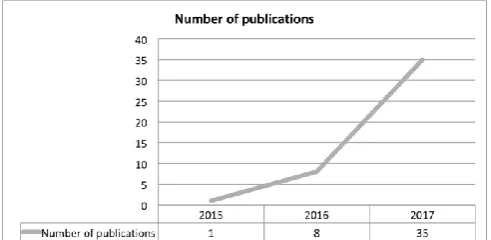
Authors’ strategy was to identify articles that included “digital twin” and “production” as keywords in all fields. Additionally, Authors took into account various synonyms of each of these terms such as “industry 4.0” and “smart factory”. Our search identified 44 empirical academic papers that were published between 2015 and 2017. Their titles, abstracts and texts were reviewed in detail for relevance to the study.
The distribution of publications over the years (Figure 1) shows a growing trend of articles and it reveals a significant increase in 2017. This could be due to the implementation of “Industry 4.0” techniques.
[image:2.595.46.292.317.437.2]In terms of geographical distribution, the publications reviewed where from many different countries around the world, based on the main author's university affiliation. A few countries stand out: Germany and The USA. Hence, it might be argued that digitalization and DT are primarily rooted in these countries.
[image:2.595.46.293.471.585.2]Fig. 1. Distribution of publications over the year
Fig. 2. Distribution of publications over the country
Another important finding in the literature review is that a high percentage of publications are conference papers (55%), 41% are articles (table 1) while only 4% are book chapters.
TABLE I
DISTRIBUTION OF PUBLICATIONS OVER THE TYPE OF CONTRIBUTION Document type Number of publications
Conference paper 24
Article 18
Book chapter 2
Based on the findings of this review, it is possible to establish an overview of the predominant DT characteristics.
In the last few years, Industry 4.0 has been considered as one of the most prevalent topic in production engineering
[6], nevertheless its methods and techniques are still inadequately represented within manufacturing operations.
In this context the DT, as a key enabler of the Industry 4.0, follows the same trend, needing more studies and definitions.
Demartini et al., define the DT as well as Cyber Physical Production System (CPPS), prerequisites for the digitalization of the Manufacturing Execution System (MES), which enable a decentralized and self-organized production system controlled in real time [7].
Uhlemann et al., have strengthen the link between CPPS and DT; they claim that DT is an enabler technology for CPPS. It acquires data, which is necessary for the CPPS functioning. DT allows a coupling of the production system with its digital environment as a base for an optimization with a minimized delay between the time of data acquisition and the creation of the Digital Twin [8].
Furthermore, Rosen et al., presents DT as an essential condition to implement intelligent and efficient production systems, which allow optimizing product design and production execution for achieving higher performances. DT is a “repository” which stores information created in each stage of the product lifecycle and make it seamlessly available [9].
Weyer et al. describe the DT as a “promising approach” that is able to overcame drawbacks and reduce efforts in reverse engineering. Once again, it is defined as a database that contains all information in a structured way [10].
With this in mind, the scope of this paper is to develop an application of DT using simulation techniques with the scope of optimize a production line and control over the product.
III. CASE DESCRIPTION
The manufacturing system proposed in this paper takes inspiration from a real plant, which produces anchoring plates for electric motor brake discs. Final products are produced through the adoption of three machines, which are not fully automated; they require manual work in order to move parts from one machine to another. This production cycle can be defined as an intermittent one, there is no direct communication between machines, and therefore there is a continuous need of operators’ support.
The first two machines, which provide milling and grinding works, do not require continuous communication because, are not sequential. This means that two different products can be processed at the same time.
On the contrary, the second and the third machine, which are called Grinding and Burton need to be linked, in fact they have to process all products. Therefore, products can be worked by machine 1, but works provided by the second and third machines are mandatory for all products. What’s more, required manual works have to be considered between machine 2 and 3 and they involve the following issues:
bottlenecks;
The possibility that machines are inactive until an operator moves parts between them;
Operators provide works that can be carried out automatically by machines themselves;
To improve this situation, an automatic transport system has been introduced in order to connect machines without the intervention of an operator.
The following factors need to be assessed and managed in order to perform an internal automatic transport system:
State of the material to be moved:
oSolid: it can be bulk, in loading units or packages;
oLiquid;
oGaseous;
Operation:
oContinuous;
oDiscontinuous;
Power drive:
oManual transport;
oBy means of manual trolleys;
oSlides;
oMotorized;
Type of movement:
oVertical lifting means;
oHorizontal transport means;
oLifting and transporting means;
oVehicles equipped with vibratory motion;
oMeans equipped with rotating movement;
Control types:
oOn-board maneuver;
oGround control;
oWithout maneuver;
oAutomatic.
In the case considered here, products are in solid state (bulk) moved by horizontal continuous movement through automatic type control and energy availability for motorization. Therefore conveyor belts have been introduced.
After the choosing of internal transport to be implemented, the study of the interaction between the system design machinery has been deepened.
The parameters considered for the design are:
Processing times;
Products’ size;
Machinery location.
These parameters allow us to define:
The conveyor belt speed;
Width;
Length and inclination.
With respect to the conveyor belt speed, in order to avoid mutual interference between the pieces discharged by the machine grinder, it has to vary from a minimum of 1,060 mm/min to a maximum of 1,850 mm/min.
Regarding the width of the ribbon, considering the maximum diameter of the pieces to be transported by 188 mm, it is believed that it should not be less than 200 mm.
Finally, the plant layout should assume an L shape considering machinery sizes and the available space. It has
been suggested to use: 4 meters for the sloping tape, 1.2 meters linearly and finally 80 cm for the load.
IV. SIMULATION MODEL
The simulation model has been implemented through Anylogic tool and can be divided into three steps:
Representing the plant layout (using the Space Markup functions);
Functions definition;
Real loop and parameters definition.
Firstly, to represent the plant layout, the map area of the plant has been created towards the path command and rectangular node in the Space Markup library of Anylogic.
Then the 3D Object library allows us to depict products, operators, machines and the production and packaging workings.
The Process Modeling Library allows us to model the real-world system in terms of:
Agents (customers, pieces, products, etc);
Processes (sequences of operations);
Resources.
The production cycle is simulated in the form of flow charts, which can be hierarchical, scalable and extensible. The main functions used are:
Resource-Pool: defines a set of resource units that can be retrieved and released by agents using some flow blocks. Resources can be static, dynamic, or portable. In this case, we define the workers as such;
Source: represents the starting point of a process model;
Queue: a queue, buffer, of agents waiting to be accepted by subsequent objects in the process flow or in a generic file for agents. The buffering rule can be FIFO (first in first out), LIFO (last in first out), or priority-based;
Delay: delays and is often needed in situations that require some time for decision making or simulating a work process. It is used to represent the machine cycle time;
Seize: recalls a number of resource units defined in the Resource Pool and sends the resources recalled to a specific zone. In this case calls the operator in the pick-up area of the material and in the packaging area;
Release: releases resource units previously recalled with Seize. Resources can return to the starting position or stay in the area where they were released;
Move To: moves the agent to a new location;
Conveyor: simulates a conveyor belt, moves agents along a path at a certain speed while maintaining a minimum gap between them. It was used for automatic loading of the first machine and discharges of both;
Batch: converts a number of agents into one agent. Used to drain the grinding to create baskets that will be transported to the third machine;
Finally, to display the 3D representation (Fig.3), the camera function has been introduced from the Presentation Library.
Fig. 3. 3D real workshop
The enhancement concerns the introduction of a conveyor belt between the Grinding and Burton machines and the removal of workers’ movements and operations.
The conveyor function has been introduced in order to simulate and connect the two machines. In the above definition of the conveyor path, the inclination angle for the first part of the conveyor belt was defined, while the lengths and speeds are defined within the function.
[image:4.595.340.510.202.324.2]Once again, the camera function with its 3D Object has been inserted in order to be able to display the 3D representation (Fig 4).
Fig. 4. 3 D improving production cycle
V. RESULTS
In this section the results obtained from the simulation runs performed for a set of schedules are reported and discussed.
Two simulation scenarios have been considered; the first represents the current state of the production line, while the second one assesses the proposed solution through the introduction of the conveyor belt.
The parameters that have been set are (Table II):
Quantity of the upstream parts of the cycle, defined in an indicative way as 3000 total;
Length of the grinding load band, which is 3 meters
at a speed of 0,1 m / s;
The grinding cycle time has been defined for each type according to the time taken on site, as reported in Tab. I;
Size of the batch defined for each type of work as in Tab. I;
The cycle time, defined as 3 minutes for each type;
Conveyor : length 6 m, width 20 cm, velocity 0.1 m/s;
Time spent by the operator to move the bin and load, as a motion rate of 0.5 m / sec.
TABLE II
PRODUCTION CYCLE PARAMETERS Typology Grinding cycle time
[sec/pz]
Burton flow [pz]
349-3 10 50
349-4 10 60
349-5 20 25
349-11 8.5 80
349-12 12 100
349-13 15 50
349-18 20 30
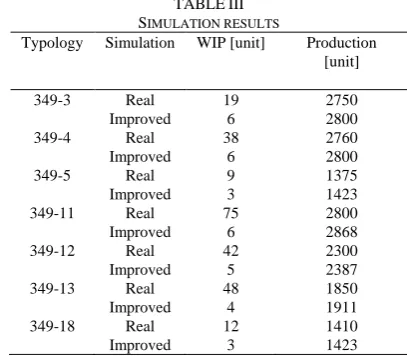
WIP is a technical term used to indicate the number of pieces that are processed simultaneously within a production system. In particular, this is the output from a phase of the machining process pending the next processing. This parameter can be used as an indicator to evaluate system performance: for the same number of batches is preferred the solution that matches the lowest level of WIP, and then the company can thus reduce the cost of storing inventories of raw materials and semi-finished products.
Analyzing the results in Tab. III it is possible to observe that the simulation regarding the introduction of the conveyor belt provided an increase of production by 4% compared to the current production cycle.
TABLE III SIMULATION RESULTS
Typology Simulation WIP [unit] Production [unit]
349-3 Real 19 2750
Improved 6 2800
349-4 Real 38 2760
Improved 6 2800
349-5 Real 9 1375
Improved 3 1423
349-11 Real 75 2800
Improved 6 2868
349-12 Real 42 2300
Improved 5 2387
349-13 Real 48 1850
Improved 4 1911
349-18 Real 12 1410
Improved 3 1423
[image:4.595.46.291.414.601.2] [image:4.595.322.526.508.686.2]VI. CONCLUSION
The study at the mechanical company has made it possible to verify that in a serial production the continuity of flow is a critical factor and that eliminating any accidental interruption is in itself a sensible improvement factor. The solution found, based on the adoption of simple electromechanical equipment such as a conveyor belt, allows optimizing the work of the staff in increments both in terms of physical effort and control over the product.
The adoption of modeling and simulation software like AnyLogic has allowed us to analyze the results of the modifications studied without having to realize them in reality and thus without significant economic impacts due to the cost of implementation. This solution can be considered as a real application of DT. The DT can be used for a number of use cases and in several phases of the object’s lifecycle [11]. Although the idea of the DT can be applied to nearly every real world entity, the presented approach focuses on its application in the industrial context. The usefulness of the DT is not a matter of quantity of data, i.e. it is not productive to try to collect all the information about everything or to be as precise as possible [12]. Instead, a very clear view on what information is necessary for the given tasks (and which is not) is the basis for creating a powerful DT, both efficient and comprehensive at the same time.
From the analysis of the results obtained it is noted that the production remains almost unchanged as that who "rules" the production cycle are the times of the start-up cycle machine - grinding - which can’t be further improved; however, the introduction of automation such as conveyor belt has ensured the continuity of machining by making the Burton power completely unblocked by the action of an operator. In the original version, this could not be as safe and timely as it had to be run by an operator. Additionally, this change has allowed the WIP to be eliminated and hence the possibility that some pieces remain in the middle of the cycle.
Optimizing the work time of the worker, relieved of the job of transporting parts from one machine to another, allows you to pay more attention to other tasks such as quality controls with obvious improvement in production standards. The insertion of an acoustic/luminous alarm system in case of anomalies in the operation of the tape would make the system even more powerful and secure.
In summary, making the cycle in the long run this will be even more productive as a result of the factors just analyzed and even the work of the employee becomes more valuable when it is now more oriented towards relevant actions such as the quality control of the pieces produced, rather than on activities mainly based on porterage.
REFERENCES
[1] K. Zhou, T. Liu, and L. Zhou, “Industry 4.0: Towards future industrial opportunities and challenges,” 2015 12th Int. Conf.
Fuzzy Syst. Knowl. Discov. FSKD 2015, pp. 2147–2152,
2016.
[2] E. Negri, L. Fumagalli, and M. Macchi, “A Review of the Roles of Digital Twin in CPS-based Production Systems,”
Procedia Manuf., vol. 11, 2017.
[3] S. Choi, G. Kang, C. Jun, J. Y. Lee, and S. Han, “Cyber-physical systems: A case study of development for
manufacturing industry,” Int. J. Comput. Appl. Technol., vol. 55, no. 4, 2017.
[4] B. Rodič, “Industry 4.0 and the New Simulation Modelling Paradigm,” Organizacija, vol. 50, no. 3, 2017.
[5] P. Svejvig and P. Andersen, “Rethinking project management: A structured literature review with a critical look at the brave new world,” Int. J. Proj. Manag., vol. 33, no. 2, pp. 278–290, 2015.
[6] F. Almada-Lobo, “The Industry 4.0 revolution and the future of Manufacturing Execution Systems (MES),” J. Innov.
Manag., vol. 3, no. 4, p. 17, 2016.
[7] M. Demartini, F. Tonelli, L. Damiani, and R. Revetria, “Digitalization of Manufacturing Execution Systems : the core technology for realizing future Smart Factories,” in XXII edition of the Summer School “Francesco Turco,” 2017.
[8] T. H.-J. Uhlemann, C. Lehmann, and R. Steinhilper, “The Digital Twin: Realizing the Cyber-Physical Production System for Industry 4.0,” in Procedia CIRP, 2017, vol. 61. [9] R. Rosen, G. Von Wichert, G. Lo, and K. D. Bettenhausen,
“About the importance of autonomy and digital twins for the future of manufacturing,” IFAC-PapersOnLine, vol. 28, no. 3, pp. 567–572, 2015.
[10] S. Weyer, T. Meyer, M. Ohmer, D. Gorecky, and D. Zühlke, “Future Modeling and Simulation of CPS-based Factories: an Example from the Automotive Industry,”
IFAC-PapersOnLine, vol. 49, no. 31, 2016.
[11] S. Konstantinov, M. Ahmad, K. Ananthanarayan, and R. Harrison, “The Cyber-physical E-machine Manufacturing System: Virtual Engineering for Complete Lifecycle Support,” in Procedia CIRP, 2017, vol. 63.
[12] K. Reifsnider and P. Majumdar, “Multiphysics stimulated simulation digital twin methods for fleet management,” in
Collection of Technical Papers -
AIAA/ASME/ASCE/AHS/ASC Structures, Structural