Poetess Archive Journal 2.1 (20 December 2010)
Digital Representation and the Hyper Real © Susan Schreibman 2010
In Oscar Wilde's dialogue, ‘The Decay of Lying’, Vivian and Cyril discuss the
interdependence of Nature and Imagination, with imagination, in that typically Wildean fashion, more faithfully representing the real than the material world. For much of the dialogue Vivian reads an essay aloud to Cryil that he has authored: his thesis is that there must be a return to 'lying in art' (5): a return to the roots of art in the purely imaginative abstract. This imaginative work, rooted in the 'unreal and non-existent' takes as its rough material life, 'recreates it, and refashions it in fresh forms, absolutely indifferent to fact', to what is true or natural or real (20). Wilde's theory of artistic process can also serve as a starting point in articulating a theory of digital mimesis; of understanding the
relationship(s) between the original and its digital manifestation(s), as well as the relationship between and amongst digital surrogates. Moreover, it can be taken as a framework for exploring the complex and shifting relationship between a digitally-presented hyper-reality and the material world.
As other chapters in this volume argue, art has never been a mere mirror up to nature, but in no other medium has it been so easy to create a simulacra of reality; a 'heterocosm', simultaneously simulating the familiar while deconstructing it. While the mimetic effect of visualizations, simulations, and virtual reality inherit a set of conventions between an audience and its expectations of a work, these conventions are ultimately unstable, shifting as the technology, and our expectations of it, change.
object itself, but our beliefs and conventions about it. The second part of this chapter will explore mimesis from the viewpoint of digital representations as conscious fashionings of hyper-reality or in Wildean terms, employing the unreal and non-existent to recreate the material world in unexpected, fresh, or subversive ways.
In the opening paragraphs of Poetics, Aristotle declares that all forms of poetry (in which he includes music and dance in addition to lyric and dramatic poetry) are an imitation or mimesis of human actions. Poetry is a re-presentation of reality in which certain features of the world are brought into focus by stylizing or exaggeration (Davis 3). These features manifest themselves differently depending on three modalities: the medium (the use of the voice in song, the use of an instrument, or by language alone); the objects being represented (men as archetypes as opposed to ordinary individuals); and manner (a narrative versus a lyric poem). The interplay between these three modes is a framing of reality: paradoxically, the more real the more fraudulent the imitation.
processing or analysis: a novel in digital format is amenable to data mining or an
enhanced image of a damaged manuscript may reveal text not visible to the human eye. Objects in museums or libraries exist at a remove from the circumstances under which they were produced: an author's papers neatly arranged in stacks may bear little resemblance to how they were organized while they were in the author's possession; a native American bowl behind a glass case does not reflect its utilitarian nature.
Nevertheless, even in these settings, the object's existence in three-dimensional space provides important clues as to its meaning. A researcher in an archive can hold a manuscript up to the light to better read a deleted word, or by feeling the paper and viewing a watermark may be able to accurately date it. A scholar can hold a bowl in her hands to feel its weight, the thickness of its walls, and the method used to apply glaze so as to identify the potter.
Digital representations of three-dimensional objects, necessarily, lose their corporeality, becoming two-dimensional artifacts1 engaged with through the mediating presence of an electronic viewing device (a computer monitor, a mobile phone, an e-book). What we engage with, however, are only representations of digital corporeality: what we see are manifestations of the underlying code, much as the prisoners in Plato's allegory of the cave saw only shadows cast on the wall. What we engage with is in fact, not the digital object, but a representation of it. The pottery bowl of my earlier example is stored in the computer as a series of ones and naughts, and only made visible when invoked via hardware and software that can interpret it.
Johanna Drucker in 'Digital Ontologies: The Ideality of Form in/and code Storage – or – Can Graphesis Challenge Mathesis?' posits that although throughout Western history images have been charged with being essentially deceptive or illusionary, the
orchestra performs a score. He calls this a distinction between code and surface: '[t]he source code represents a kind of notation or musical score that is interpreted by the computer when a page is called up by a specific browser'. Each time a page is invoked the browser performs the code and displays it on the surface of the monitor. For Richard Powers, binary code represents a true transformable panglossary, where every impulse is conveyed as strings of binary digits. These binary digits are not interpretable by humans: we cannot look at a disk array and know whether we are looking at email, a digital image of the Statue of Liberty, or an Excel spreadsheet.
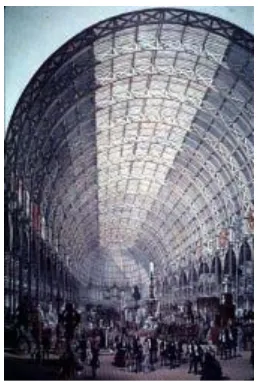
Figure 1: An image from the 1853 Dublin World's Fair and its binary equivalent.
In classical discussions of mimesis the thing being represented typically reflects, however distorted the lens, the represented; the essence of the represented recognizable in the simulacra. By the twentieth century, art, such as abstract painting, no longer sought to re-present reality, to comment on, to refer to, to imitate -- but invited viewers to attend to it as a physical object in its own right. (Novitz 302). Digital media conflates these
perspectives: objects are both representational and incarnate, the object as it never existed, a simulation or hyper-realization:
Looked at from the representational side, a data structure of--to invoke the ghost of John Stuart Mill--a chair is just an image, a string of bits given over to modeling color depth and volume and
spatial orientation, perhaps realized with a zeal for surfaces that would be the envy of Dutch Golden Age painters, yet a mere depiction nonetheless. But looked at from the operational side, that same encoded chair becomes a set of computational algorithms that can instruct other digital bodies below a certain virtual weight to conform to it and stay aloft in space. The digital chair can creak or break. It can possess tensile strength, texture, pliancy, abrasion, any affordance its joiner might care to give it. Set free to execute, it becomes an instance of its own description. (Powers)
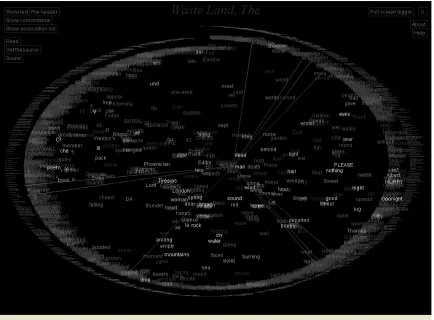
[image:5.612.90.524.355.675.2]Powers argues that the digital releases symbols, freeing them to become actors and agents. Intellectual structures can be acted upon, made visible through the operant. The program TextArc is a case in point. TextArc takes ASCII text and re-presents it visually, using a concordance to spatially reconfigure it. This reconfiguration harks back to Aristotle's three modalities, only becoming instantiated through its algorithmically-generated performance.
Simulations may also represent objects as they never existed in the material world
reflecting our theories and beliefs about them. Digital imagery, for example, may be used to make visible the characters of a manuscript no longer perceptible to the human eye due to fading, decay, damage, or simply neglect. What is represented is not the manuscript as it existed before the damage, nor the manuscript as it exists today: it is not the shadows on the cave wall, nor the reality which casts those shadows, but a hyper-reality which exists between these worlds.
This has deep implications for the future study of our cultural heritage. When scholars engage with originals they use physical clues to establish authenticity. Digital objects, however, exist outside time and space in a way that material objects do not. Digital objects do not decay due to the ravages of time or environment (although digital objects may be rendered useless by not having the proper hardware and software to read them). As with other surrogates (microfilm, photographs, or other reprographic forms), the authenticity of digital objects is overlaid with 'additional questions about the methods of representation' (Bearman and Trant). The methods employed and the choices made in the creation of the surrogate affect the surrogate's subsequent utility. Although no one would mistake the digital representation of the manuscript of Beowulf for the physical artifact (as one might mistake a forgery), it is not always clear how a viewer of a digital facsimile can be certain that the object she is viewing is authentic, i.e. that it is a representation of the manuscript known as Beowulf held at the British Museum created at a specific point in time and under specific conditions.
This type of metainformation provides clues to an object's origins – who created it, when it was created, the software and hardware used -- and becomes part of an object's digital provenance. Metainformation can also be generated by humans, such as descriptive or bibliographic information. It is used by systems to categorize, sort, and retrieve, and by humans, to help make sense of the object once presented with it. Metainformation embedded around the object may also give clues to the digital object's integrity.
In a digital preservation environment where the goal of the system is self replication (note the name of a widely-used digital preservation system, LOCKSS, an acronym for 'Lots of Copies Keeps Stuff Safe'), the system automatically, and without human intervention, makes copies of digital data, spreading the copies across its servers and systems so that if hard drive A fails, the copy on hard drive B can be used to populate hard drive C with another copy, only to repopulate hard drive A when it is repaired. Although the copy on hard drive A may be identical to the copy first placed on it, it may not be the same. Asking if a digital artifact is genuine is not the same as asking if the painting of the Mona Lisa in the Louvre genuine, that is, it is not a fake or a forgery. By their very nature, digital representations of analogue objects are not genuine. Because of this, the nature of the questions to ask of them changes. Are they accurate in their representation? Are they
trustworthy in that they do indeed represent what they purport to represent, and are they in some way certifiable. Bearman and Trant suggest that authenticity may be determined through 'an analysis of the methods that have been chosen to transform the original into a digital form, or through an assessment of the methods used to capture original digital data.' Thus, the integrity of a particular digital copy may be determined. Integrity and authenticity may be concepts more valuable in evaluating the truthfulness of digital surrogates than concepts like representation or copy.
Or perhaps, as David M Levy suggests, authenticity is our ability to distinguish between
Austin. While over time society has developed procedures for distinguishing the authentic from the inauthentic, this process is in its infancy for digital media. Digital media exists in an environment of multiplicity where the ability to copy is unprecedented. Levy goes so far to argue that in a digital realm there may be no originals, only copies (and lots of them!). And since we are still in the formative stages of understanding the norms of this environment, there is no agreement on what properties and characteristics an enduring digital object must possess (1).
Because the technical challenges are so immense in ensuring authenticity, organizations in which society has vested trust (libraries, archives, museums) have taken on the role of assuring the authenticity and reliability of digital objects. These trusted digital
repositories are evolving a set of protocols for ensuring the reliability and the permanence of digital objects (Levy 3). Permanence, however, does not carry the same meaning as it does in an analogue world. It does not necessarily imply that an object is retained because of its uniqueness or origins, such as the Beowulf manuscript, or that it is representative of a class, such as a first edition of Hemingway's For Whom the Bell Tolls. As noted earlier, multiplicity abounds in the digital realm. Rather, reliability and permanence means that the digital object has a certain relation to the original and that in its transformation the trusted digital repository ensures that in its refashioning, the digital object re-presents the analogue artifact. Moreover, through the use of handles or persistent identifiers, the trusted digital repository assures users that despite the inevitable changes in hardware and software, and despite migrations from one file format to another, a digital object will be, for certain purposes and under certain conditions, interchangeable, with the ones that have gone before and the ones that will come after it.
Interchangeability is not only applicable to how digital objects may, over the course of time, in some senses stay the same but be different, it is also applicable to how one engages with them in a distributed environment. Objects in a distributed digital
variables. The same is not true of digital artifacts. Objects that are database driven are typically designed to function differently when called into different environments. In one display, the Beowulf manuscript may be retrieved as a thumbnail as one of 1000
manuscripts held by the British Museum. In another display the digital facsimile may be dwarfed by accompanying scholarly apparatus. In yet a third display, the manuscript may be used as a background to a piece of electronic literature. The information a viewer takes away from the presentation may also differ due to the mediating presence of the software, such as a browser, and the color calibration of the monitor. Moreover, when an indexing program is used to retrieve information, a viewer may not even be presented with this manuscript if it does not meet the indexing criteria, although a different indexing program, using a different algorithm, may deem it relevant and present it to the user (Lynch 13: 2001).
We accept these various uses of the digital facsimile of Beowulf as being authentic, each having an integrity within the environment it is operating. Here, objects are 'strangely similar to the original', duplicated by their own scenarios (Baudrillard 23). These digital artifacts are what Plato termed phantastic: simulacra 'which correct their proportions to account for the position of the viewer'. The simulacrum copies only the appearance of the original, rather than being endowed with resemblance -- what Plato termed eikasti or an exact replica. The distinction had interesting implications: simulacra 'are historically grounded to the condition of the viewer, not to an abstract or purely rational conception of truth' (Potolsky 151). Digital simulacrum call attention to themselves as objects which exist autonomously from their original sources. Objects are typically not represented to scale, so a map that is 3x2 feet appears the same size as one that is 8x10 inches. Our search engines reduce hundreds, thousands, even millions of objects to a text string displayed ten to a page, or a table populated by 20 2x2 inch thumbnails. This
As more of our cultural heritage is engaged with in the ways mentioned above, the original object is also transformed. As in Baudrillard's example in Simulations in which, in an effort to preserve the caves of Lascaux, an exact replica has been constructed some 500 meters from the original. This replica is what is open to visitors, and Baudrillard argues that over time, future generations may not perceive a difference between the original and the duplication, rendering both artificial (18). So too, as it becomes
commonplace to engage with cultural heritage materials in digital form without reference to the original, the transmutability of the digital will seem normative, and the original, fixed in its materiality, artificial.
Thus the further we get from the original, the more pressure there exists to restore digital objects to their cultural contexts. Cultural heritage institutions have long maintained that objects receive significance by the thoughts that 'cluster around them' (Trant 1). Ways of conveying these thoughts may be via the arrangement of items in a museum (an object placed in the ancient Egyptian room as opposed to the ancient Greek room), through textual information such as catalogues, monographs, and finding aids. Another method of conveyance is through descriptive metadata -- textual metadata that provides the reader with information about the object's cultural heritage and natural origins. In a distributed, online environment, metadata is often considered to be as important as the objects themselves. Metadata is a way of making meaning for the system to sort, file, and retrieve. Typically it is the only method of access for non-textual data (images, sound, moving images). Metadata thus becomes another form of mimesis. It not only conveys the authenticity of digital artifacts, but can carry more authority than the digital facsimile, particularly for non-textual objects.
bibliographies). Indeed, the catalogue as a whole is a system that represents the library (San Segundo 108). But within a digital context, metadata is more than a sign for the digital object, rather, it is, ultimately, another form of representation.
Digital artifacts are compound objects whose component parts are acted upon by the system. Some states of the object are invisible to humans but essential to the computer. Meaning typically does not reside in any one component, but is created only through a complex set of interactions (as in the TextArc example), what Marcos Novak calls a 'liquid architecture' or what San Segundo refers to as a 'representation of knowledge': the symbolization of productive and useful electronic information, encompassing syntaxes, semantics, notations, models, formats, and data structures (110). This fungible interaction of code and surface is nowhere more evident than in the born digital. Increasingly, digital objects are not created as digital representations of material objects, but as original, possibly unique objects. The born digital takes many forms: some simulate aspects of the material world (virtual worlds such as MySpace, and Second Life), others are modeled on published formats (as Wikipedia is to print encyclopedias or flickr is to photo or flickr is to photo albums or Blogger and LiveJournal is to diaries and journals). Digital art and literature bear some resemblances to their analogue predecessors, but the ease of
integrating multimedia in digital works is breaking down disciplinary boundaries. What these new forms of electronic discourse have in common is that they exist only digitally. They depend on a complex representation of knowledge for humans to engage with them. These dynamic heterocosms pose even greater challenges to issues of representation, originality, authenticity, and preservation.
The current hype in the popular media extolling the mimetic qualities of metaverses (metaphysical universes) such as Second Life, is not all that different from the hype in the early days of the World Wide Web. In 1995 it was still unclear how a virtual
for making a profit; they have become a "place" to conduct business by establishing "sites"' (Nunes). 1995 was the infancy of online businesses such as amazon.com and ebay, and it was not certain how one could use one's mouse and keyboard to 'travel' to an online store to make purchases.
Almost a decade later, the same uncertainty surrounds how virtual worlds will extend our reality. Business reporting a couple of years ago was almost giddy in its coverage of how traditional businesses have established presences in Second Life (Siklos) mirroring the heyday of the first wave of store openings on the World Wide Web. What both these landscapes have in common is that they substantiate real world practices within a virtual typography. Some social critics worry that spaces like Second Life will turn into a virtual strip mall, much as the World Wide Web has evolved into an information space with big business driving its development. Other critics find this less worrying, arguing that the lure of virtual reality games is that they do not simply 'repeat the world', but 'evoke the imagination' (Powers):
VR is not a new form of mediated representation, but a specific kind of computer-generated simulation that deconstructs the metaphysical system that institutes and regulates the very difference between representation and reality. (Gunkel 46) In virtual worlds, avatars that are killed come back to life, there is not an irreversible directionality of time, injuries do not result in permanent damage or disability, and many players, unbeknownst to one another, perform the same action, such as slaying a dragon (Ryan). Like the material world, and unlike traditional fiction, no one individual has an omniscient perspective: typically players are unaware of what is happening in parts of the game space that do not intersect with theirs. Like the material world, virtual reality games involve systems of progression, with avatars, through their own skills or via purchase of goods and services (typically with real world money) progress to higher levels in the game hierarchy. What games like Second Life simulate, in Baudrillard's words, is 'the presumption of an ideal counterfeit of the world' (89). Here, simulacra are not simply 'a game played with signs'. Rather, 'they imply social rapports and social power'
world. According to the Xinhua News Agency, after several days of playing World of Warcraft, a girl died from exhaustion (Steven Levy 50). Whether this story is tragically true, or whether it is apocryphal, it is indicative of the simulation to have irrevocable consequences in the world it world it purportedly enacts.
The canvass on which all this life is enacted is Powers' panglossary or Baudrillard's universal substance: the binary code of the computer performed through a highly non-linear dynamic system. Like the material world, virtual games are liquid architectures in which no one state captures its essence. Yet, it is not only virtual games that are re-descriptive. Consider dynamically-driven newspapers that deliver content appropriate to the type of devise making the request: a sentence to a RSS feed, an abstract to a mobile phone, an article to an iPad, and the article with photographs to a web browser. The newspaper is not one object amenable to web harvesting, but series of complex objects generated by the system depending on when and from what device the request is made. The home page of The New York Times is a dynamic mélange with certain features such as advertisements and photographs changing each time a browser makes a request. Breaking news from the AP and Reuters is updated frequently, and lead stories are subject to change, particularly when there are fast moving events.
While the current day's offerings from The New York Times are laid out within a browser like a traditional newspaper with columns, it is not possible to view previous day's offerings within this paradigm. A search for content available on 1 December 2006 returns a result page listing tens of articles for that date. Clicking on one article brings up the text, but displays it within the framing device of the newspaper of today's date.
Clicking on TheNew York Times icon in the top left hand corner, brings up the homepage for today, not the date of the article.
Asking what the New York Times ison a particular day is not the same thing for the print as for the digital. Today's version of the digital New York Times embeds in it its
color influence how we read? These features are lost daily, only available for the current day's viewing. Textual scholars have long argued over these points. Is meaning
embedded in the text apart from its presentation, or does presentation influence meaning? If I were to give you a text to read in a cheap paperback edition or one elegantly and expensively produced with leather covers and gold stamping, would you think differently of the author's work? Textual scholars call these non-linguistic features bibliographic codes, and many argue that it is a decisive factor in the creation of meaning. It is these bibliographic codes that are lost each time The New York Times strikes midnight. Are these bibliographic codes, like the thousands of daily interactions in Second Life, recoverable? Can they be recreated from the code, algorithms, metainformation and content of the database in an effort to recover the object interacted with at a specific point in the past. The answer would, given today's technology and the distribution of archival responsibilities, have to be no.
While the cultural heritage community is moving rapidly to ensure its present and future users that the digital objects they engage with are reliable and authentic, the same cannot be said of liquid architectures. Does Walter Benjamin statement that the 'presence of the original is the prerequisite to the concept of authenticity' (220) still hold true with the born digital? Is it even possible to detach the 'object' from its method of production? With the born digital, the object may not be what the viewer interacts with, but the data
structure itself performing the imaginative abstract, taking the rough material of life, refashioning it in fresh forms, absolutely indifferent to the fact of what is true or natural or real . It is both operator and operand, original and copy, code and surface, weaving itself into the very fabric of the material world.
Director, Digital Humanities Observatory June 2010 Bibliography
Baudrillard, Jean. Simulations. New York: Semiotext[e], 1983.
Benjamin, Walter. Illuminations. Edited by Hannah Arendt. New York: Harcourt, Brace & World, 1968.
Davis, Michael. Poetry of Philosophy: On Aristotle's Poetics. South Bend, Indiana: St Augustine's Press, 1999.
Drucker, Johanna. 'Digital Ontologies: The Ideality of Form in/and Code Storage – or –Can Graphesis Challenge Mathesis?' Leonardo, the International Society for the Arts, Sciences and Technology 34.2 (2001): 141-145.
Gunkel, David. 'Rethinking Virtual Reality: Simulation and the Deconstruction of the Image'. Critical Studies in Media Communication. Vol 17, No. 1 (March 2000) 45-62.
Huber, Hans Dieter. 'Only!4!!!!!!!!!!!!!!!!!!!!!!4-for YOUR Private Eyes. A structural analysis of
http://www.jodi.org'. Accessed 4 December 2006. <http://www.hgb-leipzig.de/ARTNINE/huber/writings/jodie/indexe.html>
'Living a Second Life' The Economist (30 September 2006) 77-79.
Levy, David M. 'Where's Waldo? Reflections on Copies and Authenticity in a Digital
Environment'. CILIR Publication < http://www.clir.org/pubs/reports/pub92/levy.html> Accessed 4 January 2007.
Levy, Steven. 'Living a Virtual Life'. Newsweek (18 September 2006) 48-50.
Lynch, Clifford. ' Authenticity and Integrity in the Digital Environment: An Exploratory Analysis of the Central Role of Trust'. CLIR Publications. Accessed 2 January 2007.
<http://www.clir.org/pubs/reports/pub92/lynch.html>
Lynch, Clifford. 'When Documents Deceive; Trust and Provenance as New Factors for Information Retrieval in a Tangled Web'. Journal of the American Society for Information Science and Technology Vol1 No 52 (2001): 12-17.
Nocak, Marcos. ' Transmitting Architecture: The Transphysical City'
<http://www.alchemists.com/c-writings/novak1.html>. Accessed 5 January 2007.
Novitz, David. 'Art, Life and Reality'. British Journal of Aesthetics. Vol. 30, No. 4 (October 1990) 301-310.
Nunes, Mark. 'Jean Baudrillard in Cyberspace: Internet, Virtuality and Postmodernity'. Style Vol 29 No 2. (Summer 1995). Accessed through EBSCO.
Nunes, Mark. 'Virtual Topographies'. Cyberspace Textuality. Edited by Mare-Laure Ryan. Bloomington: Indiana University Press, 1999). 61-77.
Potolsky, Matthew. Mimesis: the New Critical Idiom. New York: Rutledge, 2006.
<http://www.centerforbookculture.org/context/no3/powers.html> Accessed 5 January 2007.
Ryan, Marie-Laure. 'Introduction: From Possible Worlds to Virtual Reality'. Style Vol 29 No 2. (Summer 1995). Accessed through EBSCO.
San Segundo, Rosa. 'A New Conception of Representation of Knowledge'. Knowledge Organization Vol 31 (2004) 106-111.
Silkos, Richard. 'A Virtual World but Real Money'. The New York Times. (19 October 2006). C1,4.
Trant, Jennifer and Bruce Wyman. 'Investigating Social Tagging and Folksonomy in Art Museums with steve.museum'. Accessed 23 December 2006.
<http://www.steve.museum/static/reference/www2006-tagging-steve.pdf >
Wilde, Oscar. The Decay of Lying: An Observation. Cork: CELT: Corpus of Electronic Texts, 1999. Last accessed 6 September 2006. <http://www.ucc.ie/celt/published/E800003-009/>
1 This is true even when the computer emulates three-dimensional space, such as utilizing software to be able to view 360° of a sculpture, or using virtual reality software to