Measuring Roughness: considerations for the
microtonalist
Richard Duckworth
Contexts
๏
exploration of xenharmonic scales and the holistic inclusion of factorssuch as interface and timbre as factors
๏
...and also assess historical uses of tunings and perceptions ofdissonance - as these can differ from our own
๏
The use of the scale leads to the evolution of a music theoryRoughness
๏
Roughness one of the auditory attributes along with Pitch, Timbreand Loudness.
๏
as distinct from dissonance - culturally loaded and context dependent๏
dissonance = ‘sensory dissonance’๏
first research without cultural bias: Helmholtz 1885๏
little research carried out in the area until the 1960’s (with theexception of von Békésy’s work in the 1930-40’s)
๏
von Békésy, (1960); Terhardt, (1974); Plomp & Levelt, (1965);Kameoka & Kuriyagawa, (1969); Hutchinson & Knopoff, (1978);
Consonance & Dissonance
๏
That certain conditions cause the ear to be ’thrown into turmoil’ hasbeen observed throughout the ages.
๏
psychoacoustics research explains these physiological and perceptualphenomena.
๏
tones which lie closely together in frequency exhibit a phenomenonknown as beating as they cycle in and out of phase with one another
rapidly.
๏
this swift beating (fluttering) is perceived as roughness and persistsuntil the tones are separated by a distance known as the critical band.
๏
when a number of tones and or their partials lie within the sameCritical Bands
๏
Fletcher’s ‘Auditory Patterns’,(1940) - the graphics
highlight areas of excitation on the basilar membrane
๏
the existence of CBs wasconfirmed by the
phenomenon of masking: a noise signal concealed a sine
wave from the subject.
However, when the the sine
wave was swept up or down
in pitch, it it would reappear
- confirming the existence of
place-specific areas of
sensitivity.
Critical Bands
๏
The width of the CBs waslater mapped by Zwicker,
‘Subdivision of the Audible Frequency Range
(Frequenzgruppen)’, (1961)
๏
and presented as a tablePlomp & Levelt
๏
First to tie concept of roughness perception to the parameters of theCritical Band*
๏
found that maximum roughness point occurs at 1/4 width of the CB๏
and that the curve is wider for lower frequenciesTerhardt
๏
attributes the sensation of roughness directly to temporal fluctuationsin amplitude when they appear within the ‘spectral regions’ known as
critical bands (CBs).
๏
the roughness created across all of the CBs is summed to give anoverall roughness effect
๏
confirming the assumption that, for a pair of timbres, adjacentpartials of each timbre that lie within the same CB will contribute to
the overall sensation of roughness.
๏
Terhardt mentions phase but does not present any process for dealingParncutt
๏
Terhardt’s ideas (tonalness, virtual pitch) were extended by Parncutt.๏
applied them to common practice music & 12 tet composition๏
implemented an extended version of Hutchinson & Knopoff’sVassilakis
๏
pan-musical interdisciplinary dissertation (2005) inclusive of non-Western music
๏
clarifies the confusion surrounding amplitude fluctuation andamplitude modulation depth
๏
highlights importance of roughness as an integral sonic attribute ofmany types of music
๏
revises models estimating to roughness of complex tones with aBohlen Pierce
๏
non-octave scale with 13 steps๏
repeats every 12th๏
Just Intonation and Equal Tempered versions๏
None of the BP scales sit well on the physical key arrangement of the12-TET keyboard
๏
so following from Elaine Walker (and from Heinz Bohlen) , aBohlen Pierce Just Intonation
๏
BP Just Intonation (JI) chromatic1/1, 27/25, 25/21, 9/7, 7/5, 75/49, 5/3, 9/5, 49/25, 15/7, 7/3, 63/25, 25/9, 3/1
๏
BP JI diatonic: ‘Lambda Mode’1/1, 25/21, 9/7, 7/5, 5/3, 9/5, 15/7, 7/3, 25/9, 3/1
C D E F G H J A B C’
๏
The keyboard provides a ‘front-end’ for anadditive synthesis instrument implemented in
Pure Data. The partials have high resolution
frequency and amplitude controls, and there
are individual envelopes on each partial.
๏
Diatonic BP notes mapped to white keys, andthe ratios corresponding to the chromatic notes
are mapped to the reconfigured black keys.
๏
Only parts of the MIDI protocol are used (e.g.,velocity). The frequency values assigned to the
keys are not used; instead each unique MIDI
note ID is re-assigned to trigger scale maps
created within the pd patch itself.
๏
The synthesizer allows the user to select eitherET or JI BP scales
BP JI chromatic scale mapped out as a set of message boxes
in pd
These are then sent sequentially through an
expression for the
calculation of the ratios...
... and mapped out on an
array to provide scale ratios to be applied to a base
Timbres that complement B
-
P
๏
B-P practitioners have traditionally chosen timbres consisting of oddinteger multiples of the fundamental.
๏
Preliminary tests with triangle and square waves confirmed thesuitability of these types
๏
Sethares presents a useful way of constructing a spectrum for a givenscale
๏
‘Symbolic Computation of Spectra’ is a technique for selecting spectralcomponents with the goal of maximising the number of co-incident
partials.
๏
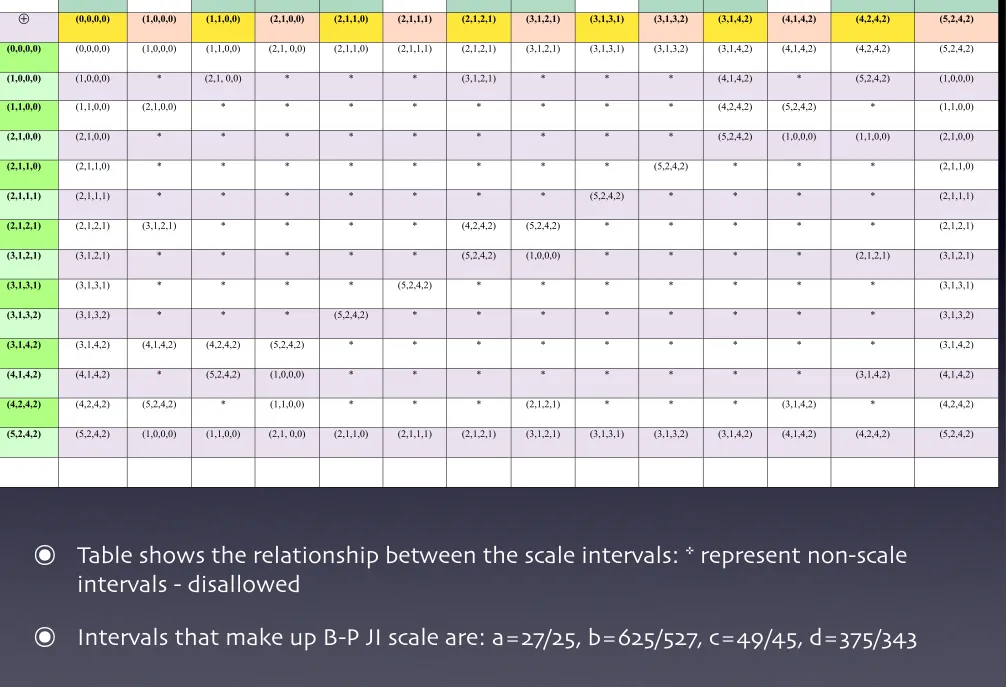
This is accomplished by ensuring that the ratios between the partials1/1 27/25 25/21 9/7 7/5 75/49 5/3 9/5 49/25 15/7 7/3 63/25 25/9 3/1
⊕ (0,0,0,0) (1,0,0,0) (1,1,0,0) (2,1,0,0) (2,1,1,0) (2,1,1,1) (2,1,2,1) (3,1,2,1) (3,1,3,1) (3,1,3,2) (3,1,4,2) (4,1,4,2) (4,2,4,2) (5,2,4,2) (0,0,0,0) (0,0,0,0) (1,0,0,0) (1,1,0,0) (2,1, 0,0) (2,1,1,0) (2,1,1,1) (2,1,2,1) (3,1,2,1) (3,1,3,1) (3,1,3,2) (3,1,4,2) (4,1,4,2) (4,2,4,2) (5,2,4,2)
(1,0,0,0) (1,0,0,0) * (2,1, 0,0) * * * (3,1,2,1) * * * (4,1,4,2) * (5,2,4,2) (1,0,0,0)
(1,1,0,0) (1,1,0,0) (2,1,0,0) * * * * * * * * (4,2,4,2) (5,2,4,2) * (1,1,0,0)
(2,1,0,0) (2,1,0,0) * * * * * * * * * (5,2,4,2) (1,0,0,0) (1,1,0,0) (2,1,0,0)
(2,1,1,0) (2,1,1,0) * * * * * * * * (5,2,4,2) * * * (2,1,1,0)
(2,1,1,1) (2,1,1,1) * * * * * * * (5,2,4,2) * * * * (2,1,1,1)
(2,1,2,1) (2,1,2,1) (3,1,2,1) * * * * (4,2,4,2) (5,2,4,2) * * * * * (2,1,2,1)
(3,1,2,1) (3,1,2,1) * * * * * (5,2,4,2) (1,0,0,0) * * * * (2,1,2,1) (3,1,2,1)
(3,1,3,1) (3,1,3,1) * * * * (5,2,4,2) * * * * * * * (3,1,3,1)
(3,1,3,2) (3,1,3,2) * * * (5,2,4,2) * * * * * * * * (3,1,3,2)
(3,1,4,2) (3,1,4,2) (4,1,4,2) (4,2,4,2) (5,2,4,2) * * * * * * * * * (3,1,4,2)
(4,1,4,2) (4,1,4,2) * (5,2,4,2) (1,0,0,0) * * * * * * * * (3,1,4,2) (4,1,4,2)
(4,2,4,2) (4,2,4,2) (5,2,4,2) * (1,1,0,0) * * * (2,1,2,1) * * * (3,1,4,2) * (4,2,4,2)
(5,2,4,2) (5,2,4,2) (1,0,0,0) (1,1,0,0) (2,1, 0,0) (2,1,1,0) (2,1,1,1) (2,1,2,1) (3,1,2,1) (3,1,3,1) (3,1,3,2) (3,1,4,2) (4,1,4,2) (4,2,4,2) (5,2,4,2)
๏
Table shows the relationship between the scale intervals: * represent non-scaleintervals - disallowed
[image:19.1024.18.1024.64.751.2]๏
Spectrum t(i) constructed by consulting O-plus table and selecting likely candidates.Then partials are tested against each other: f(i)/f(j) = scale step. In this case, not all
of the ratios between partials are scale steps, so this timbre is only partly related to
the B-P scale
i 1 2 3 4 5 6 7 k
t(i) (0,0,0,0) (5,2,4,2) (9,4,8,4) (12,5,8,4) (13,5,10,5) (13,5,12,6) (14,5,12,6) s(i) (0,0,0,0) (0,0,0,0) (4,2,4,2) (2,1,0,0) (3,1,2,1) (3,1,4,2) (4.1.4.2)
r (i,k) (5,2,4,2) (4,2,4,2) * * * (1,0,0,0) 1 (4,2,4,2) (2,1,0,0) * * * 2
(2,1,0,0) (3,1,2,1) (4,1,4,2) * 3
(3,1,2,1) (3,1,4,2) * 4
(3,1,4,2) (4.1.4.2) 5
Roughness curves
๏
in contrast to the JI advocates, tuning creators who manipulatetimbral components for the purposes of achieving coherence of
partials with scales that would not work with acoustic timbres occupy
a space of their own in contemporary tuning studies.
๏
utilising the flexibility granted by digital synthesis and controlsystems, researchers are able to create scales that would be bereft of
consonance if used with timbres containing ‘partial placements’
usually associated with traditional instruments.
๏
The reverse process also holds true - a unique scale can be derived๏
dissonance curve of spectrum of waterphone sample drawn using Moore and Glasberg’s formula for the calculation of CB๏
the pd patch models the way the ear perceives dissonance by reactingeach partial together and testing for roughness. The amplitude of the
partials is taken into account, as is register, by including a critical band
model.
๏
the result is a curve which clearly shows the ‘dissonance minima’๏
it is at these points that the scale steps are fixed๏
In this case the next most consonant interval, after unison (8ve), is atype of tritone - this timbre supports the tritone as a consonant
Dissonance curve
๏
To port these minima over so that they form a meaningful scale it isnecessary to get the values out of the table and into a scale implementation device
๏
this time Kontakt was used: both to host the samples and toimplement the scales. It has the disadvantage of being 8ve based.
๏
the values from 0-400 are easily readable from the curve x-axis๏
these are *3 to give 1200 - so that it now fits neatly across a 12 TETspan
Curve values for minima points
*3
(1200 cents)
Assigned note - Kontakt
0 0 C (base note)
46 138 Db
77 231 D
130 390 E
196 570 Gb
222 666 G
329 987 Bb
Rich Duckworth NUI Maynooth
๏
Moore & Glasberg’s CB equation. Fcb = critical bandwidth,Fm = mean frequency