ATTITUDE RECOGNITION SYSTEM: A
MULTIMODAL ANALYSIS OF VIDEO
BLOGS
Noor Alhusna Madzlan
Thesis submitted for the Degree of Doctor in Philosophy
School of Linguistics, Speech & Communication Sciences
University of Dublin
Trinity College
Under the Supervision and Direction of
Asst. Prof. Breffni O’Rourke and Prof. Nick Campbell
I declare that this thesis has not been submitted as an
exercise for a degree at this or any other university and
it is entirely my own work. Wherever there is published
or unpublished work included, it is duly acknowledged
in the text.
I agree to deposit this thesis in the University’s open
access institutional repository or allow the library to do
so on my behalf, subject to Irish Copyright Legislation
and Trinity College Library conditions of use and
ac-knowledgement.
Communicative content in human communication involves expressivity of socio-affective
states. Research in Linguistics, Social Signal Processing and Affective Computing in
par-ticular, highlights the importance of affect, emotion and attitudes as sources of information
for communicative content. Attitudes, considered as socio-affective states of speakers, are
conveyed through a multitude of signals during communication. Understanding the
expres-sion of attitudes of speakers is essential for establishing successful communication. Taking
the empirical approach to studying attitude expressions, the main objective of this research
is to contribute to the development of an automatic attitude classification system through a
fusion of multimodal signals expressed by speakers in video blogs. The present study
de-scribes a new communicative genre of self-expression through social media: video blogging,
which provides opportunities for interlocutors to disseminate information through a myriad
of multimodal characteristics. This study describes main features of this novel
communica-tion medium and focuses attencommunica-tion to its possible exploitacommunica-tion as a rich source of informacommunica-tion
for human communication. The dissertation describes manual annotation of attitude
expres-sions from the vlog corpus, multimodal feature analysis and processes for development of an
automatic attitude annotation system. An ontology of attitude annotation scheme for speech
in video blogs is elaborated and five attitude labels are derived. Prosodic and visual
fea-ture extraction procedures are explained in detail. Discussion on processes of developing an
automatic attitude classification model includes analysis of automatic prediction of attitude
labels using prosodic and visual features through machine-learning methods. This study also
elaborates detailed analysis of individual feature contributions and their predictive power to
the classification task.
All praises, above and beyond, to Allah the Most Gracious and Most Merciful, for giving
me the will and strength to complete this doctoral dissertation. Greatest appreciation to my
sponsors in Malaysia, the Ministry of Higher Education and Sultan Idris Education
Univer-sity (UPSI). Deepest gratitude goes to my academic supervisors in Trinity College Dublin,
Assistant Professor Dr. Breffni O’Rourke and Professor Dr. Nick Campbell for believing in
me. I may have not completed this research if not for their constant support and guidance.
For that, I am greatly indebted. Special thanks also to Dr. Loredana Sundberg Cerrato from
ADAPT Centre, Trinity College Dublin for the helpful insight and encouragement.
Deepest love and gratitude to my beloved husband, Nik Saiful Nizan for believing in me.
I also wish to convey my appreciation to my beloved parents, Madzlan Aziz and Sharifah
Ahmad for their unconditional love and support. In extension, I thank my supportive siblings,
Noor Alhuda and family, Noor Al Iman and family, Noor Alyaqeen and family, Ahmad
Munzir and family and Ahmad Basyeer for their endless advice and encouragement. You
have all kept my spirit alive and I am sincerely thankful.
Special gratitude also to my incredibly supportive colleagues Francesca Bonin, Frank
Han, Emer Gilmartin, Yuyun Huang, Justine Reverdy, Christy Elias, Sucheta Ghosh and
others from the Speech Communications Laboratory and SCSS, TCD. Last but not least,
huge thanks to my loyal friends and support system in Dublin, Nur Adyanie, Azim, Azita
Iliya, Julinawati, Hasbullah, Ika Rastika, Zurina, Asnul Hadi and family, Siti Norhayati,
Raihana Zahirah, Marlini and family and others. Thank you for keeping my sanity intact and
being with me in this long winding journey. Through all the laughter and pain, I truly value
our friendship and memories here in Ireland. Appreciation also goes to friends and family in
Malaysia. Lastly, thank you to those who have contributed to this research.
[1] Noor Alhusna Madzlan, Jingguang Han, Francesca Bonin and Nick Campbell.
Towards automatic recognition of attitudes: Prosodic analysis of video blogs.
Speech Prosody. Page 91-94, 2014
[2] Noor Alhusna Madzlan, Jingguang Han, Francesca Bonin and Nick Campbell.
Automatic recognition of attitudes in video blogs - Prosodic and visual feature analysis.
Fifteenth Annual Conference of the International Speech Communication Association,
INTERSPEECH. Page 1826 - 1830, 2014
[3] Noor Alhusna Madzlan, Yuyun Huang and Nick Campbell. Automatic classification and
prediction of attitudes: Audio-visual analysis of video blogs. Speech and Computer:
17th International Conference, SPECOM. Springer. Volume 9319, Page 96 - 104, 2015
[4] Noor Alhusna Madzlan, Justine Reverdy, Francesca Bonin, Loredana Sundberg Cerrato
and Nick Campbell. Annotation and Multimodal Perception of Attitudes: A Study on Video
Blogs. Third European Symposium of Multimodal Communication (MMSYM). Page 50-54,
2015
1 Introduction 1
1.1 Human Communication . . . 2
1.2 Attitude as a Communicative Function . . . 4
1.3 Multimodal Communication . . . 6
1.3.1 Multimodalities as Signals in Communication . . . 6
1.4 Multimodal Affective Systems . . . 7
1.4.1 Use of Machine Learning Techniques . . . 8
1.5 Conceptual Definitions . . . 10
1.6 Motivation . . . 11
1.7 Statement of Problem . . . 12
1.8 Research Objectives . . . 12
1.9 Detailed Outline . . . 13
2 State of the Art 15 2.1 Communicative Content . . . 15
2.1.1 Attitude - Definition . . . 16
2.1.2 Affective Attitudes . . . 17
2.1.3 Prosodic Attitudes . . . 19
2.2 Multimodal Expression . . . 24
2.2.1 Prosodic Signals . . . 25
2.2.2 Visual and Facial Signals . . . 28
2.2.3 Fusion of Multimodal Expressions . . . 31
2.2.4 Multimodalities in Vlogs . . . 33
2.3 Affective Recognition Systems . . . 36
2.3.1 Annotation . . . 37
2.3.2 Machine Learning Techniques . . . 40
2.4 Conceptual Underpinning . . . 42
3 Vlog Annotation Scheme 45 3.1 Introduction . . . 45
3.2 The Vlog Corpus . . . 46
3.2.1 Why Vlogs? . . . 46
3.2.2 Vlog Characteristics . . . 47
3.2.3 Ethical Considerations . . . 50
3.2.4 Speaker selection . . . 52
3.2.5 Video Selection . . . 54
3.2.6 Video Preparation . . . 56
3.3 Annotation and Segmentation . . . 59
3.3.1 Attitude Annotation Scheme . . . 59
3.3.2 Annotation Procedure . . . 61
3.3.3 Attitude Segmentation . . . 63
3.4 Validity of Attitudes . . . 67
3.4.1 Motivation . . . 67
3.4.2 Experimental Setup . . . 68
3.4.3 Results . . . 72
3.4.4 Discussion . . . 79
3.5 Conclusion . . . 82
4 Multimodal Feature Contribution 85 4.1 Introduction . . . 85
4.2 Feature Extraction . . . 86
4.2.1 Prosodic Features . . . 86
4.2.2 Visual Features . . . 90
4.3 Feature Selection . . . 95
4.4 Prominent Prosodic Features . . . 98
4.4.1 Role of Pitch . . . 101
4.4.2 Role of Voice Quality . . . 103
4.5 Prominent Visual Features . . . 107
4.5.1 Role of Jaw . . . 108
4.5.2 Role of Eyebrows . . . 108
4.6 Fusion of Multimodal Features . . . 112
4.6.1 Multimodal Perception . . . 112
4.6.2 Multimodalities in Attitude Classification . . . 114
4.7 Discussion . . . 117
4.8 Conclusion . . . 118
5 Automatic Attitude Classification 121 5.1 Introduction . . . 121
5.2 Conceptual Applications . . . 121
5.3 Classification technique using SVM . . . 122
5.4 Experimentation . . . 124
5.4.1 Experiment 1 . . . 125
5.4.2 Experiment 2 . . . 129
5.4.3 Experiment 3 . . . 134
5.5 Discussion . . . 139
5.6 Conclusion . . . 142
6 Conclusion 145 6.1 Research Contributions . . . 145
6.2 Applications . . . 147
6.3 Research Constraints . . . 148
6.4 Future Work . . . 150
A Full List of Videos 153
C Guide to Creating a Vlog 181
D Annotation with Wavesurfer 185
E Segmentation with Windows Live Movie Maker 189
F Research Ethics Committee Approval Letter 195
G Full list of 67 facial landmarks in AAM 197
1.1 Atittude Components . . . 4
2.1 19 affective attitudes . . . 18
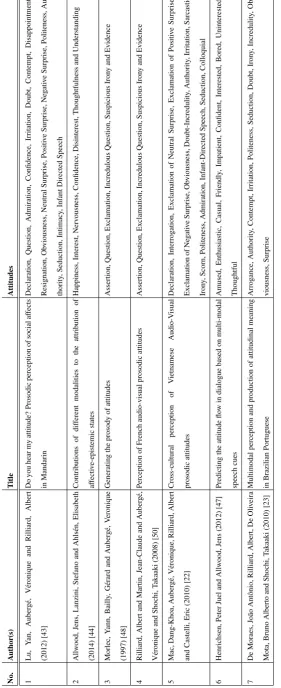
2.2 Attitudes in Past Literature . . . 23
2.3 Modalities used to indicate types of information . . . 24
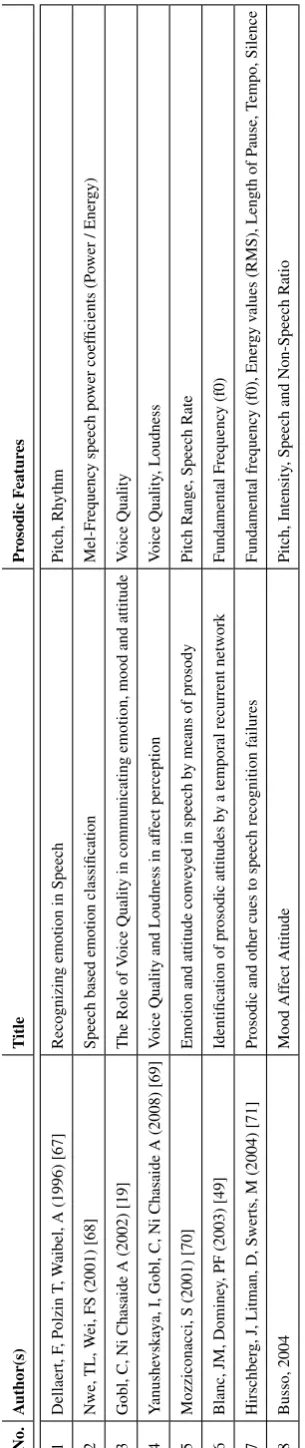
2.4 Applying Prosody in Recognition Systems . . . 27
2.5 Categories for Lip Tracking using ASM . . . 29
2.6 Classification rate per modality from Kessous’ work [92] . . . 32
2.7 Example of MUMIN coding labels . . . 39
3.1 Subset list of Video Information . . . 54
3.2 Summary of Videos per Speaker . . . 55
3.3 Standard A10-based Annotation Scheme . . . 59
3.4 Five Attitude Labels . . . 60
3.5 Segments by Attitude Category . . . 64
3.6 Segments across Speaker . . . 64
3.7 Subset List of Attitude Segments . . . 66
3.8 Percentages of Selection for Each Attitude . . . 74
4.1 Extracted Prosodic Features . . . 87
4.2 Examples of Facial Landmark Labels . . . 93
4.3 Prediction performance of Prosodic features . . . 101
4.4 PC values of prosodic features . . . 105
4.5 Predictive performance of Visual features . . . 107
4.6 PC values of visual features . . . 109
5.1 Concepts for Supervised Learning . . . 122
5.2 Total instances for each attitude label . . . 125
5.3 Mean values for each attitude category with standard deviation in brackets . 127 5.4 Results for the different feature sets. . . 128
5.5 Total instances for each attitude label . . . 130
5.6 Prosodic Mean values for each attitude category with standard deviation in brackets . . . 131
5.7 Performance of the Trained Classifier . . . 133
5.8 Total instances for each attitude label . . . 134
5.9 Performance of Speaker-Independent Classification Task . . . 135
5.10 Precision and Recall per Attitude Class . . . 136
5.11 Confusion Matrix of Attitudes . . . 137
5.12 Result of Visual Prediction . . . 138
5.13 Summary of Experiments . . . 138
A.1 List of videos . . . 168
B.1 List of Attitude Segments . . . 180
1.1 Relationship between Affect and Emotion . . . 3
1.2 Attitude as a Communicative Function . . . 5
1.3 Flowchart for Supervised Machine Learning . . . 9
2.1 Conceptual Framework . . . 43
3.1 Characteristics of Video Blogs . . . 48
3.2 Related Video Bloggers . . . 53
3.3 Details of Audio File Format . . . 57
3.4 Details of Video File Format . . . 58
3.5 Process of Annotation . . . 62
3.6 Description of the A10 and N5 attitude categories . . . 68
3.7 Participant Information . . . 69
3.8 Sections in Online Survey . . . 70
3.9 Example of Attitude Choices in Survey . . . 71
3.10 Example of the 7-point Likert Scale of Certainty . . . 72
3.11 Frequency of Occurrence for Attitude Selection . . . 74
3.12 Barplots for Each Attitude’s Certainty Rate . . . 76
3.13 Barplots for Each “Other” Attitude’s Certainty Rate . . . 78
4.1 Acoustics measurements in the speech spectrum [65] . . . 89
4.2 Facial Landmarks tracked by FaceSDK . . . 92
4.3 Process of Facial Feature Extraction . . . 94
4.4 Feature Selection in Supervised Machine Learning . . . 95
4.5 Average distribution of prosodic features . . . 99
4.6 Boxplot indicating distribution of Pitch . . . 102
4.7 Boxplot indicating Voice Quality distribution . . . 104
4.8 Scatterplot showing PCs for prosodic features . . . 106
4.9 Scatterplot showing PCs for visual features . . . 110
4.10 Distribution of Eyebrows . . . 111
4.11 Agreed answers per modality . . . 113
4.12 Feature selection using Decision Tree . . . 115
5.1 Stages of Experimentation . . . 124
5.2 Facial Tracking with FaceSDK AAM . . . 132
C.1 Showing a vlog script . . . 181
C.2 Related equipment needed . . . 182
C.3 Filming a vlog . . . 182
C.4 Editing raw film footage . . . 183
C.5 Uploading video on YouTube . . . 183
C.6 Publishing video on YouTube . . . 184
D.1 Open related wav file . . . 185
D.2 Configure settings . . . 185
D.3 Insert attitude label . . . 186
D.4 Select related attitude label . . . 186
D.5 Save transcription in directory . . . 187
E.1 Open MP4 video file from directory . . . 189
E.2 Select MP4 video file in relevant directory . . . 190
E.3 Edit on menu bar . . . 190
E.4 Trim tool . . . 190
E.5 Mark start time . . . 191
E.6 Mark end time . . . 191
E.7 Save trimmed video . . . 192
E.8 Save movie . . . 192
H.1 Open AAM software . . . 201
H.2 Select Video . . . 201
H.3 Facial Tracker . . . 202
H.4 Output folder . . . 202
H.5 Rename Output folder . . . 202
Abbreviation Meaning Page
SVM Support Vector Machine 9
RF Random Forest 9
VLOG Video Blog 10
AES Affective-Epistemic States 18
F0 Fundamental Frequency 19
HNR Harmonicity-to-Noise ratio 19 B1 Bandwidth of the First Formant 25 H1 Amplitude of the First Harmonic 26 A1 Amplitude of the First Formant 26 H1-H2 First harmonic relative to the Second Harmonic 26 H1-A3 First harmonic relative to the Third Formant 26 NAQ Normalised Amplitude Quotient 26
ASM Active Shape Model 28
FAC Facial Action Coding system 29 AAM Active Appearance Model 29 DCT Discreet Cosine Transform 30
HMM Hidden Markov Model 30
ANOVA Analysis of Variance 31
HCI Human Computer Interaction 32 wMEI Weighted Motion Energy Images 33
GP Gaussian Process 36
GMM Gaussian Mixture Model 40
LDA Linear Discriminant Analysis 41
Vlogger Video Blogger 47
Hz Hertz 80
dB Decibel 80
SEC Second 80
FMEAN Mean value of the fundamental frequency 80 FMIN Minimum value of the fundamental frequency 80 FMAX Maximum value of the fundamental frequency 80 FPCT Percentage of shape of the pitch contour 80 FVCD Percentage of the vibration of the vocal folds 80 PMEAN Mean value of power/ intensity 80 PMIN Minimum value of the power/ intensity 80 PMAX Maximum value of the power/ intensity 80
PPCT Intensity movement 80
DN Duration 80
PCA Principal Component Analysis 90
PC Principal Components 90
PC1 First Principal Component 97 PC2 Second Principal Component 97 PC6 Sixth Principal Component 97 ASR Automatic Speech Recognition 100
RBF Radial Basis Function 114
Introduction
This dissertation highlights affective expressions as a source of information content in
hu-man communication. The study explores the dynamics of attitudinal expressions conveyed
through several types of non-verbal signals. Attitudinal expressions between communicators
must be understood and displayed appropriately to ensure successful message transfer
dur-ing the communication process. This research further extends understanddur-ing of attitudinal
aspects of expression, not only through the exploration of human perception of attitudes, but
also through the development of automatic attitude recognition which will be of great utility
for automatic understanding of user perception and information retrieval.
This chapter briefly discusses human communication, its different signalling modalities
for communicating content of various types, as well as the role of attitudinal states in the
communicative setting. Further discussion about the meaning of attitudes and their relation,
or non-relation, to affect and emotions is also explored. Several definitions and concepts are
introduced to give a clearer overall view of the methodology involved in the study. The final
part of this chapter explains the research motivation and objectives.
1.1
Human Communication
Research in domains including social psychology, social signal processing and affective
computing has increasingly focused on understanding the dynamics of human
communi-cation. Humans communicate with each other in a number of different modalities and the
interpretation of their utterances may vary from a person to the other. Generally, humans
communicate with each other to share information. Human communication involves a
se-ries of processes and can take place between two or more interlocutors. This sharing of
information is transferred through signals.
Allwood [1] elaborates on the purpose of human communication, which is dissemination
of information. Allwood mentions several types of information involved in the
communica-tion process:
1. physiological states (fatigue and hunger)
2. character, identity, personality (being timid, aggressive)
3. affective-epistemic attitudes (showing joy, friendliness, surprise)
4. factual content giving information about beliefs, assumptions about facts
5. communication management (feedback, turn-taking)
Among the information streams used in communication, one interesting type of information
is the expression of affective-epistemic attitudes. This type of information is useful for
under-standing affective states and emotions of the people involved in the communicative setting.
Emotions, affect and attitudes seem to be similar concepts but there are clear distinctions
between them. Damasio [2] distinguishes between emotion and feelings, stating that
feel-ings refer to the inner, cognitive experience of an emotion while emotion is the observable
response of these feelings. The frequently cited five basic emotions are sadness, anger, fear,
surprise, disgust and happiness [3]. There are certainly other emotional ways of
represent-ing emotional states than the simply categorical, includrepresent-ing valence based representations [4]
but such concepts are not sufficient to describe the complexities of people’s affective states
[5]. A person could express a mixture of sometimes contradictory feelings simultaneously.
job, she expresses first the feeling of happiness and shifts her expression to sadness. Hence,
human emotion, although easily shown, are often complex and confusing to understand or
interpret.
Affect, on the other hand, is considered a general term for the inward feelings of the
human experience. This concept is a broader representation of feelings where emotion
con-tributes to a large part of the overall definition. While Zanna and Rempel [6] refer to affect
as “any thoughts that are infused with strong, weak or no emotion at all”, Shouse [7] claims
that affect has no relation with feelings and emotion. The term affect is sometimes used
interchangeably with emotion. It is believed that there are differences between the two
con-cepts. Emotion refers to the display of feelings while affect is a non-conscious experience.
Affect is a pre-personal experience of the speaker that unconsciously affects the consequent
feelings and actions of the speaker. Hence, affect is viewed as a broad, abstract concept of
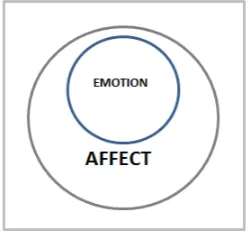
[image:25.595.256.381.405.523.2]the humanly cognitive experience, while emotion refers to the inner feelings of the person.
Figure 1.1 summarizes the relationship between affect and emotion.
Figure 1.1: Relationship between Affect and Emotion
Affect is a general and broader representation of a person’s feelings while emotion is the
displayed response of affect, and thus is incorporated into the affective state of a person.
Recent empirical studies, particularly in the field of Affective Computing, use affect to
refer to affective-epistemic states of humans when interpreted by machines. This use of
affect is a broad term as a point of reference to studies on emotion, attitude and behavioural
states of humans displayed in the communicative setting. This study supports the concept of
attitude as representation of speakers’ affective-epistemic characteristics. Attitude is viewed
differently from concepts of affect and emotion. The following section details attitude as a
1.2
Attitude as a Communicative Function
The previous section explains the differences between affect and emotion. The concept of
attitude is related to affect and emotion, but attitude has distinctive traits. Zanna and Rempel
[6] describe attitude as states that may be expressed as strong emotions or may be identified
solely from the way an individual behaves with an object. Research on the psychology of
attitude finds limited agreement on precise definitions and characteristics of attitude.
Psy-chologists relate attitude with beliefs, opinions, habits and values [8]. Oskamp [8] explains
attitude as having three main components, as shown in Table 1.1:
Components Description
Cognitive Ideas and beliefs of the agent towards the object
Affective (emotional) Feelings and emotions the agent has towards the object
Behavioural The agent’s actions towards the object
Table 1.1: Atittude Components
Fishbein and Ajzen [9] suggest that attitude is mainly associated with the affective
compo-nent. This is believed to be true as these components are independent and separate entities
but are still interrelated. The affective component of attitude is an object of interest to
sev-eral fields of research including psychology, economics, and marketing. However, some
researchers use the term attitude loosely and often interchangeably with affect or emotion.
In this study, these concepts, although similar, are treated independently. Attitude is of
particular interest for this study as it represents observable traits of speaker’s cognitive
ex-perience. Attitude refers to actions, outer representation of feelings, while emotion refers to
inner feelings that are difficult to evaluate. Attitude is believed to be a pragmatic concept
for the understanding of affect and emotions [10]. This interpretation of emotional states
involves the crucial aspect of intended, voluntary and controlled actions. Auberge [10]
Figure 1.2: Attitude as a Communicative Function
Figure 1.2 shows attitudinal functions as a component for communication. The scale
indi-cates emotional functions to be at the far left of the control scale while linguistic functions
are on the far right. Attitudinal function is in the middle of the control scale. This means
that attitudes, unlike emotions, are not vague and involuntarily expressed. Rather values of
speaker intention are expressed in a conscious, controlled and voluntary manner.
The definition of attitude may or may not have a strong emotional component but always
has an evaluative component. In fact, attitude and emotion can be seen as a continuum, a
degree of emotional involvement in attitudes. Emotion, conversely, need not have a strong
at-titudinal - i.e. evaluative - component. This is because emotions are not necessarily directed
towards any particular content, that is, you can be happy or sad (for example) without being
able to identify why. Additionally, emotions can be internal and less susceptible to
con-scious control. Whereas attitudes are held more concon-sciously, often deliberately expressed (in
language), and subject to control in the sense of reflective evaluation.
Emotion and attitude are conceptually distinct, but interact with one another in reality.
Attitudes always have an element of evaluation. Oskamp [8] has identified three components
of attitude; cognitive, affective/emotional and behavioural. In this thesis I am concerned
with the overt expression of attitude, which I take to be evidence of the first two, internal,
components, i.e., the cognitive and affective/emotional states of the speaker. Under one
understanding of the term attitude, attitudes can be entirely internal, comprising the cognitive
and affective states, but never overtly expressed. For the purposes of this research, the focus
is on attitudes as overtly displayed. Therefore, when I use the term attitude, it will frequently
1.3
Multimodal Communication
Attitude is expressed in the content of communication through several different channels
or modalities. Multimodal communication is defined as “activation, sharing and
co-construction of information simultaneously and subsequently through several modes of
per-ception and production” [11]. This concept adds to the concepts of communication with the
sharing of information as its main function. However, multimodal communication involves
several modes of information sharing using simultaneous sensory channels. These include
sight, hearing, touch, smell and taste. Multimodal communication involves two main
pro-cesses; firstly multimodal integration (perceiving information based on several modalities)
and multimodal distribution (producing information using multimodalities). This is similar
to the traditional communicative process, where both communicative agents perceive
in-formation and produce feedback. The difference is that there is emphasis on simultaneous
sensory modalities.
Multimodal communication has become an important research area as humans perceive
and produce communicative expressions through several modalities. A combination of speech,
visuals and gesture facilitates communicators to meet their communicative goal of
informa-tion sharing. As meninforma-tioned in Secinforma-tion 1.1, the contents of informainforma-tion include
affective-epistemic attitudes. The simultaneous use of multimodal signals facilitates expression of
attitudes. Due to the complexities of affective attitudes, the use of more than one sensory
modality is beneficial to better understand and interpret attitudes. For example, a person
can perceive a friend’s expression of friendliness through rising tone of voice, display of a
smile and the wave of a hand. Simultaneous use of speech, facial expressions and gestures
facilitates the communicators’ message transmission.
1.3.1
Multimodalities as Signals in Communication
Numerous studies suggest the relation between display of affective states and non-verbal
gestures [12] [13] [14] [15]. Vinciarelli and Valente [16] refer to non-verbal
communica-tion as the transmission of a message through non-verbal behavioural cues, such as facial
expressions, vocalisations, gesture and posture. Non-verbal communication relays speakers’
expresses approval when her child voluntarily makes the bed by establishing eye contact
with the child, praising her with a rising tone and giving a bright smile. In another scenario,
the mother tries not to show disapproval when the child throws a tantrum by speaking with
a level or falling tone and controlling her facial expressions from showing contempt. This
example shows how people communicate feelings and intentions through the dynamics of
several and simultaneous non-verbal signals.
With the emergence of the body of knowledge of Social Signal Processing, the role of this
area is to firstly provide physical quantification and synthesis of non-verbal signals through
which the affective behaviour of humans are expressed, and, secondly, to implement
non-verbal signals in conversational agents [12]. This area is especially interesting as multimodal
traits of humans are quantified through development of recognisers and synthesisers. This
study aims to evaluate and measure communicative contents, in particular attitudinal
rep-resentation of speakers. The outcome can be helpful in facilitating better understanding of
relationships in human-human and human-computer interaction.
1.4
Multimodal Affective Systems
One method of quantifying attitudinal states of speakers through multimodal signals is by
applying machine-learning methods. Research in the fields of affective computing, speech
technology and human-computer interaction employs machine-learning techniques. There
are numerous studies conducted in emotion recognition based on analysis of sentiment [17]
[18], prosody [19], facial features [15], gestures [20] and posture [21]. Multimodality (using
combination of signals) is also studied in great detail in emotion recognition. However,
when a distinct separation of terminology between emotions and attitudes is made, there is
little research conducted on automatic attitude recognition. Although there are some notable
studies on prosodic attitudes [22] [23][24], research in automatic classification of attitudes
using multimodal signals is still scarce.
In this century, there is growing interest in social media as a rich source of human
ex-pression. People from different areas of study, including sociolinguistics, psychology,
af-fective computing and human-computer interaction conduct studies using data from social
online blogs [25] [26] [27]. Researchers are also interestered in the social activity of
micro-blogging on Facebook [28] [29]. Other empirical studies involve research in online search
engines [30] [31], Twitter [32] [33] and YouTube [34] [35] [36]. Through conceptual and
empirical research, it is evident that social media offers a rich source of social discovery and
scientific application. Similarly, open access to instances of human behaviour, in particular,
attitude expressions, from social media users shows a dynamic social representation worthy
of exploration and understanding.
1.4.1
Use of Machine Learning Techniques
Machine learning is used in the area of Artificial Intelligence to enable computers to learn
without being explicitly programmed. The learning takes place through observations of new
data, hence the outcome of this implementation is a system that enables automatic
classi-fication of the learned data. Essentially, there are several methods of machine learning –
supervised, semi-supervised and unsupervised learning. Supervised learning involves the
task of training a dataset that has a group of features and object labels. The machine is
con-structed to predict and identify the label of an object given the set of features. Unsupervised
learning however functions without the identification of labels. Instead, labels are derived
based on the training of the dataset given by the features provided.
Classification in supervised learning is used to predict categorical labels given a set of
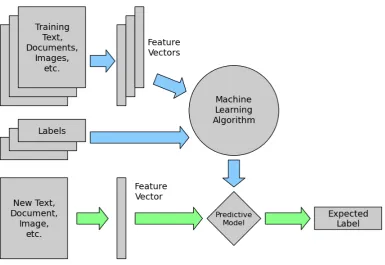
observations. Figure 1.3 [37] illustrates the work flow of building a classification model
Figure 1.3: Flowchart for Supervised Machine Learning
Figure 1.3 generally describes the processes involved in developing a predictive model using
a supervised machine learning method. Following this training process, a predictive model
is derived and will produce expected labels.
There are several learning algorithms developed for machine learning classification tasks.
One popular method of implementation is the use of statistical learning algorithms [38]. This
study adopts this method by using Support Vector Machine (SVM) and Random Forest (RF)
1.5
Conceptual Definitions
This section addresses conceptual definitions used in this thesis. The list describes definitions
for the following terminologies:
1. Annotation: Annotation is a metadata that is associated to another data by
comment-ing and notcomment-ing. In this study, annotation involves the act of assigncomment-ing attitude labels
on relevant parts of the video blogs. Annotation of attitude states creates another set
of data comprising of only video segments that are annotated with an attitude label.
2. Attitude Expression: Attitude refers to pragmatic interpretations of emotion [10].
The expression of attitudes are socio-affective states of speakers expressed in voluntary
and controlled settings.
3. Machine-Learning: Machine-learning is an area of study in Artificial Intelligence
where automatic algorithms are constructed to allow learning and prediction of
com-puters from the given data.
4. Prosody: Prosody refers to the suprasegmentals in the voice. The use of prosody in
this study covers aspects of fundamental frequency and pitch contours, intensity of the
voice, voice quality and duration of speech segments.
5. Visual: Visual refers to facial observations from videos used in this study. This
refer-ence to visual features includes movement of the eyes and other facial expressions of
the speaker’s face.
6. Vlog: Vlog is an abbreviated term for video blog. This abbreviation is used in this
research to refer to YouTube videos of speakers where they share stories of daily life
1.6
Motivation
There has been much work in the fields of Social Signal Processing and Affective
Comput-ing in developComput-ing recognisers for affective states of speakers through multimodal signals.
Human beings can detect differences in affective expressions using data gathered through
their eyes and ears. Machines can also do the same using information recorded by cameras
and microphones. So by physically capturing and then analysing affective states of speakers,
researchers are able to understand human behaviour through concrete displays of affective
expressions. Treating attitude as dissimilar to affect and emotion, the development of an
attitude recognition system through the means of multimodal signals is an interesting step
forward towards understanding human behaviour. Apart from that, development of automatic
recognisers has two main purposes:
FirstAutomatic information retrieval and categorisation. Recognition systems are used to
index and retrieve information from metadata or other forms of media. Collection of
in-formation obtained from these systems enables other systems to implement this source of
information for affective modelling.
SecondApplications for human-machine interaction. This system could be applied to
arti-ficial communicative agents such as social robots for technological advancement.
Commu-nicative content can be interpreted by an automatic system and used to inform the behaviour
to robots or avatars. This is useful to then develop socially intelligent robots that understand
and respond appropriately to humans.
This study aims to contribute to the first purpose of developing automatic recognition
systems. Communicative content, in particular, affective information is useful to be
em-bedded into systems for information retrieval and categorisation. This creates a source for
people to retrieve information on attitude expressions during speech.
Attitude expressions are especially prevalent in social media where people find comfort
and openness in expressing themselves better than in face-to-face communication. One
ad-vantage of social media is the ease of public access. This allows researchers to investigate
human behaviours, particularly affective expressions from a dynamic source. YouTube, for
example, allows public access for people to share videos about their daily life. This rich
human behaviour. Treating these videos as representations of people’s attitude expressions
makes the collection of this corpus interesting for development of an attitude recognition
system that could be applicable to other areas of study.
1.7
Statement of Problem
To the best of my knowledge, little research has so far been conducted in the area of
auto-matic attitude recognition, particularly in exploiting social media corpus such as YouTube
video blogs to understand multimodal expressions of humans. This study introduces the
con-cept of attitudes as an evaluative representation of human social experience through
sponta-neous talk in vlog speech. Following that, internalising attitude states in a computer system
for artificial intelligence also contributes to this study’s major work by applying multimodal
signals into the recognition system.
1.8
Research Objectives
The main objective of this research is to develop an automatic attitude recognition system
for information retrieval and categorisation. To achieve this, the following objectives are
defined:
Objective 1Collection of a corpus that represents attitude expressions. Expressions of
atti-tudes are observed and investigated from social media. The use of social media is essential
as they provide dynamic and rich multimodal signals that include speech, facial expressions
and gestures to indicate speakers’ attitude expressions. This study annotates and segments
five attitude expressions from vlogs in YouTube.
Objective 2 Investigation of the use of multimodal features as contributors to developing a
reliable attitude recognition system. Relevant prosodic and visual features are extracted and
analysed. Subsequently, specific prosodic and visual features are selected and examined to
understand their contribution towards the classification model.
Objective 3Development of a reliable automatic attitude recognition system. This research
highlights the development of an attitude recognition system that can predict different
attitude expressions through multimodal signals, namely prosodic and visual features.
Su-pervised machine learning is conducted using Support Vector Machines (SVM) and Random
Forests (RF).
1.9
Detailed Outline
This thesis is divided into six main chapters which are listed below:
Chapter 1Discussion of general concepts of human communication and multimodalities in
affective expression of attitudes. This chapter also outlines research motivation, statement
of problems and three main research objectives for the present study. Conceptual definitions
used in this thesis are also listed in this chapter.
Chapter 2Elaboration of discussion and criticisms of theories of attitudes, multimodalities
and use of social media for understanding human communication. This chapter also outlines
some of the recent works in the study of automatic recognition through multimodalities using
machine learning techniques.
Chapter 3Discussion of a collection of the vlog corpus. Vlogs are collected from an online
video sharing website, YouTube. An ontology of attitude annotation scheme is introduced in
this chapter. The processes of collection, annotation and segmentation of attitude states of
speakers are described in detail.
Chapter 4Discussion of the processes involved in developing an automatic attitude
classifi-cation system. This process involves steps for multimodal feature extraction, from prosodic
and visual means. The second part of the chapter discusses processes of feature selection.
This section highlights prominent prosodic and visual features that provide greatest
contri-bution to the classification system in recognising different attitudinal states of speakers.
Chapter 5Supervised machine-learning techniques and results on building a reliable attitude
classification system. A total of three experiments are reported:
a)development of an attitude classification system through prosodic modality
b)use of prosodic and visual modalities to develop an automatic attitude classification model
c)improved use of multimodal feature sets for improving the classifier
Chapter 6Statement of general conclusions, research limitations, suggestions for
State of the Art
This dissertation focuses on developing an attitude recognition system for the purpose of
classification and retrieval of human attitudes from video recordings. Prior to more elaborate
discussion, this chapter presents the state-of-the-art from related literature addressing the
notion of attitude, its relevance to multimodal and novel forms of media, and recent
applica-tions in recognition interfaces. The present work adopts some of the conceptual frameworks
and methods used from past literature to address the research goals. This chapter begins
with a description of related literature concerning attitude definitions and their relation to
communicative content.
2.1
Communicative Content
As we have noted, Allwood [1] sees the exchange of information between communicators.
We will now explore the five types of communicative information that he identifies (repeated
here for convenience):
1. Physiological states
2. Character, Identity and Personality
3. Affective-Epistemic Attitudes
4. Factual Contents
5. Communication / Feedback Management
Physiological states are expressed in the communicative setting, and these include fatigue
and hunger. The character of a person is also communicated in speech, examples include the
aggressiveness and openness of an individual. Affective-epistemic attitudes refer to the
af-fective or emotive state of the speaker: for instance friendliness, joy and surprise. Examples
of factual content include information about beliefs, theories and assumptions, while
com-munication management consists of turn-taking, sequences of feedback and topic change
[1]. Another aspect of communicative content that is relevant to the present work in this
thesis is Affective-Epistemic Attitudes. This content is essential for the communicative
pro-cess during information transfer. The next section describes relevant literature relating to
attitudes.
2.1.1
Attitude - Definition
Communicative content during communication involves several types of information. One
crucial source of information, as mentioned by Allwood [1] is the affective-epistemic
atti-tudinal states of communicators. To better understand the communicative process as well
as the modes of interaction, it is essential to first understand the role that attitudes have [1].
In the literature, attitudes are interchangeably related to affect and emotions. However, this
thesis identifies attitudes as a distinctive term and this is described through the definition and
components of attitudes.
Malhotra [39] states distinctions between affect and attitude, which agrees with Ajzen
that attitude refers to summary evaluations of an object or behaviour [9] [40]. Bargh and
Chartrand explain attitude as being judgments that are outcomes of spontaneous and
uncon-scious effort [41]. They claim that attitude can be automatically activated without any prior
goals of judgment [41]. This perspective, however, is not supported by Auberge [10] who
views attitude as driven by intention, voluntary and controlled action. Auberge describes
a continuum (see Figure 1.2) of controlled expression of affect where emotion is regarded
as an inward and involuntary cognitive experience. Attitude is pragmatic representations of
emotions, voluntary and controlled expressions of the cognitive state while linguistic
func-tion is the linguistic means of affective expression. Hence, attitude stems from a pragmatic
The definition of attitude relates to three dimensions: cognitive, affective and behavioural
[8]. All three components constitute the definition of attitude, where attitude is built on the
assumption towards an object and the reaction of the communicator through affective and
be-havioural judgments of the said assumption. Agarwal and Malhotra [42] conducted a study
on cognitive and affective components of attitude. The study involved public opinion of use
of sneakers among selected undergraduate students. A self-administered questionnaire was
distributed to participants to understand their choice of sneakers as well as their mood states
prior to the test. Results from the study proposed a model for a multidimensional method
of assessing opinions and affective states of participants to better understand participant
atti-tude. Their work provides insight to the depiction of multiple dimensions that define attitude,
namely cognitive, affective and behavioural components and their correspondence with each
other.
It is inevitable to regard cognitive and behavioural components as important in defining
attitude. However, assumptions, beliefs and opinions: features of cognitive and behavioural
attitudinal components, involve personal states of the being. Affective attitudes are highly
related to reactions triggered by the communicative process between communicators. They
are components existing in both intrapersonal and interpersonal settings. To better
under-stand the concept of affective attitudes, the next section briefs on the related literature of
affective attitudes.
2.1.2
Affective Attitudes
Yan et al. [43] conducted a study on perception of attitudes among Chinese subjects. They
regard attitudes as social affects which are expressed outwardly in controlled settings. They
define attitudes with elements of beliefs and opinions (whether intended or not) within social
settings. The study discusses results of a perception test for the recognition of the selected
attitudes. In their classification of social affect, there are three main groups comprising
attitudes, social parameters and social context. The corpus contains recordings of a female
Chinese speaker speaking 399 utterances using 19 attitudes. These attitudes are shown in
Attitudes
Declaration Question Admiration Irony
Confidence Irritation Doubt Contempt
Disappointment Resignation Obviousness Neutral Surprise
Positive Surprise Negative Surprise Politeness Authority
Seduction Intimacy Infant Directed Speech
-Table 2.1: 19 affective attitudes
The perception test was given to 30 native Mandarin Chinese listeners who were asked to
recognise different attitudes in the corpus. The results show that all participants were able
to recognise all the proposed attitudes except for Confidence. They extended the study to a
clustering analysis of attitudes. Declaration, was mostly confused with Confidence and
Po-liteness. Resignation and Disappointment were also confused between the two. The strength
of this study is the validation of attitude states through a perception test. Finding 19
atti-tudes to be quite elaborate, they conducted cluster analysis to identify which attiatti-tudes were
distinctive or confused the most. In addition, the definition of attitudes as social affects as
explained in this study is relevant to this research.
Allwood et al. [44] conducted a similar study on attitude perception through audio-visual
modalities. In this work, they attributed attitudes as affective-epistemic states (AES). The
definition of AES is defined from their previous work [45], which refers to “internal states
that simultaneously involve cognition, perception and emotion”. This includes affective
epis-temic attitudes such as boredom and surprise. Similarly, Allwood et al. conducted a
percep-tion test to validate these AES using multimodal stimuli. The study involved 12 Swedish
participants who were presented with recordings from the NOMCO First Encounter Corpus
[46] which contained gestures annotated according to an adapted version of the MUMIN
an-notation scheme. Participants were shown a 2-minute long clip of the corpus and they were
asked to choose any words that describe both affective-epistemic and behavioural states.
Re-sults from semantic analysis led to seven types of AES: happiness, interest, nervousness,
confidence, disinterest, thoughtfulness and understanding. The audio-visual modality shows
most attributions for nervousness, interest and thoughtfulness. Interesting findings from this
study suggest that the expression of an AES may be conflicting or complementing according
to different modalities. For example, happiness is expressed best through the audio modality
complex to perceive [44].
Treating attitudes as a generic terminology, Henrichsen and Allwood [47] used a standard
10-attitude set for prosodic analysis in the NOMCO corpus [46]. They conducted prosodic
analysis on a selection of the 10 attitudes for the preparation of machine-learning methods.
This work, however, focuses attention on attitude annotation and subsequent development
of a standard attitude annotation scheme. Annotators of the corpus chose attitude labels and
439 attitude events were labelled. Further analysis resulted in a reduced number of attitude
labels that show rich representation of the corpus. The ten attitudes are: Interested, Friendly,
Casual, Bored, Thoughtful, Confident, Amused, Enthusiastic, Uninterested and Impatient.
Using these attitude labels as predictors, machine-learning was conducted using prosodic
features, in particular fundamental frequency (f0), Intensity and Harmonicity-to-Noise Ratio
(HNR). Results show that prosodic signals provide faster and better information in predicting
different attitudes. The strength of this work is its development of a simple and standard
attitude annotation scheme that is useful for researchers to exploit in machine-learning and
empirical research.
2.1.3
Prosodic Attitudes
Recent studies in social signal processing build upon the definition of attitudes as a source
of information in the communicative process. The use of speech, in particular, prosody as a
signal for social actions has close congruity with attitudes [48][49] [50] [22].
Morlec et al. [48] highlight prosodic attitudes with reference to the expression of what
people feel (attitudes) using intonation (part of prosody). They suggest that attitudes have
strong correspondence to the prosodic conditions of the person. This work makes clear
dis-tinctions from cognitive and lexicon-based approaches to measuring attitudes. Their study
introduced six attitudes expressed in French from the inter-perceptual-center group (IPCG)
[51] melodic curve corpus. The corpus consisted of 322 utterances for each of the six
atti-tudes – Assertion, Question, Exclamation, Incredulous Question, Suspicious Irony and
Evi-dence. They conducted a perception study among 20 participants to validate the six attitudes
using training and testing sentence module. Results suggest that there exist confusions
from that, production of synthetic sentences using statistical evaluations performed slightly
lower than natural production of utterances. This initial study on prosodic attitudes makes a
compelling case for bringing a standard definition of attitudes from prosodic perspectives.
Rilliard et al. [50] conducted a study concerning perception of prosodic attitudes through
audio-visual modalities. Extending work on the six prosodic attitudes developed by Morlec
et al. [48], they included audio-visual recording of the six attitudes from two French
speak-ers. They were asked to speak three sentences with a 5-syllable length for each of the six
attitudes. They further conducted a perception test that presented different modalities to 32
French listeners. Results from the perception test show that listeners were able to
recog-nise different attitudes better by the first speaker than the second speaker. Audio-visual
modality also proved most helpful for listeners to identify these prosodic attitudes,
particu-larly Obviousness and Suspicious Irony. The interesting part of this study is that they
con-ducted a cluster analysis to understand confusions between these 6 attitudes, despite attaining
good recognition rates for each attitude. From analysis, they found that Doubt-Incredulity
and Surprise-Exclamation were confused in the audio modality, while Question and
Doubt-Incredulity were confused when presented in video stimuli. For the audio-video stimuli,
video helps in distinguishing Exclamation from Doubt-Incredulity. This work is helpful in
providing clear distinctions between the six prosodic attitudes by conducting a perception
study and cluster analysis through different modes of stimuli.
A similar study was conducted on prosodic attitudes in cross-cultural settings. Mac et al.
[22] define prosodic attitudes as a person’s speech relaying opinions about the interlocutor.
They conducted a cross-cultural perceptual study on audio-visual attitudes from Vietnamese
participants. A total of 20 Vietnamese and 20 French listeners were involved with the
listen-ing experiment. This test required participants to listen and watch recordlisten-ings in audio, video
and audio-visual modalities of 16 Vietnamese attitudinal expressions produced by one native
speaker from Hanoi. Results suggested mixed performance of native and non-native
speak-ers of Vietnamese. Both participants performed best in perceiving different attitudes through
audio-visual means. French participants performed best in understanding Authority and
Irri-tation attitude classes through the audio modality while native Vietnamese participants were
through audio modality. Through clustering analysis, French participants performed better
than the native participants in perceiving Admiration attitude.
This research agrees with the definition of prosodic attitudes as socio-affective states of
speakers. Attitudes are affective states expressed in social settings. However, the essence of
prosodic attitudes is their close connection to prosody, particularly when it involves
linguis-tic (phonological) differences between different languages and cultures. These attitudes are
derived based on melodic curves of the utterances. In creating an attitude recognition where
multimodal signals including prosody is applied, this study focuses attention to treating
atti-tudes as socio-affective states in simpler terminology. Despite differences in the aspects of
terminology, this research supports the works of Henrichsen and Allwood [47] in its simpler
and standard version of attitude definition within a larger realm of signaling, which does not
merely involve speech and prosody, but also other aspects of multimodalities.
Recognition of attitudinal states is not always universally perceived and understood [43]
[22]. Several factors influence people’s perception of attitudinal states such as age and
gen-der. Research in emotion recognition (considered equivalent to attitude recognition) shows
the influence of age and gender in recognising different emotion states. Orgeta and Phillips
[52] conducted analysis on age effects for emotion recognition. Forty undergraduate
partici-pants aged between 17 to 37 and 40 community dwellers above 61 years old participated in
the study. Participants were presented with images indicating six basic emotions and based
on the facial stimuli, they were required to attribute the image to the emotion. Results found
that young participants were able to identify sadness better than the older group. A notable
observation from this study is that age contributes to differences in emotion recognition
al-though results from both groups do not show a vast difference. Young people show slightly
higher ability to identify emotion faster and more accurately than older people.
This hypothesis is supported by Di Domenico et al.[53]. They conducted a similar study
on positive and negative emotion recognition among two groups of participants with
vary-ing age range. Forty young and forty older participants were required to recognise different
emotional states based on 10 videos. They had to indicate positive and negative emotions
when watching the videos. Results show that the older group recognised the happy or
difference in age contributes to the recognition of emotions.
Hall and Matsumoto [54] conducted a study on gender variations in perceiving emotions.
They conducted two related studies on gender variation between 69 male and 27 female
par-ticipants, who were required to view facial expressions for 10 seconds and rate the indicated
emotion based on seven types of emotions. Findings show that women provided varying
emotions compared to the male participants. This indicates that women are more
success-ful in identifying different types of emotions. The second study involved a larger group of
participants, consisting 126 male and 237 female students. They were presented with
video-tapes from the JACBART corpus [55], where a 1 second emotion expression was included in
the speaker’s neutral face. Analysis found similar results from the first study, where women
performed better than men in recognising different emotions through non-verbal signals.
This work is helpful to better understand gender differences in perceiving affective states
of speakers when presented with non-verbal conditions. To provide a concise overview of
2.2
Multimodal Expression
People communicate through dynamic means of multimodal signals [56] [57] [58].
Multi-modal expression puts emphasis on the fusion of different sensory channels in expressing
different types of communicative content. Multimodal signals are used in both perception
and production of communicative content. Allwood [56] suggests that communicators utilise
speech and different bodily gestures as modes of production and make use of hearing and
vision modalities for perception of communicative content. He further observes different
modalities used by communicators according to different types of information. These types
of information are listed in Table 2.3:
Type of Information Modality
Emotions and Attitudes Prosody, Gesture
Illustrations Iconic or Conventional Gesture
Feedback Content, Gesture
Table 2.3: Modalities used to indicate types of information
Table 2.3 illustrates relations between modalities used for different purposes of
infor-mation sharing. Attitudes are best expressed using prosodic and facial gestures or head
movements. Sharing an illustrated type of information, iconic gestures such as hand
point-ing makes the delivery livelier and engagpoint-ing [56]. Interactive communication management
involves the use of verbal (i.e., lexical and syntactic), prosodic and gestural modes to seek
feedback from the interlocutor. The combination of verbal and non-verbal signals is central
to face-to-face communication [56].
The current study adopts Allwood’s notion of multimodal expression particularly in
shar-ing affective or attitudinal information. Attitudes are best perceived through prosodic and
vi-sual signals. The following sections address related literature pertaining to prosodic, vivi-sual
2.2.1
Prosodic Signals
Prosodic information in speech is integral for delivery of different communicative contents
[56] [59] [60]. Nooteboom [61] refers to prosody as the melody of speech that is derived
from non-segmental phonemes within an utterance. As Laver [62] and Roach [63] mention,
prosody, also referred to as a part of suprasegmentals, contains four main components: pitch,
loudness, duration and articulatory quality.
Pitch refers to the perceptual concept of melodic movement of the voice [62]. The
acous-tic and measurable equivalent is fundamental frequency [62] [47]. Changes in pitch give
indications of changes to speaker’s different attitudinal states. Roach [60] develops a model
for attitudinal change according to changes in speaker’s tone of the voice. The fall tone
indi-cates an attitudinal state of finality and certainty while the rise tone indiindi-cates a questioning
state in the speaker. A fall-rise tone indicates uncertainty or doubt while rise-fall indicates
the state of surprise or being impressed. Henrichsen and Allwood [47] conducted a study
on attitude labels and applied fundamental frequency as one of the parameters for machine
learning applications. Results found fundamental frequency, a measurement unit for pitch,
is essential for understanding the role of attitudes in the communicative setting.
Laukka et al. [64] conducted a study on the relationship between vocal expressions
and emotion. By means of vocal expressions including vocal intensity or loudness of the
speaker’s voice, emotive states of speakers were identified. Actors expressed seven different
emotions and 30 listeners involved in this study were required to recognise the emotions.
These emotional dimensions were activation, valence, potency and intensity. Analysis of
vocal cues particularly in vocal intensity of the voice showed that listeners were able to
recognise positive valence when the intensity of the voice is low. The study shows that
activation, potency and emotion intensity are indicated through high intensity rate.
Hanson and Chuang [65] conducted a study on glottal characteristics of male
speak-ers. This work provides knowledge on the influence of voice quality in recognising speaker
characteristics. They analysed the voice quality of 21 adult male speakers and compared
results with previous work on female glottal characteristics. They introduced a theoretical
measurement of voice quality through speech waveforms and spectrum. Their voice
harmonic relative to the second harmonic (H1-H2), amplitude of the first harmonic (H1)
relative to the first-formant prominence in the spectral domain (A1) and the first harmonic
relative to the third-formant spectral peak (H1-A3). Male speakers were required to speak
one sentence in a normal tone. The sentences were repeated using three different vowels
and participants needed to repeat the same sentence three times using these three vowels.
Results showed that there are significant differences in glottal characteristics in H1-H2 and
H1-A3. What this shows is that changes in spectral tilt correlate with perceived voice quality
and contribute to gender variations. This finding based on changes in spectral tilts and open
quotients is relevant for acoustic measurement of speaker’s voice quality.
Campbell and Mokthari [66] propose voice quality as a prosodic dimension by measuring
breathiness through Normalised Amplitude Quotient (NAQ). They measured glottal
phona-tion of one female Japanese speaker, uttering over 13,000 utterances. Speaking styles (polite,
friendly and casual) and speech acts (exclamations, giving information, requesting
informa-tion, muttering and requesting repeats) of the female speaker with groups of interlocutors
(child, family, friends, others, self) were annotated by labellers. Results showed that voice
quality shows significant differences according to the speech acts and speaking styles. This
work contributes to the belief that voice quality features should be regarded as a prosodic
characteristic.
Crystal [59] and Roach [63] support an integrated analysis paradigm combining
differ-ent prosodic characteristics such as pitch, intensity, voice quality and other vocal features
when measuring speaker’s overall vocal activity. This is helpful for applications of prosodic
characteristics in measuring attitudinal states of speakers. Table 2.4 summarizes relevant
literature on applications of prosodic parameters (fundamental frequency, power, / energy,
2.2.2
Visual and Facial Signals
Non-verbal behaviour consisting of expressions of visual activity, influences content
de-livery during the communicative process [72] [73]. Ekman [72], one of the pioneers of
emotive facial expression research suggests the notion of the face as an indication of a
per-son’s emotional state. Scherer [73] further states various functions of non-verbal features.
Emotions (used interchangeably with attitudes), categorised under the pragmatic function of
non-verbal signals, are indicated determinately by the face, and assisted with hand gestures,
posture, gaze patterns and other bodily movements. In point of fact, Luettin and Thacker
[74] state that not only does visual information facilitate acoustic signals for speech
produc-tion, it accommodates information in noisy settings, a situation that is difficult to capture by
merely using acoustic signals which are determinately more sensitive to noise.
Much research in facial recognition highlights individual facial contours to recognise
different communicative contents [75] [76] [77] [74]. Sadro et al. [77] conducted a study
on the role of eyebrows in face detection. A collection of still images of celebrities was
shown to 18 participants of the study. These images were manipulated to show eyes only or
eyebrows only. Participants were required to identify the celebrities based on name or other
form of identification. The results showed that the percentage of recognition without eyes
or without eyebrows significantly dropped. However, recognition error was most notable for
the no-eyebrow stimuli. This work supports its hypothesis that eyebrows play a major role in
detecting faces. Although the work of Sadro et.al [77] focuses mainly on face identification,
the present study (highlighting attitudinal states of speakers) aims to examine the role of
eyebrows and other features that contribute most to attitude identification.
Luettin and Thacker [74] postulate a model for speechreading using visual information.
They believe that the lip contour, particularly the inner lips, provides most visual information.
To test their theory, they test their algorithm for lip tracking using the Active Shape Model
(ASM), developed by Cootes et al. [78]. Samples for training data consisted of a subset of
the Tulips 1 database [79] containing 96 images of 12 speakers. From the sample data, they
Category Position of Lip Contour
Good One quarter of the lip thickness deviation
Adequate One quarter and half the lip thickness deviation
Miss Out of lip contour
Table 2.5: Categories for Lip Tracking using ASM
Findings from this work show that the Good category for lip tracking achieved slightly 98%.
This serves as a reliable model for tracking of lips, particularly for the purpose of
speechread-ing. The use of the ASM approach provides insight for automatic tracking of individual (in
this case, the lips) visual features for recognition systems [80].
Shifting from studies that focus on individual facial features, research in facial
recogni-tion develops models for face recognirecogni-tion paying particular attenrecogni-tion to detecting multiple
facial features. Ekman and Friesen [81] postulated the Facial Action Coding system (FAC)
for the purpose of classifying facial activity. This system provides a grammar for describing
facial expressions of emotional meaning [82]. However, Ekman and Friesen developed this
model not only to cater for emotion detection based on facial movements, but as a
compre-hensive model that can be implemented for any study on facial behaviour [81]. Numerous
studies applied the FAC model in quantitative studies of facial behaviour. For instance,
Bartlett et al. [82] extended the study on FAC by developing a fully automated facial
recog-nition system in spontaneous settings. They selected two datasets, the first dataset from
the DFAT-504 database [83] which consists of videos of 100 students displaying 27
differ-ent facial expressions, with initial neutral faces. The second dataset involved videos of 24
participants displaying facial actions annotated by FAC experts. Analysis revealed a 91%
agreement between the system (trained with Support Vector machine) and the human FAC
labels. The strength of this work is evident in a successful agreement rate achieved through
machine learning methods.
Another notable model for multiple visual feature detection is an extension of the Active
Shape Model (ASM), called Active Appearance Model (AAM). As previously mentioned,
ASM highlights visual feature tracking using the statistical model of shape in the facial
regions [78] [80]. AAM, an extended work of Cootes et al. [84] is a model-based approach
which postulates a robust and fast matching of not only the shape but texture or appearance
of ASM and AAM for facial detection. The experiment involved two sets of data, the first
dataset includes 400 face images with 133 points, while the second data consists of 72 MR
brain images with 133 marked points. Results from this work suggest that AAM worked best
in the face data due to minimal texture errors while ASM performed best in localised regions
of the facial contour, as is evident in brain images from the second dataset. The AAM is
robust because it combines a larger capture region which subsequently tackles not only the
shape, but the texture of grey-scale images. The ASM is useful for image interpretation
because it concentrates on the localised region or shape of the object, by which the model
<
![Table 2.6: Classification rate per modality from Kessous’ work [92]](https://thumb-us.123doks.com/thumbv2/123dok_us/999137.614453/54.595.178.376.555.633/table-classication-rate-modality-kessous-work.webp)