ePrints Soton
Copyright © and Moral Rights for this thesis are retained by the author and/or other
copyright owners. A copy can be downloaded for personal non-commercial
research or study, without prior permission or charge. This thesis cannot be
reproduced or quoted extensively from without first obtaining permission in writing
from the copyright holder/s. The content must not be changed in any way or sold
commercially in any format or medium without the formal permission of the
copyright holders.
When referring to this work, full bibliographic details including the author, title,
awarding institution and date of the thesis must be given e.g.
AUTHOR (year of submission) "Full thesis title", University of Southampton, name
of the University School or Department, PhD Thesis, pagination
FACULTY OF ENGINEERING AND APPLIED SCIENCE
School of Electronics and Computer Science
DDLS: Extending Open Hypermedia Systems into Peer-to-Peer
Environments
by
Jing Zhou
Thesis for the degree of Doctor of Philosophy
ABSTRACT
FACULTY OF ENGINEERING AND APPLIED SCIENCE SCHOOL OF ELECTRONICS AND COMPUTER SCIENCE
Doctor of Philosophy
DDLS: EXTENDING OPEN HYPERMEDIA SYSTEMS INTO PEER-TO-PEER ENVIRONMENTS
by Jing Zhou
Peer-to-peer (P2P) computing is primarily characterised by decentralisation, scalability, anonymity, self-organisation and ad hoc connectivity. It attracted considerable attention in open hypermedia research due to its potential for supporting collaboration among a community of people sharing similar knowledge background. The aim of this re-search is to investigate the feasibility and potential benefits of incorporating the P2P paradigm in open hypermedia systems to support resource sharing-based collaboration. This is accomplished by utilising a distributed dynamic link service (DDLS) as a test bed, addressing issues that arise from implementing the paradigm, and demonstrating the efficiency of proposed techniques through simulation.
This research begins with the development of a prototype DDLS using the open hypermedia paradigm for storing and presenting resources and a centralised P2P model which adopts a central service directory for publishing and discovering resources in a well-arranged environment. This is enhanced by an operational analysis and feature comparison between prototypes based on the traditional client-server and the centralised P2P models. Various P2P models are analysed to identify the key characteristics of and requirements for the DDLS using an unstructured P2P model which empowers collaboration in an ad hoc environment.
1 Introduction 1
1.1 The Origins of Open Hypermedia and the Web . . . 1
1.2 Motivation: When Open Hypermedia Meets P2P Computing . . . 3
1.3 Objectives and Scope . . . 6
1.4 Contribution . . . 8
1.5 Thesis Structure . . . 9
1.6 Declaration . . . 10
2 Open Hypermedia Systems 11 2.1 Introduction . . . 11
2.2 Concept and Features . . . 11
2.3 The Flag Taxonomy . . . 14
2.4 Link Server Systems . . . 15
2.4.1 Intermedia . . . 16
2.4.2 Sun’s Link Service . . . 17
2.4.3 Microcosm . . . 19
2.4.4 Chimera . . . 22
2.4.5 Hyper-G . . . 23
2.5 Open Hypermedia Systems and the Semantic Web . . . 25
2.6 Summary . . . 27
3 Distributed Hypermedia Systems 28 3.1 Introduction . . . 28
3.2 Models of Distributed Computing . . . 28
3.2.1 Client-Server Architecture . . . 29
3.2.2 Three-tier/Multi-tier Architecture . . . 29
3.2.3 Peer-to-Peer Architecture . . . 30
3.2.4 Component-based Architecture . . . 31
3.2.5 Service-based Architecture . . . 31
3.3 Development Traces . . . 33
3.3.1 The World Wide Web (client-server) . . . 33
3.3.2 DeVise Hypermedia/Webvise (client-server/three-tier) . . . 35
3.3.3 Microcosm TNG (peer-to-peer) . . . 38
3.3.4 HOSS (component-based) . . . 40
3.3.5 HyperDisco (component-based) . . . 42
3.3.6 Construct (component-based) . . . 44
3.3.7 Callimachus (component-based) . . . 46
3.4 Distributed Link Service (DLS) . . . 48
3.5 Summary . . . 50
4 Requirements Analysis and Design of the DDLS 51 4.1 Introduction . . . 51
4.2 Overview . . . 51
4.3 Requirements Analysis . . . 53
4.4 Design . . . 54
4.4.1 Resource Description, Organisation and Operations . . . 54
4.4.2 User Interface and System Functionality . . . 56
4.4.3 Architecture . . . 59
4.4.4 Prototypes . . . 59
4.5 Evaluation . . . 64
4.5.1 Operational Analysis . . . 65
4.5.2 Feature Comparison between the DDLSs with Different Archi-tectures . . . 67
4.6 Summary . . . 69
5 Rethinking the P2P Paradigm 71 5.1 Introduction . . . 71
5.2 P2P Computing . . . 71
5.2.1 Categories of P2P Systems . . . 72
5.2.2 Features of P2P Systems . . . 73
5.3 A Taxonomy of P2P Systems . . . 75
5.3.1 Centralised P2P . . . 76
5.3.2 Unstructured P2P . . . 77
5.3.3 Structured P2P . . . 80
5.4 A Web-based P2P Open Hypermedia System - the Unstructured P2P DDLS . . . 84
5.4.1 Characteristics and Requirements . . . 84
5.4.2 Limitations of Existing Approaches . . . 86
5.5 Summary . . . 89
6 Evolution of the DDLS into an Unstructured P2P System 90 6.1 Introduction . . . 90
6.2 DDLS Peer Network . . . 90
6.2.1 Peer Relationship . . . 91
6.2.2 Supporting the ‘Published Topic List’ Data Structure . . . 91
6.2.3 Construction of Peer Network . . . 92
6.2.4 Peer Departure . . . 93
6.3 Resource Description . . . 96
6.3.1 Resource Description Framework (RDF) . . . 97
6.4 Resource Discovery . . . 99
6.4.1 DDLS Semantic Search . . . 100
6.4.2 Major Assumptions of the Semantic Search Algorithm . . . 100
6.4.3 Query Mechanism: Topic Query and Associated Operations . . 101
6.4.4 Distance-based Semantic Search Algorithm . . . 102
6.5 Simulation . . . 102
6.5.1 Overview of the Simulator . . . 103
6.5.2 Topic Distribution . . . 104
6.5.3 Metrics and Issues . . . 105
6.5.4 Single Topic Search . . . 106
6.5.5 Multiple Topic Search . . . 110
6.6 Understanding the Semantic Search through Simulation . . . 115
6.7 Summary . . . 116
7 Re-organising the DDLS Peer Network 117 7.1 Introduction . . . 117
7.2 Concept and Forms . . . 118
7.3 Supporting the ‘Query History’ Data Structure . . . 119
7.4 Criteria and Metric . . . 120
7.5 Enabling Techniques . . . 122
7.5.1 Exponential Decay Function-based Usefulness Decision . . . . 123
7.5.2 Simulation on Exponential Decay Function Supported Re-organisation (EDFSR) . . . 124
7.5.3 Naive Estimator-based Usefulness Decision . . . 128
7.5.4 Simulation on Naive Estimator Supported Re-organisation (NESR) . . . 130
7.5.5 Re-organisation with Virtual Overlap . . . 132
7.5.6 Comparison between EDFSR and NESR . . . 137
7.6 Understanding the Utility of Re-organisation . . . 140
7.7 Consistency Maintenance of Associated Data Structure . . . 142
7.8 Review of Re-organisation . . . 144
7.9 Summary . . . 146
8 Conclusions and Future Work 147 8.1 Conclusions . . . 147
8.2 Future Work . . . 149
8.2.1 System Enhancements . . . 149
8.2.2 Research Directions . . . 151
A Related Work on Semantic Search 154 A.1 Latent Semantic Indexing . . . 154
A.2 Simple HTML Ontology Extensions . . . 155
A.3 ASCS Semantic Search . . . 156
B Definitions of Terms and Variables Used in Simulation 158
2.1 The Flag of Hypermedia Systems . . . 14
2.2 Intermedia Architecture . . . 16
2.3 Sun’s Link Service Architecture . . . 18
2.4 Microcosm Architecture . . . 20
2.5 Chimera 2.0 Architecture . . . 22
2.6 Hyper-G Architecture . . . 24
3.1 Service-based Architecture . . . 32
3.2 Web Architecture . . . 34
3.3 DHM Architecture . . . 36
3.4 Microcosm TNG Architecture . . . 38
3.5 HOSS Architecture . . . 41
3.6 HyperDisco Architecture . . . 43
3.7 Construct Architecture . . . 45
3.8 Callimachus Architecture . . . 46
4.1 An Example of Using the XML model and Syntax to Represent the DDLS Linkbase . . . 55
4.2 Screenshot of the DDLS User Interface - the ‘Link Service’ Tab . . . . 57
4.3 Screenshot of the DDLS User Interface - the ‘Linkbase Config’ Tab . . 58
4.4 Centralised P2P Model for the DDLS . . . 60
4.5 Client-Server Model for the DDLS . . . 62
4.6 Component Interaction in the Client-Server DDLS . . . 63
4.7 Component Interaction in the Centralised P2P DDLS . . . 64
4.8 Composition of Task Time for a Link Retrieval Request . . . 65
5.1 Topics Following Zipf’s Distribution . . . 88
5.2 An Example of Using Chord to Model the DDLS Search Space . . . 88
6.1 Construction of the Semantic Overlay . . . 93
6.2 A PeerpnewJoins the Semantic Overlay . . . 94
6.3 Contact with Peers Lost due to a Leaving Peer . . . 94
6.4 Leaving PeerpdNotifies Contacts of its Neighbours . . . 95
6.5 Algorithm for Leaving PeerpiNotifies Contacts of its Neighbours . . . 96
6.6 Peer Departure . . . 96
6.7 An Example of Using the RDF Model to Represent the DDLS Linkbase 99 6.8 The Typical Specification of DDLS Topic Queries . . . 101
6.9 Algorithm for Query Processing atpi . . . 103
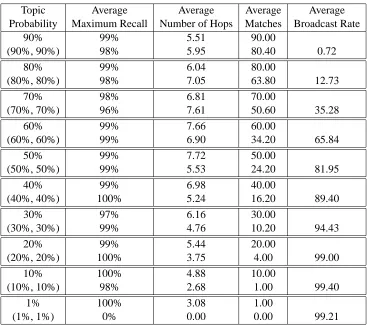
6.10 Average Recall Level at Progressive Hop Counts in Single Topic Search (Zipf’s Distribution) . . . 108 6.11 Average Recall Level at Progressive Hop Counts in Single Topic Search
(Uniform Distribution) . . . 108 6.12 Average Recall Level at Progressive Hop Counts in Multiple Topic Search
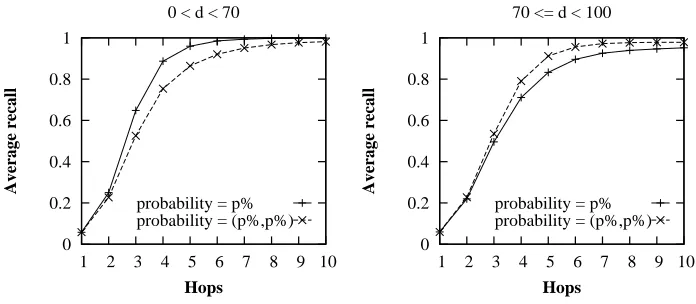
(Zipf’s Distribution) . . . 112 6.13 Average Recall Level at Progressive Hop Counts in Multiple Topic Search
(Uniform Distribution) . . . 113
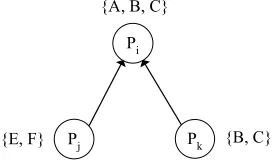
7.1 Query History ofpi at an Instant of Time . . . 120
7.2 Usefulness of Candidates for Neighbours ofpi . . . 122
7.3 Average Reduction in Hops to Achieve the Maximum Recall with EDFSR,
u.r.= 5% . . . 125
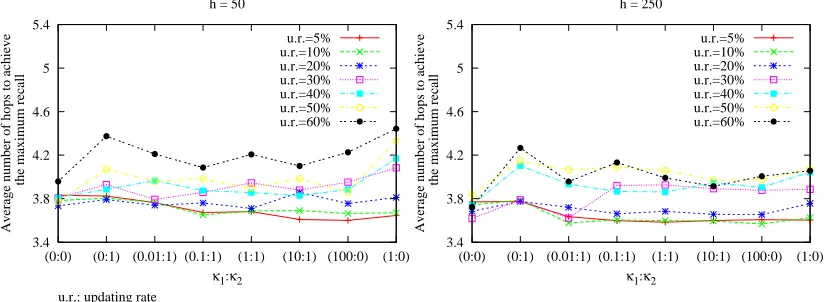
7.4 Average Number of Hops to Achieve the Maximum Recall with EDFSR,
f(m) =e−500m . . . 126
7.5 Average Reduction in Hops to Achieve the Maximum Recall with EDFSR,
f(m) =e−500m . . . 126
7.6 Average Maximum Recall and Average Broadcast Rate with EDFSR,
f(m) =e−500m . . . 127
7.7 Computation offˆi,h(t)based on Query History ofpi . . . 129
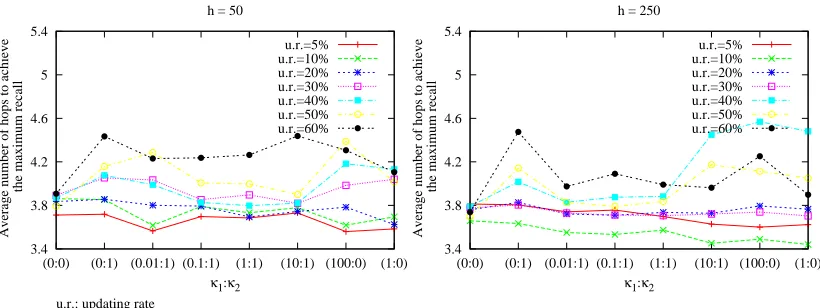
7.8 Average Number of Hops to Achieve the Maximum Recall with NESR . 130
7.9 Average Reduction in Hops to Achieve the Maximum Recall with NESR 131
7.10 Average Maximum Recall and Average Broadcast Rate with NESR . . 131
7.11 Semantic Search without Virtual Overlap . . . 132
7.12 Average Maximum Recall with EDFSR,h = 50,f(m) = e−500m . . . . 133
7.13 Average Number of Hops to Achieve the Maximum Recall with EDFSR,
h= 50,f(m) = e−500m . . . 134
7.14 Average Broadcast Rate with EDFSR,h = 50,f(m) = e−500m . . . 135
7.15 Re-organisation Leads to the Same Clustering but Distinct Topologies . 136
7.16 Average Maximum Recall with NESR,h = 50 . . . 137
7.17 Average Number of Hops to Achieve the Maximum Recall with NESR,
h= 50 . . . 138
7.18 Average Broadcast Rate with NESR,h = 50 . . . 139
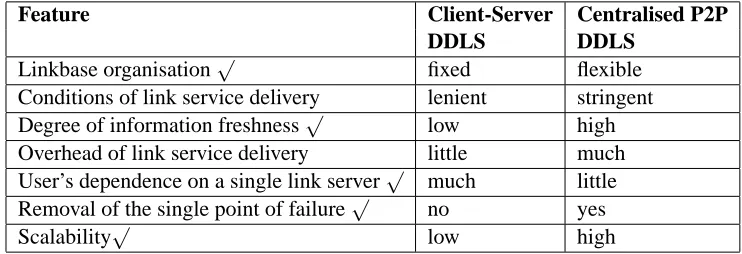
4.1 Feature Comparison between the Client-Server and the Centralised P2P
DDLSs . . . 67
6.1 A Published Topic List in the Cache of Peerpi . . . 91
6.2 Relationship between the Cache Rate and the Average Number of Hops
(Zipf’s Distribution) . . . 107
6.3 Relationship between the Cache Rate and the Average Number of Hops
(Uniform Distribution) . . . 107
6.4 Average Number of Hops to Achieve the Maximum Recall (Zipf’s
Dis-tribution) . . . 110
6.5 Average Number of Hops to Achieve the Maximum Recall (Uniform
Distribution) . . . 110
6.6 Multiple Topic Search based on Two Topics with Distinct Popularities
in Zipf’s Distribution . . . 111
6.7 Multiple Topic Search based on Two Topics with Distinct Popularities
in Zipf’s Distribution (Continued) . . . 112
6.8 Multiple Topic Search based on Two Topics with Distinct Probabilities
from Uniform Distributions . . . 114
7.1 Comparison between EDFSR and NESR . . . 139
8.1 Technologies from Multiple Disciplines Supporting the DDLS . . . 147
First and foremost, I would like to thank my supervisor, Professor Wendy Hall, for her time in revising reports, papers and thesis, for her support in attending workshops and conferences, and for her efforts in helping me overcome difficulties throughout my PhD. My PhD experience would be significantly less memorable without her.
I would like to thank Professor David De Roure for his technical support in my research, his feedback on papers and thesis, and his confidence in my capability. I am also grateful to Vijay Dialani for the numerous thought provoking conversations that kept me on the right research path.
My sincere appreciation also goes to Muan Hong Ng, whose friendly smile helped me settle down in the Intelligence, Agents, Multimedia Group when I first arrived; Zhuoan Jiao and her family who have always been concerned about me and made my life more enjoyable; Christopher Bailey for proof-reading my thesis and supplying me with very helpful comments; Norliza Mohamad Zaini for her time and patience to fami-larise me with SoFAR; Danius Michaelides for his thoughts and experience on mobile link services; Mark Thompson for his academic papers which were impossible to obtain online!; and Georgia Roidouli and Nor Aniza Abdullah for their good company.
Lean Zhou, Jiana Huang, Jian Zhou and Wei Deng
API Application Program Interface
ASCS Agent Semantic Communication Service
ASM Association Set Manager
CAN Content Addressable Network
CB-OHS Component-Based Open Hypermedia System
CGI Common Gateway Interface
CNS Context Name Service
COHSE Conceptual Open Hypermedia Services Environment
COM Component Object Model
CPU Central Processing Unit
CRI Compound Routing Index
CSCW Computer-Supported Cooperative Work
DAML DARPA Agent Markup Language
DBMS Database Management System
DCS Document Control System
DDLS Distributed Dynamic Link Service
DHT Distributed Hash Table
DLS Distributed Link Service
DMS Document Management System
EDFSR Exponential Decay Function Supported Re-organisation
FIFO First In First Out
FMS Filter Management System
FTP File Transfer Protocol
HBMS HyperBase Management System
HCM Heterogenous Communication Model
HCMT HOSS Communications Model Toolkit
HPMT HOSS Process Model Toolkit
HR Hierarchy of Resemblance
HTML HyperText Markup Language
HTTP HyperText Transfer Protocol
IR Information Retrieval
IRIS Institute for Research in Information and Scholarship
JVM Java Virtual Machine
LAN Local Area Network
LFU Least Frequently Used
LRU Least Recently Used
LSI Latent Semantic Indexing
LSS Link Server System
Microcosm TNG Microcosm: The Next Generation
NESR Naive Estimator Supported Re-organisation
NLS oNLine System
NNTP Network News Transfer Protocol
OHS Open Hypermedia System
OHSWG Open Hypermedia Systems Working Group
OWL Web Ontology Language
P2P Peer-to-Peer
RDF Resource Description Framework
RI Routing Indices
RMI Remote Method Invocation
RPC Remote Procedure Call
SCM Segregated Communication Model
SDE Software Development Environment
SHOE Simple HTML Ontology Extensions
SM Storage Manager
SMTP Simple Mail Transfer Protocol
SOA Service-Oriented Architecture
SOAP Simple Object Access Protocol
SoFAR Southampton Framework for Agent Research
SSA Semantic Search Agent
STA Semantic Translation Service
TCP/IP Transmission Control Protocol/Internet Protocol
TTL Time-To-Live
UDDI Universal Description, Discovery and Integration
URI Uniform Resource Identifier
URL Uniform Resource Locator
UUID Universally Unique Identifier
WSDL Web Service Description Language
WWW World Wide Web
W3C World Wide Web Consortium
Introduction
1.1
The Origins of Open Hypermedia and the Web
Information is the extraction and interpretation of raw data, with the ultimate goal of be-ing further analysed and utilised. When receivbe-ing information from the external world, human memory associates different pieces of information and establishes complex in-formation structures that reflect such relationships to facilitate comprehension and re-view. These structures, because of the way human memory works, are therefore rarely linear.
This essential feature of human memory was captured in the ‘Memex’, a device for individual use conceived by Vannevar Bush, President Roosevelt’s science advi-sor during the Second World War. He depicted the system in his article, ‘As We May Think’ (Bush 1945), that supported rapid and natural non-linear access to information by means of associative indexing. Bush also envisioned the concept of trails in the Memex, which associated related information under specific themes that could be re-trieved subsequently for a review.
Ted Nelson embodied his enthusiasm for Bush’s original ideas and coined the term hypertext in 1965 when describing his Xanadu system. He stated in his book ‘Dream
Machine’ that hypertext meant ‘non-sequential writing’ (Nelson 1987) and ascribed the non-sequential nature of hypertext to the non-sequential structure of ideas. As a model, Xanadu was intended to incorporate a universal repository for all information and lit-erature ever published with all versions of the documents coexisting. Relationships between information were allowed to be instantiated as hyperlinks, or links, which not only connected chunks of information, but also provided a structuring mechanism to be
utilised to navigate through the vast information space. Xanadu employed transclusions as the fundamental mechanism to realise the virtual presence of the same material in distinct contexts through embedded shared instancing (Nelson 1995), therefore effec-tively managing information reuse and other issues. However, the implementation of Xanadu has yet to be a reality.
The vision of the Memex as ‘an enlarged intimate supplement’ to human memory was profoundly shared by Douglas Engelbart who endeavoured to augment ‘the human intellect’ in view of mankind’s inability of coping with the ever increasing complexity and urgency of challenges in human situation (Englebart 1986). Engelbart gave a public debut of the oNLine System (NLS) at the Fall Joint Computer Conference in San Fran-cisco in December 1968. The 90 minute presentation successfully demonstrated, among others, innovative hypertext features which included cross-references and hyperlinking, and illustrated the use of NLS in collaborative group work.
The concepts and philosophy initiated by Bush, Nelson and Engelbart led the way for the hypertext system research and development that followed. The first working hy-pertext system, named the Hyhy-pertext Editing System running on an IBM 360/50 main-frame computer, was built at Brown University by Andries van Dam, Ted Nelson and several Brown graduate students in 1967 with most of interface being text-based (Car-mody et al. 1969). The first working hypermedia system appeared on the horizon when Aspen Movie Map was developed at the Massachusetts Institute of Technology by An-drew Lippman in 1978 (Nielsen 1990). The term hypermedia, also coined by Nelson, extends the notion of hyperlinks to include links among any set of multimedia objects, including the area of a picture, sound, motion video sequences and virtual reality.
The advent of the World Wide Web (also known as WWW, W3 and the Web) (Berners-Lee et al. 1992), the most widely used and successful hypermedia system to date, is considered an important milestone that has demonstrated the possibility of effecting hypermedia across the Internet. The Web is nothing more (or less) than a universe of network accessible information connected by an enormous number of hy-perlinks. It achieves universal readership by using a number of essential concepts
in-cluding that of hypertext, and uses data formats (e.g. HTML1) and Internet protocols
(e.g. FTP2, NNTP3and HTTP4) that make it open, extensible and standard.
The Web is open in the sense that information from a variety of sources can be incorporated in the Web and can be accessed with a Web browser running on computer
1HyperText Markup Language 2File Transfer Protocol
platforms supported by heterogeneous hardware and software. However, the way in which the Web is open differs significantly from the concept of ‘open hypermedia’ as defined by the hypermedia community. The Web can not be thought of as an open hy-permedia system because it is unable to support an open set of clients that can enjoy the services provided by the Web and to support an open set of data model formats. The concept of an open hypermedia system (OHS) predates the Web and dates back to the mid 1980s when Sun’s Link Service (Pearl 1989) was shipped with Sun’s programming in the Network Software Environment. The Link Service advocated a loose coupling between the management of data and the management of links with links stored sepa-rately from data. Such an external link model is in contrast to the embedded link model (Davis 1998) that the Web employs in which links are stored in documents. The idea of separating hypermedia link facilities from data storage and display functionality is characteristic and crucial in achieving the objectives of open hypermedia research and development.
The external link model has been recognised and encapsulated into a wide range of OHSs, for example Microcosm (Fountain et al. 1990), DHM (Grønbæk et al. 1993, Grønbæk and Trigg 1994), Chimera (Anderson et al. 1994), Hyper-G (Andrews et al.
1995) and HyperDisco (Wiil and Leggett 1997). The link service5, the term of which
was foremost used by Pearl (1989), acts as a middleware component of the client’s computing environment. By accessing and manipulating hyperlinks separately from the document, the link service allows hypermedia link facilities to be accessed by an open set of applications, thereby enhancing their performance with hypermedia linking functionality without a rewrite of the applications themselves.
1.2
Motivation: When Open Hypermedia Meets P2P
Computing
OHSs have employed distributed architectures since the late 1980s because access to computer networks potentially became commonplace and empowered both a variety of distributed online information to be utilised and groups of distributed teams to collab-orate. The prevalent model is that of client-server and three-tier (see Section 3.2). The client-server model has been adopted by a number of OHSs and the three-tier model is more commonly observed in the integration of these systems and the Web. By
inte-5The link service belongs to one of the OHS categories in the Flag taxonomy (Østerbye and Wiil
grating with the Web, OHSs allow collaboration on a global scale. Example systems include Chimera, Hyper-G, DHM and HyperDisco in which users can appreciate the benefits from both systems.
The client-server and three-tier architectures assume explicit logical separation be-tween the roles of a server and that of a client, and neglect the circumstances in which both the functionality of a server and a client is desirable possession of a single program. For instance, users of a distributed hypermedia system may anticipate to exchange in-formation. Under such a circumstance, an information requestor (client) may also be an information provider (server). The distinction between the server and the client blurs as multiple roles are required of a program. The enabling technologies, such as
peer-to-peer (P2P) computing6(Clark 2001), is a promise that can be used to support such a
system.
Suppose there is a research community in which people sharing similar knowledge background maintain network accessible resources, or documents, for resource sharing-based collaboration within the community. Upon the insertion of documents into their storage, people capitalise on their knowledge to analyse, categorise and annotate the documents. The associated intellectual products, such as categorisation and annotation information, are intended to be used by people in the community to discover and acquire documents of interest from other peers. Semantically related documents are organised and described by a concept hierarchy: the most abstract concept (as well as the doc-uments it is used to annotate) sits at the top of the hierarchy while the most concrete concepts (as well as the documents they are used to annotate) reside at the bottom. The hierarchy bears a tree structure7. Because people may have different viewpoints on the same document, sharing resources, including documents, categorisation and annotation information, enables people to understand other peers’ opinions on the same concept a document conveys by means of the way the document is categorised and annotated. For instance, if a person anticipates obtaining documents with a topic on the history of hypermedia, he/she can submit a query to other peers. A recipient peer compares the query against the annotation information about the documents he/she maintains and returns the matches if possible. Some of the documents in the result set may be directly related to the history of hypermedia, while others may be associated with the enabling technologies closely involved in the evolution of hypermedia. Nonetheless, the result reflects the different opinions of peers on the same topic, and due to the similar knowl-edge background peers possess, the query result may be of help for understanding a
6Although the term P2P computing is new, the basic P2P technology can date back to at least 1979
when USENET was originally implemented.
7In each concept hierarchy, there is a single root concept and each concept (except the root concept) in
topic from different perspectives.
The scenario above exhibits the following notable properties: equal capability and dispersed autonomy of individuals, and a collaborative relationship implied among in-dividuals. People in the research community can simultaneously be resource requestors and providers. Each of them is independent in making decisions and performing ac-tions, whereas collaboration based on resource sharing becomes crucial when peers’ knowledge can assist in accommodating information needs or broadening individual’s view. To turn the preceding scenario into reality, several key issues should be taken into account which include how resources can be discovered among multiple providers under certain circumstances, for instance in one well-arranged environment and in an-other with ad hoc properties, how resources should be organised and manipulated to potentially facilitate their presentation to requestors, and how resource discovery can be expedited.
The use of P2P technologies is to effect and enhance collaboration among people in the research community. The primary functionality of the technologies in the scenario lies in their support for efficient resource discovery and acquisition. A centralised P2P (Lv et al. 2002) approach would typically establish a central directory for resource pub-lishing and discovery, and allow the subsequent resource acquisition to occur directly between peers. In contrast, an unstructured P2P solution would preclude the existence of any form of central authority and realise resource discovery through some search mechanism and routing protocol that needs to be investigated.
Meanwhile, the responsibility of organising, manipulating and presenting resources falls back upon some other orthogonal technologies, one of which that attracts the at-tention of this work is the DLS. The DLS (see Section 3.4) is a Web-based OHS which satisfies a user’s information needs by providing hyperlinks that refer to the documents of interest. The paradigm of information provision, acquisition and presentation exhib-ited by the DLS fits in with the scenario of resource sharing-based collaboration within a research community.
The concept of grounding an OHS on a P2P architecture is not new. Microcosm (Fountain et al. 1990) and Microcosm TNG (Goose 1997) maintained some form of central repository to facilitate resource discovery in the systems. Microcosm was de-ployed across a set of workstations and peers could share their resources with others of interest. This enabled all available resources to be extensively utilised by the user community. However, Microcosm was never developed into a P2P system.
com-munication and management of computing tasks rely on central servers is no longer feasible for an environment with an ad hoc nature (see Section 5.4.1). This work there-fore attempts to identify the requirements for a Web-based OHS, more specifically an open link service, based on an unstructured P2P model which serves to enable resource sharing-based collaboration in ad hoc settings. Other efforts this work makes are to discover a solution that supports the realisation of such an open link service and to explore techniques that can enhance the performance of resource discovery for better collaboration.
1.3
Objectives and Scope
The ultimate objective of this work is to explore how the open hypermedia approach can be augmented by P2P technologies to continuously function in a collaborative environ-ment in which a dispersed resource (in the form of links and linkbases8) repository is available for sharing. The primary enabling technologies upon which this work is built are open hypermedia and P2P computing. They complement the mission of each other’s in fulfilling the goal of this work - open hypermedia deals with storage, manipulation and presentation of resources while P2P technologies provide solutions to publishing, discovery and acquisition of resources for sharing in distributed environments. There are some critical issues that neither is able to address, for instance, the mechanisms for resource description and clustering that facilitate efficient resource discovery. This calls for other technologies to be involved. As will be described, the Semantic Web (Berners-Lee et al. 2001) and Information Retrieval (IR) (Belkin and Croft 1992) pro-vide promising technologies that satisfy the requirements of this work.
The Semantic Web is an extension to the current Web in which information is made understandable for machine consumption, and is based on the Resource Descrip-tion Framework (RDF) standards (Lassila and Swick 1999) and other standards to be defined. The RDF provides a simple graph-based model for representing information about resources on the Web. The mechanism for defining groups of related resources and the relationship between these resources is missing in the RDF and is instead pro-vided by RDF’s vocabulary description language, RDF Schema (RDF-S). The RDF and RDF-S layer in the Semantic Web infrastructure effects support for some basic querying and reasoning. van Ossenbruggen et al. (2002) envisioned the potential of RDF-enabled search mechanisms to yield a significant improvement over the traditional keyword-based search mechanisms. This bears much implication for open hypermedia research
because of the following reasons. Firstly, the hypermedia community has long recog-nised the need for good query and search mechanisms (Halasz 1988). Moreover, the ex-ternal link model adopted by OHSs is inherently able to make the RDF-enabled query and search mechanism possible. Semantic relationships between links and linkbases could be encoded and stored externally by link servers, thus allowing a search for links to be conducted at both link and linkbase levels. This work primarily explores the way that resources (links and linkbases) should be expressed and maintained at link servers to facilitate querying and searching in environments with varying degrees of decentral-isation of control.
To realise resource discovery in ad hoc environments, an overlay network which comprises all peers running the open link service should be established. Ideally, the way that the overlay network is constructed should take into account certain relationships between peers or resources that peers maintain to assist discovery. Related work on the overlay network can be seen in CAN (Ratnasamy et al. 2001), Chord (Stoica et al. 2001) and Pastry (Rowstron and Druschel 2001). Because of the exclusive requirements for the open link service (see Section 5.4.1) this work investigates, the clustering techniques (Theodoridis and Koutroumbas 1999) which have been extensively studied in IR will be employed to organise the overlay network in a way that facilitates resource discovery by grouping peers on the basis of similarity of certain features of their resources.
This work will begin with extending the original DLS into a centralised P2P link service which encapsulates a central service directory for resource discovery in a well-arranged distributed environment. For explanatory and comparison purposes, another link service prototype that adopts a client-server architecture - the common architecture shared by many OHSs, will also be developed. This work will then identify the unique characteristics of and requirements for an unstructured P2P link service that supports resource sharing-based collaboration in an ad hoc environment. The absence of a central service directory in the unstructured P2P link service entails improvements on the the centralised P2P link service. Firstly, this work will need to devise mechanisms for describing, maintaining and manipulating resources which aim to facilitate resource discovery. Secondly, a search algorithm should be available for resource discovery in an ad hoc environment. Finally, techniques that expedite resource discovery should also be explored. Because these techniques are particularly intended to enhance the discovery performance of the link service, this work will conduct an evaluation of gains in the discovery performance that consists of an analysis and a series of simulation to demonstrate the proposed techniques.
the DDLS (Distributed Dynamic Link Service) throughout this thesis.
1.4
Contribution
This work differs from others in the sense that it presents a collective effort which primarily takes advantage of technologies of both open hypermedia and P2P computing to support resource sharing-based collaboration within a community in which people share similar knowledge background. The main contribution of this work attributes to its awareness of a fact that has not attracted sufficient attention before, i.e. the inability of current P2P technologies to help address the problems that an OHS, as required by the scenario mentioned earlier, faces. To circumvent the arising challenges, this work
• devises a way of modelling the information (about resources) space and of
estab-lishing the overlay network.
• develops a search algorithm which utilises the semantic relationship between
(re-sources of) peers to discover the re(re-sources of interest on the overlay network.
• investigates the application of enabling techniques to enhance discovery for
im-proved collaboration by re-organising the peer network.
Moreover, this work is one of the few practices that implement open hypermedia services, or likewise, based on the Semantic Web infrastructure. By using RDF to en-code information about resources and a semantic search mechanism to support resource discovery, this work provides a manifestation of the potential of the Semantic Web to promote open hypermedia research.
Finally, this work proposes the adoption of the unstructured P2P model in the DDLS to support collaboration in ad hoc settings, and investigates all the related is-sues that collectively enable the realisation of the DDLS. This enriches the research on unstructured P2P systems as described in Section 5.3.2 by providing experience of im-plementing the unstructured P2P paradigm in a different application domain - the OHS which, due to its characteristics, poses specific challenges to the DDLS approach (see Section 5.4.1).
1.5
Thesis Structure
The remainder of the thesis is structured as follows:
Chapter 2, Open Hypermedia Systems, provides an in-depth look into the field of open hypermedia systems, describes the core concepts and philosophies in detail, and documents the research themes in the area by providing a selection of influential systems.
Chapter 3, Distributed Hypermedia Systems, presents a review of distributed com-puting models and examines their development and evolution from the author’s perspec-tive. Moreover, a selection of distributed hypermedia systems with various software architectures are described.
Chapter 4, Requirements Analysis and Design of the DDLS, presents the moti-vation and design of extending the original DLS into a truly distributed dynamic link service. In particular, several aspects of software engineering are involved. Two pro-totypes that adopt a client-server architecture and a centralised P2P architecture are described, respectively. An analysis and comparison between the architectures of both are performed.
Chapter 6, Evolution of the DDLS into an Unstructured P2P System, explores the extension of a centralised P2P DDLS (see Chapter 4) to an unstructured P2P system. The approach to resource description at the linkbase level is proposed and a distance-based semantic search algorithm is presented. Simulation is conducted which helps understand the behaviour and performance of the algorithm, with varying distributions of potential resources and different query profiles involved.
Chapter 7, Re-organising the DDLS Peer Network, introduces the concept of re-organisation and its supporting data structure, query history, upon which re-re-organisation of the peer network primarily depends. The exponential decay function and naive es-timator are proposed to support re-organisation, and their different effectiveness and applicability are demonstrated by a series of simulation.
Chapter 8, Conclusions and Future Work, summarises this work and presents pos-sible future directions of the research.
1.6
Declaration
Open Hypermedia Systems
2.1
Introduction
This chapter presents open hypermedia systems (OHSs), a field that offers significant concepts, philosophies, experience and lessons potentially benefiting the entire hyper-media community. A selection of influential OHSs, chosen on the basis of the Flag taxonomy (Østerbye and Wiil 1996), are described to present the core concepts and philosophies, and to document the research development in the area. This is followed by a description of the close relationship between open hypermedia research and that of the emergent Semantic Web.
2.2
Concept and Features
An important consideration in the field of hypermedia systems is the distinction between structure and content. A hypermedia system that imposes a data model (structure and data formats) on its hypermedia enabled applications is considered to be closed, since applications have to be custom-made to participate in the hypermedia environment. An OHS, however, only imposes a structure format on its hypermedia enabled applications and allows content to be stored outside the system. The applications can store content in different formats, which encourages the integration and use of third-party applications.
An OHS is typically a middleware component in the computing environment of-fering hypermedia functionality to applications independent of its storage and display functionality. It enables the client applications to create, edit, delete and activate links
which are maintained and manipulated separately in linkbases. Hypermedia services can also be used by other third-party applications, programs and services in the com-puting environment (Wiil 1997).
The term open means that OHSs allow an open set of clients (applications) of the hypermedia services provided by the systems and support an open set of data model formats. In contrast to closed hypermedia systems, such as the Web, OHSs exhibit a variety of advantages and circumvent the limitations of closed hypermedia systems due to the inherent weaknesses in their architecture, data model, protocol and enabling tech-nologies. The advantageous properties that OHSs possess are highlighted as follows.
1. Separation of links from documents
The open hypermedia model enables the maintenance and manipulation of hyper-media links separately from the documents they describe, which fundamentally differs from the model of closed hypermedia systems. The separation of links from documents enables links to be applied to documents in any format (Carr et al. 1998a).
2. No imposition of mark-up on data
OHSs allow more types of data model formats which are not limited to either HTML or image formats. New data model formats can be supported in OHSs by enabling the applications capable of handling the required data model formats. Applications are extended to make hypermedia functionality available in the hy-permedia environment with minimum efforts while the data content remains un-altered.
3. Integration with third-party applications
Unlike the closed hypermedia system, an OHS provides a linking protocol be-tween applications and the OHS that allows any application to participate in the hypermedia service. Through the linking protocol, applications are loosely inte-grated into the hypermedia environment with various levels of hypermedia aware-ness.
4. Context-specific query
The task-specific query context can be specified by a user, or inferred by a user interface agent. Therefore, link following is affected not only by the selection of the link source but also the user’s dynamic context that indicates the kind of resources they would like to follow up.
5. Easy to add new functionality
design of OHSs. The component technology empowers the specification of the services of a component in an implementation independent manner. Each com-ponent provides descriptions of services in a separate interface serving a domain model, concealing the concrete implementation. The approach enables an exten-sible architecture in which a new hypertext domain can be added with ease by defining an interface for the description of services presented in that domain.
6. Distributable hypermedia structure processing
OHSs adopt different software architectures, spanning from traditional centralised
client-server systems with a central storage server running on a LAN1 to
multi-layer systems with multiple storage servers operating within different Internet domains. The decentralisation of storage relieves the burden on a single server and enables hypermedia structures to reside in the vicinity of where they may be requested.
Links are first-class entities in an OHS. The central feature of an OHS is that it can make use of link specifications stored in linkbases and manage the links separately from documents. By allowing links to be manipulated separately, an OHS decreases document maintenance efforts as there is no need for a document to be revised in order to change its links. An open link service allows the performance of any application to be enhanced with hypermedia functionality without a rewrite of the application (Carr et al. 1995), which is also a minimal requirement for an OHS.
Hall et al. (1996), based on their experience gained from the design and develop-ment of Microcosm (see Section 2.4.3), summarised the essential properties in defining a truly open hypermedia system as follows.
1. Size: no limitations, with regard to either the size of objects or the maximum number of such objects, should be imposed by the hypermedia system.
2. Data formats: the system should allow import and use of data in any format, including temporal media.
3. Applications: the hypermedia system should provide facilities for any applica-tion to access the hypermedia service in order to participate in the hypermedia environment.
4. Data models: the system should be configurable and extensible to allow new hypermedia data models to be incorporated. Furthermore, interoperability is an important property that the system should possess.
5. Platforms: it should be possible to implement the system across a variety of plat-forms.
6. Users: the system should support multiple users and allow the users to maintain their private views of the objects in the system.
To fully satisfy such a definition there is still a long way to go in OHS research. Examining the OHSs documented later in this chapter demonstrates that the efforts from the OHS community have only achieved part of the entire specification. However, the definition of openness as described will serve as a signpost, showing future directions for open hypermedia research.
2.3
The Flag Taxonomy
The Flag taxonomy (Østerbye and Wiil 1996) was built on the terminology of the Dexter hypertext reference model (Halasz and Schwartz 1994) which was a popular model covering ideas and experience from advanced hypermedia research at that time. The taxonomy aimed to serve as a framework to describe, classify and compare different hypermedia systems in a system independent way.
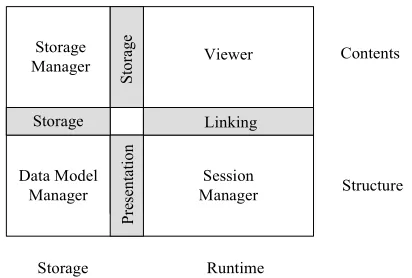
FIGURE2.1: The Flag of Hypermedia Systems (Østerbye and Wiil 1996)
[image:29.596.226.432.484.623.2]four protocols (illustrated by the grey rectangles). The Storage Manager corresponds to the within-component layer in the Dexter model, and the Data Model Manager re-sponsible for storing the structure of a hypertext maps to the storage layer in the Dexter model. The taxonomy divides the Dexter runtime layer into the Viewer module and the Session Manager module, which bridge the Dexter within-component layer and the runtime layer to reflect the exclusive property of the OHS that contents can be stored by applications outside the hypermedia system.
Each functional module provides functionality to neighbouring modules by means of available protocols. The Storage protocol encapsulates the Storage Manager from both the Viewer and the Data Model Manager because the Flag taxonomy divides stor-age into contents and structure aspects. The Linking protocol provides necessary op-erations which bind the Viewer and Session Manager functionality together. The Pre-sentation protocol defines the operations in the Data Model Manager and the Session Manager available to each other.
The taxonomy emphasises the distinction between structure and contents as the major criterion to identify an OHS, and excludes any approach to OHSs that imposes a data model on their hypermedia enabled applications. The categories of OHSs, accord-ing to the Flag taxonomy, include two fairly independent domains: link server systems (LSSs) and open hyperbase management systems (HBMSs) (Wiil and Leggett 1997). LSSs (e.g. Microcosm and Chimera) revolve around the development of middleware components that allow existing tools to use hypermedia linking functionality, whereas open HBMSs (e.g. DHM and HyperDisco) focus on the development of middleware components that not only provide linking but also storage functionality to be utilised. This thesis is only considering LSSs.
2.4
Link Server Systems
of links in a changed document is unnecessary. Besides, links may be applied to serve other legacy systems with data on read-only media.
2.4.1
Intermedia
Intermedia (Meyrowitz 1986, Yankelovich et al. 1988), developed at Brown Univer-sity’s Institute for Research in Information and Scholarship (IRIS) from 1985 to 1990, was the first advocate for an open hypermedia philosophy. It was a multi-application hypermedia system designed to support teaching and research in educational settings. Intermedia was intended to model how hypermedia functionality should be handled at the system level to provide linking capabilities integrated into the desktop environment.
! "
# ! "
#
FIGURE2.2: Intermedia Architecture
(Haan et al. 1992)
link-ing functionality, extended MacApp’s classes and added the functionality necessary to specific applications. The link client was a library bound with the Intermedia layer. The link server was also implemented as a library associated with a database manage-ment system (DBMS) running as a separate process. Intermedia was only implemanage-mented for Apple’s version of the UNIX operating system. It presented to users customised integrated applications operating on their own document types that conformed to user interface standards for consistency purposes. Thus, users would encounter quite identi-cal implementations of features seen elsewhere across multiple applications.
Intermedia allowed users to create bidirectional links between specific locations in documents (created by its dedicated applications shown in Figure 2.2) of different types. This was a distinctive property unseen in other systems, such as HyperCard (Ap-ple Computer Inc. 1989), NLS (Englebart 1986) and Notecards (Halasz et al. 1986). Intermedia named these specific locations ‘anchors’. Information about anchors and links between the anchors were stored separately from documents they described. Col-lections of anchors and links were partitioned into webs. Users could alter their working context by switching from one web to another, and therefore a different set of anchors and links in the web were superimposed on the documents that users were browsing. To maintain data consistency, the deletion of an Intermedia document would lead to the deletion of all the anchors and links within and to the document throughout the Link Database. Concurrency control was implemented in Intermedia to help manage mul-tiple users sharing a network of hypermedia material. Intermedia supported mulmul-tiple users with granted access rights to read and annotate (anchors and links of) a single document simultaneously, but only one user to write a document at a time.
Intermedia was a pioneering hypermedia system2that achieved academic success
and aroused great research interest. However, due to the failure of convincing other people to adopt its protocol and the lack of funding to upgrade to a new operating system, Intermedia fell into disuse in the early 1990s.
2.4.2
Sun’s Link Service
Sun’s Link Service (Pearl 1989) was not a hypertext system in its own right but provided a protocol and linking functionality for integrating linking mechanisms into existing ap-plications in a distributed workstation world. The link data and object data were stored
2Intermedia was considered a monolithic hypermedia system because its architecture tightly
and managed separately. Manipulating and storing objects were undertaken by indepen-dent editing applications. A linking protocol was designed to facilitate communication between the Link Service and the integrated applications.
FIGURE2.3: Sun’s Link Service Architecture (Pearl 1989)
The Link Service (see Figure 2.3) comprised the protocol specification, a link server program, a library that defined the protocol for integrating with the Link Ser-vice and utilities for managing the link databases (i.e. linkbases). Integrating with the Link Service required little change of applications. Each integrated application in-cluded a link library which was part of the link server process to communicate with the link server, and therefore became part of an extensible and loosely coupled frontend interface to the hypertext system. Applications registered their availability and capa-bility with the Link Service so that they could be called to handle objects upon users’ requests.
The manager of the object data provided an interface and application specific func-tionality for users to manipulate objects. Similarly, the Link Service offered an interface and functions for users to create and modify links between data objects. By separating the user interface for linking from that for editing, the Link Service introduced as min-imal impact as possible on the appearance of integrated applications and the burden on the cognition of users.
mecha-nisms: implicit and explicit. When a user attempted to traverse from the valid end of a link to an invalid node, the Link Service informed the user of the dangling link and suggested deletion of the link. Or, the Link Service utilised a link garbage collection mechanism to check the validity of links by querying their managing applications. The Link Service left the versioning of data objects to individual applications and main-tained the consistency of link objects to a limited degree. This is because the versioning of data objects was implemented by integrated applications and the Link Service was unable to establish any connection between the versioning of the link objects and data objects.
Although some issues required further investigation, such as the granularity of an identifiable object in structureless documents and the extension of link types available between objects, Sun’s Link Service made an initial attempt at integrating linking func-tionality into existing applications and the accompanying protocol was crucial for an extensible and loosely coupled open hypertext system.
2.4.3
Microcosm
The development of Microcosm (Fountain et al. 1990), which was one of the first OHSs, predates the Web. The initial motivation for Microcosm arose from constructing fully cross-referenced versions of very large electronic archives and information repositories (Lowe and Hall 1999). While building resource-based applications using hyperme-dia systems, the Microcosm team found that the main issues for hypermehyperme-dia designers and authors were the heavy load from working with a large number of documents and links, and the increasingly highly multimedia nature of electronic information. Besides, different users would access different parts of the information repositories and try to understand them from different perspectives. Surrounded by collections of unstruc-tured information, it was hard, even impossible sometimes, to find the beginning or end. For users who came across applications for the first time, no assumptions could be made about their preferences, knowledge, beliefs or information seeking goals, based on which some kind of assistance could be provided to support their interaction with the systems.
! "# $ "% "# $ "%
"#
$ "% &
' !
" ' #
(# ! )
" #
#
*
+ * , +
( #
+ !
FIGURE2.4: Microcosm Architecture (Lowe and Hall 1999)
the rest of the system. Viewers were identified by means of an identifier allocated by the DCS. The Filter Management System (FMS) coordinated the serial chain of filters. Filters in Microcosm were among those independent processes which were connected in a chain topology and might be dynamically installed, removed or even reordered. The
hypermedia link service was embodied within filters3. When an action was initiated by
a user, a message that contained the details of relevant information would be sent to the filter manager which arranged the message to be passed through all registered filters. Filters declared their interests in handling specific messages from users’ actions and they might block, ignore, alter messages or create new ones (Hall et al. 1996).
The sequence of some filters was fixed. For instance, the linker filter, a process which primarily dealt with the start link and end link messages, was usually positioned in the first place along the filter chain. Following it was the linkbase filter that was responsible for creating, following and resolving links. The available links filter was
3Very little of the functionality that users see was ‘hard coded’ in the core of Microcosm, which was
typically positioned at the end of the filter chain to present the result of a link traversal or search action. This filter could not precede the linkbase filter since there would be no links for it to display before the linkbase filter processed a message and gave the references to destination documents. For the linker filter and the linkbase filter, the exchange of their positions in the sequence would not incur such a problem and therefore was permissible.
The bottleneck between the DCS and the FMS was one of the limitations on the performance and scalability of Microcosm. In addition, the serial and uni-directional filter chain yielded major communication overhead because all messages are propa-gated to every filter in the chain. Such limitations were resolved in the design of filters in Microcosm TNG (see Section 3.3.3) and linkbases in the DLS (see Section 3.4) in which no chain topology was used in organising filters and linkbases. In both systems, individual filters and linkbases could be dynamically added or removed from the pro-cess of link resolution and retrieval, and consequently different views of link data were presented upon different user requests.
The Microcosm model allowed users to create three primitive link types: specific links, local links and generic links. A specific link may be followed from the source selection at a specific location in a specific document. A local link may be followed when the source selection occurs at any place in a specific document. A generic link may be followed from wherever the source selection occurs. The Microcosm team identified two distinct link integrity problems - the editing problem and the dangling link problem - that might occur in Microcosm and explored their solutions. Hall et al.
(1996) provided more details.
2.4.4
Chimera
Chimera (Anderson 1997) was an open hypermedia system developed at the University of California, Irvine. It primarily aimed to provide hypertext services in heterogeneous software development environment (SDE).
FIGURE2.5: Chimera 2.0 Architecture (Anderson 1997)
The Chimera architecture adopted a client-server approach (see Figure 2.5) and was separated into two environments: a user space and Chimera-enhanced websites. A user space consisted of Chimera clients, a client server and a Java-enabled Web browser, while a Chimera-enhanced website contained a Web server, a hyperweb manager, a hyperweb server, a set of hyperwebs and a set of client servers.
Chimera clients were applications that provided end users with hypermedia ser-vices. They interacted with the local client server which connected to the hyperweb server to provide its clients with access to hyperwebs. Java applets could also be Chimera clients in support of Chimera’s integration with the Web. However, such clients would face obstacles that normal clients did not have to. This is because Java imposes security restrictions on applets, and the Web server, the hyperweb manager and the client server must all execute on the same machine in order that applets could
commu-nicate with them. A CGI4 script was used to append HTML code to include an applet
at the end of a Web page. The Java applet was downloaded by the Web browser in the user space and it provided pervasive access to Chimera’s services to the Web page a user was visiting. Therefore, Chimera users were free to manipulate links or hyperwebs and initiate link traversal from within an applet’s interface.
In Chimera, a hyperweb that was manipulated by the hyperweb manager referred to a database file containing groupings of related hypermedia concepts. The hyperweb manager was responsible for the creation and deletion of hyperwebs. Besides, it pro-vided connection information of Chimera related servers. For instance, the hyperweb manager could reveal the contact information of the hyperweb server on the Chimera site of interest to the client server in the user space. The hyperwebs of a Chimera site were stored and managed by the hyperweb server.
In addition to hyperwebs, Chimera had a set of hypermedia concepts, including viewers, objects, views, anchors and links along with their attributes. Objects were named, persistent entities in Chimera and were displayed, created and edited by viewers. A view associated an object with the viewer that displayed it. Anchors were created and managed by a viewer with respect to the particular view of the object being displayed, rather than the object itself, while a link consisted of a set of anchors. Each instance of a Chimera hypermedia concept could be described by an arbitrary number of attribute-value pairs specifying run-time semantics or behaviour. These concepts enabled the hypermedia needs of an application to be easily modelled and implemented by means
of invoking appropriate calls to Chimera’s API5 to create persistent instances of the
concepts. Therefore, the integration of an application with Chimera was facilitated.
Chimera could not be completely modelled in the Dexter model since the former could handle the presence of links with zero or one anchor (dangling links) (Anderson et al. 1994). In this case, Chimera was similar to DHM, see Section 3.3.2. Moreover, the concept of a view in Chimera could not be modelled by a composite component in Dexter, because a view contained information about the object being displayed and the view that displayed the object, but a composite component included references to atomic components which contained only data. Finally, a Chimera viewer would be able to define anchors on the view of an object which exists only at run-time. However, Dexter was unable to specify the same type of anchors.
2.4.5
Hyper-G
Hyper-G (Andrews et al. 1995), a multi-user, multi-protocol, structured and distributed hypermedia information system, was the product of a group of researchers and devel-opers at Graz University of Technology, Austria. It integrated all the functionality of the Web with a set of facilities, resulting in much additional functionality, and therefore was seen as an extension of the Web (Maurer 1996).
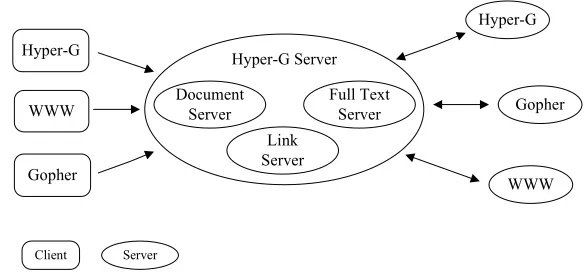
Like most information management systems, Hyper-G was client-server based (see Figure 2.6). The Hyper-G server consisted of a number of modules implemented as concurrent Unix processes. The document server maintained local documents of the Hyper-G server as well as cached documents from remote servers. The full text server was responsible for storing an inverted index of all text documents for searching. The link server, which was later renamed the object server, primarily stored a database of ob-jects and the relationship between obob-jects. Every Hyper-G object, including documents, anchors and collections (defined later), could be searched for. Hyper-G objects were typically described by a set of attributes and the search on attributes was supported. In particular, documents and collections in a Hyper-G server were automatically indexed upon the insertion into the database and could be subsequently accessed by a full-text search.
FIGURE2.6: Hyper-G Architecture (Andrews et al. 1995)
Users could access Hyper-G using a standard WWW browser, a naive Hyper-G client, or a Gopher client. A WWW gateway program was developed and installed with every Hyper-G server so as to provide the user of a WWW client with an interface to the Hyper-G functionality. When accessing the Web with Hyper-G clients, a Hyper-G server was typically used as a gateway. Hyper-G was also designed to be fully inter-operable with Gopher. Hyper-G servers could present themselves to Gopher clients by means of the Gopher gateway. When accessing Gopher servers with G, a Hyper-G server, which cached Hyper-Gopher directories and documents, acted as a proxy.
[image:39.596.172.464.324.462.2](its parent collection), the collection hierarchy must be cycle-free. The collection hier-archy could be used for a number of occasions. For instance, the logical structure of the information was made explicit to users by means of the collection hierarchy, which facilitated users’ navigation through the information space. Also, documents and col-lections might have multiple parent colcol-lections in a collection hierarchy, and therefore users could have multiple views of the same available information. The collection hi-erarchy could be attached with access permissions which supported multiple users to simultaneously use a single Hyper-G server. Finally, Hyper-G allowed the use of the collection hierarchy to define the search scope.
Hyper-G implemented links as objects containing attributes. Links could be as-signed keywords for searching and permissions for access restrictions. A link in Hyper-G connected a source anchor within one document and a destination anchor within another document, an entire document, or groups of documents. Links were not stored within documents but in separate link databases. Hence, Hyper-G supported bidirec-tional linking and link consistency within servers and across server boundaries were guaranteed.
2.5
Open Hypermedia Systems and the Semantic Web
The Semantic Web, the next generation Web infrastructure as envisioned by its inven-tor Tim Berners-Lee, is designed to provide information in the Web in a more machine understandable manner. Recent initiatives at the World Wide Web Consortium (W3C)
have produced multiple specifications, such as that of XML6, RDF and OWL7 (Smith
et al. 2004). While XML defines customised tagging schemes and RDF enables a flexi-ble approach to representing information, OWL provides more vocabulary for formally describing the meaning of terms in a Web document and the relationship between those terms. They form part of the growing stack of the W3C recommendations related to the Semantic Web.
The need of the Semantic Web to capture and represent the semantic relation-ship between resources on the Web, invalidates the embedded linking model as used in the Web. Moreover, downloading bulky semantic annotations together with Web documents deteriorates the performance of hypermedia applications, especially when annotations are even not required. A potential approach to these issues involves exter-nally encoding information about resources and the semantic relationship between the
resources, and employing dedicated servers to maintain and manipulate these seman-tics (van Ossenbruggen et al. 2002). OHSs inherently possess the capability to deal with similar problems. The most significant feature that empowers OHSs to facilitate, and also enjoy, the emergent Semantic Web technologies is that links are stored and managed separately from the documents they describe. Capturing the semantic content (concepts) of documents, modelling it as metadata, and authoring links between related concepts to construct hypertext, are therefore feasible. This is also applicable to anno-tations - the ability to annotate documents of others has been an important feature in many hypertext/hypermedia systems. Storing annotations externally to the documents that are annotated and accessing them over some protocol, can produce an OHS-like annotation service. Example systems include COHSE (Carr et al. 2001) and Annotea (Kahan et al. 2001).
The main objective of the COHSE (Conceptual Open Hypermedia Services Envi-ronment) project is to produce an ontological reasoning service which provides a con-ceptual model for describing document terms and the relationship between the terms, and a Web-based open hypermedia link service to deliver link-providing facilities in a scalable and non-intrusive manner. The conceptual information of Web documents
is represented as metadata8. Metadata can be reasoned over to classify documents by
using a predefined ontology in COHSE - a thesaurus consisting of concepts related by different relations. Documents are considered to be similar in some way if they share metadata. The COHSE link service authors links between associated concepts, and therefore corresponding documents are also linked for navigation.
The Annotea project, part of the Semantic Web efforts, aims to enhance collabo-ration via sharing metadata-based annotations, bookmarks and their variants. Annotea is a Web-based annotation system built on top of an open RDF infrastructure through combining RDF with XPointer, XLink and HTTP. Annotations are modelled as a class of metadata. They are described with an RDF schema and are stored inside generic RDF databases hosted by annotation servers. XPointer and XLink associate metadata with part of the document that is annotated. By interacting with an annotation server over HTTP, users can perform different operations on annotations, such as retrieval, addition, modification and deletion.
Both practices of COHSE and Annotea reveal that the concepts and philosophies of OHSs can be utilised to satisfy the requirements of the Semantic Web. On the other
8This is an idea borrowed by this work on resource description presented in Section 6.3.2. Although
hand, it is also demonstrated that the Semantic Web can, and definitely will, augment open hypermedia research and enrich its potential area of application by providing state-of-the-art and standardised technologies.
2.6
Summary
This chapter examined the core concepts and features of OHSs and described the Flag taxonomy which divides OHSs into two categories: link server systems (LSSs) and open hyperbase management systems (HBMSs). In particular, a selection of represen-tative link server systems was chosen and studied. Examining contemporary research on OHSs and its close relationship with the Semantic Web identified that both parties are mutually beneficial - the Semantic Web provided advanced technologies to augment open hypermedia research, and meanwhile, open hypermedia presented many years of experience and lessons to facilitate research on the Semantic Web.
Distributed Hypermedia Systems
3.1
Introduction
This chapter presents a review of distributed computing in terms of the software archi-tecture, ranging from the client-server to the contemporary service-based model. The review aims to provide a prerequisite knowledge for understanding the concepts and backgrounds in the following presentation of selected distributed hypertext and hyper-media systems along the path of development.
3.2
Models of Distributed Computing
Bass et al. (2003) define the software architecture of a program or computing system as ‘the structure or structures of the system, which comprise software elements, the ex-ternally visible properties of those elements, and the relationships among them’. The definition implies that software architecture is concerned with the encompassing ele-ments that interact with one another. The behaviour of each element is also part of the architecture.
Distributed computing is one of the software architectures in which processing oc-curs among teams of collaborative computers over a network. The architecture allows geographically distributed computers to work together with responsibility being parti-tioned among multiple parties. Distributing the computational load among appropriate computers can improve the system performance.
3.2.1
Client-Server Architecture
Client-server, a term first used in the 1980s, is a distributed computing model in which client applications request services from server processes. A client application is a process or program that sends messages to the server and requests the latter to perform specific tasks. The server process or program listens to the client requests, receives mes-sages and performs corresponding actions. A single machine can be both a client and a server depending on software configuration. However, clients and servers typically run on differently machines interconnected by a computer network.
The central server runs on powerful personal computers, workstations or main-frame computers which host the majority of computing resources, for example, files, devices and processing power. Clients are separate and subordinate to the server. They log into the server and make a search request on the server that will immediately return the search result. The subsequent requests to the server for services will also b